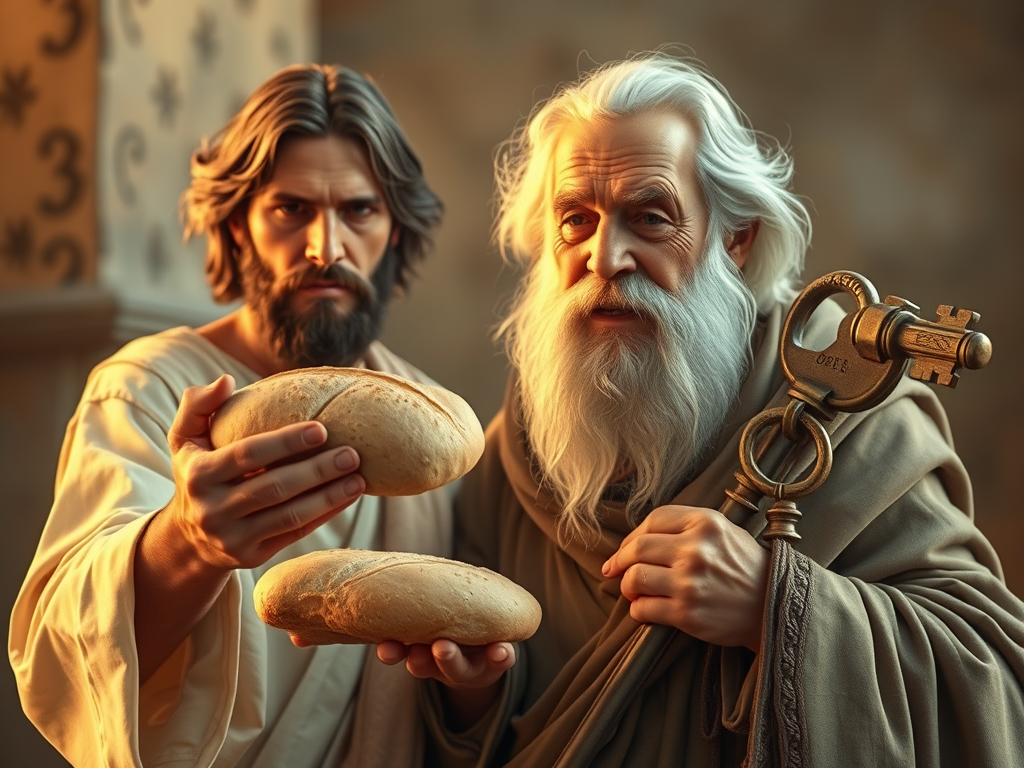
An important theme for this blog is the scene in the New Testament where Jesus can be found FLOGGING the money-changers out of the temple. My header above depicts a priest FLOGGING the devils that distort the faith and assault believers. The faith that gives us consolation can and should also make us very uncomfortable. Both Divine Mercy and Divine Justice meet in Jesus. Priests are ministers of reconciliation, but never at the cost of truth. In or out of season, we must be courageous in preaching and living out the Gospel of Life. The title of my blog is a play on words, not Flogger Priest but Blogger Priest.
[134] 1 Wisdom 2:12, 17-20 / Psalm 54:3-4, 5, 6 and 8 / 2 James 3:16-4:3 / Mk 9:30-37
The first reading is prophetic in regards to the coming Messiah, but the posture of testing God is not something new. The wicked would always seek to put up roadblocks to the Lord and his saving works. Traitors within the ranks of the covenant people fought and even killed the prophets. This is in marked contrast to the humility of a disciple who embraces divine providence and seeks to make a straight path for the Lord. The reading unveils the deceit of evil. There is no discernment of spirits; rather, they have already made up their minds.
They hate the just or righteous one because he is everything they are not. Notice today, there are critics who malign the late Mother Teresa and the Popes. If you Google priests, you will find hundreds of links about scandal and crime, but little about the thousands who have been obedient to God and loving of their people. Believers are ridiculed as hypocrites and yet little is said about the works of justice and charity that millions of the faithful make possible. Those who criticize us would not lift a finger to help others unless there is something in it for themselves. Each of us is to be a new Christ in bringing truth, healing and forgiveness to others. We see Jesus in the oppressed, the poor, the wounded, the alone and the unborn. We are not social workers. Rather, in us is realized Christ ministering to Christ.
The enemies of heaven will not allow God or his messengers to tell them what to do or to honestly expose their sins. Here too believers are castigated as hate-mongers or out-of-touch because we stress purity before marriage and regard marriage as a natural institution between a man and woman. They deny the wrong of their ways and then seek to compel believers to accept their deviancy and/or transgressions as lawful. While sin might be tolerated, the beliefs and discipleship of Christians is given little quarter. Indeed, even the government now attacks religious liberty. The Church can preach what it wants inside the church doors, at least for now, but outside those doors we will be compelled to compromise our values, as with the HHS forced-funding of contraceptives, abortifacients and sterilization. Instead of admitting that the unborn man or woman has a God-given right to life, the powers-that-be would make the Church accessories to their murder.
The wicked in Scripture argue, “With revilement and torture let us put the just one to the test that we may have proof of his gentleness and try his patience. Let us condemn him to a shameful death; for according to his own words, God will take care of him.” This is certainly the plight of Jesus Christ. While such a sentence might not befall us, there are places in the world today where Catholics still face the prospect of torture and death for their beliefs. Here we may endure public recrimination from the media and political figures, hefty fines, imprisonment and the closure of Catholic operations: schools, charities and hospitals.
Despite the mockery and faithlessness of the wicked, we have every confidence that God will never abandon his stewards. Whatever comes, we will take up our crosses and walk with the Lord. Man is not the measure of all things; instead, it is the God who made us and sets up the parameters of our existence and obedience.
The responsorial psalm gives voice to our confidence: “The Lord upholds my life. Behold, God is my helper; the Lord sustains my life. Freely will I offer you sacrifice; I will praise your name, O LORD, for its goodness.” I am reminded of a priest-friend who prayed this psalm with courage when he was arrested, not for violence or theft, but for saying his rosary outside an abortion clinic. They said he was blocking free access. He went to jail. The archbishop at that time said that we had permission to get arrested, but that we had to be bailed out for Sunday Mass. Most of us were afraid to take matters this far. We backed away. But he was filled with the Spirit of God and was dragged away and placed behind bars. The guards took away his breviary prayer book and rosary beads. He found out later that a woman coming to the clinic saw his arrest and turned around. She would credit his sacrifice with saving the life of her daughter.
If only we could truly live in right relationship with God and neighbor. The second reading is almost a lament of the human condition. We are self-seeking and rationalize our faults while we should be generous and repentant of wrongs. We attack those who would open our eyes to the truth. Our society is one where passions run amuck, nature is assaulted and foul practices abound. I grieve that our children should be exposed to such corruption. Do I over-make my case? Notice the vulgarity in music, film, television, books and the internet. More couples cohabitate than are married. Half of all marriages fail and adultery is the frequent cause. There is also a basic dishonesty where many people steal if they think they can get away with it. Fertility is treated as a disease and the unborn child is disposed of as a cancer. What can come of a society that treats a blessing as a curse? What becomes of a civilization where a curse or depravity is elevated to a civil right?
The Gospel reading has Jesus telling his friends precisely what is going to happen: “The Son of Man is to be handed over to men and they will kill him, and three days after his death the Son of Man will rise.” Nevertheless, we are told his listeners did not understand and were fearful about asking questions. Instead, they ended up arguing about who among them was the greatest. While we cannot know for sure what emotions this precipitated in Jesus, I would suspect that he was tremendously disappointed. They still did not understand— either the cost of his mission or their personal cost in following him. In response, Jesus singles out a child, places his arms around him or her, and says, “Whoever receives one child such as this in my name, receives me; and whoever receives me, receives not me but the One who sent me.” Our Lord took the least among them and singled out a child as the greatest of all. The apostles and disciples are not the masters of the kingdom, but its servants. They and those who would come after them were called to sacrifice personal ambitions for the sake of the kingdom— particularly the voiceless and marginalized. We still remember the child, both in our schools and in the womb. It is for this reason that true believers are a sign of contradiction in the world. We speak up for the rights and dignity of those who cannot speak for themselves. We proclaim the truth and hand down the values given us to each subsequent generation, both in and out of season.
We can now encourage everyone to register early – that way 100% of the donation goes to Catholic Charities.
But everyone who comes to register at the park will be very welcome and appreciated! And it’s a joint fund-raiser – so all three organizations (Catholic Charities, Community Crisis and United Communities Against Poverty) will share those registrations and funds.
Registration on site begins at 9:30 AM (Allen Pond Park, Bowie, MD).
First 300 kids get free basketballs.
09:30 AM – Jesse Buggs, Welcome
09:40 AM – Mayor Fred Robinson
10:05 AM – Councilwoman Ingrid Turner
10:15 AM – County Executive Rushern Baker
10:25 AM – Father Joseph Jenkins, Holy Family Church
God forbid that young people at school events should get a taste of traditional American liberties, like freedom of religion and freedom of speech… NOT! Schools can teach science and the faith of atheism but are to make no mention a Creator. Schools can teach safe “promiscuous” sex and give away condoms, but not a penny is available for abstinence education. Schools are forbidden to teach the 10 Commandments and then wonder why youth misbehave and get in trouble with the law. All manner of vulgarity is tolerated but not a bible verse on a sheet… yep, these girls are real trouble-makers, but the right kind. When Islamic religious fanatics burn the flag, destroy property and commit murder… we target our sights upon peaceful Christian cheerleaders at a school football game. Ah, the world is insane!
How many Catholic chapels are there in Islamic schools? Where does courtesy end and religious indifferentism begin? How does one reconcile this with the insistence that “Catholic identity” is not at risk in our parochial schools? Do the Jewish children get their private prayer space as well? What about the Wiccans and Satanists? Do they get chapels to honor the goddess and/or the horned beast? Certainly, we would not want to discriminate or be judgmental… would we? Ah, the plight of radical tolerance!
If trash television were not trasmitted at all then such accidents would not happen. The truth is that our children are exposed to unhealthy and vulgar images all the time. We cannot trust television to babysit our children. It is a compromised media. The providers are more interested in making money, even with virtual prostitution, then in helping parents to raise kids of good moral character and virtue. In any case, if adults are themselves corrupted by this media, then how can they pass on anything of value without the poison of hypocrisy?
With a “firm reliance on the protection of Divine Providence,” let us close this convention by praying for this land that we so cherish and love:
Let us Pray.
Almighty God, father of Abraham, Isaac, and Jacob, revealed to us so powerfully in your Son, Jesus Christ, we thank you for showering your blessings upon this our beloved nation. Bless all here present, and all across this great land, who work hard for the day when a greater portion of your justice, and a more ample measure of your care for the poor and suffering, may prevail in these United States. Help us to see that a society’s greatness is found above all in the respect it shows for the weakest and neediest among us.
We beseech you, almighty God to shed your grace on this noble experiment in ordered liberty, which began with the confident assertion of inalienable rights bestowed upon us by you: life, liberty, and the pursuit of happiness.
Thus do we praise you for the gift of life. Grant us the courage to defend it, life, without which no other rights are secure. We ask your benediction on those waiting to be born, that they may be welcomed and protected. Strengthen our sick and our elders waiting to see your holy face at life’s end, that they may be accompanied by true compassion and cherished with the dignity due those who are infirm and fragile.
We praise and thank you for the gift of liberty. May this land of the free never lack those brave enough to defend our basic freedoms. Renew in all our people a profound respect for religious liberty: the first, most cherished freedom bequeathed upon us at our Founding. May our liberty be in harmony with truth; freedom ordered in goodness and justice. Help us live our freedom in faith, hope, and love. Make us ever-grateful for those who, for over two centuries, have given their lives in freedom’s defense; we commend their noble souls to your eternal care, as even now we beg the protection of your mighty arm upon our men and women in uniform.
We praise and thank you for granting us the life and the liberty by which we can pursue happiness. Show us anew that happiness is found only in respecting the laws of nature and of nature’s God. Empower us with your grace so that we might resist the temptation to replace the moral law with idols of our own making, or to remake those institutions you have given us for the nurturing of life and community. May we welcome those who yearn to breathe free and to pursue happiness in this land of freedom, adding their gifts to those whose families have lived here for centuries.
We praise and thank you for the American genius of government of the people, by the people and for the people. O God of wisdom, justice, and might, we ask your guidance for those who govern us: President Barack Obama, Vice President Joseph Biden, Congress, the Supreme Court, and all those, including Governor Mitt Romney and Congressman Paul Ryan, who seek to serve the common good by seeking public office. Make them all worthy to serve you by serving our country. Help them remember that the only just government is the government that serves its citizens rather than itself. With your grace, may all Americans choose wisely as we consider the future course of public policy.
And finally Lord, we beseech your benediction on all of us who depart from here this evening, and on all those, in every land, who yearn to conduct their lives in freedom and justice. We beg you to remember, as we pledge to remember, those who are not free; those who suffer for freedom’s cause; those who are poor, out of work, needy, sick, or alone; those who are persecuted for their religious convictions, those still ravaged by war.
And most of all, God Almighty, we thank you for the great gift of our beloved country.
For we are indeed “one nation under God,” and “in God we trust.”
So dear God, bless America. You who live and reign forever and ever.
Amen!
Note: The major networks purportedly cut away from the convention and did not show the prayer.
The SSPX has made no secret of its opposition to the teachings about religious liberty both espoused at Vatican II and in the recent USCCB campaign against government intrusion.
We have faced many challenges to our religious liberty. At one time Catholics were forbidden entry into certain colleges like William and Mary. Catholic churches were burned and our worship was curtailed. Later there was the issue of public education and the reading of Protestant bibles. Catholic schools emerged to insure the faith of generations of children.
In more recent times there has been the issue of prayer in schools, the celebration of religious holidays and public symbols, and the status of the Sabbath or Sunday blue laws. The emphasis has shifted from a preference given to the Protestant faith over the Catholic, to an atheistic secular humanism that is hostile to all faith. Today, there is a concerted effort to force the Church to compromise on matters like homosexuality, artificial contraception, and abortion. Will the Church face charges of hate-speech for opposing same-sex unions and homosexual acts? Will the Church be forced to pay for contraceptives, abortifacients and sterilization in healthcare plans? How far will this fight go and how strong and courageous will we find Catholic churchmen. And will the Catholic people stand with their shepherds or with an anti-Catholic modernity? We would expect that traditionalists would be of one mind with conservatives on such matters; but such is not always the case.
The Church would not argue that religious liberty is absolute or that it “necessarily” applies to all creeds equally. However, the principle of religious liberty and freedom of conscience are critical to the Church’s understanding of human dignity. The more a religion reflects the objective order and spiritual truth, the more that faith must remain free from coercion. Mormons once taught polygamy and were rightfully corrected by the federal government. Satanism is restricted on military bases because occult services in the nude conflict with the military code of conduct. Sometimes peculiar things are tolerated in other religions so that the Church herself might benefit from non-interference, matters like the pacifism of Quakers and rigid alcoholic temperance. Then there are acts that cause quite a bit of debate, matters like snake-handling, the prohibition of blood transfusions (Jehovah Witnesses) and interdictions toward inter-racial dating. However, there are also clear limits as with ritual euthanasia, human sacrifice, bondage or trafficking, and the abuse of children.
Furthermore, society has the right to defend itself against possible abuses committed on the pretext of freedom of religion. It is the special duty of government to provide this protection. However, government is not to act in an arbitrary fashion or in an unfair spirit of partisanship. Its action is to be controlled by juridical norms which are in conformity with the objective moral order. These norms arise out of the need for the effective safeguard of the rights of all citizens and for the peaceful settlement of conflicts of rights, also out of the need for an adequate care of genuine public peace, which comes about when men live together in good order and in true justice, and finally out of the need for a proper guardianship of public morality.
These matters constitute the basic component of the common welfare: they are what is meant by public order. For the rest, the usages of society are to be the usages of freedom in their full range: that is, the freedom of man is to be respected as far as possible and is not to be curtailed except when and insofar as necessary. (DignitatisHumanae #7)
Given the persecution of the Church in England, the separation of the Church and state was interpreted as a way to protect our interests. While an ideal state is one where the Church and state are in harmony, history has proven that such unity is hard to achieve and even harder to maintain. There was also the unpleasant side-effect that with the Reformation, the creed of the land followed the local prince. While such was legally tolerated in Europe to prevent bloodshed, this arrangement was very unfair to Catholics who felt abandoned by Rome and a Catholic Europe. Religious liberty in the United States permitted the Church to expand at a rate that surprised even the Holy See. Marylanders rejoiced to be liberated from the penal laws. Our Catholic school system grew to be second to none. It must be added that the separation of Church and state never meant a disavowal of traditional religious values or culture. Such is the extreme that we see today from organizations like the ACLU and the liberal People for the American Way. The American state was viewed by many of our founders as a Christian one, not atheistic as some contend today.
The council further declares that the right to religious freedom has its foundation in the very dignity of the human person as this dignity is known through the revealed word of God and by reason itself.(2) This right of the human person to religious freedom is to be recognized in the constitutional law whereby society is governed and thus it is to become a civil right. (DignitatisHumanae #2)
If everyone were Catholic, we might presume that the public values and laws would reflect this fact. But states that are largely Catholic do not always remain sympathetic to the Church. Mexico in the 1920’s would be a case in point. The rupture of the Reformation took place in what were formerly Catholic nations. Never underestimate original sin and the hunger of men for power.
While we might hope and work for the day when earthly realms would recognize Christ and his Church, we leave such eventualities to divine providence. Anything else would be a pelagian nod to earthly utopias. Our emphasis is always upon the kingdom of Christ which is ushered in by God’s grace.
Some critics, particularly within the SSPX, would criticize the model of religious liberty taught by the late Fr. John Courtney Murray. They go so far as to fault its promulgation at Vatican II as the source for global apostasy and secularization. However, Father Murray simply gave voice to what he saw as the American experiment. I would argue that it was not an ingredient in the subsequent conflict with modernity, Vatican II or no Vatican II.
It is simplistic to demonize the council or to give a heightened importance to the pre-conciliar Church that it did not possess. The council was an attempt by the Church to respond to a changing world. Not everything worked out and many purposely distorted the meaning and purpose of the gathering. However, the world’s bishops did gather, it was a legitimate council, and the Pope ratified it. Those who utterly reject it will find themselves in opposition to a crucial Church teaching— that the universal Magisterium so gathered is safeguarded by the Holy Spirit. It is no wonder that those who oppose the council are neither united to the majority of the world’s bishops nor in juridical union with the Holy See. There are only two options open to critics of the council. Either there was a misapplication of the council by those who invented a “spirit of Vatican II” or there is no supernatural agency protecting ecumenical councils, the Magisterium and the Pope. It is for this reason that castigating the council is a very dangerous thing for a “faithful” Catholic to do. It leads either to a Catholicized variation of Protestantism or to atheism.
It is true that Cardinal Ottaviani shared a number of concerns about the council and his view regarding Church/state relations. It is no secret that this holy prelate was unhappy, especially given that his schema for the council was brushed aside and replaced. But he was only one man and in the end he was obedient. The fact remains that the majority of the world’s bishops and the Pope signed off on the council documents. The issue here is clearly one of ecclesiology. Pope Benedict XVI was at the council and yet critics would try and tell him what was what. The arrogance in all this is insufferable.
Church social teaching cannot be merely theoretical but must reflect the pragmatic reality of the world where we find ourselves. While there are stable elements, the political teaching reacts to the world around us: the disappearance of monarchies, the rise of democracies, capitalism and the world economy, the threat of communism, and increased secularism. Today, we would also add the effect of technology and communication, as well as the rise of fundamentalist Islam and their lack of tolerance toward the Church. The Church is seeking for ways to grow and arguing for its right to exist, no matter how societies might change.
Some critics contend that the “post-Vatican II Church” is apparently afraid to sanction those teaching heresy or promoting immorality; however, it is quick to enforce “disciplinary rules.” They resent that Archbishop Lefebvre was disciplined for consecrating bishops without a papal mandate while heretical priests remain in “good standing” to teach heresy and to actively dissent. I would argue that it is no less scandalous for traditionalists to dismiss the guidance of the Holy See. More than discipline is at stake but a fundamental view regarding ecclesiology and divinely appointed authority. The scandal is worse for those who feign fidelity to the Holy See while failing truly to obey the successor of St. Peter. No one expects fidelity from the liberal dissenters. Their only deceit is that they might still claim to be Catholic; but that is a shallow lie through which all but the most ignorant can penetrate. I would also argue for a heavier hand by the Church but I am neither a bishop nor the pope. I am sure the shepherds have their reasons for what they do. I suspect that the most liberal dissenters just do not respond to sanctions. The issue is not whether leftist dissenters have been properly punished; but, rather have breakaway traditionalists displayed sufficient contrition to have the last of their sanctions removed? I would place the highest gravity or wrong with the SSPX. They should have known better. Who knows what good their presence within the Church would have merited these past forty years? Instead, they abandoned her and circled the wagons. The consecration of bishops against the will of the Holy See threatened a parallel church. It is no minor crime. It deserves penance prior to absolution. I think this is the ultimate holdup. They can quickly find fault in Rome but wrongly imagine that they are immaculate and had no other recourse. What they did was wrong. It was a grievous sin. The Pope removed their excommunication, not out of justice but from charity. Pope Benedict XVI is a gentle man where I would have given them ultimatums. I am not convinced that the SSPX will ever return to juridical unity. That is my opinion and I hope I am wrong. Those who too closely align themselves with them, even if just for an anachronistic love of the old liturgy, may find themselves ultimately outside the lawful Catholic Church. They will join the Orthodox churches of the East in their schism from Peter, the ROCK of the Church and Vicar of Christ.
Certainly the license to teach theology has been stripped from numerous liberal theologians. Many have faced discipline and censure, such as: Fr. Leonardo Boff, Fr. Charles Curran, Fr. Matthew Fox, Fr. Hans Kung, Sister Margaret Farley, and Sister Elizabeth Johnson. The latter two were quite recent and Sister Johnson was my academic advisor many years ago in seminary. I have read all her books and concur with the evaluation of the U.S. bishops about the improper use of metaphor. It is so peculiar that liberal dissenters grieve about their treatment from the “right-wing” Holy See and yet certain arrogant traditionalists cry like babies that they are the only ones getting rough treatment. I would give them all a swift kick in the pants!
While there is much talk about a silent schism and a liberal fifth column of bishops who oppose Rome while weak bishops look on passively, I would include all four of the SSPX bishops as still another column opposed to the Magisterial teaching office and the living Pope. Those who castigate the council and Rome will become sedevacantists, mark my words. Liberal bishops are dying off and yet many of them would still bend the knee to Rome. The SSPX bishops have made themselves autonomous and the arbiters of all things Catholic. They want Rome to bend to them! Only the Magisterium under the Pope has the authority to interpret past Magisterial documents. The wolves are coming from every side; yes even some of the so-called sheep-dogs may revert to their wolfish ancestry. Defenders of the SSPX are wrong to say that four bishops (who are even fighting among themselves) can trump the Pope and 5,000 bishops who teach and minister in union with him! Sorry, but they are very much mistaken.
Addressing traditionalists, the Pope has given you the freedom to worship with the Tridentine Mass. You should be satisfied with that, say your prayers, raise your families, and steer clear of critiquing a lawful council of Holy Mother Church and the Holy See. Do not join the renegades, no matter what pretense to holiness or devotion they might exhibit.
I love our traditions. I see continuity in our faith. There is no pre-Vatican II Church. There is no post-Vatican II Church. There are various disciplines and rites, but old or new, there is only the Mass— the sacrifice of Calvary from which we receive the “bread of life” and the chalice of salvation”— the real presence of the risen Lord.
But I have no stomach for trouble-makers on the left or right. Pope Benedict XVI is the Pope. He is Peter. He is the Vicar of Christ. If you want to be saved, be subject to him and to those bishops in union with him— period.
Father Joe, what is your take on Father Bob Pierson?
FATHER JOE:
I had heard of him but had not followed the recent business about his ten minute statement that went viral attacking the initiative supported by the U.S. bishops in opposition to so-called same-sex marriages.
What the priest fails to appreciate is that conscience must be properly informed. Freedom of conscience is not relative moral license. Otherwise, the cause of conscience could be rallied not only for homosexuality but also for other evils like polygamy, bestiality and pederasty. Rather, true liberty comes with an orientation to that which is true and good. Obedience to divine positive law (as revealed in the Church through Sacred Scripture and Sacred Tradition) and natural law (as ascertained through the right use of reason to the objective order) makes us truly free. The commission of sin and immoral acts brings not freedom but spiritual bondage.
The priest in the video takes statements from the Church and churchmen out of context, much as a fundamentalist minister might from the Bible to support his claims. Cardinal Ratzinger, i.e. the Pope, has certainly always taught about the obligation in following conscience; however, he has likewise insisted that homosexuality is a serious sexual disorientation and that the commission of genital acts associated with it are intrinsically immoral.
Notice that he quotes Cardinal Hume who wrote, “Love between two persons, whether of the same sex or of a different sex, is to be treasured and respected.” His quote came in the context of a larger statement in the UK on the homosexual question. While it is certainly permissible to exhibit fraternal and platonic love, as in most friendships, it would be wrong to equate these words with sexual activity and or anal or oral sex. This is another instance where the priest’s remarks are deliberately deceptive. He is well educated and knows what he is doing. This makes him all the more culpable.
Father Pierson is selective in his quotes from the universal catechism. Note that he does not read from CCC #1601: “The matrimonial covenant, by which a man and a woman establish between themselves a partnership of the whole of life, is by its nature ordered toward the good of the spouses and the procreation and education of offspring; this covenant between baptized persons has been raised by Christ the Lord to the dignity of a sacrament.”
Although he attempts to bracket off sacramental marriage in the Church from civilly recognized marriages, such is only a shallow ploy to avoid personal censure and to elicit support from normally orthodox Catholics. The way that society views marriage informs and spills over into how the faithful understand the sacrament of marriage. Indeed, he, himself, is a staff member in an organization where a Protestant minister and an ex-Catholic bless same-sex unions. Understood in this light, Father Pierson is not only promoting immorality but is taking a heretical position toward one of the seven sacraments of the Church.
The speaker acknowledges that Pope Benedict XVI has declared that homosexuals should not be accepted as candidates for the priesthood. Father Pierson has “come out” that he is a homosexual who opposes Church teaching. We can only hope that he has kept his promise of celibacy. Regardless, he now ridicules the Holy Father and takes a scandalous position against the U.S. bishops and the Marriage Matters campaign. I should add, however, that marriage was threatened long before this issue of so-called same-sex marriage. Marriage was imperiled by growing rates of promiscuity, cohabitation, contraception, adultery, divorce (especially the no-fault variety), and remarriage outside the Church.
Father Pierson had resigned from his post as director of campus ministry after the Vatican officially barred men with “deep-seated homosexual tendencies” from ordination, and because of associated issues in the Church’s faith and moral teaching. “Because I can no longer honestly represent, explain and defend the Church’s teaching on homosexuality, I feel I must resign,” he said. It was also rumored that he was forced out, as he should have been, to avoid further intervention from higher-ups.
His local bishop, Archbishop John Nienstedt of St. Paul and Minneapolis has strenuously promoted the amendment in opposition to so-called same-sex marriage. He required parishioners in the archdiocese to recite A Prayer for Marriage as part of the General Intercessions at Masses. The U.S. bishops have been very clear in their opposition. Marriage is only genuine if it is between a MAN and a WOMAN.
Back in 1986, Cardinal Ratzinger, writing for the Vatican, made a statement for correction and support of a letter promulgated by the American bishops. Father Pierson selectively quoted him, but strangely and dishonestly, not this statement which speaks to the question at hand.
“Although the particular inclination of the homosexual person is not a sin, it is a more or less strong tendency ordered toward an intrinsic moral evil; and thus the inclination itself must be seen as an objective disorder…. It is only in the marital relationship that the use of the sexual faculty can be morally good. A person engaging in homosexual behavior therefore acts immorally.”
“To choose someone of the same sex for one’s sexual activity is to annul the rich symbolism and meaning, not to mention the goals, of the Creator’s sexual design. Homosexual activity is not a complementary union, able to transmit life; and so it thwarts the call to a life of that form of self-giving which the Gospel says is the essence of Christian living. This does not mean that homosexual persons are not often generous and giving of themselves; but when they engage in homosexual activity they confirm within themselves a disordered sexual inclination which is essentially self-indulgent….”
“It is deplorable that homosexual persons have been and are the object of violent malice in speech or in action. Such treatment deserves condemnation from the Church’s pastors wherever it occurs. It reveals a kind of disregard for others which endangers the most fundamental principles of a healthy society. The intrinsic dignity of each person must always be respected in word, in action and in law.”
“But the proper reaction to crimes committed against homosexual persons should not be to claim that the homosexual condition is not disordered. When such a claim is made and when homosexual activity is consequently condoned, or when civil legislation is introduced to protect behavior to which no one has any conceivable right, neither the Church nor society at large should be surprised when other distorted notions and practices gain ground, and irrational and violent reactions increase.”
Father Bob Pierson, O.S.B. should be disciplined by his Benedictine order. He has caused scandal and given rise to public dissent from the Church. His faculties to function as a priest should be revoked or curtailed. As a man under ecclesial obedience, he should either publicly recant his dissent or face immediate dismissal. A priest who recommends mortal sin is no longer aligned with Christ. Even if he should be demented or ignorant, he is now on the side of the evil one.
STEPHEN:
Father Joe, I agree with everything you said, albeit except for maybe one small clarification. You write, “Understood in this light, Father Pierson is not only promoting immorality but is taking a heretical position toward one of the seven sacraments of the Church.” Father Bob would disagree as he was careful to differentiate between civil marriages, which are all “outside the Church” and the Church does not recognize anyway and “sacramental” marriages within the Church. Thus, Father Bob would argue that his voting NO on banning same sex “marriage” has nothing to do with Church teaching on sacramental marriage.
I completely agree this priest should be disciplined severely. But will he be? Almost certainly not, and this is the primary reason for our current crisis. Dietrich Von Hildebrand called it the “Lethargy of the Guardians” as far back as the 70’s. We have suffered under the complete unwillingness of ecclesiastical authority since Vatican II to discipline clerics and bishops for egregious sins against doctrine and the faith. What makes it worse is that the same ecclesiastical authority DOES discipline and bring the hammer down for breaking procedural rules/canon laws that have nothing to do with heresy or doctrine. This sets up a practice which lessens the credibility of the bishops who selectively punish lesser offenses while allowing the most egregious publicly scandalous statements from dissenting priests to go unpunished.
I would dare say it is a sin for this man’s bishop or superior not to discipline him in some way, including at minimum, silencing him on this issue to at least minimize further scandal. Will it happen? I’m willing to bet you a shiny nickel it will not. And it is a slap in the face to you and other good priests who would be punished in a second if you did something like deny Holy Communion to a practicing Lesbian Buddhist who introduced you to her “lover” in the sacristy before Mass.
FATHER JOE:
The priest has a track record beyond the video. (I have not directly linked the video, only a strong critique. Those who want to see it can Google the liberal propaganda.)
He recognizes same-sex marriages as valid, both civilly and in the eyes of God. What confuses the issue is that he denies that there has to be concurrence or approbation from the “institutional” Church. I do not have proof, but like some of his Episcopalian liberals, he would love to bless (and maybe has) these unions. He is a regular speaker at gay-lesbian conventions. Remember, too, that priests are only allowed to witness marriages in the U.S. that are also civilly recognized. We function as both civil magistrates and as ministers of the Church. This is not the case in many countries where Catholic couples are required to endure two ceremonies. Such only happens in the U.S. when there is a convalidation.
I should add, that the Church generally recognizes civil marriages between spouses who are not Catholic. If they are legitimately baptized, then there may be a sacramental character as well. Indeed, if there is a divorce and a desire to marry a Catholic, they would have to pursue a formal case annulment with no guarantees of success. Now we will further have to clarify that we do not recognize adulterous marriages or feigned same-sex marriages. I suspect, given the pressure from the Obama administration, that clergy will eventually have to forfeit their civil authority over marriages in order to distinguish the sacramental covenant from the civil legal contract. Once the definition of marriage diverges, we cannot be party to something in which we do not believe. This may already be happening in light of no fault divorce. I would also not be surprised if the government should seek to compel clergy to witness same-sex marriages. The rights of the Church are very much threatened. I pray that our bishops and priests will have the courage to face fines and imprisonment. The latter is quite possible, if the Church’s stand against homosexuality should be judged as a violation of civil rights laws and as hate-speech.
Further, the priest has been involved in the Catholic gay, lesbian, bi-sexual, transsexual community. He knows full well the canonical restraints upon Catholics and does not care. All this is to say that the video is deceptive propaganda. He is a liar. Even when he throws out crumbs of feigned respect to Church discipline, they are lies. If you are familiar with his work in Collegeville, then you would know that he also rejects the “proles” (open to human generation) element that is essential to the covenant of marriage. He literally believes that anal intercourse consummates the bond. It is in light of all this that I said that he is a heretic regarding the sacrament of marriage.
In regards to disciplinary measures, they may actually be in the works. Had he been a secular or diocesan priest matters might have been easier. The Benedictines tend to protect their own and have a rather progressive track record in his particular community. One of them (Fr. Anthony Ruff, OSB) recently attacked the corrected translation of the Mass at the national Call to Action convention. They also honored the Lesbian Buddhist-Catholic you mentioned and the pro-abortion Catholic Maryland governor was also in attendance. There are a lot of trouble-makers to go around these days.
Orthodox and traditional churchmen have a higher capacity for suffering in that they love the Church and seek to be obedient while the other side really does not care; liberal breakaway groups, as with Archbishop Milingo and Washington’s own Father George Stallings, were also censured and even faced excommunication. In this sense, there is some parallel. I suspect that many in the Church find the contemporary situation almost overwhelming given the pervasive dissent. During this silent and not so silent schism, there is also the worry that the wrong action might lead the ignorant or weak of faith out of the Church. You are right, not all shepherds are to be trusted. But we must also be careful NOT to spread calumny and to hurt good men who are doing their best.
Pope Benedict XVI seems to be hoping that attrition and orthodox replacements among the clergy might hold the answer. My worry is that he, himself, is not a young man. I have found an almost uncharitable delight in how Archbishop Salvatore Cordileone, the new Ordinary for San Francisco is making the gay establishment squirm and fret. They were pouting the other day because he outlawed drag queens at fundraisers! Really?
Again, do not be fooled. He might say that “…for committed, same-sex couples is not the Sacrament of Matrimony,” but he really does see it as analogous. Remember, sexual activity outside of marriage is a mortal sin. There is nothing equivalent to it. As a priest he knows this. He is talking out of both sides of his mouth. The Bishops are right on this one. So-called same-sex marriages are indeed a threat to the genuine covenant of marriage, natural or sacramental. There is no loop-hole or escape clause that would allow Catholics to support institutional sodomy.
STEPHEN:
Thanks for the background. In this video he seems to take the stance of…”who cares what the state of MN deems as ‘marriage’ since the Church only recognizes sacramental marriages anyway?” He argues the flip side of religious freedom by stating that the Church should not dictate to the state how it defines “marriage” as civil and Church marriages are separate entities and (in his mind) serve different purposes.
FATHER JOE:
The secular sphere in the public forum would not appreciate marriage as a sacrament. Rather, the point of intersection between the Church and state is the traditional view of marriage as a “natural bond.” The growing division between the Church’s view of marriage, as well as that of natural law, is the reason why someone like Bai Macfarlane has campaigned heavily for traditional marriage and against no fault divorce. Some of her supporters would claim that the conflict or opposition between the civil and ecclesial view of marriage has reached a breaking point, in both the heterosexual orientation and its permanence. They argue that clergy should opt out entirely from working within the system. They suggest that the priest who witnesses any marriage for the state has corrupted (by association) the Catholic understanding. This argument becomes even more defensible if society should formally equate same-sex unions with heterosexual marriages. While priests will not officiate at the feigned marriages of homosexuals and lesbians; will the truth be compromised by our continuing partnership with government in witnessing marriages and signing civil licenses? But what is the alternative? Priests in Europe and Asia often find that in the dual ceremony-system, couples tend to cohabitate if there is any extended duration between the vows before a judge and those before a priest.
The priest errs seriously, by his own admission, for failing to fault the homosexual lifestyle as sinful. Indeed, he seems to praise and to encourage the commission of evil. People of the same gender can be friends but they cannot be spouses. A legal fiction will not make it so.
“Of the Apostle Barnabas, nothing is known, except what is recorded in the Acts. There we have an honorable encomium of his character, and a particular description of his joint labors with St. Paul. It is a great injury to him, to apprehend the Epistle which goes by his name to be his.” (Vol. I., p. 126, Church History. Boston, 1809.)
Father Joe responds:
This is becoming monotonous! It does not matter to Roman Catholics if the author is or is not St. Barnabas! Authorship concerns have been conceded for centuries! Get a life! The important matter is the reception give the document by the Church and its antiquity. It gives us an accurate depiction of the mind of the early Church.
Lou writes:
“The so-called Epistle of Barnabas, a forgery of the second century.” (Cyclopedia Biblical Literature, article Lord’s-day.)
Father Joe responds:
Sorry, fragments and references have pushed the date back to 100 to 131 AD. You must be using out-of-date archaeological sources! (Of course 131 AD would make it EARLY second century– VERY EARLY!)
Lou writes:
“But the Epistle was not written by Bamabas; it is not merely ‘unworthy of him,’ it would be a disgrace to him, and, what is of much more consequence, it would be a disgrace to the Christian religion, as being the production of one of the authorized teachers of that religion in the time of the apostles, which circumstance would seriously damage the evidence of its divine origin.” (An Examination of the Six Texts, p. 233.)
Father Joe writes:
Read what I wrote before, it still holds! As for the content, the methods of rhetoric change over the centuries. It must be appreciated as a work of its time and not according to more modern standards. Many of the Church Fathers implemented allegorical interpretation. The greatest fault of the document is not the content but that the style is a bit boring.
Lou writes:
“The tract known as the Epistle of Barnabas was probably composed in A.D. 135. It is the production, apparently, of a convert from Judaism, who took special pleasure in allegorical interpretation of Scripture.” (History of the Ancient Church, p. 367. New York, 1859. See also The Old Catholic Church, pp. 8, 13. T. & T. Clark, 1871.)
Father Joe responds:
Yes, this is quite plausible. Here at least is one intelligent quotation that adds something new to the discussion.
Lou writes:
“The Epistle of Barnabas, bearing the honored name of the companion of Paul in his missionary labors, is evidently spurious. It abounds in fabulous narratives, mystic allegorical interpretations of the Old Testament, and fanciful conceits; and is generally agreed by the learned to be of no authority. Neander supposes it to have originated in the Alexandrian school; but at what particular time he does not define” (Ancient Christianity Exemplified. chap. 2, sec. 2, p. 47. Philadelphia, 1852).
Father Joe responds:
Given that the author of the commentary was probably not thinking about its use in the Sunday observance debate, the comments here are fairly to the point.
Lou writes:
“The author was probably a converted Jew from Alexandria (perhaps by the name Barnabas, which would easily explain the confusion), to judge from his familiarity with Jewish literature, and, apparently, with Philo, and his allegorical method in handling the Old Testament. In Egypt his Epistle was first known and most esteemed, and the Sinaitic Bible which contains it was probably written in Alexandria or Caesarea in Palestine. The readers were chiefly Jewish Christians in Egypt, and the East, who overestimated the Mosaic traditions and ceremonies” (History Christian Church, Vol. II., p. 677. New York, 1883.)
Father Joe responds:
Yes, this is not bad either. Although more modern scholarship suggests that he was a Gentile convert who was quite familiar with Judaism.
Lou writes:
“He could not be the author of a work so full of forced allegories, extravagant and unwarrantable explications of Scripture, together with stories concerning beasts, and such like conceits, as make up the first part of this Epistle.”
Father Joe responds:
Who is this by? Oh no, it is just like the epistle under discussion— ANONYMOUS! And yet, do you not consider it a comment possessing some weight? Alas, such is the same with TRUE Christians and the EPISTLE OF BARNABAS.
Lou writes:
The preceding historical evidence brings only one conclusion. The Epistle of Barnabas is a vague, fanciful production of some unknown author, forged at an uncertain date in the second century. I can’t base my faith on forged and faulty works when I have the option of by faith believing in the inerrant Word of God.
Father Joe responds:
Here you come out with it. You would not accept any testimony outside of the Scriptures. If such is the case then why did you demand a response from Cathy on Sunday observance before 100 AD? You underestimated her, didn’t you? Yes, you did! Boy, am I proud of Cathy! (See previous postings in this debate.)
As I said before, there is nothing FORGED about the epistle. The early texts do not claim to be written by Barnabas. He is simply an early Christian who wanted to be known, not by his given name but by his cherished faith in Jesus Christ.
The litany of anti-Catholic books listed by Lou, some going back as much as two centuries are hardly credible and objective critiques of the EPISTLE OF BARNABAS. Does he actually have all these books? Some of them are classics of backward and prejudiced thinking. The quotations themselves show that many of them disregarded the value of the epistle because it conflicted with evangelical thinking and their watered-down doctrines. This is hardly the criterion for judging the historicity and value of a work. No doubt Lou sees them as his spiritual kin in religious bigotry and dancing around the difficulty of Catholic truths.
I think it is appropriate at this point to restore all the citations Cathy made with the hope that Lou will read them with openness to the ancient testimony of Christian faith and Sunday observance.
Lou writes:
In conclusion, you have failed to prove that Christians BEFORE the second century AD were Sunday keepers. You are relying on false, forged, works.
Father Joe responds:
In conclusion— nothing— quite the opposite is the testimony.
Lou writes:
And I might add this. Even if there were some that it could be proven did in fact keep Sunday before 100 AD – it still wouldn’t prove your position that there was a Divine COMMAND to substantiate it. There isn’t any. As for me, I’ll stick with the Word of God and shun the false forgeries of the Didache and the so-called letters of Barnabas.
Father Joe responds:
There you have it folks. Just as I said, this has been a wasted exercise over a counterfeit question. The one additive I would make to Lou’s remarks is that he DOES NOT stick with the Word of God, but his own private (mis)interpretations of Scripture. It is a BIG DIFFERENCE.
Lou writes:
You quote [speaking to Cathy] Colossians 2:16 to prove that the Sabbath has *passed away*. This is not discussing the Sabbath. It’s discussing the shadow ordinances that met their fulfillment in Christ.
Father Joe responds:
“Shadow ordinances?” But you said NOTHING would pass away. Ah, excuses, excuses!
Lou writes:
“Let no man therefore judge you in meat, or in drink, or in respect of an holyday, or of the new moon, or of the sabbath days: Which are a shadow of things to come; but the body is of Christ” (Colossians 2:16-17).
The Sabbath day of the moral law is different from the “sabbath days” of the ceremonial shadows that pointed to Christ. The Bible makes the distinction. So should all of us.
Father Joe responds:
Absolute bunk! Do you make this up as you go along or does someone feed it to you?
Lou writes:
“These are the feasts of the LORD, which ye shall proclaim to be holy convocations, to offer an offering made by fire unto the LORD, a burnt offering, and a meat offering, a sacrifice, and drink offerings, everything upon his day: Beside the sabbaths of the LORD, and beside your gifts, and beside all your vows, and beside all your freewill offerings, which ye give unto the LORD” (Leviticus 23:37-38).
God set aside certain feast days that were also sabbaths and were holy days of convocation. And God makes the distinction between those sabbaths and the Sabbath of the Lord. It’s the ceremonial sabbaths that Colossians 2:16-17 is discussing, not the Sabbath of God’s great moral law of ten commandments.
Father Joe responds:
Lou, if you are not willing to study the languages of the original texts then you really must purchase for yourself some parallel bible translations. Note the rendering from the RSV:
“Therefore let no one pass judgment on you in questions of food and drink or with regard to a festival or a new moon or a sabbath. These are only a shadow of what is to come; but the substance belongs to Christ” (Colossians 2:16-17).
It is true that a distinction is being made about the various festivals, however, the SABBATH IS THE SABBATH. The text is referring to a hierarchy of holy days: the YEARLY festivals, the MONTHLY new moon, and the WEEKLY Sabbath. Your contention is preposterous that the Sabbath here is not the one of the Decalogue. It is made manifest that you know neither the history nor the Scriptures of God’s people. Cathy is again proven astute and correct. She is one smart young woman! If all college girls were like her, we would have few problems to worry about.
Lou writes:
And again, Cathy, the catholic church doesn’t look to the Bible for support of Sunday keeping. They cite THEIR OWN AUTHORITY for the change in Gods Sabbath. It really is a major exercise in futility to try and prove that Sunday is a Divine institution. Your misuse of the Scriptures proves you wrong. Your citation of forged writings proves you wrong, and even your church who fully admits that Sunday keeping is THEIR MARK of authority proves you wrong in attempting to do something that she herself does not do, and that is try to defend Sunday keeping as Scriptural. In this instance, Cathy, you are deviating from your church that cites THEMSELVES, not Scripture, in validating Sunday keeping. Based on these truths, I do hope you prayerfully reconsider your position. Peace!
Father Joe responds:
Reconsider her position? I hope not. Despite your protestations otherwise, she shot you down on every point. Just because the Catholic Church claims the power of the keys regarding Sunday observance does not nullify the salvation truth and utility of the Scriptures. Catholics do not believe in Church authority alone or Tradition alone or Scripture alone. Your faulty commentary shows that you really do not believe in Scripture alone. Rather, you believe in LOU ALONE.
Some of the books you cite against the EPISTLE OF BARNABAS are from the Anglican and Presbyterian (Low Church) tradition. I suspect all of them support Sunday observance.
HERE IS MY CHALLENGE TO YOU:
Do any of the books you quote against the EPISTLE OF BARNABAS promote the Hebrew Saturday Sabbath over the observance of the Christian Sunday? I suspect not. Perhaps I am cynical, but I suspect that you have never even read those books and only know them second-hand? Prove me wrong, if you can. I would be pleasantly surprised. Peace.
The Letter of Barnabas (as a source before 100 AD) is unfortunately for the Sunday-keeping proponents, an unreliable source. This is not of the “Barnabas” who was the companion of the apostle Paul. This is but a forgery in a futile attempt to bolster the validity of Sunday-keeping, which has NO Biblical authority.
Father Joe writes:
Says who, you? If ignorance were really bliss, you would be in heaven already. Just as some of the Pauline letters in Scripture were written by another hand, this does not make the documents into forgeries according to the criteria of the ancients. It was attributed to Barnabas by Clement of Alexandria, Jerome, Origen, the Codex Sinaiticus, and in later manuscripts. However, the oldest texts are anonymous. We do not know the author’s identity for sure. This is the stance of the Catholic faith regarding this text. The validity of source material in both Sacred Scripture and Sacred Tradition is based not so much upon an author’s identity as it is upon the reception of these documents as expressive of the Church’s abiding faith. Thus, all your citations that dismiss the letter because of “false” authorship can, themselves, be dismissed. Again, it is the antiquity of the document and its revelatory character regarding the early Church that makes it important. It was probably written between 100 AD to 131 AD.
The thrust of the document is not merely “Sunday-keeping” as you call it. The “way of light” and “way of darkness” sections are reminiscent of the DIDACHE. He implements an allegorical means of interpreting the Hebrew Scriptures as opposed to a more radical or literal approach. It is a somewhat tedious polemic against Jewish cultic (worship) practices. His community celebrates Sunday, “the eighth day” (15:8-9). Lou claims that this was the Catholic Church’s “futile attempt to bolster the validity of Sunday-keeping”; however, it was only translated into Latin during the third century. Considered canonical Scripture by many in ancient Egypt, the epistle had little impact upon Rome and the Western Church. It is a legitimate picture of the early Church. Again, Cathy answered your response and did so quite well.
Lou writes:
“The writings of the so-called Apostolic Fathers are, alas! come down to us, for the most part, in a very uncertain condition; partly, because in early times writings were counterfeited, under the name of these venerable men of the church, in order to propagate certain opinions or principles; partly, because those writings which they had really published were adulterated, and especially so to serve a Judao-hierarchical party, which would fain crush the free evangelical spirit. We should here, in the first place, have to name Bamabas, the well-known fellow traveler of St. Paul, if a letter, which was first known in the second century, in the Alexandrian church, under his name, and which bore the inscription of a Catholic epistle, was really his composition. But it is impossible that we should acknowledge this epistle to belong to that Barnabas who was worthy to be the companion of the apostolic labors of St. Paul, and had received his name from the power of his animated discourses in the churches. We find, also, nothing to induce us to believe the author of the Epistle was desirous of being considered Barnabas. But since its spirit and its mode of conception corresponded to the Alexandrian taste, it may have happened, that as the author’s name was unknown, and persons were desirous of giving it authority, a report was spread abroad in Alexandria, that Barnabas was the author.” (History of the Christian Church of the First Three Centuries, pp. 407, 408, Rose’s Trans.)
Father Joe responds:
Cathy uses primary source material and you parrot secondary material. Again, the Catholic Church admits it may not be the companion to St. Paul. So what? Does he even make the claim? Many people have the same name! Just as many authorities claim the hand of John’s disciples in the Johannine writings, why not here in reference to Barnabas?
Note that your so-called authority dismisses all the Apostolic Fathers. This takes care of the debate quite nicely. The ostrich buries his head in the sand.
Lou writes:
“The Epistle of Barnabas was the production of some Jew, who most probably lived in this [the second] century, and whose mean abilities and superstitious attachment to Jewish fables, show, notwithstanding the uprightness of his intentions, that he must have been a very different person from the true Barnabas who was St. Paul’s companion.” (Church History, Vol. 1, p. 113, Maclaine’s Trans.)
Father Joe responds:
You miss the whole point. Using an analogy, the discussion here is about the value of eggs, not about which chicken laid them. Let me say it still again, Rome does not insist that the author of this epistle is St. Barnabas! Since he seems to have some blind spots regarding Jewish practices, he was probably not a Jew as this citation asserts, but a Gentile who was familiar with many Jewish ways.
Lou writes:
“For what is suggested by some of its having been written by that Barnabas who was the friend and companion of St. Paul, the futility of such a notion is easily to be made apparent from the letter itself. Several of the opinions and interpretations of Scripture which it contains, having in them so little, either of truth, or dignity, or force, as to render it impossible that they ever could have proceeded from the pen of a man divinely inspired.” (Historical Commentaries, Century 2, See. 53.)
Father Joe responds:
Many of the great figures of Christian history had a different assessment of the quality of this work. In any case, I will say it once more; it makes no difference if the authorship is not St. Barnabas. The Church has not made any definite claimed it was. Indeed, most authorities, Catholic or otherwise, assert that it cannot be him. But the document stands on its own historical merits.
Lou writes:
“Among the rejected writings must be reckoned also the Acts of Paul, and the so-called Shepherd, and the Apocalypse of Peter, and in addition to these the extant Epistle of Barnabas, and the so-called Teachings of the Apostles.” (Church History, Book III., chap. 25, Sec. 4. The Nicene and Post-Nicene Fathers, Vol. I., p. 156.
Father Joe responds:
The Catholic bishops did indeed REJECT all these writings as canonical Scripture. They are useful in our historical appreciation of the early Church, but they are not “lost” books of the Bible. Do we agree upon this much?
Lou writes:
“The letter still extant, which was known as that of Bamabas, even in the second century, cannot be defended as genuine” (Commentary on Acts, p. 251).
Father Joe responds:
Genuine what? We know it is plenty old. That is all that Cathy is contending. These citations about authorship (stolen from footnotes or editorial notes?) do not address her contention. Cathy wins on this score. The Sunday observance was practiced within the first century of the Christian era!
“Moreover God says to the Jews, ‘Your new moons and Sabbaths cannot endure.’ You see how he says, ‘The present Sabbaths are not acceptable to me, but the Sabbath which I have made in which, when I have rested from all things, I will make the beginning of the eighth day which is the beginning of another world.’ Wherefore we Christians keep the eighth day [Sunday] with joyfulness, the day also on which Jesus rose again from the dead” (Barnabas 15:6-8).
“Therefore let no one pass judgment on you in questions of food and drink or with regard to a festival or a new moon or a sabbath.” (Colossians 2:16).
Here are some other writings that describe the Lord’s Day being celebrated on Sunday in later centuries (just for fun):
Ignatius of Antioch (110 A.D.) wrote:
“[T]hose who were brought up in the ancient order of things [i.e. Jews] have come to the possession of a new hope, no longer observing the sabbath, but living in the observance of the Lord’s day, on which also our life has sprung up again by him and by his death” (Letter to the Magnesians 8).
Justin Martyr (155 A.D.) wrote:
“[W]e too would observe the fleshly circumcision, and the sabbaths, and in short all the feasts, if we did not know for what reason they were enjoined [on] you—namely, on account of your transgressions and the hardness of your heart. . . How is it, Trypho, that we would not observe those rites which do not harm us—I speak of fleshly circumcision and sabbaths and feasts? . . . God enjoined you to keep the sabbath, and imposed on you other precepts for a sign, as I have already said, on account of your unrighteousness and that of your fathers” (Dialogue with Trypho the Jew 18, 21).
Tertullian (203 A.D.) wrote:
“Let him who contends that the Sabbath is still to be observed as a balm of salvation, and circumcision on the eighth day . . . teach us that, for the time past, righteous men kept the Sabbath or practiced circumcision, and were thus rendered ‘friends of God.’ For if circumcision purges a man, since God made Adam uncircumcised, why did he not circumcise him, even after his sinning, if circumcision purges? . . . Therefore, since God originated Adam uncircumcised and unobservant of the Sabbath, consequently his offspring also, Abel, offering him sacrifices, uncircumcised and unobservant of the Sabbath, was by him [God] commended [Gen. 4:1-7, Heb. 9:4]. . . . Noah also, uncircumcised—yes, and unobservant of the Sabbath—God freed from the deluge. For Enoch too, most righteous man, uncircumcised and unobservant of the Sabbath, he translated from this world, who did not first taste death in order that, being a candidate for eternal life, he might show us that we also may, without the burden of the law of Moses, please God” (An Answer to the Jews 2).
The Didascalia (225 A.D.) stated:
“The apostles further appointed: On the first day of the week let there be service, and the reading of the Holy Scriptures, and the oblation, because on the first day of the week our Lord rose from the place of the dead, and on the first day of the week he arose upon the world, and on the first day of the week he ascended up to heaven, and on the first day of the week he will appear at last with the angels of heaven” (Didascalia 2).
Origen (229 A.D.) wrote:
“Hence it is not possible that the [day of] rest after the Sabbath should have come into existence from the seventh [day] of our God. On the contrary, it is our Savior who, after the pattern of his own rest, caused us to be made in the likeness of his death, and hence also of his resurrection” (Commentary on John 2:28).
Victorinus (300 A.D.) wrote:
“The sixth day [Friday] is called parasceve, that is to say, the preparation of the kingdom. . . . On this day also, on account of the passion of the Lord Jesus Christ, we make either a station to God or a fast. On the seventh day he rested from all his works, and blessed it, and sanctified it. On the former day we are accustomed to fast rigorously, that on the Lord’s day we may go forth to our bread with giving of thanks. And let the parasceve become a rigorous fast, lest we should appear to observe any sabbath with the Jews . . . which sabbath he [Christ] in his body abolished” (The Creation of the World).
The Didache (Constitutions of the Holy Apostles) written in 70 AD:
“But every Lord’s day, gather yourselves together and break bread, and give thanksgiving after having confessed your transgressions, that your sacrifice may be pure. But let no one that is at variance with his fellow come together with you, until they be reconciled, that your sacrifice may not be profaned” (Didache 14).
“And on the day of our Lord’s resurrection, which is the Lord’s day, meet more diligently, sending praise to God that made the universe by Jesus, and sent Him to us, and condescended to let Him suffer, and raised Him from the dead. Otherwise what apology will he make to God who does not assemble on that day to hear the saving word concerning the resurrection…?” (Didache, Vol. 7).
“And how can he be other than an adversary to God, who takes pains about temporary things night and day, but takes no care of things eternal? Who takes care of washings and temporary food every day, but does not take care of those that endure forever? How can such a one even now avoid hearing that word of the Lord, ‘The Gentiles are justified more than you’ as He says, by way of reproach, to Jerusalem, ‘Sodom is justified rather than thou.’ For if the Gentiles every day, when they arise from sleep, run to their idols to worship them, and before all their work and all their labors do first of all pray to them, and in their feasts and in their solemnities do not keep away, but attend upon them; and not only those upon the place, but those living far distant do the same; and in their public shows all come together, as into a synagogue: in the same manner those which are vainly called Jews, when they have worked six days, on the seventh day rest, and come together in their synagogue, never leaving or neglecting either rest from labor or assembling together… If, therefore, those who are not saved frequently assemble together for such purposes as do not profit them, what apology wilt thou make to the Lord God who forsakes his Church, not imitating so much as the heathen, but by such, thy absence grows slothful, or turns apostate or acts wickedness? To whom the Lord says to Jeremiah, ‘Ye have not kept My ordinances; nay, you have not walked according to the ordinance of the heathen and you have in a manner exceeded them… How, therefore, will anyone make his apology who has despised or absented himself from the church of God?” (Didache, Vol. 7).
“…every Lord’s day, hold your solemn assemblies, and rejoice: for he will be guilty of sin who fasts on the Lord’s day, being the day of the resurrection…” (Didache, Vol. 7).
“On the day of the resurrection of the Lord, that is, the Lord’s day, assemble yourselves together, without fail, giving thanks to God, and praising Him for those mercies God has bestowed upon you through Christ, and has delivered you from ignorance, error, and bondage, that your sacrifice may be unspotted, and acceptable to God, who has said concerning His universal Church: ‘In every place shall incense and a pure sacrifice be offered unto me; for I am a great King, saith the Lord Almighty, and my name is wonderful among the heathen,’ [Malachi 1:11, 14]” (Didache, Vol. 7).
Lou writes:
I will comment on your references of Sunday-keeping before 100 AD. Your first reference to Sunday-keeping before 100 AD is the Didache. Unfortunately, the last ten volumes of the Didache is a most unreliable source. The first six volumes are recognized as containing the binding force of the Word of God, the rest (from which you gather your information) is the work of human compilation and contrivance. The Didache is, properly speaking, the first six chapters and no more.
Father Joe responds:
Good work, Cathy, you answered Lou’s challenge and he had to tell a fable to escape the trap he made for himself!
Turning to Lou, since its teachings ring as heretical to your SDA ears, you join the likes of F. E. Vokes in saying that the DIDACHE must be later fiction.
Sorry, Lou, I do not know who told you that the DIDACHE was a counterfeit, but you were misled. Cathy is again right on target. While there is an evolutionary character to the work, its style, language, etc. all point to its authenticity in its various sections. Fragments of the DIDACHE have been found in Latin, Coptic, Georgian, and Greek (particularly of the DOCTRINA that you oppose).
The DIDACHE TON DODEKA APOSTOLON is universally held as a first century Syrian document dated around 60 AD to 70 AD. That means that it was not written long after St. Paul’s letters and about the same time period as our Gospels. It has sixteen chapters in total. The first six that you hold in high regard deal with the “Way of Life” and the “Way of Death.” Chapters seven through ten deal with liturgical affairs like baptism, fasts, and the Eucharist. You reject these chapters, not because they reflect a different hand or a later date (which is not true) but because you find their content offensive. The fact that Christians could be involved with such “Catholic” things during the “living memory” period after Jesus puts your every dissent into question. You would be more consistent and honest to spurn the entire work. Chapters eleven through fifteen cover church laws and discipline, including THE PROPER KEEPING OF THE LORD’S DAY (Sunday) and the election of bishops. Chapter sixteen prophesies the Lord’s return WITH ALL THE SAINTS (oops! I guess they were not sleeping after all). Cathy was brilliant in mentioning this document. It undermines every misconception and lie (even if inadvertent) that you might conjure up.
The DIDACHE was well known in the early Church. There are even references to some of the parts you disavow. It influenced the APOSTOLIC CONSTITUTIONS and was promoted by St. Athanasius. It also includes the earliest known Church condemnation of abortion.
Since this document is authentic, Cathy has successfully answered your challenge to give testimony prior to 100 AD in favor of Sunday worship over the Saturday synagogue service (see first post). You need to respond intelligently, without subterfuge to the texts she gives you.
This is the home of the AWALT PAPERS, the posting of various pieces of wisdom salvaged from the writings, teachings and sermons of the late Msgr. William J. Awalt.











 We can now encourage everyone to register early – that way 100% of the donation goes to Catholic Charities.









 Blogger Priest