• Our Blogger

    Fr. Joseph Jenkins

  • The blog header depicts an important and yet mis-understood New Testament scene, Jesus flogging the money-changers out of the temple. I selected it because the faith that gives us consolation can also make us very uncomfortable. Both Divine Mercy and Divine Justice meet in Jesus. Priests are ministers of reconciliation, but never at the cost of truth. In or out of season, we must be courageous in preaching and living out the Gospel of Life. The title of my blog is a play on words, not Flogger Priest but Blogger Priest.

  • Archives

  • Categories

  • Recent Posts

  • Recent Comments

    Jeremy Kok's avatarJeremy Kok on Ask a Priest
    Gary Joseph's avatarGary Joseph on Old Mass or New, Does It …
    Barbara's avatarBarbara on Ask a Priest
    Anonymous's avatarAnonymous on Ask a Priest
    forsamuraimarket's avatarforsamuraimarket on Ask a Priest

No Where to Run, the Church & the World

It is argued that the Catholic Church has lost the contraception fight and now must move on. Similarly, I am today hearing the same said about other issues. Pope Francis is asked about homosexuals and he says, “Who am I to judge?” Critics rashly interpret this as a change in the Church’s stance and a leading gay magazine names the Pope as “Man of the Year.” A special synod is called on the family and revisionists suggest a coming change regarding the reception of Holy Communion by divorced and remarried Catholics. But the Pope is still Catholic and I think the dissenters are in for a big surprise. It may be that we cannot judge the souls of individuals, but we can make moral distinctions between right and wrong. Those who commit serious sin are not in a proper disposition for the sacraments. The Pope is the servant of the Word, not its master. He cannot invalidate either divine positive law or natural law. Of course, what might happen is that many Catholics will become accustomed to an ever permeating silence— about birth control, about gay relationships, about invalid marriages, and God-forbid, even about the murder of unborn children. Here again with this last point, too many make too much of papal remarks about there being other moral concerns beyond abortion. The fact is the Church is facing conflict from every angle, including the martyrdom of Christians by ISIS swords.

An essential thrust to Vatican II was a dialogue with the world, not so that the Church might be converted to the world but that the world might be more receptive of Christ’s kingdom. Many of us feel that this remains an important mission for the Church. However, critics can rightly point at instances of impotency and weakness toward a hostile world that seems to be more successful than we are at winning hearts and minds. The Church faces a mocking atheistic secular modernity on one hand and a radical militant Islamic extremism on the other. The Church is not only caught in the middle but old friends have changed alliances.

Can the Church engage cultures that feign courtesy when we are on the same side of its agenda but otherwise find ourselves targeted for extinction? Fight against the death penalty for the guilty and we are applauded; but then we are commanded to lay down our arms in the battle against aborting children and euthanizing the sick and elderly. The bishops are praised for supporting healthcare but condemned for not wanting to provide free contraception and abortifacients. The Church was once rendered accolades for her orphanages and adoption services; but today is shut down for refusing adoptions to homosexuals and lesbians. The Islamic world once protected Christian minorities, and utilized them in government and in schools of higher learning; after all, they were the one minority that was so small it would never be a threat to the ruling powers. But today, fanatics will not rest until every drop of Christian blood is spilt or the men are converted. From the Islamic East to the Secular West, there is nowhere to run and no place to hide. It is for this reason that I fear silence. Peace today will only lead to worse wars tomorrow. Silence will be interpreted as assent, or worse still, retreat.

The Church’s Stance to the LGBT Community

thBUDHL29UContinuing this discussion as to how we approach homosexuals in the Church, I would agree that we must acknowledge the whole person. We should resist the temptation, even if they encourage it, of defining them by their disorientation. People can hide behind labels. It is also easier to ridicule and cast aside people who are labeled. We see this in racial slurs and in the language for the enemy in wars. The Church would stand against anything that dehumanizes people or compromises upon the uniqueness of personhood. Everyone is loved. Signs or billboards that say God hates this or that people constitute a false propaganda against the kingdom of Christ. Everyone is someone’s son or daughter, brother or sister. They might suffer from a genetic disorientation, or from trauma or from the manipulation of others— but right or wrong or just confused, they possess an immeasurable value in the eyes of God. If they should return our love with venom in language and deeds, we must maintain the heart and mind of God on their behalf. We cannot accept or excuse sin. If we did we might become an accomplice and a collaborator in the sin of others. But we can love them, even as our views are attacked as prejudice and our words as “hate-speech.”

Pope Francis purportedly told the reporter for La Civiltá Cattolica this about gays: “When I meet a gay person, I have to distinguish between their being gay and being part of a lobby. If they accept the Lord and have goodwill, who am I to judge them? They shouldn’t be marginalized. The tendency [to homosexuality] is not the problem … they’re our brothers.” Many would take this to mean that a blind eye can be turned to the homosexual lifestyle. However, I think not. It is neither meritorious nor neutral. It is objectively disordered. Homosexual acts are morally wrong. I have spoken before about the distinction between evil acts and the conditions for sin. Only God can know our standing before him.

My priest friend has really surprised me with his vocal dissent on behalf of those living a homosexual lifestyle. Is he inviting intervention from diocesan authorities. He says that all are welcome at his parish and that includes lesbian, gay, bi-sexual and transgendered persons. He announced that they make no distinctions in their activities (for them or for their children).

He is right that we have no window into people’s bedrooms. But we are confessors and we have eyes and ears for what people promote in public. If same-sex partners kiss each other in church, wear the symbolic rainbow colors, sport tee-shirts and hats that promote an agenda… then I would say we know what is going on. It is disingenuous to say otherwise. It is true that we are all sinners. But the Gospel proclamation comes with an admonishment TO REPENT. We need to live our lives in accordance with the moral law. Jesus says that if we love him then we will obey God. The commandments and the moral law are not optional.

He questioned the MARRIAGE MATTERS campaign that was promoted by the Maryland Catholic Conference. I would not go as far, but also suggested that marriage has been in trouble for a long time, given no-fault divorce and rampant cohabitation.  He insists that heterosexual marriage is not threatened by same-sex civil marriages. Would he quietly bless these unions? I do not know. Part of me does not want to know.

There has been a push, first coming from associates of Bai Macfarlane, that the Church should disassociate herself entirely from civil marriages.  They claim it demeans true marriage as a lasting covenant in Christ.  The argument here is that what a secular society understands by marriage is radically different from the Church; thus, we should not confuse them by allowing priests and deacons to officiate or witness marriages as magistrates for the state.  Various countries require two ceremonies, one at the courthouse and another at the church.  Is this the direction in which we want to go?  It is true that same-sex unions and no fault divorce have seriously compromised the matrimonial institution.  I have another priest friend who suggests that we get out of the marrying business entirely.  Since couples marry themselves, he suggests that we let them get to it without involvement or duplication from the Church.  I disagreed.  It seemed to me that something of the understanding of marriage as a sacrament was at stake.

While we have some control over parish facilities, legal challenges have made matters extremely complicated for our Knights of Columbus halls.  Legally, they may be obliged to host receptions for gay marriages.  External symbols associating these buildings with the Knights of Columbus are being removed.  So-called gay marriages cannot be performed in Catholic churches.  We continue to teach in religious education and from the pulpit that marriage is a bond between a man and a woman.

My priest friend blesses homes as I do.  When I do so, I bring a plaque or picture of the Sacred Heart and we consecrate the home to the Lord.  I bless each room, carrying holy water and a crucifix.  I pray that the devil will have no place to hide, either in their lives or in their house.  My associate blesses homes where the residents may be cohabitating or in same-sex relationships.  Here again I have a grievance.  Priests should do nothing to condone sin.  It would do no good to bless such homes because the lifestyles are not conducive to the graces invoked.  This comes very close to blessing the couples themselves.  A house where the matter of mortal sin is regularly practiced stands more under a curse than a blessing.  Every house blessing is a type of minor exorcism.  The home will really be blessed by the faith and good works of the inhabitants.

Some of us wonder if the whole gay marriage movement might be a sham.  I read recently that a number of the first couples who took advantage of law changes in certain states have already filed for divorce.  Homosexuality is renowned for its transitive nature and multiple partners.  Will the Church and bishops change in how we regard it?  I cannot foresee how.

I am not an ogre.  We have homosexuals who struggle with their weaknesses and who display sacrificial love.  They attend Mass and regularly ask for God’s mercy.  I have seen them care for a beloved friend and for their parents in times of sickness and approaching death.  How do we remain resolute to our teachings and not hurt them?  How do we balance orthodoxy with ministerial compassion?  We have our work cut out for us.

The Price of Compromising on Homosexuality

thKID0AXT3A priest friend recently announced that he saw the Church’s way of speaking of those with same-sex attractions as wildly exaggerated, harsh and inaccurate. His assertion deeply bothered me. I am well aware that people have taken offense and even left the Church over the assessment that homosexuals and lesbians are sexually “disordered.” Often the response to this issue or individual revelations, even from pulpits, is a deafening silence. Homosexuality is joining contraception as one of those issues rarely raised from the pulpit. Privately, people increasing accept and love their friends, regardless. Young people not only accept it but see those who do not as bigoted. Older people are generally more judgmental, but often suspend this judgment when the gay person is someone close to them. Silence is no real answer and a fire-and-brimstone sermon will arouse anger and hurt. But the truth is the truth, is it not? My priest friend argues in a way that makes my head hurt. Often I think he is more like the Episcopalians, suggesting compromise on contraception, divorce and remarriage, and now homosexuality. As for myself, I have no desire to cause pain for others; however, I was ordained to speak for Christ and his Church, not for myself. The Bible and the traditions of the Church give a negative verdict to same-sex attraction and activity. While the orientation is problematical, sin only enters the picture with wrongful fantasies and immoral actions.

My priest colleague insists that I am very wrong. There is the unspoken insinuation that he thinks I am slow or a bit dull-witted. He wonders why I cannot see things his way. He argues that we all want to be faithful to Jesus and Jesus was all about bringing the outcast home. He indicts me as doing the opposite, behaving more like a Pharisee. He raises his voice, “Show me even one place in the Gospels where Jesus teaches anything about homosexuality! If it is so important, then why is Jesus absolutely silent about it?” He laments that our Lord spoke forcibly against divorce, but points out that there is nothing on this issue. My mind works differently from his. The Bible is more than the Gospels.  The writings of St. Paul are also part of the New Testament. The whole book is the inspired Word of God. The apostle mentions homosexuality as one of a whole grocery list of sins that would forfeit the kingdom. This is serious language. If this is a sin that can land a person in hell; then how can we truly love them and either permit it or exhibit silence? He spoke as the kids do— “But they love each other! How can love ever be wrong?” Love can be plenty wrong. This was not just love, but physical and sexual behavior. This can be added to love, or express love, but love can be very wrong. You have no right to love another man’s wife. A priest has no right to love and keep a mistress. A man has no right to take another man to bed. The same goes for women with women. They can love as parent and child, as siblings, and as dear platonic friends— but erotic and genital love takes it where has no right to go. My priest friend came right out and said it, throwing aside recent papal teaching and the universal catechism, “As long as the gay couple is living in a loving and committed relationship, there is no sin, nothing is disordered.” This was not a new opinion. I heard it from one of my old professors some thirty years ago, Fr. Charles Curran. This was one of the dissenting views that cost him his license and position at the Catholic University of America.

My position is very different. I would side with my late cousin, Fr. John Harvey, the founder of an organization called COURAGE. These faithful sons and daughters deal with their disorder not by acting out but by embracing a life of celibate love, prayerful meditation and service to the community. We should not pretend that vice is virtue. Rather, we should call our brothers to repentance, conversion and heroic discipleship.

It is true that a person should not be judged by one element of his life. However, the activists themselves are the ones who raise their orientation as the singular marker for their identity. An orientation and lifestyle is redrafted as a basic expression of who they are and as something protected by civil rights laws. When you say “hate the sin” but “love the sinner,” they get mad and take it personally. They make no demarcation between their sexuality and how they are accepted as persons. They are wrong to do this but it has become an effective tool for manipulating people and institutions in our society. When it comes to the Catholic Church, though, they bust their heads against a stone wall. Everyone else is giving in, but the Church still says that “what they do” is wrong. What they hear from the Church is “who you are” is wrong. I suspect my brother priest left his guard down to this sort of control tactic. They seek to turn the guilt back on us so that the Church will give in. While we can show special compassion to individuals, I see no way for Catholicism to backtrack on this.

Women Bishops – The Lights Go Out for Anglicanism

5f0c3e5657ed3b8229685eac8a081987The General Synod of the Church of England voted on Monday to consecrate priestesses as women bishops. Well, there’s the nail to the coffin for the home of Anglicanism. Ecumenism with them will be restricted to soup kitchens, sharing contributions from C.S, Lewis, and appreciation for perfecting the English language. The bridges have been burned to most else. Since women cannot be ordained in truth, this makes arguments about their Masses and the Eucharist mute. Fake priests can only give you a counterfeit Holy Communion. When it came to morality, our ships passed in the night a long time ago. They disregard both Sacred Scripture and Sacred Tradition, wrongly approving homosexuality and dismissing the indissolubility of marriage. Abortion is reduced to a personal choice, far from the Catholic stance that sees it as an assault upon the heart of the Gospel of Life. Their last convention in the States could only agree about how terrible landmines were, as if that is a big issue in suburbia. This is what happens when morality collapses and an “everything goes” mentality takes over. Public opinion and modernity is given preference over divine revelation. Instead of obedience to God, the human becomes the measure of all things— and people are fickle and frequently wrong. The Orthodox churches are lamenting that years of work toward a common faith and even levels of recognition have been thrown upon the garbage heap. Anglicanism, except as a small group received by the Holy See, is destined not to be counted as a branch of the apostolic and “catholic” family of churches. The “reapproachment” with them since Vatican II is now a dismal failure because the Anglicanism of even half a century ago no longer exists. It has been replaced by a mutated structure that will continue to devolve and crumble. Australian Anglicans are arguing that priests might be optional and that the laity can offer the Mass. Fragmented, one segment fights with another, and there is no contemporary pretense of a world Anglican order. Certain traditionalists among them refused the offer of Pope Benedict XVI, hoping to rebuild with a union of conservative African bishops. But how long will it be until modernity will invade that new structure? Ironically, some of them attack the Anglicans who accepted the special offer from the Pope in becoming Catholics. They still buy the prejudices against Rome which were initially an element of their split. Catholicism has its dissenters; but they will have no official weight in the practice of our sacraments and doctrines. The accidentals may change, as with language, but the deposit of faith is safe and sound. As for the Anglicans, could they even agree as to what this deposit consists?

The Anglicans feel that immutable doctrine can be changed by ballot. Here is the vote approving women bishops:

  • House of Bishops: 37 to 2 with 1 abstention
  • House of Clergy: 162 to 25 with 4 abstentions
  • House of Laity: 52 to 45 with 5 abstentions

This move goes against the teachings and pattern passed down from Jesus. There was no woman among the twelve apostles. Jesus did not worry about stereotypes. But this one, he did not break. It was God’s will. Anglicans no longer care. I guess they would say that Jesus was wrong. Of course, this change was anticipated. A long time in the mix, the first ingredient was added back in 1994 when they began ordaining women as priestesses (women priests). Error breeds error. The United States made a woman its chief Episcopalian bishop some years ago, Katharine Jefferts Schori. Before her they elected their first gay bishop. Australian, New Zealand, and Canada also have women bishops. The show continues but it no longer matters. They can wear their pointy hats and play-act all they want— these women are neither true priests nor bishops. Both Orthodoxy and Catholicism are in agreement here. There is no third tier to the Church. Without a valid hierarchy, there can be no true priests. If there is no priesthood, then there can be no Eucharist (sacrifice of propitiation and real presence). If there is no Eucharist, the ecclesial community is not really a CHURCH.  End of Story

What If Money Didn’t Matter? But It Does Matter!

“What if money didn’t matter?” But the truth is— it does matter. Human work is ideally self-expressive but it is also a basic given of human existence and survival. Even if money did not exist and we returned to a bartering society, we would still have to work (and often in what we do not enjoy doing).

“For you know how one must imitate us. For we did not act in a disorderly way among you, nor did we eat food received free from anyone. On the contrary, in toil and drudgery, night and day we worked, so as not to burden any of you. Not that we do not have the right. Rather, we wanted to present ourselves as a model for you, so that you might imitate us. In fact, when we were with you, we instructed you that if anyone was unwilling to work, neither should that one eat” (2 Thessalonians 3:7-10).

Alan Watts (the narrator) was an Episcopalian priest who popularized Zen Buddhism for the West. Hidden in the perspective here is a rejection of any Catholic absolute morality. He favored certain drug usage as consciousness changing. However, he did admit to a social responsibility, particularly in regards to environmentalism. Ultimately, his philosophy was pantheistic and not compatible with true Christianity. While the presentation seems to imply a radical individualism, in actuality, he saw each and every living and non-living thing as an element of a forgetful universe coming to know itself. He died in 1973 after an excessive bout with alcoholism. He was married three times and his son, Mark Watts, is responsible for the promotion of his audio, video and films.

What he really asks is this:  what would you like to do if you could avoid responsibility? We must often sacrifice and do what is hard so that we can pay bills and support our families. It is wonderful if we can live our dreams and pursue what we desire, but such must reflect positive values (like honesty, truthfulness, self-control, etc.) and the reality of the existence given to us. I might desire to be a ballerina, but such is ill-conceived or ludicrous if I am a man built like a sumo wrestler. I might want to write bad poetry all day but such is both impractical and immoral if my family should then go homeless and my children starve. Do not be taken in by the British accent (as if that can change foolishness into wisdom) and the hollow play to modern selfishness.

You cannot do whatever you want. Instead, the question for Christians is what would God have me do? The evangelical pursuit of poverty is to seek spiritual perfection, not personal gratification. That is where the video message goes wrong. The message is very seductive. But its application could become destructive to society and to the individual. It might even be judged as demonic and an application of the moral code of that arch-Satanist Aleister Crowley, “Do What Thou Wilt.”

Capital Punishment & Heresy

ASSERTION (PJ):

Proposition condemned: “That heretics be burned is against the will of the Spirit.” (Exsurge Domine). Self-defense of a Catholic community especially is protected by this, not sure about aggression. Capital punishment for heresy is not contrary to Catholicism.

RESPONSE:

It would certainly be contrary to notions about freedom of conscience and religious liberty taught since Vatican II. Even prior to that, many theologians seriously questioned any use of force that was contrary to human dignity and the rights of the individual. The view once held by certain Protestants and Catholics was that physical intimidation and even the prospect of death could be used to compel conversion. The idea, even reckoned by Sir Thomas More, who would face execution himself, was that the one who threatened or murdered the soul was more dangerous than the villain who could destroy the body. Today, capital punishment is generally rejected since it perpetuates a culture of death and there are other reliable ways to punish criminals.

Pope Leo X released his papal bull on June 15, 1520. A somewhat confused or hastily drawn up document, it listed 41 propositions that Martin Luther was commanded to retract under pain of excommunication. Dr. Johann Maier von Eck and a committee assembled the document and the Pope released it as his own. Cardinal Cajetan was concerned about the lack of theological reflection and that minor matters were lumped together with more serious ones. Luther argued against the burning of heretics although other Protestants and even princes that favored his views also resorted to the death penalty. The Pope was also a secular ruler at that time and churchmen resisted the notion that such a penalty could not be exercised. However, the fact that just authority may have such authority is a separate question from whether or not it should be exercised. Today the consensus, even among the Catholic hierarchy, is closer to Luther than Eck or Pope Leo X. Luther cites St. Jerome and the bull makes no reference to it. But of course, this was one question, and one that was disputed even in orthodox circles. The tragedy is that the tone of this document closed the door to any further dialogue with Luther, a man whose temperament needed few excuses to argue and ridicule. He declared the Pope to be the antichrist. The Reformation split had begun.

In any case, a censure of something scandalous like this does not fall under the protection of papal infallibility. Popes can require religious assent even of propositions that have yet to be proven as absolutely true. This would certainly have been the Pope’s right toward an Augustinian priest who had pledged obedience. There are a number of factual mistakes in the bull where caricatures of Luther’s teachings are presented but they fall short of the mark. In retrospect, the Church probably should have taken more time to research the dissenter’s idea. Of course, it was a political climate inhospitable to civil and rational debate. They probably felt they had to act quickly.

Can a Priest Deny Sacraments to a Gay Man in the Hospital?

The news was on fire this morning about a DC priest who purportedly refused to give Last Rights to a gay heart-attack patient at the Washington Hospital Center.

Oh boy, here we go again! This man condemns the priest but we only have his side of the story.

I suspect there is a lot more to the story than what we are hearing.  A priest was requested and Father Brian Coelho came to the bedside of the patient, Ronald Plishka.  The priest followed the ritual by offering the Sacrament of Penance prior to the Anointing of the Sick and Holy Communion.  If a patient is unconscious, the priest will often presume contrition and a desire for the sacraments, giving absolution even without auricular confession.  In this case, the patient was alert and responsive.  The patient seemed to want to make small talk and remarked about how as a homosexual person he was so happy that the Pope was accepting of gay people.  But he next asked if this admission bothered the priest, almost as if he were baiting him.  The priest said it did not but offered to pray with him.  Nothing more was said about Extreme Unction and Viaticum.  While left unsaid in the article, this intimates that this dialogue took place as part of a Confession.

Because the disagreement probably happened during Confession, the priest is silenced by the seal and cannot share his side of the story. Indeed, he would face automatic excommunication if he says anything… something I hope that Church authorities appreciate. Even they cannot question the priest.

Instead of a civil conversation, the patient rejects the offer of prayer and tells the priest “to get the [deleted] out of here!”  That in itself probably demonstrates an improper disposition for God’s mercy.  Then the doctors came in to calm him down.

We should pray for all the parties involved. 

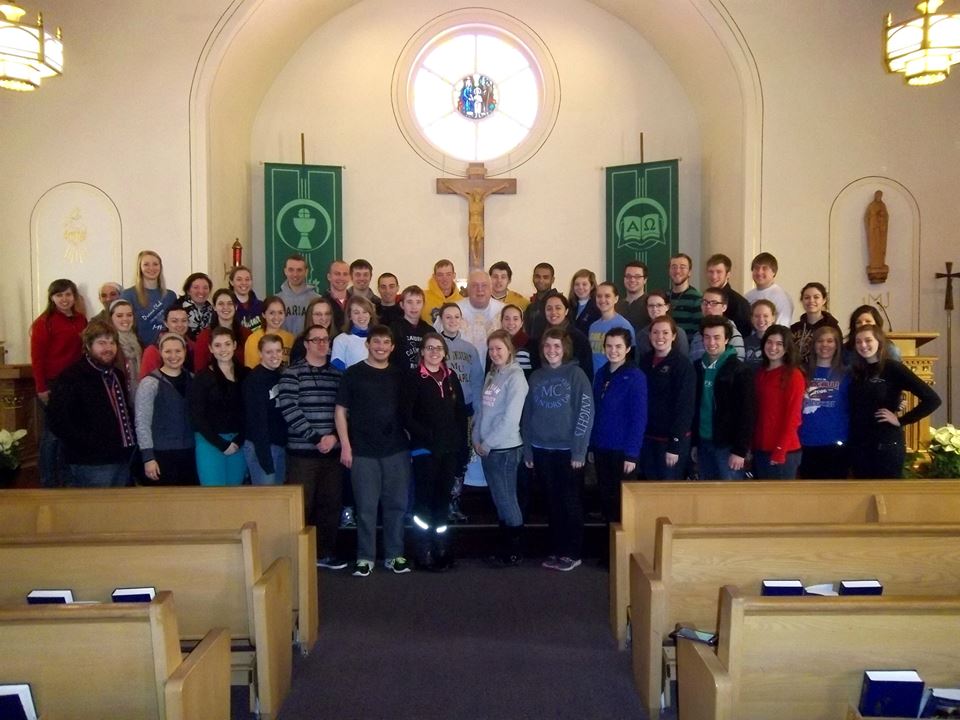
Holy Family Hosted Student Marchers for Life

About a hundred students stayed with us from Purdue, Butler and Marian Universities.

1604756_10151915305738435_1005483426_n

We had a pro-life Mass on Wednesday morning before the March. The students from Marian were largely in attendance.

1506494_10151915306588435_1967602046_n

Here are some of the Purdue and Butler students posing before our Cemetery of the Innocents.

God bless these pro-life champions. They braved freezing cold and snow to make a difference.

Question 5 – Extraordinary Synod on the Family

5. On Unions of Persons of the Same Sex

a) Is there a law in your country recognizing civil unions for people of the same-sex and equating it in some way to marriage?

Yes, such is the case in many states and the Bishops and the Maryland Catholic Conference lost the fight in Maryland despite an aggressive Marriage Matters campaign.

b) What is the attitude of the local and particular Churches towards both the State as the promoter of civil unions between persons of the same sex and the people involved in this type of union?

There is a real culture war and increased tension between conservative and liberal churches. Prince George’s is heavily Democratic and yet the voters just barely opposed the same-sex legislation. However, the high numbers in favour in other areas like Baltimore and Montgomery County carried the day for those proposing same-sex marriages. The Black churches leaned against the proposal while the liberal white churches and reformed synagogues were in favour. The Episcopal churches also largely supported the change.

c) What pastoral attention can be given to people who have chosen to live in these types of union?

That is the question right now, is it not? The Pope’s assertion about who is he to judge has fuelled speculation of a shift in attitude in the Catholic Church toward homosexuals. My late cousin (Fr. John Harvey) was the founder of COURAGE, an organization that urged homosexuals to embrace celibate love, service to others and prayer. He took a great deal of ridicule from the renegade DIGNITY group that argued for the acceptance of homosexual acts. We can urge them to go regularly to confession and Mass. But it seems to me that we cannot rubberstamp sin. Complicating the issue, homosexuals identify themselves chiefly by their orientation. Thus they reject the “hate the sin but love the sinner” scenario. They contend that if you judge “how they love” then you judge them and that this is hate speech.

d) In the case of unions of persons of the same sex who have adopted children, what can be done pastorally in light of transmitting the faith?

Boston and Washington, DC shut down their adoption services. What else can we do? I fail to see how we might deliberately place children into homosexual and lesbian households. There may be no pastoral answer that suffices. Having said this, other organizations are going to make this happen. Lesbians are also going to get themselves inseminated (they often abort male children). If they come to us it seems that we should reach out to them with compassion and understanding of human weakness and the need for love. Life is messy and we may have to get our hands dirty. Some situations are going to defy correction or fixing. News stories of parochial schools firing lesbian teachers or expelling children with “two daddies or two mommies” only seems to make matters worse. But how should we proceed?

Popes Opposed Slavery against Dissenters

138092815772350

Medallion from 1787 Wedgwood Anti-slavery Campaign

We often think that dissent from the Holy See and the teaching Church is a new phenomenon. However, just as the land of “life, liberty and the pursuit of happiness” silences any reference to God in her schools and promotes the mass murder of the unborn in the womb, so too did our land, and even her Catholic citizens, dissent from papal admonitions against slavery. Catholic churchmen held large parcels of land and like their Protestant fellows, maintained the institution of slavery. The Maryland colony first founded as a haven for Catholics would later facilitate in Baltimore Harbor a central commercial trade in slaves. People were bartered as nothing more than animals or property. Personhood was denied. Human rights were trampled upon. The rights of landowners and the “choice” of European stock immigrants were made preferential over the needs and wants of people kidnapped from the African shores.

Slavery as practiced by the Jews or later by Christians in the ancient world did not compare to it. Slaves were taken from conquered peoples and indentured servants would be used well into the colonial period of America. After a period of service, and even restitution, such slaves were freed. However, we are the ones (European colonialism) who invented perpetual racial slavery– a foul business that could be passed on from generation to generation. Families could be separated. Torture and death could be implemented without any care or worry about censure. Great Britain would renounce slavery many years prior to the Civil War (ended 1865) when the issue would be forced in the United States. Here is the irony. If the Revolutionary War had gone the other way, blacks would have known freedom many generations earlier.

  • 1778 – Slavery outlawed in Scotland.
  • 1807 – British slave trade outlawed.
  • 1833 – All British slaves freed.

Reserving ourselves to the Catholic community, it must be admitted that Catholics often catechized and had their slaves baptized. However, the churches would be segregated and later their schools. It is interesting that Cardinal O’Boyle in Washington, DC would order the desegregation of parochial schools in the 1950′s prior to similar efforts by the federal government. But, past injustice must not be excused because of later enlightenment.

Today many of our people and liberal Catholic theologians and bishops argue for abortion, artificial contraception and active homosexuality. They are the spiritual heirs to the Catholic dissenters on the matter of slavery.

Pope Eugene IV ordered that black slaves be freed in the Canary Islands back in 1435. Columbus was not even born yet! He demanded that “these peoples are to be totally and perpetually free” (Sicut Dudum). Slaveholders who refused the order were excommunicated.

Indians from the New World would be brought to the Pope with the absurd question as to whether or not they were human beings. It was hoped that if the Holy Father deemed them subhuman or animals, that this would legitimate the slave trade and the confiscation of their lands.

Pope Paul III (1537) condemned slavery in the New World, saying, “The Indians and all other peoples … who shall hereafter come to the attention of Christians … are not to be deprived of their liberty and their possessions” (Sublimis Deus).  While in regard to the mistreatment of Native Americans, this condemnation of slavery was absolute.  Slavers were rebuked as minions of the devil and rationalizations for slavery denounced as without any value.  Pastorale Officium  imposed automatic excommunication for any who tried to enslave the Indians or take their possessions.

The Holy Office of the Inquisition responded to a question on March 20, 1686 about the practice of enslaving innocent blacks.  The Church rejected such actions and argued that they had to be freed and restitution made for the injustice against them.

The later popes spoke with one voice. Pope Gregory XVI (1839) stipulated that no one should “dare to bother unjustly, despoil of their possessions, or enslave Indians, Blacks, or other such peoples” (In Supremo). He decried the traders for their “sordid gain” and the slave trade as an “inhuman traffic.”  Even the defending of such slave trade was ordered forbidden.

Nevertheless, the Catholic bishops met in Baltimore in 1840 and contended that the Pope was only condemning the slave trade, not domestic slavery in the U.S.  Is there a similarity between the position of the bishops (for which Bishop John England was a major spokesman) in 1840 and the position of certain Churchmen today in excusing U.S. military intervention around the world or pampering pro-abortion Catholic politicians here at home?

Toward the end of the nineteen century, Pope Leo XIII, the great pope who wrote about the dignity and rights of workers, also deplored the remnants of slavery in Africa and parts of South America.

Supreme Court Justice Clarence Thomas (a Catholic and former seminarian) argues from natural law that the situation of slavery in America and abortion today are analogous– both strip human beings of personhood, liberty and life.

Where is the prophetic voice? What will future generations, if a culture of life should supplant one of death, think of this generation and her leaders– civil and religious?

This topic is revisited in many ways.  It would also regard how we treat the immigrants.  Some would invite them to work here but deprive them of the benefits given our citizens.  The rise of labor unions and Catholic social teaching responded to the needs and rights of American laborers.  Further, what about the sweat shops where workers are exploited so that we might buy cheaper goods?  Many of the identical concerns attached to slavery are encountered here.

I would direct readers to Fr. Joel Panzer’s excellent book, The Popes and Slavery. Those who would fault the Church on this question would have to further impugn the apostles and Christ.  However, Christianity, while it did not eradicate this social institution, did create a new mindset in its regard.  One had to share the faith with servants and treat them in a manner that would recognize them as brothers and sisters in the Lord.  There are numerous documents from Popes and churchmen, and even in the journal of the much maligned Christopher Columbus, that spoke of a temporary bondage so that civilization and faith might be shared with the pagans. This is not to make excuses for what we know today as repugnant; but the Church and faith is given to us in human history and culture, not purely as something from outside.  Those well-versed in historiography would appreciate what I am trying to say.  The Bible and the Church were not privy to an immediate, complete and definitive Christian Anthropology.  The truth required time and reflection.

It is untrue that the Church was silent on the evils of certain forms of slavery until after the Civil War.  As I said before, American “chattel” or “traditional” slavery would not pass the moral litmus test of the Church.  However, there were other forms of servitude.  Our country also saw the employment of indentured servants.  After the debt was paid or the contract satisfied, the servant was given his freedom.  Such would be a form of “slavery,” would find a parallel with prison chain gangs and prisoners of war.

Slavery under pagan Roman law was brutal and stripped the person of basic rights.  While Christianity did not eradicate the institution, believers were rightfully conflicted and challenged as to how the institution might be maintained.  The treatment of individual slaves necessarily changed and the seed which was the spirit of the Gospel would work toward its eventual abolition. All men were reckoned children of God and brothers and sisters to one another, regardless of social standing or class.  Given St. Paul’s command that slaves should obey their masters, it was argued by many authorities that certain forms of slavery or servitude were in accordance with natural law.  Distinctions were made about voluntary and involuntary servitude.  Immoral acts could not be required of anyone, even a slave.  Temporary versus perpetual slavery was debated and delineated.  Chattel slavery was condemned for treating the human being as an animal and not respecting personhood.  The master was also morally obligated.  He had to clothe, shelter, and feed the slave.  He had to give him a Christian upbringing.  The servant could not be tortured, killed or given inhuman working conditions.  The master could not separate families. I am not saying that everyone followed the rules; but there were rules. Indeed, given that the rules for Christians were so often broken, later moralists rejected the whole notion of slavery as justifiable, either with natural law or with the spirit of the Gospel.  Slavery had to be abolished if people were to have genuine freedom and a sense of self-respect.