























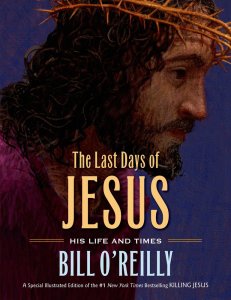
Let me begin by saying that I admire Bill O’Reilly and often enjoy his program on FOX News. One can also tell in his writings, especially about Lincoln and Kennedy, that he was probably a first class high-school history teacher. Having said this, I fear that writing about Jesus may have placed him somewhat at a disadvantage. Jesus was a man but so much more. When we miss that element of more, history itself becomes falsified or distorted. Like any good researcher, he relies heavily upon sources. And yet, religion more than any other field, is subject to a vast range of opinion and much of it unreliable or biased. Of course, his task from the very beginning may have been handicapped. Can people of faith ever approach Jesus as if that faith does not matter and does not speak to the truth?
The book for young readers, The Last Days of Jesus by Bill O’Reilly alternately embraces a biblical literalism as with the Nativity narratives, harkens to pious tradition as with the association of Mary Magdalene with the prostitute, and is permeated with a modern agnostic historical-criticism as with the avoidance of the miracles and resurrection of Christ. The book often reads like a disjointed commentary on various biblical texts. O’Reilly connects Mary Magdalen with the prostitute or sinner woman in Scripture. This is a correlation disputed by many modern exegetes and even by the authorities he cites in the back of the book. (He recommends these sources for further reading but they are not written for young readers.)
This work is the offspring to the adult book, Killing Jesus: A History. The difficulty in the focus upon our Lord in the former work is transplanted into the latter. The emphasis is placed upon “the man” Jesus of Nazareth and not upon Jesus as the Christ, Messiah or Savior. Taken too far and this ushers us back to the ancient heresy of Nestorianism where the divine unity is shattered and we begin to speak of two sons, Jesus the Man and Christ the God. Nestorius was condemned for preferring the Marian titles “Mother of the Christ” and “Mother of the Man” to the label, “Mother of God.” Subtracting his godhood entirely would restore the ancient heresy of Arianism. Any history that subtracts the divinity and its attributes becomes a falsification of the past. Those who would utterly restrict themselves to Christ as a human creature have already adopted a methodical atheism. In his usual gentle way, Raymond Arroyo brought this up on his television EWTN interview with O’Reilly. O’Reilly elaborated with him, too, that he purported to give a historical accounting of Jesus, not a spiritual one. My concern as a priest is simple: is such a rendering really possible and does it not malign the spiritual as if it is somehow unreal? (I do not question or doubt O’Reilly’s word that he remains a Catholic and a believer.)
When speaking about the incident where our Lord as a boy is teaching the teachers in the Temple, we must be careful not to speculate too much about what Jesus knows and feels (see page 36). There is a real debate about the psychology of Jesus. While he has human experiential knowledge, he is reckoned by the Church as a divine person. Thus, he knows what he needs to know. While he might pocket elements of his divine knowledge, it is always there. Even for ourselves, as human beings, we do not focus upon everything we know at any given moment. Further, when Jesus had disappeared from the caravan, he was puzzled that they had to search and did not know that he had to be in his “Father’s house.” Notice in the conversation between Jesus and Mary that Joseph is silent. He well appreciates that as the foster father of Christ, his role is reserved to protector or guardian of the Holy Family. He is already beginning to decrease and will never appear again in the Gospels. Christ will be obedient to them but given his true identity, such is by choice and not necessity.
We cannot know for sure why Jesus does all that he does. We cannot begin to imagine how infused science might have impacted upon Jesus’ knowing. But the question keeps arising, what did Jesus know and feel? Did Jesus know only “a little Hebrew”? Jesus seemed very learned and probably spoke to Pilate in Latin. Greek was also a popular language. We know our Lord spoke Aramaic. He was raised as a Jew in a Jewish community. It is true that he had experiential knowledge, but it would be wrong to infer that he had nothing of the divine. Ours is not an amnesiac deity. He always knows who he is.
Does O’Reilly come close to heresy? If so it is probably inadvertent and has to do with the selection of words. I am troubled how he speaks about the agony in the garden. We all know what our Lord does and says but O’Reilly writes, “It is a moment of anguish and despair” (page 190). Anguish, yes, but despair, no! Despair is a sin against hope and such would be impossible for the God-Man. As with the temptations, our Lord could be tempted but he could not fall. God cannot be placed in opposition to himself. There is no historical Jesus or strictly human Jesus that has ever existed. He is an exegetical fiction. His angst is not despair but the genuine sign that the incarnation was real. No human being in his right mind wants to be tortured and murdered. Our human nature rebels at the prospect and that is what happens here. Nevertheless, in the face of this sorrow, he reaffirms the mission given him by his Father. This is more than asking for strength. Jesus is not going to run away. He knows what is coming. He demonstrates what true fidelity means. He shows us the true face of courage.
It was not so much that Christians were embarrassed by the Cross (see page 258); rather, the difficulty had to do with a Greek philosophical bias against such vulnerability, especially from one purported to be divine. It was a stumbling block to conversions. Christians were aware that the Cross was a sign of contradiction and yet the symbol of Christ’s role as our sin-offering; he dies on our behalf. As we see in the Good Friday liturgy, the Cross appeared to be Christ’s defeat and yet it becomes a sign of his victory. It is precisely this demarcation in the text between the so-called historical Jesus and the Christ of faith that skews a proper understanding of what Jesus is about. Of course, such falls in line with the atheistic agenda of the Jesus Seminar (which the book recommends as a source).
The author writes, “But Jesus has committed a grave offense—he interrupted the flow of funds from the temple to Rome when he flipped over the money changer’s tables” (page 197). I am not sure that there is much evidence for such a financial collusion. The text infers at this point that the financial pressure and greed from the Pharisees is what brought Jesus to trial. However, later on the text rightly narrates it as blasphemy. Does O’Reilly view the allegation of blasphemy as a trumped charge to indict Jesus? Again, I think a narrow vision damages the full truth. The Pharisees and scribes are true believers and zealots. Yes, they do not want anyone to erode their authority. Yes, the turning over of the money-changing tables did not win him friends among them. However, they were also appalled by his healings on the Sabbath and references to him as God’s Son. Monotheism and the Law were principal elements of their religion and they failed to see how Jesus could fit into this picture.
I seriously doubt that this book will find a place in parish catechesis programs. Too much is missing. Even if one were to restrict an evaluation to our Lord’s social mission, the outreach of Christ to the poor, the sick, the oppressed, the weak and to women, is largely neglected. And yet, it was precisely this preferential option for the poor, the suffering and sinners that made the religious leadership hate Jesus all the more. They may have been afraid of an uprising but they also resented that he was winning the hearts of the people, especially the rabble. God did not only bless the religious elite or the rich and powerful. God also loved those who were lost, afraid and weak. We would not want to cast Jesus as an Obama-like social worker; but neither would we image him as a modern-day Republican hardliner or fiscal conservative.
The Lord’s Supper is essentially reduced to an interchange about Judas and the betrayal. Totally absent is how Jesus will take the Seder and change the rubrics to refer to himself as the new sacrificial Lamb of God. I find this odd because he immediately connects this meal with the coming ordeal of the Cross. I suspect it is subtracted because it refers to sectarian topics like the priesthood and the Mass. However, it also removes the sense that Jesus will not simply have his life taken from him; rather, he will lay it down.
As with the Pharisees, the principal motivation for Judas is depicted as greed and yet many biblical authorities suggest that it was far more complex. It may be that Judas was impatient and wanted to force Jesus’ hand— to compel him to act as the Messiah and bring about insurrection. This other element is breeched quickly on page 177.
The incident of the tax and the coin is reduced to Jesus not offending Rome but giving it deference. Here too the situation is far more complex. Yes, it is a trap but a question is asked. Often the more liberal voices will speak about how this supports dividing our loyalties between Caesar and God. This is the thinking of politicians who claim to be good Catholics but enable the murder of children through the administration’s reproductive services policies. The fact is that Jesus neither falls for the trap nor answers the question. He never really says one should pay the tax. If he says not to pay then he can be painted as an enemy of Rome. If he says pay, then he can be judged as a traitor to his own people. All he does is point to a coin with the emperor’s face on it and says give to God what belongs to God and give to Caesar what belongs to Caesar. In truth, everything belongs to God. The Scriptures are clear, ours is a jealous God.
Is Jesus “a revolutionary with a band of disciples and growing legion of followers” (page 162)? The text itself admits that Jesus did not intend to establish a new government or overthrow the Romans. He often steers away from the title of Messiah because it is so generally misinterpreted in military terms. Nevertheless, our Lord did come to establish a new People of God or a Church. This theme is generally omitted from the text. Note that when Jesus asks the question about his identity, he applauds Peter for seeing the truth, “You are the Messiah, the Son of the living God” (page 127). However, absent in the text is the Lord’s offer of a new identity upon Peter as ROCK and that upon this ROCK he would build his Church. (A brief mention of the renaming appears on page 97 but minus the connection to the Church.) Our Lord next prophesies his coming passion and death. He will die for the Church. He will pass on something of this authority to the Church. Without this appreciation, a major theme that leads to his sacrifice is omitted. Certain religious revisionists propose that references to the Church were later written into the biblical accounts; however, the teaching Church would argue that such reflected the mind of Christ and were part of these events.
When it comes to the miracles, the text speaks of “stories” of Jesus doing so (page 119) and that he “apparently” healed a man’s withered hand. The miracles are viewed by Christianity as proofs to Christ’s divinity and mission. Along with the resurrection, their subtraction or reduction to conjecture immediately eliminates any arguable profession of divinity. Except for how Jesus has been “used” by people in history, the assessment of our Lord would be that he was a failed prophet who was executed as a criminal and later had his body stolen and probably destroyed. O’Reilly never says this, and as a Catholic would probably not hold such a view, however, it is what the text tends to communicate. While Jesus does use “logic and words of Scripture to upend” the arguments of the Pharisees, the primary mode of communication is through stories and actions. He tells parables and he works miracles. Much of his attraction comes down to these two operations. They are elements largely missing from the book’s overall assessment of Christ.
The Afterword itself, after mentioning the story of the Jewish leadership that Jesus’ body was stolen, gives the various views about our Lord held by Christians, Jews, Buddhists, Hindus, and Muslims. The implication within this religious indifferentism is that all the interpretations might be fanciful. Of course, restricting oneself to the natural elements throughout would seem to invalidate the supernatural altogether. It ends with the empty tomb and the simple line, “To this day, the body of Jesus of Nazareth has never been found.” While we have a curt ending in the Gospel of Mark, the Christian testimony is far richer. I have serious reservations about an agnostic or atheistic retelling of the story of Jesus that subtracts the miraculous. Who is to say that these things are not based upon real history?
Bill O’Reilly talks about “Killing Jesus” on “60 Minutes”
The Holy Spirit inspired Killing Jesus
A Conversation with Bill O’Reilly
Bill O’Reilly’s ‘Killing Jesus’ Spiritualizes the Historical Christ
Fox News’s Bill O’Reilly strikes at atheist Bill Maher
Filed under: Atheism, Bible, Catholic, Faith, Jesus, Religion | 5 Comments »





















 Blogger Priest