The blog header depicts an important and yet mis-understood New Testament scene, Jesus flogging the money-changers out of the temple. I selected it because the faith that gives us consolation can also make us very uncomfortable. Both Divine Mercy and Divine Justice meet in Jesus. Priests are ministers of reconciliation, but never at the cost of truth. In or out of season, we must be courageous in preaching and living out the Gospel of Life. The title of my blog is a play on words, not Flogger Priest but Blogger Priest.
This ad brings to the fore a concern that I have sought earnestly to expose. Couples say they are in love and yet they treat each other as disposable commodities. They have sex and cohabitate, treating the beloved like a used car taken out for a test drive. What a terrible way to treat persons!
Let me begin by saying that I admire Bill O’Reilly and often enjoy his program on FOX News. One can also tell in his writings, especially about Lincoln and Kennedy, that he was probably a first class high-school history teacher. Having said this, I fear that writing about Jesus may have placed him somewhat at a disadvantage. Jesus was a man but so much more. When we miss that element of more, history itself becomes falsified or distorted. Like any good researcher, he relies heavily upon sources. And yet, religion more than any other field, is subject to a vast range of opinion and much of it unreliable or biased. Of course, his task from the very beginning may have been handicapped. Can people of faith ever approach Jesus as if that faith does not matter and does not speak to the truth?
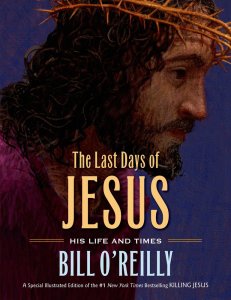
The book for young readers, The Last Days of Jesus by Bill O’Reilly alternately embraces a biblical literalism as with the Nativity narratives, harkens to pious tradition as with the association of Mary Magdalene with the prostitute, and is permeated with a modern agnostic historical-criticism as with the avoidance of the miracles and resurrection of Christ. The book often reads like a disjointed commentary on various biblical texts. O’Reilly connects Mary Magdalen with the prostitute or sinner woman in Scripture. This is a correlation disputed by many modern exegetes and even by the authorities he cites in the back of the book. (He recommends these sources for further reading but they are not written for young readers.)
This work is the offspring to the adult book, Killing Jesus: A History. The difficulty in the focus upon our Lord in the former work is transplanted into the latter. The emphasis is placed upon “the man” Jesus of Nazareth and not upon Jesus as the Christ, Messiah or Savior. Taken too far and this ushers us back to the ancient heresy of Nestorianism where the divine unity is shattered and we begin to speak of two sons, Jesus the Man and Christ the God. Nestorius was condemned for preferring the Marian titles “Mother of the Christ” and “Mother of the Man” to the label, “Mother of God.” Subtracting his godhood entirely would restore the ancient heresy of Arianism. Any history that subtracts the divinity and its attributes becomes a falsification of the past. Those who would utterly restrict themselves to Christ as a human creature have already adopted a methodical atheism. In his usual gentle way, Raymond Arroyo brought this up on his television EWTN interview with O’Reilly. O’Reilly elaborated with him, too, that he purported to give a historical accounting of Jesus, not a spiritual one. My concern as a priest is simple: is such a rendering really possible and does it not malign the spiritual as if it is somehow unreal? (I do not question or doubt O’Reilly’s word that he remains a Catholic and a believer.)
When speaking about the incident where our Lord as a boy is teaching the teachers in the Temple, we must be careful not to speculate too much about what Jesus knows and feels (see page 36). There is a real debate about the psychology of Jesus. While he has human experiential knowledge, he is reckoned by the Church as a divine person. Thus, he knows what he needs to know. While he might pocket elements of his divine knowledge, it is always there. Even for ourselves, as human beings, we do not focus upon everything we know at any given moment. Further, when Jesus had disappeared from the caravan, he was puzzled that they had to search and did not know that he had to be in his “Father’s house.” Notice in the conversation between Jesus and Mary that Joseph is silent. He well appreciates that as the foster father of Christ, his role is reserved to protector or guardian of the Holy Family. He is already beginning to decrease and will never appear again in the Gospels. Christ will be obedient to them but given his true identity, such is by choice and not necessity.
We cannot know for sure why Jesus does all that he does. We cannot begin to imagine how infused science might have impacted upon Jesus’ knowing. But the question keeps arising, what did Jesus know and feel? Did Jesus know only “a little Hebrew”? Jesus seemed very learned and probably spoke to Pilate in Latin. Greek was also a popular language. We know our Lord spoke Aramaic. He was raised as a Jew in a Jewish community. It is true that he had experiential knowledge, but it would be wrong to infer that he had nothing of the divine. Ours is not an amnesiac deity. He always knows who he is.
Does O’Reilly come close to heresy? If so it is probably inadvertent and has to do with the selection of words. I am troubled how he speaks about the agony in the garden. We all know what our Lord does and says but O’Reilly writes, “It is a moment of anguish and despair” (page 190). Anguish, yes, but despair, no! Despair is a sin against hope and such would be impossible for the God-Man. As with the temptations, our Lord could be tempted but he could not fall. God cannot be placed in opposition to himself. There is no historical Jesus or strictly human Jesus that has ever existed. He is an exegetical fiction. His angst is not despair but the genuine sign that the incarnation was real. No human being in his right mind wants to be tortured and murdered. Our human nature rebels at the prospect and that is what happens here. Nevertheless, in the face of this sorrow, he reaffirms the mission given him by his Father. This is more than asking for strength. Jesus is not going to run away. He knows what is coming. He demonstrates what true fidelity means. He shows us the true face of courage.
It was not so much that Christians were embarrassed by the Cross (see page 258); rather, the difficulty had to do with a Greek philosophical bias against such vulnerability, especially from one purported to be divine. It was a stumbling block to conversions. Christians were aware that the Cross was a sign of contradiction and yet the symbol of Christ’s role as our sin-offering; he dies on our behalf. As we see in the Good Friday liturgy, the Cross appeared to be Christ’s defeat and yet it becomes a sign of his victory. It is precisely this demarcation in the text between the so-called historical Jesus and the Christ of faith that skews a proper understanding of what Jesus is about. Of course, such falls in line with the atheistic agenda of the Jesus Seminar (which the book recommends as a source).
The author writes, “But Jesus has committed a grave offense—he interrupted the flow of funds from the temple to Rome when he flipped over the money changer’s tables” (page 197). I am not sure that there is much evidence for such a financial collusion. The text infers at this point that the financial pressure and greed from the Pharisees is what brought Jesus to trial. However, later on the text rightly narrates it as blasphemy. Does O’Reilly view the allegation of blasphemy as a trumped charge to indict Jesus? Again, I think a narrow vision damages the full truth. The Pharisees and scribes are true believers and zealots. Yes, they do not want anyone to erode their authority. Yes, the turning over of the money-changing tables did not win him friends among them. However, they were also appalled by his healings on the Sabbath and references to him as God’s Son. Monotheism and the Law were principal elements of their religion and they failed to see how Jesus could fit into this picture.
I seriously doubt that this book will find a place in parish catechesis programs. Too much is missing. Even if one were to restrict an evaluation to our Lord’s social mission, the outreach of Christ to the poor, the sick, the oppressed, the weak and to women, is largely neglected. And yet, it was precisely this preferential option for the poor, the suffering and sinners that made the religious leadership hate Jesus all the more. They may have been afraid of an uprising but they also resented that he was winning the hearts of the people, especially the rabble. God did not only bless the religious elite or the rich and powerful. God also loved those who were lost, afraid and weak. We would not want to cast Jesus as an Obama-like social worker; but neither would we image him as a modern-day Republican hardliner or fiscal conservative.
The Lord’s Supper is essentially reduced to an interchange about Judas and the betrayal. Totally absent is how Jesus will take the Seder and change the rubrics to refer to himself as the new sacrificial Lamb of God. I find this odd because he immediately connects this meal with the coming ordeal of the Cross. I suspect it is subtracted because it refers to sectarian topics like the priesthood and the Mass. However, it also removes the sense that Jesus will not simply have his life taken from him; rather, he will lay it down.
As with the Pharisees, the principal motivation for Judas is depicted as greed and yet many biblical authorities suggest that it was far more complex. It may be that Judas was impatient and wanted to force Jesus’ hand— to compel him to act as the Messiah and bring about insurrection. This other element is breeched quickly on page 177.
The incident of the tax and the coin is reduced to Jesus not offending Rome but giving it deference. Here too the situation is far more complex. Yes, it is a trap but a question is asked. Often the more liberal voices will speak about how this supports dividing our loyalties between Caesar and God. This is the thinking of politicians who claim to be good Catholics but enable the murder of children through the administration’s reproductive services policies. The fact is that Jesus neither falls for the trap nor answers the question. He never really says one should pay the tax. If he says not to pay then he can be painted as an enemy of Rome. If he says pay, then he can be judged as a traitor to his own people. All he does is point to a coin with the emperor’s face on it and says give to God what belongs to God and give to Caesar what belongs to Caesar. In truth, everything belongs to God. The Scriptures are clear, ours is a jealous God.
Is Jesus “a revolutionary with a band of disciples and growing legion of followers” (page 162)? The text itself admits that Jesus did not intend to establish a new government or overthrow the Romans. He often steers away from the title of Messiah because it is so generally misinterpreted in military terms. Nevertheless, our Lord did come to establish a new People of God or a Church. This theme is generally omitted from the text. Note that when Jesus asks the question about his identity, he applauds Peter for seeing the truth, “You are the Messiah, the Son of the living God” (page 127). However, absent in the text is the Lord’s offer of a new identity upon Peter as ROCK and that upon this ROCK he would build his Church. (A brief mention of the renaming appears on page 97 but minus the connection to the Church.) Our Lord next prophesies his coming passion and death. He will die for the Church. He will pass on something of this authority to the Church. Without this appreciation, a major theme that leads to his sacrifice is omitted. Certain religious revisionists propose that references to the Church were later written into the biblical accounts; however, the teaching Church would argue that such reflected the mind of Christ and were part of these events.
When it comes to the miracles, the text speaks of “stories” of Jesus doing so (page 119) and that he “apparently” healed a man’s withered hand. The miracles are viewed by Christianity as proofs to Christ’s divinity and mission. Along with the resurrection, their subtraction or reduction to conjecture immediately eliminates any arguable profession of divinity. Except for how Jesus has been “used” by people in history, the assessment of our Lord would be that he was a failed prophet who was executed as a criminal and later had his body stolen and probably destroyed. O’Reilly never says this, and as a Catholic would probably not hold such a view, however, it is what the text tends to communicate. While Jesus does use “logic and words of Scripture to upend” the arguments of the Pharisees, the primary mode of communication is through stories and actions. He tells parables and he works miracles. Much of his attraction comes down to these two operations. They are elements largely missing from the book’s overall assessment of Christ.
The Afterword itself, after mentioning the story of the Jewish leadership that Jesus’ body was stolen, gives the various views about our Lord held by Christians, Jews, Buddhists, Hindus, and Muslims. The implication within this religious indifferentism is that all the interpretations might be fanciful. Of course, restricting oneself to the natural elements throughout would seem to invalidate the supernatural altogether. It ends with the empty tomb and the simple line, “To this day, the body of Jesus of Nazareth has never been found.” While we have a curt ending in the Gospel of Mark, the Christian testimony is far richer. I have serious reservations about an agnostic or atheistic retelling of the story of Jesus that subtracts the miraculous. Who is to say that these things are not based upon real history?
Why do we ask saints to pray for us if they are dead?
RESPONSE:
Why do we believe that Jesus can save us if he is dead? It all comes down to the resurrection. We believe that Jesus conquered sin and death and that he gives us a share in his risen life. The dead are not really dead, but alive.
Notice that even prior to his redemptive work, Elijah and Moses appeared with Jesus in the transfiguration. We read in Mark 12:26-27: “As for the dead being raised, have you not read in the Book of Moses, in the passage about the bush, how God told him, ‘I am the God of Abraham, [the] God of Isaac, and [the] God of Jacob’? He is not God of the dead but of the living. You are greatly misled.”
Christians believe that the redemptive work of Christ merits a place for the saints in heaven with God. The whole meaning of the communion of the saints is that they (as the Church in heaven) are alive, loving and praying for the pilgrim Church on earth. They are still apart of us.
I was diagnosed as bi-polar when I was 15 years old. I have been on medication for the last 16 years to control my disease. I have always wanted children; however, as I mature, I have realized that being on medication while pregnant is not wise. Neither would I want to bring a child into a situation that could be potentially unstable. So recently, I have been thinking about whether or not I should indeed have a child. If this is the course of action I choose to take, is it accurate that in the eyes of the Church I should never be allowed to get married, to share my life with someone, or enjoy the marital bed all because I chose not to have children?
RESPONSE:
I know bi-polar people who have children and do quite well. You are correct that there are certain medications that can make pregnancy problematical. I have seen this especially with paranoid schizophrenics. As for your question, unless you are married then it is entirely academic as you cannot morally have children as a single person. The Church views marriage as having two purposes: the propagation of the human race and the fidelity of the spouses. Older couples might be infertile but they can still get married. The marital act must still be that type of act that generates new human life even if such an eventuality is unlikely or impossible. Younger couples must want to have children in order to get married in the Church. The priest will ask this question as part of the prenuptial investigation. Rejecting the possibility makes marriage impossible. Indeed, if there is deceit about this, it is grounds for the annulment of a bond. Depending how long you wait to get married, the issue may become academic as the clock is always ticking on female fertility. You can be happy unmarried and there are joys other than those of the marriage bed.
It’s hilarious how either you are completely indoctrinated about the history of the Jesuits/Catholic church and their many atrocities toward humanity or just an agent of disinformation. I suspect the latter. The Nazis modeled the SS from your precious Jesuits.
“Above all I have learned from the Jesuits. And so did Lenin too, as far as I recall. The world has never known anything quite so splendid as the hierarchical structure of the Catholic Church. There were quite a few things I simply appropriated from the Jesuits for the use of the [Nazi] Party.–Adolph Hitler
FATHER JOE:
It may be that Hitler envied the organization of the Jesuits and the Church. However, he planned to replace Catholicism and Christianity with a church of his own making, one based upon his racist ideology. Again, I am surprised that you would give him so much attention and credibility. What is your source for this quote?
It amazes me that there are still people who swallow anti-Catholic bigotry and parade their ignorance as legitimate scholarship and learning. Christians are just as much sinners as anyone else and in the history of the world there is plenty of blame to go around. The late Pope John Paul II offered his “mea culpas” as a magnanimous gesture from the Church for healing. However, instead of reciprocity, the world is still in denial and the atrocities of the third millennium are much as they were before. However, in the face of injustice and a culture of death, the Church is frequently the lone voice crying out for the oppressed and the unborn. At a time when religious liberty is threatened, she is the advocate for the poor and the hurting. The Church proclaims the Gospel of Life and Catholic believers even sacrifice their lives in the cause of freedom and in the defense of human dignity. Your blindness to this reality is what makes your apologetic so very tragic and disappointing. You inadvertently place yourself on the side of a darkness that seeks to overwhelm the light.
Heinrich Luitpold Himmler was raised a Catholic and yet he turned his back on the Church and Christianity. Focusing on a Germanic mythology, he embraced the occult while trying to strip away elements of Catholicism to make his new religion. While some claim that the Society of Jesus (Jesuits) was his model for the SS, it was actually the ancient Teutonic Knights. Hitler, himself a superstitious man, placed little confidence in Himmler’s mysticism and may have made a joke of calling him his “Ignatius of Loyola.” This may be where the confusion with the Jesuits started. But other than the elements of order and obedience, there were no similarities. The Jesuits defended the papacy and the Catholic faith. Himmler’s SS was the start of a so-called humanistic religion which worshipped Hitler.
THOMAS:
Since you are obviously educated in the art of logical fallacies, I was wondering if you will use ad hominem, guilt by association, begging the question or straw man. Maybe a combination of these and others? My guess is you will delete this post.
FATHER JOE:
Logical reasoning is not fallacious. You rely upon the actual tactics of the Nazis, telling the BIG LIE with the expectation that gullible people will believe it. There is no need for me to resort to an “ad hominem” argument in that you have sufficiently disgraced yourself without my assistance. I am unsure with whom you associate, but I can well imagine given the venom of your attack and style. The straw man is entirely yours. You create a false caricature of Catholicism (and the Jesuits) which you immediately impugn or tear down. I have read your quotes, and yet many of them are attributed to men who shared your uniformed biases against Catholicism. You even cite Hitler, as if a man who orchestrated the art of deception and murder could be trusted in anything he says.
THOMAS:
Here are a few quotes for you to deny.
“The Jesuits are a MILITARY organization, not a religious order. Their chief is a general of an army, not the mere father abbot of a monastery. And the aim of this organization is power – power in its most despotic exercise – absolute power, universal power, power to control the world by the volition of a single man. Jesuitism is the most absolute of despotisms – and at the same time the greatest and most enormous of abuses.”–Napoleon Bonaparte
FATHER JOE: Napoleon, like you, would also have his issues with the Church. He falsely viewed the Jesuits in terms of the very things which he coveted: power and empire. Napoleon was keenly concerned about the loyalty of hearts and minds. He dreaded competition from the Jesuits or the Church. The Jesuits were not a military organization, but a religious order founded by a former military man who put aside the sword. What is your source for this quote?
THOMAS:
“It is my opinion that if the liberties of this country – the United States of America – are destroyed, it will be by the subtlety of the Roman Catholic Jesuit priests, for they are the most crafty, dangerous enemies to civil and religious liberty. They have instigated MOST of the wars of Europe.”–Marquis de Lafayette
FATHER JOE: Lafayette shared the prejudices of many in France against the Jesuits. Indeed, such biases would lead Rome to suppress the Jesuits. All 23 priests in the thirteen colonies were former Jesuits. The irony was that they were defenders of the papacy. Lafayette was impressed by the Protestants in America and successfully worked for their co-existence with Catholics in France. What is your source for this quote?
THOMAS:
“The Jesuit Order at last reached the pinnacle of its power and prestige in the early eighteenth century [i.e., the early 1700s]. It had become more influential and more wealthy than any other organization in the world. It held a position in world affairs that no oath-bound group of men has ever held before or since… ‘Nearly all the Kings and Sovereigns of Europe had only Jesuits as directors of their consciences[i.e., as confessor-priests], so that the whole of Europe appeared to be governed by Jesuits only.’” (1927 / using a short quote by Jesuit Cordara)–Boyd Barrett (Ex-Jesuit)
FATHER JOE:
The situation with the ex-Jesuit Boyd Barrett was tragic because he very much believed in the Church and in his priesthood. He expressly wrote against condemning the Jesuit order and the Church as you and other anti-Catholics delight in doing. However, he suffered at the hypocrisy he found and in the hardness of hearts which can afflict the men placed over us. His book, The Jesuit Enigma (New York, 1927) both celebrates the saintly achievements of his order as well as laments its failures. Given his testimony, this would also include the shabby treatment shown its loyal sons. He writes (page 335-36): “Twenty years had passed since I had entered the Society of Jesus, believing in the description given of it by the Jesuit General Roothan, as ‘a splendid abiding-place of science, piety and virtue ; an august temple extending over the earthy consecrated to the glory of God and the salvation of souls’ I had given the best years of my life to the Society, striving as faithfully as I could to realize the ideal of the perfect Jesuit, ‘one who, having shed all personal interests and affections, clothes himself with Christ, and shows himself in labor, patience, charity and the love of truth the servant of God, fighting with the arms of Justice through days of ill-fame and days of honor.’”
You should note that The New York Times would carry a beautiful story about him, entitled, “EX-PRIEST EXPLAINS RETURN TO CHURCH; Dr. E. Boyd Barrett Says 22 Years of Brother’s Prayers Brought Reconciliation.” The article begins, “Dr. E. Boyd Barrett, who left the Roman Catholic Church and the Jesuit Order in 1924 after twenty years of education for and in the priesthood, publicly announced his reconciliation with the church yesterday.” Praise God!
THOMAS:
“All these things cause the Father-General [of the Jesuits] to be feared by the Pope and sovereigns… A sovereign who is not their [the Jesuits’] friend will sooner or later experience their vengeance.” (1852)–Luigi de Sanctis (Official Censor of the Inquisition)
FATHER JOE: Luigi de Sanctis left the priesthood and got married. As an Italian Protestant, he co-founded the Evangelical Christian Church and became a leading anti-Catholic apologist. I would hardly regard his criticisms of the faith as wholly credible. He leagued with the Waldensians. The pertinent book here is Popery and Jesuitism at Rome in the 19th Century, published in London, 1852. He found a market in Protestant England for speaking against the Church, the Jesuits and sacraments like Confession. He was a scandal to all those Jesuits martyred because they ministered and brought the faith back to England.
What is wrong with Fr. Nicholas Gruner and The Fatima Crusader magazine? He seems to be very holy, intelligent, and sincere–not anything like the “nut” people make him out to be. His main message seems to be that the consecration of Russia requested at Fatima was never performed properly and that humanity could be headed for a chastisement.
RESPONSE:
Compliance with a request to consecrate Russia and/or the world remains with the judgment of the Holy See. Such has been done and it can be repeated. However, it does not rest with Fr. Gruner or with you and me. We can certainly dedicate ourselves to the Immaculate Heart of Mary and the Sacred Heart of Jesus, but such also demands fidelity in our state of life, as well as respect to the Church and the Pope. Fr. Gruner proposes to direct what is best for the world and the Church while he cannot even get his own house in order. The Soviet Union fell and many nations knew freedom. But faith is not magic. Sin still exists in Russia (just ask the Ukraine), around the world and here in the U.S. where our religious liberty is threatened by the current administration and a culture of death. Any utopian view or interpretation of Fatima and its fruits are arguably not in sync with Catholic or Christian eschatology.
Fr. Gruner has not had proper priestly faculties for much of his priesthood. He argues that we must prove otherwise but that is not how the process works. He must present signed faculties from his bishop to the diocesan officials of any local church he visits. He cannot do this because he is not in good standing. Thus, he is not welcome by true Catholic authorities anywhere in the United States. His censure was reaffirmed by the Congregation for the Clergy. Priests are not the same as the laity. We are not our own men. We belong to the Church and our bishops. The problem with the priest is simply this… he disobeyed and continues to disobey his legitimate bishop. He says “public” Mass even though he is forbidden to do so. He cannot even “lawfully” hear Confessions. He is closer today to the schismatic SSPX than the Roman Catholic Church.
[No other bishop can extend him faculties or give him permission to minister while he is suspended. No other bishop could even adopt him unless he were formally released by his home bishop. He has never been released.]
I am told that when the late Sr. Lucia took issue with him, he accused her of lying. Similarly he has directly attacked the popes and questioned the honesty of the Vatican. How is any of this meritorious? Sorry, I can well appreciate that his manner is very disarming. While critics accuse him of being a self-serving scam artist, he seems quite pious and sincere. But it remains true that he brings in plenty of money from donations and has no one, not even a Catholic bishop, to oversee him.
As a diocesan priest, he can only function as an extension of his bishop. But what happens when a priest will allow no one to tell him what to do? Disobedient priests are by definition, bad priests. This is a rule that I take seriously to protect my own priesthood. Many of the renegade clergy know the code-words to get people on their side. Particularly troubling is that to justify himself and his standing, Fr. Gruner wrote a book that distorts the truth of his situation and conflicts with Catholic ecclesiology. I would simply ask him, who and where is your bishop? Have you obeyed him? His defense fails before it begins. Catholicism is a mediated religion. We do not follow God directly but through his appointed authority. He cannot claim fidelity to Jesus and Mary while ignoring the summons of his bishop or by defaming the Holy See as deceptive or satanic.
Fr. Gruner’s claims not only lack substantiation; nothing that he has done can be justified. It is said that he has become increasingly traditional (at least externally) because, as has been observed, he seeks kindred bedfellows and follows the money trail. And yet, certain traditionalists mock him as a false priest because he was ordained within the reformed ordination ritual after Vatican II, which they reject.
Does he have any legitimate convictions? Might he be more delusional than fraudulent? I cannot say. But he should not be supported. Catholics should urge him to be humble and to submit as a priest to the lawful authority to which HE PROMISED OBEDIENCE. A priest that breaks his promise of obedience to his bishop is as bad as a priest who breeches celibacy. Again, do not be fooled. His name and organization does not appear in the official directory of institutions and clergy in the U.S or Canada. He does not work for the Catholic Church in any capacity whatsoever. He is independent. In that sense, he has fabricated his own church.
The appeal letters that he sends out include the signatures of other renegade clergy. I was surprised some years ago to discover that the names included that of an old retired priest who purportedly went senile and another priest who was long dead. I have not checked the current names. Again, he wants to give himself a false credibility.
While I would urge against material support, I would recommend that everyone should pray for Father Gruner and that he will know repentance and humbly accept the guidance of his bishop under holy obedience. I suspect that this is what would most please our Lord and the Blessed Mother. Let us never forget that the devil likes to fool us, making the darkness look like light. Pray for him and all priests.
1976 – Bishop Pasquale Venezia ordained Fr. Gruner. He refused to serve the diocese of Avellino and left for Canada without permission.
1978 – Bishop Venezia sent Gruner a letter saying that he could remain in Canada if a local bishop incardinated him. None did and no applications were made.
Bishop Gerardo Pierro ordered him to return to his diocese. Fr. Gruner did not answer his letter.
Cardinal Innocenti, Prefect of the Congregation for the Clergy, wrote to him and ordered him to return to Italy and his bishop. Fr. Gruner refused.
1989 – Bishop Gerardo Pierro again sent Gruner a letter ordering him to return or find another bishop in 30 days.
1990 – Fr. Gruner went to Avellino and met with Bishop Pierro to give him time to seek incardination. This was granted but two years later he still had not started the process or found a receptive bishop.
1992 – Cardinal Sanchez and Archbishop Sepe stated in L’Osservatore Romano that Fr. Gruner and his Apostolate had not been approved by the competent ecclesiastical authorities (October 14, 1992).
1994 – The new bishop of Avellino issued a decree declaring Fr. Gruner a vagus priest. Such priests have no faculties and cannot publicly offer the sacraments.
Permission for the public celebration of the Traditional Latin Mass has been revoked at Fisher More College by the newly appointed Ordinary, Bishop Michael Olson in Fort Worth, Texas. On top of this, the school’s president, Michael King, made expansion efforts that have left the college in dangerous financial straits. The former school chancellor, Dr. Taylor Marshall, states that it is all a reaction to the college president “politicizing” the old Mass to distract from his financial scandal and to avoid personal fault should the college close in coming months. The bishop, himself, has shown support for the Priestly Fraternity of St. Peter in his diocese.
A professor attacked Vatican II. The renegade priest Fr. Gruner and purportedly others without faculties have been allowed to offer Mass. The FSSP withdrew some time back. The chancellor resigned and certain Catholic students complained about the situation. Suspension of the old Latin Mass was in reaction to these serious matters. The bishop is a friend of the old Latin Mass and directed them to a parish where it is regularly offered. The president cancelled ALL MASSES and will not allow the revised Missal to be offered– showing the lie about respecting the validity of the ordinary form! The president has said he would sooner have the school close than offer the reformed liturgy. As for the bishop’s authority, he is on solid ground since it is a school chapel or oratory.Canon 1225 states that “All sacred celebrations can be performed in legitimately established oratories except those which the law or a prescript of the local ordinary excludes or the liturgical norms prohibit.”
The news was on fire this morning about a DC priest who purportedly refused to give Last Rights to a gay heart-attack patient at the Washington Hospital Center.
Oh boy, here we go again! This man condemns the priest but we only have his side of the story.
I suspect there is a lot more to the story than what we are hearing. A priest was requested and Father Brian Coelho came to the bedside of the patient, Ronald Plishka. The priest followed the ritual by offering the Sacrament of Penance prior to the Anointing of the Sick and Holy Communion. If a patient is unconscious, the priest will often presume contrition and a desire for the sacraments, giving absolution even without auricular confession. In this case, the patient was alert and responsive. The patient seemed to want to make small talk and remarked about how as a homosexual person he was so happy that the Pope was accepting of gay people. But he next asked if this admission bothered the priest, almost as if he were baiting him. The priest said it did not but offered to pray with him. Nothing more was said about Extreme Unction and Viaticum. While left unsaid in the article, this intimates that this dialogue took place as part of a Confession.
Because the disagreement probably happened during Confession, the priest is silenced by the seal and cannot share his side of the story. Indeed, he would face automatic excommunication if he says anything… something I hope that Church authorities appreciate. Even they cannot question the priest.
Instead of a civil conversation, the patient rejects the offer of prayer and tells the priest “to get the [deleted] out of here!” That in itself probably demonstrates an improper disposition for God’s mercy. Then the doctors came in to calm him down.
QUESTION: Dear Father, I am seeking for advice that comes from my religion. I am a Catholic and a Filipino. I want to get married but my girlfriend and I don’t have enough money budgeted for a church wedding. We are looking for a civil wedding but based on our faith, this wedding doesn’t have a blessing from our Lord God. Is it possible that we can get married through a civil wedding and after that go to our parish priest to bless us as a couple? Can we have our honeymoon then? Please give me advice. Thank you and God bless.
ANSWER:
You seem to already know the answer. I cannot tell you anything different. It might sound harsh, but I will keep you both in prayer.
Some countries require a dual ceremony, even Italy, since priests do not function as magistrates of the state. In the United States, parish priests are authorized to witness weddings that are recognized both by the Church and by the state. You are right that the Church gives no weight to a strictly civil wedding. It must be witnessed by a priest and at least two witnesses.
I have heard your plight before and I am not very sympathetic. You could still have a church wedding because the sacraments are free. You do not need the expensive window dressing. My father got married in his blue suit, the only suit he owned. My mother wore her prettiest dress. The family had a picnic afterwards. They lived happily as man and wife until my father died 40 some years later. They had seven children and went to Mass every Sunday.
Get your priorities straight. Marriage outside the Church would place your beloved in serious sin and cut you both off from absolution in Confession and the reception of Holy Communion. A fancy gown and reception is not worth your immortal soul. Any children conceived deserve a mother and mother who are truly married in the eyes of God. Otherwise, what would it make you?
A priest could con-validate a civil wedding, but this does NOT bless the prior secular bond. The con-validation would be your true wedding. What came before was play-acting. You would have to repent, receive marriage preparation and receive the sacrament of Penance before the con-validation. Many priests today refuse to give large church weddings for couples civilly married and/or with children. Instead, they insist upon small con-validations with a few family and no music and no Mass. The reason for this is simple, so that other couples would not imitate such shameful and sinful acts. It is a proper punishment and/or penance for couples who are more interested in “show” and “money” then in “truth” and “virtue.”
God gives helping graces to couples who share the sacrament of marriage. Believers who reject the covenant of marriage for a secular contract forfeit divine help, cause scandal, and threaten each other with the prospect of perdition. That does NOT say love in my book.
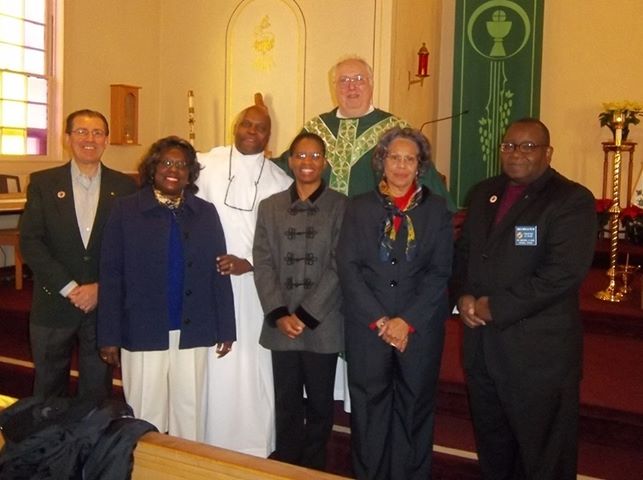
The following are the members of the re-established Pastoral Council here at Holy Family: Mrs. Ida Belinky, Miss Cheryl Blake, Mrs. Cynthia Bowie, Mrs. Eleonora Foronda, Mrs. Marsha Hansen, Mr. Joseph Hebron, Mrs. Melissa Hicks, Mrs. Laurel McDonald, Mr. James Murry, Mr. Andres Padilla, Mr. Brian Payne, Mrs. Janet Renze, Mrs. Monette Roxas, and Mr. Michael Turner. This is the maximum number of members permitted by the new Archdiocesan guidelines (15 counting the pastor). The presentation and installation of members was held on Sunday Mass at 9:30 AM on January 26, 2014. Absent on Sunday were Ida, Ellie, Marsha and Joe.
Pictured here with me after Mass are Andres, Cheryl, Brian, Melissa, Laurel, and Jim.
This is the home of the AWALT PAPERS, the posting of various pieces of wisdom salvaged from the writings, teachings and sermons of the late Msgr. William J. Awalt.













































 Blogger Priest