• Our Blogger

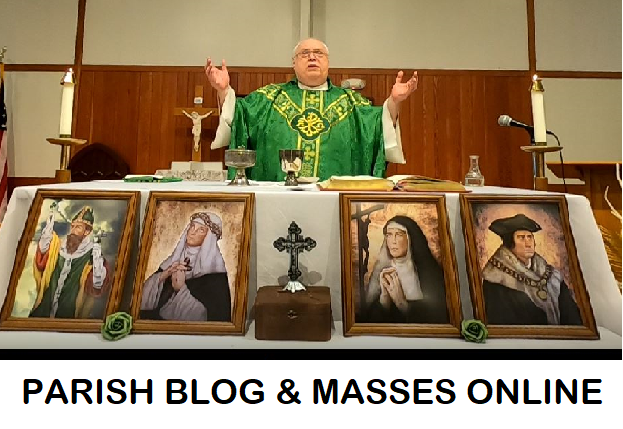
    Fr. Joseph Jenkins

  • The blog header depicts an important and yet mis-understood New Testament scene, Jesus flogging the money-changers out of the temple. I selected it because the faith that gives us consolation can also make us very uncomfortable. Both Divine Mercy and Divine Justice meet in Jesus. Priests are ministers of reconciliation, but never at the cost of truth. In or out of season, we must be courageous in preaching and living out the Gospel of Life. The title of my blog is a play on words, not Flogger Priest but Blogger Priest.

  • Archives

  • Categories

  • Recent Posts

  • Recent Comments

    Barbara King's avatarBarbara King on Ask a Priest
    Ben Kirk's avatarBen Kirk on Ask a Priest
    Jeremy Kok's avatarJeremy Kok on Ask a Priest
    Barbara's avatarBarbara on Ask a Priest
    forsamuraimarket's avatarforsamuraimarket on Ask a Priest

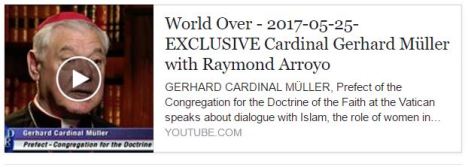
Cardinal Müller Gives Needed Clarification

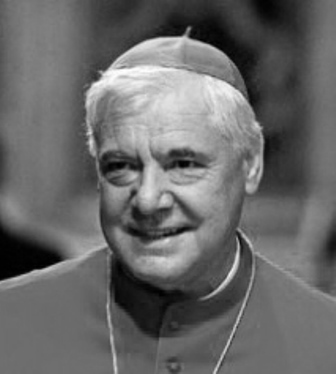
muller

This was probably the most important interview that Arroyo ever presented on World Over. CARDINAL MÜLLER says that the “moral” is the “pastoral”… there can be no conflict… no polygamy… no sacramental spouse and another civil law spouse… the Holy Father’s document must be interpreted within the Catholic tradition. Anything else is heresy! He spells out that any accommodation that would permit the restoration of the sacramental life (without an annulment) would be a “brother” to “sister” relationship. He also said that women deacons are impossible. The biblical title was not a reference to Holy Orders. The ongoing commission is being misinterpreted. Nevertheless, he did say that we may find new non-sacramental charges for women.

The Rights of the Accused: Innocent Priests

tom

This is an insightful article that every priest AND BISHOP should read from my old friend Fr. Tom Guarino.

Rolling Stone, Alan Dershowitz and Catholic Priests by Thomas Guarino

The Conspiracy:  An Innocent Priest by Msgr. William McCarthy

Sacrificing Priests on the Altar of Insurance by D. Shaneyfelt & J. Maher

Finding Hope & Not Despair in the Synod

I am troubled that otherwise orthodox Catholic critics are suggesting that the Synod on the Family in Rome will signal a fall into apostasy.  While there may be a number of wrong-thinking priests and bishops, I have confidence that nothing of the Church’s doctrinal integrity will be sacrificed to pastoral expediency.

While the deposit of faith is both fixed and develops, there can be no revocation of objective truths.  Those couples living in second marriages or irregular unions cannot be uncritically invited to receive Holy Communion.  They may come up without our invitation; but we cannot encourage people to commit either mortal sin or sacrilege against the Eucharist.  No degree of penance would suffice unless there is genuine repentance and a firm amendment of life.  Any projected change in discipline or a so-called pastoral provision cannot justify regularizing church life for recalcitrant adulterers.

Despite the derision by angry critics that many priests are spineless wimps, most men in ministry are dedicated and courageous in their service.  Priests who seem to turn a blind eye to scandalous behavior are often in the dark or uncertain about the marital status of others.  The opposite may also be true.  Their apparent passivity may consist of knowing too many facts about which they are duty bound to keep within professional secrecy and/or the seal of Confession.  A priest may do nothing by word or gesture or intimation based upon what he learns in the sacrament of Penance.  This is the case even when absolution is withheld.  Such a predicament does not prevent others from condemning faithful priests who are already suffering when they must treat adulterers, active homosexuals and child-murderers as if they are Catholics in perfectly good standing.

Of course, it is no wonder that many of the laity might expect churchmen to invite blasphemy against the Eucharist when ministers are generally forbidden by their bishops to refuse the sacrament to others for fear of negative publicity or scandal.  We have witnessed for many years the tension of various pro-life groups with certain U.S. Bishops demanding that they turn away from the altar pro-abortion politicians and others who enable the murder of the unborn.  This conflict has yet to be resolved and continues to alienate those who should be on the same side and working together.  In any case, there is a vast difference between a general passivity and a universal invitation.

The Holy See and the Church are servants of the Word, not its master.  The words of St. Paul about fornicators, homosexuals and adulterers cannot be stripped from Scripture or from the constant tradition of the Church.  Similarly, the notion of the “closed-table” finds it roots in St. Paul and the censures of the early Church:  “And therefore, if anyone eats this bread or drinks this cup of the Lord unworthily, he will be held to account for the Lord’s body and blood. A man must examine himself first, and then eat of that bread and drink of that cup; he is eating and drinking damnation to himself if he eats and drinks unworthily, not recognizing the Lord’s body for what it is” (1 Cor. 11:27-29).  While there are different theologies in the Church, they must speak to the same doctrinal truths.  Disciplines and pastoral practices are not geared to circumvent doctrine but to help express and realize them.

What can we expect from the Synod on the Family in Rome?  Compromise would precipitate acceleration in the breakdown of marriages.  I foresee a reaffirmation of the timeless faith with suggestions to redouble our efforts to welcome and bring healing into the lives of our people.  Let us trust our bishops.  Let us work with our people and not against them.  Let us put aside the silly sensationalism in the news and give the living Church the opportunity to teach and minister as she should.  There will be discussion and debate in Rome.  But we have confidence in the Holy Spirit and the Magisterium.  The process can be messy but so is life.  The truth will prevail.

A Response to Marriage, Divorce, Remarriage & Defection

dev

RUFUS:

I am (was??) a Catholic. I am now divorced and in a second relationship. I have no idea what God has in store for me, whether I am going to roast in Hell or simmer in Purgatory; but I am done with the double standards and hypocrisy of the Catholic church.  I still love God and believe in Jesus but I think it is ridiculous to attend church and not have communion; either you are or are not in good grace… there is no middle ground… Hell or Heaven.

FATHER JOE:

It seems the issue is more than a disagreement about the perpetuity of marriage as a sacrament; you quarrel about basic Catholic soteriology. Like many Protestants you would reject the notion of Purgatory and yet this teaching is reflective of divine mercy and the tradition of praying for the dead that we inherited from the Jews of Christ’s time. We must be perfected by grace if we are to enter fully into the kingdom and the heavenly presence of God. Protestants get around this conundrum by positing a juridical imputation over any kind of actual transformation into the likeness of Christ. Thus, people might remain sinful worms but as long as they have faith they can enter heaven because Christ conceals them from divine justice. Catholics believe that all will be unveiled. Unless there is a true conversion and perfection, we could not bear to stand in the divine presence. A process of purgation heals the soul that belongs to God so that it might be purged of the last remnants of selfishness and venial sin. Saints already perfected would indeed rush into heaven. Those who die in mortal sin would be cast into hell. The damned are damned because they place their own will above that of God and his commands. Such souls might say they love God and believe in Jesus, but they fashion for themselves a counterfeit Christ that cannot save them. Hypocrisy is immediately implied with sinfulness from believers; but the Church, while composed of sinners, is holy because Christ is holy. Our Lord called sinners to himself and so the Church must do the same, even if it sometimes compromises her witness. You should have remained with the Church. One more sinful hypocrite would have made little difference— and you had everything to gain from abiding in the house established by Jesus Christ.

As for participation at Mass, this is a fulfillment of the command to keep holy the Lord’s Day. Every Mass is a re-presentation of the oblation of Christ on the Cross, albeit in an unbloody manner. Here too your faith was evidently defective. The reception of Holy Communion is a great gift and the ideal, but you closed that door because of a weakness of the flesh and a heart that loved, not too much, but too little. The prohibition about divorce and remarriage is clearly taught by our Lord in the Gospel of Matthew. Only since the reformation and particularly in the modern era has this teaching been called into question by dissenters. Short of an annulment, the Church’s hands are tied. Jesus is unapologetic, we are talking here about adultery, no matter how one might “feel” about it.

Matthew 5: 31-32

“It was also said, ‘Whoever divorces his wife must give her a bill of divorce.’ But I say to you, whoever divorces his wife (unless the marriage is unlawful) causes her to commit adultery, and whoever marries a divorced woman commits adultery.”

Matthew 19: 3-12

Some Pharisees approached him, and tested him, saying, “Is it lawful for a man to divorce his wife for any cause whatever?” He said in reply, “Have you not read that from the beginning the Creator ‘made them male and female’ and said, ‘For this reason a man shall leave his father and mother and be joined to his wife, and the two shall become one flesh’? So they are no longer two, but one flesh. Therefore, what God has joined together, no human being must separate.” They said to him, “Then why did Moses command that the man give the woman a bill of divorce and dismiss her?” He said to them, “Because of the hardness of your hearts Moses allowed you to divorce your wives, but from the beginning it was not so. I say to you, whoever divorces his wife (unless the marriage is unlawful) and marries another commits adultery.” His disciples said to him, “If that is the case of a man with his wife, it is better not to marry.” He answered, “Not all can accept this word, but only those to whom that is granted. Some are incapable of marriage because they were born so; some, because they were made so by others; some, because they have renounced marriage for the sake of the kingdom of heaven. Whoever can accept this ought to accept it.”

If an annulment can ascertain that a union is “unlawful,” then one might be free to enter into a true marriage. But if the marriage is real then it endures until the death of a spouse.

RUFUS: 

The bottom line is this, if you are Catholic and marry and the marriage, for whatever reason, your fault or not, ends in divorce then if you start another relationship (because God gave us the power of love and the will to use this most beautiful gift), whether a marriage or not, the Catholic church teaches you will go to hell unless you sincerely repent, i.e.. end the relationship and live the rest of your life alone.

FATHER JOE:

Do you think people only hate themselves into hell? I perceive plenty of hate in your words, but you fail to note that love can be disordered or distorted. We can love the wrong things. Ultimately, we are to love God above all else and that means following his commandments. If you love yourself or even another person in a way that is not in sync with divine love, then you manufacture a type of idolatry. True husbands and wives are to see Christ in the beloved. That makes the defection from a marriage into an abandonment of Christ who is signified in the sacramental covenant and union. Note that here you only think about yourself. If you trusted Christ’s words (not just the Church’s rules), then you would have been wary of risking the soul of the person with whom you committed adultery. If you really loved her than you should sooner die than do anything that would place at risk her share in eternal life. Resentful for yourself, you enter into a tirade against the Church. I suppose this is an attempt at self-justification. Instead of facing or even struggling with your guilt, you castigate the Church. Mass attendance would have exposed you to God’s grace, even if you were not fully receptive toward it. Did you attempt an annulment? Or did you just run away? If you go to hell, and we leave that judgment to God, it will be because of your closed disposition to his grace and gift of mercy— not because you fled a Church that was both faithful to God’s law and desiring to show you compassion. The way you talk about “repentance,” you make it sound like a dirty word. The problem here is yours.

RUFUS:

Thinking you can get away with this until you are on a your deathbed and repent at the last minute doesn’t count as such repentance is insincere, as if planned.

FATHER JOE:

No one is saying that you had only the deathbed for which to look forward. That is you speaking. Such cynicism is poison to the hope that should be the life’s blood of every believer. No one would urge you to wait until close proximity to death to repent. However, neither should you malign the sincerity of such conversions at the end of mortal life. Not only do you blaspheme against divine mercy; such an attitude would negate the value of contrition, perfect and imperfect, as displayed by the good thief on the Cross who steals heaven. Ideally we should be sorry because we love God.  Nevertheless, God’s forgiveness will even reach out to us if our faith be largely grounded on the fear of losing heaven and suffering the pains of hell.

RUFUS:

Of course, you could die in a road accident, in which case, you have no time to repent and are going to go straight to hell. So the choice for a divorced Catholic who cannot get an anulment is bleak; spend the rest of your life alone or accept that you are going to hell anyway, so you might as well eat, drink, be merry, whore to your heart’s content, and break just about every commandment in the book. This is ridiculous.

FATHER JOE:

Sin is sin. A mountain climber might miss a footing or a ledge by an inch or by a yard, it is all the same. He would be just as dead. You cannot make one sin an excuse for others. I bet no priest ever told you that you were going to hell. It may be that God faced you with this prospect in your life and you refused to acknowledge your fault. Your problem is not so much with the Church and her catechism but with God and his living Word. I cannot say if you would have gotten an annulment, but if you walked with the Lord then you would never really be alone. Am I supposed to feel sorry for you? I freely embraced a celibate life. There were wonderful girls I knew in my youth who would have made incredible wives and mothers; but I dedicated my life to Jesus and his Church. The trouble with you is that you did not trust and love God enough. Now all you can share with others is venom or poison.

RUFUS:

There is nothing in the bible that unambiguously states this and the outmoded catechism needs to be thrown out and rewritten. This, and good marketing is the only way the catholic church will save itself from the extinction it is suffering.

FATHER JOE:

Does it make you feel better to attack the Church? God’s laws and truths are timeless but you would have us subscribe to the fads and fashions of a fallen world that parades its broken promises. Christ keeps his promise to us. We must keep our promises to him and to each other. Faithfulness still matters. I would call you back to fidelity and the safe harbor of faith. You need not join the world’s chorus in forsaking the Church and Christ. Yes, the Church is increasingly a sign of contradiction. Yes, religious liberty is threatened and faith is attacked. But believers have everything to gain in being fools for Christ. The folly of the world leads only to death and despair. Have faith— have courage— embrace sacrificial love— and come home.

ATHEIST COMMANDMENT 10

“Leave the world a better place than you found it.”

big-bag-of-money-6497-largeThis is a nice platitude but that is about all it is. The truth is that we have very little control over the world. We can try to make a positive difference over our small piece of it, but even here things often do not go our way. Indeed, we might be in conflict with one another as to what makes the world better. Is it technology, more parks, electric cars or gas guzzlers, laws that promote “choice” over human life, legalizing sodomy, what? Those who promote justice for some often want it revoked for others. That was a facet of the religious liberty fight between the Church and the current government administration. Often we experience life as a mess and leave the world in a mess. Despite progress can we say that the world is a better place than in the past? There are still acts of terrorism and genocide. This year it was estimated that the one percent of the world population owns over 50% of the world’s wealth and resources. There is an old saying about this— the rich get richer and the poor get poorer.

We live and we die. Many people just scrape along, try to find some happiness and deal with dreams realized and/or broken. Relationships give comfort and belonging but there is also betrayal and abandonment. We are a society of givers and takers and critics debate as to which it might be better to be.

Catholic Charities is the largest social service organization in the world just behind the U.S. government. Believers are often very generous to those in need. I heard one atheist share his deep regrets that they were frequently shamed by believers in how they respond to the needy and human suffering. Why is that? What is it about the so-called “pie-in-the-sky religion” that also focuses on earthly struggles and pain? Why is it that by comparison non-theistic forms of humanism often become oppressive and part of the problem?

ATHEIST COMMANDMENT 9

“There is no one right way to live.”

Eye-3372-largeAnd what is this supposed to mean? Would the atheist tolerate a radical Islam that covered a woman’s face and body, reducing her to property, denying her an education and life outside the home? Would they turn a blind eye to a pre-civil war south where slavery allowed a genteel life for some and one of brutal servitude for others? This so-called commandment is actually nonsense. The truth is that while there are many different states of life and a certain cultural diversity; nevertheless, there are ways of living that countermand human decency and the laws of God. Keeping harems or same-sex partners would also fall within prohibited acts; however, I suspect the atheist critic wants to make room for deviancy. Once more there is a problem with specificity. Who decides what an appropriate lifestyle is and is not? Failure to make any judgment will lend legitimacy to anything and everything.

The Christian would argue that there is a right way to live and that is to live in right relationship with God and man. Sex outside of heterosexual marriage is a sin. A lifestyle that depends upon the oppression of others is a sin. A life that is addicted to booze and drugs is one that faces imminent destruction. Commercialism and materialism will ultimately fail to satisfy the longing of the soul. We live in such a way, in accordance with our nature, so that we can draw out the best that makes us human. We are social creatures which need to interact with each other in a manner that both preserves human freedom and insures the healthy functioning of society. Putting it bluntly, there are right “ways” of living and there are wrong ways, too.

I am somewhat surprised that that a man who promotes science would suggest this dictum. The Mythbusters devote each episode at dispelling myths and trying to ascertain the truth. There is little truth in this so-called new commandment. As with the proper fuel for a car a protocol before a dangerous experiment or explosion— there is a right way and a wrong or dangerous way to proceed.

This new law is really just an excuse for liberality and unhampered toleration. Not that I think he really means it because I suspect there are elements to the Christian life that he would find personally objectionable. In other words, the rule here is biased with unspoken exceptions. He would stretch the definition of marriage and family. Marriage, itself, might be viewed as an unnecessary human construct. Obviously, the atheist critic would not interpret it as a sacrament configured to give grace.

Man is not the final arbiter of right and wrong. The rejection of this truth is at the heart of many contemporary problems. Everything is politicized, even human behavior. If the law says something is right, many presume that it must be okay. The war against drugs goes badly, so advocates argue for their legalization and taxation. When the prostitution situation resists resolution, there is a lobby that suggests making it legal with defined health or safety standards. Assault against children, even in the womb was reckoned as manslaughter and a war crime but now it is regarded as a right of women to choose. Within living memory homosexuality goes from being criminalized to being protected and promoted as a basic civil right. No matter what the issue or behavior, people no longer turn to ministers or philosophers but to lawyers and politicians.

This process promotes a lie… about human nature, about God and his commandments… and about our sphere of influence. The subjective eclipses the objective. The relative dominates over point of permanence. The end result is that we damage ourselves and all our associations. Not only is there a loss of a sense of sin but also of any concrete definition.

ATHEIST COMMANDMENT 4

“Every person has the right to control over their body.”

baby-girl-5683-large

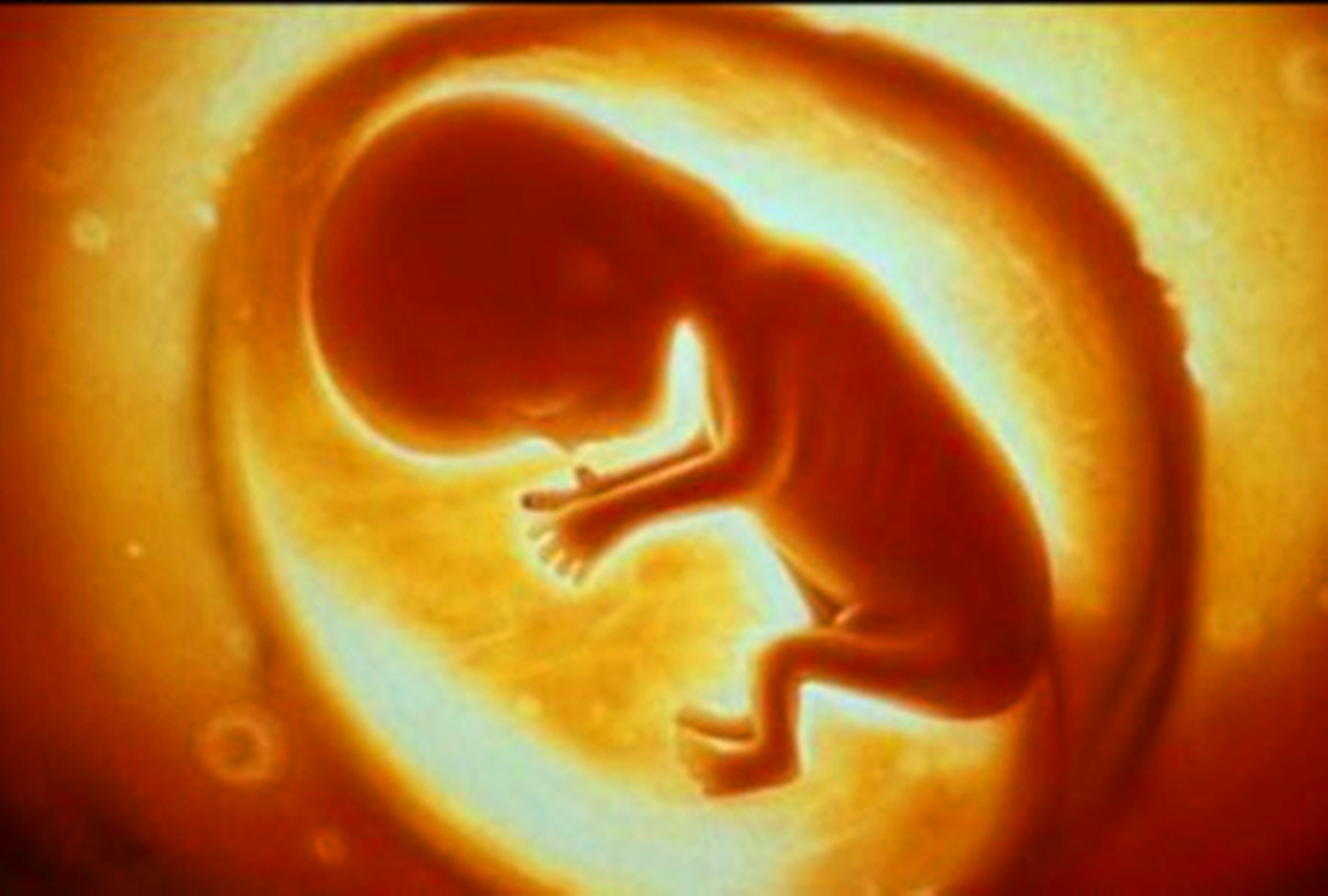
This modern commandment is directly connected to the issue of legalized abortion. Atheists deny the existence of a soul. Thus it is easy for many of them to discount the embryonic as human with rights. Despite a human developmental trajectory, the unborn (at least at early stages) is judged as no more than tissue or at most, only a human being “in potency.” This commandment would have more credibility if there were respect for the body and/or the separate but dependent integrity of the unborn child. Frequently language games will be employed to avoid the truth about the child’s humanity in the womb. When it comes to issues like partial birth infanticide an irrationality takes hold. It is argued that it would be cruel to adopt a child out to strangers; and yet, with adoption they would become a loving family. The blindness of selfishness is heinous. If there be a physical defect, a strained comeback might point to a dubious or difficult quality of life. Frequently there is an appeal to overall viability although medical science is saving the lives of increasing premature babies. Certain ethicists have noted that young children (up to maybe three years of age) are not really viable without constant adult intervention. They just do not know how to care for themselves. That is why a few rogues are proposing “post-birth abortion.” Beyond the logical inconsistencies, the pro-abortion position gives rights to some and strips them entirely from other persons. The definition of a baby becomes shallow: “it is only a baby if you want it.”

pretty-girl-9917-large

Life issues are often interconnected. A consequence of this maxim would also be assisted suicide. If the person has absolute dominion over the body then he or she can terminate the life of that body whenever he or she deems to do so. With God extracted from the equation, he no longer has sovereignty and out goes the fifth commandment: “Thou shalt not kill.” Turning to lesser matters, it would also permit all sorts of bizarre tattoos and piercings. Indeed, one could turn his or her body into a for-profit advertising banner if so desired. This is really a monstrous commandment and points out that separated from God; we really do not know how to be good. Since we are our bodies, this permissive commandment would also open the door to all sorts of distortions in sexual behavior, way beyond the evils of artificial contraception and fornication. The Christian would argue that personal control of the body is not absolute. We must respect that all life belongs to God and the plan of nature by which we are made. We must also respect others, including the little people who start out in the womb.

Counseling for Catholic Marriages

Catholics with marital problems should have readily available avenues within the Church for professional counseling in the hopes of salvaging their marriages.

More can be done to prepare priests for this kind of work but I think there is also a need for full-time professionals with training in psychology and intervention-counseling. These counselors should be well-versed with the Catholic faith. If they are not on the same page with us about human sexuality and the value of marriage, then they can escalate a problem instead of being part of the solution.

  • When red lights appear in the Pre-Cana preparation, referrals can be made before marriages in the Church.
  • When problems develop within marriages, referrals can be made to facilitate healing or reconciliation.
  • When questions arise about sexual identity and remaining in good standing with the Church, referrals might be made to assist people in coping and to counteract bias from non-Catholic sources.

While there are good independent counselors who charge fees, I would also recommend that there be professionals hired directly by the Church. Their salaries might be shared between parishes as within deaneries. They would work closely with pastors, while preserving confidentiality, to either prevent bad marriages or to salvage troubled ones. Such staffing should be viewed as serious as religious education directors, office managers and bookkeepers. In any case, a public list of counselors vetted by the Archdiocese should be readily available to pastors and the people they serve.

Catholic marriage counseling is necessarily different from that which is offered by those who do not share our understanding of marriage or our views about human sexuality. These counselors need to discern how a troubled Catholic marriage might be fixed. The truths of faith are integrated into our appreciation of psychology. The goal is to have couples living a daily vocation where there is both joy and sacrificial love. Marriage is viewed as a covenant and as a permanent union. Too many quickly jump to divorce as the answer. Catholics should see that as an option generally taken off the table.

Instead of urging an immediate divorce, a separation might be promoted so as to further the conversation or to prevent verbal and/or physical abuse. If a marriage has terminal problems and cannot be salvaged, then the counselor might suggest an annulment. That is where the pastor and/or the officials on a Church Tribunal would enter the picture. However, this is inherently always a sad or tragic situation. It means that avenues to save a marriage have failed.

Right now we have noble efforts like Retrouvaille but there is a pressing need for something more clinical.

A Few Thoughts about the Synod Relatio & Debates

My head is spinning about some of the things that are being seriously argued at the Vatican’s Synod on the Family. I am already concerned that a Commission was established to look at streamlining the process for annulments even prior to the start of the Synod. It seems to me that if such were a concern then the bishops would then request the Holy See to do so. Will the documents which will be formulated reflect the majority view and Catholic tradition or will there be attempts to steal the show for the minority progressives?

synod-of-bishops

What is it about this new Synod document that has critics saying it signals a revolutionary shift in favor of same-sex couples? It is acknowledged that this “relatio” urges clergy to make “fraternal space” for homosexuals. But what does it say? We read:

“Homosexuals have gifts and qualities to offer the Christian community: are we capable of welcoming these people, guaranteeing to them a further space in our communities? Often they wish to encounter a Church that offers them a welcoming home. Are our communities capable of proving that, accepting and valuing their sexual orientation, without compromising Catholic doctrine on the family and matrimony?”

Are we reading the same document? All I see are questions. Hopefully they are not rhetorical. Do we eject gay brothers and sisters from our churches? No we do not. Can we invite them forward for Holy Communion? Yes, provided that they maintain chaste and celibate lives. Can we affirm or value their sexual orientation? No, we cannot do so. Such would devalue the true meaning of marriage and human sexuality. We cannot move away from the assessment of disorientation or that same-sex carnality is mortal sin.

As a so-called case-in-point of past intolerance, the news contrasted this development with the story of Barb Webb who was fired from a Catholic school when she and her partner announced her pregnancy. Similarly, her partner, Kristen Moore was asked to resign from her post as a music director at a Catholic parish. The secular media glossed entirely over the moral issues that extend beyond same sex unions, like the freezing of embryos, donated semen and IVF technologies. All these elements are reckoned as moral evils and sinful.

This relatio is being interpreted precisely as Cardinal Kasper would suggest. The doctrinal truth is eclipsed, if it remains, for the sake of a pastoral provision or slackening of discipline. The same reasoning he uses for divorced and remarried couples is being applied to active homosexuals. I find this reckoning very disturbing. Discipline can be distinguished from doctrine but discipline is always at the service of doctrine. There are doctrinal elements that cannot be ignored. It is contradictory to say that gay acts are sinful and then to value, in any way, homosexuality. It is contradictory to say that marriage is a lifelong institution and that divorce is a sin, while inviting couples to receive Holy Communion who are living in adultery. The truths of Scripture are clear and we must always be at the service of the truth on every level: doctrinally, canonically and pastorally.

The document recognizes that same-sex couples live lives where they render “mutual aid to the point of sacrifice [which] constitutes a precious support in the life of the partners.” Critics are saying that this is a crack in the door that may one day lead to full acceptance. I would say that this is not the case. The statement is one that reflects the immediate horizontal human condition but says nothing about the vertical supernatural dimension. It is a mere statement of fact that these couples support each other in their day-to-day lives. However, this does not mean that they are in right standing before God. Mortal sin is still mortal sin. I suspect that there are many “nice and pleasant” people who make good neighbors and yet will suffer damnation and hellfire. We are not saved by simply being nice but by being faithful and obedient to God. The Church can relax certain disciplines but she cannot change divine positive law. My fear is that tolerant language might enable or encourage more sinners to remain within their sins. The Church must be a place for saving truth and grace. She should never be an enabler for sinful lifestyles or blasphemous acts like receiving the Eucharist while ill-disposed or in mortal sin. This document does NOT acknowledge the “holiness” of such couples as was suggested in the Huffington Post article by Antonia Blumberg (1/13/14). It simply asks if we might tolerate with passivity and silence the situation of people living in sin.

I cannot buy this application of any “law of graduality.” No matter how slow might be the movement to holiness; the Church should never compromise on the fullness of truth. Confessors can exhibit great understanding and compassion for married couples who use artificial contraception, with the hope that they will eventually come around to the Church’s understanding of human dignity and the full value of the marital act. It is here that I can well appreciate “graduality.” However, this is not the same as cohabitating, adulterous and same-sex couples. They have no right to a shared bed.  In their regard, where there is neither contrition nor amendment of life, absolution must be withheld. Similarly, while they should attend weekly Sunday Mass, they should abstain from taking Holy Communion. The priest will not usually embarrass people in public but he fails his sacerdotal charge if he does not challenge such couples in private.

This law or better yet, theory of graduality was very much the rationale for the “open table” of Anglicanism. It was hoped that this welcoming to receive the Eucharist would draw others into greater unity. Contrastingly, the “closed table” of Catholicism sees Holy Communion as an expression of an ecclesial unity that is already realized. This is representative of the ancient tradition wherein heretics and grievous sinners were denied the sacrament or even excommunicated. The Church’s censure of interdict would also illustrate this posture. One had to be properly disposed and graced to receive the sacrament. Anything less was judged as blasphemous and scandalous. One should not pretend there is a union that is not truly there. This resonates with the current debate about divorced and remarried couples as well as with active homosexuals. We cannot allow a false compassion to tolerate normalization for the sake of public acceptance while the pastoral accommodation is deceptive to the doctrinal truth and the spiritual state of souls before God. We can move away from using pejorative biblical terms like “sodomites” and “adulterers,” but the underlying reality will remain the same. Does this really serve the summons to repent and believe?

If we change the discipline for those in serious sin and the intrinsically disordered, would we not logically have to open up Holy Communion to others (particularly Christians) who might be in ignorance of the full ecclesial reality but who live moral lives? It is a real can of worms and I would prefer to leave it closed. But that is my opinion.

Relationship between Discipline & Doctrine

It is unusual to hear a debate between bishops aired in the press and public forum. Continue to pray for all the participants in the Vatican Synod of the Family.

Cardinal+Walter+Kasper-300x229

Cardinal Kasper:

“Nobody denies the indissolubility of marriage. I do not, nor do I know any bishop who denies it. But discipline can be changed. Discipline wants to apply a doctrine to concrete situations, which are contingent and can change.”

archbishop_wuerl_elect

Cardinal Wuerl:

“The reception of Communion is not a doctrinal position. It’s a pastoral application of the doctrine of the Church. We have to repeat the doctrine, but the pastoral practice is what we are talking about. That’s why we are having a synod. Just to repeat the practice of the past without trying to find a new direction today is no longer tenable.”

“That’s going to be the challenge, and I think that’s what the Holy Father is calling us to do. He’s saying, we know this, we believe this, this is what is at the heart of our teaching. But how do you meet people where they are? And bring them as much of that as they can take, and help them get closer?”

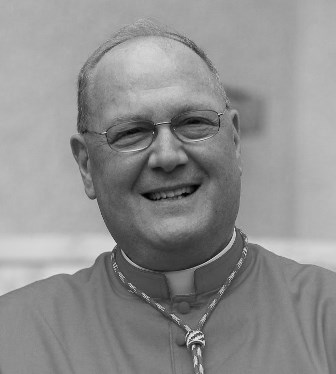
235148-cardinal-timothy-dolan

Cardinal Dolan:

“When we talk about some time of renewal and reform of our vocabulary, we don’t mean to soften or to dilute our teaching, but to make it more credible and cogent,” he said. “It’s not a code word for sidestepping tough things; it’s more a methodology.“

Cardinal_Burke

Cardinal Burke:

“There can’t be in the Church a discipline which is not at the service of doctrine.”

“The reformers were saying: ‘Oh, we’re not questioning the indissolubility of marriage at all. We’re just going to make it easy for people to receive a declaration of nullity of marriage so that they can receive the sacraments.’ But that, is a very deceptive line of argument which I’ve been hearing more now in this whole debate.”

cardinal_pell

Cardinal Pell:

“As Christians, we follow Christ. Some may wish Jesus might have been a little softer on divorce, but he wasn’t. And I’m sticking with him.”

“We’ve got to be intellectually coherent and consistent.  Catholics are people of tradition, and we believe in the development of doctrine, but not doctrinal backflips.”

“Communion for the divorced and remarried is for some — very few, certainly not the majority of synod fathers — it’s only the tip of the iceberg, it’s a stalking horse. They want wider changes, recognition of civil unions, recognition of homosexual unions. The church cannot go in that direction. It would be a capitulation from the beauties and strengths of the Catholic tradition, where people sacrificed themselves for hundreds, for thousands of years to do this.”

muller_CNS

Cardinal Müller:

“One cannot declare a marriage to be extinct on the pretext that the love between the spouses is ‘dead.’  Indissolubility does not depend on human sentiments, whether permanent or transitory. This property of marriage is intended by God himself. The Lord is involved in marriage between man and woman, which is why the bond exists and has its origin in God. This is the difference.”