• Our Blogger

    Fr. Joseph Jenkins

  • The blog header depicts an important and yet mis-understood New Testament scene, Jesus flogging the money-changers out of the temple. I selected it because the faith that gives us consolation can also make us very uncomfortable. Both Divine Mercy and Divine Justice meet in Jesus. Priests are ministers of reconciliation, but never at the cost of truth. In or out of season, we must be courageous in preaching and living out the Gospel of Life. The title of my blog is a play on words, not Flogger Priest but Blogger Priest.

  • Archives

  • Categories

  • Recent Posts

  • Recent Comments

    Barbara King's avatarBarbara King on Ask a Priest
    Ben Kirk's avatarBen Kirk on Ask a Priest
    Jeremy Kok's avatarJeremy Kok on Ask a Priest
    Barbara's avatarBarbara on Ask a Priest
    forsamuraimarket's avatarforsamuraimarket on Ask a Priest

We Will Never Exhaust the Divine Mystery

151051890275679

The souls of the dead in heaven are divinized as saints by grace but by nature are still human.  We will have a share in the risen life of Christ.  However, we will always be finite creatures.  There can be no boredom in heaven because by intellect and will we can never fully exhaust the divine mystery.  We will be drawn eternally into the depths of knowing and loving God.  This process begins in this world.  We come to the Lord with a faith realized in loving obedience.  God gives us sanctifying grace and we are made sons and daughters to the Father, kin to Christ, children of Mary and inheritors of the kingdom of heaven.  Death makes this orientation permanent.  We encounter Christ, not as strangers but as friends.  Indeed, restricting ourselves to this world, we find that all the saints of the Church demonstrated great holiness while many of their ideas, even in reference to religious faith, often fell short or were erroneous.  Error will certainly end when we pass through the door from this world to the next; but our capacity to understand and to contain the mystery of God will always be limited by our nature.  This truth applies to both angelic and human spirits.

I do suspect there is a profound openness to truth and the gift of love in heaven.  This would conflict with hell where the demons and lost souls know something of the truth but place a limit or barrier upon their knowing and loving.  We experience in this world a similar type of division and adversity where someone says, “I want nothing to do with you!  I don’t want to know anything more about it!  You mean nothing to me!  I disown you!”  The damned probably have a comparable mentality and stagnation of the heart.

Here on earth we receive the risen Lord in the Eucharist.  God feeds us.  There are no sacraments in heaven as there is no need for sacred signs.  The saints see God and the mystery directly.  There is no more faith because the saints see and know God (as well as his truths) in an immediate fashion.  There is no more hope because every aspiration has been realized.  The only theological virtue that can cross the threshold of heaven with us is love or charity.  This love draws us into the Trinitarian life.  The banquet of heaven is literally one course after another.  The pattern is established with the Pilgrim Church.  God will continue to feed us with himself.

As I said in my first paragraph, there can be no boredom in heaven.  This is a far cry from the popular image of lazy angels sitting on clouds playing harps.  The mystery of God can never be diminished.  There will always be more to know.  The more we know, the more we will love.  The more we love, the more we will want to know.  This is the pattern of the finite creature to the infinite Creator.

I can well appreciate that secular critics deny the soul and view the intellectual life as the operation of our brains.  Romantics might speak of the heart as the source of love, but in truth the brain is the place where material memories and thinking takes place.  As a Christian, I would suggest that as a composite of flesh and spirit, the efforts of the brain mimic the powers of the soul.  Brains are not all the same and all of them have limits in regard to learning and to the physical senses.  Brains can also become diseased, causing people to struggle with thinking and remembering the most basic of facts and relationships.  The brain is physical and like the rest of the body, it has parts that can break down.  Parallel to this, the human soul has no parts and is indestructible.  It grants us a self-reflective knowledge that goes beyond the ability of the brain.  We are more than thinking meat.  Memories are not merely stored as electrochemical processes used by neurons but also make lasting impressions upon the human soul.  Just as we are often surprised by the detail of dreams; I suspect we will also be surprised as to what the soul retains after death.  What would a human being be if he was never to forget and we were to ponder matters with perfect clarity?  I suspect that the material brain both enables rational knowing and reflection as well as impedes it.  (In any case, I would not want to define the soul as simply a hard drive or cloud backup of what is in our brains.  There is a constant interworking that is part of the mystery of the human mind as understood by Christian believers.)  What we now see as through a fog or veil, we will see clearly.

151051890275679 (1)

What and who we know, as well as love, survives the grave.  Indeed, it gives us our eternal orientation.  We are either like the wise virgin bridesmaids at the door with the burning lamps or like the foolish one who walk away looking for more oil.  When Christ, the divine bridegroom comes for us, he should find us alert and ready to enter into the nuptial banquet.   If we fail to remain steadfast and prepared, we might hear those terrible words of damnation, “Amen, I say to you, ‘I do not know you.’”

If pride is the overriding sin of the devils, then a lasting humility is the posture of the saints.  Compared to God we may seem insignificant, literally as nothing.  And yet, Almighty God has looked upon us as his children.  I would argue that the prayer that Jesus gave his apostles will have an eternal significance.  The word for “Father” that is used by Jesus is literally the one used by little children.  I suppose we would render it as “papa” or “daddy.”  All of us, even the greatest doctors of the Church like Augustine and Aquinas, may be counted among the babes of heaven.  We are summoned to know and to love God while in this world.  All we know is still just scratching the surface.  Eternity will allow us to continue this exploration of knowing and loving.  Humility is not just the approach of men and women in this world, but of the saints and angels in the next.  We must become like little children if we want a place in the kingdom.  Those who are bloated with pride, feeling that they are all grown up and know enough already will find themselves in hell.  Similarly, all those who place limits on love will also know the loss of heaven.


Dark Powers & Principalities

art24

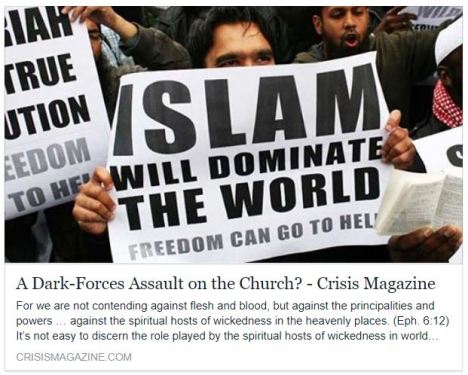
It is a contention of mine for some time that we are in the midst of terrible battles with dark powers and principalities… consciences are being numbed to the truth, especially about the dignity of persons and the sanctity of life. The demonic influences earthly minions, seeking to corrupt both civil society and the life of the Church. Individuals are being infected with a self-righteous and prideful hubris… in terms of basic opinions, the presence and will of God, dissent and misplaced toleration, etc. When we target this dark power, there is disbelief, cynicism and anger… even from those who feign Catholicity or basic belief in God. The Christian is denounced as ignorant or as a bigot. White becomes black and black becomes white. We need active efforts at exorcism and spiritual deliverance!

Why do exorcists ask demons to reveal their names?

Stuck Between the Rock & a Hard Place

art13

Who are we going to punish? I worry about this as a priest in reference to the distribution of Holy Communion, absolution in the sacrament of Penance and in terms of preaching a faith message from the Scriptures that might immediately be interpreted as “hate speech.” Passivity and toleration is not enough to appease certain people… it is being demanded that conventional Christians become advocates for sinful behavior. If a priest gives the sacraments to anyone, no matter what their views and lifestyle, then does he not become an accomplice in their sin? Would he forfeit his own immortal soul for causing scandal and violating conscience, the commandments and his sacred duty? For the sake of accompaniment, can a bishop or even pope force a priest to say or do something that he views as sinful and wrong?

The Fall of Satan & the Bad Angels

downloadQuestion

Isaiah 14:12 tells us that the morning star (Lucifer) fell from the heavens. Revelation 12:3–9 implies that a third of the angels fell with him.  What does the Church teach as to the reason for why Satan fell? Why does the devil still inflict us?  Why does he punish sinners who also have strayed from God’s path as he has? One would think that he would celebrate with them as fellow comrades against the divine throne.

Response

There is much speculation about the fall of Satan. Certain early Church fathers thought that it was the prospect of the incarnation itself that the devil could not stomach. Awed by his own light and high spiritual nature, he refused to bend the knee to the Christ Child. He literally viewed human beings with disdain, no more than animated sacks of blood or thinking-meat. He refused to adore. Certain reformed theologians speak about the sin of the devils as “tarrying” or reluctance to do God’s will. Angelic beings would ordinarily do whatever they do immediately. Reservation would be viewed as rebellion. Knowing duration but not time, their ultimate choice was eternal and unchangeable. Others speak of intellectual pride. As for why the devils plague human beings, I am tempted to adopt Milton’s solution… everlasting spite. The devil has lost the war. Christ wins. But the devil continues to fight his skirmishes for souls. As for why he would torment souls, remember that he hates us. There is no true friendship or comradery in hell.  The devil has made the choice he has made. But creation was made for God. He has forfeited real happiness. Hell is an abode of frustration and alienation from God. (Even unhappy people in our world often seem to embrace the odd pursuit of making others unhappy.)

Once Saved, Always Saved?

KATHLEEN:

Hello, I am a “catholic.” I firmly believe that through my faith in Jesus he has saved me. I, along with everyone else who believes in Jesus already has salvation. We are not going to hell. So my question is why would a “catholic” want or need to wear a scapular? How can one save what is already saved? And isn’t their belief in Jesus enough for salvation?  Thank you for input.

FATHER JOE:

You may be a Catholic, but your assessment of “blessed assurance” is representative of a Protestant view. Indeed, it is the sin of presumption for a Catholic to view himself as irrevocably saved. Certain evangelicals believe in the “once saved, always saved” interpretation that emerged from Martin Luther’s teaching of juridical justification through imputation. Simply put it means that after a faith profession in Christ one is saved regardless of personal sins and weaknesses. Supposedly, we are masked by Christ when the Father looks upon us. The Catholic understanding is different. The ancient Catholic truth has to do with being born again as a new creation. We must be transformed. Faith and baptism makes us members of God’s people, but just as faith can grow, it can sour. The Evangelical would say that if a person becomes a grievous sinner that their earlier faith was counterfeit. Catholics would not nullify or doubt such faith. Instead, we argue that we must grow in the life of grace.

Your view would dismiss a lot more than scapulars. If you are already saved then you would need no sacraments, no Mass, no Eucharist and no Church. That is why those who hold such ideas reject the divine mysteries and reduce the “Church” to a place for fellowship and making converts. Catholicism is the true Bible Church and views salvation in terms of faith and obedient works in charity.

I would recommend that you attend a Parish RCIA program and relearn your Catholic faith.

Catholics live in the sure and certain HOPE of their salvation in Christ. Salvation is God’s free gift to us. But faith is defined as more than believing with our heads. The apostles understood faith as something lived out in faith and obedience. It is in this manner, and the reception of the sacraments, that the life of grace grows within us. The spiritual life is not stagnant but dynamic. We must always be properly disposed to God’s mercy and strength.

Here are some passages for spiritual reflection:

Matthew 7:21 – “Not everyone who says to me, ‘Lord, Lord,’ will enter the kingdom of heaven, but only the one who does the will of my Father in heaven.

John 5:28-29 – Do not be amazed at this, because the hour is coming in which all who are in the tombs will hear his voices and will come out, those who have done good deeds to the resurrection of life, but those who have done wicked deeds to the resurrection of condemnation.

Philippians 2:12 – So then, my beloved, obedient as you have always been, not only when I am present but all the more now when I am absent, work out your salvation with fear and trembling.

Hebrews 5: 7-10 – In the days when he was in the flesh, he offered prayers and supplications with loud cries and tears to the one who was able to save him from death, and he was heard because of his reverence. Son though he was, he learned obedience from what he suffered; and when he was made perfect, he became the source of eternal salvation for all who obey him, declared by God high priest according to the order of Melchizedek.

Hebrews 10:26-27 – If we sin deliberately after receiving knowledge of the truth, there no longer remains sacrifice for sins but a fearful prospect of judgment and a flaming fire that is going to consume the adversaries.

James 2: 17-24 – So also faith of itself, if it does not have works, is dead. Indeed someone might say, “You have faith and I have works.” Demonstrate your faith to me without works, and I will demonstrate my faith to you from my works. You believe that God is one. You do well. Even the demons believe that and tremble. Do you want proof, you ignoramus, that faith without works is useless? Was not Abraham our father justified by works when he offered his son Isaac upon the altar? You see that faith was active along with his works, and faith was completed by the works. Thus the scripture was fulfilled that says, “Abraham believed God, and it was credited to him as righteousness,” and he was called “the friend of God.” See how a person is justified by works and not by faith alone. So faith by itself, if it has no works, is dead….You see that a man is justified by works and not by faith alone.

Argument Over Jesus & Intercession

Georgios argues:

The primary role and purpose of the devil is to take the believer’s attention as far away as possible from the truth and the blue-prints or foundations of Christians, which is the Bible.

He would have us compromise them with unbiblical diatribes so that the believer loses focus upon JESUS.

He would have the Christian weakened by diminution from 100% fidelity to the doctrine of JESUS.

JESUS is the Way and the Truth and the Life— the only way toward the Father-God.

JESUS taught with parables and he is our answer to all intentions in the spiritual process.

The parable of the sinful rich man and poor Lazarus is sufficient to verify that the saints who died are in a place where intercession for people on earth is impossible! What this means is that only the living saints have the right to do so.

God does not give exemptions to the prohibition of acting outside his Word, which is JESUS.

If Mary can intercede for us, then God is lacks constancy with his Word and that is something that God will not do. He will not oppose his Word. If God made such exceptions then he would not be God at all.

Receive this revelation of the Spirit of God— what he is saying to you Now in the mighty NAME OF JESUS!

Father Joe responds:

The devil’s primary aim is one of eternal spite. He would have us corrupted so as to offend God. He would have us embrace selfishness and a disordered love.

The devil knows well the Bible. The trouble is that what he knows, he utterly rejects. While the devil is certainly involved with error, this in itself is not his primary purpose. Good men and women might be confused or ignorant about many matters of faith. They may yet be saved. The devil places an emphasis upon the will. HE especially delights in one who comes close to the truth and then rejects it. The more you know the more that you will be held accountable.

Much of the confusion and fracturing of the Church after the Reformation has to do with men and a rejection of the shepherds appointed by Christ. You seem to infer that the Bible is self-sustaining and interpreting. This is simply not the case— historically or theologically. I suspect that the “diatribes” you condemn are efforts within the Church to prayerfully reflect upon the saving kerygma.

If you have rejected the sacraments and the teachings of the Catholic faith then you have quite literally separated yourself from elements of the revelation received from Jesus Christ. The Church follows the Lord and his two sources for Christian revelation: Sacred Scripture and Sacred Tradition. Only the reformation churches, and not all of them, would utterly reject the second tier established by Christ.

Jesus is also one with the Mystical Body or the Church. That is why the early Church spoke about Christ and our life in the Church as the WAY.

Jesus taught in many ways. Yes, his parables give us insight into the kingdom of God. But he also prophesied, made commands, and witnessed the message of the Gospel.

The parable of the rich man and Lazarus does indeed speak to life after death, although there is some question as to whether Lazarus was in heaven or the limbo of the fathers. Similarly, was the rich man in hell or in purgatory? The gates of heaven are only opened by Christ, and at the telling of this parable, Jesus had yet to undergo his saving trial. Further, the parable does not offer us an instance of attempted intercession as understood by the Church. He requests that Abraham send a message to the living or make an appearance to warn them. The intercession of the saints is directed, not to another saint, but to almighty God. We pray that they will add their prayers to ours in asking God for his mercy and favor.

Actually, the trouble here is you have a very narrow notion of how the Word operates. The Word is written upon human flesh in the incarnation. The Word is breathed into the Scriptures. The Word becomes one with his Holy Church. The Word is given perpetual efficacy through the sacraments. The Word takes to himself a human mother, sanctifies her and gives her to us as a model of the Church. The Word conquers death and all who are alive in Christ can pray for themselves and others, including the saints of heaven.

Who are you to tell God his business? Who are you to make yourself the interpreter for all Christianity, including attacking a Church that was instituted by Christ, gave us the Bible and is the Mother of all the breakaway Protestant denominations? Mary can do as she did at Cana… intercede when the wine runs out.

I would caution you again hubris. You are not God’s special messenger or prophet. You are just one poor confused soul putting on airs to others.

Bishop Tobin on Remarried Couples & the Eucharist

pptobin280409Has anyone else read Bishop Thomas Tobin’s letter posted on the Providence Diocese’s website?  He invites discussion.  Thus, with all due respect, I would like to share my concerns.  The bishop writes:

In my personal reflection on this dilemma, I turn to the incident in the Gospels in which Jesus and His followers were walking through a field of grain on the Sabbath and because they were hungry, began to pick and eat the grain, a clear violation of an important Mosaic Law. The offense was roundly condemned by the religious experts, the Pharisees. But in response, Jesus said, “The Sabbath was made for man, not man for the Sabbath” (Mk 2:23-28).  In other words, while not denying the validity of the law, our Lord clearly placed it in a “pastoral context,” exempting its enforcement due to the human needs of the moment. Could we not take a similar approach to marriage law today?

One cannot really compare the issue of divorced-and-remarried Catholics being allowed to receive Holy Communion with the incident where our Lord’s apostles are charged with violation of the Sabbath by picking and eating the heads of grain (Mk 2:23-28).  The first is in regard to spiritual disposition and the sacrilege of taking Holy Communion while in mortal sin.  The latter simply focuses upon a pharisaical interpretation of the commandment demanding rest.  The apostles were not in any grievously sinful state.  Jesus excuses them, as a foretaste of the freedom that comes with his dispensation.  But, more than this, Jesus is God.  The lawgiver can excuse whatever laws he wills.  The Church can also make modifications, as with our keeping the Sunday Observance over the traditional Hebrew Sabbath.  However, such authority is not absolute and this juridical rendering is a far cry from trying to circumnavigate around basic objective moral norms.  The Church and the Pope do not have the authority to authorize sin and sacrilege.

What constitutes a genuine pastoral approach?  Excusing or enabling serious sin is no favor to anyone.  While we may be troubled by exclusion and feelings of hurt; how can these compare to the fires of hell and the loss of God’s friendship.  The pastoral cannot be so focused on the external situation or appearances that we neglect the internal reality.  The corollary to the assertion that “matrimony is made for man, not man for matrimony” does not find its solution in feigned second marriages but in a chaste celibacy.  Promises are made to be kept.  If the first marriage is authentic, then as long as one spouse lives, any attempted second marriage is a fiction.  That is the long-and-short of it.  There is no viable solution out of this conundrum.  This is more than “the lofty demands of the law,” but the enduring truth that the two become one flesh.  Affections might stray but one spouse continues to belong to the other.  Infidelity is stealing what is the spouse’s due and giving it to another.  There is no way that the Church could rubber-stamp such a scenario.

The bishop writes,

But at the same time, the Church has taught the pre-eminent value of receiving the Holy Eucharist, and I keep hearing the words of Jesus about the Eucharist, words that are just as valid and important as His words about marriage: “Unless you eat the flesh of the Son of Man and drink his blood, you do not have life within you” (John 6:53).

Missing from this assessment is the ancient teaching, recited in the sequence for Corpus Christi, that the same sacrament which brings life to one, brings judgment to another.  Purposely giving Holy Communion to those who are in an adulterous situation would invite condemnation upon them and ridicule upon a hypocritical Church.

Bishop Thomas Tobin states:

And I know that I would much rather give Holy Communion to these long-suffering souls (divorced-and-remarried couples) than to pseudo-Catholic politicians who parade up the aisle every Sunday for Holy Communion and then return to their legislative chambers to defy the teachings of the Church by championing same-sex marriage and abortion.

The bishop means well and he says, honestly, that he does not know the answer to the predicament; however, sympathy for small devils while castigating large ones is no answer at all.  A man can jump from one ledge to another.  If he misses by a foot or an inch, it makes no difference.  He is still just as dead.  This is the appropriate analogy here.

Bishop Tobin echoes an article in the National Catholic Reporter by Fr. Peter Daly who suggested that annulments be simplified by handling the situations entirely at the local level.  The bishop writes:

Can we eliminate the necessity of having detailed personal interviews, hefty fees, testimony from witnesses, psychological exams, and automatic appeals to other tribunals?  In lieu of this formal court-like process, which some participants have found intimidating, can we rely more on the conscientious personal judgment of spouses about the history of their marriage (after all, they are the ministers and recipients of the sacrament!) and their worthiness to receive Holy Communion?

The true Sensus Fidelium is that collection of the laity that keeps our moral laws and regularly goes to Mass.  They would be critical of this proposed solution.  The grounds for annulments often rests in ignorance, deceit, lack of proper discretion, inability to fulfill the obligations of marriage, mental problems, prior addiction, etc.  People are often blind to their own faults and shortcomings; but here the bishop is literally saying, “Physician, heal thyself!”  Would this apply for only the second marriage?  What about the third?  What part would “the other woman” play when marriages were deliberately destroyed?  Such a measure would play into the hands of selfishness.  Many of them do not understand the difference between an annulment and a divorce.  If the bishop’s notion were adopted, there would be no difference— and a basic command from Christ would be explicitly violated.

This is all quite serious.  The marriage analogy plays a crucial part in our understanding of the Church’s relationship to Christ and the sacrament of Holy Orders.  Weaken one and we hurt the others— the dominoes will begin to fall.

The Situation We Face

Holy-Spirit-Clip-Art-20

I have been giving some thought to the pressing issue of keeping our young people Catholic and in the Church. Before I lay fault at the proper doorposts, it must be said that many of our parents are faithful in raising their children in the faith and insuring the opportunity for the sacraments. When their kids abandon the faith and Mass attendance, these good people are the first ones who feel guilty and wonder if there be more they could have done. But they did their duty and there comes a point where we have to let go and trust the Holy Spirit. Similarly, there are pastors and catechists who try program after program in hoping that the next one might turn matters around. They join their tears to those of heaven praying that prodigals might come home and that the children might be counted among the saints. Too many have forgotten God. Too many have turned their backs on the practice of their faith.

I would not want to condemn anyone, even parents who are themselves “fallen away” Catholics. God will be their judge. But of course, we can target many sources for the current problem. Whole generations of Catholics were poorly catechized. Poor text books and an air of dissent infected the Church. I recall tried-and-true books being thrown away because they represented the thinking of “the old pre-Vatican II Church.” And yet, this mentality betrayed a false dichotomy. There are no two churches. The accidentals may change but the deposit of faith is faithfully transmitted generation after generation in the one true Church instituted by Jesus Christ. The later publication of the universal catechism was an attempt to correct any false thinking about this issue. Our appreciation of doctrine can develop but the public revelation is fixed. What is objectively true will always be true. The false “spirit of Vatican II” has been exposed and in many circles has increasingly lost sway as a general segment returned to orthodoxy. This is cause for hope.  Those resisting it have necessarily found themselves set adrift.  The truths of faith were never denied by the Magisterium, but progressive theologians and their enthusiasts wrestled to place the whim of men over the wisdom of God.

There is no denying that the dominoes began to fall. The damage was done.  Religious relativism, a false view of universal salvation, and the moral failure of churchmen to live out the faith compounded the situation. People fell away from the Church. The stakes did not seem as high as they once did. Meanwhile, the world was changing and Western Christian culture was collapsing. The process had begun prior to Vatican II. Indeed, the Enlightenment and later the French Revolution were signposts to what was fast approaching. Pope Pius IX promulgated his Syllabus of Errors. Pope Pius X confronted Modernism. When Vatican II arrived, many had hoped that there might be a dialogue with the modern world. Unfortunately, the world did not play fair and the council was unable to forestall the many negative agencies poised against her. A secular humanism was quickly taking hold. Man would be regarded as the measure of all things. The degree of hubris involved here would have been unthinkable in much of our earlier history. The “God is Dead” movement of the 1960’s and 70’s was thought by many as the final result of this movement. But there was more to come. Today many do not consider God as dead but rather, while rejecting the incarnation, declare that Man is God. The love of science, which in its place is a good thing, becomes a kind of idolatry where technology and the media are secular sacraments. There is the fantasy and/or pseudo-science that even death will one day succumb to man’s genius. Paralleling all this there has been the ascendance of a new paganism, expressed through heightened eroticism (homo- and heterosexual) and a general vulgarity in speech, music and behavior. Pleasure is sought as an ends to itself, not as an element of a greater good.

What does the baptized Catholic believe today? It is amazing how many false assumptions are made about the faith. While the Church teaches intelligent design and the complementarity between science, theology and philosophy; many view Catholicism through the prism of Protestant fundamentalism. Enthusiasts for evolution ridicule the Church for a literalism which she does not profess. Neither does Catholicism embrace a blind faith, which is rightly decried as mindless. While recognizing mystery, we espouse a faith seeking understanding and as a true companion to human reason. The Church argues for modesty and yet is not puritan in her aesthetic appreciation for the human body and the beauty of sexual love as a part of the divine plan. Nevertheless, some critics (even Catholics) mock the Church as if it is a Calvinist congregation or one knotted to Jansenism. The Church seeks to work with non-Catholics for a better world and for the remittance of human suffering; however, despite false allegations from traditionalists, lays hold to no ecumenism that would compromise her singular faith claims. It has also been a sad discovery that many Catholics suffer an impoverished understanding of the Trinity, the meaning of the incarnation, the value of the Mass, the mystery of the real presence in the Eucharist, the nature of the afterlife and the prayers for the dead, etc. Indeed, some believers deny the existence of hell despite the biblical testimony and the presence of evil that demands the full measure of divine justice. The occult has also infected believers, substituting magic for supernatural faith. It is ironic that atheism and the occult should simultaneously infect members of the Church. We need to do all we can to correct the errors of our times. There is no reincarnation. There is no parallel oriental bad force that counterbalances the good. We do no become angels after death as popularized in movies. The dead human body is a corpse. The human soul is a ghost. We are promised restitution in the resurrection of the dead. I cannot begin to say how many Catholics do not know the truth about these matters. Yes, even those in the pews need correction and a renewed formation. But, other than with preaching how do we do this? Many will not attend special classes or even online workshops. They fail to attend bible study or instruction classes. As for those not in the pews, is there any way left to bring them and their children home? How can the message of the Church compete with the many voices of the world?

The Price of Compromising on Homosexuality

thKID0AXT3A priest friend recently announced that he saw the Church’s way of speaking of those with same-sex attractions as wildly exaggerated, harsh and inaccurate. His assertion deeply bothered me. I am well aware that people have taken offense and even left the Church over the assessment that homosexuals and lesbians are sexually “disordered.” Often the response to this issue or individual revelations, even from pulpits, is a deafening silence. Homosexuality is joining contraception as one of those issues rarely raised from the pulpit. Privately, people increasing accept and love their friends, regardless. Young people not only accept it but see those who do not as bigoted. Older people are generally more judgmental, but often suspend this judgment when the gay person is someone close to them. Silence is no real answer and a fire-and-brimstone sermon will arouse anger and hurt. But the truth is the truth, is it not? My priest friend argues in a way that makes my head hurt. Often I think he is more like the Episcopalians, suggesting compromise on contraception, divorce and remarriage, and now homosexuality. As for myself, I have no desire to cause pain for others; however, I was ordained to speak for Christ and his Church, not for myself. The Bible and the traditions of the Church give a negative verdict to same-sex attraction and activity. While the orientation is problematical, sin only enters the picture with wrongful fantasies and immoral actions.

My priest colleague insists that I am very wrong. There is the unspoken insinuation that he thinks I am slow or a bit dull-witted. He wonders why I cannot see things his way. He argues that we all want to be faithful to Jesus and Jesus was all about bringing the outcast home. He indicts me as doing the opposite, behaving more like a Pharisee. He raises his voice, “Show me even one place in the Gospels where Jesus teaches anything about homosexuality! If it is so important, then why is Jesus absolutely silent about it?” He laments that our Lord spoke forcibly against divorce, but points out that there is nothing on this issue. My mind works differently from his. The Bible is more than the Gospels.  The writings of St. Paul are also part of the New Testament. The whole book is the inspired Word of God. The apostle mentions homosexuality as one of a whole grocery list of sins that would forfeit the kingdom. This is serious language. If this is a sin that can land a person in hell; then how can we truly love them and either permit it or exhibit silence? He spoke as the kids do— “But they love each other! How can love ever be wrong?” Love can be plenty wrong. This was not just love, but physical and sexual behavior. This can be added to love, or express love, but love can be very wrong. You have no right to love another man’s wife. A priest has no right to love and keep a mistress. A man has no right to take another man to bed. The same goes for women with women. They can love as parent and child, as siblings, and as dear platonic friends— but erotic and genital love takes it where has no right to go. My priest friend came right out and said it, throwing aside recent papal teaching and the universal catechism, “As long as the gay couple is living in a loving and committed relationship, there is no sin, nothing is disordered.” This was not a new opinion. I heard it from one of my old professors some thirty years ago, Fr. Charles Curran. This was one of the dissenting views that cost him his license and position at the Catholic University of America.

My position is very different. I would side with my late cousin, Fr. John Harvey, the founder of an organization called COURAGE. These faithful sons and daughters deal with their disorder not by acting out but by embracing a life of celibate love, prayerful meditation and service to the community. We should not pretend that vice is virtue. Rather, we should call our brothers to repentance, conversion and heroic discipleship.

It is true that a person should not be judged by one element of his life. However, the activists themselves are the ones who raise their orientation as the singular marker for their identity. An orientation and lifestyle is redrafted as a basic expression of who they are and as something protected by civil rights laws. When you say “hate the sin” but “love the sinner,” they get mad and take it personally. They make no demarcation between their sexuality and how they are accepted as persons. They are wrong to do this but it has become an effective tool for manipulating people and institutions in our society. When it comes to the Catholic Church, though, they bust their heads against a stone wall. Everyone else is giving in, but the Church still says that “what they do” is wrong. What they hear from the Church is “who you are” is wrong. I suspect my brother priest left his guard down to this sort of control tactic. They seek to turn the guilt back on us so that the Church will give in. While we can show special compassion to individuals, I see no way for Catholicism to backtrack on this.

Can a Priest Deny Sacraments to a Gay Man in the Hospital?

The news was on fire this morning about a DC priest who purportedly refused to give Last Rights to a gay heart-attack patient at the Washington Hospital Center.

Oh boy, here we go again! This man condemns the priest but we only have his side of the story.

I suspect there is a lot more to the story than what we are hearing.  A priest was requested and Father Brian Coelho came to the bedside of the patient, Ronald Plishka.  The priest followed the ritual by offering the Sacrament of Penance prior to the Anointing of the Sick and Holy Communion.  If a patient is unconscious, the priest will often presume contrition and a desire for the sacraments, giving absolution even without auricular confession.  In this case, the patient was alert and responsive.  The patient seemed to want to make small talk and remarked about how as a homosexual person he was so happy that the Pope was accepting of gay people.  But he next asked if this admission bothered the priest, almost as if he were baiting him.  The priest said it did not but offered to pray with him.  Nothing more was said about Extreme Unction and Viaticum.  While left unsaid in the article, this intimates that this dialogue took place as part of a Confession.

Because the disagreement probably happened during Confession, the priest is silenced by the seal and cannot share his side of the story. Indeed, he would face automatic excommunication if he says anything… something I hope that Church authorities appreciate. Even they cannot question the priest.

Instead of a civil conversation, the patient rejects the offer of prayer and tells the priest “to get the [deleted] out of here!”  That in itself probably demonstrates an improper disposition for God’s mercy.  Then the doctors came in to calm him down.

We should pray for all the parties involved.