• Our Blogger

    Fr. Joseph Jenkins

  • The blog header depicts an important and yet mis-understood New Testament scene, Jesus flogging the money-changers out of the temple. I selected it because the faith that gives us consolation can also make us very uncomfortable. Both Divine Mercy and Divine Justice meet in Jesus. Priests are ministers of reconciliation, but never at the cost of truth. In or out of season, we must be courageous in preaching and living out the Gospel of Life. The title of my blog is a play on words, not Flogger Priest but Blogger Priest.

  • Archives

  • Categories

  • Recent Posts

  • Recent Comments

    Anonymous's avatarAnonymous on Ask a Priest
    Michael J's avatarMichael J on Ask a Priest
    Jeremy Kok's avatarJeremy Kok on Ask a Priest
    Mike Zias's avatarMike Zias on Ask a Priest
    Jeremy Kok's avatarJeremy Kok on Ask a Priest

How Do We Get Out of This Mess?

802947510-612x612

His Enemy Came and Sowed Weeds All through the Wheat

These are dark days for the Church.  One of my friends even said, “These scandals make me feel ashamed to work for the Church.” I well understood.  At every Mass a priest mentions and prays for his bishop by name.  What if a bishop should disappoint you or you discover that one was likely a reprobate?  I suspect a number of priests have paused or recently winced during the saying of the Eucharistic prayer.  In any case, we are called to pray for the good and the bad, always remembering as priests that we are all sinners and have fallen short of the glory of God.
153444973830414067 (1)

Jesus’ apostles often disappointed him— one even betrayed and despaired, taking his own life.  I suppose the best of priests are wounded healers.  Nevertheless, there are certain sins that cry out to heaven.  I am reminded of one of the parables:

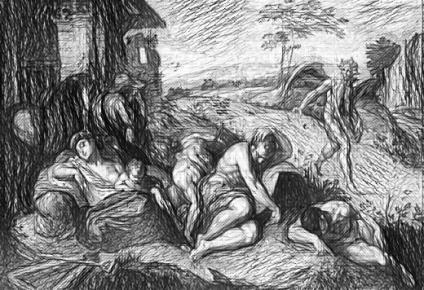
“The kingdom of heaven may be likened to a man who sowed good seed in his field. While everyone was asleep his enemy came and sowed weeds all through the wheat, and then went off. When the crop grew and bore fruit, the weeds appeared as well. The slaves of the householder came to him and said, ‘Master, did you not sow good seed in your field? Where have the weeds come from?’ He answered, ‘An enemy has done this.’ His slaves said to him, ‘Do you want us to go and pull them up?’ He replied, ‘No, if you pull up the weeds you might uproot the wheat along with them. Let them grow together until harvest; then at harvest time I will say to the harvesters, “First collect the weeds and tie them in bundles for burning; but gather the wheat into my barn.”’” (Matthew 13:24-30)

Is it time for the harvest?  It is so very hard to separate the weeds from the wheat.  Indeed, the weeds threaten to strangle the wheat.  We desperately want to see the weeds bundled and burned.

The Devil Made Me Do It

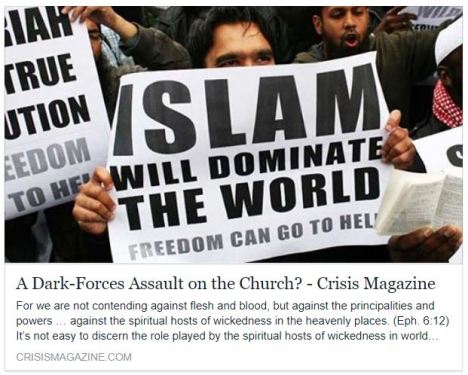
Alarmists about Vatican II regularly cite a quotation attributed to Pope Paul VI that “from some fissure the smoke of Satan has entered the temple of God.”  While I neither have a naïve celebratory nor a pejorative view of the Council, I do feel that a diabolical attack upon the Church extending back to the very beginning of the incarnation is reaching a fever pitch in these latter days.  The assault targets both clergy and lay.  The complicit backdrop is a culture where sexual perversion is increasingly regarded as normative, where immigrant families are derided as criminals and subhumans and where mothers argue for the choice or right to murder their children.
 153444973830414067

Just as Christ is the fulfillment of the ancient promise for redemption given our first parents; the devil is all about broken promises.  He corrupted Adam but failed when it came to Jesus and that failure fills him with an eternal spite.  He numbs consciences to the truth about the sanctity of life and the dignity of persons.  He hardens hearts, not merely against charity but even about what should be obvious in regards to compassion, mercy and decency.  Truth is an immediate casualty but so is the love that beckons to us from the Cross.  We become comfortable with our sins and selfishness.  Divine commands become weak suggestions.

Christ was tempted but could not fall; however, we still struggle with the brokenness of the first Adam.  Apart from Christ we are destined to fail.  The world pampers our pride.  The flesh entices our senses.  The devil seeks to oppress and even to possess us.  Satan has a burning hatred for us and the Church.  He lost the war against Christ but continues to corrupt and steal in skirmishes for individual souls.  We should not pretend that the devil is a fool.  He knows that the best way to hurt the Church is to undermine her ministers— as goes the priesthood, so goes the Church.  It was only a matter of time that this crisis would turn to the bishops given that they possess the fullness of priesthood.

Jesus redeemed us and yet some would return to their bondage of suffering, sin and death.  We hear the devil speaking through the mouths of his slaves all the time:  “I am not a saint so why try? May we always be going to hell but never get there.  You can’t tell me what to do.  If it feels good then do it.  It is my body.  Everyone is doing it! Those foreigners are all drug dealers and rapists!  I’ll run over anyone who gets in my way!  Going to church is a waste of my time.  To hell with her brains, I want her for her body.  We don’t want his kind around here. It only becomes a baby if you want it.”  Yes, I am convinced that the devil has a hand in this abuse scandal; but, of course, none of the guilty can escape personal culpability.

Man Has Made Himself the Measure of All Things

153444973830414067 (3)

Everything is salted with sensuality and eroticism: television, movies, music, books, art, the internet, etc.  Fifty Shades of Grey becomes a bestselling book and it leads to sequels and films, affirming that pornography has truly gone mainstream.  We feed our children to demons, not only with abortion but by eroticizing adolescents— dressing them as provocative adults, putting makeup on babies, romanticizing their juvenile relationships and allowing them to set the rules in our homes (giving them everything they want).  We fill their heads with profane music and delight in their dancing, much as did lecherous Herod over Salome.  Nevertheless, denying our own cooperation in sin, we point the finger at others when lines are crossed.  Man imposes his strictures of fad as dictates over natural law, the height of lunacy. Few are willing to admit that gender confusion and same-sex unions have fashioned a twisted parody of marriage. A political correctness mislabels the clergy scandal so that it cannot be adequately addressed. We clamor about a few pedophiles when the problem remains a cabal of unsated homosexual pederasts.

Forbidden are a host of words and concepts like purity, chastity, virginity, temperance, obedience, duty, sacrifice, etc.  Truth is no longer “what is” but simply “what we want it to be.” A Christian society has largely vanished.  Many elements of the Church have given up the fight and have been seduced.  Custody of the eyes is virtually impossible.  If there remains any element of shame from damaged consciences and complicity in scandal then it is brushed aside by critics upon others.  We find much of this transference in how the Church is faulted, especially her clergy.  A problematical infestation of active homosexuals is ignored or tolerated because the culture wants to affirm and normalize homosexuality.  Thus, the errant priests who largely target males are labeled as “pedophiles” when in actuality they are essentially repressed homosexuals acting out with other men or committing pederasty with older minors. (I must quickly add that this judgment should not diminish a respect for persons or insinuate that all homosexuals are a danger to minors. We need to be sympathetic to those who seek to be chaste and celibate, even if they should not be welcomed into holy orders.)

153444973830414067 (4)

Where do we go from here?  Silence is not the answer; indeed, it becomes part of the problem.  Moving the men around is not the answer; like shipping the trash out to sea it only makes a problem for others somewhere else.  Much of the damage evades healing, at least in this world.  What is done cannot be undone.  (Many of us hoped and prayed that this problem was largely behind us.)  Now we know that most of us will be long in the grave before these troubled seas are calm again.

The late cardinal-priest Avery Dulles was a prophet about this problem, urging adequate protections for innocent priests but also alerting the bishops that they should not exclude themselves from inspection, reprimand and public penance. When these issues first began to make headlines the USCCB recommended a day of penance for the laity to pray upon this issue— but the criticism was rightfully made that the laity would prefer to see the bishops and priests on their knees.  The situation with the disoriented and misbehaving clergy might have been a symptom of a sick society and a repressive Church but still people were right to argue about the blinders that some of the shepherds were wearing.  I suppose the issue of fault is often connected to liability and lawyers.  It should be about contrition, amendment of life and penance.

The revelations during the last few weeks have caused many of us who love the Church, clergy and laity alike, to weep as we have prayed.  How can we win back the confidence of God’s people as credible witnesses to the Gospel? The flock has every right to be upset at the many allegations of misconduct and the passivity from bishops in protecting our children.  Where was accountability in all this?  How could anyone move up the ranks of the hierarchy when there were sordid rumors and even past settlements for sexual misbehavior?  Many of us are shaking our heads; it is so unbelievable.  And yet, like throwing gasoline into an open fire, there are many in authority claiming “I did not know” or “We thought we could morally reform the man” or “A few of the details need correction or clarification.”  No one should be falsely charged, either in the commission of heinous acts or as concealing that which cries out to be known; however, missteps were made and we will never move forward while there is a refusal to accept responsibility for how matters were handled.

I’m Mad as Hell and I am Not Going to Take This Anymore!

Most bishops do not regularly live and work in parishes.  They may not be fully aware of how angry people are.  I am reminded of the 1976 movie Network where the television newscaster shouts, “You’ve got to say: I’m a human being, g-dammit! My life has value! So, I want you to get up now. I want all of you to get up out of your chairs. I want you to get up right now and go to the window. Open it, and stick your head out, and yell: I’M AS MAD AS HELL, AND I’M NOT GOING TO TAKE THIS ANYMORE!”

153444973830414067 (5)

As I said, the faithful have every right to be upset.  They deserve good and holy priests.  They should expect that their bishops and priests would love and protect them, especially the children.  Will we see more empty pews?  Will needed funds dry up?  I cannot yet say, although I have heard more than one person say that he or she will be cutting back.  As with the lawsuits and large monetary awards to victims and their lawyers— we could also end up victimizing the faithful in the pews and the needy in our communities. While the Church’s moral authority is compromised, we are still a voice and helping hand for the oppressed and the poor.  What will happen to them if our resources are stripped away from the Church?

A Proposal for the Future

I have a hard time believing some of the things I am hearing.  I do not want to believe it all.  The deteriorating situation signifies bad news in terms of our credibility in proclaiming the Good News.  Again, what must we do?  Msgr. Charles Pope writes:

“As a lower-ranking priest I cannot issue demands or send binding norms to those in wider and upper ranks of the hierarchy, but I do want to say to God’s faithful how powerfully aware I am of their justified anger and agree with their insistence that something more than symbolic action or promises of future reform is necessary.”

At the end of his article at the National Catholic Register, he states:

“Remember, too, not every bishop or priest is equally to blame. Some are suffering as much as you are. However, no one, clergy or lay, should exempt himself from the task of summoning the Church to reform and greater holiness.”

That is exactly the case and I would like to applaud his courage and forthrightness in saying so.

153444973830414067 (6)

It is my view that only something drastic will make any difference in the current climate of anger and distrust.  I am only a priest and maybe a poor one, but here are my suggestions:

  • There should be a new review board given over entirely to the laity (men and women) where bishops could participate as observers and advisors (on ecclesial protocols as well as canonical and theological questions.)
  • While certain facets of professional secrecy and the seal of confession would have to be respected, there should be no secret agreements and a general transparency in the process.
  • There would need to be collaboration with the Holy See, not only to modify certain canons of the Church (returning to the explicit language of the 1917 code), but to create an independent canonical board and to facilitate canonical trials.
  • This review board should also become a clearing house for charges against clergy, especially bishops; priests would be able to share what they know without fear of reprisal in their dioceses.
  • There should be a general purge of those in the upper hierarchy who have tolerated active homosexuality or who have failed in their duty to protect vulnerable persons and the young from predator priests (through either silence or shuffling clergy elsewhere).
  • There should be a bill of rights for priests to insure justice and due process in determining innocence or guilt along with a provision for legal representation (an innocent priest should not be reduced to bankruptcy in trying to defend his good name while Church lawyers defend bishops).
  • Continue to insure that those who have abused or harmed minors would be permanently removed from Church ministries.
  • Insure that all programs of priestly formation also include regular psychological evaluation from a therapist who assents to Church teaching on human sexuality, not minimizing issues like consensual heterosexual relations (fornication), homosexual acts, masturbation, pornography and/or a general discomfort around women.
  • Forbid seminary formation to anyone who has committed homosexual acts and permanently remove any priests from ministry who violate their celibacy in committing them.
  • Suspend a priest from active ministry who has violated his celibacy with heterosexual acts, requiring either his laicization or that he spend five years doing penance in a monastic environment along with appropriate counseling prior to returning to ministry in another (arch)diocese.
  • Reparation for victims that brings some degree of healing and help to those harmed while not destroying the resources that rightly belong to those in the pews and to those assisted by our charity and justice initiatives. (Do we have to review the “corporate sole” model?)
  • Promote policies that both protect vulnerable persons and yet insure fair and just treatment for those accused.
  • As witnessed by Pope Francis, bishops should be required in all cases to live a very modest lifestyle with no more perks than those given to the poorest priest.
  • A penitential reform within the Church that would fully restore the Friday fasting and abstinence practices of the past for everyone and add particular acts of penance (over and above this) for all bishops and priests.
  • A daily campaign of praying the Rosary and/or the Liturgy of the Hours for the sanctification of priests, the fidelity of the Church and the conversion of sinners.
  • Restore the Prayer of St. Michael the Archangel to the liturgy, either at the end of the bidding prayers or at the conclusion of the Mass (Satan needs to be uprooted).

Reverse the Pyramid: Faithful Laity Can Save the Church

This is one of those situations where the good suffer along with the bad.  The true “sensus fidelium” is not with dissenters, but with the faithful laity and they are the ones through their prayers and intervention who will now make a difference. Everyone should pray for the Church. Dialogue with the bishops and priests must be fair and open.  This is not a situation the bishops can fix.  As one person said to me, “Their credibility is shot!”

pyramid inverted

I noticed online that a few of the Hollywood celebrities have added their two cents (mostly negative) to this crisis in the Church.  It would seem to me that when it comes to scandal they should be the last ones to talk, but I suppose it makes good fodder for deflection.  Pointing to the sins of others takes the attention off one’s own. Years ago when these scandals first broke, I asked an elderly priest (who has since gone to God) about such matters.  He explained that he was surprised about the child abuse but that the problem of errant priests was not new.  However, he explained, the Church treated transgressions (as when a priest fell with a woman) entirely as moral ones, not focusing on psychological issues or any kind of pathology beyond the man’s control.  It was presumed that after a reprimand, going to confession, a retreat and a verbal assurance of repentance— that a priest might be returned to ministry.  Evidently, when it came to some of them, and particularly regarding disordered urges and an attraction to youth, no such assurances could be trusted.
153460881053501909 (1)

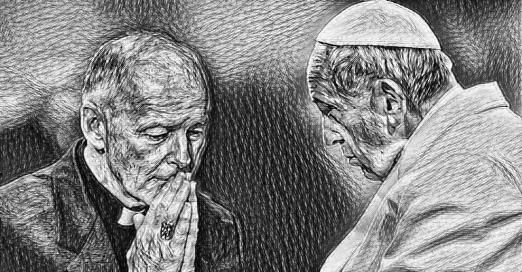
There has been a great deal in the news about allegations of misconduct by Cardinal McCarrick.  He has resigned from the College of Cardinals and Pope Francis has ordered him to pursue a “life of prayer and penance.” There is not much more that I can say about what has come out about Cardinal McCarrick.  He was a great communicator and extremely charismatic.  We clashed years ago when I openly opposed the practice of giving Holy Communion to pro-abortion politicians.  I am still deeply troubled about such policies, although the scope seems to be expanding to include invitations for those in adulterous unions to take the sacrament and even to receive absolution.  How can the mortal sins of enabling murder or committing marital infidelity properly dispose one for the divine mysteries?  I shake my head.  Maybe I am too stupid to understand?  I promised him years ago that I would pray for him daily.  Now, more than before, I am dedicated to keeping that promise.

The Pennsylvania Grand Jury Report on sex abuse in the Catholic Church was hard to read.  I became overwhelmed by grief and wept.  How could this happen?  Priests are called “Father” and fathers are supposed to protect, nurture and heal their children.  My next emotion was anger.  Men broke their promises and they lied about it.  Others were so afraid of scandal and litigation that they apparently kept silent.  Was this the Church for which I sought to be a priest by entering the seminary 40 years ago?  Our faith is ultimately not in weak men but in Jesus who is God come down from heaven to save us.  Given all the negativity and the painful stories, how is it affecting the people in the pews?  (I am planning a monthly parish program on the saints.  That is where we find the real legacy of the Church.  We will focus on those who faithfully ran the race and won their crowns.)

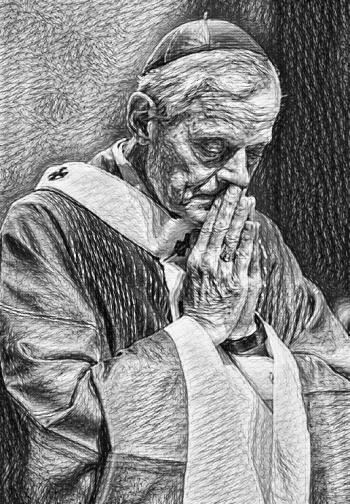
Years ago when I heard that Cardinal Wuerl was coming to Washington I was delighted as I had been a fan of his catechism, The Teaching of Christ, going back to my college seminary days.  His little book, The Mass: The Glory, the Mystery, the Tradition, co-authored with Mike Aquilina, is a real gem and a useful tool in teaching about the Eucharistic liturgy.  As one of his priests, it is hard to hear all the criticism from his time in Pittsburgh.  It seems to me that he did so very much to make a positive difference in protecting children.  Did he stumble at some point?  I am certain that there are many families and victims appreciative for what he tried to do for them.  There has been some talk that the Grand Jury Report got a number of particulars wrong.  I am not in possession of all the facts and so I will leave it up to others to figure out.  I will keep him in my prayers, especially in the Mass, and urge our good people in the pews not to despair.

I am reminded of John Cardinal Newman’s work on the Arian crisis and St. Athanasius when so many of the bishops had fallen into heresy. He concluded that in the fourth century the laity were the heroes who had saved the day for the true faith. While the Lord will be the one to ultimately separate the weeds from the wheat or the goats from the lambs, we need to trust our good lay men and women today.  I am not talking about dissenters but the homeschooling family, the teacher in the parish school, the volunteers running the bible study, the Blue Army lady always rattling off her beads in the lonely church, the teenager eager to serve Mass, the Knights of Columbus men who actively live out charity in communities, the virtuous souls who march for life and stand outside abortion clinics praying for the unborn and their parents, the reader faithful to his service, the altar guild ladies who help set up for the liturgy, etc. Allowing the laity to take the lead may be hard for bishops as it seems to be a surrender of their authority; however, in truth this is precisely the kind of humiliation that may restore their moral jurisdiction as servants of the Most High God.

Statement from the Archdiocese of Washington to Pastors

Many of you have addressed the Pennsylvania Grand Jury report, as well as the Archbishop McCarrick matter in homilies or comments to your parishioners.  Cardinal Wuerl requests that you not shy away from addressing these matters again in a spirit and manner that you feel appropriate. He also requests that you include in your Prayers of the Faithful the following intercession:

“For young people and our most vulnerable that they remain safe and protected, and for those survivors of abuse whether by power or violence, especially by the clergy who have not lived up to their call to holiness. Let us pray to the Lord.”

Finally, as a concluding prayer after the Prayers of the Faithful, he requests the following Prayer for Healing Victims of Abuse from the USCCB:

God of endless love,
ever caring, ever strong,
always present, always just:
You gave your only Son
to save us by the blood of his cross.

Gentle Jesus, shepherd of peace,
join to your own suffering
the pain of all who have been hurt
in body, mind, and spirit
by those who betrayed the trust placed in them.

Hear our cries as we agonize
over the harm done to our brothers and sisters.
Breathe wisdom into our prayers,
soothe restless hearts with hope,
steady shaken spirits with faith.
Show us the way to justice and wholeness,
enlightened by truth and enfolded in your mercy.

Holy Spirit, comforter of hearts, 
heal your people’s wounds
and transform our brokenness.
Grant us courage and wisdom, humility and grace,
so that we may act with justice
and find peace in you.

We ask this through Christ, our Lord. Amen.

FROM CARDINAL WUERL:
153460881053501909

Episcopal Support as Pope Carries Out Reform

Statement Regarding Archbishop McCarrick

Statement on PA Grand Jury Report

Statement in Response to Grand Jury Report (in full)

But Judging Credibility in Abuse Cases Is a Tough Call

“I Met with Every Victim” (TV Interview)

FROM OTHER SOURCES:

Scapegoating Cardinal Wuerl

Pennsylvania Grand Jury Report Debunked

Pope Francis is on the Side of the Victims of Pennsylvania Abuse

The Good Ole Shepherds Club

Bishops will Have to Sacrifice Power & Privilege to Resolve the Abuse Crisis

Bishop Morlino: ‘Homosexual Subculture’ a Source of Devastation

After PA Grand Jury Report, Will Laws Change to Better Protect Children?

US Bishops Express Anguish Over Abuse Reports

Active Homosexuality in the Priesthood Helped Cause This Crisis

Janet Smith to Bishops: ‘Save the Church — Tell Everything’

Heaven & the Comedy of God

151139279599844 (1)

One definition of humor is this:  “complying with the wishes of someone in order to keep them content or happy with us, no matter how unreasonable such wishes might be.”  It is in this vein that we might understand God and heaven as having a sense of humor.  It may be that in the kingdom that which is serious and that which is comic somehow coalesce or become one.

There is much about the truth of Christ which consoles and challenges, and yet, simultaneously there is much that seems absurd. Creation itself is not immune from the comic.  It should be warned that trying to discern this element in God might inadvertently lead to a kind of cynicism.  For instance, focusing on God as the author of creation, I have heard it remarked: “Why did God make the most fertile females in the world, only sixteen years old?” Teens that are least able to deal with the needs of children easily have babies while established and mature women struggle to have offspring.  Those who work with crisis pregnancies often shake their heads in bewilderment.  We can laugh or we can cry about it.  God’s ways often seem unfathomable. It is almost as if intelligent design took a wrong turn.

Turning to salvation history, the ministry of Jesus begins with a humorous oddity.  His mother tells him that they have run out of wine at a wedding banquet.  Our Lord is curt, what has this to do with me— my time has not yet come?  Mary tells the servants to do as he says.  He has water poured into jars.  The stewards are already imagining the disappointment of the gathering when they get water instead of wine.  But miraculously water becomes wine; indeed it is the best wine so far.  Who would have thought such a thing?  Surprise!

If your eye causes you to sin, pluck it out!  If your hand causes you to sin, cut it off! Call no man your father!  You must be born again!  He who loses his life will save it!  He who does not hate mother and father is not worthy of me! Let the dead bury their dead! Hebraic hyperbole gives an emphasis to the demands of Christ, but still they seem crazy to our ears.  If we were to view such matters in a literal way, we would find ourselves set firmly within a Monty Python script.

There are some elements of the Gospel that readily lend themselves to joking.  Even the questions of Jesus can be funny.  A blind man comes up to Jesus and our Lord asks, “What do you want?”  Is it not obvious?  It may be he was hoping that someone would ask for sins to be forgiven, but the given response was more than likely.  He says, “I want to see!”  No surprise in the response here, only in the question.

When a woman is caught in adultery, our Lord tells the crowd, let the one without sin cast the first stone.  The text relates that they all walk away and that our Lord, who could condemn her, forgives her instead.  A contemporary joke version has a stone sailing past Jesus and plunking the woman on the head, knocking her down.  Surprised, Jesus looks around and then says, “Mother, I told you to stay home!” (This is a Catholic joke as we understand Mary to be the sinless or immaculate Virgin Mary.)

Our Lord tells parables that are familiar to us but which were ridiculous to his first listeners.  Which among you would not leave his ninety-nine sheep to go in search of the one lost lamb?  Later, he speaks about the shepherd rejoicing in having found it.  However, in truth, most shepherds would have written it off.  Why risk all the rest to thieves and wolves? And yet, this good shepherd regards the least of his flock as having a value commensurate with all the rest.  This is crazy but it is part of the irony or humor of God.  Then there is the story of the good housewife.  She tears her house apart in search of a lost coin.  When she finds it she has a party with her friends that probably amounted to more than the coin’s value.  Again, his listeners, probably frugal women, would have thought the whole business was crazy or nonsensical.

Take the last place at gatherings.  You must become like little children.  Sell all that you have and follow me.  The one who would be the greatest must become the least servant of all.  Our Lord never lets up.  The absurdity is amplified as the topics become more grave or important.  Thousands have followed him to an isolated location.  When asked to dismiss them so that they might find sustenance, he tells his apostles to feed the crowd themselves.  All they have are a few fish and a little bread.  Nevertheless the multitude are fed and there is food left over.

His humor is so severe that one day most of his followers walk away. He says that unless we eat his flesh and drink his blood then we can have no life in us.  Today, the guys in the white suits would be coming to take him away.  And yet, it is precisely this Eucharist that has sustained the Church for two thousand years.  Indeed, these are the rations from the promised shore to which we travel as pilgrims of faith.  We must become a parable people.  We must become fools for Christ.

Everyone likes to receive a gift or reward, so Jesus assures us of a litany of favors. Our Lord gives a series of benedictions, assuring us that we will receive the kingdom, will be comforted, inherit the land, have justice satisfied, know mercy, see God, become God’s children, and one more thing—know persecution, including torture and murder.  It sounded pretty good until that last bit.  But such is the humor of God.  “Blessed are you when they insult you and persecute you and utter every kind of evil against you [falsely] because of me. Rejoice and be glad, for your reward will be great in heaven” (Matthew 5:11-12).

“For as I see it, God has exhibited us apostles as the last of all, like people sentenced to death, since we have become a spectacle to the world, to angels and human beings alike. We are fools on Christ’s account, but you are wise in Christ; we are weak, but you are strong; you are held in honor, but we in disrepute. To this very hour we go hungry and thirsty, we are poorly clad and roughly treated, we wander about homeless and we toil, working with our own hands. When ridiculed, we bless; when persecuted, we endure; when slandered, we respond gently. We have become like the world’s rubbish, the scum of all, to this very moment “(1 Corinthians 4:9-13). Our Lord writes his straight lines with our crooked ones.  He shows his greatness, not by calling the best of men but making the least and the weakest into his ministers and messengers.

These are the ones that make up the great saints of heaven.  Yes, the joke is on us, but it is a joke that brings not brief laughter but eternal joy.  The infinite and omnipotent God has filled his house with the likes of thieves, prostitutes and traitors.  Just as he could change water to wine and wine and bread into his flesh and blood, he can transform the weakest of sinners into the greatest of saints.  I suspect, albeit in a spiritual manner, there erupts a celestial guffaw that the children of heaven appreciate and which leaves the devils of hell scratching their heads.  They do not get it and that is why they have cast themselves outside the gates to paradise.

The greatest humor or ironic sign of contradiction is found in the heart of the incarnation.  It is here that we discover the full scope of infinite power, love and humor.  The perfect Spirit, the Creator of this and all dimensions and universes, the one who is truly omnipotent and omniscient, the one that stands outside and yet sustains all that he has made— makes himself almost infinitely small, weak and subject to all the petty jealousies and enmity of humanity.  The devil is the first to distance himself from God in utter disbelief— something ridiculous and impossible happens— the great Unmoved Mover moves… and the Word becomes flesh.

Is One Free to Sin in Heaven?

151088056944260

There are some questions that can be regarded as silly.  Why?  It is because they focus on a fallacy.  For instance, take this question:  Given that God can do anything; can he make a rock too heavy for him to pick up?  If the answer is YES, then he is not all powerful because he cannot lift the rock.  If the answer is NO, then he is not all powerful because he cannot make such a rock.  What is the answer?  The assertion is nonsense because it contains an inner contradiction.  Similar conflicts are found as in the biblical temptation scene.  Some will argue that if the devil’s temptations were real then Jesus could have potentially given in and sinned.  However, temptation does not necessarily imply the possibility of succumbing.  In the case of Jesus, it was impossible.  Sin is by definition an act of disobedience against God.  However, Jesus is a divine Person.  God cannot sin against himself.  Similarly, the question is raised:  if the saints of heaven are free then are they free to sin?  The problem is how we understand freedom.  While it might be misused in this world, it is perfected in the world to come.  True freedom means loving obedience to God.  The misuse of freedom or a false freedom is realized in sin or disobedience to God.  Indeed, it is to embrace bondage to the diabolical.

Free will and moral perfection are in sync for the saints of heaven.  While sin is possible for those who only see dimly as through a veil, such is not possible for those who see God face-to-face.  When confronted by the greatest good, which is God, the will is immediately disposed to embrace it.  There is no apparent good.  There is nothing which can compete with it.  Arguably even the angels knew some sort of demarcation when they were tested.

It can also be argued that our ultimate decisions were already made during our mortal lives.  Our orientation is fixed with death.  Along these lines, certain theologians argue that the unborn and children who die before reaching the age of reason might be given the opportunity for making a choice in regard to their eternal destiny.  Many suspect that their personal innocence and the intercession of the parents and/or the Church would nudge them to make free decisions in loving God.  But this is speculation, no matter how optimistic the Church might be in their regard.  In any case, the denizens of heaven, both human and angelic cannot change their minds.  They have freely turned their backs to sin and have set their sights on almighty God. Coincidentally, such is also the state of hell and the slavery they have exchanged for freedom. We read the following in the fourth book of Milton’s Paradise Lost:  “Nay, cursed be thou; since against his thy will / Chose freely what it now so justly rues. / Me miserable! which way shall I fly / Infinite wrauth and infinite despair? / Which way I fly is Hell; myself am Hell…” (line 75)


Sin in heaven would be a violation of the very identity of the saints.  Their wills are united to that of Christ.  They have been made holy as God is holy.

Dark Powers & Principalities

art24

It is a contention of mine for some time that we are in the midst of terrible battles with dark powers and principalities… consciences are being numbed to the truth, especially about the dignity of persons and the sanctity of life. The demonic influences earthly minions, seeking to corrupt both civil society and the life of the Church. Individuals are being infected with a self-righteous and prideful hubris… in terms of basic opinions, the presence and will of God, dissent and misplaced toleration, etc. When we target this dark power, there is disbelief, cynicism and anger… even from those who feign Catholicity or basic belief in God. The Christian is denounced as ignorant or as a bigot. White becomes black and black becomes white. We need active efforts at exorcism and spiritual deliverance!

Why do exorcists ask demons to reveal their names?

Stuck Between the Rock & a Hard Place

art13

Who are we going to punish? I worry about this as a priest in reference to the distribution of Holy Communion, absolution in the sacrament of Penance and in terms of preaching a faith message from the Scriptures that might immediately be interpreted as “hate speech.” Passivity and toleration is not enough to appease certain people… it is being demanded that conventional Christians become advocates for sinful behavior. If a priest gives the sacraments to anyone, no matter what their views and lifestyle, then does he not become an accomplice in their sin? Would he forfeit his own immortal soul for causing scandal and violating conscience, the commandments and his sacred duty? For the sake of accompaniment, can a bishop or even pope force a priest to say or do something that he views as sinful and wrong?

The Devil Dances on the Graves of Priests

suicide

I have this mental image of the devil dancing wildly on the graves of priests? Why is this? Do the eyes of the soul see the true agent behind our many troubles? Within a lifetime we have witnessed a terrible collapse of the Church… almost unbelievable scandal, massive defection, the end of a society with Christian values and a priesthood that has gone from being deeply revered to widely scorned. The character John Adams in the musical 1776 sings, “Is anybody there? Does anybody care? Does anybody see what I see? … Come what may, come what may– Commitment!” Many good priests share such sentiments, albeit for the Church. We will continue to love and care for our people. We will pray for the children who were catechized and forgot us. We will do our duty.

Pope Urges Use of Exorcists

devilshirts

It is no wonder that Pope Francis is urging the appointment of more exorcists!

CRUX reported:

According to Pope Francis, confessors should not be averse to referring their penitents to exorcists if they suspect demonic activity is at work, and after consulting psychological professionals. The pontiff said the ministry of confession takes place on the “peripheries of evil and sin.”

Pope Francis stated:

Discernment is necessary also because those who approach the confessional may come from the most desperate situations; they could also have spiritual disturbances, whose nature should be submitted to careful discernment, taking into account all the existential, ecclesial, natural and supernatural circumstances. When the confessor becomes aware of the presence of genuine spiritual disturbances – that may be in large part psychic, and therefore must be confirmed by means of healthy collaboration with the human sciences – he must not hesitate to refer the issue to those who, in the diocese, are charged with this delicate and necessary ministry, namely, exorcists. But these must be chosen with great care and great prudence.

LINK: Audience with participants in the Course on the Internal Forum

Not Quite Alone in the Dark

scare7I will begin with the admonishment, “Beware of what lurks in the shadows!” Properly forewarned, I will tell my story. My brothers and I delighted in scaring one another and/or testing our courage. We would tell scary stories in closets. We would make faces in the dark and then shock one another with a flashlight showing a devilish grin or eyes popping out. I was probably the best with scary faces. Even today, young mothers should probably remember this when babies spy me over their shoulders and start to cry. Did I make a face or am I just naturally scary looking?


My parents had added two bedrooms to our small house. There was an interconnecting hallway room with three doors. There was no light in the small space. When all the doors were closed, it was quite dark. Mike, Danny, Paul and I would play in the room. The hard tiles made marbles exceptionally good fun. We would also play dare games, sitting in the blackened enclosed space, making eerie sounds and telling scary stories, daring each other to be the first to open a door and run for it. I was quite good at this game.

I recall one in particular . . .

“Hey, Joe, come and play!” I heard my baby brother Paul call out.

Okay, I thought, this will be good. He’s the easiest one to scare. I entered the dark space and closed the door behind me. Surrounded by pitch darkness, I sat down on the floor, facing where my brother was obviously sitting.

I started, “Booooo! Muhahaha! I’m coming to get you! Muhahaha!”

“I’m not scared,” Paul cried, “now it’s mine turn.”

“I’m coming to get you!” he parroted in baby fashion.

I interrupted, “Oh come on, try something different.”

“Let me finish!” he complained.

“All right, go ahead, give it your best shot.”

“I will, I really will,” he responded. His voice had taken on a shrill quality. Hum. He was getting better at this. “I’m coming to get you! I’m not your brother! I’m coming to get you! I’m not your brother.” His speech entered into an up-and-down sing-song kind of pattern. It was really quite unusual. “I’m coming to get you! I’m not your brother! I’m a demon from hell! I’m not your brother!”

He really was getting good at this. The voice he was using was now nothing like it was usually. I tried to interrupt again. “Uh, that’s pretty good, but it’s my try again,” I said.

Nevertheless, he did not quit. It was as if he no longer heard me.

“Stop it, I said, it is my turn,” I argued.

Still he continued in the peculiar rhythmic speech. “I’m not your brother! I’m a demon from hell! I’m coming to get you!”

I could not believe it, I was actually getting scared. He would not stop, that was unlike him. Paul always listened to me. His voice got louder and he began to hold the vowels longer. The words were clear but the inflection was all wrong, as if he did not know how to speak as a human.

“I’m not your brutheeer, Joooooe! I’m a deeemon from hell! I’m going to get you! I’m right next to you! Ready to grab you! Take you with me to hell! I’m not your brother! I’m a demon from hell! A demon from hell! From Hell!”

I yelled at him to stop but he wouldn’t. I had all I could stand. This was a little too scary and on top of that I had to go to the bathroom. I opened the door. Light poured into the small chamber. I stared at my brother, well I would have, except there was one small problem. He was not there. I had been in the dark space alone. I stared in disbelief and ran to the kitchen where mom was cooking. My brother Paul was eating a cookie. He had been there the whole time. I had been by myself or worse, maybe not? I can still hear the shrill sing-song voice after all these forty plus years, “I’m not your brother! I’m a demon from hell!”

The darkened space was created by the addition of two rooms upon the house. We had neglected to have that section blessed and there were no holy pictures or crosses in the enclosed space. Maybe this oversight was all the thing that I had encountered needed to violate our home. Or, perhaps it was all the overworked imagination of a young boy?

One evening not long after, I recall awakening in the middle of the night and putting my hand out into the hallway beyond my bedroom door. Again, in the darkness there was absolutely no light to see. Everyone was in bed asleep except for me. I dared myself to get over the fear I had experienced in the connecting space to the new rooms. There was nothing in the dark that was not there in the light, right? I had to prove it to myself. I would not be a coward. I stretched out my hand as far as my arm could reach. Just as I was ready to dismiss my earlier experience, something grabbed at my finger tips and I quickly withdrew my hand. I shook with fear in my bed. The grownups were wrong. There was SOMETHING IN THE DARK that was not there in the light!

Humanity has always feared the unknown associated with the darkness. We cling to the light. Many of the dying saints have begged to have a lantern or candle burning by their bedsides so that they might not have to die in the darkness. May we take comfort and courage in the true Light of the World who leads us out of the darkness of sin and death.

The Apostles’ Creed, the Righteous Dead & Hell

limbo

Bob brings up an interesting inquiry regarding the Apostles’ Creed.  He writes:

“During the celebration of the Mass and reciting the Creed we say, ‘He descended into hell.’ The classroom posters for the children say, ‘He descended unto the dead.’ Now I was taught that our Lord Jesus descended into hell to show Satan and his followers that he is the Light of the World and that he has the power over sin and death; but based on research, professors of theology are using the Greek word “Hades” meaning place of the dead and as I remember it was similar to purgatory. Please give your thoughts on this.”

Sorry to say, it sounds like Bob and others were taught wrong. The current translation of the Creed at Mass uses the word HELL. The poster has the previous liturgical translation of the Creed, UNTO THE DEAD. It changed with the newer and corrected translation of the Roman Missal. A translation that was popular in Anglican circles rendered it as UNTO THE QUICK. Hell is a more literal translation; unfortunately, it can also be misunderstood. It refers not to the hell of the damned but to the more generic abode of the dead, what the Church termed as THE LIMBO OF THE FATHERS. Such a place no longer exists. Sin had breached humanity from God; the gates of heaven were closed with the sin of Adam and Eve. None could enter true heaven until the coming of the Christ. The righteous dead (Jews and Gentiles) awaited their Savior. Jesus descends into hell or unto the dead or into the limbo of the fathers so that they might now be translated into heaven. The Eastern churches have an icon where Jesus flies from the flames carrying Adam and Eve out by the hair. Jesus is the Way and the Truth and the Life. There is no way to the Father except through him. He is the bridge or “pontifex.” His saving Cross makes possible our passage. We have been redeemed by the Lord. He pays the price for our entry. It is an affirmation that none are saved apart from Christ. As I said, the limbo of the fathers is not hell of the damned, not heaven of the saints and not purgatory. Those three realities still exist. However, at the final consummation and judgment, purgatory will also cease to be. The poor souls would have completed their passage to the heavenly shore.  Then there will be two realities, heaven (the victory of love) and hell (the frustration of hatred and the wrong kind of loving).

Can the Most Wicked Be Forgiven?

devils summer-picnic-outdoors-clip-art_420988

Mike asked a few questions about forgiveness that I have heard from others and are worth sharing.

1.  I have been wondering about forgiveness in general. Are there any sins so bad that they will never be forgiven, regardless of how much you repent and accept Jesus?

As long as you are alive, there is hope. If you are sorry, you can be forgiven. However, after death, our orientation and choice becomes permanent.  Of course, we are creatures of habit.  The longer we wallow in our sins, the less able and willing we might be to crawl out of the hole we have made for ourselves.  God wants to save us; but, we must also want to be saved.

2.  As an extreme hypothetical, if Lucifer suddenly repented and asked for forgiveness from God, would he be forgiven?

This is regarded as a nonsense question. It contains within itself a self-contradiction. The devil is a pure spirit. He lives outside of time. He has turned away from God. He cannot turn back. He hates God. This status is forever. Hell is more than a place. It is also a disposition. That is why the devil can say, “I am hell.” We should not feel sorry for or romanticize about the devil. We in our mortality are capricious in our choices. But the angels and the souls of the dead live in eternity. All they know is the eternal now. They are what they are. There is neither the desire nor the opportunity to change. Just as the saints are safely in their heaven forever and ever; so too are the damned fixed in their perdition, lost forever. The fallen angels define something of their angelic natures by their rebellion. They cannot be remade.

3.  Does God’s forgiveness only apply to humans, in other words?

Yes, only “living human beings” can avail themselves of God’s mercy. The demons would have none have it. Indeed, they hate the Divine Mercy, itself.

Another question came from Sarah.  She writes:

I did the Blasphemy Challenge years ago and regret it now that I’m re-discovering faith. Was it an unforgivable sin?

As long as there is breathe in your body, sin can be forgiven.  The atheists who promoted the “challenge” did not understand hyperbole and the correct reading of Scripture.  Sin is only unforgiveable when there is no sorrow for sin and repentance.  One cannot simultaneously reject God’s mercy and invoke it through contrition.  Are you sorry for your sins?  The Divine Mercy is ready and desirous of forgiving you.