• Our Blogger

    Fr. Joseph Jenkins

  • The blog header depicts an important and yet mis-understood New Testament scene, Jesus flogging the money-changers out of the temple. I selected it because the faith that gives us consolation can also make us very uncomfortable. Both Divine Mercy and Divine Justice meet in Jesus. Priests are ministers of reconciliation, but never at the cost of truth. In or out of season, we must be courageous in preaching and living out the Gospel of Life. The title of my blog is a play on words, not Flogger Priest but Blogger Priest.

  • Archives

  • Categories

  • Recent Posts

  • Recent Comments

    Josh's avatarJosh on Mixed Signals about Homosexual…
    gjmc90249's avatargjmc90249 on Marian Titles & the Mantle…
    Jeremy Kok's avatarJeremy Kok on Ask a Priest
    Anonymous's avatarAnonymous on Ask a Priest
    forsamuraimarket's avatarforsamuraimarket on Ask a Priest

Pope Francis on Homosexuality & Consecrated Life or Priesthood

0002044The Pope’s Own Words:

The issue of homosexuality is a very serious issue that must be adequately discerned from the beginning with the candidates, if that is the case. We have to be exacting. In our societies it even seems that homosexuality is fashionable and that mentality, in some way, also influences the life of the Church. This is something I am concerned about, because perhaps at one time it did not receive much attention.

We have to take great care during formation in the human and affective maturity. We have to seriously discern, and listen to the voice of experience that the Church also has. When care is not taken in discerning all of this, problems increase. As I said before, it can happen that at the time perhaps they didn’t exhibit that tendency, but later on it comes out. The issue of homosexuality is a very serious issue that must be adequately discerned from the beginning with the candidates, if that is the case.

I had a somewhat scandalized bishop here who told me that he had found out that in his diocese, a very large diocese, there were several homosexual priests and that he had to deal with all that, intervening, above all, in the formation process, to form a different group of clergy. It’s a reality we can’t deny. There is no lack of cases in the consecrated life either. A religious told me that, on a canonical visit to one of the provinces in his congregation, he was surprised. He saw that there were good young students and even some already professed religious who were gay. The religious wondered if it were an issue and asked me if there was something wrong with that. Francis said he was told by one religious superior that the issue was not “that serious, it’s just an expression of an affection.” That’s a mistake. It’s not just an expression of an affection. In consecrated and priestly life, there’s no room for that kind of affection. Therefore, the Church recommends that people with that kind of ingrained tendency should not be accepted into the ministry or consecrated life. The ministry or the consecrated life is not his place.

We have to urge homosexual priests, and men and women religious, to live celibacy with integrity, and above all, that they be impeccably responsible, trying to never scandalize either their communities or the faithful holy people of God by living a double life. It’s better for them to leave the ministry or the consecrated life rather than to live a double life. When there are candidates with neurosis, marked imbalances, difficult to channel not even with therapeutic help, they shouldn’t be accepted to either the priesthood or the religious life. They should be helped to take another direction, but they should not be abandoned. They should be guided, but they should not be admitted. Let us always bear in mind that they are persons who are going to live in the service of the Church, of the Christian community, of the people of God. Let’s not forget that perspective. We have to care for them so they are psychologically and affectively healthy.

Statements are taken from an interview with Pope Francis conducted by Fr. Fernando Prado, director of Claretian Publishing House.

Doctor Who Has Become Preachy & Boring

dw

The trouble started a while back, especially in episodes that aggressively promoted homosexuality and atheism. Subtlety disappeared and it stopped being a children’s show. The trouble escalated with Peter Capaldi. His version of Doctor Who was too dark. In one episode a child dies in the ice and he seems not to care. Now we have a Doctor Who with a feminine side, and she seems to care too much. Why can’t the BBC get it right? Episodes that stereotype Americans or which offer backseat criticism of past British imperialism are not going to win viewers. We get too much of politics already. A recent episode even mentions President Trump. Please, is there no sanctuary from this crazy messed up world?

Bradley John Walsh is the only thing working out for the new incarnation of Doctor Who. One has to be careful in saying this because he is the singular middle-aged white male in the cast. Jodie Whittaker is a bust, although she is a good actress. The problem is that the program is no longer really Doctor Who. Indeed, the episodes are so PC and preachy that it has become utterly annoying to those who detest either direct or subliminal manipulation. The writing is terrible. One episode is often worse than the one before it. Viewers want science fiction action and escapism; what they are getting instead is a liberal take on moral issues— like same gender marriages and men having babies. One critic has joked, how many minorities or ethnicities can we squeeze into the Tardis? The one episode that was impressive (Rosa Parks) harked back to the historical shows of the first Doctor, David Hartnell. However, it was also notable for the Doctor Who character stepping back as the hero. Rather than within the context of a fantasy show, might the story about American racism had better been told on its own without the science fiction elements?

Offer criticism and instead of listening to fans, the fans are being attacked. When all is said and done, the episodes are boring and hard to watch. As a fan of Doctor Who from the 1960s I did something the other day that I had never done before when watching Doctor Who— I changed the channel.

DOCTOR WHO RATINGS PLUNGE

A Priest’s Reflection During a Time of Crisis

154250010567750063 (1)

When I was a boy pondering a vocation some forty years ago, I was intrigued by a pamphlet from the Divine Word Missionaries.  It chronicled a lonely priest with his mule carrying his Mass and medical supplies as he journeyed to a remote mountain outpost.  It detailed a religious version of “Indiana Jones,” years before the movie, RAIDERS OF THE LOST ARK.  It grabbed my romantic imagination.  However, my poor mother grieved my leaving home and I settled on becoming an archdiocesan priest.  I do not regret the change in direction, especially now when “everything hurts” but sometimes I do wonder how different my life might have been.

I am amazed these days that we still have young men answering a call.  We have given them few heroes and one scandal after another.  It must surely be the movement of supernatural grace.

As I reflect upon my priesthood, I struggle with what has always been a dark shadow in my ministry.  I have never felt myself worthy.  No matter whether it were true or not, I always considered myself the worst of priests, a poor and weak example among a throng of virtuous saints in the faith.  We have preachers who can readily inspire and move hearts.  We have celebrants who both look the part and conduct the sacraments with great solemnity and seeming ease.  We have men who have apparently brushed aside distractions and are always about prayer and service.  When I look to myself, I see a man who forgets far more than he remembers.  My sermons are mediocre at best and my liturgical abilities come across as clumsy and amateurish.  I do not have much in the way of ambition and my attention easily strays.  I often talk to God not with typical or expected piety but much as one might irreverently talk to a friend sharing a beer.  Indeed, I recall telling God, “All I want to be is a humble priest” and hearing him in my heart respond, “Well you certainly have much about which to be humble.” I often imagine Mary cloaking me with her veil and telling me that she loves me even though I am the least of her sons.

I certainly recognize that sin in the life of any Christian represents a terrible duplicity where we are convicted as hypocrites.  What surprises me is how some of the clergy could have committed sins that literally cry out to heaven.  Self-destruction is truly awful; but hurting and tearing down others compounds the sin in a way that shatters the sacramental signification of the man in holy orders.  It places men into the mold of antichrists.  The current scandal has damaged the ability of bishops to govern the Church and of priests to proclaim the doctrinal and moral teachings which are constitutive of the Gospel.  Any hold we have upon God’s people is purely through their free consent.  There is no Medieval dictatorial religious state that can demand or force one to remain a Catholic or Christian.  Forfeit favor and good will— and churchmen will find themselves abandoned— with empty coffers and pews.  The direst effect may be the loss of souls.  When did we forget that our most pressing obligation is to realize the forgiveness of sins and the salvation of souls?

The Church is not a company where businessmen might do anything or everything to preserve revenue.  The Church is not a priestly boy’s club where members protect their leadership to the detriment of their flocks.  Our preoccupation should not gravitate to the powerful and the rich, but as in the ministry of Jesus to echo the universal call to salvation, albeit with a preferential option for the poor.  Clergy must also place the teachings of the faith ahead of their own pet ideas.  We are summoned to convert the world to Christ, not to compromise the kerygma of faith to the demands of subjective truth and a hostile secular modernity.  Indeed, our clergy and people alike must allow the courage of Christ to take precedence over their own passivity and fearfulness.  Much of the trouble we are facing is a crisis of holiness and belief.  Why would any churchman allow a known child-rapist an opportunity to bring harm to youth and families?  Why would we allow men who have disordered and perverse desires to minister and to threaten our people?  Fornication is a sin.  Adultery is a sin.  Homosexual acts constitute sin.  Perhaps many of the clergy have become soft upon such mortal sins because they too are perpetrators of such transgressions of the moral law?  There is no denying that there are also thieves, drunkards and gluttons among us.  But the sexual sins are the ones that most draw the ire of God’s people.  Indeed, I suspect the Lord, himself, is most troubled by these sins because they are a direct violation of a priest’s profound promise toward obedience and celibacy.  We are pledged to celibate love.  Do all our priests fully appreciate the meaning of their celibacy or do they simply experience it as a difficult discipline to endure?  It is not merely the avoidance of genital relations.  It is not the same as virginity and chastity.  Christian celibacy is a manner of self-donation and sacrificial loving.  It is the priest’s way of saying he belongs entirely to the Lord.  This love is expressed in worship, prayer, fidelity and service.  It is factored into everything he is about; it is the manner through which the good priest repeatedly says, to the Lord and to his people, “I love you.”  The priest prays his breviary— I love you.  The priest celebrates Mass— I love you.  The priest helps in outreach to the poor— I love you.  The priest preaches and teaches— I love you.  The good priest is consumed within his pledge of celibate love.  It is within this obedient and giving celibacy that the priest finds holiness in Christ.  The current scandals are not the fault of celibacy.  The answer would not be a married clergy.  The solution would be in loving fidelity to the priestly mission and to the truth.  The priest or bishop is not the master of the faith community, but its most profound servant.

Admittedly there are intimate and delicate matters difficult to speak about; so much so that they are often left outside of public deliberations.  Priests are men and they live in a world where the custody of the eyes is very difficult.  Priests need to earnestly defend their celibacy, taking threats seriously. Too many men and women probably excuse the habit of masturbation as part of a false contemporary enlightenment.  It should always be voiced in Confession; indeed, those elements that feed the sin need purification from the lives of God’s people, particularly from those called as priests.  Chief among the sinful contributing factors is the danger of pornography which is easily accessed and has taken upon itself epidemic proportions in modern society. It has even infected marriages where couples commit virtual adultery and then substitute sexual shenanigans other than the prescribed marital act. Pleasure is substituted for true fidelity and companionship with each other in Christ.  It is among the devil’s deceits that such secret sins do no real harm or necessarily contribute to a person’s movement into adulthood. While many contemporary psychologists would disagree, in truth, the man (or woman) in bondage to pornography and masturbation suffer a stunted emotional and spiritual maturation; they are caught within a juvenile self-absorption that inhibits an integrated sexual identity as a person able to fully realize his (or her) capacity to interact with others in love and service.

Turning toward the Lord, the priest must renounce the seductions of the world.  The priest’s hands are made for the chalice and host.  His hands render blessing and absolution.  The priest’s eyes should look at every person as a child of God.  He must never forget his spiritual fatherhood— even toward those who have ruined themselves by lust and exploitation.  The priest’s body is not made for pleasure but for sacerdotal sacrifice.  His association with Christ draws him inevitably toward the passion and crucifixion.

Many priests feel increasing estranged from those they serve.  This does not help matters.  He has sacrificed much to be a priest and it often seems that many if not most people really do not care.  Increasingly, while there is little praise, there is no shortage of rebuke or even mockery.  That is why efforts like those by the Knights of Columbus espousing solidarity with bishops and priests are so very important.  The laity should not be uncritical; they have a right to good and holy priests.  It is in this vein that God’s people should never hesitate to pray for their priests.  We must not allow the scandals and accompanying anger to destroy this important component to the inner life of the Church.  The priest does not pray alone.  According to our station in life, we pray for each other.  We should reject the false demarcations of the People of God as either an institutional Church or the Church in the pews.  The Church is one— she is a family, even if sometimes sinful in her members and dysfunctional in her practical relationships.

154250010567750063The definition of a priest is one who renders sacrifice to his deity.   The Catholic priest makes his oblation as the principal worship of the Lord.  He makes it both for himself and for others. Christ is the great high priest.  Those ordained share in his priesthood where Jesus is both priest and victim.  The priest at the altar is one with Christ (the head of the Church) who dies so that we might live.  He atones for sin and heals the rift between heaven and earth.  Jesus offers his own blood and dies once and for all.  The mystery of his oblation is made present in our liturgy, albeit in a clean or unbloody manner.  The only thing missing from Christ’s historical sacrifice is our participation. The Mass allows us to return to that one-time offering where we (grafted to Christ) can offer ourselves to the heavenly Father as an acceptable oblation.

Just as the gifts of bread and wine are transformed into the risen body and blood of Christ; so too, are we beseeching the Lord to change us ever more and more into the likeness of God’s Son.

The efficacy of the sacraments is assured even if the priest is in mortal sin and a terrible reprobate.   However, this does not mean that the sacraments are still all that they should be.  The movement of grace is damaged by poor witness.  People disillusioned by their ministers can close their hearts and minds to God.  They may even walk away from the sacraments entirely.  The priest stands convicted at the altar of sacrifice.  As with the communicants, we must be properly disposed to what the sacraments entail.  That is why many of us are concerned about inviting everyone to the altar so as to receive the Eucharist.  The sacrament that heals and saves can also bring condemnation to those in mortal sin.

What does it mean to receive the bread of life if one is an active enabler of the culture of death?  Too many feign Catholicity within the church doors and then once outside become the chief advocates in the public forum for the death of unwanted unborn children.

What does it mean to partake from the nuptial banquet table of Christ and his bride the Church when one is living in violation of his or her own marriage vows?  Christ rejects divorce and demands that marriage between men and women reflect fidelity within the Church.  Are we witnesses to his promise or do we substitute our broken promises instead?

Currently there is also a great debate about the status of active homosexuals in the Church.  Nevertheless, priests, bishops and even popes do not stand above Sacred Scripture but rather below as servants of the Word.  What does the Word say?  We read in Paul’s epistle to Timothy:

“We know that the law is good, provided that one uses it as law, with the understanding that law is meant not for a righteous person but for the lawless and unruly, the godless and sinful, the unholy and profane, those who kill their fathers or mothers, murderers, the unchaste, sodomites, kidnapers, liars, perjurers, and whatever else is opposed to sound teaching, according to the glorious gospel of the blessed God, with which I have been entrusted” (1 Timothy 1:8-11).

Along with the concern that many of us have about welcoming pro-abortionists, adulterers and active homosexuals to take Holy Communion; the priest must also focus upon his own status before almighty God.  Is the one offering the sacrament of salvation to others bringing down judgment upon himself by celebrating the Mass unworthily? How is it that we can become comfortable with the prospect of priests standing at our altars while in mortal sin or not truly believing?

Christians in the early days of the faith were warned not to take part in the food offerings from pagan sacrifices.  Unlike the sacrifices of the Jewish temple or that of the Eucharist, these oblations to false gods were deemed as poisoned food given to demons.  It was customary in such sacrifices that a third was burned and given to the so-called deity, a third went to the priests (even the pagan ones) and a third was given to the poor.  Believers were warned against taking this tainted food.

While the Eucharist, by comparison, is all holy since Christ is holy, the liturgy can be polluted or corrupted by priests in mortal sin or who are closet atheists or who fail to give due  diligence about what they celebrate.   It does not matter so much as to what language or anaphora (eucharistic prayer) is used as long as the priest is one with the Church and faithful in the rubrics of the celebration.  He must be attentive to what he is doing and that care begins with himself.  The ordained priest should feel humbled by his role.  His priesthood compliments and makes possible the operation of the laity’s baptismal priesthood.  A basic symbolism of Catholic sacraments, centered upon the paschal mystery, is that we must die with Christ if we hope to live with him.  The priest’s celibate love is subsumed into this profound mystery.  When the priest processes to the altar, he should be fully aware and prepared for both Christ’s sacrifice and his own— he is Jesus Christ entering Jerusalem— he is coming to the altar to die.

Reflecting Upon the Abuse Crisis

154164358031183741 (7)The clergy abuse issue just never seems to let up.  Today there was a headline in THE WASHINGTON POST, Three Teens Allege Abuse by Catholic Priest in D.C.” A Capuchin parochial vicar from Sacred Heart Church was charged with a single count of second degree sexual abuse and brought to the D.C. Superior Court in shackles.

The dark tragedy of clerical abuse of minors conflicts with a core element of the Church’s identity.  The mission of every priest is to be a spiritual father— teaching, nurturing and healing his flock.  The center of the priestly vocation is his role as a vehicle for the forgiveness of sins.  Any priest who would harm or corrupt others stands in stark violation of his sacred calling and the mission of the Church.  When the scandals first emerged, many disbelieved the allegations and assumed that none of it could be true.  Today, that mentality can no longer be substantiated.  While individual cases may or may not be credible, the issue is real and some priests have failed us and violated the trust we had in them.  Excuses cannot be made.

Given the type of violation we are discussing, it must be admitted that efforts at healing will fall short.  How does one restore trust when it is violated so egregiously?  Clergy abuse of minors signifies a profound attack against innocence that leaves a lasting wound.  That is why people come forward decades after such assaults.  Lives are changed forever.  Many of those assaulted abandon the faith.  Others are hampered in their later relationships and suffer from trust issues.

The comeback that “we are all sinners” does little to soften the blow about such infidelity.  Yes, it is true that the history of the faith is one where corruption and sin has infected both leaders and followers.  But, we argue as well that the true legacy of the faith is written with the lives of the saints.  We have not always been successful at the discernment of spirits.  We struggle to distinguish those who really walk in holiness and those who only put on a show.  The Church is holy because Christ is holy and the Church is his mystical body.  This is the case, even though the Church is composed of sinners.

The apparent but largely unreported fact that abuse is even more pervasive outside the Church does nothing to ease our disappointment and shame about misbehaving clergy.  The Church should be above such violations of decency.  We rightly expect a lot of our priests.  Celibacy which should be the shining treasure of Catholic ministry is subjected to ill-repute and questioned as either the cause or situation that enabled wrong doing.  Apologists argue that the celibacy is not the problem but rather the solution— if priests will follow through with their promises.  What we need are shepherds and laity courageous enough to embrace the hard truths that confront us and to fully cooperate with God’s grace in the sacraments toward the cleansing of our ministries.  This will necessitate a full acquisition of the truth; in other words, a realization that the problem is not largely one of pedophilia but of sexually disordered and frustrated men who are mostly but not entirely homosexual.  The proof of the pudding is the number of pederasts who have also broken their promises with adults and older teens.  Of course, if such men kept their promises this discussion and need for purification would be largely mute.  However, promises have been broken and in ways that demonstrate a lack of commitment to faith, holiness and prayer.  They loved God too little and sought satisfaction where it was forbidden to them.

What most of us once regarded as rare and aberrational has proven to be more serious than we imagined and devastating for thousands of children and their families.  Compounding the problem, many wrongly targeted the victims and witnesses that came forward for resulting scandal instead of disciplining rogue clergy and removing them from ministry.  We must continue corrective efforts.  We must perfect policies to protect our youth while insuring a process that safeguards innocent clergy from charges that are not credible.  My worry today is that there is an intense malice that clouds the subject, one that focuses upon any and all clergy, regardless of the truth.  Mercy toward the guilty will not bring restoration to ministry or escape from censures and punishment.  Justice toward the innocent must protect the rights and sacerdotal dignity of priests who may be falsely charged or condemned by association.

Reflecting upon how we might personally respond to the scandals facing the Church, here is a good list:

  1. Stay put and do not abandon the Barque of Peter— remember the words of Peter, where would we go?
  2. Keep faith in Christ and in the Catholic Church— do not stop believing.
  3. Remain faithful to the Mass and the discipline of prayer— offer our own fidelity in reparation for the unfaithful.
  4. Acknowledge our own faults and seek mercy in absolution— while not all sin cries out to heaven, we are all sinners needing forgiveness.
  5. Open your mind about the issues facing us and grow in the faith— as believers we must always know and proclaim the truth.
  6. Continue to live for others in acts of Christian charity— such is an antidote to the selfishness that has manufactured this situation.
  7. Avoid hate and calumny, exhibiting a heartfelt sacrificial love and mercy— if we are to face the devil then we must put on Christ.
  8. Clean your house of that which conflicts with our Gospel witness— we should have no part in the hypocrisy that makes this matter worse.
  9. Seek the purification of the Church from any satanic enemies within— the poison in the mix must be expelled, even if it means the end of individual ministries.
  10. Fight for justice and healing toward the oppressed, wounded and innocent— the dignity of persons must always be safeguarded.


[152] Thirty-first Sunday in Ordinary Time

November 4, 2018

Deuteronomy 6:2-6 / Psalm 18 / Hebrews 7:23-28 / Mark 12:28b-34

154164358031183741 (5)

Moses exhorts that honor and obedience to God brings forth the blessings of long life and prosperity upon his people.  Indeed, if they expect the LORD to keep his promises for a land of their own then they must reciprocate with their own fidelity.  This illustrates a profound message about justice— God rewards faithfulness, punishes disobedience and protects his own who love him.  This appreciation is the glue that preserves the identity of the Jews as God’s chosen people, from the time that they were a family and tribe through their transition as a nation and then a religion.  Indeed, it may be argued that such an appreciation is the seed, first for the ordering of the Jewish community and later for the emergence of Christianity and a Judeo-Christian civilization.  Such a community, ordered around both divine truth and justice, is now in the wane as it is increasingly replaced by a secular culture that makes man and not God the measure of all things.  The Church today is ever more an isolated sign of contradiction in this modern world.  As such, power, money and politics manipulate the larger community even as its pawns endlessly belabor about invented rights and fraudulent freedoms.  It must be said that a general chaos reigns (everyone doing their own thing) and the error of subjective truth (disorientation around a false foundation) wrongly countermands what is objectively true.

The responsorial carries forward the theme of our dependence upon God.  Note that the psalmist calls the LORD his rock.  Many of the ancient pagan believers literally were idolaters.  While their statues over time came to represent false deities, initially the idols of metal or stone or wood were worshipped in themselves.  Certain anthropologists argue that next to the worship of celestial elements like the sun and moon, many early people actually worshipped rocks.  These rocks were eventually carved into various shapes.  Any visitor to the Holy Land will know that it is a place littered with rocks.  That is why stoning became a routine manner of enacting capital punishment.  The rocks took on an importance because they could be used in defense, hunting and building.  They were particularly effective in fighting, either against other people or in killing animals for food.  Indeed, heavy rocks were also used in crushing grain in the process of making life-giving bread.  Contrasted to the idolaters, the Hebrew people were called to follow an invisible God.  While he was the Creator, he could not be identified with his creation.  God’s people strenuously fought against the use of idols but it may be that they borrowed something of the language of their pagan neighbors.  Calling the LORD their rock, they were asserting that he was both their firm foundation and that he had sufficient power to protect his own.

Illustrated in both our first reading and the Gospel, the backbone to all the commandments is their relationship with the living God.  This is why idolatry was regarded as the vilest sin:  “Hear, O Israel! The LORD is our God, the LORD alone! Therefore, you shall love the LORD, your God, with all your heart, and with all your soul, and with all your strength.”  While we appreciate our saving faith in Jesus as the Son of God, this command retains its binding force for Jews and Christians, alike.  All sin or rebellion signifies a turning away from this truth— placing either persons or things before our allegiance to God.  Adherence to this command changes everything.  A failure to embrace this truth corrupts discipleship as a matter of external show or exhibition.  It is this love of God that should fuel all human charity.  It is the unseen element by which all souls will be judged.  St. Paul as the Pharisee-turned-Christian knew this truth well.  He wrote the Corinthians: “If I speak in human and angelic tongues but do not have love, I am a resounding gong or a clashing cymbal. And if I have the gift of prophecy and comprehend all mysteries and all knowledge; if I have all faith so as to move mountains but do not have love, I am nothing. If I give away everything I own, and if I hand my body over so that I may boast but do not have love, I gain nothing” (1 Corinthians 13:1-3).  The fidelity of men is not like the actions of pre-programmed ants.  God wants our hearts.  He wants us to prize him as our treasure before all else.  He is a jealous God and does not want to share us— it is all or nothing!

Jesus adds as a corollary of the great commandment toward the Lord one that includes the neighbor:  “You shall love your neighbor as yourself.” The scribe that comes to him affirms the answer and Jesus tells him, “You are not far from the kingdom of God.” If we were to imagine this love as water in a cup it would be brimming over.  It cannot be contained.  That is why such a love of God must spill upon our brothers and sisters.

The courts order the removal of the Decalogue from the walls of courtrooms and from display on public grounds. (There was one notable exception when authorities said they would permit an edited listing that subtracted the commandments about God.)  The problem is, take God out of the equation and the commandments become mere suggestions.  We have faced similar problems in the public schools.  Efforts to teach virtues in public schools have collapsed because who is to say what is wrong if there is no divine command?  What are the consequences?  We can no longer even agree about questions of gender.  Despite obvious disordered elements, sexual orientation and behavior has become a free-for-all.  Children can celebrate the Wiccan and occult elements of Halloween but only the Easter Bunny and a sanitized Santa have survived the purging of Christ’s birth and resurrection.  Mother’s and Father’s Day has been removed from calendars or transformed so as not to offend those with no acknowledged male or female parents.  Instead of telling children to wait until marriage for sexual intimacy, school nurses pass out condoms and in some cases schedule abortions for the children under their care.  Nevertheless, they still cannot give those same children an aspirin for a headache.  Tired of teaching children to behave, many children are drugged for purported attention disorders (which they may or may not have).  When children are challenged for bad behavior their answers are quick and to the point.  “Who are you to tell me what to do?”

Note the first half of the traditional Act of Contrition:  “O my God, I am heartily sorry for having offended Thee, and I detest all my sins, because of Thy just punishments, but most of all because they offend Thee, my God, who art all good and deserving of all my love.”  The essential message from Moses to Christ was love; however, if love should be found wanting, then at least the fear of punishment would make possible contrition and help to insure proper behavior.  At a minimum, the fear of punishment (the loss of heaven and the fires of hell) protects the good from evil men and upholds a moral society.  However, today it could rightly be said that many people neither love God nor fear punishment.  It should not surprise us that this attitude has arisen at the same time as when atheism is claimed by a quarter of the U.S. population.  Worse than this, many who are believers live as if there were no God.  Separated from God, we do not know how to be good.

154164358031183741 (6)

As an aside to this homily theme, the second reading speaks about the priesthood of Christ.  Here we can also say something about the love of God and the fidelity we should show him.  While the priests of old could only serve until their deaths, Christ’s priesthood is eternal.  Indeed, his priestly service can save all who approach him for mediation.  While the Jewish priests daily offered a sacrifice that could not fully appease the dishonor of God caused by sin, the oblation of Jesus on Calvary makes true satisfaction and has lasting value.  Men ordained to the priesthood in the Church share in his one priesthood.  The Mass is a real and unbloody re-presentation of Calvary behind the sacred signs of bread and wine.  While ordained clergy stand at our altars, it is Jesus who celebrates every Mass.  Jesus is our high priest and our divine and innocent victim.  While our priests may offer the Mass daily, it is only because they live and minister in time.  The underlying truth is that every Mass participates in the onetime sacrifice of Jesus.  Jesus realizes the full meaning of the commandment of love.  Given his identity, he joins within himself the power of divine love with the fidelity that we are commanded to grant to the Father.  Jesus spreads his arms on the Cross as the offering of a love beyond measure.

  • Can you truly say that the priorities of your life illustrate fidelity to the two-fold commandment of love?
  • Can you really say that you love God while you hate your neighbor?
  • What competes with our intimacy and loyalty to the Lord?
  • What motivates our prayers and acts of charity?
  • Can people really love the Lord as they should if they fail to pray and to worship with the believing community of the Church?
  • Is it well appreciated that the priest is Christ and that the Mass is Calvary?
  • Can we really be good without God?
  • Are we moved more out of fear or love of God?

The Rise of False Worship

witches

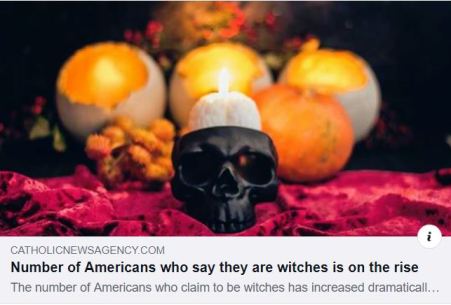
There are now more witches in America than Presbyterians. Sorcery is on the rise and it is more than fun-and games.

Christmas Oratorio at Holy Family Parish

Pass the word. Holy Family Parish will be the only venue where the PG Choral Society will be performing for Christmas. Support the arts. Enjoy traditional music. Make the season a time of special remembrance.

R-2541364-1289644657b

Trust the Power of the Mass for Healing

154090764894273935

I was reminded of the “Healing Your Family Tree” phenomenon among certain Charismatics and Exorcists while reading about Msgr. Clement Machado and watching a few of his YouTube EWTN videos.  He claims to have had visions of the Blessed Mother and St. Patrick.  I am skeptical… but who knows?  The Church has many saints and seers.  The children of Fatima were given a vision of hell so as to pray more fervently for souls.

While Catholicism certainly encourages prayers for the souls of the dead, this idea of targeting sins and woundedness in past generations for current problems faced by believers goes back to the ancient Jews.  They believed that punishment for the sins of one’s fathers could be visited upon the children.  Our notion of Original Sin is an extension of this.  However, at least as a routine source of particular ailments, Jesus seems to dismiss this notion.

“As he passed by he saw a man blind from birth. His disciples asked him, ‘Rabbi, who sinned, this man or his parents, that he was born blind?’ Jesus answered, ‘Neither he nor his parents sinned; it is so that the works of God might be made visible through him. We have to do the works of the one who sent me while it is day. Night is coming when no one can work. While I am in the world, I am the light of the world’” (John 9:1-5).

While we would not deny our connection with those who have gone before us, if taken too far, we might fall into superstition or the occult.  The sacrifice of the Mass makes possible atonement but it is a sacrament that conveys grace and mercy.  It is not sorcery or magic.  Further, we cannot purely blame our problems on deceased family members.  We live in a broken world and sometimes we are our own worst enemies.  It may be that certain maladies are placed before us so that we might demonstrate or witness to a courageous faith.  Catholicism does not run away from all sickness and pain but often seeks to transform the dark realities.  They are opportunities for us to take up our crosses in following Jesus. There is already too much of a “victim mentality” inflicting our society— regarding ethnicity, gender, orientation and social status.  I am worried that such ideas as healing the family tree may often be misunderstood in this light.

We are all aware of the excesses of popular Protestant ministers who put on a big show in conducting “purported” healings.  Many pagans and so-called demonologists dangerously tinker with exorcisms.  Returning to the Catholic camp, there is a temptation, especially among the rising celebrity priests, to emphasize what they can do over what Jesus can do.  While the Church needs exorcists, it is best that the ministry be imposed upon the priest rather than enthusiastically embraced outside of an episcopal summons.  Indeed, while any priest can offer absolution and deliverance prayer, full exorcisms require the authorization of the immediate bishop.  (When I think about this issue my mind quickly recalls Fr. Thomas J. Euteneuer, a wonderful defender of human life who fumbled in this area.)

Sharing information is fine, but sensationalism about the devil, exorcism and obsession can pose a real danger.  After the release of popular horror movies, chanceries are bombarded by phone calls of people who all think they are possessed.  While we battle powers and principalities, much sin finds its origin in the world of men and many who imagine they are spiritually afflicted are in actuality mentally disturbed.

During November there is a special emphasis upon prayers for the dead.  Yes, we can claim spiritual benefits for the dead and the living.  There is a two-fold action— uniting and breaking off.  A funeral Mass offered for the dead brings grace and we commend the deceased, particularly the souls in purgatory, to the mercy of God.  They are sped on their way.  We invoke the purification of God’s love, a fire that heals. Our prayer also joins us to the communion of the saints.  Simultaneously, if there are any negative spiritual elements, as with those who have rejected God’s love, then that bond is severed with the living.  The expression “rest in peace” can apply to the living just as well as to the dead.  But ultimate judgment is left to almighty God.  While there might be little or no fanfare, Catholics need to trust the sacraments, especially the Mass.  We need to encourage the offering of Masses for the dead and for healing in times of trauma.  This is the most effective and resolute manner of healing “the family tree.”

My late father back in the 1950’s spent time as a Trappist monk at Holy Cross Monastery in Berryville, VA.  He firmly believed that his life of work and prayer there, combined with the sacrifice of the Holy Mass, facilitated the translation of all our family ancestors from purgatory to heaven.  The emphasis should NOT be upon how links to the dead can plague us.  Rather, recalling that the poor souls are now helpless, we should intercede on their behalf.  As we prepare to celebrate All Souls Day, we should all recommit ourselves to praying for the dead.

Mass at Mother Seton Shrine

44961141_10156022376323435_3236456985104744448_o

The deacons and I took a photo together after the 4:00 PM Saturday Mass at the Mother Seton Shrine in Emmitsburg. It was the Fall Meeting for the MD State Knights of Columbus.

October 28, 2018

[149] Thirtieth Sunday in Ordinary Time

1 Jeremiah  31:7-9 / Psalm 126 / 2 Hebrews 5:1-6 / Mark 10:46-52

God’s people from the Northern Kingdom are returning home from their exile imposed first under the Assyrians.  The Lord has appeared to them on their return and the scene is reminiscent of the Mosaic exodus.  The prophecy of Isaiah is fulfilled and Jeremiah shares with them their joy from God.  He tells them to praise God saying, “The LORD has delivered his people, the remnant of Israel.”

The Lord also calls to his children in the Church.  We are summoned as his new People of God from “the ends of the world.”  The apostles would preach the kingdom into the lands of the diaspora and the Gentiles.  We are made a new nation of prophets.  Just as Jesus went out to poor and the oppressed, healing the blind and the crippled; the Church is also commissioned to “console and guide them.” The Church is the New Israel. While the responsorial carries this theme of joyous restoration, in the Church it is so much more.  It is both a consummation and a new beginning.

Our fundamentalist friends often equate the New Zion with the institution of the current political state of Israel.  However, the Catholic Church sees herself as the New Jerusalem or Zion to which God calls his people.  Instead of liberation from the Egyptians or the Assyrians or the Babylonians or the Romans, God’s people are delivered from bondage to suffering, sin and death.  We are no longer the devil’s property but have been redeemed by Christ, the long-awaited Jewish Messiah and the Savior of the world.

While the only crown Jesus would wear in mortal life was one of thorns, it is in the Lord that the earthly or Davidic kingdom is united to Christ’s eternal or divine kingdom.  We are invited into this kingdom through faith and baptism.  More than simple subjects, we are anointed as a royal household— adopted sons and daughters of the Father, kin to Christ and with Mary as our Queen Mother.

The Christian ceremony of baptism for children has us anointed into Christ as “priest, prophet and king.”  The house of Jesus is a priestly one where we are called to take up our crosses and to follow the Lord.  Priests offer oblation.  It is within our baptismal priesthood that we render loving sacrifices to God and for others.  We join ourselves with the successors of the apostles, the ordained priests, so as to offer ourselves with the Lord at Mass to the Father as an acceptable sacrifice.  We seek to be transformed in surrendering ourselves with the eternal Lamb of God.

Paul’s letter to the Hebrews compares the Jewish priesthood with the priesthood of Christ.  It is clear that an old order passes away in favor of the new.  “You are a priest forever according to the order of Melchizedek.” Jesus is our true high priest before God and he offers the sacrifice of his very self for our sins.  This new People of God will have its own leadership and order.  The authority given to the apostles is quickly understood to have a sacerdotal dimension; they and their successors are sharers in the one priesthood of Christ.

The blind beggar calls Jesus by a messianic title, “Son of David.” The crowd is embarrassed by him and tries to silence the poor man.  He refuses to shut up.  Jesus stops and tells them to call him.  Their posture changes and they are suddenly supportive of Bartimaeus, saying, “Take courage; get up, Jesus is calling you.” Notice what he does— he threw his cloak aside and proceeded to Jesus.  This in itself demonstrates faith in the person of Jesus.  He trusts that he will be able to see so as to retrieve his cloak.  What Jesus does next might sound absurd.  He asks, “What do you want me to do for you?”  Was it not obvious? The man says, “Master, I want to see.”  Why did Jesus ask such a question? We must remember that the many miracles of Jesus always pointed to deeper realities.  Everyone healed would become ill in the future and die.  I suspect he was looking for a more profound response— like “I want to be holy” or “I want to follow you” or “I want to be saved.” Yes, the beggar immediately receives his sight; but again, we must notice the words of Jesus.  He says, “Go your way; your faith has saved you.” This man not only received a healing but absolution.  Light came to his eyes and his soul is also enlightened.  Jesus confirms his faith, even though he may have hoped for a more profound response.  Look at the text.  Jesus tells him to go on his way and we are next told that the beggar “followed him on the way.”

The expression “way” would come to mean the way of faith as a Christian, literally our Lord’s summons to take up our crosses and to follow him.  This walking with Christ is our participation in the new exodus of Jesus… as children redeemed to walk in the freedom of Christ.  We are called to leave our old lives behind and trust that Jesus will open our eyes to follow him in the Christian life.  Our saving faith in Jesus Christ is not simply a profession of faith but is one of transformative unity with the Lord.

The theme of exodus has the subjects both leaving something and moving toward something.  The elements of exodus are uttered in the cry, “Repent and believe.”  We move away from our former life of sin and move toward a new life of faith and obedience to God.  Every time the priest gives absolution to a soul that was in mortal sin, there is an exodus from bondage to freedom— from death to life.  This pattern is true for groupings of people and for individuals.  Missionary endeavors seek to bring the Gospel to whole classes of people.  The spiritual life focuses on a personal exodus experience for individuals.

It should also be noted that we are sometimes reluctant to participate in an exodus.  The Israelite community grumbled against Moses and Aaron: “If only we had died at the LORD’s hand in the land of Egypt, as we sat by our kettles of meat and ate our fill of bread! But you have led us into this wilderness to make this whole assembly die of famine!” (Exodus 16:3). Unhappy with the struggle of their journey, many wished they had never left Egypt.  Similarly, at the time of the restoration, many of the Jews refused to return to Jerusalem as they had integrated into their Babylonian exile and lived comfortable lives.  Indeed, some remained but sent resources with departing Hebrews so that they could rebuild. We can face similar struggles and temptations in the spiritual life.  People can become comfortable with their sins.  Bad habits or vices can direct lives and make it difficult for grace and virtue to change direction.  An important point is at play.  God makes possible the exodus, but you have to want to go.  This is not unlike the old anecdote, “You can lead a horse to water but you can’t make him drink.”  It is an unfortunate truth that some prefer bondage to freedom and thirst to the cup of salvation.

  • Are there things holding you back from being a true companion with Christ and his people “on the journey”?
  • The story of the exodus became an important part of the Seder celebration for the Jewish people. What is your own exodus and Passover story?
  • Unlike the people of Judah, the other Jews of the diaspora and exile were never formally given an opportunity to return to Jerusalem. Are there people or forces that would keep you in bondage and in exile from God?
  • As a sharer in Christ’s priestly love, what are the chief sacrifices that you have made for the kingdom of Christ?
  • As a member of the royal household of God, do you see yourself and others with God’s eyes— as having an “incommensurate” value in terms of human dignity and life?
  • Have you been faithful to the great commission as a prophet of Good News, witnessing for Christ and his Church? (Often this translates as practicing the faith and raising one’s family in the Church and in union with parish faith formation programs.)

Shocked by Bishop Holley’s Forced Retirement

154047720237661021

Installed in October 19 of 2016, Bishop Holley generated controversy soon after arriving in Memphis when he ordered the transfer of about 75 percent of the diocese’s pastors, an unprecedented move. The Diocese of Memphis has about 65,000 Catholics and 42 parishes. There was no set policy on assignment times when Bishop Holley arrived and many had spent inordinately long periods in certain parishes, accruing strong followings. Successful pastors at the more lucrative parishes were also frequently allowed certain autonomy. Bishop Holley wanted to impose a policy that was followed in the Archdiocese of Washington. Bishop Holley decided to appoint pastors for six-year terms, with a possible renewal of the term for six more years.

As a response to the change, it was subsequently reported that morale among priests was low, and that parish collections and contributions to the annual diocesan appeal had declined significantly. Many parishioners became very vocal and labeled the bishop as unresponsive. Parishioners followed pastors to new assignments and left their prior churches.  It was said that as many as a quarter of one church’s membership defected.  Others stopped attending entirely.  The Holy See sent Archbishop Wilton Gregory of Atlanta and Archbishop Bernard Hebda of St. Paul-Minneapolis to visit and respond to the complaints. They met with as many as 50 priests and disgruntled laity of the Memphis Diocese during their visit.

The verdict came out on October 24, 2018 with Pope Francis removing Bishop Martin Holley from the pastoral governance of the diocese of Memphis, Tennessee. The Pope has named as apostolic administrator, Archbishop Joseph Kurtz of Louisville, Kentucky. Archbishop Kurtz stated: “I humbly accept the appointment of our Holy Father, Pope Francis, to serve as the apostolic administrator of the Diocese of Memphis, while remaining archbishop of Louisville. I am eager to work with the priests, curia and faithful of the Diocese of Memphis to promote stability, peace and healing until Pope Francis appoints a new bishop.”

What message does this removal send? Can parishioners make so much noise about the transfer of priests that bishops can get sanctioned and removed? This is ridiculous. There must be more to this. Bishops have the authority to assign their priests and to close and consolidate parishes and schools, especially if they are failing. It seems he did all this. Where is his crime demanding dismissal? One parishioner noted: “Bishop Holley doesn’t kowtow to the powers that be here. There’s a lot of people who really love Bishop Holley. He’s a really holy man. He doesn’t pander to egos. The majority is really thankful he moved the pastors around. It was past due.”

The impression is given that the USCCB and the Holy Father capitulated to financial blackmail from laity manipulated by a few disobedient clergy angry about their transfers. I suspect that Bishop Holley saw the seeds for such a dangerous situation (threatening trusteeism) and decided to break it up, supposing that the Holy See would support him. [Very few of the pastors gave television news interviews and I suspect that most of the presbyterate were good men hurt by the transfers but unable themselves to reign in the forces of upset and retaliation around them.]

As for the school closures, we are told that they had exhausted available funds and that few if any of the children were Catholic. While we seek to help the poor of any denomination, we must not do so at the expense of the needs and faith formation of our own children.

It seems to me that Bishop Holley essentially followed patterns he witnessed in the Archdiocese of Washington where pastors are given six year assignments (renewable) and where the Inner City Consortium was necessarily reduced in size and scope. As far as I can recall canonical regulations about “immovable pastors” do not exist in the current Code of Canon Law. This may be cause for many other bishops to be fearful, as such a move by the Pope over administrative matters is virtually unprecedented.

The visitation from two archbishops and the papal sanction signals the end of episcopal sovereignty from the intrusive authority of bishops’ conferences. Indeed, the Pope as the bishop of Rome has traditionally respected the governance of other bishops within their (arch)dioceses as long as the faith and morals of the Church were promoted. This is no longer insured.

Bishop Holley is known to be a shepherd faithful to Church teaching and devotion. While centered on the Eucharist, he has personally witnessed to a deep devotion to the Blessed Mother and daily says his rosary. He is a dear friend and I was told that his intervention here in Washington made possible my current assignment. He remains a bishop and as one of our Lord’s priests, I pray that he will be permitted to continue in ministering the sacraments and Christ’s healing mercy to others. Knowing him as a personable and caring person, I cannot help but feel that those who derided him were the ones who closed the doors to friendship and failed to give him a real chance to make a positive difference in Memphis.

I am deeply distressed by his removal by the Pope. He is a man deeply concerned about the faith, needs and rights of all of God’s children. I cannot help but think that there has been a terrible misjudgment and injustice committed in his regard. Whatever has happened, he remains in my prayers and in my heart.

ADDENDUM

hol

No matter where one might stand in the Church, the bishop is right that there must be due process and a legitimate transparency. We damage our own moral authority if we do not proceed in a manner that ensures fairness and justice (for all parties).