• Our Blogger

    Fr. Joseph Jenkins

  • The blog header depicts an important and yet mis-understood New Testament scene, Jesus flogging the money-changers out of the temple. I selected it because the faith that gives us consolation can also make us very uncomfortable. Both Divine Mercy and Divine Justice meet in Jesus. Priests are ministers of reconciliation, but never at the cost of truth. In or out of season, we must be courageous in preaching and living out the Gospel of Life. The title of my blog is a play on words, not Flogger Priest but Blogger Priest.

  • Archives

  • Categories

  • Recent Posts

  • Recent Comments

    Barbara King's avatarBarbara King on Ask a Priest
    Ben Kirk's avatarBen Kirk on Ask a Priest
    Jeremy Kok's avatarJeremy Kok on Ask a Priest
    Barbara's avatarBarbara on Ask a Priest
    forsamuraimarket's avatarforsamuraimarket on Ask a Priest

Lift Up Your Hearts & Hands & Voices

Israel’s war against Amalek might have been a foreshadowing of the Church’s struggle against the world and the devil. The raised hands of Moses are often connected to the raised hands of the priest at the altar. The power that wins the battle is not Moses but that of God. However, Moses is seen as a conduit for divine power, showering his soldiers with heavenly strength and inspiring them with his presence on top of the hill. When Moses grew tired, Aaron and Hur supported his arms.

I am reminded about the story of an elderly priest who had to offer Mass from his wheelchair. A makeshift table was placed on the lower level before the altar. The priest had a debilitating muscular disease and his arms and hands were weak and useless. Two men from the community would hold up his arms for the orations and blessings. When he needed to hold the sacred elements, they would clasp their hands upon his so that he could raise up the bread and wine for consecration. Visitors one weekend were critical, noting that it was a shame that there was no healthy priest to say Mass properly. A large number of parishioners quickly objected to the criticism. One of them retorted, “What do you mean? We have our priest and he is empowered by Christ to give us the Eucharist and God’s blessing… what more could we want?”

The faith of the Jews and later of Christians is a mediated faith. We lift our hands and voices to the Lord. God uses weak human vessels to show his power and to transmit his gifts. God sends his deliverers, prophets, apostles, bishops, priests and deacons. God is our ultimate guardian but he gives us human sentinels who keep watch over his flock.

A Priest Trying to Understand the Pope

LINK:  Msgr.Charles Pope – One Priest’s Concern About Recent Remarks by the Pope

0002044Priestly men have embraced celibacy and obedience, even when difficult. They weep over their sins and those of their people. They surrender many of the things that most men count as gain, just so that souls might be saved. And what is their reward? Accompaniment with sinners in the world should not mean recrimination of those priestly stewards who struggle to show people the proper direction, the WAY that is Christ. The Pope may feel that he is giving necessary guidance to priests; but where is the support and prayer for them as fishers of souls and as shepherds who daily lay down their lives for their flocks?

Many traditional but loving priests feel wounded by the constant assaults directed toward them. There is a terrible danger in joining the secular chorus that derides priests as worldly, as mean-spirited and as sexual deviants. Most priests are good and faithful men. We are warned by numerous saints that Satan targets the priesthood. Why? The devil knows very well that if he really wants to seriously wound the Church then he must destroy the influence and ministry of the priesthood. Our ordained priests participate in the one priesthood of Christ. The heart of the Church is no vague sentiment for goodness or humanism or even works of charity; no, it is the priestly heart— the burning and pierced heart of Christ.

(Response to Pope Francis’ words on June 16 at the Pastoral Conference of the Diocese of Rome.)

I am at a loss about what the Pope regards as intrusion into people’s moral lives. As a confessor, every priest is FATHER, DOCTOR, TEACHER and JUDGE. We cannot excuse sin because it damages one’s relationship with God. We must know what we are up against if we are to help people. The surgeon uses his scalpel not because he is cruel but because he wants to help his patients. The priest gets no joy in causing pain for others; but he also knows that confession and repentance is vital if there is to be any true accompaniment. This matter comes up in his GOSPEL OF JOY back in 2013: “I want to remind priests that the confessional must not be a torture chamber but rather an encounter with the Lord’s mercy which spurs us on to do our best” (44). I have never known a priest who wanted to so transform the confessional; but neither do we want to lie to people, offering soothing empty words or an absolution rooted in sacrilege and bound to collapse again into the quagmire of mortal sin.

13537506_10153743954493435_1858920903025198596_n

It seems to me that this sends the wrong message and undermines the truth of sacramental marriage. Catholics are bound to get married according to the proper form: before a priest and two witnesses. Cohabitation and sexual intimacy is a variation of FORNICATION. How are they faithful if there is no real marriage? There is no vow or promise. Practice shows that such couples are frequently subject to infidelity. There is a fear or hesitance to make a commitment. What we are talking about here is the matter of mortal sin. It is only a feigned parody of marriage. There can be no sanctifying and actual grace in shacking up. Accompaniment should also include helping people in changing their direction. Fellowship on the road to hell is meaningless. The Gospel urges the narrow road. We cannot change Church teaching. Our goal is to help people in their pilgrimage to heaven— to save souls.

13533214_10153743940943435_4288578431999756750_n

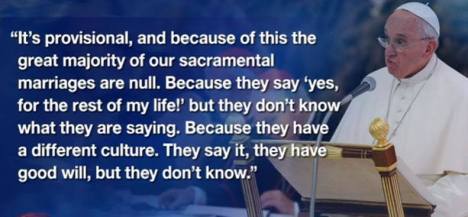
Marriage is based upon human nature. We are sexual beings and marriage is created by God for the propagation of children within the intimate friendship of men and women. Our Lord raises this natural bond to the level of a sacrament. Would not the Pope’s words have every couple question whether or not they are truly married? Culture has a definite influence, but it can no more nullify marriages than a pagan culture can give valid status to same-sex unions. Our presumption is always in favor of the validity of our marriages. Redirecting fault for failed marriages away from the couple to the culture is to strip them as moral agents of their overall responsibility. Would he argue that a clashing culture invalidates other sacraments? If it can negate marriage then what about priesthood? We do not want to go down this road.

SCRIPTURAL LITANY OF MERCY #2

Litany Composed by Fr. Peter John Cameron, O.P. (MAGNIFICAT)

DSC00546

Offered at the 9:30 AM Mass at Holy Family 12-20-15

Throughout the ages, almighty God has manifested his unfailing mercy.
Oh infinite, divine mercy, you are:

Response: Lord, have mercy on us.

Elijah’s unlimited jar of flour feeding the widow.
Elijah’s victory over the prophets of Baal.
The tiny whispering sound Elijah heard on the mountain.
The cure of Naaman the leper.
The new eyesight given to Tobit.
The conquering might of Judith.
The intervention of Esther that saved her people from destruction.
The valor of the mother with her seven martyred sons.
The compassion shown to Job.
The shepherd sung of by the Psalmist.
The lover sought in the Song of Songs.
Divine Wisdom, overlooking sins so that people may repent.
The comfort proclaimed by the Prophet Isaiah.
The expiation of guilt proclaimed by the Prophet Isaiah.
The wolf and the lamb grazing together.
The voice that formed us in our mother’s womb.
The new law within us, written on our heart.
The new heart and new spirit replacing our stony heart.
The spirit and flesh put on once-dry bones.
The rescue of the young men from the fiery furnace.
The espousal of the Lord of the unfaithful wife.
The fish that swallowed Jonah, saving him from drowning.
The preaching of Jonah, converting the great city of Nineveh.
The Day of the Lord foretold by the prophets.

Fourth Sunday of Advent

December 19 & 20, 2015

Celebrant: Almighty God and Father, You have created all things and know the desire of every heart. In this Year of Mercy, we reflect on your great love for us, and acknowledge our sinfulness and need for your healing mercy. Trusting that you never tire of forgiving us, we open our hearts to receive your forgiveness and love. Having encountered you, Mercy itself, and guided by the Holy Spirit, may we witness to the love we have received by sharing it with those most in need: the hungry, the homeless, the afflicted, and the oppressed. We ask this through Jesus Christ our Lord. Amen.

(Archdiocesan Prayer for Mercy)

Once Saved, Always Saved?

KATHLEEN:

Hello, I am a “catholic.” I firmly believe that through my faith in Jesus he has saved me. I, along with everyone else who believes in Jesus already has salvation. We are not going to hell. So my question is why would a “catholic” want or need to wear a scapular? How can one save what is already saved? And isn’t their belief in Jesus enough for salvation?  Thank you for input.

FATHER JOE:

You may be a Catholic, but your assessment of “blessed assurance” is representative of a Protestant view. Indeed, it is the sin of presumption for a Catholic to view himself as irrevocably saved. Certain evangelicals believe in the “once saved, always saved” interpretation that emerged from Martin Luther’s teaching of juridical justification through imputation. Simply put it means that after a faith profession in Christ one is saved regardless of personal sins and weaknesses. Supposedly, we are masked by Christ when the Father looks upon us. The Catholic understanding is different. The ancient Catholic truth has to do with being born again as a new creation. We must be transformed. Faith and baptism makes us members of God’s people, but just as faith can grow, it can sour. The Evangelical would say that if a person becomes a grievous sinner that their earlier faith was counterfeit. Catholics would not nullify or doubt such faith. Instead, we argue that we must grow in the life of grace.

Your view would dismiss a lot more than scapulars. If you are already saved then you would need no sacraments, no Mass, no Eucharist and no Church. That is why those who hold such ideas reject the divine mysteries and reduce the “Church” to a place for fellowship and making converts. Catholicism is the true Bible Church and views salvation in terms of faith and obedient works in charity.

I would recommend that you attend a Parish RCIA program and relearn your Catholic faith.

Catholics live in the sure and certain HOPE of their salvation in Christ. Salvation is God’s free gift to us. But faith is defined as more than believing with our heads. The apostles understood faith as something lived out in faith and obedience. It is in this manner, and the reception of the sacraments, that the life of grace grows within us. The spiritual life is not stagnant but dynamic. We must always be properly disposed to God’s mercy and strength.

Here are some passages for spiritual reflection:

Matthew 7:21 – “Not everyone who says to me, ‘Lord, Lord,’ will enter the kingdom of heaven, but only the one who does the will of my Father in heaven.

John 5:28-29 – Do not be amazed at this, because the hour is coming in which all who are in the tombs will hear his voices and will come out, those who have done good deeds to the resurrection of life, but those who have done wicked deeds to the resurrection of condemnation.

Philippians 2:12 – So then, my beloved, obedient as you have always been, not only when I am present but all the more now when I am absent, work out your salvation with fear and trembling.

Hebrews 5: 7-10 – In the days when he was in the flesh, he offered prayers and supplications with loud cries and tears to the one who was able to save him from death, and he was heard because of his reverence. Son though he was, he learned obedience from what he suffered; and when he was made perfect, he became the source of eternal salvation for all who obey him, declared by God high priest according to the order of Melchizedek.

Hebrews 10:26-27 – If we sin deliberately after receiving knowledge of the truth, there no longer remains sacrifice for sins but a fearful prospect of judgment and a flaming fire that is going to consume the adversaries.

James 2: 17-24 – So also faith of itself, if it does not have works, is dead. Indeed someone might say, “You have faith and I have works.” Demonstrate your faith to me without works, and I will demonstrate my faith to you from my works. You believe that God is one. You do well. Even the demons believe that and tremble. Do you want proof, you ignoramus, that faith without works is useless? Was not Abraham our father justified by works when he offered his son Isaac upon the altar? You see that faith was active along with his works, and faith was completed by the works. Thus the scripture was fulfilled that says, “Abraham believed God, and it was credited to him as righteousness,” and he was called “the friend of God.” See how a person is justified by works and not by faith alone. So faith by itself, if it has no works, is dead….You see that a man is justified by works and not by faith alone.

Argument Over Jesus & Intercession

Georgios argues:

The primary role and purpose of the devil is to take the believer’s attention as far away as possible from the truth and the blue-prints or foundations of Christians, which is the Bible.

He would have us compromise them with unbiblical diatribes so that the believer loses focus upon JESUS.

He would have the Christian weakened by diminution from 100% fidelity to the doctrine of JESUS.

JESUS is the Way and the Truth and the Life— the only way toward the Father-God.

JESUS taught with parables and he is our answer to all intentions in the spiritual process.

The parable of the sinful rich man and poor Lazarus is sufficient to verify that the saints who died are in a place where intercession for people on earth is impossible! What this means is that only the living saints have the right to do so.

God does not give exemptions to the prohibition of acting outside his Word, which is JESUS.

If Mary can intercede for us, then God is lacks constancy with his Word and that is something that God will not do. He will not oppose his Word. If God made such exceptions then he would not be God at all.

Receive this revelation of the Spirit of God— what he is saying to you Now in the mighty NAME OF JESUS!

Father Joe responds:

The devil’s primary aim is one of eternal spite. He would have us corrupted so as to offend God. He would have us embrace selfishness and a disordered love.

The devil knows well the Bible. The trouble is that what he knows, he utterly rejects. While the devil is certainly involved with error, this in itself is not his primary purpose. Good men and women might be confused or ignorant about many matters of faith. They may yet be saved. The devil places an emphasis upon the will. HE especially delights in one who comes close to the truth and then rejects it. The more you know the more that you will be held accountable.

Much of the confusion and fracturing of the Church after the Reformation has to do with men and a rejection of the shepherds appointed by Christ. You seem to infer that the Bible is self-sustaining and interpreting. This is simply not the case— historically or theologically. I suspect that the “diatribes” you condemn are efforts within the Church to prayerfully reflect upon the saving kerygma.

If you have rejected the sacraments and the teachings of the Catholic faith then you have quite literally separated yourself from elements of the revelation received from Jesus Christ. The Church follows the Lord and his two sources for Christian revelation: Sacred Scripture and Sacred Tradition. Only the reformation churches, and not all of them, would utterly reject the second tier established by Christ.

Jesus is also one with the Mystical Body or the Church. That is why the early Church spoke about Christ and our life in the Church as the WAY.

Jesus taught in many ways. Yes, his parables give us insight into the kingdom of God. But he also prophesied, made commands, and witnessed the message of the Gospel.

The parable of the rich man and Lazarus does indeed speak to life after death, although there is some question as to whether Lazarus was in heaven or the limbo of the fathers. Similarly, was the rich man in hell or in purgatory? The gates of heaven are only opened by Christ, and at the telling of this parable, Jesus had yet to undergo his saving trial. Further, the parable does not offer us an instance of attempted intercession as understood by the Church. He requests that Abraham send a message to the living or make an appearance to warn them. The intercession of the saints is directed, not to another saint, but to almighty God. We pray that they will add their prayers to ours in asking God for his mercy and favor.

Actually, the trouble here is you have a very narrow notion of how the Word operates. The Word is written upon human flesh in the incarnation. The Word is breathed into the Scriptures. The Word becomes one with his Holy Church. The Word is given perpetual efficacy through the sacraments. The Word takes to himself a human mother, sanctifies her and gives her to us as a model of the Church. The Word conquers death and all who are alive in Christ can pray for themselves and others, including the saints of heaven.

Who are you to tell God his business? Who are you to make yourself the interpreter for all Christianity, including attacking a Church that was instituted by Christ, gave us the Bible and is the Mother of all the breakaway Protestant denominations? Mary can do as she did at Cana… intercede when the wine runs out.

I would caution you again hubris. You are not God’s special messenger or prophet. You are just one poor confused soul putting on airs to others.

ATHEIST COMMANDMENT 10

“Leave the world a better place than you found it.”

big-bag-of-money-6497-largeThis is a nice platitude but that is about all it is. The truth is that we have very little control over the world. We can try to make a positive difference over our small piece of it, but even here things often do not go our way. Indeed, we might be in conflict with one another as to what makes the world better. Is it technology, more parks, electric cars or gas guzzlers, laws that promote “choice” over human life, legalizing sodomy, what? Those who promote justice for some often want it revoked for others. That was a facet of the religious liberty fight between the Church and the current government administration. Often we experience life as a mess and leave the world in a mess. Despite progress can we say that the world is a better place than in the past? There are still acts of terrorism and genocide. This year it was estimated that the one percent of the world population owns over 50% of the world’s wealth and resources. There is an old saying about this— the rich get richer and the poor get poorer.

We live and we die. Many people just scrape along, try to find some happiness and deal with dreams realized and/or broken. Relationships give comfort and belonging but there is also betrayal and abandonment. We are a society of givers and takers and critics debate as to which it might be better to be.

Catholic Charities is the largest social service organization in the world just behind the U.S. government. Believers are often very generous to those in need. I heard one atheist share his deep regrets that they were frequently shamed by believers in how they respond to the needy and human suffering. Why is that? What is it about the so-called “pie-in-the-sky religion” that also focuses on earthly struggles and pain? Why is it that by comparison non-theistic forms of humanism often become oppressive and part of the problem?

ATHEIST COMMANDMENT 9

“There is no one right way to live.”

Eye-3372-largeAnd what is this supposed to mean? Would the atheist tolerate a radical Islam that covered a woman’s face and body, reducing her to property, denying her an education and life outside the home? Would they turn a blind eye to a pre-civil war south where slavery allowed a genteel life for some and one of brutal servitude for others? This so-called commandment is actually nonsense. The truth is that while there are many different states of life and a certain cultural diversity; nevertheless, there are ways of living that countermand human decency and the laws of God. Keeping harems or same-sex partners would also fall within prohibited acts; however, I suspect the atheist critic wants to make room for deviancy. Once more there is a problem with specificity. Who decides what an appropriate lifestyle is and is not? Failure to make any judgment will lend legitimacy to anything and everything.

The Christian would argue that there is a right way to live and that is to live in right relationship with God and man. Sex outside of heterosexual marriage is a sin. A lifestyle that depends upon the oppression of others is a sin. A life that is addicted to booze and drugs is one that faces imminent destruction. Commercialism and materialism will ultimately fail to satisfy the longing of the soul. We live in such a way, in accordance with our nature, so that we can draw out the best that makes us human. We are social creatures which need to interact with each other in a manner that both preserves human freedom and insures the healthy functioning of society. Putting it bluntly, there are right “ways” of living and there are wrong ways, too.

I am somewhat surprised that that a man who promotes science would suggest this dictum. The Mythbusters devote each episode at dispelling myths and trying to ascertain the truth. There is little truth in this so-called new commandment. As with the proper fuel for a car a protocol before a dangerous experiment or explosion— there is a right way and a wrong or dangerous way to proceed.

This new law is really just an excuse for liberality and unhampered toleration. Not that I think he really means it because I suspect there are elements to the Christian life that he would find personally objectionable. In other words, the rule here is biased with unspoken exceptions. He would stretch the definition of marriage and family. Marriage, itself, might be viewed as an unnecessary human construct. Obviously, the atheist critic would not interpret it as a sacrament configured to give grace.

Man is not the final arbiter of right and wrong. The rejection of this truth is at the heart of many contemporary problems. Everything is politicized, even human behavior. If the law says something is right, many presume that it must be okay. The war against drugs goes badly, so advocates argue for their legalization and taxation. When the prostitution situation resists resolution, there is a lobby that suggests making it legal with defined health or safety standards. Assault against children, even in the womb was reckoned as manslaughter and a war crime but now it is regarded as a right of women to choose. Within living memory homosexuality goes from being criminalized to being protected and promoted as a basic civil right. No matter what the issue or behavior, people no longer turn to ministers or philosophers but to lawyers and politicians.

This process promotes a lie… about human nature, about God and his commandments… and about our sphere of influence. The subjective eclipses the objective. The relative dominates over point of permanence. The end result is that we damage ourselves and all our associations. Not only is there a loss of a sense of sin but also of any concrete definition.

ATHEIST COMMANDMENT 8

“We have the responsibility to consider others, including future generations.”

landscape-with-a-tree-swirl-cloud-4545-largeWhy? God is out of the picture, so why care? No matter what we do, top scientists tell us that the universe is doomed. It is hard enough to care for ourselves and find happiness. Does it really make sense to care for others and generations unborn? We already abort half a million unborn children in the U.S. each year. If the living does not matter then caring about prospective people seems arbitrary and meaningless. Cold and honest atheistic logic cries out: “Maybe it would be better to let the poor and the defective die outright? If we eliminate the world’s refuse, then there will be more for us and the Western elite. We can make the world safe for endangered species by subtracting overcrowding populations of humans. Do we have any more right to the earth than the animals? Show me scientifically that we have an obligation to others and the future! Prove it or give it up. Our personal world might be better off if there were a few less mouths to feed.”

Anyway, we are all such hypocrites. Look at all the stuff we buy these days that comes from slave labor and where people are oppressed. If it is cheaper, it is better… that is today’s mantra. We take advantage of the poor and the worker. The host of Mythbusters can make up this commandment… but even his television show bobble heads and DVDs are manufactured in Chinese sweatshops. We can thus avoid paying local workers at all and pay others a non-livable wage. The rich get richer and the poor get poorer! Yeah, we really care about others… NOT!

As a Christian, I believe that every person has an incommensurate worth. All human life is sacred and we are called to be good stewards of creation. I believe that there is something immortal and lasting about every person conceived into this world. We are all God’s children and God loves you no more or less than he does me. I believe there is an order and a divine plan. It is important to play our part as instruments of divine providence.

ATHEIST COMMANDMENT 7

“Treat others as you would want them to treat you, and can reasonably expect them to want to be treated. Think about their perspective.”

creepy-guy-pointing-6790-largeEarlier I spoke about how there is a certain Christian spillage into the non-theistic environment. There is no table rasa for the atheist in the creation of his godless Decalogue. Here he has essentially borrowed THE GOLDEN RULE from Jesus: “Do to others whatever you would have them do to you. This is the law and the prophets” (Matthew 7:12). Stripped from the commandment is the underpinning of a divine imperative. Also missing is the unique appreciation of sacrificial love espoused by Christ. Our Lord tells us to lend without expecting repayment. He urges us to love those who hate us. He says we must forgive those who hurt and persecute us. This means that we would treat others with compassion and generosity and not measure the cost. Without this appreciation, the Golden Rule might be interpreted as a quid pro quo situation: you rub my back and I will rub yours. There is no bartering when it comes to the quality of love. Once again, there is an element of uncertainty. What can we “reasonably” expect? We might want someone to show us charity and mercy, but in earthly terms are they obliged to do so? Similarly, how far do we put ourselves out for others? Each of us has his own problems and debts. I have heard hard men say, “I ask nothing of others and in return I would like to be left alone by all the panhandlers!” In a cold and cruel way this might be applied to the rule here. I have also heard people say, “Nobody ever gave me a free lunch so why should I have to buy for everyone else?” This reductionism can reach a level where the rule is no more than this: “Don’t try to kill me and I won’t kill you!” The rule is echoed in many cultures and among many religions. However, the full meaning and truth comes clear within the Christian dispensation. God has been good and generous to us. We need to extend this generosity to others.  The matter is deeper than “their perspective” but rather how does God see it?

ATHEIST COMMANDMENT 5

“God is not necessary to be a good person or to live a full and meaningful life.”

priest-10214-largeWhat does it mean to be a good person? What makes life meaningful or worth living? It seems to me that God is like the paper upon which we write. Without him we do not even have the tools or perspective to answer satisfactory either question. The atheist critic contends that the believer is greedy and wants a better deal than the universe gives. Unhappy with a broken world, he argues that theists imagine another world where there is a God who cares and an order that will make sense of the present mess. Karl Marx made much of this “pie-in-the-sky” interpretation of religion. These critics contend that eternal life and the joys of heaven are imaginary rewards fabricated to placate those who are currently suffering or doing without. Note that the rise of American atheism has followed the fall of Soviet communism and the red threat. Many Americans once viewed socialist leanings and atheism as stripes belonging to the same animal. In contradiction, we still find a lingering merger of faith to patriotism. It is almost always the atheist or secularist who throws down the gauntlet: challenging “under God” in the pledge, public prayer, the Bible in schools, the teaching of intelligent design along with evolution and civic toleration of religious symbols.

It is true that sinners and the godless can know good fortune and a level of earthly happiness. But what happens when things do not go our way? The believer finds consolation in his faith, particularly in the face of disappointments, suffering and struggle. Other than taking a mood pill, what does the atheist do when he is facing the prospect of failure, pain and death? What is the meaning of life when everything must be defined in terms of limited mortality? Apart from God, do we even know what it means to be a good person? Why be charitable or self-sacrificing when it costs us and this is the only life we will ever know? Are fornication and homosexuality good? Is adultery only bad when you are caught? Is it okay to steal if you think you can get away with it and there will be no negative consequences? If life gets too hard is it good to take an overdose of pills and end it all? If drugs make you happy then should it not be a personal decision to take them? Is it good to help a scared girl to have an abortion even if believers contend it is the murder of a child? Christians are confused about such matters, too. Many think that simply being good will save them or that following their conscience, even an erroneous one, absolutely frees them from culpability. It does not.

People who reject God might stumble upon being good persons, and there are such things as natural virtues, but I suspect it is usually because they have been touched or “contaminated” by the faith of people around them. It is hard to argue for supernatural virtue or ethical principles or defined commandments when there is no belief in God. It strips the law of any genuine imperative. Precepts become arbitrary or capricious. We see this with the current transition of homosexuality from a crime and defect to a right and gift. Instead of civil laws backing up the laws of God, the laws of men become the final authority and they can change at any moment with the current fads and fashions. Politicians become the new priests and prophets, demanding that vice be regarded as virtue and that moral evil be rendered as good. Morality becomes a matter for vote and legislation, not something imposed by a God in Scripture or from a principal agent behind nature and creation.

Liberalism might rule the day at present, but views can change and we may see an atheistic secular world fighting itself over what is right and wrong. A person might tolerate sodomy but condemn pederasty. The pederast or pedophile might object to bestiality. The bar is increasingly lowered but not every atheist may find he can bend so low in reference to certain indignities. Killing the child in the womb might earn his or her remarks of gratitude as a feminist for women’s rights; but kill a three year old that no one wants might make the same critic puke in disgust. Such is the brave new world we are creating. What we have forgotten is that even Hitler and his Nazis thought they were good persons doing good work with eugenics and holocaust. Today we would stamp them as evil although many of their stratagems against the innocent have been put back into place. I will say it again and again. Without God, we do not know how to be good. Of course, this is a different question than, are Christians actually good? The believer acknowledges that he is a sinner who has fallen short. We need the mercy of Jesus. While God’s grace can make us saints; his law reveals how much we have fallen short and how much conversion we still require. If there is no God then there is no sin and no need for forgiveness. We must also then face a universe that could not care less about us. We can live for a few seconds of a hundred years, but eventually the world will get its way and we will die. We are children of nature and we are destined to die. A fallen world will kill us. We will get cancer or diabetes or heart trouble or something else. The atheist says he is not afraid to live and die. I suppose those who feel they have achieved something might feel this way. But what if you are a “nobody” with nothing going right in your life? Suppose you think that nobody loves you. No one wants you. You might conclude, “I would be better off dead,” and if the atheists are right then you would probably be right. In any case, you will get your wish. You will die. We all do. The atheist has to face the prospect that he will be forgotten. It will be as if he never were. Nothing he did will have any permanent significance. How can one be really happy when the transitory is all that one believes to exist? The story of Job was in response to such concerns. The ancient Jews gave little thought to an afterlife. They saw God’s reward in earthly success: wealth, property and family. But what if evil men should flourish and good or innocent people should suffer? Where is the justice in that? Here is the conundrum and it leaves us with one of two possibilities. Either there is no God or at least none that cares a damn for us or there is a good God who will balance the scales in another life where some will be rewarded and others punished. The former argues that we live in a universe where ultimately there is neither justice nor mercy— a prospect that many of us find too terrible to conceive. The latter claims that there is more to reality than we know and that a just God has given us an innate desire for life and happiness that he will satisfy— not in this world but in the kingdom of Christ.