• Our Blogger

    Fr. Joseph Jenkins

  • The blog header depicts an important and yet mis-understood New Testament scene, Jesus flogging the money-changers out of the temple. I selected it because the faith that gives us consolation can also make us very uncomfortable. Both Divine Mercy and Divine Justice meet in Jesus. Priests are ministers of reconciliation, but never at the cost of truth. In or out of season, we must be courageous in preaching and living out the Gospel of Life. The title of my blog is a play on words, not Flogger Priest but Blogger Priest.

  • Archives

  • Categories

  • Recent Posts

  • Recent Comments

    Anonymous's avatarAnonymous on Ask a Priest
    Michael J's avatarMichael J on Ask a Priest
    Jeremy Kok's avatarJeremy Kok on Ask a Priest
    Mike Zias's avatarMike Zias on Ask a Priest
    Jeremy Kok's avatarJeremy Kok on Ask a Priest

Marriage Still Matters

wedding_16Numbness in conscience inflicts many of the members of our modern society. It is as if people have lost the capacity to distinguish between right and wrong. The values of traditional faith and Scripture are not taken into consideration as credible when moral decisions are made. Further, there is a rupture between our nature and the laws that can be discerned by reason. This leads to a profound disconnect from objective reality. Instead, the notion that man is the measure of all things is extended to a fanciful absurdity. The unborn child in the womb is denied the personhood that comes along with his very presence. The purpose of the marital act is reduced to recreation with the reproductive ends subtracted by contraception. The bodies of men and women are complementary and yet same-sex attraction is made into a legal right even though it is a fiction and not fact. The aberration is counted as normal and any emphasis upon genuine normalcy is discounted as intolerance. The institution of marriage is bombarded by all sorts of threats: divorce, adultery, fornication, cohabitation, etc. Any stigma or embarrassment for having children outside of wedlock is measured as insensitive and mean-spirited. Marriage is regarded as a mere piece of paper, even by Catholics who were taught that it was a sacrament to give grace.

What a mess with which we are living!

Msgr. Pope rightly laments on his blog that many regard “living” in sin as “no big deal.” The misnomer here is that one does not really LIVE in sin; instead, one begins to DIE in sin. Sin by its very definition brings forth suffering and death. It alienates us from the one who created us and from the life present in the soul.

Pastors are challenged when they preach about sin and punishment. They are challenged for stressing judgment when our Lord was apparently all about mercy and love. However, the dispensation of Christ is neither magic nor capricious. You have to love in return. You have to want to be forgiven. Too many live as if there will be no judgment and no hell. While the catechism teaches about the universal call to salvation, this is not the heresy of universalism. God’s gifts can be ignored or rejected. Using a medical analogy, a doctor might be able to treat you but you must be willing to seek him out. The divine physician would heal our souls, but millions prefer the spiritual sickness that comes with hedonism, greed or a spiritual ennui.

I like straight talk and yet such is almost always found offensive by someone. People these days do not like to be told their business. There is an arrogance to sin today that has smothered the guilt that once brought contrition and repentance. Do you want proof? Tell a couple who are having sex outside of marriage that unless they repent they will go to hell. See how they respond. “What we do is none of your business! Who are you to talk to us that way? You can go to hell, yourself! Who are you to judge? We love each other, what is so wrong with that? Who is being hurt by what we do?” The fact that it violates God’s Word is given little or no measure in their evaluation. What they are really saying is this: “No one can tell us what to do, not you and NOT God!”

Msgr. Pope gives us a list of Scriptures that we would do well to review.  If we believe that the Bible is God’s Word, then we should take to heart the saving message:

  • Matthew 5:27-30; 15:19-20
  • Mark 7:21
  • 1 Corinthians 6:9-11, 15-20
  • Galatians 5:16-21
  • Ephesians 5:3-7
  • Colossians 3:5-6
  • 1 Thessalonians 4:1-8
  • 1 Timothy 1:8-11
  • Hebrews 13:4
  • Revelation 21:5-8; 22:14-16

When Caesar will Not Play Fair

A decade ago when I challenged giving Holy Communion to pro-abortion politicians, I was told that we needed these men and women for other important issues and should not burn our bridges. Of course, when push came to shove, these politicians largely abandoned the Church anyway: forcing us to shut-down adoption services because of homosexual inclusion, redefining marriage as something other than one man and one woman, requiring contraceptive and abortifacient coverage to healthcare plans, and tightening the screws on our tax exemption.

Democrats have frequently been demonized for promoting every type of liberality that spurns traditional morality. Republicans have been castigated as uncaring or insensitive to the poor. In truth, both parties are often opportunistic. Republicans liked Pope Benedict. Democrats liked Pope Francis. But both parties play with slogans and listen to lobbyists more than operating from incontrovertible convictions. Real Catholics should know that we belong to Christ more than to any political party. Real Catholics should place the teachings of the faith above the fickle fads and fashions of men. Today the attitude is if it is civilly recognized or law then it is morally okay. This is ridiculous. Catholics must be a sign of contradiction to the world, not an enabler for evil and not a deaf ear.

Are our Catholic people on the same page with the teaching Church? Here is where we find our crisis. Many are not. Many of the political enemies of the Church are self-professed Catholics. Back in 2004, 48 Catholic Democratic members of Congress signed a letter to Cardinal McCarrick in Washington, complaining that the bishops’ statements were counterproductive and “miring the Church in partisan politics.” In other words, the Church was told to shut its mouth! The religious liberty battle stems from this attitude. The Catholic card is played at election time, but once elected they are more likely to follow the money than scruples about fundamental human rights. This often leads to a re-prioritizing of what these rights actually are. As for the rest of us, we can be as Catholic as we want inside the church doors; but once outside the church building, we are expected to surrender to Caesar.

How can we play with any of them when they do not play fair? But what would happen to us if we collect our chips and cards and go home? Would we forfeit any say? Could matters be made worse?

No Where to Run, the Church & the World

It is argued that the Catholic Church has lost the contraception fight and now must move on. Similarly, I am today hearing the same said about other issues. Pope Francis is asked about homosexuals and he says, “Who am I to judge?” Critics rashly interpret this as a change in the Church’s stance and a leading gay magazine names the Pope as “Man of the Year.” A special synod is called on the family and revisionists suggest a coming change regarding the reception of Holy Communion by divorced and remarried Catholics. But the Pope is still Catholic and I think the dissenters are in for a big surprise. It may be that we cannot judge the souls of individuals, but we can make moral distinctions between right and wrong. Those who commit serious sin are not in a proper disposition for the sacraments. The Pope is the servant of the Word, not its master. He cannot invalidate either divine positive law or natural law. Of course, what might happen is that many Catholics will become accustomed to an ever permeating silence— about birth control, about gay relationships, about invalid marriages, and God-forbid, even about the murder of unborn children. Here again with this last point, too many make too much of papal remarks about there being other moral concerns beyond abortion. The fact is the Church is facing conflict from every angle, including the martyrdom of Christians by ISIS swords.

An essential thrust to Vatican II was a dialogue with the world, not so that the Church might be converted to the world but that the world might be more receptive of Christ’s kingdom. Many of us feel that this remains an important mission for the Church. However, critics can rightly point at instances of impotency and weakness toward a hostile world that seems to be more successful than we are at winning hearts and minds. The Church faces a mocking atheistic secular modernity on one hand and a radical militant Islamic extremism on the other. The Church is not only caught in the middle but old friends have changed alliances.

Can the Church engage cultures that feign courtesy when we are on the same side of its agenda but otherwise find ourselves targeted for extinction? Fight against the death penalty for the guilty and we are applauded; but then we are commanded to lay down our arms in the battle against aborting children and euthanizing the sick and elderly. The bishops are praised for supporting healthcare but condemned for not wanting to provide free contraception and abortifacients. The Church was once rendered accolades for her orphanages and adoption services; but today is shut down for refusing adoptions to homosexuals and lesbians. The Islamic world once protected Christian minorities, and utilized them in government and in schools of higher learning; after all, they were the one minority that was so small it would never be a threat to the ruling powers. But today, fanatics will not rest until every drop of Christian blood is spilt or the men are converted. From the Islamic East to the Secular West, there is nowhere to run and no place to hide. It is for this reason that I fear silence. Peace today will only lead to worse wars tomorrow. Silence will be interpreted as assent, or worse still, retreat.

We Awaken to the Problem

The defection from faith is an important issue and why for the past two years I invited a young FOCUS missionary named Katie to give her appeal in the parish. Along with other young adults, FOCUS ministers to our youth on college campuses. The statistics are frightful. Some 80% of our youth fall way while at college. These young adults put their careers and much about their personal lives on hold so that they might make a difference for others.

students

I think in truth the issues began long before our teens headed off for college or entered the work force. Minimally Catholic kids suddenly find that they do not have the watchful eyes of parents upon them. Quickly, they are influenced by peers who have no quarter in their lives for organized religion or traditional values. Liberal faculties deride Christianity and mock the sacraments as the domain of ignorance. Professor Paul Zachary Myers is the most blatant on this list, urging college students to steal consecrated hosts so that he can document on the Internet his desecration of the Eucharist. This is not representative of a civil debate about belief; rather, it is an emotional and militant attack upon people of faith.

College campuses will sometimes have Newman Centers and/or Catholic Student Associations. But many of the Catholic students fail to get involved. The attendance of Catholic students at Mass, even at Catholic schools is often pathetic. The best numbers I have heard are at places like St. Francis in Steubenville, Ohio and Ave Maria in Florida. I know one school where the chaplain schedules Masses at midnight so that students will have less competition for their time. One is more likely to see lewd photos on Facebook than posts about religious epiphanies and retreats or time before the Blessed Sacrament. Of course, many parents might not know because they are quickly blocked from seeing what is actually going on.

I am not saying that efforts to evangelize in college are in vain. Rather, I am suggesting that more could have been done (or done differently) earlier to minimize the damage later on. Catholic schools could also be more proactive with single-sex dorms, expectations about participation at Mass, and an uncompromised message about fidelity to the faith and the living out of the commandments. However, we have a problem— when honors are granted to those who seek to strip the Church of her religious liberty— when organizations that promote a homosexual agenda and lifestyle are given funds and recognition— when health service referrals include artificial contraception and abortions— and when crucifixes are removed from classroom walls so as not to offend— then we have become our own worst enemy.

Women Bishops – The Lights Go Out for Anglicanism

5f0c3e5657ed3b8229685eac8a081987The General Synod of the Church of England voted on Monday to consecrate priestesses as women bishops. Well, there’s the nail to the coffin for the home of Anglicanism. Ecumenism with them will be restricted to soup kitchens, sharing contributions from C.S, Lewis, and appreciation for perfecting the English language. The bridges have been burned to most else. Since women cannot be ordained in truth, this makes arguments about their Masses and the Eucharist mute. Fake priests can only give you a counterfeit Holy Communion. When it came to morality, our ships passed in the night a long time ago. They disregard both Sacred Scripture and Sacred Tradition, wrongly approving homosexuality and dismissing the indissolubility of marriage. Abortion is reduced to a personal choice, far from the Catholic stance that sees it as an assault upon the heart of the Gospel of Life. Their last convention in the States could only agree about how terrible landmines were, as if that is a big issue in suburbia. This is what happens when morality collapses and an “everything goes” mentality takes over. Public opinion and modernity is given preference over divine revelation. Instead of obedience to God, the human becomes the measure of all things— and people are fickle and frequently wrong. The Orthodox churches are lamenting that years of work toward a common faith and even levels of recognition have been thrown upon the garbage heap. Anglicanism, except as a small group received by the Holy See, is destined not to be counted as a branch of the apostolic and “catholic” family of churches. The “reapproachment” with them since Vatican II is now a dismal failure because the Anglicanism of even half a century ago no longer exists. It has been replaced by a mutated structure that will continue to devolve and crumble. Australian Anglicans are arguing that priests might be optional and that the laity can offer the Mass. Fragmented, one segment fights with another, and there is no contemporary pretense of a world Anglican order. Certain traditionalists among them refused the offer of Pope Benedict XVI, hoping to rebuild with a union of conservative African bishops. But how long will it be until modernity will invade that new structure? Ironically, some of them attack the Anglicans who accepted the special offer from the Pope in becoming Catholics. They still buy the prejudices against Rome which were initially an element of their split. Catholicism has its dissenters; but they will have no official weight in the practice of our sacraments and doctrines. The accidentals may change, as with language, but the deposit of faith is safe and sound. As for the Anglicans, could they even agree as to what this deposit consists?

The Anglicans feel that immutable doctrine can be changed by ballot. Here is the vote approving women bishops:

  • House of Bishops: 37 to 2 with 1 abstention
  • House of Clergy: 162 to 25 with 4 abstentions
  • House of Laity: 52 to 45 with 5 abstentions

This move goes against the teachings and pattern passed down from Jesus. There was no woman among the twelve apostles. Jesus did not worry about stereotypes. But this one, he did not break. It was God’s will. Anglicans no longer care. I guess they would say that Jesus was wrong. Of course, this change was anticipated. A long time in the mix, the first ingredient was added back in 1994 when they began ordaining women as priestesses (women priests). Error breeds error. The United States made a woman its chief Episcopalian bishop some years ago, Katharine Jefferts Schori. Before her they elected their first gay bishop. Australian, New Zealand, and Canada also have women bishops. The show continues but it no longer matters. They can wear their pointy hats and play-act all they want— these women are neither true priests nor bishops. Both Orthodoxy and Catholicism are in agreement here. There is no third tier to the Church. Without a valid hierarchy, there can be no true priests. If there is no priesthood, then there can be no Eucharist (sacrifice of propitiation and real presence). If there is no Eucharist, the ecclesial community is not really a CHURCH.  End of Story

Beginning & End of Life Intervention

QUESTION (Deirdre):

I would like to preface my comments by saying that I was raised Catholic. I was baptized, received communion and was confirmed. I am confused on the Church’s stance on fertility treatments to conceive a child. Why is it not okay to use fertility treatments to “artificially” create life but it is strictly enforced to use “modern medicine” and any means necessary to artificially pro-long life, i.e. feeding tubes, ventilators etc.?

RESPONSE:

First, certain fertility treatments are permitted by the Church. This would include medications to induce ovulation, increase sperm count, etc. Second, it is judged wrong to manipulate the elements of life through artificial insemination or in vitro technologies to create new human persons. The reasoning for the prohibition has to do with the meaning of the marital act and the dignity of human persons. The child should never be reduced to a commodity. Further, the Church views every fertilized embryo as a human person with an immortal soul. The freezing of human beings and/or the mass destruction of embryos that are part of this process is judged as the killing of persons.

You make the false presumption that the Church would agree without qualification about technologies that keep people alive. Pope Paul VI established that we are not morally obliged to use every extraordinary means to prolong human life. What the Church would insist on is that we provide necessary hydration and nutrition. Also, we should not employ “active” euthanasia as in suffocating someone with a pillow or injecting them with a deadly poison. Feeding tubes should not be judged as medicinal; however, the stomach can reach a point where because of swelling and infection, such processes of feeding will no longer work. A person may also suffer great discomfort and pain, making such a procedure difficult or impossible to employ. Painkillers like morphine might also inadvertently speed up death, but are permissible as long as out immediate intent is to relieve suffering or pain. The rule about ventilators is also not absolute, especially if there has been liquefaction of the brain. Although, I must say, there is a serious debate among ethicists as to what signifies true death of the human being. The late Pope John Paul II resisted extraordinary means at the end of his life. The Church has no issue with a terminally ill person who wants to die at home or in their own bed. While the Church has important ethical principles, each case varies from another and needs specific attention.

Capital Punishment & Heresy

ASSERTION (PJ):

Proposition condemned: “That heretics be burned is against the will of the Spirit.” (Exsurge Domine). Self-defense of a Catholic community especially is protected by this, not sure about aggression. Capital punishment for heresy is not contrary to Catholicism.

RESPONSE:

It would certainly be contrary to notions about freedom of conscience and religious liberty taught since Vatican II. Even prior to that, many theologians seriously questioned any use of force that was contrary to human dignity and the rights of the individual. The view once held by certain Protestants and Catholics was that physical intimidation and even the prospect of death could be used to compel conversion. The idea, even reckoned by Sir Thomas More, who would face execution himself, was that the one who threatened or murdered the soul was more dangerous than the villain who could destroy the body. Today, capital punishment is generally rejected since it perpetuates a culture of death and there are other reliable ways to punish criminals.

Pope Leo X released his papal bull on June 15, 1520. A somewhat confused or hastily drawn up document, it listed 41 propositions that Martin Luther was commanded to retract under pain of excommunication. Dr. Johann Maier von Eck and a committee assembled the document and the Pope released it as his own. Cardinal Cajetan was concerned about the lack of theological reflection and that minor matters were lumped together with more serious ones. Luther argued against the burning of heretics although other Protestants and even princes that favored his views also resorted to the death penalty. The Pope was also a secular ruler at that time and churchmen resisted the notion that such a penalty could not be exercised. However, the fact that just authority may have such authority is a separate question from whether or not it should be exercised. Today the consensus, even among the Catholic hierarchy, is closer to Luther than Eck or Pope Leo X. Luther cites St. Jerome and the bull makes no reference to it. But of course, this was one question, and one that was disputed even in orthodox circles. The tragedy is that the tone of this document closed the door to any further dialogue with Luther, a man whose temperament needed few excuses to argue and ridicule. He declared the Pope to be the antichrist. The Reformation split had begun.

In any case, a censure of something scandalous like this does not fall under the protection of papal infallibility. Popes can require religious assent even of propositions that have yet to be proven as absolutely true. This would certainly have been the Pope’s right toward an Augustinian priest who had pledged obedience. There are a number of factual mistakes in the bull where caricatures of Luther’s teachings are presented but they fall short of the mark. In retrospect, the Church probably should have taken more time to research the dissenter’s idea. Of course, it was a political climate inhospitable to civil and rational debate. They probably felt they had to act quickly.

Marriage & Willingness for Children

QUESTION (Deirdre):

I was diagnosed as bi-polar when I was 15 years old. I have been on medication for the last 16 years to control my disease. I have always wanted children; however, as I mature, I have realized that being on medication while pregnant is not wise. Neither would I want to bring a child into a situation that could be potentially unstable. So recently, I have been thinking about whether or not I should indeed have a child. If this is the course of action I choose to take, is it accurate that in the eyes of the Church I should never be allowed to get married, to share my life with someone, or enjoy the marital bed all because I chose not to have children?

RESPONSE:

I know bi-polar people who have children and do quite well. You are correct that there are certain medications that can make pregnancy problematical. I have seen this especially with paranoid schizophrenics. As for your question, unless you are married then it is entirely academic as you cannot morally have children as a single person. The Church views marriage as having two purposes: the propagation of the human race and the fidelity of the spouses. Older couples might be infertile but they can still get married. The marital act must still be that type of act that generates new human life even if such an eventuality is unlikely or impossible. Younger couples must want to have children in order to get married in the Church. The priest will ask this question as part of the prenuptial investigation. Rejecting the possibility makes marriage impossible. Indeed, if there is deceit about this, it is grounds for the annulment of a bond. Depending how long you wait to get married, the issue may become academic as the clock is always ticking on female fertility. You can be happy unmarried and there are joys other than those of the marriage bed.

Holy Family Hosted Student Marchers for Life

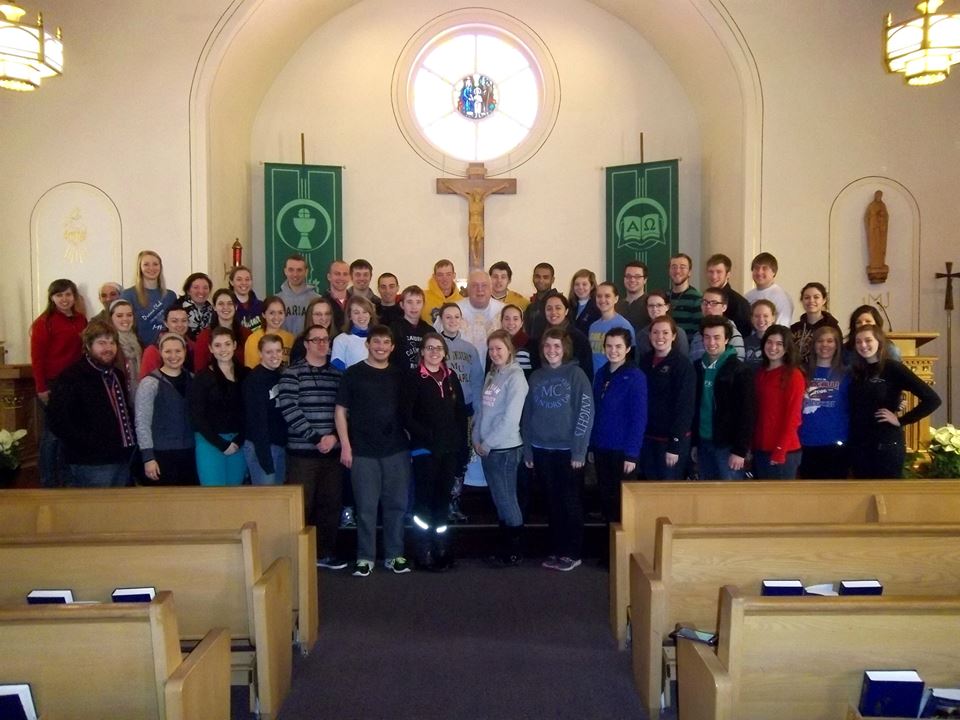
About a hundred students stayed with us from Purdue, Butler and Marian Universities.

1604756_10151915305738435_1005483426_n

We had a pro-life Mass on Wednesday morning before the March. The students from Marian were largely in attendance.

1506494_10151915306588435_1967602046_n

Here are some of the Purdue and Butler students posing before our Cemetery of the Innocents.

God bless these pro-life champions. They braved freezing cold and snow to make a difference.

Question 3 – Extraordinary Synod on the Family

3. The Pastoral Care of the Family in Evangelization

a) What experiences have emerged in recent decades regarding marriage preparation? What efforts are there to stimulate the task of evangelization of the couple and of the family? How can an awareness of the family as the “domestic Church” be promoted?

It seems to me that marriage preparation is frequently too little too late. The class or classes become streamlined so that an obligation might be checked off the list. It seems to me that a successful program would cover basic Christian anthropology and would be so challenging that some couples would even decide not to get married or to continue relationships. We do not want to rubberstamp bad choices or assist people in going through the motions. There is already too much of this with our children. The Archdiocese has standards for catechesis but the guidelines have no teeth and are not binding for advancement. 60% was regarded as passing and yet in my book that rates a failing grade. Are we doing the same with marriage preparation programs? Many dioceses are also pushing off the responsibility to external groups or to individual parishes. But there is no mandated accreditation for these efforts. Some even seem to cloud the truth. For instance, methods of NFP might be taught. However, even NFP is immoral if practiced to avoid pregnancy. It can only be permitted for the spacing of births or to get pregnant. The exclusion of openness to procreation in the marital act is wrong and sinful. Do our couples know this? Are they getting NFP instruction? And is that instruction trustworthy? Hopefully the Theology of the Body plays a large part of such efforts. Catholics should appreciate the sacramental nature of marriage as a covenant established and renewed between themselves and the Lord. A love and passion for persons should be given preference over disorientation or the poison of lust and selfishness. They need to see the family as the little church.

Beyond content, I am also worried about timing. Instruction about marriage and moral human sexuality (not just a biology class) must begin early enough so that mistakes will not be blindly embraced in the dating scene. Courtship should be taught over the popular dating efforts in modern society. The truth that sex belongs only to marriage should be emphasized and witnessed by others. Catholics should also be encouraged to reserve their courtship to Catholics. When a Catholic dates a non-Catholic, we should not hesitate or be embarrassed to emphasize the faith and the joy of conversion to the truth. Such marriages still require dispensations.  Maybe we should require RCIA for mixed marriages and require a year or more waiting period?  If the husband and father is head of the home, it is only fitting that he should be the religious head. If he is not a Catholic, then this is compromised. Similarly the mother and wife should have a Catholic sense taken from the model of the Blessed Mother. A non-believer would not have this benefit. Marriages to Protestants might sometimes be tolerated. Marriages to Jews and especially Moslems should be strenuously discouraged. It is best not to date such persons. I am not arguing for an absolute prohibition but there should be a clear mutual agreement that the children will be raised as Catholics.  Such is for the good of faith, for the Catholic party and the children. I really think we have to rethink how we do things in our secular and diverse culture.

b) How successful have you been in proposing a manner of praying within the family which can withstand life’s complexities and today’s culture?

What is the measure of such success? People do not always share the intimacies of their spiritual lives. I have urged that we talk with God and that if we love someone then we want to know as much as possible about them. Prayer is a two-way communication that enhances and makes real our personal and corporate relationship with Jesus. I put together a small book for parishioners which speaks briefly about the meaning and variety of prayer; I list important devotional works that are part of our Catholic heritage; and I reproduce some traditional prayers. We live in a busy age, but we must make time for prayer, even if only short aspirations. Parishioners asked for and took the little book. Hopefully, along with my pastoral teaching it made some small difference. We instigated the Traveling Madonna (to pray for marriages and the right to life) and the Traveling Chalice (to pray for priests and vocations). I have urged families to set up prayer spaces or shrines in their homes; to consecrate their homes to the Sacred Heat and to have house blessings. I have suggested that couples have a pattern of prayer into which they can later introduce their children. Hopefully, they have taken all this to heart. Trying to transmit our faith and values can be frustrating.  One sometimes wonders if any difference was made.  But God does not demand that we be successful, only faithful.

c) In the current generational crisis, how have Christian families been able to fulfil their vocation of transmitting the faith?

You cannot give what you do not possess. The leaders of the Church played the part of the ostrich with its head in the sand. It was pretended that everything was going well while the house of cards was collapsing all around us. Many only became alert to the problem in the face of an aging demographic and a shortage of funds. If 75% of our people no longer participate at Sunday Mass, I think it is safe to say that the faith is not being transmitted to the next generation. Many are baptized and remain uncatechised. We can no longer count Catholics on the basis of sacraments received. Even among those practicing their faith, it is hard to light a fire for the faith. Parents are supposed to be the chief religious educators of their children, but practicing Catholics increasingly relinquish this role to the schools or to once-a-week catechesis. It just does not work. Past poor catechesis from the 1960’s and 70’s still haunts us. Adults cannot pass on or transmit what they do not have. There are several lost generations. Every Catholic family, no matter whether they use a parochial school or parish-based program, should be in essence a home-schooling family when it comes to our Catholic religion. It is not enough to do homework and count on others.  Religious faith and values should be studied every night without exception. Indeed, the habit of study should remain with our people so that as adults they will continue to explore the depths of our holy faith. But such is right now rarely the case.

d) In what way have the local Churches and movements on family spirituality been able to create ways of acting which are exemplary?

I think such efforts are few and far between. Certainly young adults and teen groups are sometimes the source of religious education, prayer and worship. Small faith-sharing groups were once popular, but some authorities became concerned about the quality of materials and what was being taught. The Rosary remains a staple and the Stations of the Cross are important during Lent. Parishes offer Eucharistic Adoration. Charismatic prayer groups still exist although they seem less prevalent than a few years ago. They also suffered from too much dependence on lay prayer leaders, some of whom became overly intrusive into the personal lives of members. I would encourage the restoration of traditional efforts like the Holy Name Society, Sodalities, and the spiritual works of fraternal organizations like the Knights of Columbus.

e) What specific contribution can couples and families make to spreading a credible and holistic idea of the couple and the Christian family today?

First, we must resist the modern temptation to clericalize the laity with all sorts of Church ministries. Second, everything should be done to foster family life and values. (Catholics and other Christians should refrain from shopping on Sundays and spend time at home. This will also allow believers to be with their families and to be able to worship instead of working. We need to safeguard the Lord’s Day better than we have lately. Third, priests should consecrate the homes of couples in faithful marriages, reinforcing the sanctity of the home and urging them to keep negative elements outside their doors. Fourth, couples should stay together despite the obstacles and treat their fertility as a great blessing to be fulfilled with joy. In other words, love each other, have babies, work hard, and go to Mass. It really is no secret.

f) What pastoral care has the Church provided in supporting couples in formation and couples in crisis situations?

I will speak more about this in later questions, but feel that marriage preparation should be more than a quick Pre-Cana class. Marriage is a life-time commitment. Maybe it needs something more akin to the RCIA? Too often halls are rented and gowns are bought before the couple calls the priest. We need to turn this agenda around. While there are special programs to help hurting marriages; we also need a pool of professional counsellors who would be on call at modest cost to assist couples in struggling marriages. These counsellors should have the mind of the Church. Secular counsellors often see little or no value in permanence and quickly urge clients to separate and terminate relationships.