• Our Blogger

    Fr. Joseph Jenkins

  • The blog header depicts an important and yet mis-understood New Testament scene, Jesus flogging the money-changers out of the temple. I selected it because the faith that gives us consolation can also make us very uncomfortable. Both Divine Mercy and Divine Justice meet in Jesus. Priests are ministers of reconciliation, but never at the cost of truth. In or out of season, we must be courageous in preaching and living out the Gospel of Life. The title of my blog is a play on words, not Flogger Priest but Blogger Priest.

  • Archives

  • Categories

  • Recent Posts

  • Recent Comments

    Jeremy Kok's avatarJeremy Kok on Ask a Priest
    Gary Joseph's avatarGary Joseph on Old Mass or New, Does It …
    Barbara's avatarBarbara on Ask a Priest
    Anonymous's avatarAnonymous on Ask a Priest
    forsamuraimarket's avatarforsamuraimarket on Ask a Priest

Synod of the Family: Revisionist Proposals, part 1

144201609311261

Cardinal Christoph Schönborn of Vienna echoes a few points that will no doubt be discussed at the upcoming Synod on the Family.  (No disrespect is intended to this brilliant man who was the secretary that helped assemble the universal catechism.)  Here is one of the controversial points:

A civil marriage is better than cohabitation because it signifies “a formal public commitment.”

I am not sure about this statement.  Both, in my estimation, are bad.  Might we say that one is worse than the other?  And which is worse?  Cohabitation might leave emotional strings, but after a breakup there would be no civil or ecclesial ties to unravel.  The good cardinal seems to think that people are thrown together chiefly because of financial worries; I suspect he is too quick to dismiss the carnal elements and the attitude that “living together” constitutes either a trial marriage or a viable alternative.  He asserts that civil marriages are better, but for the Catholic, what is it really?  Sure, the state would recognize the bond.  Two Protestants or non-believers married in such a way would be truly married, even if only in terms of a natural bond.  However, the Catholic has turned his back on marriage as a sacrament of the Church.  Indeed, in this age of same-sex marriages, we would not even define marriage as does our secular culture.  The bond is not recognized by the Church and thus has no standing before almighty God.  If the marriage fails, a quick declaration of nullity because of lack of canonical form proves this point.  The bond is not worth the paper it is written upon.  Their sexual congress still constitutes fornication and if there were a prior bond, adultery.  How is this good or better?  Will the Church now seek a demarcation within mortal sin?  If the soul is darkened or dead, the persons are no longer disposed to saving grace.  The role of the Church is not simply to help people feel happy or whole but to give them true mercy and joy in the Spirit.  Our mission is to save souls, not to pamper people who have turned their backs on the Church, her sacraments and basic values.  It may be too harshly said, but where Catholics are involved, civil marriages are to cohabitation what Nevada houses of ill repute are to prostitution.  It might give the profession a certain public recognition and standing, but it is no less damning.

Here is another point listed by the cardinal:

“Instead of talking about everything that is missing, we can draw close to this reality, noting what is positive in this love that is establishing itself.”

The good cardinal applies this, not only to cohabitation and civil unions, but also to second unions and same-sex unions.  I will neglect the last possibility in this reflection because I think there is sufficient cause already to reject the assertion for heterosexuals.  That which is missing is paramount and ignoring or excusing its absence leads to a false analysis of the problem.  The fact remains that sexual activity outside of marriage is immoral and sinful.  Marriage is an institution to foster both spousal fidelity and the propagation of the species.  If you are not married, then you have no right to these goods, even if they are feigned.  What do I mean by feigned?  Pretending to be husband and wife does not make one husband and wife.  Similarly, even in marriages, the marital act is what it is.  If distorted by violence or lust, it becomes a parody.  If couples are made sterile through contraception then the basic meaning of the marital act is short-changed and it no longer signifies the bond or renews the marital covenant.  Let me attempt a silly analogy.  A cowboy facing bandits will be thankful for his gun.  However, he will be intensely disappointed when the fighting starts to find that he has no bullets.  Again, that which is missing can be crucial to any scenario.

This notion of finding the positive in sin or wrongful relationships can lead to a distortion in values.  We can say that such tolerance will not affect doctrine, but this has not yet been proven.  Usually the praxis or discipline is imposed to insure a doctrinal teaching.  Certainly I can appreciate compassion and mercy.  We might also admit that certain relationships will take time to correct and heal.  But the problem that many refuse to acknowledge is that there are some relationships and actions that can never be made right.  If a person is married in truth, a second union is adultery— yes, no matter how satisfying and loving is the irregular union.  Living together and sharing sexual congress outside of marriage is not only wrong, it is the cooperation in another’s sin or a spiritual exploitation.  Many couples acknowledge that they cohabitate because this makes sexual activity more convenient.  Is this the positive element we are seeking?  No!  Civil unions provide little extra in terms of foundational substance, especially when there is “no fault” divorce and half of such unions fail.  Couples might say they grew apart, but increasingly the unstated cause of marital breakup is adultery.  Would not kindness to adulterers be demeaning to spouses who struggle to maintain fidelity?

If we look hard enough, we might imagine something positive in the most tragic of situations.  Indeed, I was asked one time about this in regard to hell.  My response was that it was unlikely the devils would find fulfillment in simply torturing damned souls for all eternity.  I suspect that if there be one positive element it might be the intellectual life.  The demons have incredible intellects, albeit without divine illumination.  As creatures without bodies there would be nothing that corporeal pleasure could offer them.  They would probably seek an escape into their minds.  Of course, no matter how high calipered the debates, hell would still be hell.

The love of fornicators and adulterers might be very tender and gentle.  It might be incredibly affirming and life-giving.  The problem is both what is missing and what is supplied instead.  The sacrament is absent and that which should sanctify them brings scandal and grievous sin.  Their union is built upon a foundation of broken promises and a basic deception.  They give what belongs to another.  They give what they have no right to give.  Like a thief, they steal what does not belong to them.

This proposition collapses entirely with a proper definition of love.  Love is ever so much more than feelings.  Love is sacrificial.  Love is a promise kept.  Love is consecrated by God and such lasts a lifetime.

Increasing numbers cohabitate because of financial insecurity.  The bishops should ask, “Are we here to deplore this phenomenon instead of asking ourselves what has changed?”

It is true that there are financial issues that drive couples to live together, although formerly men and women took housemates of the same gender to share a home. Are they less likely to do so today because others will suppose they are gay when they are really straight? I think too great an emphasis is placed on economics as an excuse or rationale for what is happening. In truth, I think there has been an erosion of the meaning and importance of marriage. Many times I have heard young people, particularly those estranged from the Church, say that marriage is “just a slip of paper.” Boys and girls living together do so largely for what the good cardinal might demote as mere fringe benefits. It makes sexual intimacy easier. When young people start spending time with each other their friends will invariably ask, “When are you going to move in together?” A situation that was once judged as scandalous is now judged as routine or expected.

The good cardinal poses “either-or” questions when there should be a two-fold focus.  We are talking about more than living together or cohabitation, but rather about variations of sexual concubinage. The bishops by necessity should “deplore this phenomenon.” Nothing should deflect their disdain. Too often I hear the complaint that we should not shame the girl or couple, especially if they should conceive an illegitimate child. While the Church is pro-life and the baby is innocent; the parents are not. They should be ashamed of themselves, and this goes back to their living arrangements. These are situations where the rights of children are not properly served and there is a heightened likelihood of abortion. The Church’s moral outrage immediately focuses upon what has changed— a lack of shame and a diminution in the meaning of marriage. Of course, then the Church is attacked as intolerant and mean-spirited. We hear echoed a rhetorical question that emanates from those who have no respect for the Church or her authority, “Who are you to judge?” This repudiation of ecclesial moral assessment is then backed up with a listing of all the latest scandals in the Church, particularly regarding pedophilia and pederasty. By comparison, the Church is imaged as the biggest sinner and a hypocrite as well. Critics say we are looking for splinters while we have planks jabbed in our eyes. Unfortunately, objective truth and genuine moral scrutiny is the victim of this back-and-forth. Right and wrong remain what they are even if the one who cites the misdeed is the greatest reprobate on the planet.

Are we really being helpful?  “There is a risk of easily pointing a finger at hedonism and individualism, when it takes much more effort to observe the realities carefully.”

It may be that the good cardinal is critical of the bishops and the Church for making abstract moral judgments without a regard for how the practical situations of people make difficult any fidelity to the divine moral law.  However, the place for pastoral accommodation is in the Confessional, not in general statements of faith.  There has to be a universal standard.  The Church teaches us what ought to be.  The priest in the trenches deals in a proximate way with what is and the effects of original sin.  Saint John Paul II understood this.  He was concise and clear about questions in the moral order.  His theology of the body was the mastery of his genius.  And yet, this same Pope urged priests to show gentleness and compassion to penitents who struggled with the sin of artificial contraception and the manner of their sexual intimacy.  He urged ministers to take people where they found them.  Jesus ministered similarly.  He brought healing and forgiveness to others but nothing of the Decalogue lost its compelling power.  Indeed, some commands became more intense.  The mere hatred of another makes one guilty of violating, “thou shalt not kill.”  The woman caught in adultery is guilty but he saves her from stoning and opts himself not to condemn her.  Rather he forgives her with a warning to avoid this sin in the future.  The writ of divorce is dismissed and those who do so are charged with adultery.  This sounds harsh but it protected the rights of women who were often abandoned and left destitute.

Each case may have complications that surface.  But one would have to be blind not to see how our society is saturated by hedonism.  The natural desire for happiness and the avoidance of pain is amplified to the level where the pursuit of pleasure becomes everything.  While much of the planet suffers squalor and poverty, Western society is enraptured by self-indulgence.  Alcohol, drugs, sexual promiscuity, pornography, and lurid entertainments saturate our environment.  Keeping the proper custody of the eyes becomes virtually impossible.  Everyone from the elderly to the small child is touched by it.

A stark individualism is often praised in American circles and yet while we delight in freedom, often this can come at the price of another’s rights and the cohesion of duty or obligation for family, for community, and for church.  The slogan for the mentality, at least when it becomes terminal, is the cry, “No one can tell me what to do!”

9 Posts on Milingo & a Married or Celibate Priesthood

  1. BREAKWAY BISHOPS SEEK SUCCESSION THRU MILINGO!
  2. DEBATE ABOUT MILINGO & MARRIED PRIESTS NOW!
  3. Repudiation of MARRIED PRIESTS NOW!
  4. The Church’s Right to Regulate Her Sacraments
  5. Celibacy, Married Priests & Vocations
  6. More about Married Priests, Celibacy & the Vocation Crisis
  7. ARCHBISHOP MILINGO EXCOMMUNICATED!
  8. ARCHBISHOP MILINGO – SCHISM OVER MARRIED PRIESTS
  9. Finishing Up the Archbishop Milingo/Married Priests Debate

These are links to posts from about nine years ago on married priests, celibacy, vocations and the problem of dissent.

RESPONDING TO DR. MILAN KUCERA

KUCERA: Good Grief, such fanaticism from Roman Catholics, if I ever saw such. Open your eyes! There are several dozen thousand married Eastern Catholic priests in the world and in full unity with the Vatican working just fine.

FATHER JOE: Until recently Eastern rite priests in this hemisphere were supposed to be celibate. But this often broken rule was recently made defunct. I suspect as with Orthodoxy, celibacy will virtually disappear (except for monastics). How this will affect Western discipline, I cannot say. But I am not optimistic. The modern diaspora has brought about a mingling of Catholics from the various rites. Something like two million Latin rite Catholics in the U.S. are related by family ties to Eastern rite believers. It is increasingly asked, if they can have good married priests, then why must ours remain celibate? I would argue that celibacy reflects a closer kinship with the model of Christ and St. Paul. Even the Orthodox churches insist upon celibate bishops, acknowledging the higher value of this charism; Roman Catholicism wants to preserve this for all its priests. Celibacy is a discipline, that is true, but it is a discipline with crucial doctrinal implications.

KUCERA: More than that. Until 11th century Roman Catholic priests were often married. There are even six Popes that were married, successors of St. Peter!

FATHER JOE: It is true that the 11th century saw a significant prohibition against married clergy. However, the Church attempted to make the celibacy rule absolute even in the early days of the faith. The problem was the same as now, priests refused to obey. Further, while faith and morals was protected, the popes were not impeccable when it came to their personal lifestyles. The Spanish Council of Elvira (295-302 AD) mandates celibacy in canon 23 upon the three degrees of holy orders. Prior to this, perfect continence was frequently practiced by married priests.

KUCERA: Hardly anything wrong with that, or you speak hypocrisy. The last married Pope (Clement IV) died in mid-13th century!

FATHER JOE: I live out my priesthood with a celibate love. I am in full juridical union with the Church. You cannot claim the same. Indeed, as a lay person you have cast your fortunes with an illicit UK bishop excommunicated by Christ’s Church. Pope Clement IV only took holy orders after his wife died. He was not a married Pope but one praised for his asceticism.

KUCERA: The founder-bishop of Church in Armenia was a married bishop and a venerated saint, Roman Catholic and Orthodox. He was a married bishop, as the New Testament says it should be.

FATHER JOE: Are you making reference to St. Gregory the Illuminator? If do then note that while he was married, he later separated from her to enter monastic life. This seems to reaffirm the value of celibacy.

KUCERA: How precisely is the Roman Catholic Church keeping the order and very specific instruction of St. Paul in 1 Timothy 3:2, huh? It is not. It actually decides time and again to go against the very express wish of St. Paul.

FATHER JOE: The early Church ordained married men by necessity given its quick expansion and the shortage of single candidates. Certain authorities suggest that these married men practiced perfect continence after ordination. This created a tension that was later eased by restricting candidates to single men who could freely embrace lives of celibate loving. It is a case where the Church discipline was modified. Like women keeping silent or covering their heads, the Church could even modify the stipulations recorded in Scripture.

KUCERA: If a man is a married Catholic and hears the call, who are the shepherds in Vatican to say this man shall not be ordained? Is it their priesthood or what? Are they the source of the sacrament?

FATHER JOE: A vocation must be affirmed by the Church. Who are the shepherds? They are the men appointed by Christ to govern the Church. They have every right to make this determination. Christ cooperates with his Church in dispensing his sacraments. Yes, the sacraments and that includes the priesthood, belong to the Church. St. Francis understood this and his communities only ordained as many priests as they needed. Otherwise, the men remained religious brothers. Priesthood is a gift, not an entitlement. No one can demand it. You reject this view because your own ecclesial community has been deemed illicit, having no juridical standing in the Catholic Church.

KUCERA: Saints Peter and Paul provably and invincibly laid their hands upon married men, ordaining them not only into priesthood but also into episcopacy. Come on! A married man being ordained by the Old Catholic, Polish National Catholic or by an Orthodox bishop is just as much a “catholic” priest and within the One Holy Catholic Apostolic Church as any other one. He serves valid and licit sacraments to his flock; and under the circumstances of Dominus Iesus (Vatican, August 2000) also valid and licit sacraments to Roman and Eastern Catholics.

FATHER JOE: Dominus Iesus still claims a truth you apparently reject: [17] “Therefore, there exists a single Church of Christ, which subsists in the Catholic Church, governed by the Successor of Peter and by the Bishops in communion with him.” You claim a lot from your academic pedigree but then you write things that make me wonder about your overall competency. We do not deny that the early Church ordained married men. But the preference remained a celibate priesthood, particularly in those churches closely aligned with the Holy See. The acceptance of married clergy from Eastern rites was a conciliatory move for the sake of Church unity, not a full affirmation or approval of relaxing the discipline. Old Catholic churches are in union with the Anglicans who have a counterfeit priesthood. Like you, they reject papal authority, and not just about infallibility. Like the Anglicans it has moved toward affirming homosexuality and ordaining women. Women cannot be validly ordained and so any sacred orders they had are now compromised and/or dubious. Catholics are now forbidden from approaching their ministers for sacraments, even in the most dire of situations. The Polish National churches are no longer in ecclesial communion with the Old Catholic churches (largely because of their modern liberality). Concessions for Catholics to receive the Eucharist in certain Orthodox churches would not include those faith communities with women priests.

KUCERA: Really, people, open your eyes and stop trying to usurp the sacraments, they are not yours. Every Christian desiring a sacrament and meeting terms for it should be served such sacrament. That is the universal principle of Ask, and You Shall Receive.

FATHER JOE: Nonsense! The sacraments are expressions of the Church’s identity as the great Sacrament or divine mystery. We encounter Christ through the sacraments in the Church. It is vital that those sacraments be valid. The communities you applaud have illicit and in some cases, invalid sacraments. We cannot have everything we want. The task of the believer is to bend his will to that of Christ and to want what God wants. This demands that we walk in the ways of truth. It is this truth that you wrongly compromise.

KUCERA: One day you will stand before your Father in Heaven and you will see your life run its course on his palm. You will painfully and regretfully note all the moments you refused to serve a sacrament that was not up to you to decide to refuse. Truly, have the cardinals in Vatican forgotten they are mere humble servants of Jesus and are cardinals only from His mercy alone, that they deny the call placed in hearts of many young married men by our Father in Heaven? As He has done for two thousand years?

FATHER JOE: Actually, the sacraments are through the instrumentality of the Church. The Lord instituted the priesthood which includes the order of bishop as its exemplar. However, the role of cardinal or elector is a man-made position for the good governance of the Church. The Church always had “episcopoi” or bishops; she did not always have cardinals. There is a universal call to salvation, not to priesthood. There is sufficient freedom in the choice either to get ordained a priest or to get married. God will give couples the grace to be helpmates. God will give the grace to priests to embrace a celibate love. The Church is working with God, not against him. The dissent is yours. You insist that married men must be allowed to be priests or else! You are willing to sever yourself from his true Church so that you can have your way. That is what I perceive as regrettable.

KUCERA: The Church is holy, the men who lead her quite often obviously far from it. I wish there is a huge and steady wave of transfer from Roman Catholic Church to Eastern Catholic Churches and as many ordinations into priesthood of married men in Eastern Rite as possible. I have this in my constant prayers. –Dr. Milan Kucera, ex-novice and married Roman Catholic layman in good standing.

FATHER JOE:

What you leave us with is a curse against the Church instituted by Christ. Concessions toward the Orthodox churches could not be granted to the others you espouse. And yet, even they have separated themselves from the See of Peter. You personally walked away from the religious life and got married. That is your business. But speaking out against Catholic unity is sinful. You will have to account to God for this.

Despite your online attestation, the Catholic Church does not recognize the peculiar David Bell as one of her bishops and his “church” is in schism. This means that his ordinations are also not recognized. Thus, his Roman Catholic Society of Pope Leo XIII and the Igreja Católica Apostólica Brasileira are schismatic communities that have no status whatsoever in the Catholic Church.

Nuncio D’Aniello wrote the following to Cardinal Damasceno on October 8, 2012:

“The Pope Leo XIII community is schismatic and as such cannot receive official recognition from the Catholic Church. Furthermore, bishops ordained in that community cannot carry out a ministry in the Catholic Church as it does not recognize these ordinations. All organizations or associations linked to that society should be treated as one would treat any non-Catholic institution. Having committed the crime of creating a schism, those “ordained” by him will in turn be committing the same crime, incurring a latae sententiae excommunication.”

Are We Validly Married?

Couple-Kiss2HENDRIX:

I got married to a woman I knew through my first wife (whom I didn’t married in a Catholic Church). When I and my first wife were separated, I got married to that women knowing fully well that she got married in Catholic Church before, although she divorced her first husband. For more than two years now, I and the woman are not living together again due to her aggressive nature. Is our marriage valid or invalid according to Catholic Church teachings?

FATHER JOE:

Your comment is a bit confusing as to which woman and lacks significant details.  Thus, it is very hard to give you a precise or clear answer.

Are you Catholic?  Were the other parties Catholic?

A Catholic must get married in the Catholic Church for a bond to be both licit and valid.  Prior bonds aside, marriages outside the Church (as before a civil magistrate or Protestant minister) are deemed invalid. They are not regarded as married either by the Church or God.

Marriages that take place in the Catholic Church are regarded as binding until death.  If an annulment is granted through the Marriage Tribunal then they might be free to get married again.  Otherwise, divorce or no divorce, they are still considered as married.  That means that attempted secondary or tertiary marriages are regarded as invalid.  It is as Jesus reminds us in the Gospel of Matthew, an opening to adultery.

A Response to Marriage, Divorce, Remarriage & Defection

dev

RUFUS:

I am (was??) a Catholic. I am now divorced and in a second relationship. I have no idea what God has in store for me, whether I am going to roast in Hell or simmer in Purgatory; but I am done with the double standards and hypocrisy of the Catholic church.  I still love God and believe in Jesus but I think it is ridiculous to attend church and not have communion; either you are or are not in good grace… there is no middle ground… Hell or Heaven.

FATHER JOE:

It seems the issue is more than a disagreement about the perpetuity of marriage as a sacrament; you quarrel about basic Catholic soteriology. Like many Protestants you would reject the notion of Purgatory and yet this teaching is reflective of divine mercy and the tradition of praying for the dead that we inherited from the Jews of Christ’s time. We must be perfected by grace if we are to enter fully into the kingdom and the heavenly presence of God. Protestants get around this conundrum by positing a juridical imputation over any kind of actual transformation into the likeness of Christ. Thus, people might remain sinful worms but as long as they have faith they can enter heaven because Christ conceals them from divine justice. Catholics believe that all will be unveiled. Unless there is a true conversion and perfection, we could not bear to stand in the divine presence. A process of purgation heals the soul that belongs to God so that it might be purged of the last remnants of selfishness and venial sin. Saints already perfected would indeed rush into heaven. Those who die in mortal sin would be cast into hell. The damned are damned because they place their own will above that of God and his commands. Such souls might say they love God and believe in Jesus, but they fashion for themselves a counterfeit Christ that cannot save them. Hypocrisy is immediately implied with sinfulness from believers; but the Church, while composed of sinners, is holy because Christ is holy. Our Lord called sinners to himself and so the Church must do the same, even if it sometimes compromises her witness. You should have remained with the Church. One more sinful hypocrite would have made little difference— and you had everything to gain from abiding in the house established by Jesus Christ.

As for participation at Mass, this is a fulfillment of the command to keep holy the Lord’s Day. Every Mass is a re-presentation of the oblation of Christ on the Cross, albeit in an unbloody manner. Here too your faith was evidently defective. The reception of Holy Communion is a great gift and the ideal, but you closed that door because of a weakness of the flesh and a heart that loved, not too much, but too little. The prohibition about divorce and remarriage is clearly taught by our Lord in the Gospel of Matthew. Only since the reformation and particularly in the modern era has this teaching been called into question by dissenters. Short of an annulment, the Church’s hands are tied. Jesus is unapologetic, we are talking here about adultery, no matter how one might “feel” about it.

Matthew 5: 31-32

“It was also said, ‘Whoever divorces his wife must give her a bill of divorce.’ But I say to you, whoever divorces his wife (unless the marriage is unlawful) causes her to commit adultery, and whoever marries a divorced woman commits adultery.”

Matthew 19: 3-12

Some Pharisees approached him, and tested him, saying, “Is it lawful for a man to divorce his wife for any cause whatever?” He said in reply, “Have you not read that from the beginning the Creator ‘made them male and female’ and said, ‘For this reason a man shall leave his father and mother and be joined to his wife, and the two shall become one flesh’? So they are no longer two, but one flesh. Therefore, what God has joined together, no human being must separate.” They said to him, “Then why did Moses command that the man give the woman a bill of divorce and dismiss her?” He said to them, “Because of the hardness of your hearts Moses allowed you to divorce your wives, but from the beginning it was not so. I say to you, whoever divorces his wife (unless the marriage is unlawful) and marries another commits adultery.” His disciples said to him, “If that is the case of a man with his wife, it is better not to marry.” He answered, “Not all can accept this word, but only those to whom that is granted. Some are incapable of marriage because they were born so; some, because they were made so by others; some, because they have renounced marriage for the sake of the kingdom of heaven. Whoever can accept this ought to accept it.”

If an annulment can ascertain that a union is “unlawful,” then one might be free to enter into a true marriage. But if the marriage is real then it endures until the death of a spouse.

RUFUS: 

The bottom line is this, if you are Catholic and marry and the marriage, for whatever reason, your fault or not, ends in divorce then if you start another relationship (because God gave us the power of love and the will to use this most beautiful gift), whether a marriage or not, the Catholic church teaches you will go to hell unless you sincerely repent, i.e.. end the relationship and live the rest of your life alone.

FATHER JOE:

Do you think people only hate themselves into hell? I perceive plenty of hate in your words, but you fail to note that love can be disordered or distorted. We can love the wrong things. Ultimately, we are to love God above all else and that means following his commandments. If you love yourself or even another person in a way that is not in sync with divine love, then you manufacture a type of idolatry. True husbands and wives are to see Christ in the beloved. That makes the defection from a marriage into an abandonment of Christ who is signified in the sacramental covenant and union. Note that here you only think about yourself. If you trusted Christ’s words (not just the Church’s rules), then you would have been wary of risking the soul of the person with whom you committed adultery. If you really loved her than you should sooner die than do anything that would place at risk her share in eternal life. Resentful for yourself, you enter into a tirade against the Church. I suppose this is an attempt at self-justification. Instead of facing or even struggling with your guilt, you castigate the Church. Mass attendance would have exposed you to God’s grace, even if you were not fully receptive toward it. Did you attempt an annulment? Or did you just run away? If you go to hell, and we leave that judgment to God, it will be because of your closed disposition to his grace and gift of mercy— not because you fled a Church that was both faithful to God’s law and desiring to show you compassion. The way you talk about “repentance,” you make it sound like a dirty word. The problem here is yours.

RUFUS:

Thinking you can get away with this until you are on a your deathbed and repent at the last minute doesn’t count as such repentance is insincere, as if planned.

FATHER JOE:

No one is saying that you had only the deathbed for which to look forward. That is you speaking. Such cynicism is poison to the hope that should be the life’s blood of every believer. No one would urge you to wait until close proximity to death to repent. However, neither should you malign the sincerity of such conversions at the end of mortal life. Not only do you blaspheme against divine mercy; such an attitude would negate the value of contrition, perfect and imperfect, as displayed by the good thief on the Cross who steals heaven. Ideally we should be sorry because we love God.  Nevertheless, God’s forgiveness will even reach out to us if our faith be largely grounded on the fear of losing heaven and suffering the pains of hell.

RUFUS:

Of course, you could die in a road accident, in which case, you have no time to repent and are going to go straight to hell. So the choice for a divorced Catholic who cannot get an anulment is bleak; spend the rest of your life alone or accept that you are going to hell anyway, so you might as well eat, drink, be merry, whore to your heart’s content, and break just about every commandment in the book. This is ridiculous.

FATHER JOE:

Sin is sin. A mountain climber might miss a footing or a ledge by an inch or by a yard, it is all the same. He would be just as dead. You cannot make one sin an excuse for others. I bet no priest ever told you that you were going to hell. It may be that God faced you with this prospect in your life and you refused to acknowledge your fault. Your problem is not so much with the Church and her catechism but with God and his living Word. I cannot say if you would have gotten an annulment, but if you walked with the Lord then you would never really be alone. Am I supposed to feel sorry for you? I freely embraced a celibate life. There were wonderful girls I knew in my youth who would have made incredible wives and mothers; but I dedicated my life to Jesus and his Church. The trouble with you is that you did not trust and love God enough. Now all you can share with others is venom or poison.

RUFUS:

There is nothing in the bible that unambiguously states this and the outmoded catechism needs to be thrown out and rewritten. This, and good marketing is the only way the catholic church will save itself from the extinction it is suffering.

FATHER JOE:

Does it make you feel better to attack the Church? God’s laws and truths are timeless but you would have us subscribe to the fads and fashions of a fallen world that parades its broken promises. Christ keeps his promise to us. We must keep our promises to him and to each other. Faithfulness still matters. I would call you back to fidelity and the safe harbor of faith. You need not join the world’s chorus in forsaking the Church and Christ. Yes, the Church is increasingly a sign of contradiction. Yes, religious liberty is threatened and faith is attacked. But believers have everything to gain in being fools for Christ. The folly of the world leads only to death and despair. Have faith— have courage— embrace sacrificial love— and come home.

A Courageous or Timid Church?

Msgr. Pope touches a cord on the Archdiocesan Blog that is very dear to my heart, the fact that a “timid” Church is in contradiction to its very nature as a sign of contradiction in the world.

Msgr. Pope speaks of the new secularized faith as “Sad, pathetic, wrong, and cowardly—hardly the revolutionary faith that got Paul arrested. . . . We have got to rediscover how revolutionary our Catholic faith truly is to this world gone mad. And as we proclaim healing and an allegiance to something other than this world, we will become increasingly obnoxious to the world around us. . . . No tame, domesticated Christianity will threaten or change this world. When Paul preached, the people rioted. Modern preaching too often incites only yawns and indifference.”

St. Paul and the other apostles did not qualify the Gospel and so they faced arrest, torture and martyrdom. The early Church was persecuted precisely because the truths of Christ allowed for no compromise or tolerance for participation in false worship. Even a pinch of incense to the Roman gods or to the so-called divine emperor was too much. Today’s world misconstrues the incident of the Roman coin and the likeness of the emperor. When Jesus said give to God what belongs to God and to Caesar what belongs to Caesar, he was avoiding a trick to have him either arrested by the authorities or to be rejected by the crowds as a traitor. Ours is a jealous God. What belongs to him? The answer is everything, even Caesar! Many in contemporary society play games with their Christianity. They create a false image of Christ to follow, one that would have fit in nicely with the pantheon of ancient pagan deities. Indeed, the battle over religious liberty is a symptom of this— as if believers could restrict their faith and values to the inside walls of churches and during Mass. And yet, the dismissal at the end of Mass echoes our commission to take the Good News out into the world. The ideal is not co-existence with the world or evil but rather to plant the seeds for repentance and conversion. Today many Catholics are silent upon important issues. A candidate for the office of governor in Maryland is a “practicing Catholic” and yet he is on the record as pro-abortion, yes even for allowing partial-birth infanticide. How can we reconcile this with the faith? The issues continue to mount: no fault divorce and remarriage, same-sex marriages, lack of support for parochial schools, contraception giveaways in public schools, free contraception, abortion on demand and growing sympathies for euthanasia. Sins are counted as rights and Catholics and their Church are expected to fall in line. Wimpish silence satisfied in the past, and that was bad enough, but today complicity is demanded.

St. Paul would exorcize the demonic, not try to accommodate it. Too often we hear from churchmen that we do not want to alienate politicians on “other issues” that are important to us, like the status of immigrants, or just employment, or the dismissal of capital punishment, or tax breaks for churches, etc. We cower to the power of the secular world when we should bring the authority of Christ to bear on the challenges of our day.

Christianity was persecuted by the Roman Empire precisely because it was viewed as intolerant. Today, much of the faith has lost its teeth. The enablers for the murder of children are invited without sanction to take Holy Communion. Even high level shepherds hypothesize ways to get around or to turn a blind eye to homosexuality, adultery and fornication. We are urged to find a new language, removed from that used in Scripture, so that no one might get their feelings hurt. The fact that these activities might cost people the kingdom and their share in everlasting life does not seem to measure up anymore. Who are we to judge? We are the people given the gift of the Holy Spirit and who follow the Light of the World, dispelling the darkness. What is saving faith? It is courageous obedience to God, qualified by charity. That’s who we are and what we are about!

Counseling for Catholic Marriages

Catholics with marital problems should have readily available avenues within the Church for professional counseling in the hopes of salvaging their marriages.

More can be done to prepare priests for this kind of work but I think there is also a need for full-time professionals with training in psychology and intervention-counseling. These counselors should be well-versed with the Catholic faith. If they are not on the same page with us about human sexuality and the value of marriage, then they can escalate a problem instead of being part of the solution.

  • When red lights appear in the Pre-Cana preparation, referrals can be made before marriages in the Church.
  • When problems develop within marriages, referrals can be made to facilitate healing or reconciliation.
  • When questions arise about sexual identity and remaining in good standing with the Church, referrals might be made to assist people in coping and to counteract bias from non-Catholic sources.

While there are good independent counselors who charge fees, I would also recommend that there be professionals hired directly by the Church. Their salaries might be shared between parishes as within deaneries. They would work closely with pastors, while preserving confidentiality, to either prevent bad marriages or to salvage troubled ones. Such staffing should be viewed as serious as religious education directors, office managers and bookkeepers. In any case, a public list of counselors vetted by the Archdiocese should be readily available to pastors and the people they serve.

Catholic marriage counseling is necessarily different from that which is offered by those who do not share our understanding of marriage or our views about human sexuality. These counselors need to discern how a troubled Catholic marriage might be fixed. The truths of faith are integrated into our appreciation of psychology. The goal is to have couples living a daily vocation where there is both joy and sacrificial love. Marriage is viewed as a covenant and as a permanent union. Too many quickly jump to divorce as the answer. Catholics should see that as an option generally taken off the table.

Instead of urging an immediate divorce, a separation might be promoted so as to further the conversation or to prevent verbal and/or physical abuse. If a marriage has terminal problems and cannot be salvaged, then the counselor might suggest an annulment. That is where the pastor and/or the officials on a Church Tribunal would enter the picture. However, this is inherently always a sad or tragic situation. It means that avenues to save a marriage have failed.

Right now we have noble efforts like Retrouvaille but there is a pressing need for something more clinical.

A Few Thoughts about the Synod Relatio & Debates

My head is spinning about some of the things that are being seriously argued at the Vatican’s Synod on the Family. I am already concerned that a Commission was established to look at streamlining the process for annulments even prior to the start of the Synod. It seems to me that if such were a concern then the bishops would then request the Holy See to do so. Will the documents which will be formulated reflect the majority view and Catholic tradition or will there be attempts to steal the show for the minority progressives?

synod-of-bishops

What is it about this new Synod document that has critics saying it signals a revolutionary shift in favor of same-sex couples? It is acknowledged that this “relatio” urges clergy to make “fraternal space” for homosexuals. But what does it say? We read:

“Homosexuals have gifts and qualities to offer the Christian community: are we capable of welcoming these people, guaranteeing to them a further space in our communities? Often they wish to encounter a Church that offers them a welcoming home. Are our communities capable of proving that, accepting and valuing their sexual orientation, without compromising Catholic doctrine on the family and matrimony?”

Are we reading the same document? All I see are questions. Hopefully they are not rhetorical. Do we eject gay brothers and sisters from our churches? No we do not. Can we invite them forward for Holy Communion? Yes, provided that they maintain chaste and celibate lives. Can we affirm or value their sexual orientation? No, we cannot do so. Such would devalue the true meaning of marriage and human sexuality. We cannot move away from the assessment of disorientation or that same-sex carnality is mortal sin.

As a so-called case-in-point of past intolerance, the news contrasted this development with the story of Barb Webb who was fired from a Catholic school when she and her partner announced her pregnancy. Similarly, her partner, Kristen Moore was asked to resign from her post as a music director at a Catholic parish. The secular media glossed entirely over the moral issues that extend beyond same sex unions, like the freezing of embryos, donated semen and IVF technologies. All these elements are reckoned as moral evils and sinful.

This relatio is being interpreted precisely as Cardinal Kasper would suggest. The doctrinal truth is eclipsed, if it remains, for the sake of a pastoral provision or slackening of discipline. The same reasoning he uses for divorced and remarried couples is being applied to active homosexuals. I find this reckoning very disturbing. Discipline can be distinguished from doctrine but discipline is always at the service of doctrine. There are doctrinal elements that cannot be ignored. It is contradictory to say that gay acts are sinful and then to value, in any way, homosexuality. It is contradictory to say that marriage is a lifelong institution and that divorce is a sin, while inviting couples to receive Holy Communion who are living in adultery. The truths of Scripture are clear and we must always be at the service of the truth on every level: doctrinally, canonically and pastorally.

The document recognizes that same-sex couples live lives where they render “mutual aid to the point of sacrifice [which] constitutes a precious support in the life of the partners.” Critics are saying that this is a crack in the door that may one day lead to full acceptance. I would say that this is not the case. The statement is one that reflects the immediate horizontal human condition but says nothing about the vertical supernatural dimension. It is a mere statement of fact that these couples support each other in their day-to-day lives. However, this does not mean that they are in right standing before God. Mortal sin is still mortal sin. I suspect that there are many “nice and pleasant” people who make good neighbors and yet will suffer damnation and hellfire. We are not saved by simply being nice but by being faithful and obedient to God. The Church can relax certain disciplines but she cannot change divine positive law. My fear is that tolerant language might enable or encourage more sinners to remain within their sins. The Church must be a place for saving truth and grace. She should never be an enabler for sinful lifestyles or blasphemous acts like receiving the Eucharist while ill-disposed or in mortal sin. This document does NOT acknowledge the “holiness” of such couples as was suggested in the Huffington Post article by Antonia Blumberg (1/13/14). It simply asks if we might tolerate with passivity and silence the situation of people living in sin.

I cannot buy this application of any “law of graduality.” No matter how slow might be the movement to holiness; the Church should never compromise on the fullness of truth. Confessors can exhibit great understanding and compassion for married couples who use artificial contraception, with the hope that they will eventually come around to the Church’s understanding of human dignity and the full value of the marital act. It is here that I can well appreciate “graduality.” However, this is not the same as cohabitating, adulterous and same-sex couples. They have no right to a shared bed.  In their regard, where there is neither contrition nor amendment of life, absolution must be withheld. Similarly, while they should attend weekly Sunday Mass, they should abstain from taking Holy Communion. The priest will not usually embarrass people in public but he fails his sacerdotal charge if he does not challenge such couples in private.

This law or better yet, theory of graduality was very much the rationale for the “open table” of Anglicanism. It was hoped that this welcoming to receive the Eucharist would draw others into greater unity. Contrastingly, the “closed table” of Catholicism sees Holy Communion as an expression of an ecclesial unity that is already realized. This is representative of the ancient tradition wherein heretics and grievous sinners were denied the sacrament or even excommunicated. The Church’s censure of interdict would also illustrate this posture. One had to be properly disposed and graced to receive the sacrament. Anything less was judged as blasphemous and scandalous. One should not pretend there is a union that is not truly there. This resonates with the current debate about divorced and remarried couples as well as with active homosexuals. We cannot allow a false compassion to tolerate normalization for the sake of public acceptance while the pastoral accommodation is deceptive to the doctrinal truth and the spiritual state of souls before God. We can move away from using pejorative biblical terms like “sodomites” and “adulterers,” but the underlying reality will remain the same. Does this really serve the summons to repent and believe?

If we change the discipline for those in serious sin and the intrinsically disordered, would we not logically have to open up Holy Communion to others (particularly Christians) who might be in ignorance of the full ecclesial reality but who live moral lives? It is a real can of worms and I would prefer to leave it closed. But that is my opinion.

Relationship between Discipline & Doctrine

It is unusual to hear a debate between bishops aired in the press and public forum. Continue to pray for all the participants in the Vatican Synod of the Family.

Cardinal+Walter+Kasper-300x229

Cardinal Kasper:

“Nobody denies the indissolubility of marriage. I do not, nor do I know any bishop who denies it. But discipline can be changed. Discipline wants to apply a doctrine to concrete situations, which are contingent and can change.”

archbishop_wuerl_elect

Cardinal Wuerl:

“The reception of Communion is not a doctrinal position. It’s a pastoral application of the doctrine of the Church. We have to repeat the doctrine, but the pastoral practice is what we are talking about. That’s why we are having a synod. Just to repeat the practice of the past without trying to find a new direction today is no longer tenable.”

“That’s going to be the challenge, and I think that’s what the Holy Father is calling us to do. He’s saying, we know this, we believe this, this is what is at the heart of our teaching. But how do you meet people where they are? And bring them as much of that as they can take, and help them get closer?”

235148-cardinal-timothy-dolan

Cardinal Dolan:

“When we talk about some time of renewal and reform of our vocabulary, we don’t mean to soften or to dilute our teaching, but to make it more credible and cogent,” he said. “It’s not a code word for sidestepping tough things; it’s more a methodology.“

Cardinal_Burke

Cardinal Burke:

“There can’t be in the Church a discipline which is not at the service of doctrine.”

“The reformers were saying: ‘Oh, we’re not questioning the indissolubility of marriage at all. We’re just going to make it easy for people to receive a declaration of nullity of marriage so that they can receive the sacraments.’ But that, is a very deceptive line of argument which I’ve been hearing more now in this whole debate.”

cardinal_pell

Cardinal Pell:

“As Christians, we follow Christ. Some may wish Jesus might have been a little softer on divorce, but he wasn’t. And I’m sticking with him.”

“We’ve got to be intellectually coherent and consistent.  Catholics are people of tradition, and we believe in the development of doctrine, but not doctrinal backflips.”

“Communion for the divorced and remarried is for some — very few, certainly not the majority of synod fathers — it’s only the tip of the iceberg, it’s a stalking horse. They want wider changes, recognition of civil unions, recognition of homosexual unions. The church cannot go in that direction. It would be a capitulation from the beauties and strengths of the Catholic tradition, where people sacrificed themselves for hundreds, for thousands of years to do this.”

muller_CNS

Cardinal Müller:

“One cannot declare a marriage to be extinct on the pretext that the love between the spouses is ‘dead.’  Indissolubility does not depend on human sentiments, whether permanent or transitory. This property of marriage is intended by God himself. The Lord is involved in marriage between man and woman, which is why the bond exists and has its origin in God. This is the difference.”

Racism, Semen & the Designer Child

The article entitled “White woman sues sperm bank after she mistakenly gets black donor’s sperm,” by Lindsey Bever ran on October 2, 2014 in THE WASHINGTON POST about a white lesbian couple litigating against the sperm bank that gave them semen from a black donor when they had specifically asked for white only.

johnny_automatic_young_lady

Jennifer is all upset about the mix-up. She lives in a white Ohio neighborhood and says that she does not want her daughter to face the discrimination she has suffered. The little girl conceived is now two years old. She is suing the sperm bank for “wrongful birth and breach of warranty and economic damage.” Her money was refunded and she was given an apology, but this is not enough for her.

She seems blind to her own initial prejudice and how the whole process reduced a child to property or a commodity. Every child conceived (even if in sin) is a unique individual. Different semen would have meant that a different child would have entered their lives. Instead of prizing the child they have been given, the couple are lamenting the loss of a child they might have had. This is petty and sickening.

Would they look this little black (or bi-racial) girl in the eyes and tell her that they would rather trade her in for a straight haired, blue-eyed white child? Probably not, but in a fashion that is what the lawsuit is doing as they project their anger and disappointment upon the sperm bank. Such places should not exist so I would shed no tears if they should have to close. But I have no sympathy for this couple either. My sadness is for this child.

Instead of rejoicing in the miracle of her child, the article says the mother wept about the mistake. “All of the thought, care and planning that she and Amanda had undertaken to control their baby’s parentage had been rendered meaningless. In an instant, Jennifer’s excitement and anticipation of her pregnancy was replaced with anger, disappointment and fear.”

We are told that not all her friends and families are “racially sensitive.” In other words, her circle is composed of racial bigots. It sounds to me that this couple was not “sensitive” either. They are saying that they wish they could do it over again. Where is the gratitude in this? Would they trade her in for a white child? There is an old saying, “Birds of a feather flock together.” One is known by his or her friends. The problem is not the child, but the people with whom the couple associates.

The fact remains that same-sex couples cannot naturally have children. They must conceive either through heterosexual fornication or immoral medical intervention. There is no actual sharing of DNA even if they find donors of the same race. In this vein, there is a fiction or personal deception that taints this situation. The silliness of the upset is amplified when the mother talks about problems in finding hair care for an “African American girl.” Did she imagine brushing the blond hair of her pasty white girl with curls? Now she wants to hold others accountable when in my estimation they are all guilty, that is everyone but the child.

This is just the beginnings of a moral issue that will grow worse in the years to come, especially with increased DNA manipulation. The issue is human selfishness and the desire for designer children. Would she have aborted the child had it been a boy? Were boy fetuses aborted?

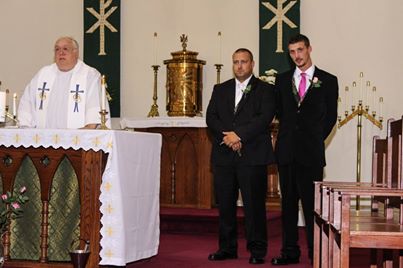
Recent Wedding at St. Mary’s

10710811_10100208428090753_5104784494930251522_n

A few pictures from a Wedding at St. Mary of the Assumption this Summer. Beautiful couple!
10622839_10100208422956043_3353013905157015087_n