
• Our Blogger

    Fr. Joseph Jenkins

  • The blog header depicts an important and yet mis-understood New Testament scene, Jesus flogging the money-changers out of the temple. I selected it because the faith that gives us consolation can also make us very uncomfortable. Both Divine Mercy and Divine Justice meet in Jesus. Priests are ministers of reconciliation, but never at the cost of truth. In or out of season, we must be courageous in preaching and living out the Gospel of Life. The title of my blog is a play on words, not Flogger Priest but Blogger Priest.

  • Archives

  • Categories

  • Recent Posts

  • Recent Comments

    Anonymous's avatarAnonymous on Ask a Priest
    Michael J's avatarMichael J on Ask a Priest
    Jeremy Kok's avatarJeremy Kok on Ask a Priest
    Mike Zias's avatarMike Zias on Ask a Priest
    Jeremy Kok's avatarJeremy Kok on Ask a Priest

Heated Conversation Over Annulment Article

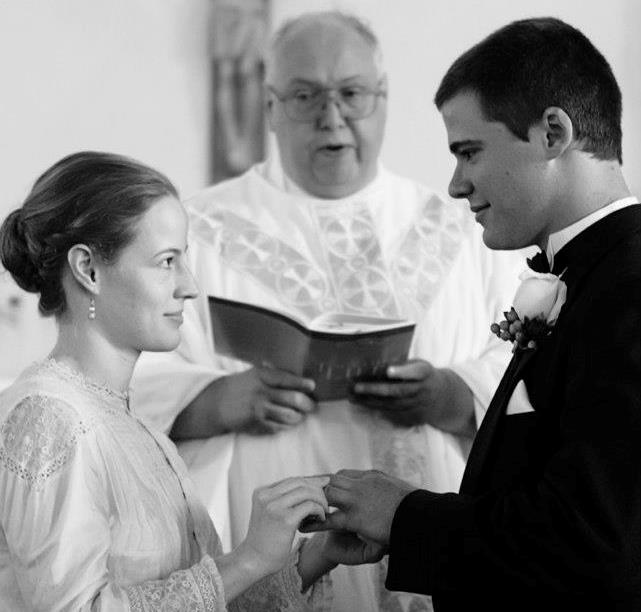
wedding125

This morning I was alerted on Facebook to a commotion on the Internet regarding an article by a brother priest of the Archdiocese of Washington.  Another priest, Msgr. Charles Pope, who authors the Archdiocesan blog noted:

“I was saddened to see that a priest of my Archdiocese wrote a rather harsh article on Church Marriage teaching. I do think we need to look to clarify the annulment process but I guess I would reform it in very different ways than Fr. Peter Daly says. Anyway, Ed Peters does a pretty good job here of answering my brother priest.”

I said my prayers, offered Mass and then tracked down the article and Dr. Peters’ response.  CATHOLIC WORLD REPORT aligned itself with Dr. Ed Peters as did Father John Zuhlsdorf on his blog.

Doctor Peters versus Father Daly

The first thing that Google found was the site for the canonist Dr. Edward Peters.  He offered a stinging rebuke to Fr. Peter Daly’s NATIONAL CATHOLIC REPORTER article on reforming annulments.  While the issues at stake were vitally important, saying that it was harsh would be an understatement.  Castigating my brother priest as sarcastic and childish, he critiqued Father Daly’s article, saying:

  • He violates the “heart of Church teaching on the permanence of marriage.”
  • He is “repackaging common historical errors, irrelevant platitudes and bad theology.”
  • His dismissals of the juridical are “complaints about Christ’s economy of salvation.”
  • Fr. Daly does not want reform of annulments but their “abandonment.”

Wow, regular readers are aware that I routinely struggle with a pugnacious manner of my own, but goodness, Dr. Peters certainly pulled no punches!

I guess I was going about this backwards.  What did my priest friend say that merited such rebuke?  I tracked down Fr. Daly’s article at the newspaper site.

Oh boy, what can I say?  As another parish priest, I will share my (personal) position, hopefully with an ample supply of charity.   So what did he write to cause all the Internet chatter?  The article is entitled, “Pope Francis Should Consider the Church’s Outdated Annulment Process” (January 13, 2014) by Fr. Peter Daly.

True Sensus Fidelium

He admits that the catalyst for the article was the recent request from the Holy See for input in the upcoming special Synod on the Family.  Along with many others, he is excited by the apparent new openness of the Magisterium to hear from the rest of the Church, the rank-and-file priests in the trenches and the laity in the pews.  (Some critics are arguing that the survey was only addressed to the bishops but this is not strictly true.  The bishops sent the questions to priests and the faithful for collaboration.  Several dioceses placed the questions online for quick electronic responses.  Deadlines were give clergy and laity as to when to send in their answers.)  He stamps this change of direction as a miracle and writes:

“In our top-down hierarchical church, the concept of the sensus fidelium has been pretty much a dead letter since the Second Vatican Council. Usually Rome talks and we listen. But now he wants to hear from us. Thank you.”

Certainly, there is much to be said about listening, but we all still have different roles to play and ultimately the response of sheep to a shepherd is that of obedience.  As for the sense of the faithful, we must be wary of the fact that many if not most today are formed more by a secular, hedonistic and materialistic world than by the Gospel.  Only those believers who maintain the core truths, worship, and conscientiously live out their discipleship are truly agents of sensus fidelium.  You cannot transmit or develop what you really do not have.  I would suggest that fallen-away uncatechized Catholics and the majority of dissenters do not qualify despite the fact that someone spilled water over their heads decades ago to appease aging grandparents.

The Protestant Practice & the Orthodox Model Fall Short

Father Daly takes the survey from Rome and narrows his focus to the question of annulments.  His response is blunt:  “scrap our current annulment process and look east to see what our Orthodox brothers and sisters are doing.”  As a priest in good standing, he rightly asserts that Jesus did not approve of divorce and remarriage.  (I have often been amazed at the mental gymnastics that certain Protestant churches must employ to get around this restrictive teaching, especially in the Gospel of Matthew.  They make wiggle-room where there really is none.  But is Father Daly trying to force wiggle-room?)  He also knows full well that the current annulment process is an effort to respect this teaching while showing compassion to our people.

He brings up the Orthodox churches of the East which allow second Penitential Marriages as a possible solution.  But many of us fault it as a negative symptom of national churches.  Remember that Roman Catholicism was willing to allow the entire English church to slip away over the issue of marital permanence and King Henry VIII.  Would we now backtrack and say we were just kidding about the gravity of this issue?  Neither Sir Thomas More nor Bishop John Fisher can be given back their heads; and neither can we really turn back the clock on licit and valid marriages.  Along with certain Protestant notions about faith, authority and Scripture that are trying to get a foothold in the Eastern churches, especially those transplanted into the West, this issue of second marriages may be a greater hurdle to ecclesial reunion than either the Filioque Clause or Papal Primacy.

The annulment process might need to be reworked, but I do not believe the Orthodox provide a viable alternative.  Although not as shallow as our Anglican friends, the Orthodox might hide a false caricature of marriage behind elaborate ceremony and the pretension of sorrow.  True contrition means reform or change of life.  The so-called Penitential Marriages just give the couple their own way while feigning some degree of anxiety in conscience about it.  Father Daly insists that the matter should rest entirely with one man, the priest on the ground.  But he and I know that priests are not the same and there are some who may wrongly replace the Gospel with their own opinions and sentiment.  The Tribunal seeks an objective reality.  Is the prior bond a true or false marriage?  There are the judges, an advocate and the defender of the bond.  Beyond these five or more people, the judgment rendered will be reviewed again by another Church court.  They study the facts of the case and hopefully are neither susceptible to the manipulation of money nor to a false compassion.

I must admit that I am devilishly amused by Father Daly’s Episcopal priest-friend finding delight that the Catholic Church’s stand on divorce and remarriage will always give cause for the “Episcopal church.”  The shadow of the reformation still falls upon us.  His friend may be right.  Indeed, I would add (perhaps without charity) that until the final judgment, there will be a place for the Episcopalian church so long as sinners cling to a counterfeit priesthood and Mass, the fantasy of priestesses, the blessing of same-sex unions, the promotion of contraception and tolerance for abortion, the marrying of adulterous couples and the reception of renegade Catholic priests who want to bed their paramours.  Goodness me, I really have to work harder on my ecumenism!  But I would rather be a member of the Church that goes to heaven than the “church of anything-goes.”

The Pastoral versus the Legal?

Father Daly writes:

“The problem with the process in the Roman Catholic church is that it takes what ought to be a pastoral matter and turns it into a legal one. It is complicated, often unfair, and frequently unintelligible to the participants. Some tribunals are easy. Some are hard. It can be very capricious.”

(Is the use of the small “c” in Church an editorial liberty taken by his newspaper?)  As a civil lawyer, Father Daly has a point.  The subjective elements in how many cases are handled can be very worrisome.  Although I would usually be cold water to Father Daly’s hot, we agree upon this much.  The annulment process is not easy.  Formal cases require people to revisit all the pain and betrayal that poisoned their unions.  Adequate grounds have to be discerned in the muddle of mutual allegations and tears.  Witnesses are gathered.  Interviews are given.  Essays are written.  Then a thousand dollars and a year later a verdict hopefully emerges from the backlogged Tribunal.  That verdict is then reviewed by a second court that can approve or send it back.  Most applicants I have assisted seem to get declarations of nullity, but not all.  Sometimes I have to scratch my own head about the grounds.  But I am not a canon lawyer and would not want to be.  I pray for those who must spend so much of their lives and ministry ruminating over the dark side of life and marriages gone sour.

Father Daly desperately wants to be welcoming to those attracted to Catholicism.  While I have serious disagreements with him, he obviously cares and grieves about those estranged by marriages gone bad and new bonds that are not recognized.  My heart also bleeds for the few who wanted to save their marriages— angry and weeping daily at what they see as complicity in allowing their spouses to marry again in the Church.  Annulments are very staggering in principle and practice.  We are saying that couples previously regarded as married, even before a priest in Church, are not really married and that there is no sacrament.  Some defect invalidated the meaning of their marital act (sleeping together, i.e. sexual congress), having children and living a common life.  They said in their vows before God and to each other that they would forever be faithful and endure all hardships for each other.  But now we hear that someone lied or was incapable of living out the vocation or was mentally ill or had no intention of being faithful or practiced deceit or really did not understand what he or she was doing (after a six month wait and pre-Cana instruction).  One or both of the spouses want out.  It may be a year or twenty years later, but they feel entitled to start over.  Father Daly and I both help such people to begin again, although I am left troubled in conscience by many cases.  People even joke these days, “Promises are made to be broken.”  However, I was raised to believe that vows were made to be kept— in marriage and in the priesthood— even unto the Cross.

I certainly understand the RCIA dilemma for divorced and remarried candidates but there is no good way around it.  Fr. Daly argues that “All the annulment process does is put a road block in their way to entering the church.”  I would contend instead, that the barrier is their failed marriage and their attempt to bypass divine law in marrying again.  The annulment is the Church’s way of respecting the indissolubility of the sacrament while trying to help a couple out of the mess of their own making.  The process has its faults and is not perfect.  But, we would have them authentically married and delivered from the bondage of grievous sin.  It is not just or charitable to ignore a problem that damages their relationship with God and his Church.  They may not subjectively be aware of how much they need this healing.  We should not side-track or halt this process.

Speaking about non-Catholics having to get annulments before entering the Church, he writes that the process is “painful and pointless.”  I have to admit that this use of the word “pointless” makes me cringe.  It may be that the good Father is employing a degree of hyperbole.  He writes:

“They have to find witnesses, get records, take statements, dig up old contacts, and open old wounds. All of our language is legal, not pastoral. We speak of petitions, tribunals, witnesses, advocates, petitioners, defendants and evidence. It is Kafkaesque. It turns pastors into bureaucrats, to no purpose.”

I certainly appreciate his frustration and empathy for the people he serves.  But I would not say it is pointless or lacking purpose.  How else might we make something that is wrong into something right?  It is a difficult business but life is hard and frequently a real mess.  There was a time when divorce was illegal and annulments were rarely or not granted.  I am sure that Father Daly would not have us backtrack.  At least we are trying.

Father Daly says that he has taken “the pastoral route” for the elderly and terminally ill— in other words, he has invoked internal forum.  I have no comment about this.  It is the business of the confessional.  As long as a couple is not engaging in sexual congress and there is no danger of scandal, the priest may have certain discretion.  But I would be very careful about how far I would stretch this pastoral stratagem.  Dr. Edward Peters seems to read more into it; he wonders what he means and warns that if he married such people then these rites are “gravely illicit” (Canon 1085 § 2), “possibly invalid” (Canon 1085 § 1) and/or “sacrilegious” (Canon 1379).  He states that it would be an “abuse of ecclesiastical power” (Canon 1389).  I suspect that all Fr. Daly is doing is helping sick and elderly people to face their last days in right relationship with God.  I would not make more of it than that.

God Opposes Divorce & Remarriage

While all must follow natural and divine positive law, only Catholics are obliged to follow “man-made” Church laws.  (Of course, some Church laws reflect God’s explicit providence and cannot be abrogated.)  Heterosexual marriages between Protestants are acknowledged as sacraments, no matter if witnessed before a minister or civil magistrate.  Marriages with those not baptized are natural bonds but are also generally regarded as fully binding (with the possible exception of referral to the Pauline and Petrine privileges).  Homosexual unions between anyone, anywhere, are not true marriages.  A Catholic must pledge his or her marriage vows before a priest or deacon.  This law could change but it is unlikely and probably unwise to tamper with it.  Divorce is forbidden by Jesus (Matthew 19:3-9):

Some Pharisees approached him, and tested him, saying, “Is it lawful for a man to divorce his wife for any cause whatever?” He said in reply, “Have you not read that from the beginning the Creator ‘made them male and female’ and said, ‘For this reason a man shall leave his father and mother and be joined to his wife, and the two shall become one flesh’? So they are no longer two, but one flesh. Therefore, what God has joined together, no human being must separate.” They said to him, “Then why did Moses command that the man give the woman a bill of divorce and dismiss [her]?” He said to them, “Because of the hardness of your hearts Moses allowed you to divorce your wives, but from the beginning it was not so. I say to you, whoever divorces his wife (unless the marriage is unlawful) and marries another commits adultery.”

Nevertheless, there is the irony that no Church annulment case can precede until after a civil divorce.  While some authorities, even clergy, would wrongly argue against the view that divorce is a sin— such is the case, at least for the party or parties who damage the bond and force the separation.  Spouses have vocational obligations or responsibilities toward one another.  Separation does not immediately dispense culpability for marital duties.  Divorced persons should not date.  Rather they should live chastely with no corner given to possible adultery.  Nevertheless, in practice, most annulments come after couples are civilly married and are sexually intimate.  The mess can get messier.

The husband as head of the home expects a certain level of obedience.  That is why he is also regarded as the final authority when it comes to the discipline of children.  The wife must be respected as the heart of the home.  I tell every man who gets married, that his primary duty in life is to make his wife happy.  I tell the ladies that their devotion to the husband must be that of a best friend, and that she is literally his home.  Together they are responsible for their common life, with all its struggles, joys, sorrows, affection, accomplishments and failures.  They are ordered by nature and their vocation to give intimate friendship to one another where there is the satisfaction of sexual passion and openness to procreation.  It is the duty of a husband and wife to become lovers and parents.  The husband is commanded to treat his wife in a generous and honorable way.  They must work together as partners in insuring the goods of the family, materially, emotionally and spiritually.  Husbands and wives are called to be help-mates to one another.  It is grievously wrong to steal the affection and support owed to a spouse and to give it to another.  Mutual respect and esteem should properly be realized.  Indeed, if there is a separation, one of the duties is not to get married again.  A man who walks out on his wife deprives her of his support and a possible family.  Many such women in the time of Jesus were then forced into adultery to find a means of taking care of themselves.  A woman who abandons her husband will deprive him of the friendship owed him, including the physical intimacy to which men are strongly oriented.  How many stories have we heard about men who turned to mistresses when their wives became to their overtures?  Women who use sex (deprivation) against innocent husbands sin mortally.  This would also apply the other way around.  A woman neglected by her husband might be tempted to fulfill her yearning for affection and friendship elsewhere.  Divorce is not recognized by the Church.  Neither separation nor divorce exonerates or frees the spouse from the various inherent duties of marriage.  While extending marital benefits to the spouse would become impossible or absurd in breakups; still no such recourse can be made to others to procure or to offer these benefits.  Doing so is the commission of adultery, even if tender and loving.

An Administrative Law of the Church for Good Order

The “loophole” for Catholics is really nothing of the kind.  Catholics married outside the Church are not married.  That is why a declaration of nullity is short paperwork.  When convalidations take place we are at pains to emphasize that the new ceremony is not a renewal of promises previously made before a Justice of the Peace.  Instead, even if only five people are in the chapel, this convalidation is the true marriage— not the big expensive affair at the rented mansion or before the judge at the seaside garden of a rich friend.

Fr. Daly laments that these quick annulments or declarations seem unjust.  I can top this.  A couple came to me where the bride-to-be was the “other woman.”  She joked that she stole the Catholic boy from a life of sin so that he could marry in the Church.  This woman deliberately made a play for the civil husband of another woman.  Now she justified it in light of the quick declaration of nullity from the Archdiocese. Her attitude sickened me.  I felt compromised by my association with them.

The priestly critic sees no sense in Church legalities about marriage.  But it is not silly.  The Church has a right to regulate her sacraments.  Given that society and the Church no longer share a common vision of marriage, it seems to me that the Church’s legal appreciation of marriage is more important than ever before.  The pastoral cannot trump objective truth.  The priest might want to give the couple a second chance but it is not for him to decide.

The canonist is not dealing with law like a civil lawyer.  Society today deems law as capricious and open to constant revision.  The Church lawyer must acknowledge laws for the good order of the Church, divine positive law and natural law.  The Church could remove the requirement that Catholics must be married before a priest or deacon.  However, it would only complicate the question about true and false marriages.  But the Church cannot dissolve marriages simply on the say-so of forgiving and caring priests.  The priest has the power to absolve sin.  He does not have the authority to redefine right and wrong in marrying people who are already married, divorce decree or no decree.  If God has made a couple one flesh, and it is fully a sacramental reality, then neither a parish priest nor the Pope has the authority to say otherwise.  The priest is a servant of the Gospel, not its master.  We stand under God’s Word, not above it.  When it comes to marriage we must not by the lie that annulment is a Catholic divorce.  The only reality akin to divorce in regard to the Catholic understanding of marriage is death.  Couples are married,  “until death do they part.”  Annulments are simply a limited means of intervening in cases where a prior bond is determined in justice not to be fully real and binding.  If genuine, no act of charity and compassion could intervene.  It is here that Dr. Peters would interpret Fr. Daly’s argument as one against marital permanence.  The good priest acknowledged Christ’s teaching and the understanding of the Church; however, his solution would utterly compromise the doctrine of marriage.

The Plight that Faces Us

Father Daly writes:

“Nobody is deterred from getting divorced and remarried by our annulment process. But many people are deterred from coming into or back to the church by our annulment process. It is spiritually counterproductive.”

The numbers may be few but I would not say “nobody.”  I have known people who broke off relationships because they loved the Lord and his Church more than a romantic entanglement.  Admittedly I am confused by some of my brother priest’s opinions.  People may not understand the annulment process but all we are doing is asking people to keep their promises.  Everyone on their marriage day thinks with the Catholic Church and they vow to be faithful to each other, for better or worse, for richer or poorer, until death do they part.  It is only later when something goes wrong that people want out.  If we close our eyes and mouths to believers who marry outside the Church then do we become accomplices in their sin?  We need to invite them into seeing the annulment process as a stage of healing.  We must also invoke courage and strength when no annulment is possible and any second or third marriage attempt is a form of adultery.  Filling our churches with couples locked into lives of mortal sin is not the answer and would also be “spiritually counterproductive.”

Closing Thoughts

I have long since lost the argument in the Archdiocese about withholding communion, particularly to the enablers of abortion.  I have personally wept over the sacrilege against the sacrament and the prospect of bringing the full weight of judgment to communicants ill-disposed to receive our Lord.  Father Daly writes:  “To our faithful, the real scandal is not the fact that divorced and remarried people might receive Communion, but that sincere people who really desire the Eucharist are kept from it by a legalistic, complicated, capricious and alienating annulment process.”  I think the world of this priest, and I could never challenge his legal knowledge and writing skills.  He was ordained a month after me back in 1986.  He is a beloved and successful pastor.  Family members attend his church and adore him.  He remains in my daily prayers.  I see many of the problems and issues he sees; but I cannot agree in all his assessments and proposed solutions.  I am a parish priest and would not trust myself to write off a command from the mouth of Christ.  I could not do it.  As for Holy Communion, I urge everyone to go to Mass; however, I also ask that each of us reflect upon our worthiness for the Eucharist.  If we are living in an objectively immoral situation and mortal sin, it would be sacrilege to take the sacrament.

The Mass is also a testimony to a marriage banquet.  Christ is the groom and the Church is his bride.  Jesus will never break his promises to his bride.  We should keep our promises.  Christ who is ever faithful was brought to his Cross by all our broken promises.  Yes, even in the face of abuse, betrayal and abandonment, we should remain faithful.  I suspect that the answer for which we are looking in this debate rests with an imitation of Christ and a deeper awareness and resolve to practice sacrificial love.

Question 1 – Extraordinary Synod on the Family

The following series of questions allows the particular Churches to participate actively in the preparation of the Extraordinary Synod, whose purpose is to proclaim the Gospel in the context of the pastoral challenges facing the family today.

1. The Diffusion of the Teachings on the Family in Sacred Scripture and the Church’s Magisterium

a) Describe how the Catholic Church’s teachings on the value of the family contained in the Bible, Gaudium et spes, Familiaris consortio and other documents of the post-conciliar Magisterium is understood by people today? What formation is given to our people on the Church’s teaching on family life?

There is not much in the way of workshops or seminars on family life or values. People are sometimes challenged by preaching but there is also a deafening silence from certain quarters. The popular media used to reinforce the Christian view of family but this is no longer the case. People are more formed by the secular culture than by the Church. Its interpretation of the family is increasingly open-ended and non-traditional. Those who attempt to restrict any definition of marriage and family are regarded as hateful and bigoted.

Priests and other professional “religious” people might know something of Vatican II documents and papal teachings, but many or most of the laity would not even be able to identify the titles. Except for Marriage Preparation, youth catechesis and preaching, there are probably few opportunities to form people in the Church’s understanding of family life. As for the Bible, there is widespread dissent upon issues like homosexuality and premarital sex. People either ignore the teachings or only view them in the negative sense, i.e. what is forbidden, not what is worthwhile. Indeed, given the clerical pederast scandals, the bishops and priests are not given much credibility as teachers on human sexuality. Even the more respectful are quick to object that celibate priests should tell husbands and wives what they can and cannot do in the bedroom. Many feel that we have lost the fight over artificial contraception and need to move on. Of course, the problem that arises is that of the proverbial slippery slope. Disconnect marriage from procreation and one immediately finds an increase in fornication, cohabitation, homosexual liaisons, and the plight of abortion. Indeed, our people fail to see how a contraceptive mentality is the handmaid to abortion.

A difficulty that many have with biblical teachings is that our Holy Book cannot be used as a clear manual of the moral life. Catholics do not know how to read Scripture in a contextual way. That is one of the reasons why anti-Catholic apologists are often effective with the use of so-called “isolated” proof texts. Our Lord had to deal with this problem over the matter of divorce. He argues that such was not the way it was supposed to be. He explains that Moses allowed divorce because of the “hardness of their hearts.” Thus, the polygamy, use of handmaidens as mistresses and the writ of divorce that we find among Old Testament patriarchs has no binding force upon the consciences of Christians. Everything is interpreted in light of the mystery that is Christ. Turning to the New Testament, many misconstrue the headship of the husband and father as culturally conditioned and not having any permanent value. Others might claim it as support for a dictatorial male role in the family. The Church would rightly speak of the value of both the head (husband/father) and the heart (wife/mother). A body cannot live without either a head or a heart.

Gaudium et spes, may be Vatican II teaching, but we all know how the nebulous “spirit” of the Council has been allowed over the past half-century to supplant genuine and timeless truths taught by the Council fathers. While most in the pews would be ignorant of the document itself; that is not to say that there has been no influence (one way or another) by preaching in light of it. The Council certainly appreciated the problems facing families, many of which are far worse today:

“Yet the excellence of this institution is not everywhere reflected with equal brilliance, since polygamy, the plague of divorce, so-called free love and other disfigurements have an obscuring effect. In addition, married love is too often profaned by excessive self-love, the worship of pleasure and illicit practices against human generation. Moreover, serious disturbances are caused in families by modern economic conditions, by influences at once social and psychological, and by the demands of civil society. Finally, in certain parts of the world problems resulting from population growth are generating concern” (GS #47). Redefinitions of marriage would not respect the teaching that “Marriage and conjugal love are by their nature ordained toward the begetting and educating of children” (GS #50).

While the institution of marriage and family life has weathered many social changes; those changes today direct target the family for mutation into an analogous but different type of reality.

Many were enamoured by Pope John Paul II’s personal charm and his role in the collapse of Soviet communism; nevertheless, there remains a disconnect with Familiaris consortio and his depiction of Christian womanhood in another encyclical. He nails on the head the problem we face; however, only a piece-meal treatment is given to his writings and speeches by the media. The media, and even many religious teachers, feel that people are unable or unwilling to comprehend the middle-term or argumentation for the Church’s stances. Many favour contraception but few have ever read or could explain even one contention made in Pope Paul VI’s Humanae Vitae. Instead, they parrot the so-called experts (really dissenters) who have explored the matters for them. The people then move in the direction of least resistance. They also tend to favour the prejudices of parents and peers who are also more formed by the world than by the Gospel. Pope John Paul II writes: “On the one hand, in fact, there is a more lively awareness of personal freedom and greater attention to the quality of interpersonal relationships in marriage, to promoting the dignity of women, to responsible procreation, to the education of children. There is also an awareness of the need for the development of interfamily relationships, for reciprocal spiritual and material assistance, the rediscovery of the ecclesial mission proper to the family and its responsibility for the building of a more just society. On the other hand, however, signs are not lacking of a disturbing degradation of some fundamental values: a mistaken theoretical and practical concept of the independence of the spouses in relation to each other; serious misconceptions regarding the relationship of authority between parents and children; the concrete difficulties that the family itself experiences in the transmission of values; the growing number of divorces; the scourge of abortion; the ever more frequent recourse to sterilization; the appearance of a truly contraceptive mentality” (FC #6). This is still where matters stand. Freedom or choice is apparently made the supreme value and yet the license for some can become the bondage for others. We see this with the government intrusion into the business of churches and the question of religious liberty. The primacy instead should be upon human dignity and objective moral values.

Do couples today even wonder about God’s plan for them in Christian marriage?

Do they see the marriage analogy of Christ and his Church as reflecting any value in their relationships?

Are children seen as the fruit of love and the gift of God, or rather as an accident of passion and a disease to be either medicated away or surgically extracted?

Given that sexual expression outside marriage is now regarded as a rite of becoming, how do we safeguard fidelity in marriage and the value of virginity?.

b) In those cases where the Church’s teaching is known, is it accepted fully or are there difficulties in putting it into practice? If so, what are they?

Is Church teaching really known anywhere or just caricatures of it? As with the commandments, there are a lot of perceived “thou shalt not’s” but not so many affirmative values about the intrinsic goodness and objective qualities of marriage and family. Easy divorce and remarriage, a predominate cohabitation and the mainstreaming of fornication has polluted the waters of popular opinion. The Church is viewed as backward. Traditional families are increasing squeezed into a social ghetto.

c) How widespread is the Church’s teaching in pastoral programs at the national, diocesan and parish levels? What catechesis is done on the family?

Catechesis is reserved to certain stages of life: catechesis for children, RCIA for adults, pre-Cana for engaged couples and maybe baptismal preparation classes for parents with babies. Bible studies rarely focus upon the subject, at least not at length. What other catechesis is there?

d) To what extent — and what aspects in particular — is this teaching actually known, accepted, rejected and/or criticized in areas outside the Church? What are the cultural factors which hinder the full reception of the Church’s teaching on the family?

What do people actually know? It is simple: a man and woman come together and have a baby. They may or may not be married. The man might not even stick around. Of course, with same sex-unions, there is also the increase of adoption and artificial insemination for lesbians. Grandparents also often raise grandchildren when the parents are too busy or do not care to embrace their responsibilities. Two-thirds of our people no longer go to church, so faith is a minimal factor. People look to the liberal media which is largely uninformed about religious questions. Instead of positive witnessing, self-conceited celebrities from television, movies, music and sports are worshipped by fans. The Church’s message often gets lost.

A Rebuttal to Sex and the Single Priest

priest_1THE NEW YORK TIMES, December 1, 2013

Sex and the Single Priest by BILL KELLER

Given that he long ago quit the Church, it is more than disingenuous for Bill Keller to cite the ancient corpse of his own Catholicism as grounds for critiquing priestly ministry or to belittle the celibate love realized by the majority of our clergy.  He admits that he surrendered “citizenship” in the Catholic kingdom and is no longer “subject to [the Church’s] laws.  Nevertheless, he would urge change to a law that speaks to priestly character and service like no other.  It would seem to me that he forfeited long ago any right to participate in this inner-church discussion about priestly celibacy and the prospect of married priests.

The catalyst for his article is his tenuous tie to a religious sister from his school days; and not surprisingly one that met and married a priest.  She gave up her veil and he took off his collar 41 years ago.  The writer of the editorial is very sympathetic to them and their story.  He is far less so to good priests and nuns who kept their vows.  While he contends that the couple remained within the embrace of Catholicism while he did not; I would argue that both defected, although his was the more honest breech.  John and Roberta Hydar simply went from being young dissenters to elderly ones.  He remarks that they participate in a spin-off community where priests are married, same-sex marriages are solemnized and women are ordained.  In other words, theirs is a faith community which claims a false Catholic pedigree and lives a lie— women playing priests, defrocked clergy feigning legitimacy without faculties, and blessing what God has deemed as perversion.  This is his ideal for the Church, even though he has personally stopped believing.  Note how quickly the spurning of the Church’s authority leads not only to violations of discipline but also to heretical teachings and practices.

Keller categorizes faithful Catholic priests as lonely men.  Certainly the celibate must be comfortable with “aloneness,” but this is not the same as loneliness.  Married men and women are not exempt from sometimes feeling lonely.  Such feelings are part of the human condition.  The Hydars recognize that change will not come in time for them.  However, I would argue that the types of change they anticipate will never occur.  The Church will never rewrite the moral code.  Such subjectivism flies into the face of divine sovereignty.  Further, their ecclesiology is not one of humility or dialogue but of arrogance and intimidation.  They and their associates mold themselves into their own magisterium, albeit without any protection from the Holy Spirit.  Roberta employs the jargon-expression that exposes their hypocrisy.  She says that “there is no stopping Her by the institutional church.”  One can make distinctions, but there is no real division between the Church as an institution and as a community of saving fellowship.  The Pope, cardinals, bishops, priests, deacons, men and women religious and the laity are all part of a single pie.  It cannot be sliced or diced.  There is no dissection.  Separated from Peter or the Pope and we have no Church.  The true “sensus fidelium” is not found in dissenters but rather in the men and women who give religious assent and filial obedience.

Despite words and symbolic gestures, the writer is not optimistic that Pope Francis will bring about substantial changes.  Given that he means a reversal to Church stances, I think he is correct.  Ultimately the progressive voices will be disappointed.  Artificial contraception, homosexual relations and priestesses will never find acceptance in the Church of Christ.  That is not to say that they will fail in finding a home somewhere else.  There are plenty of faith institutions founded by men and swayed by the fads of the day.

But next Keller hits the nail on the head when he states that celibacy is a separate case.  As a discipline this could be changed.  It may not be retroactive and these men would still have to profess an orthodox faith.  That would exclude many of the dissenters; but, they still have the freedom to jump ship for the passing raft of Anglicanism.

He speaks about the urgency to change the discipline without any appeal to the supernatural.  Rather, he references that mandatory celibacy is driving away good prospects, that the shortage is immediate and dire, that we need clergy with firsthand experience with family issues, and that we must counteract the clericalism that has enabled and sought to cover-up pedophilia.  After colluding with an ex-nun and an ex-priest, Keller next quotes Thomas Groome, another former priest, who observes that celibate priests are viewed by most people as “peculiar” and “not to be trusted.”  He says that of the hundreds of priests he has known; only three or four have lived a rich and “life-giving” celibacy.  Of course, the problem may have been that as an unhappy priest, himself, he hanged around with other discontents.  Most priests I know are happy and faithful to their promises.  This article is biased or tilted against orthodoxy from the very beginning.

Keller then tells us that celibacy is not a doctrine (true) but blasts it instead as “a cultural and historical aberration.  Nothing could be further from the truth.  Historical studies reveal that many early priests lived in perfect continence with their wives.  The periodic celibacy of the Jewish priests became perpetual for Catholic priests.  Except for the national churches of the East, celibacy quickly became the ideal in the West.  We see decree after decree in its favor reaching a climax with the First Lateran Council (1123 AD).  Priestly celibacy was no oddity but the norm and a signature element in priestly character or identity.  It signified total dedication to God and to his Church.  His very flesh became an eschatological sign.  Celibacy was not a refusal to love but a more expansive way of loving, close to the heart and witness of Christ.  The aberration was the married priest, but without any negative judgment against the validity of his share in holy orders.  The crimes and scandals of our times are not due to celibacy but rather to a refusal to be faithful to this solemn promise or vow.  The charge that celibacy was instituted simply to safeguard Church properties against children and inheritance is a slur with only isolated substance.  The resources of the Church had to be protected, for sure, but the greater possession of the Church was the priest, himself.  Why demand celibacy only to those men who would be candidates for the episcopacy?  Roman Catholicism requires and both God and his people deserve such a single-hearted loving from all priests.

Keller says that the Church looks the other way in regard to priests who attempt marriage in parts of Africa and Latin America.  I cannot say for sure if there is a hesitance to censure these reprobates; but regardless, they are not free to marry and they place both themselves and their love-interests in mortal sin.  Why should we reward rebellion and sin?  The truth and objective morality is not open to the democratic process or human capriciousness.  This is not dissimilar from the “everyone’s doing it” argument that we so often hear in regard to fornication, cohabitation and artificial contraception.  It has also been employed in regard to self-destructive behaviors like drug use.  It is the poorest possible argument.  Indeed, it is no argument at all.

Archbishop Pietro Parolin could certainly state that priestly celibacy would be open for discussion; however, this should not imply that any change is in the offering.  Indeed, I would not be surprised if there is a tightening regarding future Catholic Anglican-use priests (particularly sons of the current married clergy) and a reiteration that the Catholic Eastern rites should not ordain married men for priestly service in this hemisphere.  Pope Francis is all about poverty; celibacy more than any other trait points to the rich man who was asked to put aside everything to follow Jesus.  Like the apostles, we leave everything and everyone else behind.  This mandated a special suffering for the married apostles.  In light of Christ’s example and the preference of St. Paul, the Church would spare its priests from struggling with divided loyalties and hearts.  It is sufficient that we have many married deacons.  There is no need to open the priesthood to married men. It is a fallacious assertion that it will turn around the shortage in vocations.  Many Protestant communities have married clergy and they also suffer from a lack of good vocations.  Married ministers have also not preserved them from scandals.

Keller returns to his dissenting couple and John (the ex-priest) says that most of those who left ministry would have stayed if celibacy had been made optional.  However, even in the Eastern model, men are married before ordination, not afterwards.  Had it been permitted, he and the thousands who left with him could still not get married and continue to serve as priests.  Note that the married Episcopalian priests who become Catholic clergy are ordained “absolutely” because Anglican orders are neither accepted by Catholicism as valid nor licit.  Priests who promised celibacy would be expected to keep their promises; just as married men would be required to keep their nuptial vows as they entered holy orders.  It would not be retroactive.  Another wrinkle in John Hydar’s contention is that a majority of those priests who left ministry for marriage have since divorced and many are remarried.  Why should we think that men who cavalierly break one promise will keep another?  In any case, John and many like him also espouse a false ecclesiology where legitimate authority is undermined.  They campaign for doctrinal heresies like priestesses.  Some of these men who left have seen their wives ordained so that they can feign the sacraments beside them.  There is no way for them to come back.  There is no viable path for them, except after a heartfelt repentance demonstrated by public renunciation of their falsehoods and their counterfeit ministry.  Such might allow them back into the pews but they would never again stand before the altar.  That ship has forever sailed.

Optional celibacy and married priests may become a future eventuality; but I hope not.  The writer laments that Roberta Hydar passed from cancer.  She will never see that day.  We can pray for her soul.  However, I would submit that most of the priests and the women for whom they left are elderly now.  It may be the wisdom of the Church that they pass away and their small pseudo-churches with them before the Church further explores this issue.  If we see optional celibacy, the candidates with be committed and obedient Catholics, homeschoolers, with large families, filled with traditional piety and practicing timeless objective morality.  They will be the right kind of men.  Their wives will accept the headship of their husbands and suffer much in knowing that their husbands belong more to the Church than to them.

The history of celibacy in the Church is no aberration.  Rather, it is a calling intimately connected with the vocation of priesthood.  It is a discipline that has doctrinal implications in the bridal imagery of Christ the groom to his bride the Church.  Every priest at the altar enters into this mystery.  Celibacy best preserves its meaning and realizes it.  Celibacy is not a man-made construct.  As with the transmission of the deposit of faith and the efficacy of the sacraments, the legacy of priestly celibacy represents a significant movement of the Holy Spirit in the life of the Church.  Christ does not fight his Church.  If a man is truly called, God will give him the gift of celibacy.

Popes Opposed Slavery against Dissenters

138092815772350

Medallion from 1787 Wedgwood Anti-slavery Campaign

We often think that dissent from the Holy See and the teaching Church is a new phenomenon. However, just as the land of “life, liberty and the pursuit of happiness” silences any reference to God in her schools and promotes the mass murder of the unborn in the womb, so too did our land, and even her Catholic citizens, dissent from papal admonitions against slavery. Catholic churchmen held large parcels of land and like their Protestant fellows, maintained the institution of slavery. The Maryland colony first founded as a haven for Catholics would later facilitate in Baltimore Harbor a central commercial trade in slaves. People were bartered as nothing more than animals or property. Personhood was denied. Human rights were trampled upon. The rights of landowners and the “choice” of European stock immigrants were made preferential over the needs and wants of people kidnapped from the African shores.

Slavery as practiced by the Jews or later by Christians in the ancient world did not compare to it. Slaves were taken from conquered peoples and indentured servants would be used well into the colonial period of America. After a period of service, and even restitution, such slaves were freed. However, we are the ones (European colonialism) who invented perpetual racial slavery– a foul business that could be passed on from generation to generation. Families could be separated. Torture and death could be implemented without any care or worry about censure. Great Britain would renounce slavery many years prior to the Civil War (ended 1865) when the issue would be forced in the United States. Here is the irony. If the Revolutionary War had gone the other way, blacks would have known freedom many generations earlier.

  • 1778 – Slavery outlawed in Scotland.
  • 1807 – British slave trade outlawed.
  • 1833 – All British slaves freed.

Reserving ourselves to the Catholic community, it must be admitted that Catholics often catechized and had their slaves baptized. However, the churches would be segregated and later their schools. It is interesting that Cardinal O’Boyle in Washington, DC would order the desegregation of parochial schools in the 1950′s prior to similar efforts by the federal government. But, past injustice must not be excused because of later enlightenment.

Today many of our people and liberal Catholic theologians and bishops argue for abortion, artificial contraception and active homosexuality. They are the spiritual heirs to the Catholic dissenters on the matter of slavery.

Pope Eugene IV ordered that black slaves be freed in the Canary Islands back in 1435. Columbus was not even born yet! He demanded that “these peoples are to be totally and perpetually free” (Sicut Dudum). Slaveholders who refused the order were excommunicated.

Indians from the New World would be brought to the Pope with the absurd question as to whether or not they were human beings. It was hoped that if the Holy Father deemed them subhuman or animals, that this would legitimate the slave trade and the confiscation of their lands.

Pope Paul III (1537) condemned slavery in the New World, saying, “The Indians and all other peoples … who shall hereafter come to the attention of Christians … are not to be deprived of their liberty and their possessions” (Sublimis Deus).  While in regard to the mistreatment of Native Americans, this condemnation of slavery was absolute.  Slavers were rebuked as minions of the devil and rationalizations for slavery denounced as without any value.  Pastorale Officium  imposed automatic excommunication for any who tried to enslave the Indians or take their possessions.

The Holy Office of the Inquisition responded to a question on March 20, 1686 about the practice of enslaving innocent blacks.  The Church rejected such actions and argued that they had to be freed and restitution made for the injustice against them.

The later popes spoke with one voice. Pope Gregory XVI (1839) stipulated that no one should “dare to bother unjustly, despoil of their possessions, or enslave Indians, Blacks, or other such peoples” (In Supremo). He decried the traders for their “sordid gain” and the slave trade as an “inhuman traffic.”  Even the defending of such slave trade was ordered forbidden.

Nevertheless, the Catholic bishops met in Baltimore in 1840 and contended that the Pope was only condemning the slave trade, not domestic slavery in the U.S.  Is there a similarity between the position of the bishops (for which Bishop John England was a major spokesman) in 1840 and the position of certain Churchmen today in excusing U.S. military intervention around the world or pampering pro-abortion Catholic politicians here at home?

Toward the end of the nineteen century, Pope Leo XIII, the great pope who wrote about the dignity and rights of workers, also deplored the remnants of slavery in Africa and parts of South America.

Supreme Court Justice Clarence Thomas (a Catholic and former seminarian) argues from natural law that the situation of slavery in America and abortion today are analogous– both strip human beings of personhood, liberty and life.

Where is the prophetic voice? What will future generations, if a culture of life should supplant one of death, think of this generation and her leaders– civil and religious?

This topic is revisited in many ways.  It would also regard how we treat the immigrants.  Some would invite them to work here but deprive them of the benefits given our citizens.  The rise of labor unions and Catholic social teaching responded to the needs and rights of American laborers.  Further, what about the sweat shops where workers are exploited so that we might buy cheaper goods?  Many of the identical concerns attached to slavery are encountered here.

I would direct readers to Fr. Joel Panzer’s excellent book, The Popes and Slavery. Those who would fault the Church on this question would have to further impugn the apostles and Christ.  However, Christianity, while it did not eradicate this social institution, did create a new mindset in its regard.  One had to share the faith with servants and treat them in a manner that would recognize them as brothers and sisters in the Lord.  There are numerous documents from Popes and churchmen, and even in the journal of the much maligned Christopher Columbus, that spoke of a temporary bondage so that civilization and faith might be shared with the pagans. This is not to make excuses for what we know today as repugnant; but the Church and faith is given to us in human history and culture, not purely as something from outside.  Those well-versed in historiography would appreciate what I am trying to say.  The Bible and the Church were not privy to an immediate, complete and definitive Christian Anthropology.  The truth required time and reflection.

It is untrue that the Church was silent on the evils of certain forms of slavery until after the Civil War.  As I said before, American “chattel” or “traditional” slavery would not pass the moral litmus test of the Church.  However, there were other forms of servitude.  Our country also saw the employment of indentured servants.  After the debt was paid or the contract satisfied, the servant was given his freedom.  Such would be a form of “slavery,” would find a parallel with prison chain gangs and prisoners of war.

Slavery under pagan Roman law was brutal and stripped the person of basic rights.  While Christianity did not eradicate the institution, believers were rightfully conflicted and challenged as to how the institution might be maintained.  The treatment of individual slaves necessarily changed and the seed which was the spirit of the Gospel would work toward its eventual abolition. All men were reckoned children of God and brothers and sisters to one another, regardless of social standing or class.  Given St. Paul’s command that slaves should obey their masters, it was argued by many authorities that certain forms of slavery or servitude were in accordance with natural law.  Distinctions were made about voluntary and involuntary servitude.  Immoral acts could not be required of anyone, even a slave.  Temporary versus perpetual slavery was debated and delineated.  Chattel slavery was condemned for treating the human being as an animal and not respecting personhood.  The master was also morally obligated.  He had to clothe, shelter, and feed the slave.  He had to give him a Christian upbringing.  The servant could not be tortured, killed or given inhuman working conditions.  The master could not separate families. I am not saying that everyone followed the rules; but there were rules. Indeed, given that the rules for Christians were so often broken, later moralists rejected the whole notion of slavery as justifiable, either with natural law or with the spirit of the Gospel.  Slavery had to be abolished if people were to have genuine freedom and a sense of self-respect.

Priestly Celibacy – Adam, Standing Before God

What is wrong? Why is there this persistent bias or negativity against sexuality and its expression, in marriage or not, across religious lines, around the globe and throughout human history? Okay, I am well aware of the modern-day hedonism and about such practices in pagan Rome; but there as well there were rules for conduct and marriage was a regulated institution.  People of faith pray and hope that this slide into decadence will be aberrational and temporary.  In any case, ancient Rome also had its vestal virgins, priestesses who dedicated their lives to maintaining the fire at Vesta’s temple.  Why this emphasis upon virginity at all?  Why this anxiety about human sexuality, even in marriage?  Could it be that we are afraid should the beast in humanity return and that the order of civilization might be lost?  Promiscuity is associated with anarchy and chaos.  The devil, himself, is sometimes labeled simply as “the beast.”  The Scriptures make the distinction between the Lord of the world and Christ with his kingdom.  My suspicion is that the bias or wariness about sexual union and passion reflects something primordial, reflective of original sin and our developmental roots. The Church does not buy completely into Darwin and there is no evolution of the human spirit. But, when God had prepared a body for the first man and woman, he infused an immortal soul. Despite this tremendous honor, he was still very much like the primates around him, primitive and acting largely by instinct. It has been speculated that the sin of Adam was his refusal to step forward as a man. Suddenly, upon the world scene there was a conscious creature intensely aware of himself and of the God who made him. He was called to respond to God in kind, knowing and loving him in return. This awareness, this rationality, this “being” with self-reflective knowledge was presented with the challenge of his great dignity and calling. He stands on two feet as the human steward of creation, given the tremendous duty of representing all material creation before the throne of God. But it is too much, too hard, and he is afraid. He falls back upon all fours. The way of the mindless beast is easier. Of course, he could not so easily escape his moral obligation and authority. His fall damages him. His vision is blurred. There will be no immediate consummation. He forfeits preternatural gifts. Suffering and death enters the human world when God had promised so much more. It is this memory, buried but still present as a trace in every man and woman, that sours the milk of human sexuality. We know what it should be. But it is easier to be an animal, and so we pretend to be less than what we really are. We settle upon lesser gratuities, gifts that are damaged as we take them out of the box. What do animals do? They eat and drink. They relieve themselves. They copulate when in heat. This is the way of the animal. This is the way of men and women who have ruined themselves with debase lusts and wayward appetites. Sexual abandon brings us back to that moment after the fall. We embrace the carnal and deny the spiritual component of our nature. There are few sins that can so terribly tarnish human dignity like sexual depravity. Unfortunately, even married couples struggle to preserve the sacredness of their sexuality when their fallen nature and an erotic world conspire to bring them down.

When our Lord admonishes his listeners in the Gospel about divorce, he sternly tells them that this was not the way it was supposed to be. The Mosaic writ of divorce was tolerated because of the hardness of their hearts. Divorce is a deception that allows successive polygamy. He cites Genesis and tells them that the pledge of a man and woman in the matrimonial bond is until death do they part. When followers express surprise, it is remarked that it might be better not to marry (not to have sexual congress) at all. Jesus acknowledges that not all have this great gift of celibate love. Both celibate love and monogamous marriage between a man and woman, harken back to Genesis and the ideal or paradigm of the created order, before it all went wrong.

Marriage is both a natural institution and a sacrament.  It began in holiness.  We remember when the first Adam stood alongside Eve, one who was like him and yet different, one in whom he could see himself looking back from her eyes. She was a great gift.  They were God’s gift to each other.  As a married couple before the fall, Adam and Eve were living in friendship with each other and with God. But then sin enters the picture and chaos ensues with only the promise of God to give hope. Fidelity in marriage and in the promise of celibacy are what hold back the floodgates of wild abandon and decadence. Today, the dam is leaking and the very pillars of both discipleship and civilization are compromised.

Where is the celibate priest in all this? Genesis and the Gospels harken to us.  It all began with just one solitary man, complete in himself, living harmoniously in the garden, standing before God in right relationship. Unfortunately, he would not stand for long. The celibate priest is a symbol of this early Adam. He is unfettered by the needs of a wife and family. He is a mediator or emissary before God. Although the priest is a sinner, he brings to mind when the entire human race in one man stood before God as a saint. He also reminds us of the Christ, the second Adam, who restores what was lost. He acts in the person of Christ, our new Adam.  Reason and will take precedence over the instincts and appetites of the beast. Our challenge today is to keep hope alive and not to despair.  Just when Church teaching offers the most sublime and moving depiction of marriage, human sexuality and the theology of the body; we are shocked by the purveyors of flesh and secretly wonder if maybe the Manicheans were right, after all.

Jimmy Carter Attacks Church on Women’s Ordination

137210714256035The news is abuzz about Jimmy Carter’s TIME interview remarks with Elizabeth Dias promoting the conference, “Mobilizing Faith for Women: Engaging the Power of Religion and Belief to Advance Human Rights and Dignity” at the Carter Center in Atlanta, Georgia.  It will be held from June 27 to June 29.  Carter and the United Nations High Commissioner for Human Rights are bringing together representatives from around the world to speak about women’s rights.  At least this is what they project; in truth they also are inviting radical feminists like Elisabeth Schussler Fiorenza and liberal voices to give a distorted understanding of women’s rights and to attack the religious views of others.  Indeed, while Catholicism has often been a lone voice crying out on behalf of human rights, especially about issues like poverty, repressive regimes, and the unborn; it was associated here with the most repressive Islamic movements and terrorists.

Carter focused on the Catholic rejection of priestesses; but the motivation goes far deeper.  The Church opposes so-called Choice and the lie that abortion is a woman’s right even as it strips the unborn child of all rights, starting with life.   Just picking one participant at ransom, there is Susan Thistlethwaite, a Senior Fellow with the Center for American Progress and who writes for The Washington Post.  American Progress promotes gay, lesbian, bi-sexual and transgendered rights.  It has lobbied for same-sex marriages.  It wholeheartedly supports contraceptive and abortifacients provisions in Obama’s Healthcare plan over the religious liberty of the Catholic Church.  It is on the record as pro-abortion.  They even oppose chastity education over free condom giveaways and safe-sex education.  It is also on the side of what it calls “progressive” religion and women’s ordination.  The deck is fixed and more neutral and opposing voices are not invited.

Jimmy Carter regards the exclusion of women from the priesthood as a human rights abuse?  This makes absolutely no sense to me.  Ordination to the priesthood is not a natural right.  It is a spiritual calling and a divine gift.  It cannot be merited.  No one deserves it.  By definition it cannot be associated with any social justice agenda.  People might debate the subject and others might request it; but no one can demand it.  It is a sacrament of the Church.  The Church has every right to regulate her sacraments as she sees fit.  The Church has made great overtures in empowering women.  They minister as pastoral associates, chancellors, office managers, directors of religious education and catechists, music directors, readers, extraordinary ministers of Holy Communion, religious sisters, lay missionaries, principals and teachers, and the greatest vocation of all, as mothers.

Instead of dictating to the churches and other religions; Carter should have encouraged them to find new avenues for inclusion and service for women.  It is not his place to dictate “theology” which conflicts with the settled doctrine of other faith communities.  If we are going to respect religious liberties then we have to paint in broad strokes and allow them the freedom and ingenuity to find ways to heal gender inequality.  Not everyone looks at the world through the lenses of liberal Protestantism.  Catholicism has its Magisterium and Sacred Tradition.  Conservative Protestantism has its strict reliance upon a literal understanding of Scripture.  Islam is a religion of “the Book” and “the Law.”  Judaism is the religion of “the Promise.”  Unless we are going to respect each other than there can be no true dialogue.  It seems that his conference will host only those on the fringes of religious communities; not the genuine leaders who can make a difference.  Dissenters condemned by lawful authority will not bring change to their religions, only more division.  As for Catholics, maybe the issue is not that women are not allowed to be priests?  Perhaps the real issue is that many fail to appreciate the nature of the priesthood and the many ways that women already have to serve in the Church?

The priest acts at the altar as an “alter Christus” or “in persona Christi” (in the person of Christ), the head of the Church.  The priest at the altar speaks Christ’s words in the first person.  He is a living icon for Christ.  While men and women share their human nature; men and women are not the same.  Our Lord had many affiliations with women.  He made the Samaritan woman at the well into a prophetess for her people.  Mary Magdalene would be at the Cross and the empty tomb.  Lazarus’ sisters, Martha and Mary took the posture of disciples.  Mary was his Mother and the Immaculate Conception.  She cooperated with the saving work of her Son like no other human being.  However, not one of these women was ordained into the priesthood of Christ’s Church.   Jesus broke all sorts of stereotypes, but not about this.  Might it be that there is something constitutive or singular and important about the male identification of his priests with him?  If so, then it would be foolhardy to attempt any change in this apostolic tradition that goes all the way back to Christ.  Baptists have no such view of their ministers and do not believe that their bread and grape juice is God come down from heaven.  Catholics believe that the sacred elements are transformed (transubstantiation) into the body and blood, soul and divinity, of Jesus Christ.  We participate in an unbloody or clean way at the oblation of Calvary.  Catholics are given the Risen Christ in Holy Communion.  As an educated man, I would have hoped that Carter would have known better; evidently, he is ignorant of Catholic doctrine and thus made a fool of himself in trying to dictate to the Church.

ancient-egyptian-symbols-8No woman will ever be an authentic priest.  As offensive as it might sound, their history is more related to that of priestesses in ancient pagan religions than in Christianity.  The excommunicated Catholic women who attempted ordination are not real priests.  Most of the men and all of the women in the Episcopal Church are not priests and certainly not bishops.  However, none of this means that women are demeaned or looked down upon.  Cardinal O’Boyle’s homilies at ordinations often sounded like Mother’s Day sermons.  He thanked the women for giving the Church their sons; he promised the Church would always look after their boys; and he explained that they would always be the most special women in their lives.  Priests are men but they are also sons.  They love their mothers, as well as their sisters.  They are thankful for the wonderful ladies in the parishes who breathe life into our communities and do so much of the work.  The priest is the servant of all but especially to them.  They see something of their mothers in all the women around them.  They are faithful sons.  The priesthood is no guarantee of personal holiness.  No one has to be a priest to be saved.  Indeed, the priesthood might bring a harsher judgment upon a man because the more one has been given the more one will be held accountable.  Most men will never be priests.  Women will never be priests.  But all benefit from the priesthood and it is a sacrament that touches the whole Church.  It makes possible the forgiveness of sins in the sacrament of Penance.  It grants us all a share of the bread of life and the chalice of salvation.

Carter’s increasing modernist views forced him to separate from the Southern Baptist Convention.  He states in a 2000 press release that he could only associate with other Baptists “who continue to share such beliefs as separation of church and state, servanthood and not domination of pastors, local church autonomy, a free religious press and equality of women.”  While there are areas of legitimate rights, anti-Catholic remarks were placed in the mix, and Catholic teaching demonized by their association with genuine wrongs.  The issue of women’s ordination is a far cry from subjects like female castration, violence against women, human trafficking in terms of slavery and prostitution, and denying the rights of women to education and to full participation in the governing structures of society.

Am I exaggerating about the extent of this assault upon Catholic discipline and doctrine?  Look at what the former president said in the interview:

“Well, religion can be, and I think there’s a slow, very slow, move around the world to give women equal rights in the eyes of God. What has been the case for many centuries is that the great religions, the major religions, have discriminated against women in a very abusive fashion and set an example for the rest of society to treat women as secondary citizens. In a marriage or in the workplace or wherever, they are discriminated against. And I think the great religions have set the example for that, by ordaining, in effect, that women are not equal to men in the eyes of God.”

Notice that he is lumping together Christianity with other world religions as if there is no distinction.  This seems surprising given that he is a deacon in the Baptist church!  Of course, he has issues with his own denomination and left the more conservative branch of his denomination for an “anything goes” version, where his wife has also been made a deacon.  How could he sanely compare the treatment of women in the Church with the repression we see in Islam?  There are Islamic societies where women must clothe their entire bodies, even their faces, from the outside world.  Their bodies are mutilated and they are regarded as property.  Radical Islam and it has yet to be proven that this is the minority view, grants them only the most elementary education and no leadership roles.  Catholicism, on the other hand, argues for the full dignity of women, which includes “motherhood,” a bad word to some of the liberal dissenters!  Catholicism would grant them education, civil leadership, and participation in the workforce.  Catholic women serve as the chancellors of dioceses, office managers of churches, principals and teachers of parochial schools, physicians and nurses in our hospitals, and are counted among the great saints and doctors of the Church!  Indeed, the greatest of God’s creatures is “the Woman” or New Eve, the Blessed Virgin Mary!

While the priesthood is reserved to men, such is because we are restricted to the model given us by Christ and it is not subject to social reinterpretation.  The equality for which Catholicism argues is one of complementarity, not egalitarianism.  Men and women are coheirs in grace and equal in dignity.  But men and women are not the same.  Those who argue otherwise logically have no problem with homosexual and lesbian unions.  Such is the plight of those who make gender utterly insignificant.  It is a deception against nature and the God of nature.  Just as only women can be mothers; only men can be priests.  Women conceive and give birth to new life from their wombs.  Priests consecrate the real presence of Christ upon our altars and make possible new life from the womb of the Church.

Carter becomes as bad a fiend as the current administration in dictating to the Church what should be doctrine and morals.  Has there been collaboration in this?  It is in this light that the bizarre recent Supreme Court case becomes clearer.  Why would the administration want authority over the staffing of churches and seminaries?  It would insure that only the people who thought as they do would have positions of influence and teaching.  Note also President Obama’s recent words in Ireland:

“There are still wounds [in Northern Ireland] that haven’t healed and communities where tensions and mistrust hangs in the air… If towns remain divided – if Catholics have their schools and buildings, and Protestants have theirs – if we can’t see ourselves in one another, if fear or resentment are allowed to harden, that encourages division. It discourages cooperation.”

No matter how you try to spin it, the fact is this comes across as an effort to shut down or maybe even to nationalize Catholic schools— and taking God out of public schools much as we have in the United States.  Brian Burch, president of the group Catholic Vote, offered this pointed correction: “Catholic schools educate children without regard for race, class, sex, origin, or even religious faith. The work of Catholic education is a response to the Gospel call to serve, not divide.”

One could argue that through Catholic Relief Services and Catholic Charities, through our parochial school system and universities, etc., Catholics have been at the forefront of the battle for human rights.  Back when Jimmy Carter’s church was urging segregation and espousing racism, the Catholic Church was already desegregating its schools and had priests marching with Martin Luther King.  There was no greater defender of labor unions and worker’s rights as the late Msgr. Higgins.  Today, we are at the forefront of the fight against abortion and the defense of the sanctity of life, something which Carter and other humanists have betrayed.  He and his compatriots no longer have sufficient moral standing to critique the Catholic faith.

Carter has his doctorate in physics, but what does he really know of Catholic doctrine and moral teaching?  Has he read Pope John Paul II’s apostolic letter, Mulieris Dignitatem on the Dignity and Vocation of Women?  Pope John Paul II, who argued infallibly that only men can be ordained as priests, wrote this:

“Therefore  the Church gives thanks for each and every woman: for mothers, for sisters, for wives; for women consecrated to God in virginity; for women dedicated to the many human beings who await the gratuitous love of another person; for women who watch over the human persons in the family, which is the fundamental sign of the human community; for women who work professionally, and who at times are burdened by a great social responsibility; for ‘perfect’ women and for ‘weak’ women – for all women as they have come forth from the heart of God in all the beauty and richness of their femininity; as they have been embraced by his eternal love; as, together with men, they are pilgrims on this earth, which is the temporal ‘homeland’ of all people and is transformed sometimes into a ‘valley of tears’; as they assume, together with men, a common responsibility for the destiny of humanity according to daily necessities and according to that definitive destiny which the human family has in God himself, in the bosom of the ineffable Trinity. / The Church gives thanks for all the manifestations of the feminine ‘genius’ which have appeared in the course of history, in the midst of all peoples and nations; she gives thanks for all the charisms which the Holy Spirit distributes to women in the history of the People of God, for all the victories which she owes to their faith, hope and charity: she gives thanks for all the fruits of feminine holiness. / The Church asks at the same time that these invaluable ‘manifestations of the Spirit’ (cf. 1 Cor 12:4ff.), which with great generosity are poured forth upon the ‘daughters’ of the eternal Jerusalem, may be attentively recognized and appreciated so that they may return for the common good of the Church and of humanity, especially in our times. Meditating on the biblical mystery of the ‘woman’, the Church prays that in this mystery all women may discover themselves and their ‘supreme vocation’.”

Women would do better to subscribe to the Holy Father’s view of women over the distorted and impoverished version promoted by our society and by the former president.

Clinton understands neither Christian anthropology and womanhood nor the sacramental nature or reality of the priesthood.  Of course, how could he understand?  As a Baptist, he rejects the identification of the ordained man with the high priesthood of Jesus Christ.  Priests are not the same as ministers.  Indeed, his version of ministry would even strip Catholic ministers of their pastoral authority and make them pawns of trustees like himself.

Carter enumerates upon his view of Catholic discrimination:

“This has been done and still is done by the Catholic Church ever since the third century, when the Catholic Church ordained that a woman cannot be a priest for instance but a man can. A woman can be a nurse or a teacher but she can’t be a priest. This is wrong, I think. As you may or may not know, the Southern Baptist Convention back now about 13 years ago in Orlando, voted that women were inferior and had to be subservient to their husbands, and ordained that a woman could not be a deacon or a pastor or a chaplain or even a teacher in a classroom in some seminaries where men are in the classroom, boys are in the classroom. So my wife and I withdrew from the Southern Baptist Convention primarily because of that.”

The truth be said, the pattern was established by Christ that only men could be ordained.  The Council of Nicea would forbid the placing of hands upon the head of a woman for ordination but this was not because there was a debate in Catholic circles.  There were false Christians or Gnostics who regarded matter as evil and contended that Jesus was a spiritual being who only pretended to be human and to die on the Cross.  They had priestesses because of this basic rejection of the incarnation.  Gender is not an accidental but touches the core identity of the person.  The Church, then and now, felt compelled to follow the pattern of Christ and the apostles.  As Pope John Paul II explained, the Church does not have the authority to change this pattern.  If we were to do so anyway, and such was in contravention of the divine will, we would forfeit forever both the priesthood and the Eucharist.  In other words, the Church, herself, would come to an end.  Remember, while Protestants have ecclesial communities, theologically speaking a “church” requires an authentic priesthood and the Eucharist (Christ’s real presence and the unbloody re-presentation of Calvary).  Baptists have neither of these already.  Carter wants the Catholic Church to become a variation of liberal Protestantism!

Carter continues:

“But I now go to a more moderate church in Plains, a small church, it’s part of the Cooperative Baptist fellowship, and we have a male and a female pastor, and we have women and have men who are deacons. My wife happens to be one of the deacons.  So some of the Baptists are making progress, along with Methodists. For instance the other large church in Plains is a Methodist church, and they have a man for the last eight years and the next pastor they get will be a woman. They’ve had a woman pastor before, before the Baptists did. And of course the Episcopalians and other denominations that are Protestant do permit women or encourage women to be bishops, as you know, and pastors.”

Okay, so he bases his entirely opinion to change 2,000 years of Catholic practice and holy orders upon a handful of Protestant churches in his hometown!  As for the Episcopalians, they also allow divorced and gay clergy.  Would he argue for these concessions as well?

He concludes by speaking about the status of women under Islam, as if there is any real comparison.  Even here he contends that strict laws against women are due to “misquoting the major points of the Qur’an.”  Evidently, he now counts himself not only an expert on Catholic sacraments and administration as well as Islamic teaching and laws.  Please, this is ridiculous.  He is fearful of offending the Moslem world by saying that the Qur’an is wrong for teaching such things.

Clinton ignores Sacred Scripture and Sacred Tradition entirely by condemning Catholic practices.  Catholicism would allow women to serve in virtually any occupation they want except the priesthood.  Nothing is said about the powerful and saintly women who served selflessly and courageously in our religious orders.  Nevertheless, he associates such a prohibition with Islam forcing “ten year old girls” to “marry against their wishes,” “that women can be treated as slaves in a marriage,” “that a woman can’t drive an automobile,” and that “some countries don’t let women vote, like Saudi Arabia.”  He neglects to tell us that Christianity is virtually outlawed in Saudi Arabia.  The rights of women have emerged and have been protected in Christian and Catholic nations.  There is no comparison, although he forces one upon us.

It saddens me that this proposed conference is so slanted to the left.  Where are the more sober voices? He states, “But anyway, I say that the emphasis of condoning of violence on the general population, and the denigration of women as inferior, those are the two things we are going to address in this conference.”  The topic is good but I am fearful that his targeting is way off.

The topic of women’s ordination in the Catholic Church is permanently off the table.  Dissenters and busy-bodies from other denominations will just have to get used to it.  As Pope John Paul II declared:

“Wherefore, in order that all doubt may be removed regarding a matter of great importance, a matter which pertains to the Church’s divine constitution itself, in virtue of my ministry of confirming the brethren (cf. Luke 22:32) I declare that the Church has no authority whatsoever to confer priestly ordination on women and that this judgment is to be definitively held by all the Church’s faithful.”

As if ignorant Catholics giving a distorted witness were not bad enough, now we have a Baptist deacon and former president trying to tell the Church its business and what it should do. It is unbelievable. How many Catholic priests or deacons would argue for the reform of the Baptist denomination so that it would conform to the structure of historic Catholicism? We might invite them to become Catholics but we would not proselytize or seek control over the internal structures of their churches. Today, the executive administration of our country and dissenters are seeking just that in regard to Catholicism, the overthrow of the Church and the severing of ties to the Pope and traditional Christianity. It sickens me and is ample evidence that all the talk about tolerance and mutual understanding is a smokescreen for just the opposite. Religious liberty does not mean that we can change the Church into whatever we want. Rather, it means that churches, temples and synagogues have a right to exist on their own terms and not to have doctrine changed or imposed by either government or radical fringe groups. If liberal Catholics want birth-control, abortion, euthanasia, same-sex unions, sexual cohabitation, no-fault divorce with legalized adultery, and women priests— then they should make up their own “church” with their counterfeit Jesus, leaving the rest of us to the truth. Or they could just join the “anything goes” Episcopalians with their charade liturgies and “real absence” communion sacrament.

Married Priests Now? Um, No Thank You!

Cathy feels very strongly that the Church should allow priests to marry. I took exception to her opinion.

CATHY:  It is impossible to make the assumption that having a wife and children would be distraction to priests, bishops, cardinals and the pope when they were never allowed to have a family in the first place and many have fooled around anyway.

FATHER JOE:  You are presumptuous that many priests have “fooled around.”  Most Catholic priests are faithful to their promises and to the commitment of obedience and celibacy.  Priests are normal men who grew up in families.  We also deal with the marriages and families of others.  Many married people who have come to understand what priesthood entails have themselves told me that celibacy is the best way.  The Catholic preference is that the priest’s wife and family is his parish— he belongs to them, 24 hours a day, 7 days a week, 365 days a year (or 366 in leap year).  I am not saying that we do not have some good and holy married priests.  We do.  But the daily character of their priesthood and personal life is very different.  It has to be or they would not be good and faithful husbands and fathers.  Even things that are usually reckoned as good can be distractions to the priest.  Here I speak not just about activity but about the donation or surrender of himself and of his heart.

CATHY:  To make people choose against a holy sacrament of marriage is to break the first commandment in the bible which is to be fruitful and multiply.

FATHER JOE:  First, the sacrament of marriage comes with the Christian dispensation; all that comes before belongs to the natural covenant of marriage.  Second, the mention of fruitfulness comes not as a command in itself but rather as part of man’s stewardship over creation.  Third, what we are dealing with here is a divine benediction or blessing.  We read:  “God blessed them and God said to them: Be fertile and multiply; fill the earth and subdue it. Have dominion over the fish of the sea, the birds of the air, and all the living things that crawl on the earth. (Genesis 1:28).  Fourth, it is a generalized matter for the whole human race and not a particular command to individuals.  You personally cannot fill the earth and subdue it.  You personally do not have mastery over all the animals.  There is no commandment that says that men and women MUST get married.  Choosing celibacy is not simply opting never to get married; rather, it is the decision to love in another way.  Marriage is regarded by the Church as a natural right.  However, the man called to priesthood or religious life opts not to exert this right.  Yes, it does signify sacrificial love but so does marriage.  What makes it a higher form of love is that it is the road less traveled.  It points in a unique fashion to the coming kingdom where there will neither be marriage nor the giving in marriage.  This is what theologians mean when they speak of priestly celibacy as an eschatological sign.

CATHY:  You would take away some of the supposed scandal from the church if you would allow for men and women (nuns) to serve and be married.

FATHER JOE:  Are you so sure?  Have you noticed the divorce and remarriage rates among Lutheran clergy?  Child abuse rates are higher in marriages than among celibate clergy.  No, you are very wrong about this.  The Church could make the discipline of celibacy optional; however, it will neither be because of scandals nor because genital sexual expression has become a modern necessity.

CATHY:  How can ministers of the word even begin to identify with parishioners if they have not lived through some of their circumstances, especially since ministry begins in the home?

FATHER JOE:  Again, you pile one false presupposition upon another.  Priests do not come from distant Pluto.  We have grown up in families, some good and a few that were dysfunctional.  Priests prepare couples for marriage, give counseling, interact regularly with families, and know all the blessings and malignancies that can plague the home.  It comes first through our pastoral training and then in our daily association with the people we serve.  I would suspect in all this that priestly experience is far beyond yours or that of many married people.  This is precisely an area where celibacy frees the priest so that he can be available to his parishioners.  Otherwise, the cares and tribulations of his own home would have to come first.

CATHY:  Sex is not vile if done within marriage. It is a God sanctioned act.

FATHER JOE:  Did I ever say that sex was vile?  Please do not put words into my mouth.  The marital act consummates the marital union and it regularly renews the covenant of the spouses with each other and with God.  Marital love and family are great treasures; but celibate love is a still greater gift.  You do not prize it.  You do not understand.  This is the tragedy of the modern age.  We agree with St. Paul, that the single-hearted love of God (celibacy) is the better way.  But, it is not the only way.  God will give the gift of celibacy to any man truly called to the priesthood.  I firmly believe this.  We see it realized in the lives of thousands upon thousands of priests.

CATHY:  This not being married is a man sanctioned decree.

FATHER JOE:  There are doctrinal components, but yes it is what the Church terms a discipline.  Remember that the Church is both a human and a divine institution.  While the Church has charge over such disciplines, it is the mind of the Church that celibacy pleases God and that such reflects his providential will over the orders of the Church.

CATHY:  Every prophet and most of the apostles including St. Peter were married.

FATHER JOE:  So what?  We still have married clergy, a few priests and many deacons.  And they are permitted to exercise their marital prerogatives.  However, many married clergy in the early Church opted after their ordinations to live like Joseph and Mary.  They may have had children before ordination but then practiced perfect and perpetual continence just as the Jewish priests practiced temporary abstention during their terms of service.

CATHY:  Their trials were due to the times they were living in. Now, unless you are living in pagan or atheist parts of the world, no one is trying to burn or stone you for being Catholic.

FATHER JOE:  What you say here is not entirely topical to this discussion.  But, your gullibility frightens me.  Have you missed all the uproar this past year about religious liberty?  I have a parish with members from Asia and Africa.  They have seen their priests killed and churches at home destroyed.  I know priests here at home who have suffered the prison cell for peacefully protesting evils in our society like abortion.  I suspect the day will soon come when declaring homosexual acts as sinful from the pulpit will be equated as hate-speech.  When that happens, we will see many more priests behind bars.  A priest-friend was murdered in his bedroom just a few years ago by a madman unhappy with him.  We had several priests up north killed by a homeless man who beat their brains out with the very soup can with which these holy men sought to give the beggar nourishment.  The family of married priests, as with ministers, can become the ground for manipulation and the cause for passivity in the face of evil.  How is that?  The celibate priest has only himself.  The married man thinks first of his wife and children.  He needs an income to provide for them.  He needs a home to shelter them.  The world plays hardball all the time.  How many ministers have shut their mouths on certain issues for fear of alienating parishioners and forfeiting lucrative positions?  We have some incredibly poor parishes.  We already have men who can barely pay their small salaries.  Could you raise a family on a thousand or fifteen hundred dollars a month?  When all the assessments are paid there is not much left.  Sometimes there is nothing left.  The Church’s resources go back into our care for the poor, our schools, hospitals, and churches.  As I said, we belong to the people we serve.

Another Attack Against Catholicism

CHARISSE:

And the third day there was a marriage in Cana of Galilee; and the mother of Jesus was there: And both Jesus was called, and his disciples, to the marriage. And when they wanted wine, the mother of Jesus saith unto him, They have no wine. Jesus saith unto her, Woman, what have I to do with thee? mine hour is not yet come. (John 2:1-4)

Jesus mildly rebuked Mary for trying to command him. It shows that Mary is not perfect and she had no right to interfere in His business. Jesus honored her anyway to fulfill the commandments He gave to Moses.

FATHER JOE:  Mary is “the Woman” and she does not argue with Jesus.  She tells the steward to do as Jesus says; she knows there will be no debate.  Such reminds us of the power of prayer.  Mary asks and she receives.  There is no rebuke of Mary.  You merely fail to appreciate a manner of speech.  Jesus will again call her “Woman” on the hill of Calvary.  She is the Woman, the new Eve, and at the Cross, the Mother of the Redeemer becomes the Mother of all the redeemed.

CHARISSE:

But when ye pray, use not vain repetitions, as the heathen do: for they think that they shall be heard for their much speaking. (Matthew 6:7)

Why do priest advise repetitive prayers, when it says here not to? “Our Father” prayer is a model for praying but should not be prayed like a mantra. Prayer loses its meaning when you do so.

FATHER JOE:  Ridiculous!  Our Lord was criticizing the repetitious nonsense words recited by certain pagans.  They wrongly thought that if they stumbled upon a deity’s secret name they might have some power over him.  Catholic prayers are not gibberish.  Others thought that with accolades they might bargain with God.  This is also foolishness.  God is sovereign and he holds all the cards.  Catholics repeat certain prayers (like the Hail Mary) as elements of meditation.  It also acknowledges that we are creatures who live in time.  Each moment is an opportunity for “becoming” and grace.  The Lord’s Prayer constitutes the very words of Jesus and his word never grows old or forfeits its power.  It also gives us a pattern of prayer.  Repetition in itself is not bad, like breathing and the heart beating; when it stops, we die.  Some repetition is a good thing.

CHARISSE:

He answered and said unto them, Well hath Esaias prophesied of you hypocrites, as it is written, This people honoureth me with their lips, but their heart is far from me. Howbeit in vain do they worship me, teaching for doctrines the commandments of men. For laying aside the commandment of God, ye hold the tradition of men, as the washing of pots and cups: and many other such like things ye do. And he said unto them, Full well ye reject the commandment of God, that ye may keep your own tradition. (Mark 7:6-9)

The Catholic Church (and many other religions) have more tradition and commandments of men than of God.

FATHER JOE:  I cannot speak for other religions, but Catholics have a sound appreciation of the sources of revelation.  The Bible itself emerged from the adoption of the Hebrew Scriptures and an oral and written tradition.  Letters and books were collected.  The Church was preaching and worshipping even before we had a completely compiled and/or authored Bible.  This Sacred Tradition continues to this very day.  The commandments of God are combined with the laws of his Church, providing order and guidance to men.  Christ gave his shepherds the authority to loosen and to bind.

CHARISSE:  As for the rosary and purgatory, it is not in the Bible unless the Bible you have is altered.

FATHER JOE:  The Catholic Church is the Mother of the Bible.  You would have no New Testament without her.  Purgation reflects the mercy of God and reflects the Jewish practice of praying for the dead (see 2nd Maccabees).  But maybe you cannot, because you are the one with an abbreviated or incomplete Bible.  As for the Rosary, it is simply a manner of prayer.  Most of the meditations of the Rosary are mysteries from Scripture.  But I doubt you give much time to pondering such things given that you are more about attacking the faith of others than building up your own.

CHARISSE: Buddhism has prayer beads too and do their prayers as mantra or chants.

FATHER JOE:  And Islam has the Koran.  Critics might compare it to our Bible and argue that both camps are misguided to trust in holy books.  Similarities mean nothing in this context.  The trouble is that you are so closed-minded and such a reductionist that you will grasp at straws to attack the Catholic Church.  It is a terrible sign of your spiritual impoverishment.

CHARISSE: Also once you’re dead, you are dead.  There is no purgatory or second chances.

FATHER JOE:  You do not even understand what you ridicule.  Purgatory is NOT a second chance.  If you have damned yourself then you are destined for hell— the end of the story.  All the souls of Purgatory are going to heaven.  Purgatory is a purging or healing as they approach the throne of God.  They are perfected by the fire of God’s love.  Sinners must be more than forgiven, they must be changed.

CHARISSE:  When you pray for the souls of the dead, it has no effect and you become like the pagans that do the same. You have only one life to live here on earth, and after that it’s either life everlasting in God’s kingdom or eternal death.

FATHER JOE:  We pray for the dead so that we might join our love to that of God for our beloved dead.  Prayers will not rescue the damned.  Once they enter heaven, they have no more need of our prayers.  However, we do ask the heavenly saints to intercede or pray for us.  The reason you fail to appreciate this stems from two things:  (1) a faulty view of justification and (2) a negligible understanding of the Church and the communion of the saints.  We are a community.  We do not come to God alone.  At the final consummation there will be two realities, heaven and hell.  Believers hope to live with God forever in the heavenly Jerusalem.

CHARISSE:

Jesus answered and said unto him, Verily, verily, I say unto thee, Except a man be born again, he cannot see the kingdom of God. (John 3:3)

People are born of sin because of the sin Adam and Eve committed; it is not because of your profession, or ceremonies you do, or privileges of birth, or whether you were raised from a Christian family or not, or how religious you are that you are saved.

FATHER JOE:  We are conceived with original sin.  Through faith and baptism we are regenerated, born again, made into a new creation.  The sacraments of the Church are a way in which we enter into the mystery of salvation.  We encounter our saving Lord through the proclamation of faith and in the body of the Church.  Christ has redeemed us.  As Christians we live in the “real and certain” hope of our salvation.

CHARISSE:  It is by the mercy and grace of God that when you yourself decide to follow Him & accept Him as your ONLY Lord and savior, that he changes your heart and life. That is when you are baptized & given salvation, and not the baptism you were given when you were a baby. The baptism you take in flesh as an adult is a symbol of you being born again, and the actual baptism is when the Holy Spirit changes you inwardly.

FATHER JOE:  Our Lord speaks about a Church and obedience.  Saving faith is not merely a verbal profession or a private activity.  Catholics acknowledge the whole truth that we need both a personal and a corporate relationship with Christ.  You would make baptism optional or even something readily dismissed.  Philip did not think so when he baptized the Ethiopian eunuch.  It amazes me how some can so privatize faith when the Scriptures speak throughout about the Church.  At Pentecost the Spirit of God did not come upon one individual, but upon many.  It is a gift given to the Church.  The Holy Spirit makes conversion and faith possible.  The Holy Spirit inspires the Scriptures, protects the Church’s shepherds in the truth and gives efficacy to the sacraments.  You would deny this work of the Spirit over the living Church where he continues to abide.

CHARISSE:  So unless you are born again as it says in the Scripture, you will not see the kingdom of God, nor if you knowingly and continue to sin after being born again. But Catholics do not even emphasize that in their teaching.

FATHER JOE:  You know nothing about Catholic teaching.  We are cognizant that faith can sour.  We urge fidelity and obedience to God.  We ask for God’s mercy when we sin and we have the wonderful sacrament of Penance where we receive absolution, the mercy of Christ.

CHARISSE:  Now I see on Facebook going around my Catholic relatives to pray to St. Michael, the archangel, to protect the conclave.

FATHER JOE:  The angels are about the business of God.  St. Michael is regarded as one who has been given a measure of power over Satan.  It makes sense that his intercession might be sought in these perilous times.  But, whatever happens, we trust the guiding presence of the Holy Spirit to safeguard the Church.

CHARISSE:  God is a jealous God. No matter how you say that the prayers are directed to God, you are still praying to those who are not God, when there is no mediator but Jesus who is God.

FATHER JOE:  No, you are quite wrong.  All prayer, even intercessory prayer, has as its proper object, almighty God.  We ask the saints to pray for and with us.  Again, this is an expression of our corporate faith and union.  Christ is still the Mediator between heaven and earth.  Christ is still the sin-offering that purchased us at a great price.

CHARISSE:  I hope you are certain about what you preach because those who lead the people will have a great responsibility to God, for they are responsible in leading them to either God’s kingdom or to a great deception that will lead to their eternal death. And their punishment is greater.

FATHER JOE:  I am absolutely certain.  If this were not the case, I would never go through the motions.  I am also certain that you are in the wrong.  The reason I respond is that I hope you might begin to reconsider your posture to Catholics.

CHARISSE:  Many Christians are in hell for not preaching the Truth.

FATHER JOE:  I leave entirely in God’s hands those whom might or might not be in hell.  But I would warn you as I have others to be cautious so as not to blaspheme the Holy Spirit and his work.

CHARISSE:  By God’s leading, thru Jesus, and His Holy Spirit, I know where I stand and His truth has set me free. I have a lot to work in my life and my self, because God said to be holy for He is holy, and be perfect for He is perfect, but by God’s grace and mercy He will help me and I pray that He will do the same for you and many others.

FATHER JOE:  I would not want to attack your faith as you would assault that of Catholics.  I take you for your word that you count yourself a friend of Jesus.  But remember that everything is grace.  You cannot save yourself.  Even your obedience, which God desires, is not that which will save you.  Everything is a gift.  The Spirit of God calls us to repentance and faith.  The Spirit of God moves us to prayer and prays in us.  Apart from Christ our works have no value; and yet the works of Christ, on the Cross and in our lives has immeasurable worth.  We were made in the image of God.  But now through Christ we can be refashioned into his likeness.

CHARISSE:  I cannot change you nor convince you, that is for sure, Only God can. So I hope he reveals the same to you and move in your life. God bless!

FATHER JOE:  Many of our Protestant brothers and sisters love the Lord and there is a measure of truth in their faith.  There are many issues upon which we disagree and some of them may be significant.  God knows the sincerity of our hearts and will not utterly condemn those ignorant of the full truth.   However, some are also infected with a belligerence and blindness that comes from a dark spirit.  He numbs consciences and closes minds to the truth and hearts to compassion.  The devil hates the Catholic Church.  Believers of any sort should be wary of doing the devil’s work.  Amen.

Religious Liberty, Traditionalists & Obedience

The SSPX has made no secret of its opposition to the teachings about religious liberty both espoused at Vatican II and in the recent USCCB campaign against government intrusion.

We have faced many challenges to our religious liberty.  At one time Catholics were forbidden entry into certain colleges like William and Mary.  Catholic churches were burned and our worship was curtailed.  Later there was the issue of public education and the reading of Protestant bibles.  Catholic schools emerged to insure the faith of generations of children. 

In more recent times there has been the issue of prayer in schools, the celebration of religious holidays and public symbols, and the status of the Sabbath or Sunday blue laws.  The emphasis has shifted from a preference given to the Protestant faith over the Catholic, to an atheistic secular humanism that is hostile to all faith.  Today, there is a concerted effort to force the Church to compromise on matters like homosexuality, artificial contraception, and abortion.  Will the Church face charges of hate-speech for opposing same-sex unions and homosexual acts?  Will the Church be forced to pay for contraceptives, abortifacients and sterilization in healthcare plans?  How far will this fight go and how strong and courageous will we find Catholic churchmen.  And will the Catholic people stand with their shepherds or with an anti-Catholic modernity?  We would expect that traditionalists would be of one mind with conservatives on such matters; but such is not always the case.

The Church would not argue that religious liberty is absolute or that it “necessarily” applies to all creeds equally. However, the principle of religious liberty and freedom of conscience are critical to the Church’s understanding of human dignity.  The more a religion reflects the objective order and spiritual truth, the more that faith must remain free from coercion. Mormons once taught polygamy and were rightfully corrected by the federal government. Satanism is restricted on military bases because occult services in the nude conflict with the military code of conduct. Sometimes peculiar things are tolerated in other religions so that the Church herself might benefit from non-interference, matters like the pacifism of Quakers and rigid alcoholic temperance. Then there are acts that cause quite a bit of debate, matters like snake-handling, the prohibition of blood transfusions (Jehovah Witnesses) and interdictions toward inter-racial dating. However, there are also clear limits as with ritual euthanasia, human sacrifice, bondage or trafficking, and the abuse of children.

Furthermore, society has the right to defend itself against possible abuses committed on the pretext of freedom of religion. It is the special duty of government to provide this protection. However, government is not to act in an arbitrary fashion or in an unfair spirit of partisanship. Its action is to be controlled by juridical norms which are in conformity with the objective moral order. These norms arise out of the need for the effective safeguard of the rights of all citizens and for the peaceful settlement of conflicts of rights, also out of the need for an adequate care of genuine public peace, which comes about when men live together in good order and in true justice, and finally out of the need for a proper guardianship of public morality.

These matters constitute the basic component of the common welfare: they are what is meant by public order. For the rest, the usages of society are to be the usages of freedom in their full range: that is, the freedom of man is to be respected as far as possible and is not to be curtailed except when and insofar as necessary.  (Dignitatis Humanae #7)

Given the persecution of the Church in England, the separation of the Church and state was interpreted as a way to protect our interests. While an ideal state is one where the Church and state are in harmony, history has proven that such unity is hard to achieve and even harder to maintain. There was also the unpleasant side-effect that with the Reformation, the creed of the land followed the local prince. While such was legally tolerated in Europe to prevent bloodshed, this arrangement was very unfair to Catholics who felt abandoned by Rome and a Catholic Europe. Religious liberty in the United States permitted the Church to expand at a rate that surprised even the Holy See. Marylanders rejoiced to be liberated from the penal laws. Our Catholic school system grew to be second to none. It must be added that the separation of Church and state never meant a disavowal of traditional religious values or culture. Such is the extreme that we see today from organizations like the ACLU and the liberal People for the American Way. The American state was viewed by many of our founders as a Christian one, not atheistic as some contend today.

The council further declares that the right to religious freedom has its foundation in the very dignity of the human person as this dignity is known through the revealed word of God and by reason itself.(2) This right of the human person to religious freedom is to be recognized in the constitutional law whereby society is governed and thus it is to become a civil right. (Dignitatis Humanae #2)

If everyone were Catholic, we might presume that the public values and laws would reflect this fact. But states that are largely Catholic do not always remain sympathetic to the Church. Mexico in the 1920’s would be a case in point. The rupture of the Reformation took place in what were formerly Catholic nations. Never underestimate original sin and the hunger of men for power.

While we might hope and work for the day when earthly realms would recognize Christ and his Church, we leave such eventualities to divine providence. Anything else would be a pelagian nod to earthly utopias. Our emphasis is always upon the kingdom of Christ which is ushered in by God’s grace.

Some critics, particularly within the SSPX, would criticize the model of religious liberty taught by the late Fr. John Courtney Murray. They go so far as to fault its promulgation at Vatican II as the source for global apostasy and secularization. However, Father Murray simply gave voice to what he saw as the American experiment. I would argue that it was not an ingredient in the subsequent conflict with modernity, Vatican II or no Vatican II.

It is simplistic to demonize the council or to give a heightened importance to the pre-conciliar Church that it did not possess. The council was an attempt by the Church to respond to a changing world. Not everything worked out and many purposely distorted the meaning and purpose of the gathering. However, the world’s bishops did gather, it was a legitimate council, and the Pope ratified it. Those who utterly reject it will find themselves in opposition to a crucial Church teaching— that the universal Magisterium so gathered is safeguarded by the Holy Spirit. It is no wonder that those who oppose the council are neither united to the majority of the world’s bishops nor in juridical union with the Holy See. There are only two options open to critics of the council. Either there was a misapplication of the council by those who invented a “spirit of Vatican II” or there is no supernatural agency protecting ecumenical councils, the Magisterium and the Pope. It is for this reason that castigating the council is a very dangerous thing for a “faithful” Catholic to do. It leads either to a Catholicized variation of Protestantism or to atheism.

It is true that Cardinal Ottaviani shared a number of concerns about the council and his view regarding Church/state relations. It is no secret that this holy prelate was unhappy, especially given that his schema for the council was brushed aside and replaced. But he was only one man and in the end he was obedient. The fact remains that the majority of the world’s bishops and the Pope signed off on the council documents. The issue here is clearly one of ecclesiology. Pope Benedict XVI was at the council and yet critics would try and tell him what was what. The arrogance in all this is insufferable.

Church social teaching cannot be merely theoretical but must reflect the pragmatic reality of the world where we find ourselves. While there are stable elements, the political teaching reacts to the world around us: the disappearance of monarchies, the rise of democracies, capitalism and the world economy, the threat of communism, and increased secularism. Today, we would also add the effect of technology and communication, as well as the rise of fundamentalist Islam and their lack of tolerance toward the Church. The Church is seeking for ways to grow and arguing for its right to exist, no matter how societies might change.

Some critics contend that the “post-Vatican II Church” is apparently afraid to sanction those teaching heresy or promoting immorality; however, it is quick to enforce “disciplinary rules.” They resent that Archbishop Lefebvre was disciplined for consecrating bishops without a papal mandate while heretical priests remain in “good standing” to teach heresy and to actively dissent. I would argue that it is no less scandalous for traditionalists to dismiss the guidance of the Holy See. More than discipline is at stake but a fundamental view regarding ecclesiology and divinely appointed authority. The scandal is worse for those who feign fidelity to the Holy See while failing truly to obey the successor of St. Peter. No one expects fidelity from the liberal dissenters. Their only deceit is that they might still claim to be Catholic; but that is a shallow lie through which all but the most ignorant can penetrate. I would also argue for a heavier hand by the Church but I am neither a bishop nor the pope. I am sure the shepherds have their reasons for what they do. I suspect that the most liberal dissenters just do not respond to sanctions. The issue is not whether leftist dissenters have been properly punished; but, rather have breakaway traditionalists displayed sufficient contrition to have the last of their sanctions removed? I would place the highest gravity or wrong with the SSPX. They should have known better. Who knows what good their presence within the Church would have merited these past forty years? Instead, they abandoned her and circled the wagons. The consecration of bishops against the will of the Holy See threatened a parallel church. It is no minor crime. It deserves penance prior to absolution. I think this is the ultimate holdup. They can quickly find fault in Rome but wrongly imagine that they are immaculate and had no other recourse. What they did was wrong. It was a grievous sin. The Pope removed their excommunication, not out of justice but from charity. Pope Benedict XVI is a gentle man where I would have given them ultimatums. I am not convinced that the SSPX will ever return to juridical unity. That is my opinion and I hope I am wrong. Those who too closely align themselves with them, even if just for an anachronistic love of the old liturgy, may find themselves ultimately outside the lawful Catholic Church. They will join the Orthodox churches of the East in their schism from Peter, the ROCK of the Church and Vicar of Christ.

Certainly the license to teach theology has been stripped from numerous liberal theologians. Many have faced discipline and censure, such as: Fr. Leonardo Boff, Fr. Charles Curran, Fr. Matthew Fox, Fr. Hans Kung, Sister Margaret Farley, and Sister Elizabeth Johnson. The latter two were quite recent and Sister Johnson was my academic advisor many years ago in seminary. I have read all her books and concur with the evaluation of the U.S. bishops about the improper use of metaphor. It is so peculiar that liberal dissenters grieve about their treatment from the “right-wing” Holy See and yet certain arrogant traditionalists cry like babies that they are the only ones getting rough treatment. I would give them all a swift kick in the pants!

While there is much talk about a silent schism and a liberal fifth column of bishops who oppose Rome while weak bishops look on passively, I would include all four of the SSPX bishops as still another column opposed to the Magisterial teaching office and the living Pope. Those who castigate the council and Rome will become sedevacantists, mark my words. Liberal bishops are dying off and yet many of them would still bend the knee to Rome. The SSPX bishops have made themselves autonomous and the arbiters of all things Catholic. They want Rome to bend to them! Only the Magisterium under the Pope has the authority to interpret past Magisterial documents. The wolves are coming from every side; yes even some of the so-called sheep-dogs may revert to their wolfish ancestry. Defenders of the SSPX are wrong to say that four bishops (who are even fighting among themselves) can trump the Pope and 5,000 bishops who teach and minister in union with him! Sorry, but they are very much mistaken.

Addressing traditionalists, the Pope has given you the freedom to worship with the Tridentine Mass. You should be satisfied with that, say your prayers, raise your families, and steer clear of critiquing a lawful council of Holy Mother Church and the Holy See. Do not join the renegades, no matter what pretense to holiness or devotion they might exhibit.

I love our traditions. I see continuity in our faith. There is no pre-Vatican II Church. There is no post-Vatican II Church. There are various disciplines and rites, but old or new, there is only the Mass— the sacrifice of Calvary from which we receive the “bread of life” and the chalice of salvation”— the real presence of the risen Lord.

But I have no stomach for trouble-makers on the left or right. Pope Benedict XVI is the Pope. He is Peter. He is the Vicar of Christ. If you want to be saved, be subject to him and to those bishops in union with him— period.

The Scandal of Father Bob Pierson

STEPHEN:

Father Joe, what is your take on Father Bob Pierson?


FATHER JOE:

I had heard of him but had not followed the recent business about his ten minute statement that went viral attacking the initiative supported by the U.S. bishops in opposition to so-called same-sex marriages.

What the priest fails to appreciate is that conscience must be properly informed. Freedom of conscience is not relative moral license. Otherwise, the cause of conscience could be rallied not only for homosexuality but also for other evils like polygamy, bestiality and pederasty. Rather, true liberty comes with an orientation to that which is true and good. Obedience to divine positive law (as revealed in the Church through Sacred Scripture and Sacred Tradition) and natural law (as ascertained through the right use of reason to the objective order) makes us truly free. The commission of sin and immoral acts brings not freedom but spiritual bondage.

The priest in the video takes statements from the Church and churchmen out of context, much as a fundamentalist minister might from the Bible to support his claims. Cardinal Ratzinger, i.e. the Pope, has certainly always taught about the obligation in following conscience; however, he has likewise insisted that homosexuality is a serious sexual disorientation and that the commission of genital acts associated with it are intrinsically immoral.

Notice that he quotes Cardinal Hume who wrote, “Love between two persons, whether of the same sex or of a different sex, is to be treasured and respected.” His quote came in the context of a larger statement in the UK on the homosexual question. While it is certainly permissible to exhibit fraternal and platonic love, as in most friendships, it would be wrong to equate these words with sexual activity and or anal or oral sex. This is another instance where the priest’s remarks are deliberately deceptive. He is well educated and knows what he is doing. This makes him all the more culpable.

Father Pierson is selective in his quotes from the universal catechism. Note that he does not read from CCC #1601: “The matrimonial covenant, by which a man and a woman establish between themselves a partnership of the whole of life, is by its nature ordered toward the good of the spouses and the procreation and education of offspring; this covenant between baptized persons has been raised by Christ the Lord to the dignity of a sacrament.”

Although he attempts to bracket off sacramental marriage in the Church from civilly recognized marriages, such is only a shallow ploy to avoid personal censure and to elicit support from normally orthodox Catholics. The way that society views marriage informs and spills over into how the faithful understand the sacrament of marriage. Indeed, he, himself, is a staff member in an organization where a Protestant minister and an ex-Catholic bless same-sex unions. Understood in this light, Father Pierson is not only promoting immorality but is taking a heretical position toward one of the seven sacraments of the Church.

The speaker acknowledges that Pope Benedict XVI has declared that homosexuals should not be accepted as candidates for the priesthood. Father Pierson has “come out” that he is a homosexual who opposes Church teaching. We can only hope that he has kept his promise of celibacy. Regardless, he now ridicules the Holy Father and takes a scandalous position against the U.S. bishops and the Marriage Matters campaign. I should add, however, that marriage was threatened long before this issue of so-called same-sex marriage. Marriage was imperiled by growing rates of promiscuity, cohabitation, contraception, adultery, divorce (especially the no-fault variety), and remarriage outside the Church.

Father Pierson had resigned from his post as director of campus ministry after the Vatican officially barred men with “deep-seated homosexual tendencies” from ordination, and because of associated issues in the Church’s faith and moral teaching. “Because I can no longer honestly represent, explain and defend the Church’s teaching on homosexuality, I feel I must resign,” he said. It was also rumored that he was forced out, as he should have been, to avoid further intervention from higher-ups.

His local bishop, Archbishop John Nienstedt of St. Paul and Minneapolis has strenuously promoted the amendment in opposition to so-called same-sex marriage. He required parishioners in the archdiocese to recite A Prayer for Marriage as part of the General Intercessions at Masses. The U.S. bishops have been very clear in their opposition. Marriage is only genuine if it is between a MAN and a WOMAN.

Back in 1986, Cardinal Ratzinger, writing for the Vatican, made a statement for correction and support of a letter promulgated by the American bishops. Father Pierson selectively quoted him, but strangely and dishonestly, not this statement which speaks to the question at hand.

Follow this link for the statement:

Letter to the Bishops of the Catholic Church on the Pastoral Care of Homosexual Persons 

ON THE PASTORAL CARE OF HOMOSEXUAL PERSONS

“Although the particular inclination of the homosexual person is not a sin, it is a more or less strong tendency ordered toward an intrinsic moral evil; and thus the inclination itself must be seen as an objective disorder…. It is only in the marital relationship that the use of the sexual faculty can be morally good. A person engaging in homosexual behavior therefore acts immorally.”

“To choose someone of the same sex for one’s sexual activity is to annul the rich symbolism and meaning, not to mention the goals, of the Creator’s sexual design. Homosexual activity is not a complementary union, able to transmit life; and so it thwarts the call to a life of that form of self-giving which the Gospel says is the essence of Christian living. This does not mean that homosexual persons are not often generous and giving of themselves; but when they engage in homosexual activity they confirm within themselves a disordered sexual inclination which is essentially self-indulgent….”

“It is deplorable that homosexual persons have been and are the object of violent malice in speech or in action. Such treatment deserves condemnation from the Church’s pastors wherever it occurs. It reveals a kind of disregard for others which endangers the most fundamental principles of a healthy society. The intrinsic dignity of each person must always be respected in word, in action and in law.”

“But the proper reaction to crimes committed against homosexual persons should not be to claim that the homosexual condition is not disordered. When such a claim is made and when homosexual activity is consequently condoned, or when civil legislation is introduced to protect behavior to which no one has any conceivable right, neither the Church nor society at large should be surprised when other distorted notions and practices gain ground, and irrational and violent reactions increase.”

Father Bob Pierson, O.S.B. should be disciplined by his Benedictine order. He has caused scandal and given rise to public dissent from the Church. His faculties to function as a priest should be revoked or curtailed. As a man under ecclesial obedience, he should either publicly recant his dissent or face immediate dismissal. A priest who recommends mortal sin is no longer aligned with Christ. Even if he should be demented or ignorant, he is now on the side of the evil one.

STEPHEN:

Father Joe, I agree with everything you said, albeit except for maybe one small clarification. You write, “Understood in this light, Father Pierson is not only promoting immorality but is taking a heretical position toward one of the seven sacraments of the Church.” Father Bob would disagree as he was careful to differentiate between civil marriages, which are all “outside the Church” and the Church does not recognize anyway and “sacramental” marriages within the Church. Thus, Father Bob would argue that his voting NO on banning same sex “marriage” has nothing to do with Church teaching on sacramental marriage.

I completely agree this priest should be disciplined severely. But will he be? Almost certainly not, and this is the primary reason for our current crisis. Dietrich Von Hildebrand called it the “Lethargy of the Guardians” as far back as the 70’s. We have suffered under the complete unwillingness of ecclesiastical authority since Vatican II to discipline clerics and bishops for egregious sins against doctrine and the faith. What makes it worse is that the same ecclesiastical authority DOES discipline and bring the hammer down for breaking procedural rules/canon laws that have nothing to do with heresy or doctrine. This sets up a practice which lessens the credibility of the bishops who selectively punish lesser offenses while allowing the most egregious publicly scandalous statements from dissenting priests to go unpunished.

I would dare say it is a sin for this man’s bishop or superior not to discipline him in some way, including at minimum, silencing him on this issue to at least minimize further scandal. Will it happen? I’m willing to bet you a shiny nickel it will not. And it is a slap in the face to you and other good priests who would be punished in a second if you did something like deny Holy Communion to a practicing Lesbian Buddhist who introduced you to her “lover” in the sacristy before Mass.

FATHER JOE:

The priest has a track record beyond the video. (I have not directly linked the video, only a strong critique. Those who want to see it can Google the liberal propaganda.)

He recognizes same-sex marriages as valid, both civilly and in the eyes of God. What confuses the issue is that he denies that there has to be concurrence or approbation from the “institutional” Church. I do not have proof, but like some of his Episcopalian liberals, he would love to bless (and maybe has) these unions. He is a regular speaker at gay-lesbian conventions. Remember, too, that priests are only allowed to witness marriages in the U.S. that are also civilly recognized. We function as both civil magistrates and as ministers of the Church. This is not the case in many countries where Catholic couples are required to endure two ceremonies. Such only happens in the U.S. when there is a convalidation.

I should add, that the Church generally recognizes civil marriages between spouses who are not Catholic. If they are legitimately baptized, then there may be a sacramental character as well. Indeed, if there is a divorce and a desire to marry a Catholic, they would have to pursue a formal case annulment with no guarantees of success. Now we will further have to clarify that we do not recognize adulterous marriages or feigned same-sex marriages. I suspect, given the pressure from the Obama administration, that clergy will eventually have to forfeit their civil authority over marriages in order to distinguish the sacramental covenant from the civil legal contract. Once the definition of marriage diverges, we cannot be party to something in which we do not believe. This may already be happening in light of no fault divorce. I would also not be surprised if the government should seek to compel clergy to witness same-sex marriages. The rights of the Church are very much threatened. I pray that our bishops and priests will have the courage to face fines and imprisonment. The latter is quite possible, if the Church’s stand against homosexuality should be judged as a violation of civil rights laws and as hate-speech.

Further, the priest has been involved in the Catholic gay, lesbian, bi-sexual, transsexual community. He knows full well the canonical restraints upon Catholics and does not care. All this is to say that the video is deceptive propaganda. He is a liar. Even when he throws out crumbs of feigned respect to Church discipline, they are lies. If you are familiar with his work in Collegeville, then you would know that he also rejects the “proles” (open to human generation) element that is essential to the covenant of marriage. He literally believes that anal intercourse consummates the bond. It is in light of all this that I said that he is a heretic regarding the sacrament of marriage.

In regards to disciplinary measures, they may actually be in the works. Had he been a secular or diocesan priest matters might have been easier. The Benedictines tend to protect their own and have a rather progressive track record in his particular community. One of them (Fr. Anthony Ruff, OSB) recently attacked the corrected translation of the Mass at the national Call to Action convention. They also honored the Lesbian Buddhist-Catholic you mentioned and the pro-abortion Catholic Maryland governor was also in attendance. There are a lot of trouble-makers to go around these days.

Orthodox and traditional churchmen have a higher capacity for suffering in that they love the Church and seek to be obedient while the other side really does not care; liberal breakaway groups, as with Archbishop Milingo and Washington’s own Father George Stallings, were also censured and even faced excommunication. In this sense, there is some parallel. I suspect that many in the Church find the contemporary situation almost overwhelming given the pervasive dissent. During this silent and not so silent schism, there is also the worry that the wrong action might lead the ignorant or weak of faith out of the Church. You are right, not all shepherds are to be trusted. But we must also be careful NOT to spread calumny and to hurt good men who are doing their best.

Pope Benedict XVI seems to be hoping that attrition and orthodox replacements among the clergy might hold the answer. My worry is that he, himself, is not a young man. I have found an almost uncharitable delight in how Archbishop Salvatore Cordileone, the new Ordinary for San Francisco is making the gay establishment squirm and fret. They were pouting the other day because he outlawed drag queens at fundraisers! Really?

Again, do not be fooled. He might say that “…for committed, same-sex couples is not the Sacrament of Matrimony,” but he really does see it as analogous. Remember, sexual activity outside of marriage is a mortal sin. There is nothing equivalent to it. As a priest he knows this. He is talking out of both sides of his mouth. The Bishops are right on this one. So-called same-sex marriages are indeed a threat to the genuine covenant of marriage, natural or sacramental. There is no loop-hole or escape clause that would allow Catholics to support institutional sodomy.

STEPHEN: 

Thanks for the background. In this video he seems to take the stance of…”who cares what the state of MN deems as ‘marriage’ since the Church only recognizes sacramental marriages anyway?” He argues the flip side of religious freedom by stating that the Church should not dictate to the state how it defines “marriage” as civil and Church marriages are separate entities and (in his mind) serve different purposes.

FATHER JOE:

The secular sphere in the public forum would not appreciate marriage as a sacrament. Rather, the point of intersection between the Church and state is the traditional view of marriage as a “natural bond.” The growing division between the Church’s view of marriage, as well as that of natural law, is the reason why someone like Bai Macfarlane has campaigned heavily for traditional marriage and against no fault divorce. Some of her supporters would claim that the conflict or opposition between the civil and ecclesial view of marriage has reached a breaking point, in both the heterosexual orientation and its permanence. They argue that clergy should opt out entirely from working within the system. They suggest that the priest who witnesses any marriage for the state has corrupted (by association) the Catholic understanding. This argument becomes even more defensible if society should formally equate same-sex unions with heterosexual marriages. While priests will not officiate at the feigned marriages of homosexuals and lesbians; will the truth be compromised by our continuing partnership with government in witnessing marriages and signing civil licenses? But what is the alternative? Priests in Europe and Asia often find that in the dual ceremony-system, couples tend to cohabitate if there is any extended duration between the vows before a judge and those before a priest.

The priest errs seriously, by his own admission, for failing to fault the homosexual lifestyle as sinful. Indeed, he seems to praise and to encourage the commission of evil. People of the same gender can be friends but they cannot be spouses. A legal fiction will not make it so.