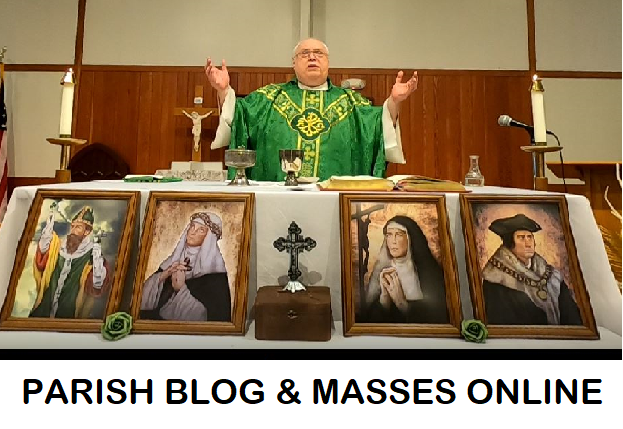
When I began this blog, my header image was the New Testament scene where Jesus flogged the money-changers out of the temple. I imaged myself and all priests flogging the devils that distort the faith and assault believers. The faith that gives us consolation can and should also make us very uncomfortable. Both Divine Mercy and Divine Justice meet in Jesus. Priests are ministers of reconciliation, but never at the cost of truth. In or out of season, we must be courageous in preaching and living out the Gospel of Life. The title of my blog is a play on words, not Flogger Priest but Blogger Priest.
JOANA:Father, my question is about faith healers and quack doctors. Are they considered genuine or given the power to anoint a sick person?
FATHER JOE:
Only Catholic bishops and priests have the authority to offer the official Anointing of the Sick. It is a sacrament of the Church and very closely connected to the priestly charge over the sacraments of Penance and the Eucharist. It is an element of the priest’s power to forgive sins or function as a minister of reconciliation. God is at liberty to grant or to facilitate physical restoration and yet the most important element is spiritual healing.
The definition of a “quack doctor” is that he is a fraud. There are too many of those around.
The issue of “faith healers” is more complicated as they include both Catholics and Protestants. There might be an anointing or just the laying on of hands and prayer. God can use whomever he wills. A constant theme of mine is that we should not seek to stifle or ridicule where the Holy Spirit might be active. We can discern something of the truth by the fruits but must be ever on our guard against deception.
I recall an expose several years ago where a minister used a portable receiver in his ear to learn about attendees at the revival or meeting. The information was whispered to him from a pre-show interview with volunteers. It gave the appearance that the minister was somehow clairvoyant and knew their ills before they came forward. Some of those healed were plants and others had been sent to a special hospital where they were treated but told to keep quiet about the medical intervention. Others got caught up in the euphoria of the moment, claimed healing, only to find themselves still belabored by pain or crippled when the meeting was over and the cameras were off. There was one minister who used to berate those not healed, saying that it was their own fault and that they did not have sufficient faith. Of course, the organizers were still very quick to pass the money basket to the assembled throng.
However, with all this said, the miraculous sometimes happens. Miracles of healing are often reported and investigated in the process of canonizing saints. The late Fr. John Lubey here in Washington, DC, (and the priest who married my parents and baptized me), regularly offered healing services along with Mass. People would sometimes collapse (sleeping in the Spirit) when he placed his hands on their heads. He told me that the ministry started in the late 1950’s when he blessed a woman who suffered from a disintegrated hip. She returned a week later walking with ease and holding x-rays that showed a perfectly formed hip. He was a very humble man and regarded ALL priests as “healing” priests. He gave all credit to our Lord and never asked for any money for his services.
CATHY: It is impossible to make such assumption that having a wife and children would be distraction to priests, bishops, cardinals and the pope when they were never allowed to have a family in the first place and many have fooled around anyway. To make people choose against a holy sacrament of marriage is to break the first commandment in the bible which is to be fruitful and multiply. You would take away some of the supposed scandal from the church if you would allow for men and women (nuns) to serve and be married. How can ministers of the word even begin to identify with parishoners if they have not lived through some of their circumstances especially since ministry begins in the home. Sex is not vile if done within marriage. It is a God sanctioned act. This not being married is a man sanctioned decree. Every prophet and most of the apostles including St. Peter were married. Their trials were due to the times they were living in. Now, unless you are living in pagan or atheist parts of the world, no one is trying to burn or stone you for being Catholic.
FATHER JOE:
You assert several serious falsehoods:
First, the Church in the West once had a married clergy and determined that celibate clergy best served the Lord and the Church. In other words, we have “been there and done that.”
Second, most Catholic ministers are faithful to their promises and do not “fool around” as you put it. You malign me and many good priests. How dare you do this?
Third, the command in Genesis is given to the species, not to every individual. Otherwise, you would have to force people to get married and mandate that all fertile females get pregnant. Such would be absolutely silly. Our Lord did not get married and neither did St. Paul. Deacons represent both married and unmarried clergy in the Catholic Church. Most priests and all bishops are celibate. We did not “choose against marriage” but rather “chose a spiritual marriage to Christ’s Church.” You minimize the sacrifice and the value of such single-hearted love. You should be ashamed of yourself for that.
Fourth, please, do not be silly; sick and unfaithful people are still sick and unfaithful if they are married. A majority of men who left priesthood for marriage subsequently divorced. Protestant churches may not have their dirty laundry paraded on the news, but they have their own scandals with married clergy. A Methodist minister and friend of mine had a large and vibrant church in Washington, DC. He had an affair with a lady in the choir and got himself fired and defrocked. A married clergy would only amplify the possibility of scandal, albeit with divorce, abuse, incest, etc. There is nothing unnatural or wrong with celibacy. The answer to our problems is not a married priesthood. Allowing nuns to marry violates the very nature of their calling.
Fifth, the family may be the little Church but there is no requirement that every man be an ordained priest. Priests deal with many families. There is marriage preparation, counseling, and confession. We see and hear it all. We know the plight of our people. Our celibacy makes us available to them. We might not have our own wives and families, but we belong to our many parish families. Priests are not fools.
Sixth, a celibate priesthood is no condemnation of human sexuality and marriage. Do you know nothing about Pope John Paul II’s theology of the body? The marital act must remain within marriage as the consummation and renewal of the marital covenant. But there is no requirement that we collect as many sacraments as possible. Most men will never be priests. Most Western priests will never be married. I will never have a child. But few men can stand at the altar and make Christ present with the words of consecration. The Priesthood with Mass and Confession are enough for me.
Seventh, celibacy is a discipline of the Church. But our Lord gave such authority to his Church and it is not for you or me to impugn or spurn it. The Church has the mind of Christ in this matter.
Eighth, the Jewish and Christian view of marriage was not the same. Jews tended to see God’s blessings in progeny, wealth and land. Christians are urged to embrace a poverty of spirit. It is in this light that St. Paul recommends celibacy as the better way. You would be hard-pressed to show a married background for all the prophets. St. Paul and certain others were not married. There is evidence that the early Church had a preference for perfect continence on the part of married men who became priests. Strict celibacy would relieve the tension caused by such a situation.
Nine, while I not entirely sure how this fits into the debate about priesthood and marriage, we are facing terrible trials today, too. I have parishioners with family members suffering violence and death in Asia and Africa. Churches are being bombed and Christians are being martyred. The news here at home is filled with daily assaults upon the Church and our religious liberty. Indeed, the government is seeking to shut us down or compromise our moral message. Sorry, but you really do not know what you are talking about. Not having a wife and family might free a priest from fears of retaliation against them or intimidation through them. Men often feel that they must make compromises to secure their families. Are you married Cathy? Does your husband agree with you about mandating married priests?
Cathy, you really know very little about men as priests or what matters to us. We have men and women friends but we save our intimacy for God. Marriage is a wonderful thing, but so is celibate love. Do you find that hard to believe? We do not need to be married. We do not want to be married. We are happy. Why is it that people like yourself want to mess with our lives? If a man is called to holy orders then God will give him the graces for this state of life.
The CORPSE BRIDE promotion really has nothing to do with this article, although the film did remind viewers about sacrifice and “until death do we part,” albeit in a morbid way.
The post is an OPINION piece for me, and maybe I am wrong, but here are my two cents worth.
I recently read an article where a renown and orthodox philosophy professor argued that Catholic priests should not perform marriages as civil officials of the state. Right now in the United States, a wedding witnessed by a priest is both recognized by the Church and by the civil authorities. The couple must have a license and the priest signs it after the service, giving the couple their segment, keeping a copy for Church records, and sending the third page back to the courthouse for formal registration. The professor argues that given the disparity in how the State and the Church defines marriage, the priest taints himself and undermines the sacrament.
Obviously, the divorce culture has compromised the notion of marriage, and the absurdity of homosexual marriages has definitely complicated matters; however, should the Church isolate herself as an ideological, cultural and civic ghetto or safehaven?
Would this not surrender the public institution of marriage to secular humanists and hedonists?
Would we forfeit our right to enter into the national debate on marriage?
The priviledge of a priest witnessing legal marriages is not just a sign of overcoming past prejudices, but remains a steadfast witness that legal marriages reflect the natural law and that couples are called to holiness and fidelity. The priest and the Church offer preparation classes on marriage, the state does not. There is also a safeguard in the two-tiered program in that State and Church records help to confirm the freedom of people to marry.
The good doctor says that Catholic priests should witness sacramental marriages only. He adds that if the newlyweds want to get a civil law marriage certificate as well, that is left to them.
Does a priest really compromise his office by witnessing marriages that are recognized both by the State and the Church?
Given that such a statement were true, would this not mean that “every” priest and bishop would be compromised and guilty of serious sin?
If we permitted sacramental weddings that were not licensed by the state, would we not endanger the permanence of marriage further?
Would our married people be stamped with the stigma of cohabitation and lewd conduct in the eyes of non-Catholic believers and secular persons with high morals?
Since the state would not recognize such marriages, and common law marriages are no longer recognized in most places, could not such couples easily separate (even more so than with No-Fault Divorce) with little if any civil recourse?
Some countries require two ceremonies, a civil one before a judge or notary public and a ceremony before a priest and two witnesses. This is a possible eventuality, although it increases the likelihood that some couples would dispense with the Church service entirely. If the couple attempted to consummate the civil contract before engaging in the marital covenant, then they would commit mortal sin. Every such marriage would become a convalidation. Giving the Catholic minister the faculties to perform both a civil and an ecclesial wedding is a small insurance that this eventuality need not happen. I do not even want to imagine what the implications would be for inheritance, health insurance, pension and other benefits. Critics would contend that the problem is not the priest and his role for the Church and State; the trouble is that Catholic couples, who are the true ministers of the sacrament, are not keeping their promises. There is also an “intentional” difficulty with Catholics going to a hall or court after the Church wedding. First, it might undermine the full reality of the sacrament, as if there is something constitutive that is missing. Second, given whatever ritual that may be used, it may constitute “simulation” which is forbidden regarding the sacraments. (Marriage renewals must always adjust the vows to recognize that there is a distinction with the original and true marriage.) Remember, that while the notion of permanence has been compromised by divorce, the vows used by civil officials are often the same used at Church weddings, and stipulating “until death do we part”. Schizophrenic or not, such is the situation. For the Catholic there is no such thing as a parallel marriage, once the deed is done, it is done. Two ceremonies tends to harm this appreciation.
If one argues that state marriage is an entirely different species from Church weddings, then what about the marriages of Protestants and other non-Catholics by civil magistrates? Not bound by Catholic law, we always considered those marriages valid. However, by extension, the professor’s argument would seem to infer that such marriages, even between men and women, would have no more reality and substance than that of gays and outright fornicators. Of course, I am probably wrong here, and he would likely contend that “properly disposed” people would still be able to confect a suitable bond, even if only a natural one.
As a postscript, I have a priest friend (on the faculty of a seminary) who vehemently disagrees with me. He thinks that the Church should get out of the marriage business completely and hand the whole mess over to the state. Obviously, I would very much object.
********************
Here is a recommended book that continues the discussion about the tension and disconnect between Catholicism and contemporary American society, particularly the Democrat Party:
Agree or not with it, the book makes interesting reading and will surely inspire lively discussions!
Father Joe, what is your take on Father Bob Pierson?
FATHER JOE:
I had heard of him but had not followed the recent business about his ten minute statement that went viral attacking the initiative supported by the U.S. bishops in opposition to so-called same-sex marriages.
What the priest fails to appreciate is that conscience must be properly informed. Freedom of conscience is not relative moral license. Otherwise, the cause of conscience could be rallied not only for homosexuality but also for other evils like polygamy, bestiality and pederasty. Rather, true liberty comes with an orientation to that which is true and good. Obedience to divine positive law (as revealed in the Church through Sacred Scripture and Sacred Tradition) and natural law (as ascertained through the right use of reason to the objective order) makes us truly free. The commission of sin and immoral acts brings not freedom but spiritual bondage.
The priest in the video takes statements from the Church and churchmen out of context, much as a fundamentalist minister might from the Bible to support his claims. Cardinal Ratzinger, i.e. the Pope, has certainly always taught about the obligation in following conscience; however, he has likewise insisted that homosexuality is a serious sexual disorientation and that the commission of genital acts associated with it are intrinsically immoral.
Notice that he quotes Cardinal Hume who wrote, “Love between two persons, whether of the same sex or of a different sex, is to be treasured and respected.” His quote came in the context of a larger statement in the UK on the homosexual question. While it is certainly permissible to exhibit fraternal and platonic love, as in most friendships, it would be wrong to equate these words with sexual activity and or anal or oral sex. This is another instance where the priest’s remarks are deliberately deceptive. He is well educated and knows what he is doing. This makes him all the more culpable.
Father Pierson is selective in his quotes from the universal catechism. Note that he does not read from CCC #1601: “The matrimonial covenant, by which a man and a woman establish between themselves a partnership of the whole of life, is by its nature ordered toward the good of the spouses and the procreation and education of offspring; this covenant between baptized persons has been raised by Christ the Lord to the dignity of a sacrament.”
Although he attempts to bracket off sacramental marriage in the Church from civilly recognized marriages, such is only a shallow ploy to avoid personal censure and to elicit support from normally orthodox Catholics. The way that society views marriage informs and spills over into how the faithful understand the sacrament of marriage. Indeed, he, himself, is a staff member in an organization where a Protestant minister and an ex-Catholic bless same-sex unions. Understood in this light, Father Pierson is not only promoting immorality but is taking a heretical position toward one of the seven sacraments of the Church.
The speaker acknowledges that Pope Benedict XVI has declared that homosexuals should not be accepted as candidates for the priesthood. Father Pierson has “come out” that he is a homosexual who opposes Church teaching. We can only hope that he has kept his promise of celibacy. Regardless, he now ridicules the Holy Father and takes a scandalous position against the U.S. bishops and the Marriage Matters campaign. I should add, however, that marriage was threatened long before this issue of so-called same-sex marriage. Marriage was imperiled by growing rates of promiscuity, cohabitation, contraception, adultery, divorce (especially the no-fault variety), and remarriage outside the Church.
Father Pierson had resigned from his post as director of campus ministry after the Vatican officially barred men with “deep-seated homosexual tendencies” from ordination, and because of associated issues in the Church’s faith and moral teaching. “Because I can no longer honestly represent, explain and defend the Church’s teaching on homosexuality, I feel I must resign,” he said. It was also rumored that he was forced out, as he should have been, to avoid further intervention from higher-ups.
His local bishop, Archbishop John Nienstedt of St. Paul and Minneapolis has strenuously promoted the amendment in opposition to so-called same-sex marriage. He required parishioners in the archdiocese to recite A Prayer for Marriage as part of the General Intercessions at Masses. The U.S. bishops have been very clear in their opposition. Marriage is only genuine if it is between a MAN and a WOMAN.
Back in 1986, Cardinal Ratzinger, writing for the Vatican, made a statement for correction and support of a letter promulgated by the American bishops. Father Pierson selectively quoted him, but strangely and dishonestly, not this statement which speaks to the question at hand.
“Although the particular inclination of the homosexual person is not a sin, it is a more or less strong tendency ordered toward an intrinsic moral evil; and thus the inclination itself must be seen as an objective disorder…. It is only in the marital relationship that the use of the sexual faculty can be morally good. A person engaging in homosexual behavior therefore acts immorally.”
“To choose someone of the same sex for one’s sexual activity is to annul the rich symbolism and meaning, not to mention the goals, of the Creator’s sexual design. Homosexual activity is not a complementary union, able to transmit life; and so it thwarts the call to a life of that form of self-giving which the Gospel says is the essence of Christian living. This does not mean that homosexual persons are not often generous and giving of themselves; but when they engage in homosexual activity they confirm within themselves a disordered sexual inclination which is essentially self-indulgent….”
“It is deplorable that homosexual persons have been and are the object of violent malice in speech or in action. Such treatment deserves condemnation from the Church’s pastors wherever it occurs. It reveals a kind of disregard for others which endangers the most fundamental principles of a healthy society. The intrinsic dignity of each person must always be respected in word, in action and in law.”
“But the proper reaction to crimes committed against homosexual persons should not be to claim that the homosexual condition is not disordered. When such a claim is made and when homosexual activity is consequently condoned, or when civil legislation is introduced to protect behavior to which no one has any conceivable right, neither the Church nor society at large should be surprised when other distorted notions and practices gain ground, and irrational and violent reactions increase.”
Father Bob Pierson, O.S.B. should be disciplined by his Benedictine order. He has caused scandal and given rise to public dissent from the Church. His faculties to function as a priest should be revoked or curtailed. As a man under ecclesial obedience, he should either publicly recant his dissent or face immediate dismissal. A priest who recommends mortal sin is no longer aligned with Christ. Even if he should be demented or ignorant, he is now on the side of the evil one.
STEPHEN:
Father Joe, I agree with everything you said, albeit except for maybe one small clarification. You write, “Understood in this light, Father Pierson is not only promoting immorality but is taking a heretical position toward one of the seven sacraments of the Church.” Father Bob would disagree as he was careful to differentiate between civil marriages, which are all “outside the Church” and the Church does not recognize anyway and “sacramental” marriages within the Church. Thus, Father Bob would argue that his voting NO on banning same sex “marriage” has nothing to do with Church teaching on sacramental marriage.
I completely agree this priest should be disciplined severely. But will he be? Almost certainly not, and this is the primary reason for our current crisis. Dietrich Von Hildebrand called it the “Lethargy of the Guardians” as far back as the 70’s. We have suffered under the complete unwillingness of ecclesiastical authority since Vatican II to discipline clerics and bishops for egregious sins against doctrine and the faith. What makes it worse is that the same ecclesiastical authority DOES discipline and bring the hammer down for breaking procedural rules/canon laws that have nothing to do with heresy or doctrine. This sets up a practice which lessens the credibility of the bishops who selectively punish lesser offenses while allowing the most egregious publicly scandalous statements from dissenting priests to go unpunished.
I would dare say it is a sin for this man’s bishop or superior not to discipline him in some way, including at minimum, silencing him on this issue to at least minimize further scandal. Will it happen? I’m willing to bet you a shiny nickel it will not. And it is a slap in the face to you and other good priests who would be punished in a second if you did something like deny Holy Communion to a practicing Lesbian Buddhist who introduced you to her “lover” in the sacristy before Mass.
FATHER JOE:
The priest has a track record beyond the video. (I have not directly linked the video, only a strong critique. Those who want to see it can Google the liberal propaganda.)
He recognizes same-sex marriages as valid, both civilly and in the eyes of God. What confuses the issue is that he denies that there has to be concurrence or approbation from the “institutional” Church. I do not have proof, but like some of his Episcopalian liberals, he would love to bless (and maybe has) these unions. He is a regular speaker at gay-lesbian conventions. Remember, too, that priests are only allowed to witness marriages in the U.S. that are also civilly recognized. We function as both civil magistrates and as ministers of the Church. This is not the case in many countries where Catholic couples are required to endure two ceremonies. Such only happens in the U.S. when there is a convalidation.
I should add, that the Church generally recognizes civil marriages between spouses who are not Catholic. If they are legitimately baptized, then there may be a sacramental character as well. Indeed, if there is a divorce and a desire to marry a Catholic, they would have to pursue a formal case annulment with no guarantees of success. Now we will further have to clarify that we do not recognize adulterous marriages or feigned same-sex marriages. I suspect, given the pressure from the Obama administration, that clergy will eventually have to forfeit their civil authority over marriages in order to distinguish the sacramental covenant from the civil legal contract. Once the definition of marriage diverges, we cannot be party to something in which we do not believe. This may already be happening in light of no fault divorce. I would also not be surprised if the government should seek to compel clergy to witness same-sex marriages. The rights of the Church are very much threatened. I pray that our bishops and priests will have the courage to face fines and imprisonment. The latter is quite possible, if the Church’s stand against homosexuality should be judged as a violation of civil rights laws and as hate-speech.
Further, the priest has been involved in the Catholic gay, lesbian, bi-sexual, transsexual community. He knows full well the canonical restraints upon Catholics and does not care. All this is to say that the video is deceptive propaganda. He is a liar. Even when he throws out crumbs of feigned respect to Church discipline, they are lies. If you are familiar with his work in Collegeville, then you would know that he also rejects the “proles” (open to human generation) element that is essential to the covenant of marriage. He literally believes that anal intercourse consummates the bond. It is in light of all this that I said that he is a heretic regarding the sacrament of marriage.
In regards to disciplinary measures, they may actually be in the works. Had he been a secular or diocesan priest matters might have been easier. The Benedictines tend to protect their own and have a rather progressive track record in his particular community. One of them (Fr. Anthony Ruff, OSB) recently attacked the corrected translation of the Mass at the national Call to Action convention. They also honored the Lesbian Buddhist-Catholic you mentioned and the pro-abortion Catholic Maryland governor was also in attendance. There are a lot of trouble-makers to go around these days.
Orthodox and traditional churchmen have a higher capacity for suffering in that they love the Church and seek to be obedient while the other side really does not care; liberal breakaway groups, as with Archbishop Milingo and Washington’s own Father George Stallings, were also censured and even faced excommunication. In this sense, there is some parallel. I suspect that many in the Church find the contemporary situation almost overwhelming given the pervasive dissent. During this silent and not so silent schism, there is also the worry that the wrong action might lead the ignorant or weak of faith out of the Church. You are right, not all shepherds are to be trusted. But we must also be careful NOT to spread calumny and to hurt good men who are doing their best.
Pope Benedict XVI seems to be hoping that attrition and orthodox replacements among the clergy might hold the answer. My worry is that he, himself, is not a young man. I have found an almost uncharitable delight in how Archbishop Salvatore Cordileone, the new Ordinary for San Francisco is making the gay establishment squirm and fret. They were pouting the other day because he outlawed drag queens at fundraisers! Really?
Again, do not be fooled. He might say that “…for committed, same-sex couples is not the Sacrament of Matrimony,” but he really does see it as analogous. Remember, sexual activity outside of marriage is a mortal sin. There is nothing equivalent to it. As a priest he knows this. He is talking out of both sides of his mouth. The Bishops are right on this one. So-called same-sex marriages are indeed a threat to the genuine covenant of marriage, natural or sacramental. There is no loop-hole or escape clause that would allow Catholics to support institutional sodomy.
STEPHEN:
Thanks for the background. In this video he seems to take the stance of…”who cares what the state of MN deems as ‘marriage’ since the Church only recognizes sacramental marriages anyway?” He argues the flip side of religious freedom by stating that the Church should not dictate to the state how it defines “marriage” as civil and Church marriages are separate entities and (in his mind) serve different purposes.
FATHER JOE:
The secular sphere in the public forum would not appreciate marriage as a sacrament. Rather, the point of intersection between the Church and state is the traditional view of marriage as a “natural bond.” The growing division between the Church’s view of marriage, as well as that of natural law, is the reason why someone like Bai Macfarlane has campaigned heavily for traditional marriage and against no fault divorce. Some of her supporters would claim that the conflict or opposition between the civil and ecclesial view of marriage has reached a breaking point, in both the heterosexual orientation and its permanence. They argue that clergy should opt out entirely from working within the system. They suggest that the priest who witnesses any marriage for the state has corrupted (by association) the Catholic understanding. This argument becomes even more defensible if society should formally equate same-sex unions with heterosexual marriages. While priests will not officiate at the feigned marriages of homosexuals and lesbians; will the truth be compromised by our continuing partnership with government in witnessing marriages and signing civil licenses? But what is the alternative? Priests in Europe and Asia often find that in the dual ceremony-system, couples tend to cohabitate if there is any extended duration between the vows before a judge and those before a priest.
The priest errs seriously, by his own admission, for failing to fault the homosexual lifestyle as sinful. Indeed, he seems to praise and to encourage the commission of evil. People of the same gender can be friends but they cannot be spouses. A legal fiction will not make it so.
FSSP transform a modernistic free-standing altar into a very beautiful High Altar. The church that this took place in is in France and is now operated by the Fraternity of St. Peter. The complete time for this “Altar-ation” was just about 15 minutes!
A number of years ago, I posted this simple video of an ugly modern communion table being transformed into a visible altar of sacrifice. The posting was a whim, a small aside. The discussion that followed floored me. This was much more important to believers than I had thought. This is all for the good.
Here is the Discussion
MARY O: Deo Gratias!
GERRY L: Amazing! That’s how it should be.
ANNA MARIA: To Mary O— A big “Amen” to your comment. I couldn’t say it better. To Father Joe— Thanks for posting this! Where there is a will there is a way. I hope we see more of this Stateside!
JOHN S: Next stop improve the music!
KAY: Amen!!!!
KRISTIE: Beautiful! And I agree; that is how it should be! Wouldn’t it be wonderful if it spread State side? Thanks Father Joe! You are awesome!
VICTORIA: Reverent…one aspect of many of the beauty of Catholicism. (I didn’t witness this reverence in the Baptist, Unitarian, Nondenominational, or Methodist churches.) I’m sooo happy I’m Home.
BOB: John S— Sanctus fumus! More Palestrina, that’s what wants here!
LADY GODLESS: Well, that was nice! It looked too much like a lethal injection gurney before.
REGINA: Fr. Joe, this is why women are not priests…I spent an hour reading your blog and it reminds me of something I already know— men have a thick skin. They are tougher than us women. I heard a caller to a secular radio station say that the gates of hell referred to in the bible would not prevail against the Church, which, as the caller pointed out, was a battering ram. I loved this insight— you are a battering ram! Keep battering those gates Father! I pray for you.
ANITA MOORE OPL: One of these days, the change will be permanent. We can look at the cost as a penance for having wrecked the old furnishings in the first place. Is it possible there are some bishops who will not get out of Purgatory until the wreckovations they ordered are undone? If so, that makes the restoration of the Churches even more urgent.
HIDDEN ONE: I know a few altars that could use that kind of treatment… at least one of which a renovation group could sneak into, remodel, and leave, likely without being noticed. *sigh*
MR. FLAPTRAP: This is the installation of the new altar at my parish, St. Raphael’s in Rockville, Md. The old altar was similar in style to the original one in this video (four round concrete legs and a slab.) The base on the new one features the three archangels named in the Bible.
FATHER JOE: Yes, I remember the before and after. There are also shots of the late Father Bill Finch who died after Mass on Holy Thursday 2009. Rest in Peace. Thank you for sharing the video.
BILL C:
I recently joined a parish where altar, tabernacle, and crucifix are in a traditional vertical line of worship as in the video. Sadly, I am aware of only a few churches in the archdiocese of Cincinnati that are configured with the tabernacle placed at the altar. I must drive farther to my new parish, but the trip is well worth it because I now experience a much deeper sense of worship, adoration, and reverence for the Eucharist.
I pray our new archbishop will institute a uniform policy to place the tabernacle at the altar in all parish churches in the archdiocese. This would be a huge achievement for the catechesis of young and old on Christ’s Eucharistic presence.
Pope Pius XII, in his 1956 Address on the Liturgy, addressed with prophetic insight what would happen only a decade later shortly after Vatican II by warning: “To separate tabernacle from altar is to separate two things which by their origin and their nature should remain united.” Indeed, Church tradition for seven centuries — from mid-thirteenth century until after Vatican II — had placed the tabernacle at the altar. Surely the Holy Spirit inspired the holy union of tabernacle and altar over so many centuries.
This is a really informative website. Keep up the good work, Fr. Joe! God bless.
JOHN: The problem today is that the priests have been formed to think that they are pastors first and the Mass means very little.
FATHER JOE: That was not my experience. Most priests I know would argue with you. The Eucharist is the center of our lives.
JOHN:
If you look at the new Code of Canon Law promulgated in 1983 by Pope John Paul II, take a look at Canon 276. This canon directly addresses the question of how Catholic priests are to pursue holiness. It lists:
First, the obligation to ‘faithfully and untiringly….fulfill the duties of pastoral ministry’; Second, the obligation to Sacred Scripture and the celebration of the Eucharist; Third, reading the breviary.
FATHER JOE: Are you being purposely deceptive? The code begins by saying, “In leading their lives, clerics are bound in a special way to pursue holiness since, having been consecrated to God by a new title in the reception of orders, they are dispensers of the mysteries of God in the service of His people.” The initial statement of the canon stresses “the mysteries of God” and the chief among these are the Eucharist and the Sacrament of Penance. Priests have been empowered by Christ to offer the sacrifice of the Mass and to forgive sins. I suspect that you have a watered down appreciation of the pastoral ministry. A man is not ordained chiefly for his own salvation but for that of others. Jesus washed the feet of his apostles and told his followers to do so for one another. The priest is the servant of God who lays down his life for others. A pastor serves God by sacrificing his life for his flock. Only priests can offer the Mass and forgive sins. This has not changed since Vatican II.
JOHN: Canon 276 sets forth a weird priority of obligations. For years Catholics (including priests) have been taught that because the Eucharist is the centre of the Church the obligation to celebrate Mass was far and away the most important in priestly life. In fact, this principle was often demonstrated by the famous example that a priest will still celebrate Mass even though there is no one in attendance.
FATHER JOE: I suspect you are not appreciating the language of the Code. It is still recommending that priests celebrate daily Mass. Most if not all priests I know do precisely that. Indeed, many of us offer the Mass several times a day.
JOHN: The obligation of all priests to pastoral duties also undermines the life of any priest living the contemplative life.
FATHER JOE: There are different codes for pastors and monks. It is a different life. Many religious priests in monasteries regularly concelebrate. Most diocesan priests are the only priest present at their liturgies. Some groups like the Trappists only ordain enough priests to care for the community. The other monks remain religious brothers. The old code also placed a pastor-priest’s salvation on the line in how he fulfilled his pastoral duties: not neglecting the needs of his people for the Eucharist and Confession and Extreme Unction. The transmission of the true faith, especially to the children is crucial in both codes. Failure to give adequate care to this would constitute mortal sin.
JOHN: Although the canon refers to all priests (not merely diocesan), one wonders how it can be applied to the many priests living in a monastery.
FATHER JOE: Particular rules of life in orders approved by the Holy See and the codes on religious take precedence since it is seen as a higher vocation.
JOHN: In fact, it is very difficult, if not impossible, to see how monks can be said to have any priestly obligation to pastoral ministry. It would also not be exaggeration to say that the Vatican II theology of the priesthood, which makes pastoral obligations intrinsic to the Sacrament of Holy Orders, undermines the life of the monk-priest.
FATHER JOE: Such ministry is in regard to the religious community. Similarly priests were sometimes given charge of a convent. Their flock would be the nuns. Pastoral ministry always exists in some form, even if it is just Mass for the dead. The word “pastoral” is a reference to the role of a priest as a shepherd. He cares for the sheep and does so according to the powers and authority given him. You are making a false case. Accidentals have changed in some cases, but the priesthood is as it has always been. The old code was even more concerned about accidentals to ministry, like tonsure and clerical property and certain rights.
JOHN:
This approach seems little else that an attempted synthesis between the Catholic diocesan priesthood and the Lutheran ministry. Further, it is a change so radical that it can be safely said that the Catholic priesthood has been turned upside-down.
On October 24, 1995, Cardinal Joseph Ratzinger, in a speech given on the thirtieth anniversary of Presbyterorum Ordinis, said that Vatican II attempted to broaden the classical image of the priesthood and to satisfy the demands proposed by the Reformation, by critical exegesis, and by modern life but from the reading of Canon 276 it seems more likely that the Council, in its ecumenical effort, embraced the Protestant ideas of ministry but unfortunately loosened its grasp of the core of the Catholic priesthood. The consequence was that Vatican II produced a document which at its core is little else than a warmed-over version of the Protestant ministry.
FATHER JOE: You mean well, but your hatred of the Church after Vatican II colors your reasoning. Catholic priests are not defined as one would Lutheran ministers. Many Lutherans believe that ordination can expire. The priesthood is forever. Catholic priests offer daily Mass. Many Lutherans do not and are only part-time ministers. Catholic priests offer a propitiatory sacrifice of the Mass (a true re-presentation of Calvary) and offer us the risen Christ in the Blessed Sacrament. Protestants have occasional communion services and give out bread and juice. Catholic priests claim to have the power to forgive sins. No Lutheran minister would say that. Look at the catechism, which is far more revelatory about the priesthood than the Code on the rights and responsibilities of the clerical state.
JOHN: These liturgical changes, which were introduced over forty years ago, can now be seen as part of the larger picture. It is no secret that vernacular liturgy, the concept of Eucharist as-meal (implicit in the Mass of Paul VI), and the use of a table in the sanctuary (rather than an altar) were applauded by most Protestant sects. In fact these liturgical changes were the companion of very serious changes to the Catholic priesthood— all under the influence of Protestant theology.
FATHER JOE: Abuses happened, but the liturgical reform and a movement to a vernacular liturgy were being explored even in the 1930′s. We saw the development of the dialogue Mass prior to Vatican II. There is no denial of sacrifice by regarding the altar as also a table. There need be no either/or. As for Protestant sects, we came to appreciate a common love for Jesus, but most of them still reject the Mass and the priesthood. The sacraments are still wholly Catholic and neither the priesthood nor the Mass has lost that spiritual efficacy given them by Christ.
JOHN: And I continue to find it so amusing how everyone thinks of Pope JPII as being so conservative where it was he who introduced a new Code of Canon Law, new Catholic Catechism, new translations of the Bible (USCCB and NAB but approved on the Vatican website and explained as such), proudly proclaimed ecumenism as the cornerstone of his pontificate and participated in false worship that in infallible councils and in encyclical after encyclical proclaimed any Catholic let alone a Pope who would do such was excommunicated.
FATHER JOE: The Old Catholics broke away from the true Church prior to Vatican II. Many Anglicans practice ancient rituals. However, like so many Latin Traditionalists, their fight over ecclesiology and the authority of the Pope makes them the REAL PROTESTANTS. You can offer the Tridentine Mass and still be a heretic, schismatic, excommunicant, and a PROTESTANT. Unlike certain churches of the East locked into a stagnant tradition; the Catholic Church has a Magisterium that is protected by the Holy Spirit. We have a teaching authority centered upon the Pope which along with the world’s bishops (in and out of council) guides the Church. A few renegade bishops and priests have no such divine protection.
JOHN: This mess will take generations to clean up and millions of souls will be lost because of those who were entrusted to save souls.
FATHER JOE: And some of the lost souls will follow the guidance of illicit bishops who deny the Jewish holocaust and who rebuke the authority of Christ’s Vicar on Earth.
ANNE W. PALMER: I cried and cried when I saw the video. Thanks be to God! I grew up with the traditional years ago. There is such a difference in realization of the sacredness of our precious Lord in the Eucharist. Vatican II was so misinterpreted, adding things that were never there in the first place. I will never understand how that happened. The video makes it so plain. Thank you for posting it. I will share it with as many as possible. By the way, the music was awesome too. I would like to know from where it came? Music also denotes the sacred and that was sacred.
JOHN: Why is my comment still awaiting moderation? [I had to find time to respond in the original discussion.] Is it that difficult or do you not want to acknowledge the new form of the priesthood, which after Vatican II saw thousands leave and starting with the late 1950′s, the “wandering eye” priest (not to be accepted as good) give way to the pedophile, gay, liberal priest who has led millions of souls to hell?
FATHER JOE: There is no new form of priesthood. That is the lie promulgated by those who misrepresent the teachings of the present-day Catholic Church under Peter’s successor. Those who give greater weight to accidentals over substance or essentials fall into grievous error, particularly in regard to ecclesiology and juridical authority. You might not like the current reformed rituals, but the sacraments are intact and the Church endures. As for pedophile priests, many of the lawsuits regard clergy who were formed by the old Latin regime. What is the old saying about people living in glass houses throwing stones?
JOHN: Our Sermon today at the SSPV chapel in Oyster Bay was just that, how the priesthood right before and after Vatican II with its changes in its form as well as intent as I have stated above, is more concerned about being “liked” and knowing the bible than about saving souls and leading those astray to find Christ.
FATHER JOE: You belong to a splinter group of a splinter group, a schism of a schism? You are being deceived. I will pray that you will return to the one holy “Catholic” and apostolic CHURCH.
BILL C:
I’m surprised more people have not responded to this topic and I would really like to know what you think. I’m 62 years old. Although I’m happy to have recently joined a parish with the tabernacle at the main altar, it makes me downright angry that so many parishes in my archdiocese displace the tabernacle. Let me give you a few examples. The parish where I grew up removed the tabernacle from the altar sometime after Vatican II and placed it in a side wing near the choir. They put the baptismal font at the altar where the tabernacle once stood.
Another parish I attended for several years was an older church with a beautiful altar having a built-in tabernacle. When it was remodeled, they put the tabernacle at a side altar outside the sanctuary, and “boarded up” the hole at the main altar with an ornamental cross display.
The last parish I attended for several years before joining my present one actually had the tabernacle as a small wall-closet outside the sanctuary. I finally had my fill of this nonsense and was delighted to find a traditional parish with the tabernacle at the main altar.
Call me “old fashioned” if you like, but to my way of thinking, Christ’s Eucharistic presence is either real or make-believe. If make-believe, then it really doesn’t matter where we put the tabernacle or whether anyone genuflects before it. But if Christ’s Eucharistic presence is real, then where on earth would you even think about placing the tabernacle — other than at the main altar.
As I pointed out in my earlier comment, Catholic tradition placed the tabernacle at the altar for 7 centuries — from mid-13th century until shortly after Vatican II. And contrary to what some Catholics mistakenly believe, Vatican II did NOT mandate or encourage the removal of the tabernacle from the altar. This nonsense resulted from liturgists who used the reform momentum of Vatican II as an excuse to radically redesign churches with the consent of some bishops who frankly were “asleep at the wheel.”
And where has this nonsense led. My observation is that most people do not genuflect when the tabernacle is absent from the altar, and if they do it’s often not even in the direction of the tabernacle. There is also a lot more talking in the pews before and after Mass. In short, reverence for the Eucharist is lacking to some extent and Mass seems more a “communal meal” and less an act of divine worship. At least, that’s my personal experience.
And, what about catechesis on Christ’s Eucharistic presence? What does it say to young and old alike when the baptismal font replaces the tabernacle at the altar, or when the tabernacle is placed at a side altar like a saint’s statue, or when the tabernacle is a wall closet outside the sanctuary?
Eucharistic adoration doesn’t make a lot of sense to me in churches where the tabernacle is displaced. After all, what is the sense of placing the Eucharist in a monstrance on the main altar when the tabernacle is not afforded the same position of honor? Isn’t the same Eucharist inside the tabernacle or am I missing something?
To reiterate the words of Pope Pius XII in my earlier post above: “To separate tabernacle from altar is to separate two things which by their origin and their nature should remain united.” Also, I think it’s hard to argue with 7 centuries of Church tradition that placed the tabernacle at the altar. Certainly, the Holy Spirit inspired the holy union of tabernacle and altar over so many centuries.
Okay, Father Joe, what do you think about all this? It troubles me spiritually to see such disconnect between my belief about the Eucharist and the placement of the tabernacle in so many churches?
FATHER JOE: In regard to our parish churches, tabernacles are best placed in the center, along with the altar. We pretty much agree. My last parish had a side tabernacle (built in 1971). I moved it to the center where it belonged.
MARY O: “I moved it to the center where it belonged.” God bless you for that, Father Joe.
The PATHEOS portal advertises itself as “hosting the conversation of faith,” however— it does more than this, it seeks to reframe and/or to delineate religious truth. While several good Catholic blogs are hosted; it seeks neutrality with other religious or non-religious systems that is not possible without compromise and contradiction. For instance, while admitting that Catholicism “traces its history to Jesus of Nazareth,” which it defines as merely an “itinerant preacher,” the quick facts given stipulate the following:
The Roman Catholic Church formed between the 3rd to the 5th centuries C.E.
The bishops formed a “universal” church.
The exact date of the beginning of the Roman Catholic Church is indeterminable.
Many historians suggest that Pope Leo I (440-461) is the first to claim universal jurisdiction over the worldwide Church, thus initiating the rise of the papacy, a uniquely Roman Catholic structure.
While the nomenclature of “Roman Catholic” and “Pope” develops over time, the Church is directly instituted by Jesus Christ, God-made-man. The apostles were bishop-priests. There was no generic first and second century Christianity. Those who accepted Christ in faith and baptism were Catholic Christians. All the apostles and disciples were Catholic. The Virgin Mary was a Catholic. Jesus calls Simon ROCK or Peter and says that he will build his Church on this ROCK. He gives Peter the keys to the kingdom and universal jurisdiction as his visible shepherd. While there is certainly development, all the important elements go back to Christ and the apostles. Anti-Catholic critics have long contended for the late institution of the Church. Revisionist Catholics, even in academia, spout similar nonsense. These are not credible historians, no matter what alphabet soup follows their names. It seems to me that while individual voices at PATHEOS are orthodox, the site is tainted by a religious relativism that spills over into the section about Catholicism. Might this represent the wrong type of ecumenism about which Pope Benedict XVI has warned us? I think so. There is no sense of the supernatural nature of Mother Church. Dissenting voices are given as much legitimacy as those which speak the truth. There is no imprimatur or protection to insure against misleading statements. Attempting to appease many authorities, there is a definite religious indifferentism and denominationalism. Both are contrary to Catholic teaching and are affronts to the truth.
Mark Shea has a good article on his blog (hosted at PATHEOS) entitled, “Why it’s Our Ruling Class vs. the Rest of Us.” It alerts us to media consolidation and control of information, even religious information. I did not even know that PATHEOS existed until after I looked at the post and had my eye drawn away to the ads and links. I found it very unsettling and confusing. I hope over time the problems can be fixed, but I fear a continuing tension and struggle over what is or is not genuine Catholicism.
I find this story somewhat difficult to figure out. Christian-style weddings are all the vogue in Japan and Westerners are making lots of money pretending to be priests at these services.
Mark Kelly from the UK explained,
“I was living in Sapporo, studying Japanese, and I needed the money. It’s far better paid than teaching in a language school. Being a fake priest is big business in Japan – I’ve done a TV commercial for one company. In Sapporo, there are five agencies employing about 20 fake priests. In a city like Tokyo, there must be hundreds.”
Since the weddings have no legal force, the couples must also go to civil magistrates. It is truly bizarre because while only about 1% of the Japanese are Christian, 90% of weddings are performed in a Christian way. I am not talking about the content of the prayers, but rather the borrowed ritual and festivities. Prayers are often perloined from many sources. The old Shinto chapels are gathering dust and Christian ones are doing a booming business!
Of course, it is all about externals. These wedding chapels have flowing fountains, plastic cherub angels, flowers and special lighting. They are popping up everywhere, even in shopping malls.
The article says that the Japanese priests are not happy, but the problem is that there are not enough priests to satisfy the demand. The article and the Japanese are both missing the point.
The real priests in Japan have every right to be angry. It is admitted that many people do not know that fake priests are performing the ceremonies. Impostering a cleric is illegal in many nations and such should be the case in the Orient, too.
Is no one using this fascination with Christian marriage ceremonials for evangelistic and catechetical purposes? It is a tragedy that people are attracted to the externals and yet unable to appreciate the meat-and-potatoes of what Christian faith and the sacraments are about.
Does not the presence of fake priests pose a real danger that a few actual believers might get conned by them and think they are married when really they are not?
Real Catholic priests are generally forbidden to marry couples where neither is a member of the Church. Thus, the dilemma is more than a priest shortage.
Are there any ex-priests or laicized priests among these so-called fake priests? It all reminds me of the local problem with Rent-a-Priests. There are no checks on their abuses. If you pay, they will pray.
This story might seem like only a harmless oddity, but I would disagree. A fake priest and a ceremony for show, empty of substantial meaning or faith constitutes a deceit or fraud. Marriage implies promises being made where honesty and truth are paramount. A counterfeit priest and service undermines the truth with lies.
You claim that Peter was the first Pope, and yet Scripture attests that he was married. Since this great apostle could be married, why not all bishops and priests?
RESPONSE:
Restricting ourselves to the Gospels, no doubt you are referring to Peter’s mother-in-law. We read in Luke 4:38-39: “After he left the synagogue, he entered the house of Simon. Simon’s mother-in-law was afflicted with a severe fever, and they interceded with him about her. He stood over her, rebuked the fever, and it left her. She got up immediately and waited on them.” See the story again in Mark 1:30.
The Catholic Church does not deny that Peter was married. However, note her general absence in the New Testament texts. We do not even know her name. We only encounter the mother-in-law, never his wife or any children. Indeed, throughout the Gospels and the Acts of the Apostles, references are made to Peter’s activities and travels; but, only a vague intimation by Paul in 1 Cor. 9:5 that he had a right to travel with his “believing wife.” If it were not for this mention in the epistle, one might suppose that Peter was a widower. Tradition suggests that his wife was martyred. It is peculiar that although the wife would ordinarily have cared for the needs of guests, Peter had to rely upon his wife’s mother.
However, granting that she was still around (somewhere); she evidently assumed a secondary role in his life behind his leadership of the infant Church. Indeed, her insignificance in the biblical witness would seem to provide weight to the supporters of priestly celibacy. Like Peter, bishops and priests might do better to serve God’s people without the distraction of wives and children. Jesus gives his sheep to Peter. Pastors similarly love Christ and care for their flocks. This is the emphasis of Catholic ministry, our family in faith.
This post was never meant to be a defamation against Peter’s wife. I have also edited it to avoid any peripheral discussion about whether or not the tradition can be trusted regarding her martyrdom; given that some authorities speculated that she might have died earlier and/or that there might have been a second bond. It is probably best that we accept the tradition at face value.
Here are early testimonies for the martyrdom of Peter’s wife:
CLEMENT OF ALEXANDRIA (died around 215 AD)
(THE STROMATA, 7:11)
So then he undergoes toils, and trials, and afflictions, not as those among the philosophers who are endowed with manliness, in the hope of present troubles ceasing, and of sharing again in what is pleasant; but knowledge has inspired him with the firmest persuasion of receiving the hopes of the future.
Wherefore he contemns not alone the pains of this world, but all its pleasures.
They say, accordingly, that the blessed Peter, on seeing his wife led to death, rejoiced on account of her call and conveyance home, and called very encouragingly and comfortingly, addressing her by name, Remember the Lord. Such was the marriage of the blessed and their perfect disposition towards those dearest to them.
Thus also the apostle says, that he who marries should be as though he married not, and deem his marriage free of inordinate affection, and inseparable from love to the Lord; to which the true husband exhorted his wife to cling on her departure out of this life to the Lord.
Was not then faith in the hope after death conspicuous in the case of those who gave thanks to God even in the very extremities of their punishments? For firm, in my opinion, was the faith they possessed, which was followed by works of faith.
EUSEBIUS (around 265 AD to 340 AD)
(ECCLESIAL HISTORY, 3:30)
1. Clement, indeed, whose words we have just quoted, after the above-mentioned facts gives a statement, on account of those who rejected marriage, of the apostles that had wives. Or will they, says he, reject even the apostles? For Peter and Philip begot children; and Philip also gave his daughters in marriage. And Paul does not hesitate, in one of his epistles, to greet his wife, whom he did not take about with him, that he might not be inconvenienced in his ministry.
2. And since we have mentioned this subject it is not improper to subjoin another account which is given by the same author and which is worth reading. In the seventh book of his Stromata he writes as follows: They say, accordingly, that when the blessed Peter saw his own wife led out to die, he rejoiced because of her summons and her return home, and called to her very encouragingly and comfortingly, addressing her by name, and saying, ‘Remember the Lord.’ Such was the marriage of the blessed, and their perfect disposition toward those dearest to them. This account being in keeping with the subject in hand, I have related here in its proper place.
DISCUSSION
GERRY:
Thanks for all your insights, Fr. Joe. They are priceless! I’d like to let you know that I look forward to reading the “feeds” from your blog site. God Bless!
KARL:
Who would sit in judgment for all the annulments? Certainly the Pope does not have the time and men who cannot keep their houses in order (like those divorced and seeking annulments) certainly should not sit in judgment of each other and their wives.
What would happen to a bishop who abandoned his wife? Should he continue to serve as a bishop? Who would pay for the divorce, alimony and child support settlements? Who would get the Cathedral, the wife?
Anyone who thinks it is wise to have a married clergy is likely naive, foolish or has difficulty keeping their mind off their private parts. Oops, or Orthodox or one of the Uniate Rites.
ALEXANDER ROMAN: As a Ukrainian Catholic, I wanted to take great exception to a comment on that refers to Eastern Catholics as “uniates.” That term is pejorative and offensive – that it is used by a Latin Rite Catholic is not helpful.
FATHER JOE:
Churches of the East do not permit dating priests. They have to be married before ordination. Only single men become bishops. There is a different sense of priesthood between those who are celibate and the ones who are married. The first married Episcopalian priest in the U.S. who became a Catholic priest is now divorced. His wife left him, saying that nothing in the Episcopal church prepared them for what his life would be like. She gave him an ultimatum, leave the Catholic priesthood or she would leave him. He is now a divorced and celibate priest.
CATHOLIC GIRL:
Catholics and Protestants arguing for a married Priesthood (or worse those who propose that Mary was not a perpetual Virgin) miss the point with their literal interpretations.
Catholics are not literalists (although most Protestants are). We hold the Bible as no more or less important as Church tradition and teaching. Remember who put the Bible together – the Catholic Church. Who better to understand and interpret the meaning?
The important part of the message about St. Peter is that he – Peter – represents the Church. Christ was returning to the Father and so he gave Peter a duty as the first Pope and left us with the Church as the visible symbol of his love. He specifically said that he would be with the Church until the end of time and gave it the “keys to heaven,” what they bind on Earth is bound in Heaven.
He knew Peter was not perfect – after all, he denied he knew Christ three times. He did expect and continues to expect that we follow him and that means that unmarried persons should remain celibate – as he did.
Only the Catholic Church has the keys to the kingdom. Pope Benedict says that the tradition will not be changed. The Church isn’t a democracy and those that don’t agree are simply not Catholic. So he’s the boss and that discussion is closed!
MARK:
The Church has never taught the two sacraments are incompatible; neither did Our Lord. That the Church has chosen to promote celibacy in the model of Christ should be sufficient for the discussion.
“In essentials, unity. In non-essentials, liberty. In all things, charity.”—St Augustine
FATHER JOE:
It is probable that his wife later suffered martyrdom but her absence from the Scripture texts is still a significant fact. Except for the fact that Peter had the right to bring her along, there is little or nothing that can be cited to show that his wife actually did participate in his most important missionary journeys.
You are right that the sacrament of marriage and that of holy orders are not intrinsically incompatible with each other; although, there is early evidence of tension. Many of the Popes and saints over the centuries have written about celibacy in the priesthood and religious life as if it were the best course to pursue. Could it be said that just as there was an organic development of doctrine, that celibacy for priests reflects a positive evolution in discipline as well, also under the guidance of the Holy Spirit? I think so. Indeed, there is growing evidence that priests who were married during the apostolic and patristic age were expected to practice perpetual continence after ordination.
ANGELA:
I personally believe that leaders of the church should be able to get married if they want; but I think it is great when they are capable of remaining celibate. I guess I feel if God has called you to become a priest, then he has also called you to become celibate since that is in accordance to what priesthood is.
I no longer attend a Catholic church, although I grew up in one. I have met some great priests and some not so great. I have also met some great married pastors and some not so great. It does talk about how it is better for a man to remain celibate unless you are incapable. I believe if a man can do this successfully he will be greatly rewarded.
Unfortunately, if a man is choosing to go into the priesthood and have lust issues, they may want to consider what going into the priesthood really means. He should either first address such issues or consider the possibility that maybe God wants him to be a leader of men in a different way that allows marriage. He should not necessarily change denominations if he feels his faith corresponds more greatly with Catholic belief systems; but there are so many ways to be a shepherd among men and yet be married.
That being said, I still admire the man and woman who can devote their hearts, minds, and souls solely to God and remain pure in heart, mind, body and soul.
JAKE:
Peter was a [expletive deleted] and his wife was well to be rid of him. Peter is well said to be the founder of the ‘mother of [expletive deleted] church’. Women were nothing more than cattle in the [expletive deleted] bible and the men, including jayzus were perverted [expletive deleted] [expletive deleted]. The catholic church is indeed the true church of jayzus. If priests aren’t [expletive deleted] each other, they are [expletive deleted] innocent children and being paid by stupid people to do so.
FATHER JOE:
I must report your IP number (Atlanta) to the authorities for misuse of this forum. Sorry, but you forced my hand.
JAKE:
Peter=child molester
jayzus=[deleted pejorative word for homosexuals]
catholic church=mother of [plural expletive deleted]
FATHER JOE:
Jake=Bigot
LUCIA:
It is an interesting topic and one I am not sure I yet fully understand. It is my understanding that the vows of celibacy from the priesthood all the way to the pontiff are a matter of the disciplines of the Church. Its necessity is established by the Authority of the Church based on the inspired judgments of the Church.
Thus it is possible that the Church can change its mind on this point for its own reasons, or make exceptions to the rule. For example I know that in cases of Eastern Catholics, those from the predominantly Orthodox regions which are now in full communion with Rome, there are exceptions allowing married priests. None of this creates a problem.
So to my thinking, if as Clement of Alexandria and Eusebius relate, Peter was in fact married as an apostle/bishop it doesn’t matter. If the Church then later decided that it would require celibacy of priests and all the clergy in the higher ranks as well then that is the rule. The rule established by the authority of the Church. If Peter was not married as a bishop likewise it remains a discipline the Church has established and maintained for good reason. And one which, in limited cases to which it makes exception.
Do I understand correctly? Thanks.
FATHER JOE:
Sounds like you do. Priests promise celibacy when they are ordained transitional deacons.
MD:
Lucia has the simplest answer but the most profound.
CO:
First of all, the Bible refers to Peter’s mother-in-law. My assumption is that there is a wife and the Scriptures do not tell me different…meaning, he was married. My concern, however, is the belief that he was the first Pope. If you are basing it on the fact that Jesus said that on this Rock I will build my church, and he was speaking to Peter, Christ is the Rock, not Peter. Peter in the original Greek is petros, which in interpreted… “pebble.”
FATHER JOE:
Actually, in common usage the word PETROS could mean more than pebble. The reason why that word is used instead of the more common Greek word for ROCK is because Greek words have gender. Peter is given the male version of the word. In itself it is a transliteration of the Aramaic which makes no distinctions about ROCK. Peter is literally a chip off the old block, Jesus Christ, who is the foundation stone of the Catholic Church. Peter is Rock because Jesus is ROCK.
Many younger men shared the Pauline preference for both celibacy and the single life. They were distinguished from the married men upon whom special rules were given. One might wonder as well if Paul did not already infer something of his marriage analogy in the life of celibate ministers. Christ was the bridegroom and the Church was his bride. The man ordained to Christ’s priesthood was called to regard the Church as his spouse. He embraced our Lord’s spousal love. He had to be willing as was our Lord to lay down his life for her (see 2 Corinthians 11:2 and Ephesians 5:22-32). Over time, there was a tendency to see a priest’s wife as “the other woman.” While it was not strictly the case, the Western Catholic sentiment came to regard the priest with an earthly wife as living in spiritual adultery. One must be very careful about promoting such views today in that they unfairly malign good married priests in the East and Anglican returnees in the West.
We know that Peter was married and there is ample evidence that episcopoi (bishops), presbyters (priests) and deacons also had families (see Mark 1:29-31; Matthew 1:29-31; Matthew 8:14-15; Luke 4:38-39; 1 Timothy 3:2, 12; Titus 1:6). This pattern extended into the patristic period.
Some have assumed, usually those desirous of a change today in discipline, that priestly celibacy was only of later manufacture by the Church. Despite growing evidence to the contrary, they still resist the fact that it is of apostolic origin. Legislation in its favor appears in the fourth century; but, this merely confirmed or codified what was a practice and growing preference in ministry. Hebrew priests of the Old Covenant embraced a periodic celibacy or abstinence during the time of their service. Given that the office and service of New Covenant priests is permanent and perpetual, it would logically make sense that their celibate lifestyle should also never know compromise. This hints to a practice in biblical and patristic times that critics in our sexually addicted society might find unfathomable: that many if not most married Christian priests practiced perpetual continence. As they sought to be new Christs for their communities, they imitated the chaste (dare I say virginal) love of Joseph and Mary. Two themes permeate the Catholic appreciation of celibacy: first, that it is an eschatological sign for the sake of the kingdom (Matthew 19:22) and two, that it should allow us an undivided joyful heart (1 Corinthians 7:32-35).
I know well the biblical texts which speak of the bishop (1 Timothy 3:2), the priest (Titus 1:6) and the deacon (1 Timothy 3:12) as “the husband of one wife.” The Church grew quickly and leadership was desperately needed. It was vital that they were men of faith with a certain degree of stability. The Council of Carthage (390 AD) unanimously stressed that an absolute continence was a fitting discipline to honor the sacraments “so that what the apostles taught and antiquity itself maintained, we too may observe… It is pleasing to all that bishop, priest and deacon, the guardians of purity, abstain from marital relations with their wives so that the perfect purity may be safeguarded of those who serve the altar” (CCL 149, 13). It might seem peculiar to us today, but a man’s fidelity to a monogamous union was interpreted as evidence that he could be just as faithful to perfect continence after ordination.
This is the home of the AWALT PAPERS, the posting of various pieces of wisdom salvaged from the writings, teachings and sermons of the late Msgr. William J. Awalt.












 QUESTION:
 Many younger men shared the Pauline preference for both celibacy and the single life. They were distinguished from the married men upon whom special rules were given. One might wonder as well if Paul did not already infer something of his marriage analogy in the life of celibate ministers. Christ was the bridegroom and the Church was his bride. The man ordained to Christ’s priesthood was called to regard the Church as his spouse. He embraced our Lord’s spousal love. He had to be willing as was our Lord to lay down his life for her (see 2 Corinthians 11:2 and Ephesians 5:22-32). Over time, there was a tendency to see a priest’s wife as “the other woman.” While it was not strictly the case, the Western Catholic sentiment came to regard the priest with an earthly wife as living in spiritual adultery. One must be very careful about promoting such views today in that they unfairly malign good married priests in the East and Anglican returnees in the West.
 Some have assumed, usually those desirous of a change today in discipline, that priestly celibacy was only of later manufacture by the Church. Despite growing evidence to the contrary, they still resist the fact that it is of apostolic origin. Legislation in its favor appears in the fourth century; but, this merely confirmed or codified what was a practice and growing preference in ministry. Hebrew priests of the Old Covenant embraced a periodic celibacy or abstinence during the time of their service. Given that the office and service of New Covenant priests is permanent and perpetual, it would logically make sense that their celibate lifestyle should also never know compromise. This hints to a practice in biblical and patristic times that critics in our sexually addicted society might find unfathomable: that many if not most married Christian priests practiced perpetual continence. As they sought to be new Christs for their communities, they imitated the chaste (dare I say virginal) love of Joseph and Mary. Two themes permeate the Catholic appreciation of celibacy: first, that it is an eschatological sign for the sake of the kingdom (Matthew 19:22) and two, that it should allow us an undivided joyful heart (1 Corinthians 7:32-35).