Posted on March 7, 2012 by Father Joe
 I was only a boy sitting in church when I started to think about the meaning of having a single or undivided heart (1 Corinthians 7:32-34). It puzzled me because my own love or at least my childish affections seemed so fractured or divided. My loves were alternately profound (from my love of God and my family) to profane (in loving sweets and low-brow television). As I got older I fell in “love” with every pretty girl I saw; although my shyness, prudishness and poverty as a young man often short-circuited any romantic inclinations. In any case, I seemed most satisfied with an internal dialogue and friendship with God that extended back into my personal history as far as I could remember. I am told that sickly children often turn to God, particularly when poor health excludes them from play with their peers. I knew that God loved me. But how much did I love God and his Church? The Church was good to us and yet the charity bothered me. Some return was required. If I did not have money, I would give something else. What to give? Reflecting upon this question and the notion of an undivided heart, I decided one day that I would offer God my very self. It was not a sure thing that God and his Church would want what I had to offer, and yet, I would offer it all the same.
Filed under: Catholic, Celibacy, Discipleship, Priests, Sacramentals | 1 Comment »
Posted on March 6, 2012 by Father Joe
 Celibacy helps to make the priesthood an eschatological sign. Our Lord told us that in the kingdom to come there would be no marrying or giving in marriage. This is often misunderstood and upsets married couples, at least those who are happily married. Such does not mean an end to love. But marriage has a great deal to do with the propagation of the species. We are promised glorified bodies but all the elements of earthly love and passion will pale by comparison with the beatific vision. There will be no more sacraments for we shall see the mystery face to face. There will be no more faith, for we will know throughout our being the Greatest Good and the Absolute Truth. We will all be part of the singular marriage banquet of the Lamb of God with his immaculate bride, the Church. The Mass which priests celebrate in this world participates in this heavenly marriage, the eternal covenant of Christ. This sacred reality adds to the fitting quality of celibacy in priesthood. It is not part of the intrinsic nature of priesthood, but it comes very close.
Filed under: Catholic, Celibacy, Discipleship, Eschatology, Eucharist, Jesus, Priests, Sacraments | Leave a comment »
Posted on March 5, 2012 by Father Joe
Celibacy in no devalues human sexuality and marriage. Given how much we prize marriage and family life, there is a realistic appreciation of how tremendous a sacrifice it is. Today, perhaps more than ever before, celibacy contributes to the priestly life as a means to imitate Christ and to put on his heart: “There is no greater love than this: to lay down one’s life for one’s friends” (John 5:13). The priest lives not for himself, but for the people he serves. He has been configured to Christ in such a way, signed by a special spiritual character at ordination, that he can absolve sins and act at the altar in the person of Christ the head. Celibacy indicates a total consecration to our Lord that shows itself in service of the flock of Christ. If our Lord could take the form of a slave (see Philippians 2:7-8); then the ordained priest must also image himself as a servant willing to surrender everything for the Gospel.
Filed under: Catholic, Celibacy, Marriage, Priests, Sacraments, Sexuality | 2 Comments »
Posted on March 4, 2012 by Father Joe
 There is always reciprocity in the sacraments and this is no less true in the priesthood. Christ loves us and as the great High Priest extends and shares his priesthood with men called to service. God gives the call and men in turn accept this call. The Church gives validation to a person’s calling and through formation assists in its acquisition. Jesus ministers to his people through his priests. The vocation of priesthood or holy orders comes within the context of living out our baptismal call as a priestly people. A child is baptized and then anointed as priest, prophet and king. The Holy Spirit anoints or consecrates the Church (the Mystical Body of Christ) as a prophetic, royal and priestly nation. The sacraments are for men and women, and they are offered as such, but always in the name of Jesus Christ.
Filed under: Catholic, Church, Discipleship, Priests | Leave a comment »
Posted on March 3, 2012 by Father Joe
 Dissenters, arguing for priestesses (women priests), will contend that their exclusion is a violation of justice and that qualified women deserve and must demand ordination. Besides such inclusion being deemed impossible by the late Pope John Paul II, neither men nor women “deserve” to be ordained. It is not an item on a social justice or equality agenda that anyone can merit. It is a divine gift. The Church discerns as genuine or false the vocations to which people feel called. The priesthood is given to a few but in terms of service, the whole Church benefits. Jesus chose men to be his apostles and in turn they ordained bishops, priests and deacons to follow them. The Church follows the pattern of Christ and never felt directed or free to ordain women. However, while no women are called to priestly service, very few men are given this gift from God. The priest is sacramentally “another Christ” and he is an icon of Christ the bridegroom to his bride the Church at Mass. Our most precious sacraments and gifts of salvation come from the mediation of priests. A number of our Anglican or Episcopalian brothers and sisters are coming to Catholicism because they are sick of seeing vocations demeaned to purely human terms. A radical feminism led to women Episcopal priests and bishops. Now a radical homosexual movement forces gay and lesbian clergy into their ranks. Error builds upon error. The reality of the sacraments is forfeited. Human whim and fancy replaces Scripture and a living tradition. I am reminded of the reprimand that our Lord gave poor Peter, and immediately after his great profession of Christ’s identity no less. Unable to understand Jesus’ reference to his coming passion, our Lord says to him, “Get out of my sight, you Satan, you are not judging by God’s standards but by man’s” (Matthew 16:23).
Filed under: Discipleship, Priestesses, Priests, Sacraments, Sexuality, Tradition, Women Priests | 3 Comments »
Posted on March 1, 2012 by Father Joe
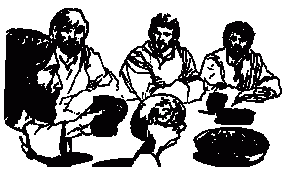 The vocation of priesthood is not like other occupations. Many people have jobs to put food on the table and a roof over their heads, but their employment does not define them. The priestly ministry, on the other hand, quantifies the man called to holy orders. It is for this reason that I always thought the current practice of having pastors retire was rather peculiar. One does not quit from priestly work. Even the infirmed clergyman in a hospital bed prays for the Church and may offer private Mass for the salvation of souls. Retired priests often still live in rectories and work in parishes. The priest literally works until he drops. The Church assures us that the mark or character distinguishing a man as a priest is also taken into the life to come. He is a priest, forever.
Filed under: Catholic, Discipleship, Priests, Sacraments | Leave a comment »
Posted on February 29, 2012 by Father Joe
 Given the new pastoral provision for Anglicans who desire to join the Catholic Church, there is a revised focus upon the question of priesthood and celibacy. Episcopalian priests will be ordained (absolutely, if not conditionally) and this will include those who are married men. While bishops must be celibate, some of the married priests (former Episcopalian bishops) will be given authority much like that given abbots of religious houses. Further, while future aspirants from their ranks would be asked to embrace celibacy; it has been assured that the Pope could make exceptions for their seminarians on an individual basis and that he would be generous in doing so. Okay, there is the rub. It seems to some conservative critics, that an accommodation is being given these “new” Catholics which continues to be denied to those with long-standing and family ties to Roman Catholicism. Intellectually, many of us are pleased and excited that there is this reciprocal motion: their movement in faith toward Catholic unity and the Church’s willingness to take them into the fold. Of course, we are not merely creatures of intellect; but, like all people, in possession of emotions and passion. That is one of the reasons that few dioceses, if any, would ever assign a celibate priest to live in the same household with a married clergyman and his family. Celibacy is a sacrifice where a man can know joy and a single-hearted love of God. Nevertheless, the sacrifice is real and like the Cross, it can be painful at times. Many good men have had their heart-strings pulled and yet they remained faithful to their promises. They made distance when necessary and cried their tears in silence. As we make room in the Western Church for married priests, we must be mindful of these wounded celibate men. I would not say that we should feel sorry for them, although I am often tempted to feel such for married men who suffer with the tension between their family needs and ministerial commitments. I suppose in that sense we could say that married priests are also wounded healers. How could any man be “another Christ” to his people if he has not embraced our Lord’s Cross? There is a mystery here: the man commissioned to heal and to bring Christ’s mercy to others must himself be like a bread broken and a cup poured out.
Filed under: Catholic, Celibacy, Marriage, Priests | 1 Comment »
Posted on February 28, 2012 by Father Joe
 Vatican II is often made a scapegoat for the many problems facing the Church. Certain traditionalists will deride priests ordained after the liturgical changes and condemn them as a class— of incompetence, heresy and a lack of fidelity. While such charges are quite unfair, as the original Modernists were ordained before the changes and celebrated the Tridentine Mass, it must be said that Satan and a secular modernity has targeted the priesthood, today. Concurring with the assessment of Pope Benedict XVI, we lament the scandals and the many ways that the desired fruits of Vatican II failed to materialize. There is hope in the new crop of vocations. The grace of God is manifesting itself, after years of turmoil. Truth is returning where a nebulous spirit of the council was often allowed to supplant what was intended by the council fathers. Those who would argue that both the tree and the fruit were rotten must face the fact of corrective truths espoused by Vatican II and imbedded in many conciliar and post-conciliar documents. Oddly they are sometimes ignored by both revisionists and traditionalists. Regarding the priesthood and its importance, we read: “The Council is fully aware that the desired renewal of the Church depends in great part upon a priestly ministry animated by the spirit of Christ” (Optatam Totius 1). This was true then, before and now. Our ministry is not our own. Christ must be alive, present and active in his ministers.
Closed churches and overworked men is the reality that we face with the vocations shortage. Critics point to the numbers in assaulting celibacy or in slamming the Church as a dying institution without meaning for contemporary men and women. We must be both sober and optimistic. Hope is one of the three things that last. Yes, there are over a billion Catholics on the planet. Truth would make us admit that while many are baptized, a quarter or less of our people still participate at weekly Sunday Mass. Among these numbers, there is measurable dissent and religious ignorance. There is a lot of work to be done. Priests and laity alike need the spirit of Christ if things are to change.
Filed under: Catholic, Priests, Sacraments | Leave a comment »
Posted on February 23, 2012 by Father Joe
 Going back to our childhood, there were people to whom we looked up. Our heroes inspired and move us. We hoped to be like them. We trusted them and they had a significant impact upon our lives. Unfortunately, heroes also frequently fall from the pedestals upon which we place them. Indeed, we often exaggerate their qualities and achievements, making their falls from grace all the more devastating. The truth is not always well served in hero worship. Men and women are bound to fail us. A boy might think that his father is the strongest man in the world; as he grows up, he is forced to realize that even the best of fathers are still mortal men dealing with sinfulness and weakness. The same can be said about our spiritual fathers or priests. It is only Christ who will never fail us.
The rector of my college seminary joined the Episcopal church and got married and the priest who ran the CCD program in my parish when I was a boy was excused from ministry because of allegations of misconduct with a youth. Priests in the media who meant a lot to me like Fr. Ken Roberts and Fr. John Bertolucci were dismissed for credible allegations. It was all quite devastating to me. These were men who inspired me to be a priest. Indeed, I modeled many elements of my life upon them. When facing the hypocrisy of the Pharisees and elders, Jesus told his friends to do as they say but not as they do. I guess those words still find application in the Christian leadership. When our heroes disappoint us, we become angry and some might even feel duped. Of course, my confidence was ultimately in the Lord. I pray every day that I will be faithful to my promises and charge as a Christian and as a priest. No human relationship or role model can ever come close to the friendship and witness of Christ. The other pieces of the puzzle only fit in place when Jesus is planted in the middle. Instead of wanting to strike out, I pray daily for my fallen heroes and for those whom they wounded, that they might know the mercy and healing of God. I also ask for guidance and strength, that I might be all that I purport and struggle to be.
Filed under: Discipleship, Priests, Sin | 1 Comment »
Posted on February 21, 2012 by Father Joe
Reflecting upon my own formation, we had opportunities for clinical pastoral care but were offered little in the way of understanding human psychology. Priests can certainly become proficient counselors over time but rarely just out of the seminary. The priest learns a great deal over the years as he undergoes his trial by fire. He becomes a master on the human condition, both good and bad. Of course, few clergy are professional psychologists or social workers. We are ministers of the Gospel and priests of the altar. We speak the language of faith in a world that has an increasingly difficult time with translation. We want to save marriages and better people’s lives, but always in terms of the redemptive work of Christ. We desire for people to find healing in a personal and corporate relationship with the Lord.
When a priest or teacher begins to talk about Jesus and religion, some people turn us off. Young people often do this and have not yet mastered masking their distraction. They know from their primary catechism that Jesus loves us but have rarely reflected upon what this really means. The full sacrificial dimension of this love has yet to seep deep into their soul and personality. They can recite the theme but do not feel its significance. If they truly appreciated the depth of Christ’s love, they would be brought to tears and would eagerly try to expunge sin from their lives. Jesus loved us so much that he died for us, to forgive our sins. This was no stoic act, but one filled with conviction and emotion. God would have us receive and return this love in kind. I would pointedly ask each listener, “Jesus loves YOU, what does this mean to YOU?” Jesus dies for them by name. He knows them better than they know themselves. He knows the problems they face and is ready to shower his grace upon them. Jesus can help and he wants to help. But have we truly invited Jesus into our life? Is he real for us or just a name we hear in church and read in the Bible? Jesus had to deal with feelings of abandonment and fear as well. The agony in the garden resonates with our own fears and sense of loneliness. You may have cried in your pillow but he wept at the death of his friend Lazarus and again when he sweated blood on the Cross. Jesus had his own relationship troubles. The leadership of his own people sought his life and his beloved apostle Judas betrayed him. His family thought that he was out of his mind. His friends often failed him. He knew, first hand, what we all go through. Maybe we have sought compensation in material things? Maybe we have raised the value of money and things over the needy and faith? Maybe the desires of the flesh have supplanted a true love of persons and God? Maybe our response has been to turn inward instead of outward? Jesus tells us to look to him. The answer is not to be found in the distractions of the world. He is the Way and the Truth and the Life.
There are many voices in the world that would lie to us. They tell us that happiness can be found in a bottle, drugs or sex. They are traps set by the evil one and his minions. Such paths are dead-end roads that will leave us with a sense of nowhere out. Too many who get lost listening to these voices are tempted to destroy themselves, wrongly thinking that it is one way out of the cage of a painful and meaningless existence. But this is the final lie on the road to hell. Instead, we listen to the voice of Jesus. He knows what you are facing and he wants to help you. Jesus is himself the medicine for the soul. He wants us to share his life and love. He will give his Spirit to any who ask. It does not matter what we have done. God is gracious and merciful.
Filed under: Conscience, Discipleship, Faith, Forgiveness, Priests, Sin | Leave a comment »










































