

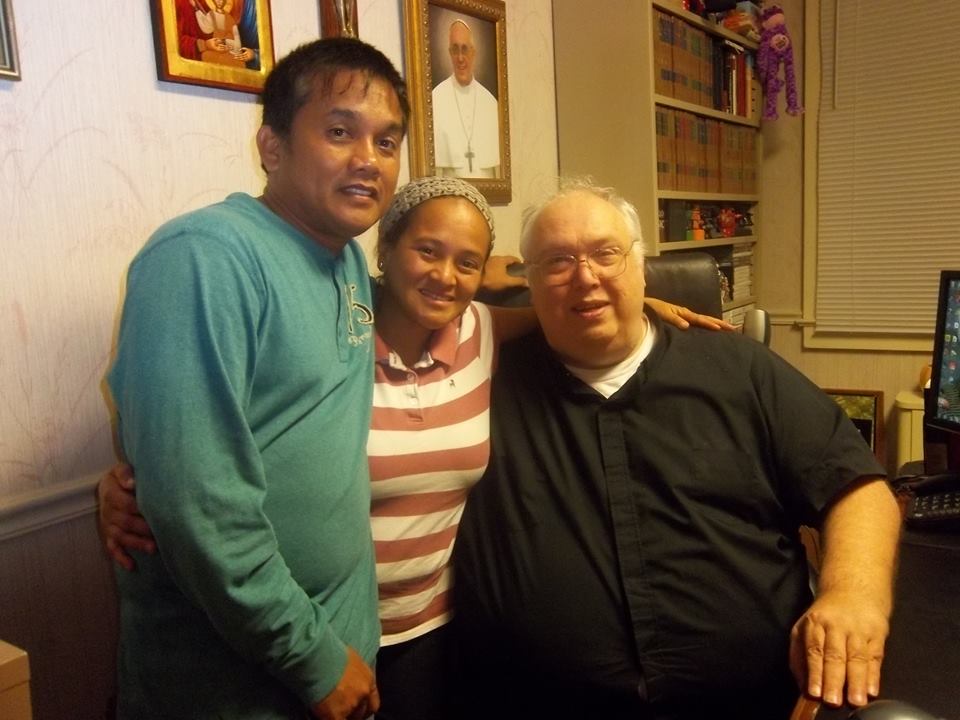
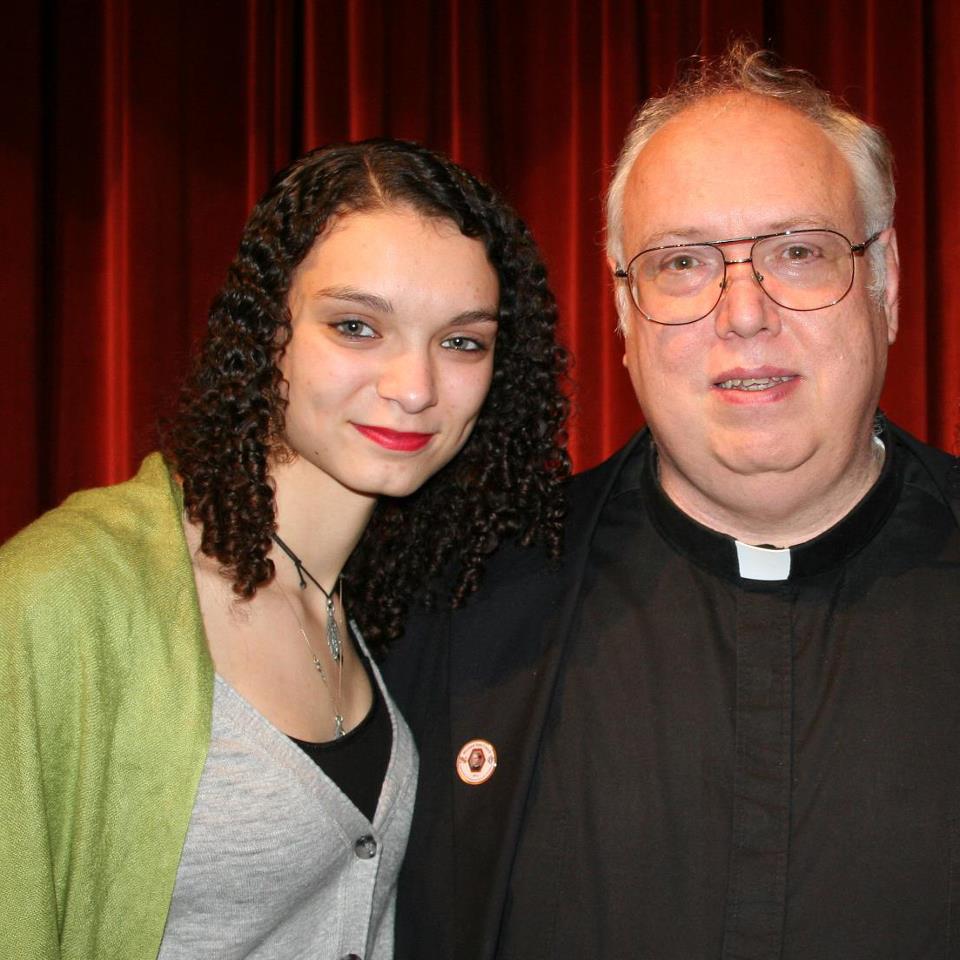
The Padayhag family are heading out today for Arizona. A teaching job opened up with sponsorship.
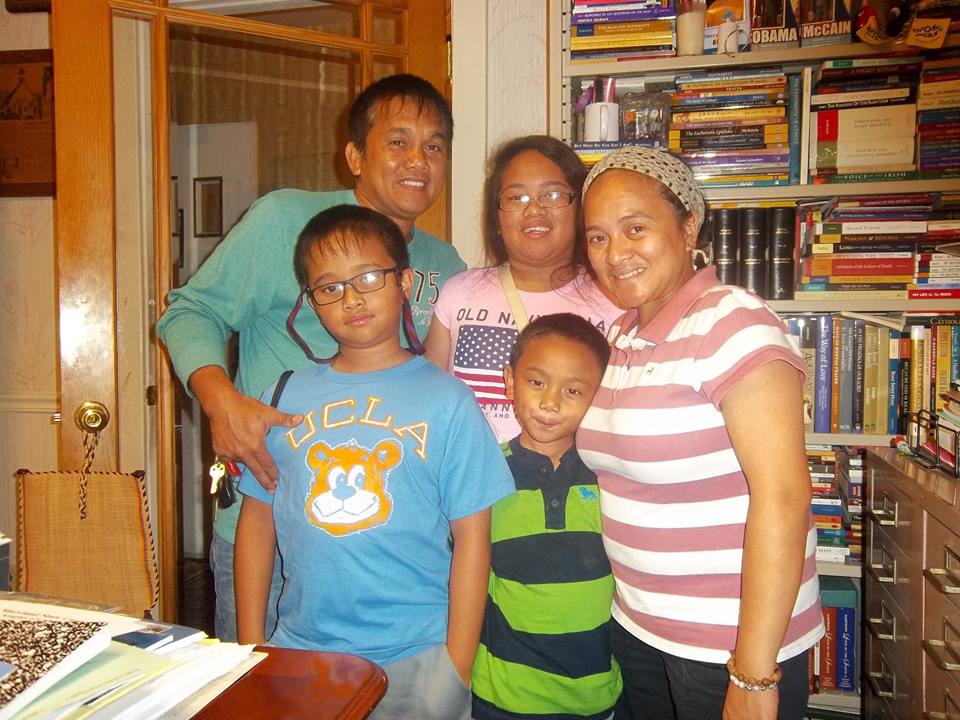
I am going to miss them very much.

Prayers for a safe journey! Many blessings and much love!
Filed under: Parish, Personal | Leave a comment »

Fr. Joseph Jenkins
 | Anonymous on Ask a Priest |
 | Michael J on Ask a Priest |
 | Jeremy Kok on Ask a Priest |
 | Mike Zias on Ask a Priest |
| Jeremy Kok on Ask a Priest |




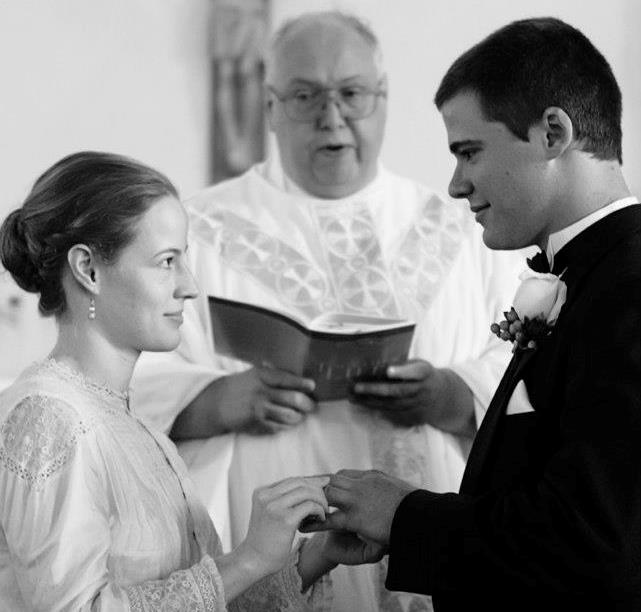
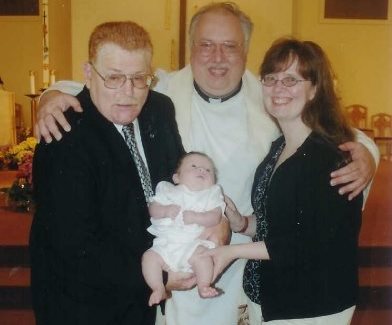
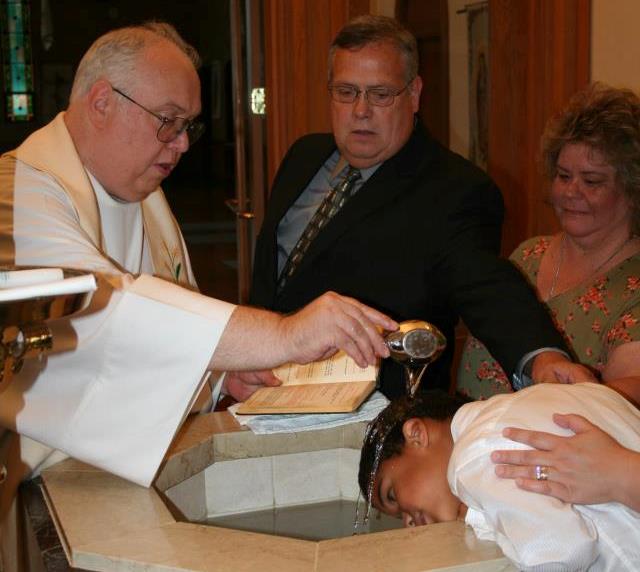
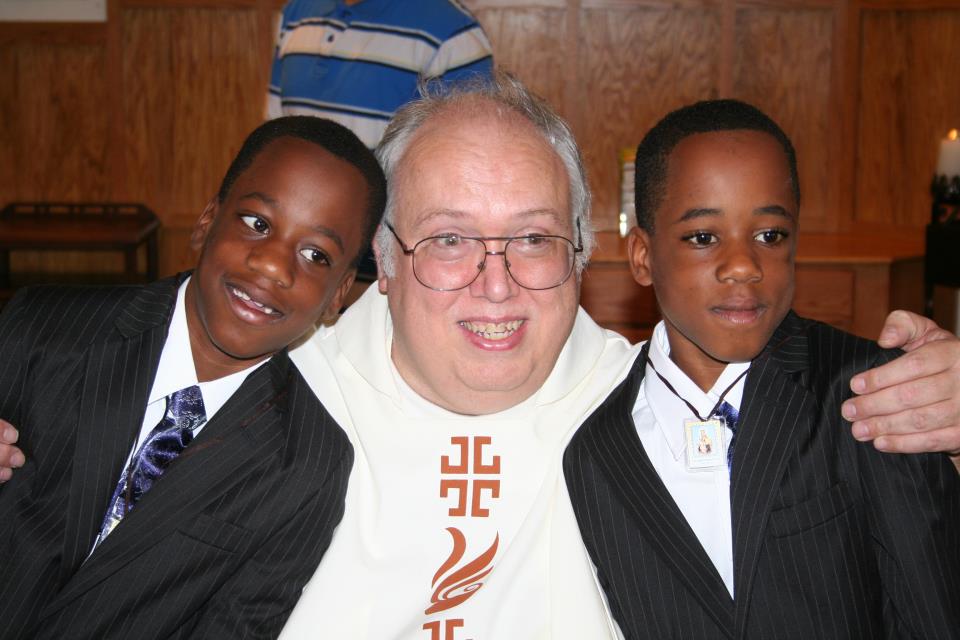





The Padayhag family are heading out today for Arizona. A teaching job opened up with sponsorship.
I am going to miss them very much.
Prayers for a safe journey! Many blessings and much love!
Filed under: Parish, Personal | Leave a comment »
The following are the members of the re-established Pastoral Council here at Holy Family: Mrs. Ida Belinky, Miss Cheryl Blake, Mrs. Cynthia Bowie, Mrs. Eleonora Foronda, Mrs. Marsha Hansen, Mr. Joseph Hebron, Mrs. Melissa Hicks, Mrs. Laurel McDonald, Mr. James Murry, Mr. Andres Padilla, Mr. Brian Payne, Mrs. Janet Renze, Mrs. Monette Roxas, and Mr. Michael Turner. This is the maximum number of members permitted by the new Archdiocesan guidelines (15 counting the pastor). The presentation and installation of members was held on Sunday Mass at 9:30 AM on January 26, 2014. Absent on Sunday were Ida, Ellie, Marsha and Joe.
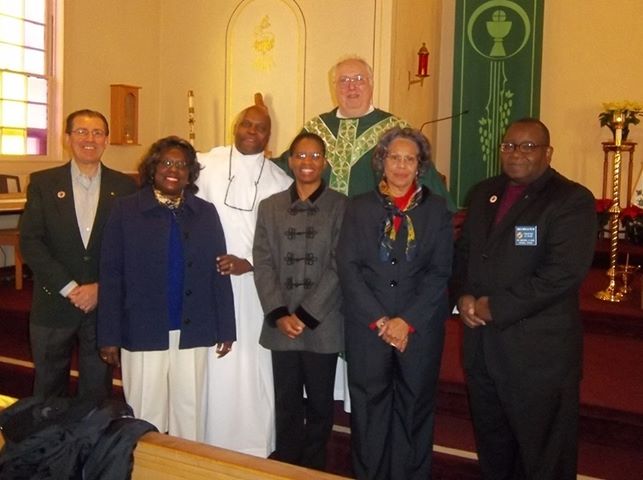
Pictured here with me after Mass are Andres, Cheryl, Brian, Melissa, Laurel, and Jim.
Filed under: Archdiocese, Church, Parish | Leave a comment »
About a hundred students stayed with us from Purdue, Butler and Marian Universities.
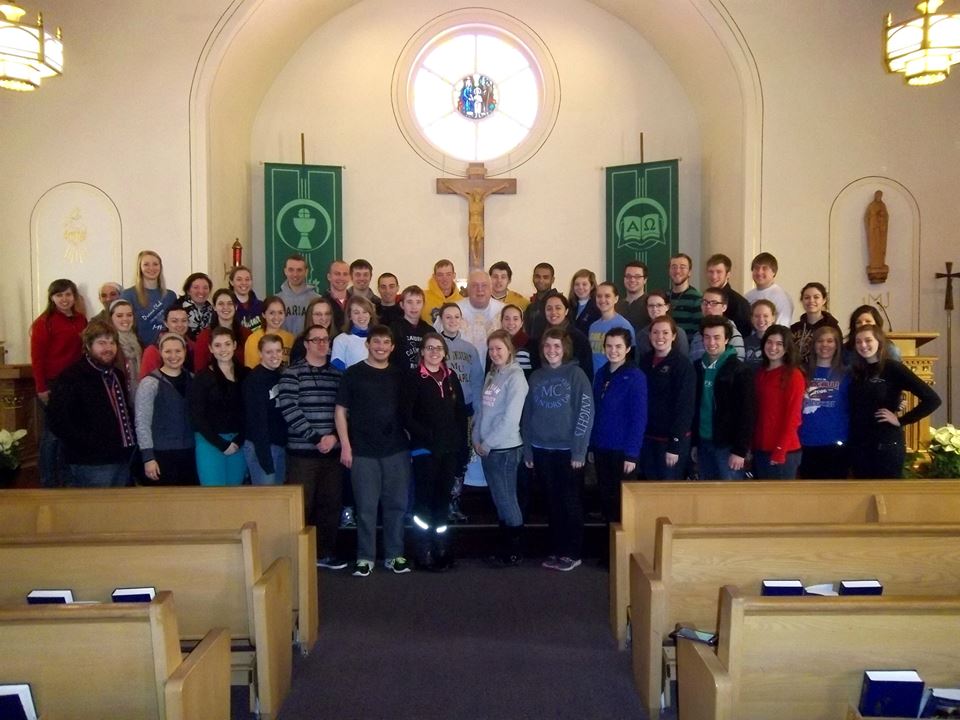
We had a pro-life Mass on Wednesday morning before the March. The students from Marian were largely in attendance.

Here are some of the Purdue and Butler students posing before our Cemetery of the Innocents.
God bless these pro-life champions. They braved freezing cold and snow to make a difference.
Filed under: Church, News, Parish, Pro-Life, Right to Life, Social Justice | Leave a comment »
4. Pastoral Care in Certain Difficult Marital Situations
a) Is cohabitation ad experimentum a pastoral reality in your particular Church? Can you approximate a percentage?
Not only is it a reality, the practice is reaching beyond “ad experimentum” in becoming a state of life all its own. Sure, there are couples who “shack up” to see if they are meant to live together, but many cohabitate for years without getting married or even intending to get married. Society, itself, is unsure how to deal with the phenomena. For instance, laws for common law marriages are falling by the wayside. It created situations where couples were regarded as legally married while they, themselves, thought they were not. I suspect that some of these couples suffer from ambivalence about marriage or a fear of the lasting commitment. Of course, the epidemic of divorce may also be a catalyst. I have heard couples say that they want to be sure and that they do not become another negative statistic. Ironically, those who cohabitate before marriage do not seem to fare as well as those couples who are virginal and/or chaste; why is this? I would submit that cohabitation grants none of the spiritual safeguards for marriage and thus is not analogous. There are no graces from the sacrament; indeed, the couple are most probably living in a state of mortal sin. Such cohabitation presumes that the couple are engaged in sexual activity or fornication. Indeed, some couples live together because it makes sexual congress easier. Others live together because they take refuge in each other within an increasingly cold and disconnected world. Men and women are lonely and afraid. Even though they are not married, they cling to each other for support and companionship. Unfortunately, mortal sin is no adequate preparation for a grace-filled marriage. Couples say they love each other… but not enough to wait and not enough to preserve the holiness of the beloved. This selfishness and mind-set is a terminal kernel.
I should add that when these couples come to the priest and ask for marriage, they are frequently treated the same as chaste couples trying to do right by God, the Church and themselves. A girl can be pregnant but she wants to wear white. But if she is living with her boyfriend and having sex, it becomes a broken sign. We can recommend separation but sometimes the length of the relationships and the logistics (including finances) of cohabitation would make this difficult. I have them stay apart the night before the wedding and require them to go to Confession. I would recommend that we marry such couples but do so in a way that minimizes the scandal. They could offer their vows in a chapel of the rectory or in a small service with less than a dozen friends. We could let couples know that cohabitation would cost them the marriage ceremony of their dreams. These are precisely the people who need to ponder more the inner realities of marriage and less the external trappings.
b) Do unions which are not recognized either religiously or civilly exist? Are reliable statistics available?
Is this question for real? Of course, they exist. Indeed, this year for the first time in the United States there are more couples cohabitating than married.
“About a quarter of women move in with a romantic partner before the age of 20, and more women than ever live with a partner before they get married, according to a new report by the National Center for Health Statistics. Nearly half of women (48 percent) between the ages of 15 and 44 lived with a partner before getting married between the years of 2006 and 2010, an 11 percent jump since 2002 and a 41 percent jump since 1995. Less than a quarter of so-called “first unions”—meaning a first marriage or first cohabitation—were marriages during that span. In 2002, 30 percent of “first unions” were marriages. According to the report, 1-in-5 women became pregnant during their first year of premarital cohabitation, 40 percent of first marital cohabitations transitioned to marriage within three years, and 27 percent dissolved within five years. People are also prolonging marriage for longer after moving in together, according to the report. In 1995, the average length of a cohabitation that transitioned into marriage was 14 months—between 2006 and 2010, it was 21 months.”
c) Are separated couples and those divorced and remarried a pastoral reality in your particular Church? Can you approximate a percentage? How do you deal with this situation in appropriate pastoral programs?
Again, of course this is a reality here in the U.S. and the Archdiocese of Washington. It was hoped that the six-month waiting period before marriage, and the accompanying preparation, might help. But the divorce issue still plagues us. The problem’s answer is shared Catholic faith and values. If couples worship and pray together, a Gallup poll shows that all but 2% stay together. And even that 2% might be an aberration from false responses. Couples that do not pray face a 50% plus divorce rate. This truth speaks for itself. If a couple practices sacrificial love and places their marriage into God’s hands, then his grace will sustain them. If they ignore his help, they are more liable to fail. As for percentages in the parish, I cannot say. Many no longer even tell the priest. This includes those who have remarried outside the Church. This complicates matters and makes for embarrassing situations among volunteers for parish service or for membership in fraternal organizations like the Knights of St. John and the Knights of Columbus. Like most priests, I have no specific parish program to deal with this issue. The priest will offer counselling if they come forward and assist in an annulment and/or subsequent convalidation. The issue is delicate and sometimes frightfully complicated. I had a situation of a couple that wanted to get married in the Church. They were both Catholic but the man was previously married outside the Church in a civil court. The Church would not recognize that bond but it lasted some years and they had children. The man procured a Declaration of Nullity Because of Lack of Canonical Form. There was nothing really stopping the second (true) marriage. However, as the priest I felt corrupted by the situation. He had abandoned his prior spouse and the girl he wanted to marry was “the other woman” who bragged about stealing him from his civilly married spouse. Married or not, it was a sickening situation!
I know that there are programs in the Archdiocese to assist troubled marriages, like Retrouvaille. There is also Marriage Encounter.
d) In all the above cases, how do the baptized live in this irregular situation? Are they aware of it? Are they simply indifferent? Do they feel marginalized or suffer from the impossibility of receiving the sacraments?
Some drop out regarding religious practice. Others act as if it is no big deal. Those who take Church teaching seriously feel guilt but there is resentment that they cannot receive absolution and the Eucharist. They frequently want to be treated as regularized when they are not. Some priests have told them that it is up to their conscience as to receive Holy Communion or not. They might even shop around for priests tolerant on this point. Of course, guidelines in the Archdiocese of Washington are currently rather permissive and priests are generally not allowed to withhold the sacrament. (Although many of us regularly substitute a quick blessing gesture, something in itself which is not proper to the communion line but which helps to avoid a negative confrontation.) I have encountered a few over the years who were unaware of Catholic marriage law, but only a few. There has also been the wrinkle of renegade rent-a-priests who posture as clergy in good standing and witness marriages without faculties. I have encountered two cases of this in the last two years.
e) What questions do divorced and remarried people pose to the Church concerning the Sacraments of the Eucharist and of Reconciliation? Among those persons who find themselves in these situations, how many ask for these sacraments?
They all pretty much ask for the sacraments or are upset when they discover that they should refrain. That is why they see the priest. The majority drop out and probably do not care. They will not make the effort to talk to a priest. Unfortunately, everyone who goes to Mass these days takes the sacrament. Ushers have to be careful not to intimidate such people to come up so as to avoid shame.
f) Could a simplification of canonical practice in recognizing a declaration of nullity of the marriage bond provide a positive contribution to solving the problems of the persons involved? If yes, what form would it take?
There has already been criticism of the many annulments granted in the United States. I suspect simplification would make the problem worse. Annulments must always be in conformity to the truth. There are some situations that cannot be fixed.
g) Does a ministry exist to attend to these cases? Describe this pastoral ministry? Do such programs exist on the national and diocesan levels? How is God’s mercy proclaimed to separated couples and those divorced and remarried and how does the Church put into practice her support for them in their journey of faith?
I think we need to do more to emphasize the value of the person who is not married or who through no fault of his or her own must now live as a single person after a failed marriage. Couples are not made up of two halfs that are made whole. We are complete unto ourselves. Not all stories in this world end happily. It is then we seek solidarity and consolation in Christ’s saving Cross.
Although not always conveniently located, there are also groups for Divorced and Separated Catholics. However, I am not certain that these always constitute the proper pastoral response. I have known divorced people becoming romantically inclined with people who share their hurts and disappointments. Instead of encouraging separated Catholics to mend fences, it makes the breaks permanent. Couples start dating when in the eyes of the Church they still belong to their lawful spouse. The Church, after all, does not recognize divorce and the person or persons who precipitate the break commit sin. This last point is either glossed over or denied, even by some assisting clergy. Are we encouraging fornication, cohabitation and adultery with our support groups for separated and divorced Catholics? Why is it that we do not encourage them to be chaste and content on their own? Do we really want a breeding ground for romance for this group?
Filed under: Adultery, Archdiocese, Bishops, Catholic, Church, Conscience, Discipleship, Faith, Family, Homily, Marriage, Modesty, Morality, Parish, Religion, Repentance, Sacraments, Sexuality, Sin | Leave a comment »
6. The Education of Children in Irregular Marriages
a) What is the estimated proportion of children and adolescents in these cases, as regards children who are born and raised in regularly constituted families?
This is essentially a census question. “Married straight couples with families now make up less than half of U.S. households, marking the first time the group has dropped below 50 percent since census data on families was first collected in 1940.” This is quite a jump. Out of the additional 11 million households since 2000, traditional husband-wife family households now comprise just 48 percent. The majority of homes have a single head, nonrelated persons and solitary residents. While other groupings have gone up, husband-wife homes went down by 5 percent.
Women are increasing leading households and/or living alone. The number of unmarried women heads among black Americans was 30 percent, three times higher than other ethnic groups. “Unmarried straight couples living together increased by 40.2 percent between 2000 and 2010, four times the national average. That’s still no comparison to the rise in the number of same-sex couples living together, which grew 80.4 percent over the same period.”
Today more couples cohabitate than are married and over 40 percent of all births are illegitimate. Many children are also being raised by one parent. The incidence of single African-American mothers is so high it has become a stereotype.
b) How do parents in these situations approach the Church? What do they ask? Do they request the sacraments only or do they also want catechesis and the general teaching of religion?
There are many children not receiving the sacraments or catechesis. Priests are not always receptive to such families when they request the sacraments for their children. I know priests who refuse to baptize babies if the parents are not married in the Church. It has angered them that I will do so. I admonish the family to get married and to live a Christian life. I tell them that baptism is not the end of something but the beginning. They are urged to witness and to share the faith. If they promise to try, and only God knows if they lie, then I will baptize the child. However, I will not baptize an illegitimate child at Mass, only in a separate service. Sometimes there is a residual faith that moves them to make the request. There might also be guilt. Grandparents might also be exerting pressure. This can become complicated when parents do not share the Catholic faith. What do you do when a Jewish or Moslem father threatens legal action should the mother get the child baptized or bring him to Mass for first communion? I took some heat a few years ago for baptizing a child who belonged to a lesbian couple. A homosexual neighbour donated the semen for one of the party’s insemination. This little girl was being raised with “two mommies.” The grandparents begged me to help. I talked to the ladies and made it clear that the Church could not and would not recognize their lifestyle. I then asked if they would pledge themselves to regular Sunday Mass attendance (without taking Holy Communion) and to raising their little girl in the Catholic faith? They said YES and the grandparents assisted. I did not want to punish the child for the parents’ sins. I baptized her. She has since attended Catholic schools, although the grandfather has passed away.
There are way too many cases where children attend catechesis simply so that they might get the sacraments. There is even a joke about it. “Confirmation is the sacrament you receive before leaving the Church.” The kids can be blunt about it. They want to get over with it. How do we set parents and youth afire with love for Christ?
c) How do the particular Churches attempt to meet the needs of the parents of these children to provide them with a Christian education?
Like so many questions in this survey, any answer given must stretch or correct the question. First, many parents are no longer even asking the basic questions of meaning, do not identify with any institutional church and are not concerned about the religious instruction of children. Second, those who are interested frequently want to minimize the impact and time involved with any religious formation. Everything else takes priority. Third, since only a very few Catholic students might be given entry into parochial schools, one would think that the emphasis would be upon parish catechesis. However, the opposite is true. Catholic school children are treated as the elite and the rest are the poor step-children. Millions of dollars go to the schools and scraps are given to parish programs. The Church does not invest proportional time, money or resources to children outside our parochial schools. Sacramental schedules follow the school year regardless of children who must get along with an hour a week of religion. We confirm children in eighth grade because that is when they leave Catholic grammar schools; and yet, the process is mostly mechanical regardless of preparedness. Efforts to raise the age for confirmation to tenth grade are struck down because such would take jurisdiction away from the Catholic school system and place it back in parish programs open to all children. Catholic schools are valuable but are becoming too expensive for many poor and immigrant Catholic families. This is causing an irony where well-to-do non-Catholics are attending parochial schools to bypass a failing public school system while Catholic children are excluded for financial reasons. This compromises the basic mission of our parishes and schools.
d) What is the sacramental practice in these cases: preparation, administration of the sacrament and the accompaniment?
Children from school and parish-based programs are lumped together for sacraments. No reconciliation is made of the fact that some get religion five days a week and the rest only once a week for an hour. As soon as the child reaches a certain age and grade they are given first communion or confirmation. Children get first confession and Holy Communion but then drop from religious education programs until junior high years. Young teens get confirmed and then, along with parents, disappear from the pews. I know this sounds terribly cynical but it is the common experience to which many pastors and catechists can attest.
Efforts that focus upon collaboration with parents suffer from the poor formation of adults who are neither informed nor motivated to assist with religious studies and homework.
Filed under: Catholic, Church, Discipleship, Faith, Family, Marriage, Morality, Parish, Religion, Sacraments, Schools, Youth | Leave a comment »

From Santa & Father Joe: “Remember, that Jesus is the reason for the season. Keep Christ in Christmas!”
Oh and yes, much to Santa’s relief, he is sitting in my lap and not the other way around.
Filed under: Aside, Parish, Personal | 1 Comment »

We had a wonderful Halloween Party for families and children at Holy Family. Many thanks to the Knights of Columbus and Parish Volunteers. Over 170 people came out!

Filed under: Knights of Columbus, Parish, Personal | Leave a comment »
The Mystery of our Lady as the Immaculate Conception is one that speaks to the Church about the identity of Christ and the sanctity of life. Things are not preserved from sin or forgiven, only persons. This dogma reminds us that human life and personhood begins at conception!

Mary is preserved from sin from the very first moment of her existence in the womb of St. Ann. This honor was shown her since the All Holy One would enter our world through her. It would not be fitting that the one who is the source of holiness should be touched by sin in the womb. Therefore, our Lord comes into the world through a sinless vessel. Mary calls the Lord her Savior, not in future tense, but present. The saving work of Jesus on the Cross reached backward into human history and embraced this precious daughter of Israel. That same saving power touches us, forward in time, through faith and baptism. Mary remains the Immaculate Virgin and Mother who intercedes for her spiritual children, we who are still so caught up in their weaknesses and sins. Mary is always about bringing others to her Son.
This appreciation of Mary as the Immaculate Conception is intimately linked to another title of Mary— that she is the NEW EVE. She cooperates in a unique manner with the work of her Son. Just as sin entered the world through a man and woman; now in Jesus and Mary we have a new Adam and a new Eve who are ever faithful. Mary utterly cooperates with the grace that fills her. She never sins but as the faithful handmaid at the Annunciation, always says YES to God.
The image we venerate acknowledges this role and the symbolism in the Book of Revelation. She stamps upon the head of the ancient serpent. This past week Pope Francis consecrated the world to her Immaculate Heart. We pray for peace. We pray for the conversion of hearts and minds.
May we also consecrate ourselves as loving children of Mary— brothers and sisters to Jesus— adopted sons and daughters of our heavenly Father.
Father Joseph Jenkins
Filed under: Knights of Columbus, Mary, Parish | Leave a comment »

The Immaculate Conception icon or image remained on display through Wednesday night, October 16 for services that began at 7:00 PM. We changed the order of the service, starting with a Rosary as is our usual practice. Mass would have been held at 7:30 PM but our chaplain was called away for the meeting of the Bishop McNamara Chapter of Grand Knights in North Beach, MD. He left copies of his reflections. The prayers were adapted as part of a Communion Service presided over by Deacon Tyrone Johnson, a Council member. Knights assisted and participated along with other parishioners. Given that the Rosary had already been offered, we inserted the Novena to Our Lady of the Miraculous Medal which is our usual Wednesday night practice. Prayer booklets were distributed and prayer cards were handed out. Thirty-five were in attendance. Two Color Corps members participated.

When the service was over, the prayer booklets were collected and the image and accompanying kit was picked up for use in the next council. Fifty-one people participated in the two services. No money was collected nor was there any social activity in accordance with Supreme’s rules. The Grand Knight recorded the council’s program in the log book that accompanied the image before sending it on to the next council.
Filed under: Faith, Knights of Columbus, News, Parish | Leave a comment »

The Immaculate Conception Prayer Program
The Immaculate Conception Prayer Program began August 7 at the 131st Supreme Convention in San Antonio, Texas. This program features an image of Mary as the Immaculate Conception, which is a copy of the original painting that is housed in the Cathedral Basilica Notre-Dame de Quebec in Canada. The church and the Archdiocese of Quebec are celebrating their 350th anniversary in 2014.
The Immaculate Conception Prayer Program is the 16th Marian Prayer Program sponsored by the Knights of Columbus, beginning with the first program – honoring Mary under her title of Our Lady of Guadalupe – in 1979. In preparation for the 1982 Centennial of the Order, the second prayer program was initiated, which also highlighted the Immaculate Conception. Since then, the Blessed Mother has been honored by her Knights under her titles of Our Lady of Perpetual Help, Our Lady of Czestochowa, Our Lady of Pochaiv, Our Lady of the Assumption, Our Lady of the Rosary and Our Lady of Charity.
These Orderwide programs of Marian Prayer have gathered together more than 16 million people at some 140,000 prayer services conducted at local councils and parishes.
Our District Deputy, Joseph Massimini notified that the state was available to the Third District. We alerted him that we wanted to participate in the Marian Prayer Program and we scheduled the event. It was announced at Holy Family Masses.
The image was delivered to Holy Family Parish/Father Kidd Council, Mitchellville, MD, on Monday evening, October 14, 2013 by Brother Knight Massimini following use in another parish and council. He met with our chaplain, Father Joseph Jenkins and the icon was set up in the parish church.
The icon/image was on display Tuesday morning, October 15 for 8:00 AM Mass. The general intercessions from the prayer service were utilized in place of the regular Prayer of the Faithful. It was the feastday for St. Teresa of Avila. Father spoke about how, along with St. John of the Cross, she was influential in the reform of the Church. At the end of the liturgy, our Grand Knight, Manny Rodriguez passed out the prayer cards associated with the program. The Rosary was recited immediately after Mass. Sixteen people were in attendance.
Filed under: Knights of Columbus, Mary, Parish | Leave a comment »












 Blogger Priest