An important theme for this blog is the scene in the New Testament where Jesus can be found FLOGGING the money-changers out of the temple. My header above depicts a priest FLOGGING the devils that distort the faith and assault believers. The faith that gives us consolation can and should also make us very uncomfortable. Both Divine Mercy and Divine Justice meet in Jesus. Priests are ministers of reconciliation, but never at the cost of truth. In or out of season, we must be courageous in preaching and living out the Gospel of Life. The title of my blog is a play on words, not Flogger Priest but Blogger Priest.
The SSPX argues that the contemporary liturgical forms have done the following: (1) Obscured the sacrificial and propitiatory character of the Mass, (2) Fostered a democratic conception of worship, and (3) Protestantized liturgical expression.
A Mass with an Obscured Sacrificial & Propitiatory Character
The claim that the Novus Ordo Missae obscured the sacrificial and propitiatory character of the Mass is refuted by the text of the liturgy itself and official Church teaching. There is no refutation of Trent, rather, the reformed Mass retains, amplifies, and explicitly declares these realities throughout its revised structure.
The sacrificial nature of the Mass is proclaimed multiple times in every Novus Ordo liturgy. Most notably, in the Orate Fratres, the priest explicitly invites the faithful to pray: “Pray, brethren, that my sacrifice and yours may be acceptable to God, the almighty Father.”
Further, the exact words of consecration restore an explicit expression of Christ’s sacrificial purpose. Take note of the phrase, “This is my body, which will be given up for you.” It directly emphasizes Christ’s redemptive offering.
The Roman Canon and the Eucharistic Prayers composed after Vatican II, all definitively state that the Church is offering Christ the holy Victim to God the Father.
Vatican II’s “Sacrosanctum Concilium,” affirms the teachings of Trent. So as there can be no confusion, it teaches that Christ is present offering Himself in the person of the priest, just as He did on the Cross.
The Catechism of the Catholic Church ensures that there can be no confusion on this matter. The Mass is identical with the oblation of Christ on Calvary. This sacrifice is “truly propitiatory” and is offered for the living and the dead.
A Democratic Conception of Worship
While the people are not mere spectators to the liturgy, they participate through a unity with the celebrant and thus with Christ whom he signifies. Proof of the hierarchical nature of the Church and the necessity of a priest at the altar is proven by the Church’s own official texts and the directives for pastoral implementation. The argument that the Novus Ordo introduced by Pope Paul VI in 1969 fostered an overly “democratic” conception of worship is a frequent point of critique among liturgical traditionalists. However, it is false in that the missal preserves the hierarchical nature of Catholic liturgy while furthering an ancient ideal of “active participation.” There is no majority rule. The role of the ordained priest is still essential— no priest, no Mass. The priest is sacramentally configured to act “in persona Christi” at the altar. Only the priest can confect or consecrate the Eucharist. He is more than a master of ceremonies. He is celebrant of Mass. Only a priest can offer Mass. Indeed, only a man in holy orders is permitted to proclaim and to preach the Gospel. Liturgical actions, prayers and rubrics are established by the universal Church, not through the popular vote of a congregation and not through the intimidation of a breakaway group like the SSPX. The liturgical reforms did not simply create something new but sought to recover something ancient to better confront modernity.
Participation of the laity at Mass is both external (responses and prayers) and internal (the right disposition). The notion of the faithful offering themselves with Christ was championed by Pope St. Pius X. It was not a notion new with Vatican II. There is a profound collaboration between the ordained priest and the laity who share a baptismal priesthood. Note that at baptism, children are anointed, “priest, prophet, and king.” This participation makes full discernment of the various presences of Christ: in the Word proclaimed, in the priest at the altar, in the Mystical Body of the Church, and in the sacrament. The orchestration of liturgy involves many playing their roles. But the ordering is not democratic but hierarchical. Christian worship is structured as a prayer to God the Father, through the sacrifice of Christ and made effective by the power of the Holy Spirit. Despite many cosmetic changes, the core structure of the Novus Ordo is the same as in the traditional Latin Mass. There is, in truth, no new or old Mass. The Mass is the Mass. The Second Eucharistic Prayer is rooted in the ancient liturgy of Hippolytus. Ancient texts went into the composition of the Third Eucharist Prayer as well. We do not celebrate ourselves in the Novus Ordo liturgy. Rather, we worship almighty God. We acknowledge his sovereignty over mankind. We invoke the Lord’s mercy upon us.
Protestantized Liturgical Expression
The argument that the Novus Ordo (promulgated by Pope Paul VI in 1969) “Protestantized” the Mass is a frequent criticism from traditionalists. However, our liturgical history and magisterial documents refute this stance. Indeed, the Vatican II rites sought to restore ancient Catholic traditions, not to succumb to Protestantism. The Protestants of the reformation rejected the Mass as a propitiatory sacrifice. This hallmark of the Catholic Mass remains essential. While the number of Eucharistic Prayers were expanded, all of them explicitly state that the Mass is a sacrifice. Note Eucharistic Prayer III: “Look, we pray, upon the oblation of your Church and, recognizing the sacrificial Victim by whose death you willed to reconcile us to yourself. . .” By comparison, Protestant reformers like Martin Luther and Thomas Cranmer obliterated all mention of sacrifice from their liturgies. Simplification of the rites was not to make them Protestant. Rather, it was an effort to return to the primary sources and to the ancient Church fathers. There was a heavier emphasis upon Scripture in the reformed Mass. The full expression of the Sign of Peace and the option for Communion in the Hand were recovered, practices that disappeared in the Middle Ages (see St. Augustine and St. Cyril of Jerusalem). Transubstantiation was reaffirmed, something rejected by the Protestants. Liturgically, we can look to the genuflections after the consecrations and the significance of the “Amen” as a response to “The Body of Christ,” at communion time. Indeed, Eucharistic Adoration was raised from a faith devotion to an official liturgy of the Church. Even the purification of the vessels affirms the real presence of the Eucharist. The use of the vernacular made the prayers more accessible to the congregation and the priest was often turned around toward the people; however, this was to further participation, not to reduce the sacrifice to a mere community meal. The Mass is still wholly Catholic!
This statement is taken from the SSPX Profession of Faith . . .
Yes, I can affirm much about the opinions expressed in the statement. But, we must be careful of false caricatures. This is a serious problem. No liturgy is absolutely “perfect.” Every Mass has its supporters and detractors. When properly offered the Novus Ordo can have an order and solemnity that is every bit as meaningful as the traditional Latin Mass. Unfortunately, comparisons frequently resort to stereotypical problems or abuses. I have said it before, and I will say it again, the classical High Latin Mass is a beauty to behold. But except for the sacred silence, the Low Mass is not much to write home about. The spiritual effects are the same, but the execution is quite different. As for the Novus Ordo, there are fewer strict rubrics and over the years too many clergy took it upon themselves to improvise where they should not have done so. We must not judge a liturgy’s value based upon abuses in celebration! There should be no clown or puppet Masses. Priests should be properly attired. Sacred music should not be switched out for banal compositions with questionable theology. More needs to be done with plain chants. The discussion should continue about the orientation of the priest with a freedom to either face the people or toward the East. I read recently that there are composers developing litany chants for the Prayers of the Faithful. That is good. There is even speculation that some of the old offertory prayers might be restored for when the Roman Canon is said. The liturgy that came to us after Vatican II contains all the essential parts of the Roman Rite Mass. However, its configuration is comparatively new compared to the age of the Church. While its beginnings were abrupt, we can hope that over time it will mature and truly flourish. But such matters take time. It was for this reason that Pope Benedict XVI wanted the old and the new rituals to continue side by side, perhaps to cross-pollinate one another. However, this is anathema to the radical left and right. The left would utterly abandon the tradition and the right might make it into a cage.
The Second Vatican II shared many of these sentiments about the Eucharist and Holy Mass. It described the liturgy as the “summit” toward which the Church’s activity is directed, and the “fount” from which all her power flows. However, while the liturgy of the Church is permanent, this does not mean that all her elements or the structure of the Mass remains stagnant or immutable in its accidentals. The pious language of this professional statement sets up the SSPX argument that the Mass prior to Vatical II is essentially immutable. But all is not as it seems. This just is not the case. Further, the Mass is one element among many in the formation of believers. The old Mass formed saints but it could not forestall the emergence of great heresies like modernism or sinners who sought to manipulate or even destroy their mother, the Church. While the Missal was edited and formalized at Trent, it could not halt the reformation and a mass defection. The French revolution was not forestalled by the traditional Latin Mass. World Wars all happened during its time of greatest prominence. Vatican II and the reformed Novus Ordo liturgy are often faulted for the many challenges of modernity, but the Church was already starting to feel its effects prior to the gathering of the world’s bishops. The Second Vatican Council sought to revitalize the Mass and deepen the faithful’s connection to this divine source.
It is true that liturgy is what it is. However, we must not underestimate what we bring to it. Those who currently attend the traditional Latin Mass are particularly attuned to its rituals and meaning. But many if not most Catholics in the past attended out of duty and were detached from the liturgical actions. The reformed liturgy was to counteract this situation.
The elaborate traditional Latin Masses are a far cry from what many experienced prior to Vatican II. There were no microphones on altars. The altar servers gave the Mass responses to the priest. The boys frequently learned the required words and their pronunciation from 78 rpm records. Did they always understand the Latin. I hate to say how often the kids would garble the words and try to hide it by mumbling. The laity entered their pews and said the rosary or other personal prayers. Low Masses, especially on weekdays had no music and the priest quickly rattled off the prayers. My old pastor could say the old Mass with the long Latin Roman Canon in 12 minutes. It was far from beautiful, but men rushing to work wanted the graces. Many of the faithful attached to this liturgy were also fond of the Latin people’s missals. However, these books with translations were long forbidden by the Church. A late development, laypeople first saw the introduction of hand missals to follow along at Mass in the 1920s and 1930s. This was part of the broader liturgical movement leading up to Vatican II. Pope Pius XII explicitly promoted missals in the 1950’s.
Richness and beauty belonged to the old Mass, but it was often locked away behind the back of the priest and the silence of the altar. Clergy and professional theologians well appreciated its richness, but the liturgical movement itself was a recognition of a problem in translating this spiritual treasury to the People of God. While there were many changes in the Novus Ordo, the Roman canon was retained and new prayers were added. The short second anaphora was devised for the quick weekday liturgy so that the priest did not have to say the vernacular words of the Eucharistic prayer at machine gun speed. Prayers that belonged exclusively to servers became those of the congregation.
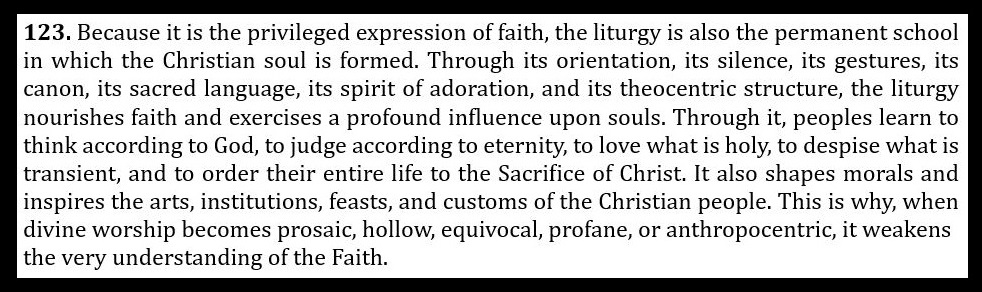
The Novus Ordo Mass is not dull or lacking imagination. The Scripture texts are far more representative of the Word of God, especially the Old Testament, than the old Mass. The prayers are rich and full of meaning. They are evocative, doing what they say. Few priests who regularly say Mass would say that it is hollow or empty. What the Mass is about is clear, not equivocal or vague. However, there are words and gestures that have a richness of meaning. The notion that the reformed liturgy is profane is a negative spurning that is a affront to God and a derision to the Magisterium that has approved it. It is the movement of God that makes it real. While there are elements that target the gathered community, the focus is always upon the worship of God. If the old liturgy emphasized the priest saying Mass for us; the new concentrates on how the celebrant makes possible our prayer with him. If there is anything mistaken for anthropocentric, it stems from the mystery of the incarnation where God becomes a man. The Mass never speaks to us exclusively regarding human values and perspectives. Any and every Eucharistic liturgy, calls us out of ourselves. We become what we were always intended, a parable people who put on the mind and heart of Christ. Every Mass makes possible our continuing transformation into Christ. As a priest who regularly says the Novus Ordo, my faith is strengthened, not weakened. I suspect that most who go to Mass would say the same.
This statement is taken from the SSPX Profession of Faith . . .
Here we begin to see a problem with the SSPX stance. What is said about the Eucharist as the substantial presence of the complete risen Christ is true. It is what we believe. But then there is a not-so-subtle opinion, more subjective than measured by immutable doctrine. The SSPX rejects the reformed liturgy as a “practice which weakens faith in the Real Presence, the respect due to the Eucharist,” and “trivializes Holy Communion.” The SSPX statement even makes liturgical architecture into a matter of faith, given what they define as the “sacred character of the sanctuary.” As a priest aware of the sacred beauty of the Tridentine Mass, I can attest disagreement to their negative assessment against the Missal of Paul VI. The reformed liturgy cannot be defined by abuses in its administration. No matter whether the priest faces away (East) or in the direction of the people, he is still facing and offering his ministrations at the altar. Certain cathedral churches with central altars, always had people behind and in front and on the sides or the celebrant. The priest raises his eyes to heaven and that is where we should set our sights. While communion on the tongue is normative, for the first thousand years the preferred manner was in the hand. Either option is permitted today. It is preferred that tabernacles be central to the worship space, but even if this is not so, the real presence of Christ is still honored. Indeed, in such cases the gravity given the altar of sacrifice is highlighted in terms of worship. It is okay that SSPX members prefer the older forms. However, it is wrong that they would condemn and force the rest of the Church to abandon the reformed liturgy. I would argue fidelity about essentials and freedom about accidentals. They would interpret their 600,000 lay worshipers as the faithful remnant against the one-and-a-half billion Catholics in juridical union with the Holy See. They would insist that their rebellious two serving bishops should be able to dictate to the 5,600 faithful bishops of the Catholic Church who are one with the Pope. No way— it will never happen. No matter whether they appreciate it or not, they malign our legitimate pastors, the faith of our people and the presence and activity of Christ in our reformed sacraments. Their own profession of faith will come back to condemn them.
This statement is taken from the SSPX Profession of Faith . . .
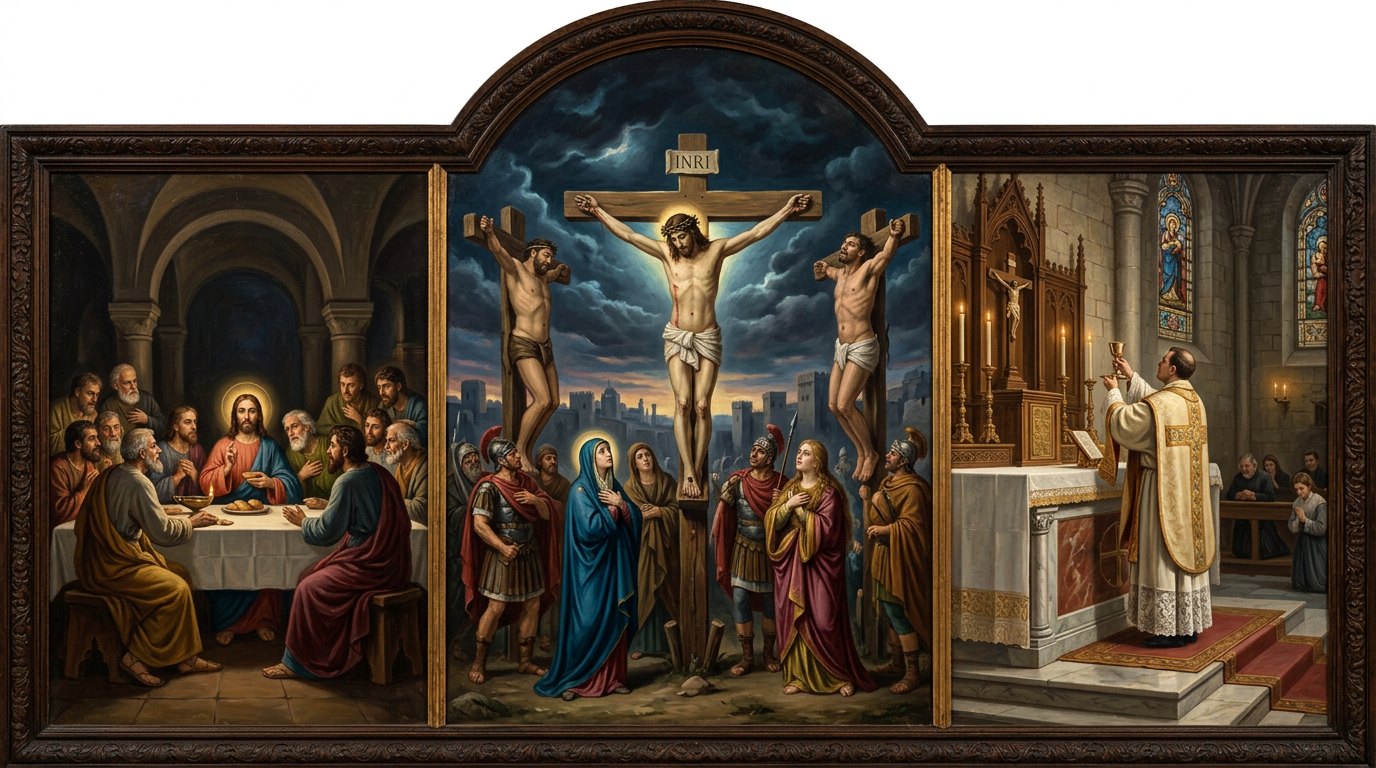
Yes, the Mass is the unbloody re-presentation of Calvary. Yes, it is truly a sacrifice. However, I suspect that the SSPX is reading the word “memorial” in a secular fashion, for instance as a statue or monument or plaque might memorialize a person or a moment in history. This is not how the fathers of Vatican II would interpret the word. The remembrance or memorial of the Mass is an “anamnesis” wherein that which is recalled is made truly present. It is not a nostalgic remembrance at all. Jesus at Calvary is more than a historical event. The Holy Mass makes the oblation of Calvary immediate and present. Thus, we could clarify that the Mass is a command performance that Jesus tells us at the Last Supper to do in “remembrance” of him— the paschal meal of the new covenant and the real propitiatory sacrifice of his Passion. The Supper or Mass is entwined with Christ’s paschal mystery, the Cross. It is not simply a symbolic remembrance, but a liturgical ritual that realizes the one-time sacrificial action of Christ on Calvary. Jesus is the priest and victim on Calvary, and he is the priest at the sacrifice of the Mass. It is the same priest, the same victim and the same event.
The CDF in 2017 gave three conditions for the SSPX to receive canonical status: (1) Adhere to Pope John Paul II’s 1988 Profession of Faith, (2) Accept the teachings of Vatican II and the post-conciliar Church, and (3) Recognize the reformed Mass and other sacraments and rituals as licit and valid. Speaking out of both sides of their mouths, they technically acknowledge the validity of sacraments in the postconciliar Church; however, the SSPX still rejects the Novus Ordo as intrinsically evil, discourages Mass participation by calling it dangerous and stamps Vatican II as heretical. Does this not deny the indefectibility of the Church? This alone is at variance with ecclesial doctrine. Will not the consecrations of new bishops against papal directives impose a new excommunication upon them as specified in canon 1397?
SSPX clergy have stated, even on their official website, that the Novus Ordo Mass is evil and dangerous to attend. This slur demands proper mental consideration. First, this assertion undermines the indefectibility of the Church under the Holy Father. It insinuates that Jesus is a liar or even impotent in keeping his words to Peter that he would be with him and sustain the Church until he comes again. It maligns Christ and undermines papal authority. Second, since the Eucharist is the very font and life-spring for the Church, the negative charge implies that the post-Vatican II Church is dried up and lifeless. There can be no fruit. But, if one rejects the true Church, then one rejects Jesus Christ. The SSPX leaders are risking their very souls. This is a grievous defamation of Christ’s Church. Third, the Mass, old and new, is the re-presentation of Calvary and makes present the body and blood of Christ as our spiritual food and drink. Any rendering of the divine mystery as evil is blasphemy against the Holy Spirit, a dire mortal sin. Lacking repentance and contrition, one cannot escape the unforgivable sin. One cannot be saved by a divine power that one rejects. The SSPX cannot take to itself the authority and power that belongs to the Church shepherded by the Pope, Christ’s visible vicar on earth. And yet, that is precisely what it is attempting to do.
I am afraid, there you have it. The SSPX response is more telling than they would readily admit, given that their subterfuge hides nothing. While the last pontificate sowed ambiguities that complicated matters, the SSPX would have had issues with any of the popes going back to John XXIII and Paul VI. Ironically, the response accuses the Holy See of a disingenuous attitude toward efforts at regularizing Marcel Lefebvre’s syndicate of discontents. As one poor priest who believes in extending freedom regarding the celebration of approved liturgies, I had hoped and prayed for full juridical reunion, not only to help preserve the Mass of the Ages, but to lend greater nuance and consistency to the Church’s tenets of faith. As it is, Pope Benedict XVI’s efforts at reunion have been thwarted, not only by the questionable antics and obscurity of the last pontificate, but by the Lefebvrites themselves in preferring a compass heading away from Rome and swinging ever closer to the sedevacantist sects. Bishop Athanasius Schneider wrote a catechism that essentially defended the Society in its repudiation of certain Vatican II tenets and accused the post-conciliar popes of false teaching, which he coined as “ambiguity.” If given a choice to mind his own business and return to his home archdiocese or to join the SSPX, what would he do? The danger exists that those sympathetic to the SSPX may join the increasingly erratic Archbishop Carlo Maria Viganò in excommunication and schism after the illicit consecrations. While Bishop Schneider is transparent in his public dialogue about doctrinal concerns, the SSPX has likely duped him that such is their core reservation. I suspect it is more about jurisdiction and power. It is unlikely they will hand over what they have to the Vatican in exchange for canonical status as a personal prelature or special ordinariate.
Is This a Genuine Application Newman’s Organic Development?
(CLICK the image to go to document.) The first paragraph of his document to the cardinals at the extraordinary consistory speaks about past historic changes in the Mass and about the process of liturgical reform as one of “organic development.” It is true that the Mass has always been subject to “a process of organic development.” However, this fact does not mitigate the tension over post-Vatican II reforms. Reforms were historically not accomplished over a period of months or a few years but extending decades and even centuries. Further, they were the product of priests and the lay faithful alike, not a small group of so-called experts or a single liturgist. Changes in the liturgy would consist of an addition here or a small deletion there, but not a wholesale rebranding and substitution of the Roman Canon. How can anyone with a straight face argue that the changes effected during the last half-century were truly “organic” in scope? There is no getting around it, the changes were revolutionary. The practical proof of this claim was the reaction among those in the trenches. While many youths embraced folk and rock Masses as part of their natural rebellion, older Catholics were upset but complied because of a strong affinity toward obedience of just authority. Catholics often did as they were told because they loved the Pope and trusted their bishops and priests. I can still recall whole parish and religious school libraries being emptied into dumpsters because the “new Church” would no longer need the old liturgical books or morality manuals. Despite debates to the contrary, this negative treatment against treasures from the past spoke volumes about a hermeneutic of rupture. The psychology here was not rooted in continuity but in a break or a new start. Everything old was deemed bad and everything new was judged good. Ironically, this mentality, in reverse, is what we hear from certain traditionalists— that the “old” is better and holier and that the “new” is bad and heretical. Increasing numbers of learned critics contend that the liturgical changes went far beyond the mandate of the council. Nevertheless, the reforms received ecclesial approbation. This truth cannot be sidestepped. It must be said that the reforms were imposed based upon various contemporary presuppositions (of questionable credulity): that the Latin liturgy was unintelligible to modern men and women, that it lacked logical internal organization, that it wrongly rebranded the preparation of the gifts into an offertory functioning as a secondary natural oblation, that it overly anticipated the transformation of the sacred species, that it lacked a coherent and clear epiclesis, that the liturgy of the Word was eclipsed or minimized by the Eucharist, and that it deified the person and power of the priest over any active participation by the laity.
Does One Faith Demand Absolute Uniformity?
The second paragraph of his missive to participants of the extraordinary consistory is just as nonsensical as the first. As a defense for the abrogation of the traditional Latin Mass, it is ironic that Cardinal Roche should cite Saint Pius V’s assertion that since “there is only one way of reciting the psalms, so there ought to be only one rite for celebrating the Mass.” Today there are many ways that the psalms are recited given the many translations, chant and modern musical renditions. The psalms may be recited straight through, antiphonally or with intruding responses. The Roman rite was translated into the vernacular from Latin, and one translation often disagrees substantially with another. Where we had one canon in the West, we now have four ordinary ones, as well as special Eucharistic prayers for children and reconciliation. Further, the Anglican returnees have their traditional liturgy and Catholicism permits many lesser rites around the world. Given all this diversity, why cannot room be carved out for those spiritually attached to the old Roman Canon? That which is not from God will pass. That which belongs to the Lord will blossom and grow under the movement of the Holy Spirit. Can we not trust God about this? How can the good cardinal both impugn Pope Pius V’s logic and then claim it as a support for the intransigence of Traditionis Custodes?
Constant Reform or Long-Term Stability?
The third paragraph of Cardinal Roche’s consistory document would seem to argue for perpetual reform without end. This ignores several important concerns. The reformed liturgy was neither something entirely old nor simply the product of “cultural elements that change in time and place.” It was largely the result of one time and place. There was an almost “Pollyanna” optimism during and after Vatican II. The signs of the times were a tradeoff of antiquity and the ageless for the contemporary and fickle. Note that many modern liturgies and the accompanying music still resemble something from the 1969 Woodstock festival. First, not all cultures and times are the same. The Church is the mother of Western civilization. It is not that she is just the product of her times but that often her faith and rituals were the catalyst and source for the ideas and cultural values around her. Second, while the relationship of the Church to the surrounding culture communicates in two directions, sometimes the situation is mutually supportive and at other times, clashing and combative. No authentic liturgical reform can embrace elements that are contrary to authentic Christian beliefs. Third, the nature of the paschal mystery itself mandates that certain elements of faith and ritual should be judged as immutable. Just as Jesus is the same, yesterday, today, and tomorrow— a liturgy should be historically grounded as a permanent anchor in a world of incessant change. Do words and ceremony communicate what they should— making present the mediation of Christ in his passion, death, resurrection and ascension? Is it not precisely the argument of the advocates for the traditional Latin Mass, that the sacred language, silence, ordered movement, and heightened reverence, all better convey a sense of the paschal mystery of Christ?
Pope Benedict versus Pope Benedict?
Is there no shame? Cardinal Roche in paragraph four of his consistory document would quote Pope Benedict XVI (out of context) to support the suppression of the traditional Latin Mass and the reversal of Summorum Pontificum. Really? Has he not read what the late Pope wrote about liturgy? Pope Benedict XVI did indeed speak about sacred tradition as a “living river,” but the streams of that river extend both to the Vatican II reforms and to what came previously. Indeed, one might ask, are the waters freely flowing to the tried-and-true of centuries past as to the novelties not yet a hundred years old? Indeed, to keep the analogy going, might Traditionis Custodes be interpreted as a dam to those waters.
A Bias for One Liturgy Over Another?
Paragraph five of Cardinal Roche’s consistory document seems to envision a “dynamic vision” as belonging exclusively to the Novus Ordo. Is this not the same kind of negative bias of which the other side in this debate is accused? Legitimate progress must not be interpreted as change for change’s sake. It is true that a living tradition would forestall a “collection of dead things.” But it was never Pope Benedict XVI’s intent to resuscitate a zombie rite. Both rituals are alive and make Christ present in his person and in his saving activity. He hoped that the old and reformed liturgy, side-by-side, might cross-pollinate and enrich one another. Might the old liturgy be pruned in part? Might it benefit from an enriched lectionary and an extended responsorial for the gradual? Might it be offered in Latin and the vernacular? Could a form of concelebration be returned to the old liturgy? Might a sense of reverence and order be given the reformed rites? Might there be a reconsideration of the reduction of the offertory in the Novus Ordo? Could we see a restoration of some Latin and Gregorian chant? Might the liturgical calendar be reconciled between the old and new? Unfortunately, all this is short-circuited by the current suppression. How is this healthy? How does this promote the life of souls? If we are all about giving the people a voice, then why do churchmen make demands against kneeling and communion on the tongue? What became of freedom about such things? Why should we care if reverence and care are taken?
Might Something Be Gained & Lost By Reform?
Paragraph six of the consistory document simply says that there is no reform of the Church without liturgical reform. This is true given the intimate inter-connectiveness of constitutive elements of the Church. Paragraph seven is an expression of confidence in the scholarship (theological, historical and pastoral) behind the liturgical reform. Left unspoken is the possibility that reformers, no matter how well intentioned, can lose their way. Reformed Judaism had gone through its own reform earlier and with unanticipated negative results. The rabbis warned churchmen that a more streamlined and ordered liturgy might not have the same compelling power of a somewhat messy conglomeration. A ritual that arises over time from the genuine prayer of a priest and congregation around an altar often proves itself better than one composed by a professor more familiar with academic than the pastoral setting. Ritual touches the human being, not only on the rational level, but upon the emotive and spiritual as well. For instance, repetition and striking the breast might change little in terms of meaning but have a tremendous impact upon the human psyche. Similarly, the “artistic” and “beautiful” cannot be reduced to cold mathematical formula. As for paragraph eight, while formation is invaluable for deeper understanding, we must not forget that the language of sign and symbol should also immediately convey a sense of the sacred and a meaning imbued with mystery. Those attached to the traditional Latin Mass may not have degrees in liturgy, but we should not devalue or undermine as inconsequential any attestation of a powerful experience of the transcendent. If the reformed liturgy places a premium on words and translation, the older ordo placed greater weight upon the sacred spectacle of smells, bells, gesture and chant. While the reformed liturgy emphasizes external participation, the older ritual emphasized an internal movement of just being present and many personal prayers. Who is to say which is better? Maybe different people vary in the type of liturgy that serves them best?
Does an Old & Reformed Liturgy Signify a Defunct and a New Church?
The danger of paragraph nine and the extended quote from Pope Francis should be self-evident. It is a direct appeal to a rupture in the tradition. It asserts that one cannot be faithful to the Vatican II Church and desire a strict association of the prior liturgy. However, in truth it is the same Church. Further, who is not to say that certain conciliar principles will not have an impact on the Tridentine liturgy over time? The argument that the Mass change is a fait accompli to which everyone must slavishly comply seems nonsensical if brute authority must be exacted against otherwise good and faithful Catholics? If the new liturgy were perfect, then it is doubtful that a problem would have arisen. Why would Pope Leo XIV beseech Eastern churches to maintain their tradition of liturgy while we have largely thrown ours away. Allowing both the old and the new to exist side-by-side may be the perfect way toward integration, not by ecclesial force but by a natural spiritual attraction. Maybe we have been too stringent in restricting and defining the movement of the Holy Spirit to the work of Archbishop Annibale Bugnini and his team? The groundswell of support for the old Mass and the demand for an end to abuses in the new might be the true work of the Spirit of God. While there is much in the way of cultural adaptation and freedom given Catholics in regard to all sort of parallel traditions and experimental liturgies, then why not carve out a space for those who acknowledge papal authority but should be shown sensitivity and compassion about a liturgy that bred many of the saints and still resonates with the Catholic soul?
Paragraph ten simply gave some of the recent history about the liturgy and the popes, conveniently omitting the name of Pope Benedict XVI. Paragraph eleven returns us to Pope Francis’ view in paragraph nine. He writes: “I do not see how it is possible to say that one recognizes the validity of the Council . . . and at the same time not accept the liturgical reform born out of Sacrosanctum Concilium . . .” Both Cardinal Roche and the late Pope Francis view it as an ecclesial matter. This mentality pretty much insures an eventual full schism with the SSPX and makes any future for groups like the Fraternity of St. Peter more than precarious. It is ironic that an attachment with the old liturgy should call their Catholicity into question. Contestations to the contrary, much of Vatican II can easily be reconciled with tradition.
A Few Broader Vatican II Questions Beyond Liturgy
As for the harder Vatican II questions like freedom of conscience and the extent of religious freedom and ecumenism, should they not be argued and hammered out by believers. Given a world where Catholic states have all but disappeared, it makes sense for Catholic social teachings to honestly reflect the current lived reality. While we have every right to insist upon the truth of our beliefs, we can still work with others for a peaceful and just society. Is it really too much to concede that believers should not use torture or violent intimidation? Indeed, is this not the high ground of the Church against Islamic extremism? Further, an emphasis upon the incommensurate value of human life and the high dignity of “persons” is no threat to the divinization of believers by grace. None of us should be so attached to the anachronistic that we would further fracture the Church and society when there is a desperate need to build bridges and heal old wounds.
I read with interest the article by Gregory DiPippo about Brian Holdsworth’s video on the Church’s liturgies. A position is critiqued that argues that it does not matter which liturgical form is followed, either ordinary (reformed) or extraordinary (TLM). But in all honesty, I know of no learned believers who hold such a position. Note that the question here is not whether either liturgy (particularly the reformed ritual) is valid, licit, or spiritually effective. Catholics in good standing hold that the Mass in either form is a re-presentation of the sacrifice of Calvary, makes Christ present in the Blessed Sacrament, participates in the marriage banquet of heaven, and is an oblation for propitiation or for the satisfaction of sin. Either form constitutes Catholic worship, although one form or the other (and even how it is conducted) impacts upon what is communicated as well as to aesthetic tastes. The tension is real because both sides in the debate feel it does matter which form is followed, at least to them.
As a priest who is familiar with the older ritual, but has always said the reformed liturgy, my preference is for the somewhat streamlined liturgy of Paul VI. However, I can lament the reduction of certain beautiful prayers, especially from the revised offertory. Having admitted this, I believe in the freedom acknowledged by the late Pope Benedict XVI in granting liberty for priests and communities to celebrate the TLM. The two forms side by side might provide for deeper insight into any future reform. Indeed, looking back, it is likely that such a strategy might have borne better fruit than the reductionist intervention imposed after the council. While what is done is done, we can pursue a more gradual organic development of the Mass in the days to come. I suspect something of the blueprint in the English-speaking world might be the providential inclusion of the Anglican returnees in their three Personal Ordinariates. Their missal savors tradition, sacred worship-language, and a profound respect for the Roman Canon.
Why does a sizable remnant prefer the Traditional Latin Mass (TLM) or Mass of Pius V? Advocates cite its perceived reverence or sense of mystery (especially with chants, Latin and sacred silence), historical continuity, and theological clarity. The concise rubrics give order to a worship that highlights the transcendent.
Those who prefer the Novus Ordo (Ordinary Form) or the Mass of Paul VI list the following: more complete biblical selections, renewed emphasis given to the homily, the restored intercessions or bidding prayers, clearer emphasis on community participation, an understandable vernacular, and an effort to connect with modern believers.
More than just subjective, the differences between the liturgies are real and objective, However, are they worth alienating whole groups in the Church? Traditional believers who argue that the reformed or “new” Mass is dangerous and refuse to attend are not being helpful and probably had a part to play in the renewed suppression of the TLM. Those who attend the reformed liturgy are also guilty of blaspheming the Holy Spirit by maligning an ancient Mass that formed and enriched the many saints.
The article sides with the advocates for the TLM and views the reformed liturgy as an orphaned child, belonging not to Vatican II and only vaguely to the Church’s patrimony. Pope Paul VI is faulted for placing his stamp of approval upon it. The author of the articles writes, “If we understand this, we can see why it is possible to question and even reject the modern rites without being disloyal to the Council.” Councils aside, popes view themselves as the Roman Rite. The late Pope Francis thought so for sure. Priests of the ancient Church imitated the papal liturgy and made it their own. If this is the case, can we really claim loyalty and reject outright the rite of the last six popes? We may each firmly believe we are right, but regardless of this, how do we move forward? I would stop worrying about the extremist fanatics and ponder the needs of the good people in the pews. If they love and feel enriched by the old Mass, then let them have it. If people prefer the new, and the celebration is reverent and sacred, then let them have their worship. Neither are second-class or bad Catholics.
We can discuss and debate the elements of liturgy. We can judge one as superior to another, or at least better in-tuned to our spiritual character. There are many rites of Mass within Catholicism. The Roman Rite is currently divided between the Traditional Latin Mass, the Novus Ordo, and (to a lesser extent) that of the Personal Ordinariate (former Anglicans). All liturgy should be reverent, giving emphasis to the sacred and focus upon the Almighty. Accidentals do matter. But the substance should not be eclipsed. There is a bottom line but all liturgies are not the same. Many today judge the Traditional Latin Mass by beautiful Gregorian chants, mysterious Latin which is the language of the Church, organized ritual and meaningful sacramentals, etc. But in days of old, there were no microphones on altars, priest often rushed through the prayers at machine-gun speed (especially on weekdays), low Masses lacked music or it was poorly done, homilies were skipped, and we simply said our rosaries or personal prayers during Mass. People grew spiritually but there was sometimes a disconnect. It was hoped that the Novus Ordo would bridge this, but problems remain and may have grown worse. Many today are quick to judge the Novus Ordo, not by reverent renderings, but by clown and puppet shows or with liturgical dancers or whatever. But these are the crazy aberrations.
My ministry is about the forgiveness of sins and helping people to get into heaven. That is really what the Church should focus upon. The Mass and the Eucharistic Christ are essential. Without the Mass, we will spiritually starve. Without the Mass, we cannot render the worship that Almighty God demands. If I were to reject a form of the Mass authorized by the Church and her popes, then my ministry would end and my flock would suffer spiritual starvation. A priest cannot reject a form of the liturgy that he is morally committed to offer. This being the case, how can any of the flock reject that Mass? I am only a poor simple parish priest in the trenches. I will leave it to better minds to ponder the important accidentals of Catholic liturgy. Meanwhile, I will daily approach the altar, knowing that I am a sharer in the Lord’s priesthood, and with the epiclesis and words of consecration, transform bread and wine into the body and blood of Christ.
This is the home of the AWALT PAPERS, the posting of various pieces of wisdom salvaged from the writings, teachings and sermons of the late Msgr. William J. Awalt.






















 Blogger Priest