




















This statement is taken from the SSPX Profession of Faith . . .
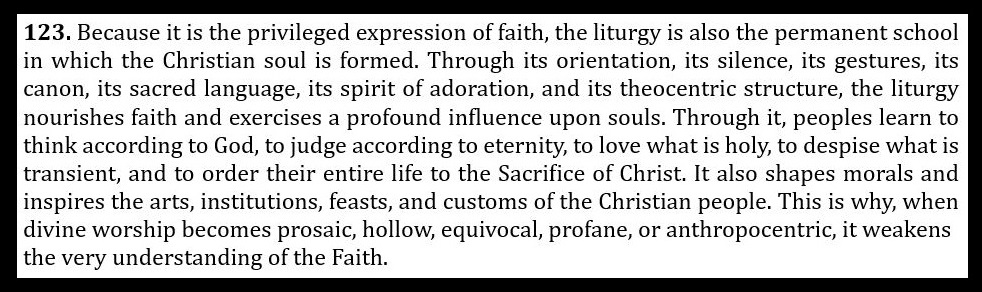
Yes, I can affirm much about the opinions expressed in the statement. But, we must be careful of false caricatures. This is a serious problem. No liturgy is absolutely “perfect.” Every Mass has its supporters and detractors. When properly offered the Novus Ordo can have an order and solemnity that is every bit as meaningful as the traditional Latin Mass. Unfortunately, comparisons frequently resort to stereotypical problems or abuses. I have said it before, and I will say it again, the classical High Latin Mass is a beauty to behold. But except for the sacred silence, the Low Mass is not much to write home about. The spiritual effects are the same, but the execution is quite different. As for the Novus Ordo, there are fewer strict rubrics and over the years too many clergy took it upon themselves to improvise where they should not have done so. We must not judge a liturgy’s value based upon abuses in celebration! There should be no clown or puppet Masses. Priests should be properly attired. Sacred music should not be switched out for banal compositions with questionable theology. More needs to be done with plain chants. The discussion should continue about the orientation of the priest with a freedom to either face the people or toward the East. I read recently that there are composers developing litany chants for the Prayers of the Faithful. That is good. There is even speculation that some of the old offertory prayers might be restored for when the Roman Canon is said. The liturgy that came to us after Vatican II contains all the essential parts of the Roman Rite Mass. However, its configuration is comparatively new compared to the age of the Church. While its beginnings were abrupt, we can hope that over time it will mature and truly flourish. But such matters take time. It was for this reason that Pope Benedict XVI wanted the old and the new rituals to continue side by side, perhaps to cross-pollinate one another. However, this is anathema to the radical left and right. The left would utterly abandon the tradition and the right might make it into a cage.
The Second Vatican II shared many of these sentiments about the Eucharist and Holy Mass. It described the liturgy as the “summit” toward which the Church’s activity is directed, and the “fount” from which all her power flows. However, while the liturgy of the Church is permanent, this does not mean that all her elements or the structure of the Mass remains stagnant or immutable in its accidentals. The pious language of this professional statement sets up the SSPX argument that the Mass prior to Vatical II is essentially immutable. But all is not as it seems. This just is not the case. Further, the Mass is one element among many in the formation of believers. The old Mass formed saints but it could not forestall the emergence of great heresies like modernism or sinners who sought to manipulate or even destroy their mother, the Church. While the Missal was edited and formalized at Trent, it could not halt the reformation and a mass defection. The French revolution was not forestalled by the traditional Latin Mass. World Wars all happened during its time of greatest prominence. Vatican II and the reformed Novus Ordo liturgy are often faulted for the many challenges of modernity, but the Church was already starting to feel its effects prior to the gathering of the world’s bishops. The Second Vatican Council sought to revitalize the Mass and deepen the faithful’s connection to this divine source.
It is true that liturgy is what it is. However, we must not underestimate what we bring to it. Those who currently attend the traditional Latin Mass are particularly attuned to its rituals and meaning. But many if not most Catholics in the past attended out of duty and were detached from the liturgical actions. The reformed liturgy was to counteract this situation.
The elaborate traditional Latin Masses are a far cry from what many experienced prior to Vatican II. There were no microphones on altars. The altar servers gave the Mass responses to the priest. The boys frequently learned the required words and their pronunciation from 78 rpm records. Did they always understand the Latin. I hate to say how often the kids would garble the words and try to hide it by mumbling. The laity entered their pews and said the rosary or other personal prayers. Low Masses, especially on weekdays had no music and the priest quickly rattled off the prayers. My old pastor could say the old Mass with the long Latin Roman Canon in 12 minutes. It was far from beautiful, but men rushing to work wanted the graces. Many of the faithful attached to this liturgy were also fond of the Latin people’s missals. However, these books with translations were long forbidden by the Church. A late development, laypeople first saw the introduction of hand missals to follow along at Mass in the 1920s and 1930s. This was part of the broader liturgical movement leading up to Vatican II. Pope Pius XII explicitly promoted missals in the 1950’s.
Richness and beauty belonged to the old Mass, but it was often locked away behind the back of the priest and the silence of the altar. Clergy and professional theologians well appreciated its richness, but the liturgical movement itself was a recognition of a problem in translating this spiritual treasury to the People of God. While there were many changes in the Novus Ordo, the Roman canon was retained and new prayers were added. The short second anaphora was devised for the quick weekday liturgy so that the priest did not have to say the vernacular words of the Eucharistic prayer at machine gun speed. Prayers that belonged exclusively to servers became those of the congregation.
The Novus Ordo Mass is not dull or lacking imagination. The Scripture texts are far more representative of the Word of God, especially the Old Testament, than the old Mass. The prayers are rich and full of meaning. They are evocative, doing what they say. Few priests who regularly say Mass would say that it is hollow or empty. What the Mass is about is clear, not equivocal or vague. However, there are words and gestures that have a richness of meaning. The notion that the reformed liturgy is profane is a negative spurning that is a affront to God and a derision to the Magisterium that has approved it. It is the movement of God that makes it real. While there are elements that target the gathered community, the focus is always upon the worship of God. If the old liturgy emphasized the priest saying Mass for us; the new concentrates on how the celebrant makes possible our prayer with him. If there is anything mistaken for anthropocentric, it stems from the mystery of the incarnation where God becomes a man. The Mass never speaks to us exclusively regarding human values and perspectives. Any and every Eucharistic liturgy, calls us out of ourselves. We become what we were always intended, a parable people who put on the mind and heart of Christ. Every Mass makes possible our continuing transformation into Christ. As a priest who regularly says the Novus Ordo, my faith is strengthened, not weakened. I suspect that most who go to Mass would say the same.
Filed under: Uncategorized | Tagged: Catholic, christianity, Faith, Jesus, latin-mass, liturgical-abuses, Liturgy, Mass, novus-ordo | Leave a comment »





















