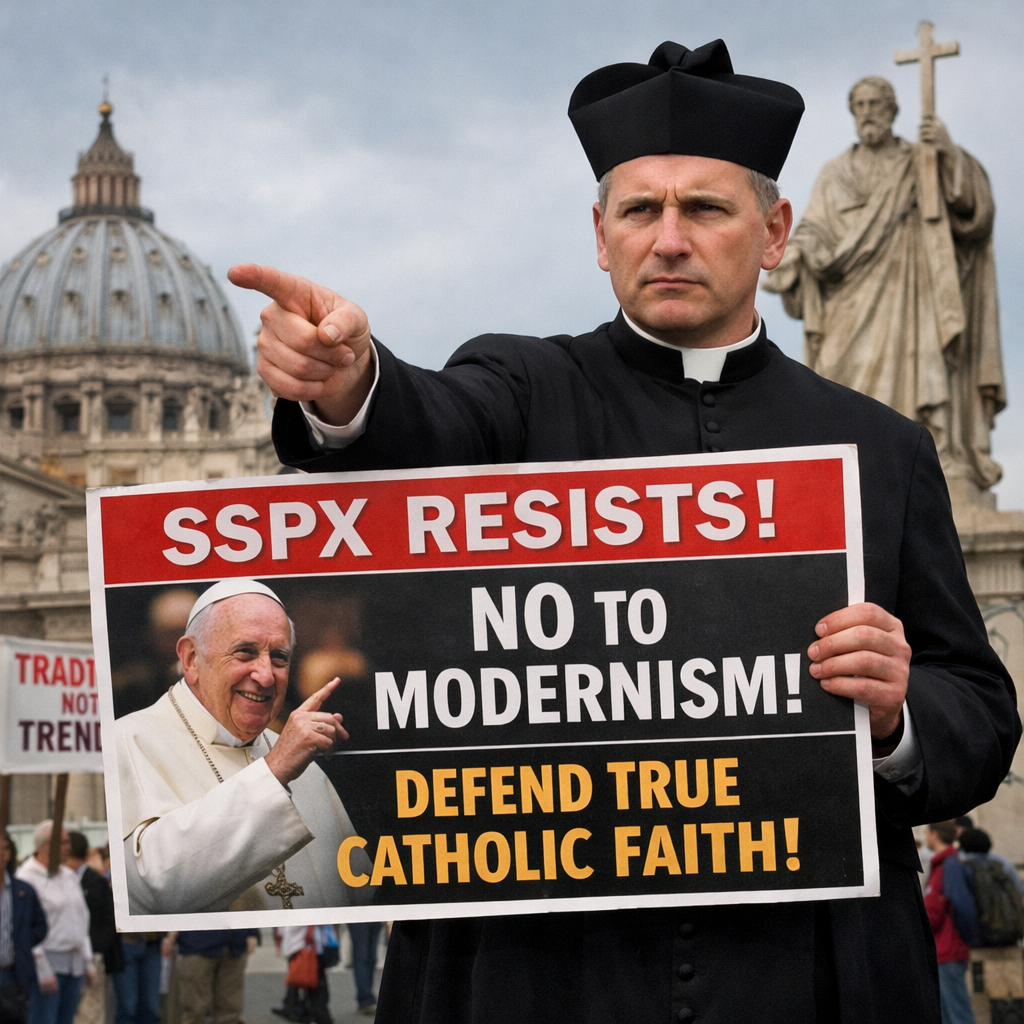
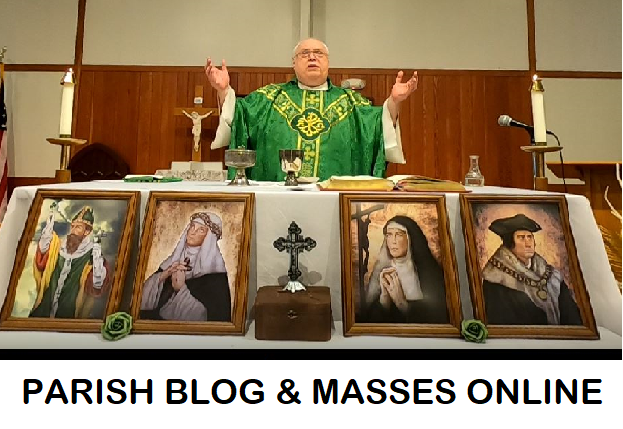
When I began this blog, my header image was the New Testament scene where Jesus flogged the money-changers out of the temple. I imaged myself and all priests flogging the devils that distort the faith and assault believers. The faith that gives us consolation can and should also make us very uncomfortable. Both Divine Mercy and Divine Justice meet in Jesus. Priests are ministers of reconciliation, but never at the cost of truth. In or out of season, we must be courageous in preaching and living out the Gospel of Life. The title of my blog is a play on words, not Flogger Priest but Blogger Priest.
Having read Kevin Wells appeal to a SSPX priest to join the Novus Ordo Church out of a desire to care for souls, I penned the following reflection. He spoke from the heart but I suspect his cry will either go unanswered or be rebuked.
First, we need to appreciate that designations like traditionalist Catholics and Novus Ordo Catholics lack real substance. One is a Catholic or not, nothing more. There is the living Catholic Church under the Pope, and then there are those who are outside of it. We might debate the extent that a Protestant is affiliated with Catholicism through baptism and shared elements of the faith; but no Lutheran, Methodist or Presbyterian would regard himself as in any way a Catholic by extension. Nevertheless, the SSPX tries to make this argument because if they admit formal separation from the See of Peter then their house of cards comes tumbling down. They would either have to go the route of the sedevacantist breakaway churches and appoint their own Pope or to adopt the stance of conciliarism and shared communion as manifest between Orthodox autocephalous churches.
Second, the failure of any reconciliation rests squarely with the SSPX. They would arrogantly usurp for themselves an authority that belongs exclusively to the Holy See. Their path to reconciliation and regularization would be as follows:
The Pope would have to renounce Vatican II, especially teachings about ecumenism, religious liberty, freedom of conscience, and the inherent dignity of persons.
All liturgical changes would have to be repealed.
There would have to be a massive number of excommunications and expulsions to purge the Church.
Indeed, all new ecclesial initiatives would be revoked, including the permission for the Divine Mercy devotion as it was suspect and forbidden prior to Vatican II.
Such was never going to happen. Despite posturing, reunion with the SSPX was never in the picture. Despite high hopes for individual clergy, it is unlikely, except for maybe a few seeking incorporation into the Fraternity of St. Peter.
The fact that a priest cares for souls is the bottom line and should not be regarded as something exceptional. But this movement of the will and heart must also be in sync with a proper understanding of the truth by the mind. Otherwise, any fruits will be seriously inhibited or even blocked. A Protestant minister might be on fire to save others from perdition and to foster a saving faith relationship with Jesus. But he has neither the Mass rendered by priests nor the absolution given to these same ministers of Christ’s reconciliation. His efforts may bear some small fruit, but they are handicapped by his own deficiencies.
Many in the traditionalist camp would stamp such a Protestant minister and his flock as likely damned for being outside the boundaries of the visible Catholic Church. Opposed to religious liberty, they would like to erase the public non-Catholic churches and schools. Indeed, they eye with suspicion the Novus Ordo liturgy as dangerous and the orders of its priests as suspect. They renounce by “association” the larger Church for its ecumenism toward so-called “separated brethren.” They subscribe to a methodology of fear— risk no change, stay separate or risk going to hell— distrust the Pope, avoid Protestant contamination, and oppose the world.
If a traditionalist priest disavows the priesthood and ministry of priests in the juridical Church under the Holy Father, then why would he be concerned about his fatigue and making “the good fight”? As far as he is concerned, despite the many protestations to the contrary, the Novus Ordo priest is not his brother but the enemy. Note that the SSPX tells its lay participants that it would be better to miss Mass entirely than to attend a Novus Ordo liturgy. The living Church in union with Pope Leo XIV would regard this attitude as blasphemous. The SSPX clergyman with this sentiment might desire to save souls but despite all the trappings of tradition, he has become what he most detests, a Protestant. The ancient faith and the efficacy of the liturgy may still be fortuitous to believers, but not because of the rebel priest but despite his failings. Wherever we find the Pope, we find the Catholic Church. This is the quandary around which the traditionalists must dance. They acknowledge the validity of the Pope in theory, but in practice his authority over them is rejected. What is the old saying about a duck? Well, right now it is quacking away!
The true Church must courageously engage the world in the time and place where she finds herself. Confident in the charism of indefectibility, she must not retreat from the world like the SSPX. The living Church applies social teachings to the world as it is (not as it was). She acknowledges the organic development of doctrine from seeds planted in the Gospel. Saving revelation has ended with the apostle John, however teachings are not stagnant but grow in our understanding. However, the SSPX goes further in the wrong direction, rejecting (in practice if not in principle) the current Pope as the chief lawgiver and rejecting the historical fact that each successor of Peter is the living and breathing embodiment of the Roman rite. The way he says Mass is the way the rest of the Western Church says Mass. We follow living popes, not dead ones.
The charge of Modernism targeted against the post-Vatican II Church is particularly upsetting and wrong-headed. Modernism came into existence by priests who regularly celebrated the Traditional Latin Mass. Fr. Alfred Loisy even acknowledged that the rubrics of the old Mass allowed him to robotically celebrate the liturgy daily out of habit long after he had stopped believing. Further, it troubles me that anyone would caricature the Novus Ordo Mass as leaving the flock starving. It is the unbloody or clean re-presentation of the sacrifice on Calvary. It is a sacrifice that honors God and makes propitiation or satisfaction for sin. The Eucharist is the substance of the real body and blood of the risen Christ, whole and complete, given as our saving food. Accidentals have changed and no liturgy is perfect. But the substance remains. The Church saw revolutions, heresy and Mass defections before, even when the rituals of sacrifice were untouched. The problem is not the Mass but a secular world that is increasingly hostile to people of faith. While the Lord gave us the great commission, too many have allowed themselves to be converted by the atheistic and materialistic hedonism of our times. For all we know, the current situation might have been worse without Vatican II. But about this, we cannot know for sure. We live in an age where there is much dissent from the left and right. Violence against the Church from the right is somewhat surprising, but perhaps more perilous than that on the left or from progressives. But neither side can stand any attempted middle-course. That is what defines the post-conciliar Church. This tension needs to end. An ancient motto from the 17th century comes to mind, quoted by Pope St. John XXIII in his 1959 encyclical Ad Petri Cathedram, “In essentials unity, in non-essentials liberty, in all things charity.”
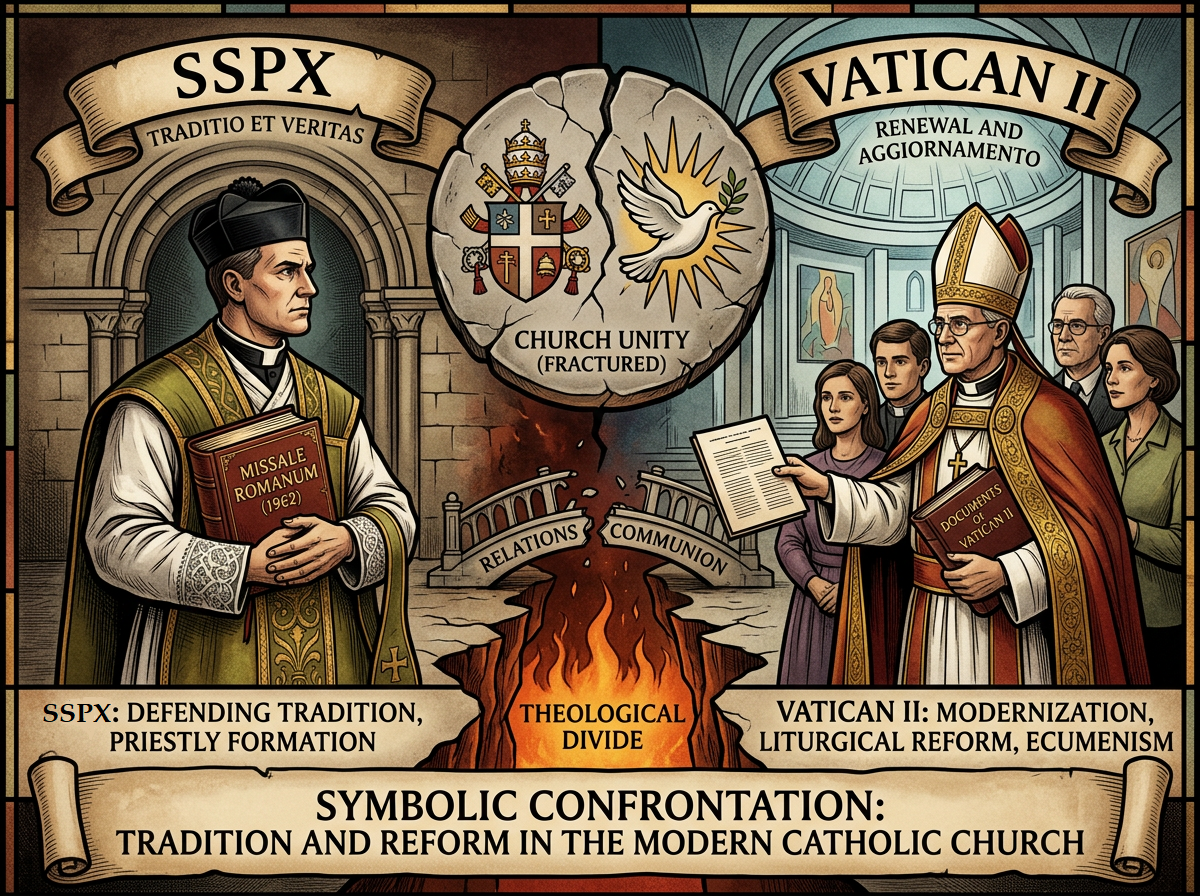
When mention is made of the Society of Saint Pius X (SSPX), what comes to the mind of most is their insistence upon celebrating the Tridentine Mass. However, their divide with the Vatican is far more serious and complicated. If the problem were simply an attachment to the older ritual, there would be no excommunications and schism. The proof of this is the regularized status of the Fraternity of St. Peter. They offer the pre-Vatican II Mass exclusively and without hindrance. The crisis with the SSPX is over the direction and teachings of Vatican II.
A growing number of living Catholics were not around or were small children prior to Vatican II (1962-1965). At the request of Archbishop Marcel Lefebvre, the Society of St. Pius X was established and canonically erected as a “pious union” on an experimental basis for six years by Bishop François Charrière of the Diocese of Lausanne, Geneva, and Fribourg in Switzerland on November 1, 1970. His successor, Bishop Pierre Mamie, petitioned Rome and formally suppressed the SSPX’s canonical status on May 6, 1975. Archbishop Lefebvre refused to shut down the operation for the formation of seminarians and restructured the SSPX as a clerical or priestly organization. While Archbishop Lefebvre signed 14 of the 16 conciliar documents from Vatican II, he later renounced the Council and accused the post-Vatican II Church of modernism, liberalism, and adopting the “spirit of the modern world.”
The point of contention continues to be an interpretation of centuries old tradition and the extent of ongoing development. There are five areas of friction:
(1) HUMAN DIGNITY – As the root premise from which flow as corollaries the other areas of objection from the SSPX, we must begin with the most foundational principle of Catholic social doctrine. At the core of our belief in what Pope John Paul II called the Gospel of Life, is the conviction that every person is created in the image of God and as such, possesses an inherent, inalienable and incommensurate value that defeats every effort at quantification. Everyone has worth, even prior to the indwelling of divine grace. Even in the womb, human life is precious and irreplaceable. This valuation stems from humanity’s place as the steward of creation. This dignity is damaged by the primordial fall and sin but not destroyed. Human worth is not a measure that society can assign or reward to those it most favors. It is given immediately by God at the moment of conception. Most recently, this teaching emerges in Dignitas Infinita (2024) wherein Pope Francis speaks of “infinite dignity” grounded in the created order as a facet of our very being. He lists the violations against this dignity as including poverty, war, human trafficking, abortion, euthanasia, and gender theory. Vatican II’s Gaudium et Spes (1965) makes human dignity a central component to Catholic teaching and outreach. This conviction places us at odds with any discrimination based on gender, ethnicity, color, social status, or religion. Such bigotry contradicts the will of God. Vatican II’s Dignitatis Humanae (1965) connected this dignity to freedom of conscience and religious freedom. Evangelium Vitae (1995) written by Pope St. John Paul II, focused on the value and inviolability of every human life, objecting to abortion, euthanasia, and the death penalty. Pacem in Terris (1963) written by Pope St. John XXIII associated dignity and human rights with the pursuit of peace while respecting truth, justice, charity, and liberty.
The Society of Saint Pius X (SSPX) contends that human nature alone does not inherently possess any dignity that grants inalienable rights. Let that sink in, especially the consequences. They argue that true dignity belongs to the Christian, achieved exclusively through divine grace, rather than merely by being a human created in the image of God. It is no wonder that traditionalists constitute hawks in terms of military intervention around the world and are often rabid defenders of the death penalty. They refuse to acknowledge any doctrinal development about capital punishment. Indeed, some will even advocate for the Church’s past passivity for slavery, echoing ancient arguments— punishment for conquered peoples, a means to pay back debts, a manner to civilize savages with the faith and Western civilization. Indigenous culture is devalued. The traditionalist fraternity finds itself in conflict, not just with liberalism but with the Catholic mainstream.
The conciliar popes see human dignity as inherently rooted in creation itself, in nature (see CCC 1700). Human rights are first based upon natural dignity. By contrast, Archbishop Marcel Lefebvre stated, “There is not a dignity of man; there is only the dignity of the Christian.” The SSPX argument is that Original Sin damages or corrupts human nature. The mainstream would also agree that it has been wounded, but not that it has become devalued. The SSPX repudiates the notion that unbaptized human beings (unregenerated and still in sin) possess any inherent incommensurate natural dignity. Where does the truth stand? There is no rift with tradition. But this is the great conflict that makes the regularization of the SSPX impossible. Our tradition is that human dignity is damaged but not destroyed. The “supernatural” or divine grace builds upon the “natural.” Baptism and saving faith transform creatures of God into adopted sons and daughters of the Father. Made in the “image of God,” divine grace makes possible our rebirth into the “likeness of Christ.” The implications of this even speak to the Church’s new interest in ecology. Why? It is because any abuse or neglect of our environment works to impoverish human persons. Our Christian anthropology looks to a creation where man stands at the center. The consequences of this understanding impact upon our understanding of the incarnation. Jesus comes into the world to save us and yet he also comes to resolve a metaphysical conflict. Christ as the Word is also the saving plan and the center of creation. You cannot have two centers. Thus, the Word becomes man. The consequence for fallen man is decisive; grace builds upon nature. While we would not reject the wonder that is man, a notion that comes down to us from the Enlightenment, it is that good seed from the natural order that grows by God’s intervention into something even more marvelous. Potency is actualized. Wired for God, that immeasurable dignity is used by God as a building block for his incarnation and the new man in baptism. That which is beyond evaluation is granted something of the infinite goodness that belongs to God.
(2) RELIGIOUS LIBERTY– The Council established religious freedom as a basic human right (see Dignitatis Humanae). No one should be compelled to violate his or her conscience about faith. But the response of the SSPX is an explicit objection. In its estimation, all must be subject to the Kingship of Christ and error has no rights. These traditionalists would reject religious liberty as an American imposition upon the universal Church.
Prior to the revolutionary War, Maryland as a colony had issued the Edict of Toleration (1649). This decree grated religious freedom for Trinitarian Christians. Maryland Catholics invited the Puritans persecuted in Virginia to join us in our colony. However, in 1654, Puritan rebels seized control of Maryland and revoked the colony’s groundbreaking Act of Religious Toleration. They quickly enacted sweeping penal laws that banned Catholic worship, prohibited Catholics from voting or holding public office, and severely restricted the religious freedoms of Jews, Quakers, and other dissenters.
As citizens, we know that freedom of religion is protected under the first amendment of the U.S. Constitution. It also established the separation of church and state. While we had to suffer the bigotries of the political Know Nothings and the prejudice of various early hate groups. The enactment of religious liberty would give us an even playing field wherein the Church in the United States could flourished.
American enthusiasts for the liturgies and spirituality of the SSPX might be less than pleased with this mentality toward our non-believing and Protestant neighbors. Our forefathers, Catholic and Protestant alike, came to this country to escape the oppression of state religions where institutionalized favoritism to one church came at the cost of persecuting all others. More than once the tables turned in Europe, and the Catholic Church suffered much in what were regarded as states favorable to Rome. But princes rose and fell and along with this movement also went the fortunes of the Church. One can certainly argue as a philosophical notion that the ideal state is one where there is harmony with the Church and concurrence with the truth. This is an ancient tradition. However, in practice, the subjective assessments of men lead to division. This particularly became the case after the reformation. The old mind about such matters allowed a king to steal the Church away in England where he made himself the head over the Pope. Even agreements of the Church to preserve peace in Europe often tolerated believers following the local prince, either into Catholicism or into the Protestant sects. The American notion of religious liberty severed this ability of the state to violate conscience and to compel a certain form of worship. Vatican II gives an emphasis to the nation of the new Israel or Christ’s reign over earthly kingdoms. Catholicism unlike the churches of the East is no national church. There is no American Catholicism or French Catholicism but rather as Roman it is, like the empire of old, international in scope. One can speak of the Catholic Church in America but never of an American Catholic Church. This distinction is often lost. Again, while in principle it would make sense that the Catholic political heads should have the moral duty to favor Catholicism and restrict error; the capriciousness of men and the changing state of the world made such imposition difficult or impossible to maintain. What was given by one monarch could just as easily be stripped away by the next. Did we really want to continue in a society where Catholics and Protestants conspired against one another and where both suspected the Jews of dark machinations? Certain Catholic traditionalists have argued, not only for the suppression of Jews to ghettos, but that Protestants should be restricted to home churches and forfeit their worship sites and schools. This is the mindset of the SSPX. But the world has moved on from such anachronism, or has it? It is precisely the mindset of militant Islam that forbids conversion to Christianity and in places like Saudi Arabia has outlawed the Church, altogether. The trouble with the shoe on the other foot is when it comes down to being kicked around. The Church’s teachings upon such matters must reflect the realities of the modern world. It makes no sense to speak of the divine rights of kings when such despots have disappeared. Toleration of false religions is not to posit faith or confidence in those creeds; no, it is rather a common respect for persons and a desire to live together in peace as brothers and sisters of a common homeland. This liberty allows us to persuade and to seek conversion through charity and dialogue, not through intimidation as through edict or decree.
(3) ECUMENISM – The Vatican Council urged dialogue over anathema. Pope John XXIII saw ecumenism as a manner to draw fallen away children back to the fold of Mother Church, not with scolding and threat of punishment but with affirmation of shared beliefs and the compelling power of the truth (see Unitatis Redintegratio, 1964). While we could never engage in non-Christian prayer, we might sometimes pray side-by-side and work together to improve the society in which we must live as neighbors. The SSPX wrongly condemns such efforts as the sin of indifferentism. But there is no pollution of true faith. Further, no one questions the ancient teaching from the Fourth Lateran Council of 1215: “There is but one universal Church of the faithful, outside which no one at all is saved.” The dogma of “Extra Ecclesiam nulla salus” is straightforward, since there is no salvation apart from Christ, and given that the Church is his mystical body, then the Church is the necessary vessel or great sacrament of salvation in Christ. It is for this reason that we seek to attract all to the safe harbor of salvation— the Catholic Church. However, teaching must be applied in a way that respects changing circumstances around us. While the great schism between the East and West had occurred in 1054 AD, the reformation rebellion did not occur until 1517 when Martin Luther nailed his Ninety-five Theses to Castle Church in Wittenberg, Germany. This signified a great fracturing of the Church in the West. The reformers absconded with many Catholic beliefs and most importantly, with the sacrament of baptism. Unfortunately, they forfeited the crown treasures of Priesthood, Eucharist and Penance. Many through no fault of their own have been born into the Protestant confessions. They are baptized, read the Bible, love Jesus and know him as the Second Person of the Trinity and the Word incarnate, and seek to keep the commandments. The SSPX would contend that these saving elements are for nought. But our hearts will not let us believe that a good God would spurn their cry. The post-Vatican II Church would argue that these elements cry out for Catholic unity. Our Lord will not abandon those who love him and place their faith in his saving Cross. While our unity is not what it should be, it is not utterly severed. The Catholic Church reaches out to them and intercedes for them to almighty God. We need to trust that the Church’s collective trust in Jesus and cry to heaven will grant hope and might be efficacious. The mystery of the keys may be impenetrable, but it is real and the authority is given to Peter. Unfortunately, the SSPX gives lip service to Rome but nothing of true respect and subservience.
The SSPX is frequently tagged for being antisemitic. Whether they are or not, it is a question I would leave to others. However, they are on the record for questioning whether the Jews today are one and the same with the Jews of old. They would insist that their covenant ended with the coming of Christ and that those Jews who failed to convert to Christianity are no longer the People of God. This is not the view of the living Magisterium (see Nostra Aetate, 1965 on relations with non-Christian religions). Yes, it is true that the Catholic Church does not subscribe to Zionism, as the prophesied new Israel or new Jerusalem is not the political state of Israel but is rather the Church, herself. We believe that Jesus Christ is the consummation of the old covenant, but that God keeps his promises, and the Jews remain God’s own and our elder brothers and sisters in faith. There are not two separate covenants but one. The old becomes something new in Jesus Christ. The natural religion of the Jews with its belief in one true God is given a further revelation in the new dispensation of God as a Trinity. This belief of one God in three divine Persons raises Christian faith to a supernatural religion. No matter whether all Jews know it or not, Jesus is the Messiah and our Savior. We believe that Jesus is the ultimate term of salvation. None are saved apart from him. But we also appreciate that God’s grace cannot be utterly contained. God will save whomever he wills. We leave judgment to God. The SSPX would outrightly condemn much of the planet to perdition. By contrast we do not teach universalism (that all will be saved). Indeed, even Catholics with a soured faith and in mortal sin might forfeit heaven. However, if we walk with the Lord, people of faith live in the sure and certain hope of their salvation in Christ. We pray and intercede for others. Again, we do not usurp a prerogative that belongs to the Almighty— we leave judgment to almighty God.
(4) LITURGICAL REFORM & THE NOVUS ORDO MISSAE –
Vatican II called for a renewal of the liturgy. After much consultation and work, the reformed Mass of Paul VI was promulgated in 1969. While Latin was to have a preferred place, the vernacular quickly displaced it. Many lamented the loss of the many chants and our legacy of hymnody. While Society of Saint Pius X has objected to the changes, it has become abundantly clear that they would resist even the most modest alterations. They contend that the Novus Ordo obscures the sacramental aspect of the liturgy and waters down Catholic elements to appease Protestants. They will go so far as to castigate the reformed Mass as dangerous. It is my argument that they trespass in their critique into the moral area of blasphemy against the Holy Spirit. If they believed that holy orders were truly conferred to priests of the living Church, why do they insist upon re-ordination when received into the SSPX? If they really believe the Novus Ordo Mass is valid then how can they urge against attendance, especially since the fruits prevail over any subjective aesthetic? No, they speak out of both sides of their mouths. Their arrogance destroys the humility necessary for a theologian and the posture of a Catholic who is one with Peter.
The changes in the liturgy were the result of a liturgical reform that in theory and small steps went back many decades prior to Vatican II— dialogue Masses, experiments with the orientation of the priest, the use of the vernacular, expansion of the Scriptures, the introduction of microphones, the permission for missal translations for the people, the reduction of duplication (as with the double Confiteor), etc. What surprised many people was the wholesale rewrite of the offertory and the addition of Eucharistic prayers. The latter is why some have suggested that the new liturgy signified a new rite and the loss of the Roman rite. However, the Roman Canon is still retained, and the liturgical pattern of the Roman rite remains the guide for our worship. What is this pattern?
THE STRUCTURE & ELEMENTS OF THE NOVUS ORDO (ROMAN RITE)
First, there are the Introductory Rites: 1. Introit (Antiphon /Hymn) & Kissing Altar, 2. Sign of the Cross & Greeting, 3. Confiteor & Kyrie Eleison & Absolution, 4. Gloria (Glory to God), and 5. Collect (Opening Prayer).
Second, is the Liturgy of the Word: 1. Reading(s), 2. Responsorial Psalm, 3. Alleluia or Gospel Verse, 4. Gospel, 5. Homily, 6. Creed (Profession of Faith), and 7. Prayer of the Faithful.
Third is the Preparation of the Gifts (Offertory): 1. Bringing Up the Offertory Gifts, 2. Blessing of the Bread, 3. Mixing Water into the Wine, 4. Blessing of the Chalice, 5. The Lavabo (The Washing), 6. The Orate Fratres (Pray Brethren), and 7. Prayer over the Gifts.
Fourth is the Liturgy of the Eucharist: 1. Introductory Dialogue & Preface, 2. Sanctus & Benedictus, 3. Eucharistic Prayer (Canon), and 4. Closing Doxology & Amen.
Elements of the Eucharistic Prayer or Anaphora: 1. Appeal to the Father or Plea for Acceptance, 2. Epiclesis (Invocation of the Holy Spirit), 3. Consecration (Words of Institution), 4. Memorial Acclamation, 5. Anamnesis (Memorial Prayer), and 6. Oblation to the Father.
Intercessions in Variable Order: 1. Intercession of the Saints, 2. Intercession for the Church, 3. Intercession & Memento for the Living, and 4. Intercession & Memento for the Dead.
Fifth is the Rite of Holy Communion: 1. Our Father, Deliver Us Prayer & Doxology, 2. Sign of Peace, 3. Fraction & Commingling, 4. Agnus Dei (Lamb of God), 5. Secret Prayer for Priestly Worthiness, 6. Ecce Agnus Dei (Behold the Lamb of God), 7. Communion & Antiphon (Hymn), and 8. Prayer after Communion.
Sixth, there are the cursory Concluding Rites: 1. Final Blessing and 2. Dismissal.
Finally, there is a truth that many seem to have historical amnesia about. Ultimately what makes the Roman rite, the Roman rite? There are many other liturgies that go back into antiquity. What gives singular value to this one ritual? The answer is simple and straightforward. The priests of the West wanted to do as the Romans do. In other words, they desired to imitate Peter or the Pope in Rome. The Holy Father is the living embodiment of the Roman rite!
The Holy Father is obligated to maintain the Church’s inheritance, but he can also rescue eclipsed traditions from the Church’s past treasure and build upon new insights that will add to the richness of faith for future generations. The Novus Ordo (the Vatican II Ordinary Form of the Roman Rite) restored several ancient liturgical elements that had been lost, obscured, or marginalized over time. These included expanded readings from Scripture (especially the Old Testament), the Prayer of the Faithful Bidding Prayers, multiple Eucharistic prayers, and concelebration. While many complain about the editing, the short Second Eucharistic Prayer borrowed from the Apostolic Tradition of Hippolytus. Communion in the hand was restored as an option that was normative for the first eight hundred years of the Church’s history.
Repeatedly, the hardliner traditionalists struggle with transition or development. One often feels more comfortable and secure with a staid tradition and dead popes than with a living tradition and breathing popes! Pope Francis was the symbol for everything a lover of tradition fears— novelty and uncertainty. I suppose that is why so many are hoping and praying that when the new cat, Pope Leo XIV, makes his final leap from the altar, that he will land on his feet and put all things right again— please, pretty, please!
(5) COLLEGIALITY & CHURCH AUTHORITY – Ultimately the fight between the SSPX and the Vatican is over ecclesiology or authority. The SSPX abhor Lumen Gentium (The Dogmatic Constitution on the Church) promulgated by Pope Paul VI on November 21, 1964. The document fundamentally reshapes the Church’s self-understanding in the modern world. Who speaks for the Church? Is it one dead archbishop and a few illicitly manufactured bishops against the thousands of bishops at Vatican II who remain in full union with Rome? Did our Lord promise Peter and his Church the gift of indefectibility or not? The SSPX has gotten so used to having its own way that it no longer knows how to concede to the papacy. It is an organization born from rebellion and its identity is tied up with its position as the opposition to reforms of any sort. It sees itself as the bastion of orthodoxy against a larger and universal Church which it has condemned as in the grips of the heresy of modernism. If it would not concede to Pope Benedict XVI, then it was highly unlikely that it would acquiesce either to Francis or now to Leo XIV. I suspect that is why the current Pope has said that it is time to let them go their way. We might get a few stragglers to return but like the Anglicans, they are set on their own path. Sadly, they will do so without Peter, which means that they have left the boat established by Christ on the sea of salvation history. Their stance over the last half century is becoming increasingly untenable. Do not be surprised when the day comes that one of their prelates will arise and be declared the great antipope of their confession.
While there is legitimate confusion about what constitutes the current synodal way, especially with the inclusion of select laity, the SSPX were not entirely happy with the college of bishops helping the Pope to govern the global Church, either. But the Church has grown too big for the small structures of the past to suffice. He needs people of varying expertise and learning. Mistakes will be made but the Church will be richer for the talents and wisdom of its saints, and yes even sinners who might become saints. While the SSPX might object that collegiality diminishes the supreme and monarchical authority of the Pontiff; it makes an exception for itself and has become querulous or whiny about being rebuffed by Rome. The SSPX tends to view sacred tradition as immutable and as a product from heaven against the dictates of shifting cultural opinions. However, just like Sacred Scripture, that is both the work of men and that of divine inspiration; tradition is a mixture of providence within the framework of human history. There is always both an immutable and a mutable component. The Church tolerated slavery but the egalitarian component of baptism and an extended reflection upon the dignity of the human person made such a concession or passivity to evil into something that could no longer be sustained or tolerated. The Church granted the state the right to execute the most dangerous criminals but here too, with the development of a more corrective penal system, the necessity of such an extreme measure was increasingly questioned. Pope John Paul II, who had known men to lose their lives under both the Nazis and later under Communist rule, distrusted the judgment of those who held the reins of power to make just decisions. Indeed, given the rise of abortion where innocent children were sentenced to death, he felt that a Western world in the grips of a culture of death had sacrificed the authority to condemn the guilty. Instead of concurrence with the world, we have witnessed the Church’s continuing moral ascendance as a sign of contradiction that challenges contemporary secular culture. The Church finds herself targeted as the enemy by the left and right. She is daily combating challenges to religious liberty, freedom of conscience, and crimes against human dignity. She is a Church in conflict, not only with the modern world, but with the world of old and the hardened traditions paraded by the SSPX. Today we are seeing this same clash or friction regarding warfare. The Church looks at weapons of mass destruction and the thousands of non-combatants in harm’s way and pleads for peace. This earns praise from the weak and recrimination from the strong. The weak look to the Pope and the Church as the voice for the oppressed and the marginalized. The strong tell Catholic leaders to stay out of politics and to mind their own business, or else.
The values of the Church are what they have always been. Homosexuality is still a disorientation, but we tell these people that we love them and desire to walk with them in the hopes that together we might “together” travel the path to conversion and holiness. We recognize a messiness and brokenness that touches many marriages and families these days. Instead of condemnation, we seek to bring healing and a path to regularization. We reach out to those who live for the flesh and remind them that there is a life in the spirit where one can find true happiness and something lasting. We plead that human beings should not be reduced to commodities— not in abortion, not in sweat shops, not in human trafficking— but persons who must be valued and loved. We are condemned for taking the cause of the immigrant. We are ridiculed for seeking to advance the poor. The same voices that might praise us for speaking up for the unborn child demand our silence about the prisoners on death row. The SSPX defenders add their voices to this worldwide ridicule. Notice how incensed they became when the Vatican library offered a small room for a few Moslems to pray privately in peace. It was no temple or public worship space, but still Vatican authorities were chastised for making a concession to the “Church of Satan”!
A man who would become a special prophet for Vatican II should be mentioned. Beloved by Traditionalists because of his orthodox television programs and a classic photo book on the Mass, Archbishop Fulton Sheen became a strong supporter for the Second Vatican Council. He praised the document Gaudium et Spes as “brilliant” in his book, Treasure in Clay. He advanced with zeal the Council’s directives. He delivered a strong and supportive speech to the Council fathers in November 1964 on our missionary outreach. He adopted the reforms of the council, including the Novus Ordo. At the beginning of the Council he remarked that Pope John XXIII was calling the Church to stop hiding behind closed doors and go out into the world because it was “waiting for salvation.” As Bishop of Rochester, Sheen fully implemented the ecumenical and pastoral directives of Vatican II. In September 1968, he became one of the first U.S. prelates to invite a Protestant leader to speak from his cathedral pulpit, aiming to make his diocese a catalyst for post-conciliar renewal and ecumenism. Archbishop Fulton J. Sheen preached at televangelist Rev. Robert Schuller’s Arboretum in 1972. Traditionalists were infuriated; how dare he speak for a Dutch Reformed minister and treat his congregation as real Christians! Archbishop Sheen also frequently used the story of Lutheran Pastor Richard Wurmbrand—who endured 14 years of brutal torture and solitary confinement in Romanian Communist prisons for his Christian faith—to illustrate the reality of modern Christian martyrdom and the redemptive power of suffering. Making the case for religious liberty and ecumenism in the same breath earned contempt from the likes of the SSPX.
The upcoming episcopal consecrations by the SSPX are rushing upon us and will result in a return to schism and the formal excommunications of those involved. Many think the matter is merely about the old versus the reformed liturgy, but the flourishing of the Fraternity of St. Peter proves this is false. The real issue is ecclesiology and obedience. While anachronistic about our Catholic past, the SSPX are “Protestant” in their attitude towards Rome. They have forfeited juridical standing in the Church, impugned the authority of the Pope, blasphemed the Holy Spirit about the Missal of Paul VI, and have cast the opinion of a few against the world’s many bishops in the Magisterium and have rejected a received ecumenical Council (Vatican II). The SSPX claims necessity for their July 1 consecrations of four new bishops due to an “unprecedented crisis in faith,” and yet, they fail to appreciate how they have contributed to this impasse. Fermenting rebellion, there has been a marked increase in belligerence to the living Church and to the Holy Father. Taking a page from their book, the discontent, Archbishop Carlo Maria Viganò, has now both rejected Vatican II and the reformed liturgy. But he has gone even further, by denying the validity of Pope Francis’ papacy and thus meriting for himself excommunication. Posturing as an anti-pope with his letters against the Holy See, he says he intends to start his own seminary to make his own priests. Traditionalism is fragmenting just as did Luther’s reformational Protestantism. Such is inevitable once there is a break with the see of unity or Peter.
This morning, I read one online poster (known as a faithful Catholic) who announced that having to choose between Pope Leo XIV and Archbishop Viganò, he would follow the excommunicated bishop “outside the gates of the so-called synodal church.” The statement deeply troubled me. I wrote the following in response:
“I will keep you in prayer. Be careful what you say. The scandals have sadly cost us many souls. Remember, even good men can forget themselves and become lost. But if we find Christ and his Eucharist in the Church (no matter the form of ritual) then our course is clear. When the murmuring Jews walked away, Jesus said to the Twelve, ‘Do you also want to leave?’ And Peter responded, ‘Master, to whom shall we go? You have the words of eternal life.’ (See John 6:67-68) There may be much we do not understand or even find offensive, but it is then most of all that we must remain faithful. So many foolishly sin these days against Christ’s pledge of ‘indefectibility’ toward the Church. Some with a grade school understanding of their catechism would even challenge the doctors of the faith. Many blaspheme the Spirit of God by disparaging the Eucharist that makes available both ‘the real presence’ of Christ and his ‘saving oblation’ on Calvary. Others latch on to learned men more filled with themselves than the Holy Spirit and a docility to just authority. If I should soon die, I would hope to pronounce two ancient cries from my lips. The first is ‘Ubi Petrus, ibi Ecclesia.’ And given the name of our current Pope, the second would echo the bishops at the Council of Chalcedon in 451 AD, ‘Petrus per Leo locutus est.’”
Archbishop Viganò says in his recent letter to Pope Leo XVI that he hid his location for several years after his exposure about Cardinal McCarrick’s crimes, insinuating that he was afraid for his life and conjectured that his predecessor in Washington, Nuncio Pietro Sambi, might have been murdered. Are we to believe that Catholic churchmen hire hitmen? I think not.
Next, he begins his wholesale assault on Vatican II by attacking a host of theologians as in league with modernists, lumping together Küng, Ratzinger (Pope Benedict XVI), Rahner, Schillebeeckx, and Congar. [It should be said that even Pope Benedict XVI reluctantly censured his friend Fr. Kung. Fr. Rahner was criticized more as a philosopher than a theologian; and was still trusted to investigate Schillebeeckx for the Holy See. Fr. Schillebeeckx, despite many just criticisms of his Christology, wrote a profound book about the Church as the sacrament of salvation.]
Denouncing postconciliar popes and rejecting pope Francis entirely, he then states the following: “In the face of the excommunication unjustly imposed upon me, I declare that I am not a schismatic!” Sorry, it just does not wash. Much of his overt piety is charming. I would further affirm his attraction to tradition and our rich past. But now is a time to build ties from modernity to antiquity, not to sever them. We need to find pathways to reconcile the last half century with the two millennium that came before.
The SSPX has from its beginnings been guilty of presumption in judging the Holy See and the heavy consensus of the many bishops who participated at Vatican II. Why they cannot see their terrible arrogance about this is a matter hard to understand. They suggest that there has been a break with the past when the best minds in the Church demonstrated organic development regarding essentials and needed changes to accidentals to respond to modernity. Had the issue only been the liturgy this impasse would have ended long ago. But it is so much more, particularly about ecclesiology and soteriology. They would reduce the magisterium to a political congress to which they alone would have an absolute veto. No, this cannot be permitted and their upcoming consecration of bishops will signify not merely the widening of a rift but the formal institution of a new offshoot or ecclesial reality like the Anglicans and the Greeks before them. They hide behind the abandoned artifacts of history, heralding tradition, while refusing to honestly engage with a changing world. They feign fidelity while dissenting from the authority of the living magisterium.
It is ironic that they appeal to “conscience” for their fractured communion when they formally reject the expansion of its definition at Vatican II. They accuse the Holy Father and the post-Vatican II Church of heresy, “destroying Catholic faith and morals.” If the reforms attest to the movement of the Holy Spirit, then they commit blasphemy against the Holy Spirit, a sin regularly committed in their attack against the Novus Ordo Mass as evil and dangerous. They spurn canon law as being used to undermine the holy faith. The law of just authority applies to all except themselves.
Fidelity to the Catholic faith is more than “devotion,” it is measured by obedience to the Pope and the living magisterium. The declaration reverses reality and presumes that the SSPX is the true Church to which the Holy See must be in communion. This is utter nonsense! What are their “indispensable” faith capitulations for juridical reunion?
One Covenant That Does NOT Include the Jews, YES or NO?
It is true that the Catholic faith is the one true Church instituted by Christ. But the SSPX refuses to acknowledge contemporary Jews as children of Abraham. As far as they are concerned, the old covenant first established with them as God’s people was rendered “definitively null and void” some two thousand years ago. The implication of their faith profession is that they are guilty of deicide and that by extension the Moslems (along with them) are now children of Satan who reject Christ as the Messiah. It is no wonder that this negative assessment includes allegations of collective guilt as enemies of the Church for the death of Christ, antisemitic slander about clandestine Jewish influence for world dominion and even denial of the Holocaust atrocities. The SSPX thoroughly rejects the Nostra Aetate declaration and interfaith dialogue.
The Catholic Church neither believes that God has severed his covenant with the Jews nor that there are two covenants, one for Jews and the other for Christians. The relationship with the Jews remains because God keeps his promises. The old covenant is fulfilled by the new in Jesus Christ. The Church is the New Israel and as such we would reject Zionism. Just as many of the Jews accepted Christ in the ancient church of Jerusalem, we pray that many of our Jewish brothers and sisters will today come to know and love him. The Jews are our elder brethren in faith, the first called, and they are still beloved of God. We read in Romans 11:25-29:
“I do not want you to be unaware of this mystery, brothers, so that you will not become wise in your own estimation: a hardening has come upon Israel in part, until the full number of the Gentiles comes in, and thus all Israel will be saved, as it is written: ‘The deliverer will come out of Zion, he will turn away godlessness from Jacob; and this is my covenant with them when I take away their sins.’ In respect to the gospel, they are enemies on your account; but in respect to election, they are beloved because of the patriarchs. For the gifts and the call of God are irrevocable.”
While we can argue a movement from the natural religion of Judaism (belief in the one true God) to a supernatural religion in Catholicism (the revelation of the Trinity), we share a common faith patrimony. The Christian Savior will always be the Jewish Messiah. None of this detracts from “Jesus” as the saving name— that none are saved apart from him— that he is our one Mediator and Savior— that none come to the Father except through him. We are redeemed by the saving work of his Cross which is re-presented to us in an unbloody fashion by the Eucharist. The significance of Christ and the sacraments remain what it has always been, but the SSPX declaration would intimate a change where there has been none.
Devaluation of Mary’s Role in Salvation, YES or NO?
While there has been a warning about misunderstanding certain Marian titles, it is still acknowledged that Mary cooperates in a unique way with the redemptive work of her Son. Nothing has changed in our teachings.
No Salvation Outside the Catholic Church – YES or NO or Qualified?
The SSPX profession next makes a subtle nod to Fr. Feeney’s literal interpretation of “Extra Ecclesiam nulla salus,” or no salvation outside the Church. Despite SSPX protestations to the contrary, this dogma of faith remains intact. Just as none are saved apart from Christ, the Church as his mystical body is also necessary for salvation. However, the SSPX would reject any nuances to this teaching. This would appreciably leave as damned, all non-Catholic “Christians” as well as all “Jews, Muslims, pagans, and atheists.” By contrast, we would resist making a verdict and leave ultimate judgment to God regarding those not in formal communion “through no fault of their own.” We would insist that the negative judgment is upon those who die knowing that the Catholic Church is the true Church and still refused to get baptized and join her. There is also ambiguity because of the reformation and Protestant faith communities. If their baptisms are judged as valid then are they not affiliated with the Catholic Church, even if tenuously? Will Jesus renounce those who have faith in him and love him? When the Protestant reformers broke away, they purloined many essential elements of the true Church. Would there not be salvific value to these elements, like baptism and the Bible, for those who were born into these sects? The SSPX says no, “Outside the Roman Catholic Church, and without the profession of Faith that she has always taught, there is neither salvation nor remission of sins.” Vatican II’s Lumen Gentium says yes, clarifying that those who, through no fault of their own, do not know the Gospel of Christ or his Church, but who nevertheless seek God with a sincere heart, may yet achieve eternal salvation. Ignorance does matter. God is neither capricious nor monstrous in his providence. Any who are saved are saved through the Church. About this there is no debate— where the SSPX and the Vatican part ways is over whether all the saved must be a visible part of the Church during their mortal lives.
Who is the Real Threat to the True Church?
The declaration asserts, “The denial of even a single truth of the Faith destroys faith itself and renders radically impossible all communion with the Catholic Church.” Given the SSPX misinterpretations, made clear by the Vatican, I would concur that the SSPX is not spiritually prepared for full reunion with the Church established by Christ. When they consecrate their illicit bishops, they will enter formal schism and face excommunication. While they may consider themselves to be the true Church, in fact they will stand condemned by their own reasoning— placing themselves outside the Barque of Peter.
The Pope is the Guardian of the Deposit of Faith, YES or NO?
The great commission has never been renounced. Continuity with our traditions has been maintained. The SSPX “doth protest too much.” We give no quarter to false worship and the reformed liturgy is both licit and valid as are all the seven sacraments. The Pope continues his role in history as the guardian of the deposit of faith. Unfortunately, some would wrestle this role away from him.
The Mass is an Unbloody Sacrifice for the Forgiveness of Sins
The Mass remains essentially a sacrifice for atonement or propitiation and yet this does not make it any less a sacred meal where the Lamb of God must be eaten. We would also affirm the real presence of the Eucharist.
We May Not Bless Gays but Should We Hate Them?
Threaded among the many things we have in common are the matters of ambiguity and deliberate misrepresentation. Outreach to gays can mandate no violation of the moral law and it is true that their unions “can in no way be blessed by ministers of the Church. This was recently reaffirmed by Pope Leo XIV. But we have always regularly blessed groups and individuals without interrogations about their state of life and sins. Blessings may be affirmations as over Christian marriages, but they might also be appeals for repentance, conversion and healing. The declaration makes no mention of this.
Should We Rescind Religious Liberty?
The SSPX declaration also makes more of a variable social teaching than I suspect it was supposed to mean. We read: “The submission of institutions and nations, as such, to the authority of Our Lord Jesus Christ flows directly from the Incarnation and the Redemption. Therefore, secularism of institutions and nations constitutes an implicit denial of the divinity and universal kingship of Our Lord.” What are we to make of this? The separation of church and state in the United States has allowed the Church to flourish. The right to religious liberty has protected the Church even as it has made space for others to freely exercise in conscience what they believe. Can we ignore a world that has changed around us? What sense would it make to speak of the divine right of kings when there are none? Should our teachings not reflect interaction with the current real world and not one that has disappeared? Many Americans might love the old Mass, but they would not be so happy to see their Protestant neighbors forcibly divested from their churches and forced to worship underground. Ecumenism does not mean we are all the same. It opens doors for Catholic reunion, yes; but it also allows separated brethren (not just heretics) to work together with us for a better world that reflects shared values about justice and charity.
Which Roman Catholicism is Truly Protestant?
The SSPX has long argued against what is seen as the Protestantism of Roman Catholicism. However, maybe they need to look at themselves? Davide Pagliarani’s declaration finishes with, “With the help of Our Lord, we would rather die than renounce them” (the listed articles of faith). I am reminded of Martin Luther at the Diet of Worms. He said, “My conscience is captive to the Word of God. I cannot and I will not recant anything, for to go against conscience is neither right nor safe. God help me. Amen.” He concluded, “Here I stand, I can do no other!”
While I am only a dabbler when it comes to pondering significant questions in religion, I must wonder if the multitude of clergy in the SSPX are any better. Most priests who minister in the trenches, no matter whether juridically licit or not, are more comfortable with settled definitions and basic catechesis than with professional theological wrangling. Dialogue with divergent groups, even among the few learned on both sides, can be difficult for numerous reasons. The millennium long schism with the Eastern churches is a case in point where politics, language and basic philosophical concepts were at odds. The communities grew apart regarding preparation of the Eucharistic species, the inner life of the Trinity, the background to Mary’s sinlessness, the role of the bishop of Rome in the universal Church, etc. While we acknowledge the sacraments in Orthodoxy as valid, disagreements persist and reunion evades us. Similarly, behind mutual anathemas, the break with Protestantism was not only because of abuses and outright heresies but because of character clashing egos and a failure to understand each other. Mutual condemnations were often directed against straw-men arguments and not the actual ideas in contention. As evidence for this, I would point to the Joint Declaration on the Doctrine of Justification (1999) wherein a consensus was achieved between Lutherans and Catholics. It is proof that dialogue can resolve doctrinal confusion between faith communities. While Lutherans emphasized justification by faith, it was conceded that we are saved by “grace alone” and not strictly by “faith alone.” “Good works” constitute a vital result of genuine faith (that takes precedence). Both sides had been arguing for centuries at cross-purposes. Scholarship, honesty and goodwill were able to heal old wounds. But can we find these elements in the current stalemate between the SSPX and the Vatican? Where there is arrogance, windows are closed to the Holy Spirit and doors are locked to men of goodwill.
Bishop Robert Barron has observed that spokesmen for the SSPX not only reject Vatican II but do so while repeatedly mischaracterizing its genuine teachings. Further, their attacks upon the Novus Ordo liturgy focus upon aberrant abuses and fail to give a proper assessment of its potential to enrich believers even as it seeks to worship almighty God. Too much weight is given to innuendo and sensational gossip while little to no attention is given to what is “actually” taught by the Council and post-conciliar popes. I have argued that the Holy Father should continue a discussion about the liturgy and Vatican II, even if the SSPX should decide not to be a part of it. The Lefebvrites may have become too comfortable with their autonomy to want to surrender anything to Rome. Note that Pope Leo XIV, at this writing, is using weekly audiences to speak about Vatican II. If he should resolve the doctrinal reservations held by the SSPX and others, then he would reveal their dissent as just empty posturing. But do not expect his critics to give him a fair hearing or to honestly assess his views.
Just as Protestant-Catholic dialogue often suffers from a confusion in terminology and language, the hermeneutical shift in Catholic theology likely has apologists for the old and the reformed at odds to understand each other. Of course, there are exceptions and Protestants frequently have their own problems in speaking to other non-Catholic Christians. Fundamentalist Bible Christians are literalists and treat the Bible as a science book and morality manual. There is a huge gulf between churches of the Word and those of the Table. Those with an intellectual bent had previously embraced the historical-critical method and as with Catholic modernism, struggled with atheism. Many of the Evangelicals focus upon the existential experience. Increasingly Protestants are gravitating from the objective to the subjective, moving from facts to how God’s revelation engages and transforms the believer. Considering all this, are we to treat the dialogue between traditionalists and post-Vatican II Catholics as in-house dialogue or as ecumenical debate?
The Catholic hermeneutical shift in theology signifies a transition from static doctrinal propositions to an increasingly dynamic, contextual, and historical perspective. Certain teachings are infallible, but their formulations are not immutable. Other teachings are not understood as settled and we should avoid creeping infallibility. As an example, many authorities taught, even prior to Vatican II and the universal catechism, that the “limbo of the innocents” was a scholastic theory and not settled doctrine. A study of the fathers was always disconcerting in this regard because St. Augustine posited unbaptized infants who died as in hell and not in any abode where they might be ignorant of God but naturally happy. What is the truth? The most honest will admit that we are not sure, but we are optimistic given our Lord’s love for the innocent children. Pope Benedict XVI subscribed not to a hermeneutic of “rupture” but one of “continuity” or reform.
Faith is not ancient dictums locked away in dusty old texts but is a living tradition that engages modernity. We know both adaptation and development. There is movement from the theoretical or abstraction to the pastoral and realized. There is a renewed interest in Christian anthropology, inter-religious dialogue and cooperation, and appreciating our place within creation. However, not lost is the chief concern of soteriology as the Church is defined as the great sacrament or mystery of salvation through which we encounter Christ.
The reformed Protestant Karl Barth labeled Catholicism as the Church “of the great AND.” What he meant was that where historic Protestantism argued for only the Bible, Catholicism would add, “and sacred tradition.” Protestants asserted that we were saved by Jesus alone, and Catholics would add, “and within his holy Church.” Mention the mediation of Christ and Catholics inserted, “and with the intercession of Mary and the saints.” Protestants would echo Luther in saying that we are saved by faith, and Catholics would insist, “and by works.” Catholicism insured that classical Christianity would never allow crucial elements of faith to be forgotten or eclipsed. The Word is vital, but so is sacrament. Knowing the truth is crucial, but no less was the gift of charity. The Church would seek to reconcile all the dualities and not repudiate or leave them hanging. Similarly, today the SSPX must find a way to reconcile what they interpret as rupture or ambiguity between the historic faith and the Church in the modern world. It is the same Church, not two. The face we show the world may have changed but “the faith” remains the ancient faith.
While nothing is denied, there has been a hermeneutical shift away from reducing faith to a series of dogmatic, liturgical and moral propositions as found in the Catechism of Trent and in the 1917 Code of Canon Law. The Catholic faith is, at its heart, not a philosophy text or a morality book, but a relationship of faith with Christ lived out in loving obedience. Many Protestants as Bible Christians make a similar mistake by reducing the new dispensation to a book religion. The saving faith or Gospel is not simply words written upon paper but a sacred encounter that penetrates minds and hearts. The law is still important, but the emphasis is how revealed truths bring us into a saving covenant with Jesus and his Church. Note that SSPX seminaries resort to reprinting centuries old religious manuals for the memorization of settled definitions. Many modern texts and even Vatican II documents are treated as Forbidden Books. By comparison, priests formed in schools sympathetic to Vatican II study the primary sources and seek to make fluid connections to the lived faith. Each does this according to his intelligence and gifts.
Revelation comes to us from both Scripture and Tradition, but we should be wary of any strict duality. An Analogy is sometimes made of God’s Word that is transmitted to us against the backdrop or parchment of Sacred Tradition. One always requires the other. The professional theologian, as St. Thomas Aquinas taught, is at the service of the Magisterium. It is not an adversarial relationship. When it comes to teachings, infallible or mutable, they are affirmed and passed down by the Pope and those bishops in union with him. Exacting dogmas wherein God reveals himself and the terms of salvation demand absolute assent as true. Teachings that belong to papal opinion or practical necessity are respected because of his office and require obedience. However, popes may disagree about the latter and change direction. For instance, instead of extending an amnesty that was typical, Pope Sixtus V ordered the execution of highway bandits in the Papal States. This is in an entirely different ballpark from Pope John Paul II who discouraged capital punishment and Pope Francis who rejected judicial homicide altogether. The authority of the Pope is respected throughout. There is a concurrence in faith. A distinction is made about those things that are always true and those that are maintained for practical expediency for the good governance of the Church. An example of this distinction is the doctrinal prohibition for women priests as compared to the discipline for celibate priests— the former is absolute— the latter is not. Reason, nature and experience constitute the prism for theological understanding and formulations about Christian doctrine. This horizontal movement must be complemented and affirmed by the teaching authority of the Church which is gifted by Christ with the protective guidance of the Holy Spirit. More than just the use of the Latin language is at stake. Indeed, while theologians are well-versed in Latin, Greek, French, German and other languages, the SSPX and the Vatican— are still at odds and seem to be speaking different theological languages. The manner itself is problematic. Where there should be mutual respect and dialogue there is distrust and enmity. You cannot expect much good fruit from that. Traditionalists tend to expand what they feel should be infallible. That is why some resist any change to the liturgical calendar, expansion of the readings or even the revised Easter Vigil from Pope Pius XII. Vatican II application of Catholic teachings or principles to intersect modernity are frowned upon or deemed as errors. While religious liberty as practiced in the United States allowed the infant Catholic Church to grow and flourish, the principle is rejected as heretical. It makes no difference that had it been practiced in England— More, Fisher and generations of Jesuits would not have been martyred. The ideal state is still regarded as wholly Catholic and monarchial, with the practice of other denominations either outlawed or restricted to private homes. It makes no difference to them that historic Catholic states would do much to persecute the Church and that Western democracies, Asian Communist dictatorships and Islamic theocracies are all that is left. The traditionalists in the SSPX camp would thus necessarily dismiss notions about freedom of conscience and Pope John Paul II’s teaching about the inherent dignity of the human “person.” They are resolute in the assertion that error has no rights and that the unregenerated person lacks genuine dignity. The post-Vatican II apologist interprets this as a recipe for oppression. While not denying the heightened value given by sanctifying grace to the baptized man or woman, Pope John Paul II also championed natural human dignity and rights from conception to natural death. His theology of the body expanded our appreciation of universal human rights, contending that human dignity is derived from our Creator God. The SSPX do not accept this expansion of the Gospel of Life.
The SSPX prefer unchanging liturgy and stagnant cut-and dry definitions. And yet, at this crucial time in history, we neither need nor want talking parrots without the basic tools for the give-and-take required in theological reflection and discourse with intellectual giants like Cardinals Robert Sarah and Gerhard Ludwig Müller.
We must be wary of those who speak out of both sides of their mouths. Certain progressives would supplant an oblation to the divine with a fellowship supper and prefer a revolutionary break with past teachings and values. Anachronistic traditionalists would embrace an unchanging liturgy and dogmas reduced to staid definitions that are either disconnected from modernity or attack it head on. Instead of ecumenical outreach the Society is often locked in attack mode and employs old and aggressive proof text apologetics. This will not get us very far. Both the SSPX and the Vatican must take care about who speaks for them in any dialogue. Many of their priests would do poorly with their ingrained resistance. This is not a debate that one must win at all costs. The starting point must be obedience to the Holy See, affirmation of the various liturgies approved, and the acceptance of Vatican II as a genuine ecumenical council. This does not mean that the door is closed to clarifying teachings and reconciling them with previous formulations. When it comes to the brightest minds in favor of the traditional Latin Mass, and who are aware of the other issues, we must turn to learned laymen like Dr. Peter Kwasniewski and Dr. Taylor Marshall. While we might sometimes disagree with them, they would legitimately seek to maintain communion with the living Magisterium. Resolution about the status of liturgy and reconciling Trent with Vatican II would be good for the Church overall, even if the SSPX and other groups should still go into formal schism or their bishops face excommunication.
My old classmate Dr. Larry Chapp summarizes in the NATIONAL CATHOLIC REGISTER (Feb. 24, 2026) the crisis with the SSPX in an article entitled, “The SSPX Rupture with Tradition.”
He spells out the situation. Father Davide Pagliarani has rejected dialogue as hopeless and has listed five reasons as to why. Dr. Chapp argues that these five reasons are “theologically deficient and ultimately expressive of a deep ecclesiological rupture with tradition.” Indeed, even the basic ground rules for any discussion among Catholics are rebuffed. Such a stance repositions this from internal Catholic discussion to a debate with defectors who reject ecumenical niceties. Dr. Chapp is correct, this sets up the SSPX as a parallel magisterium. He does not mince words, they might say they accept the Pope but are acting in a manner that subscribes to “sedevacantism.” Not trusting Rome, they treat the Pope as if he were not the Pope, stripped of any authority to compel their obedience.
I reflected at some length upon how Dr. Chapp shredded Fr. Pagliarani’s five reasons for disobedience. (1) Despite the world’s bishops, priests and laity overwhelmingly accepting Vatican II, they interpret the council as “rupture” and reject it. (2) Since the modern magisterium’s stance cannot be reconciled with the SSPX, they play the part of Martin Luther in repudiating lawful authority. (3) They question the Vatican’s motives and seek to coerce the Holy See with the threatened episcopal consecrations. (4) The SSPX inadvertently becomes a victim of modernism in setting itself up as the sole arbiter of what constitutes true and false doctrine and tradition. (5) They continue to malign Cardinal Müller’s essential 2017 ground rules: acceptance of the Holy Father’s authority and preserving a respectful presumption in favor of an ecumenical council of the Church.
Masquerading as the true Church instituted by Christ, the SSPX was founded out of rebellion, not fidelity, by the late Archbishop Marcel Lefebvre. They have ever since feigned orthodoxy and tradition regarding many tenets, all the while embracing a heretical ecclesiology that is akin to the modernism of Alfred Loisy. Dr. Chapp concludes: “So it looks as if the SSPX will once again defy Rome and incur an excommunication. . . And let us attend carefully to the recent remarks from Cardinal Müller, who contends that a true reform of the Church can only take place from within the Church.”
The CDF in 2017 gave three conditions for the SSPX to receive canonical status: (1) Adhere to Pope John Paul II’s 1988 Profession of Faith, (2) Accept the teachings of Vatican II and the post-conciliar Church, and (3) Recognize the reformed Mass and other sacraments and rituals as licit and valid. Speaking out of both sides of their mouths, they technically acknowledge the validity of sacraments in the postconciliar Church; however, the SSPX still rejects the Novus Ordo as intrinsically evil, discourages Mass participation by calling it dangerous and stamps Vatican II as heretical. Does this not deny the indefectibility of the Church? This alone is at variance with ecclesial doctrine. Will not the consecrations of new bishops against papal directives impose a new excommunication upon them as specified in canon 1397?
SSPX clergy have stated, even on their official website, that the Novus Ordo Mass is evil and dangerous to attend. This slur demands proper mental consideration. First, this assertion undermines the indefectibility of the Church under the Holy Father. It insinuates that Jesus is a liar or even impotent in keeping his words to Peter that he would be with him and sustain the Church until he comes again. It maligns Christ and undermines papal authority. Second, since the Eucharist is the very font and life-spring for the Church, the negative charge implies that the post-Vatican II Church is dried up and lifeless. There can be no fruit. But, if one rejects the true Church, then one rejects Jesus Christ. The SSPX leaders are risking their very souls. This is a grievous defamation of Christ’s Church. Third, the Mass, old and new, is the re-presentation of Calvary and makes present the body and blood of Christ as our spiritual food and drink. Any rendering of the divine mystery as evil is blasphemy against the Holy Spirit, a dire mortal sin. Lacking repentance and contrition, one cannot escape the unforgivable sin. One cannot be saved by a divine power that one rejects. The SSPX cannot take to itself the authority and power that belongs to the Church shepherded by the Pope, Christ’s visible vicar on earth. And yet, that is precisely what it is attempting to do.
I am afraid, there you have it. The SSPX response is more telling than they would readily admit, given that their subterfuge hides nothing. While the last pontificate sowed ambiguities that complicated matters, the SSPX would have had issues with any of the popes going back to John XXIII and Paul VI. Ironically, the response accuses the Holy See of a disingenuous attitude toward efforts at regularizing Marcel Lefebvre’s syndicate of discontents. As one poor priest who believes in extending freedom regarding the celebration of approved liturgies, I had hoped and prayed for full juridical reunion, not only to help preserve the Mass of the Ages, but to lend greater nuance and consistency to the Church’s tenets of faith. As it is, Pope Benedict XVI’s efforts at reunion have been thwarted, not only by the questionable antics and obscurity of the last pontificate, but by the Lefebvrites themselves in preferring a compass heading away from Rome and swinging ever closer to the sedevacantist sects. Bishop Athanasius Schneider wrote a catechism that essentially defended the Society in its repudiation of certain Vatican II tenets and accused the post-conciliar popes of false teaching, which he coined as “ambiguity.” If given a choice to mind his own business and return to his home archdiocese or to join the SSPX, what would he do? The danger exists that those sympathetic to the SSPX may join the increasingly erratic Archbishop Carlo Maria Viganò in excommunication and schism after the illicit consecrations. While Bishop Schneider is transparent in his public dialogue about doctrinal concerns, the SSPX has likely duped him that such is their core reservation. I suspect it is more about jurisdiction and power. It is unlikely they will hand over what they have to the Vatican in exchange for canonical status as a personal prelature or special ordinariate.
Is This a Genuine Application Newman’s Organic Development?
(CLICK the image to go to document.) The first paragraph of his document to the cardinals at the extraordinary consistory speaks about past historic changes in the Mass and about the process of liturgical reform as one of “organic development.” It is true that the Mass has always been subject to “a process of organic development.” However, this fact does not mitigate the tension over post-Vatican II reforms. Reforms were historically not accomplished over a period of months or a few years but extending decades and even centuries. Further, they were the product of priests and the lay faithful alike, not a small group of so-called experts or a single liturgist. Changes in the liturgy would consist of an addition here or a small deletion there, but not a wholesale rebranding and substitution of the Roman Canon. How can anyone with a straight face argue that the changes effected during the last half-century were truly “organic” in scope? There is no getting around it, the changes were revolutionary. The practical proof of this claim was the reaction among those in the trenches. While many youths embraced folk and rock Masses as part of their natural rebellion, older Catholics were upset but complied because of a strong affinity toward obedience of just authority. Catholics often did as they were told because they loved the Pope and trusted their bishops and priests. I can still recall whole parish and religious school libraries being emptied into dumpsters because the “new Church” would no longer need the old liturgical books or morality manuals. Despite debates to the contrary, this negative treatment against treasures from the past spoke volumes about a hermeneutic of rupture. The psychology here was not rooted in continuity but in a break or a new start. Everything old was deemed bad and everything new was judged good. Ironically, this mentality, in reverse, is what we hear from certain traditionalists— that the “old” is better and holier and that the “new” is bad and heretical. Increasing numbers of learned critics contend that the liturgical changes went far beyond the mandate of the council. Nevertheless, the reforms received ecclesial approbation. This truth cannot be sidestepped. It must be said that the reforms were imposed based upon various contemporary presuppositions (of questionable credulity): that the Latin liturgy was unintelligible to modern men and women, that it lacked logical internal organization, that it wrongly rebranded the preparation of the gifts into an offertory functioning as a secondary natural oblation, that it overly anticipated the transformation of the sacred species, that it lacked a coherent and clear epiclesis, that the liturgy of the Word was eclipsed or minimized by the Eucharist, and that it deified the person and power of the priest over any active participation by the laity.
Does One Faith Demand Absolute Uniformity?
The second paragraph of his missive to participants of the extraordinary consistory is just as nonsensical as the first. As a defense for the abrogation of the traditional Latin Mass, it is ironic that Cardinal Roche should cite Saint Pius V’s assertion that since “there is only one way of reciting the psalms, so there ought to be only one rite for celebrating the Mass.” Today there are many ways that the psalms are recited given the many translations, chant and modern musical renditions. The psalms may be recited straight through, antiphonally or with intruding responses. The Roman rite was translated into the vernacular from Latin, and one translation often disagrees substantially with another. Where we had one canon in the West, we now have four ordinary ones, as well as special Eucharistic prayers for children and reconciliation. Further, the Anglican returnees have their traditional liturgy and Catholicism permits many lesser rites around the world. Given all this diversity, why cannot room be carved out for those spiritually attached to the old Roman Canon? That which is not from God will pass. That which belongs to the Lord will blossom and grow under the movement of the Holy Spirit. Can we not trust God about this? How can the good cardinal both impugn Pope Pius V’s logic and then claim it as a support for the intransigence of Traditionis Custodes?
Constant Reform or Long-Term Stability?
The third paragraph of Cardinal Roche’s consistory document would seem to argue for perpetual reform without end. This ignores several important concerns. The reformed liturgy was neither something entirely old nor simply the product of “cultural elements that change in time and place.” It was largely the result of one time and place. There was an almost “Pollyanna” optimism during and after Vatican II. The signs of the times were a tradeoff of antiquity and the ageless for the contemporary and fickle. Note that many modern liturgies and the accompanying music still resemble something from the 1969 Woodstock festival. First, not all cultures and times are the same. The Church is the mother of Western civilization. It is not that she is just the product of her times but that often her faith and rituals were the catalyst and source for the ideas and cultural values around her. Second, while the relationship of the Church to the surrounding culture communicates in two directions, sometimes the situation is mutually supportive and at other times, clashing and combative. No authentic liturgical reform can embrace elements that are contrary to authentic Christian beliefs. Third, the nature of the paschal mystery itself mandates that certain elements of faith and ritual should be judged as immutable. Just as Jesus is the same, yesterday, today, and tomorrow— a liturgy should be historically grounded as a permanent anchor in a world of incessant change. Do words and ceremony communicate what they should— making present the mediation of Christ in his passion, death, resurrection and ascension? Is it not precisely the argument of the advocates for the traditional Latin Mass, that the sacred language, silence, ordered movement, and heightened reverence, all better convey a sense of the paschal mystery of Christ?
Pope Benedict versus Pope Benedict?
Is there no shame? Cardinal Roche in paragraph four of his consistory document would quote Pope Benedict XVI (out of context) to support the suppression of the traditional Latin Mass and the reversal of Summorum Pontificum. Really? Has he not read what the late Pope wrote about liturgy? Pope Benedict XVI did indeed speak about sacred tradition as a “living river,” but the streams of that river extend both to the Vatican II reforms and to what came previously. Indeed, one might ask, are the waters freely flowing to the tried-and-true of centuries past as to the novelties not yet a hundred years old? Indeed, to keep the analogy going, might Traditionis Custodes be interpreted as a dam to those waters.
A Bias for One Liturgy Over Another?
Paragraph five of Cardinal Roche’s consistory document seems to envision a “dynamic vision” as belonging exclusively to the Novus Ordo. Is this not the same kind of negative bias of which the other side in this debate is accused? Legitimate progress must not be interpreted as change for change’s sake. It is true that a living tradition would forestall a “collection of dead things.” But it was never Pope Benedict XVI’s intent to resuscitate a zombie rite. Both rituals are alive and make Christ present in his person and in his saving activity. He hoped that the old and reformed liturgy, side-by-side, might cross-pollinate and enrich one another. Might the old liturgy be pruned in part? Might it benefit from an enriched lectionary and an extended responsorial for the gradual? Might it be offered in Latin and the vernacular? Could a form of concelebration be returned to the old liturgy? Might a sense of reverence and order be given the reformed rites? Might there be a reconsideration of the reduction of the offertory in the Novus Ordo? Could we see a restoration of some Latin and Gregorian chant? Might the liturgical calendar be reconciled between the old and new? Unfortunately, all this is short-circuited by the current suppression. How is this healthy? How does this promote the life of souls? If we are all about giving the people a voice, then why do churchmen make demands against kneeling and communion on the tongue? What became of freedom about such things? Why should we care if reverence and care are taken?
Might Something Be Gained & Lost By Reform?
Paragraph six of the consistory document simply says that there is no reform of the Church without liturgical reform. This is true given the intimate inter-connectiveness of constitutive elements of the Church. Paragraph seven is an expression of confidence in the scholarship (theological, historical and pastoral) behind the liturgical reform. Left unspoken is the possibility that reformers, no matter how well intentioned, can lose their way. Reformed Judaism had gone through its own reform earlier and with unanticipated negative results. The rabbis warned churchmen that a more streamlined and ordered liturgy might not have the same compelling power of a somewhat messy conglomeration. A ritual that arises over time from the genuine prayer of a priest and congregation around an altar often proves itself better than one composed by a professor more familiar with academic than the pastoral setting. Ritual touches the human being, not only on the rational level, but upon the emotive and spiritual as well. For instance, repetition and striking the breast might change little in terms of meaning but have a tremendous impact upon the human psyche. Similarly, the “artistic” and “beautiful” cannot be reduced to cold mathematical formula. As for paragraph eight, while formation is invaluable for deeper understanding, we must not forget that the language of sign and symbol should also immediately convey a sense of the sacred and a meaning imbued with mystery. Those attached to the traditional Latin Mass may not have degrees in liturgy, but we should not devalue or undermine as inconsequential any attestation of a powerful experience of the transcendent. If the reformed liturgy places a premium on words and translation, the older ordo placed greater weight upon the sacred spectacle of smells, bells, gesture and chant. While the reformed liturgy emphasizes external participation, the older ritual emphasized an internal movement of just being present and many personal prayers. Who is to say which is better? Maybe different people vary in the type of liturgy that serves them best?
Does an Old & Reformed Liturgy Signify a Defunct and a New Church?
The danger of paragraph nine and the extended quote from Pope Francis should be self-evident. It is a direct appeal to a rupture in the tradition. It asserts that one cannot be faithful to the Vatican II Church and desire a strict association of the prior liturgy. However, in truth it is the same Church. Further, who is not to say that certain conciliar principles will not have an impact on the Tridentine liturgy over time? The argument that the Mass change is a fait accompli to which everyone must slavishly comply seems nonsensical if brute authority must be exacted against otherwise good and faithful Catholics? If the new liturgy were perfect, then it is doubtful that a problem would have arisen. Why would Pope Leo XIV beseech Eastern churches to maintain their tradition of liturgy while we have largely thrown ours away. Allowing both the old and the new to exist side-by-side may be the perfect way toward integration, not by ecclesial force but by a natural spiritual attraction. Maybe we have been too stringent in restricting and defining the movement of the Holy Spirit to the work of Archbishop Annibale Bugnini and his team? The groundswell of support for the old Mass and the demand for an end to abuses in the new might be the true work of the Spirit of God. While there is much in the way of cultural adaptation and freedom given Catholics in regard to all sort of parallel traditions and experimental liturgies, then why not carve out a space for those who acknowledge papal authority but should be shown sensitivity and compassion about a liturgy that bred many of the saints and still resonates with the Catholic soul?
Paragraph ten simply gave some of the recent history about the liturgy and the popes, conveniently omitting the name of Pope Benedict XVI. Paragraph eleven returns us to Pope Francis’ view in paragraph nine. He writes: “I do not see how it is possible to say that one recognizes the validity of the Council . . . and at the same time not accept the liturgical reform born out of Sacrosanctum Concilium . . .” Both Cardinal Roche and the late Pope Francis view it as an ecclesial matter. This mentality pretty much insures an eventual full schism with the SSPX and makes any future for groups like the Fraternity of St. Peter more than precarious. It is ironic that an attachment with the old liturgy should call their Catholicity into question. Contestations to the contrary, much of Vatican II can easily be reconciled with tradition.
A Few Broader Vatican II Questions Beyond Liturgy
As for the harder Vatican II questions like freedom of conscience and the extent of religious freedom and ecumenism, should they not be argued and hammered out by believers. Given a world where Catholic states have all but disappeared, it makes sense for Catholic social teachings to honestly reflect the current lived reality. While we have every right to insist upon the truth of our beliefs, we can still work with others for a peaceful and just society. Is it really too much to concede that believers should not use torture or violent intimidation? Indeed, is this not the high ground of the Church against Islamic extremism? Further, an emphasis upon the incommensurate value of human life and the high dignity of “persons” is no threat to the divinization of believers by grace. None of us should be so attached to the anachronistic that we would further fracture the Church and society when there is a desperate need to build bridges and heal old wounds.
This is the home of the AWALT PAPERS, the posting of various pieces of wisdom salvaged from the writings, teachings and sermons of the late Msgr. William J. Awalt.