• Our Blogger

    Fr. Joseph Jenkins

  • The blog header depicts an important and yet mis-understood New Testament scene, Jesus flogging the money-changers out of the temple. I selected it because the faith that gives us consolation can also make us very uncomfortable. Both Divine Mercy and Divine Justice meet in Jesus. Priests are ministers of reconciliation, but never at the cost of truth. In or out of season, we must be courageous in preaching and living out the Gospel of Life. The title of my blog is a play on words, not Flogger Priest but Blogger Priest.

  • Archives

  • Categories

  • Recent Posts

  • Recent Comments

    Anonymous's avatarAnonymous on Ask a Priest
    Michael J's avatarMichael J on Ask a Priest
    Jeremy Kok's avatarJeremy Kok on Ask a Priest
    Mike Zias's avatarMike Zias on Ask a Priest
    Jeremy Kok's avatarJeremy Kok on Ask a Priest

The Heat & Controversy Continues…

threebishops

The three bishops essentially cite Pope John Paul II. The argument seems more and more with the historical Magisterium itself and settled doctrine. Here is one instance:

“The other principle is that of truth and consistency, whereby the church does not agree to call good evil and evil good. Basing herself on these two complementary principles, the church can only invite her children who find themselves in these painful situations to approach the divine mercy by other ways, not however through the sacraments of penance and the eucharist until such time as they have attained the required dispositions” (John Paul II, Apostolic Exhortation Reconciliatio et Paenitentia, 34).

When it comes to the “ordinary magisterium” and opinions that conflict with settled doctrine, filial correction is an act of loyalty. Indeed, silence would be the act of betrayal.

While annulments are now free (they used to cost a thousand dollars or more) this is the first year in the Archdiocese of Washington (so I am told) that we have not had a backlog of cases. Many couples in irregular unions now feel that annulments are unnecessary and that they can freely return to the sacraments. I have had several people in my parish drop writing their cases while citing news about the Pope and “changes that are coming.” Misunderstandings abound… but there is also legitimate confusion where there should be clarity.

There are a number of voices that interpret any criticism or request for clarification as disloyalty to the Pope and as dissent.  However, one cannot be a dissenter when he or she stands with the long-standing and immutable doctrines of the Catholic faith.  One critic said that we should immediately discount the remarks of these “no name” bishops.  But note that they quote the saintly Pope John Paul II of living memory!  Further, Bishop Athanasius Schneider is not a “no name” bishop. He is a man dedicated to Catholic truth and one who has paid his dues in terms of faith witness. Although he is German, his family was sent to a gulag by Stalin. His mother was imprisoned and martyred in 1963 for helping and sheltering other Christians and a Ukrainian priest. He grew up in the outlawed underground Catholic Church and took his early sacraments in secret. He is the auxiliary bishop of Astana, Kazakhstan and titular bishop of Celerina. He has added his voice to many others in regard to the interpretation of Amoris Laetitia. While whole conferences of bishops have offered correctives, as in Poland, there are notable names daily added to the list as having serious concerns. The names (to name a few) include Cardinal Burke, Archbishop Chaput, Archbishop Sample, the Confraternity of Catholic Clergy, and two respected Catholic philosophers, John Finnis and Germain Grisez.

Popes can interpret but they cannot reverse or make up new Church teachings. The case must be made, as Cardinal Wuerl suggests, that Church praxis and discipline can change without altering Church doctrine. However, it has not yet been made and many of us cannot imagine how it might be done. One cannot legitimately silence a debate or discussion with ecclesial authority when the overwhelming gravity seems entirely with traditional and perpetual teaching. Those who claim to be following the Holy Father are suggesting that we can invite those in adulterous unions to receive the sacraments, including both the Eucharist and confessional absolution. A number of priests feel, as I do, that this would make us accomplices in the mortal sin of others (who are neither contrite nor who have a firm purpose of amendment).

Marco Tosatti’s sensational blog, in my estimation goes too far. He writes:

“La mia fonte in Vaticano mi ha confidato che ieri sera Bergoglio si è trattenuto a Santa Marta con diversi ‘addetti stampa’ vaticani e ‘consiglieri’ vari per una riunione sul come affrontare questo nuovo ‘imprevisto’ della Correzione dei Vescovi di Astana. La fonte mi ha detto che Omissis era furibondo. E’ andato su tutte le furie. Perchè non sopporta nessuna opposizione. Lo hanno sentito urlare: ‘Se ne pentiranno! Se ne pentiranno amaramente!’. Riferito ovviamente ai coraggiosi Vescovi che hanno ‘osato’ contraddire il neovangelo della neochiesa: l’Amoris Laetitia.”

This is really more gossip and possible calumny than information that furthers the discussion. I just cannot imagine the vindictiveness that the blogger suggests. Absent is the charity exhibited by the many bishops and priests wanting clarification while rightly professing fidelity and respect to the Holy See.

The best posture is to pray for the Holy Father and for faithful and loyal clergy who are trying to safeguard the truth while showing real compassion to sinners. Pray for the couples and families as well… many of us want to bring them spiritual medicine, not placebos.

Is There a Pressing Need to Change the Our Father?

ourfather

The Greek verb is εἰσφέρω which is usually rendered as “lead into” or “bring in.” While I see no serious problem with the proposed revised translation, “do not let us fall into temptation,” I am at a loss to any pressing need for dismissal of the traditional rendering. The word “lead” acknowledges the mystery of divine providence and election. God writes his straight lines with our crooked ones. God never intends evil, but the fact that we live in a broken world means that we face many temptations and must take up our crosses to follow Jesus. We can ask that God might excuse or protect us from being brought before temptations that we might find too terrible to bear. But the Pope’s translation might be inferred as divine intervention or as an imposed moral restraint that would violate the person’s human will and freedom. I would suggest an in depth catechesis upon the Lord’s Prayer before any change in the traditional English rendering.

Given all the issues that face us, do we really want to open this can of worms?

Not the Clarification for Which Many Were Waiting

alsedis

CLICK THE PICTURE ABOVE FOR LINK

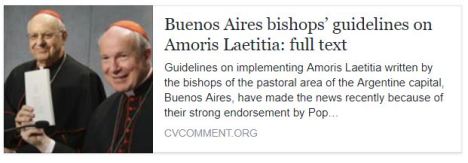
Last year the Buenos Aires bishops interpreted the pope’s apostolic exhortation Amoris Laetitia so as to permit those sexually active in invalid unions to receive Holy Communion (in certain cases). The Holy Father praised their interpretation in a private letter (September 5, 2016) to Bishop Sergio Alfredo Fenoy, the Delegate of the Buenos Aires Pastoral Region of the Bishops’ Conference of Argentina. He wrote, “El escrito es muy bueno y explicita cabalmente el sentido del capitulo VIII de Amoris laetitia. No hay otras interpretaciones.” (Translation: The document is very good and clearly explains the meaning of Chapter VIII of Amoris Laetitia. There are no other interpretations). On June 5, 2017 by order of a papal rescript, both the Criteria or Interpretation of the Buenos Aires bishops and the papal letter were published in the Acta Apostolicae Sedis, purportedly making this the position of the Church’s “authentic Magisterium.” This seems to conflict with the teaching of Pope John Paul II and with the current Code of Canon Law (canon 752). It would affect our discipline about Holy Communion and even Confessional Absolution. Cardinal Wuerl insists that the doctrine has not changed, just the pastoral discipline. I think I will go back to praying on my knees for awhile on this one.

Hoping the Pope Listens to the Right Voices

art25

Father Scanlon gets it right again. Why can’t good priests like him be the advisers to the Pope. The Holy Father needs to be surrounded by the right people… not dissenters.

Stuck Between the Rock & a Hard Place

art13

Who are we going to punish? I worry about this as a priest in reference to the distribution of Holy Communion, absolution in the sacrament of Penance and in terms of preaching a faith message from the Scriptures that might immediately be interpreted as “hate speech.” Passivity and toleration is not enough to appease certain people… it is being demanded that conventional Christians become advocates for sinful behavior. If a priest gives the sacraments to anyone, no matter what their views and lifestyle, then does he not become an accomplice in their sin? Would he forfeit his own immortal soul for causing scandal and violating conscience, the commandments and his sacred duty? For the sake of accompaniment, can a bishop or even pope force a priest to say or do something that he views as sinful and wrong?

Matters are Heating Up in Rome

art5

Bishop René Henry Gracida, Bishop Emeritus of Corpus Christi, has asked that his name be added to the Filial Correction. The document asserts that ‘Amoris Laetitia’ is promoting heretical propositions, particularly about marriage and the reception of the sacraments. He views the current situation as akin to the historical Arian controversy. This is a bad situation all around.

http://www.ncregister.com/blog/edward-pentin/vatican-remains-silent-on-filial-correction

http://www.foxnews.com/world/2017/09/28/popes-deputy-urges-dialogue-after-francis-accused-heresy.html

The Pope is Servant, Not Master

art6

Bishop Schneider states:

“We should bear in mind, that the Pope is the first servant in the Church (servus servorum). He is the first who has to obey in an exemplary manner all the truths of the unchanging and constant Magisterium, because he is only an administrator, and not an owner, of the Catholic truths, which he has received from all his predecessors.”

“The bishops are not employees of the Pope, but Divinely constituted colleagues of the Pope, although jurisdictionally subordinated to him, yet still colleagues and brothers. When the Pope is himself tolerating a wide dissemination of obvious errors of faith and of grave abuses of the sacraments (like the admittance of unrepentant adulterers to the sacraments), the bishops should not behave themselves like servile employees wrapping themselves in silence.”

Not Hard to Read Between the Lines

art12

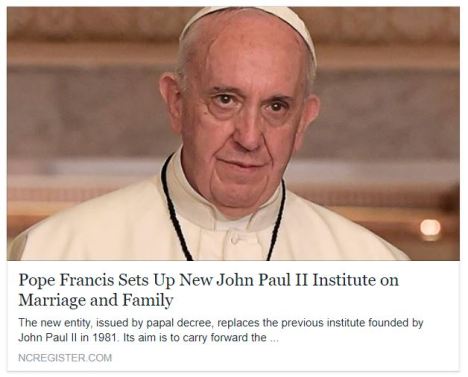
This will be interpreted by many as an attempt to supercede the clarity of St. Pope John Paul II’s FAMILIARIS CONSORTIO with the ambiguity of AMORIS LAETITIA.

I would still want to show every respect and priests need to be obedient to Christ, the Holy Father and to their bishops. But I am also trying to be honest as I struggle with this change of direction in the Church. Parsing words by those in denial will no longer work. It is obvious now, our course has shifted.

Is President Trump Pro-Life?

art18

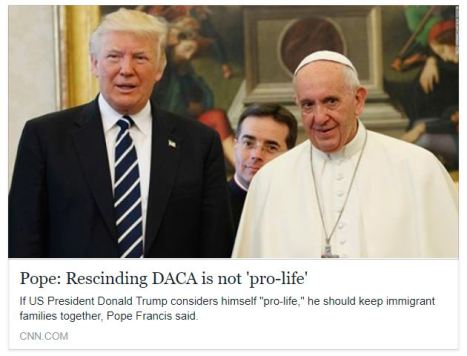
The Holy Father was critical of both the repeal of DACA and those who deny global warming… which he associated with the recent hurricanes.

Pope Urges Use of Exorcists

devilshirts

It is no wonder that Pope Francis is urging the appointment of more exorcists!

CRUX reported:

According to Pope Francis, confessors should not be averse to referring their penitents to exorcists if they suspect demonic activity is at work, and after consulting psychological professionals. The pontiff said the ministry of confession takes place on the “peripheries of evil and sin.”

Pope Francis stated:

Discernment is necessary also because those who approach the confessional may come from the most desperate situations; they could also have spiritual disturbances, whose nature should be submitted to careful discernment, taking into account all the existential, ecclesial, natural and supernatural circumstances. When the confessor becomes aware of the presence of genuine spiritual disturbances – that may be in large part psychic, and therefore must be confirmed by means of healthy collaboration with the human sciences – he must not hesitate to refer the issue to those who, in the diocese, are charged with this delicate and necessary ministry, namely, exorcists. But these must be chosen with great care and great prudence.

LINK: Audience with participants in the Course on the Internal Forum