• Our Blogger

    Fr. Joseph Jenkins

  • The blog header depicts an important and yet mis-understood New Testament scene, Jesus flogging the money-changers out of the temple. I selected it because the faith that gives us consolation can also make us very uncomfortable. Both Divine Mercy and Divine Justice meet in Jesus. Priests are ministers of reconciliation, but never at the cost of truth. In or out of season, we must be courageous in preaching and living out the Gospel of Life. The title of my blog is a play on words, not Flogger Priest but Blogger Priest.

  • Archives

  • Categories

  • Recent Posts

  • Recent Comments

    Barbara King's avatarBarbara King on Ask a Priest
    Ben Kirk's avatarBen Kirk on Ask a Priest
    Jeremy Kok's avatarJeremy Kok on Ask a Priest
    Barbara's avatarBarbara on Ask a Priest
    forsamuraimarket's avatarforsamuraimarket on Ask a Priest

Facing Our Mortality and Immortality

Although there is no Mass, the rituals for Good Friday are very moving and evocative. However, it is the faith that we bring to the ceremonies which gives it importance for us. An outsider to our faith, might look upon such ritual with awe towards its simplicity and yet confusion as to its meaning. This is because we celebrate a theme which much of our culture seeks to ignore or postpone. We commemorate death. Assuredly, it may not be death as many people understand it, but nevertheless it remains something mysterious and even feared. Our society, with its newfound confidence in science, ironically hides the tragic death of the unborn behind the guise of linguistics while many in the medical field go to elaborate techniques to keep certain other people alive, no matter what the cost. One of the tasks of the Christian is to visit the sick; and yet, how often have we hesitated from that duty? And we know why — because to meet an elderly or handicapped or sick person is to face the specter of our own mortality, death. We dye our hair, or wear something over our heads that lost recently at the horse races; we cake our faces in makeup to cover the blemishes and wrinkles of age; we diet to wear clothes that we could not fit into even as teenagers; we take an assortment of drugs to maintain our vitality; we do all this and more to escape the prospect of age and the ghost of death which lingers in the periphery of our lives.

Even believers on Good Friday might view the death we recall as simply a commemoration of an historical event. But, it is much more than that. The Lord on Holy Thursday washed the feet of his disciples as a sign to them that we are called to humble service. Good Friday is the day that he gives us a summons to imitate him. From our Christian initiation onward, we are baptized into the saving death of Christ. It would set the whole pattern of our lives in which we would experience many dyings and risings. It may sound fatalistic, but it is still true that we are on a pilgrimage from the womb to the tomb. To live means we must suffer. To live we must die. The uniquely Christian message is that although we may not escape death, Christ will give us a share in his story of the empty tomb and triumph over death.

To some extent, all the sacraments are a living out of what we celebrate in the Lenten season leading to Easter. The Mass is a special case in point whereby the sacrifice of Christ on the Cross is not only commemorated but is recalled by a living memory. Christ died once and for all for us, but in the Eucharist, that death breaks through the bonds of time and space; we are there. Celebrated in an unbloody fashion, what was missing on Calvary is now provided, ourselves and our faithfulness. If it were by our sins that Christ was crucified; then now in the various Masses of the year we are able to get to the other side of that Cross, to offer ourselves with Christ, as an acceptable offering to the Father. We offer ourselves in our prayers to God, asking him to hear us and to transform us to the likeness of his Son.

As Christians we view death as the consequence of our primordial disobedience, sin. In the ministry of Jesus this perspective is retained. When he healed the sick, he often added an admonition, to sin no more. He also showed that he was the master of both life and death. When the little girl Tabitha and his friend Lazarus had died, he restored them to health. However, he did not use this very same power to avoid his mission in the world. Why? Certainly, he had not sinned. He did not deserve to die, especially not a criminal’s death. Why then did he accept his Cross?

There is a movie which came out a number of years ago entitled, Saving Grace; in it the Pope while gardening gets locked out of the Vatican and begins to roam the street with the ordinary people. He eventually ends up in a small town where apathy has crushed the people’s spirits. They live off charity and refuse to try to improve their lot. Not surprising, the village church is in ruins; after all, what need had a dead people of a church. The Pope, who looks like any other poor man, becomes determined to help stir these people back to life. He starts work upon a primitive irrigation system with the help of children. The adults think he is mad. Lazy thugs in charge of the town try to prevent his work from coming to completion. Just when the project is about finished, the gang leader of the town throws a stick of dynamite destroying part of the works. The townspeople look on. Among the debris is a child, a small boy. All seems lost. All seems for nothing. A boy dies, and what does the successor of Peter have to show for it? And yet, the women and later the men of the village start coming to the wreckage and begin to build. What a price this boy paid. He must not die in vain. How evil an act it was, a deed their sluggishness and despair of life had allowed. They rebuild. Water comes pouring into the town. These simply people begin to rejoice and some even dance in the water. They were dead, and are now alive again. I tell you this story because it speaks to us in a small way about the Cross of Christ. Sometimes to redeem a people, takes a life.

We don’t have to dig any deeper than that for the reason why Christ allowed himself to be betrayed, tortured, and murdered. He did it for us. The words from Caiaphas in John’s Gospel took on a meaning even deeper than he would have ascribed, that there was an “advantage of having one man die for the people” (John 18:14). Jesus was betrayed by his very own friends, the ones who should have protected and loved him. His own people disowned him. Peter denied him. Judas turned him in, with of all things, a kiss! Imagine someone whom you love more than life, betraying your love and doing so with a sign of false affection. I know for some of you this would not be hard to envision. Think about the deep agony it causes. It is at the core of what the Cross is about. I cannot tell you how many men and women have come to the rectory door, crying uncontrollably, because a spouse or a loved one abandoned them. It is the Passion of Christ all over again, a story of a love rejected. And yet, if this were all that the Cross was about, we would be the most pitiful of people. The story of Good Friday is also about a love fulfilled and accepted — a love so great that Jesus was willing to stretch out his hands and feet upon the Cross to show us just how much. Taken in connection with what we celebrate at Easter, it is the message that love is ultimately stronger than pain, betrayal, or death.

Despite how we try, I doubt if any of us can completely cast the thought of death out of our minds. I am sure that among the readers, there is pain for loved ones lost. I do not have to remind you of the suffering and regrets which haunt us. We can take comfort in the Christian message that death is not the end but is rather a new beginning. It is a doorway from this life to another. Because that door closes quickly, we might easily despair as to what is on the other side. However, we do not need to fear. God has promised us that we would never be abandoned. Just as he vindicated his Son after the world’s intolerance had done all it could to him, so shall we be rescued. Jesus himself said that he has prepared a place for us and that in his house there are many rooms. When we encounter the reality of Good Friday, let us remember that we are mortal; that we are not totally in control of our lives; that we do suffer; that we are sinful; and that death is a part of who and what we are. But, let us also recall that we are so much more and that there is a part of us that death shall never reach. Where we are weak, God is strong. Where we are sinful, God can forgive. Where God forgives, there is redemption. Where there is redemption, there is eternal life.

For more such reflections, contact me about getting my book, CHRISTIAN REFLECTIONS.

Cardinal’s Hat for Archbishop Wuerl!

Here is a copy of the letter of congratulations I sent the archbishop:

October 20, 2010

Most Rev. Donald W. Wuerl
(His Eminence Donald Cardinal Wuerl)
Archbishop of Washington
P.O. Box 29260
Washington, DC 20017

Your Eminence,

When you first came to Washington, I remarked to you that your TEACHING OF CHRIST catechism was used by many of us in seminary, not only to learn the basics of faith but to give doctrinal content to our spiritual reflection and prayer. Many of us followed your life and the tasks given to you by the Holy See with prayer that God would give you both strength and courage. Sometimes the jobs you were given were hard and you were placed under great pressure; but you did what needed to be done with obedience and professionalism. You became a bishop and then an archbishop, but throughout you have remained a wonderful model of the priesthood. I watched you on television for years and it was readily apparent that here was a man who was in love with the faith and who was moved by the Holy Spirit to proclaim and teach the truth.

Today we got news of your elevation to the College of Cardinals. I cannot express how delighted I am by this news. Although I am only one of many of your priests, and one of no particular renown, please know that as you accept the responsibilities of this office, you will remain in my daily prayers and Masses. I have always taken very seriously, that while configured to Christ, every priest is also an extension of his bishop. I know that you will continue to do much good for both the local and universal Church, building up the Mystical Body in unity, holiness and peace.

Again, many congratulations and prayers on your behalf,

Fr. Joseph Jenkins
Pastor

The Struggles of Priests: A Discussion

I thought the following remarks were worthy of a posted dialogue or brief reflection. 

GUEST OPINION: Sometimes parents and grandparents lament the choice of a young man to become a priest. Given the stories about abusers and gay clergy, will the heterosexual man find himself the odd man out or one among a brotherhood of normal men who embrace single-hearted love? Parents want grandchildren and worry about his happiness.

FATHER JOE:  There is nothing more wonderful than the priesthood.  It is worth the greatest sacrifices.  The scandals around sexuality are tragic and devastating to the Church’s reputation.  But there have always been weakness, confusion and sin.  We see the same with marriage, especially today when half of all unions end in divorce, often under the grounds of adultery.  Scandals should no more prevent men from answering a call to ministry than they should deter good Christian couples from pledging their love to each other within the covenant of marriage.    

GUEST OPINION:  Many berate “celibacy,” while even clergy are often quiet and/or resentful about their chosen lifestyle. They talk about the Church DEMANDING it instead of about themselves CHOOSING and EMBRACING it. It is a discipline of the Catholic priesthood, but sacrifices might be joyfully pursued and can open all sorts of doors for discipleship. Strangely enough, I have known some who were energetic in the defense of our religion and rigorists about the rules, not because they were on fire with fervor for the faith and their promises, but because they were trying to convince themselves.

FATHER JOE:  No sooner do you say something good that you ruin it.  Celibate love opens a man to single-hearted love of God and selfless service to the community.  You are right that it opens all sorts of doors to responding to God.  While a few might be pretentious in living out the demands of priesthood; I would hope that most men do so out of a conviction and excitement about the faith and the part they play in the work of salvation made possible in Christ Jesus. 

GUEST OPINION:  The man looking at priesthood wants to take care of others, but who will take care of him? A priest friend told me that every ordination homily used to sound like a Mother’s Day sermon. The bishop assured the women that the Church would take care of their boys. Today pension plans are strapped for funds and the Church has reneged on long-term care for elderly and ailing priests. Has the Church broken a trust with these women and their sons?

FATHER JOE:  While creative, this writing is also fairly cynical. I understand the frustrations, but we have to be realists about the problems we face today as well. Men do not become priests because we want someone to take care of us. We become priests because the wondrous love of God has called us as caregivers for the salvation of souls. We want to make Christ’s sacrifice present and to be the dispensers of his sacraments, particularly the Eucharist. Empowered to forgive sins, we seek to bring divine mercy to our fellow men and women. When a man is ordained for the altar he is configured to participate in the one priesthood of Christ. He ministers, not in his own name, but as a representative of Christ and his Church. Priests are commissioned by Christ and authorized to function as extensions of their bishops. Instead of seeing tension between the shepherds, we should acknowledge the ministry of the Church as a whole and the unity that exists between her ministers. Mistakes might be made regarding practical matters, but the grace of God remains with his Mystical Body. The Church is still One, Holy, Catholic and Apostolic. The Holy Spirit safeguards the truth of the Gospel and empowers the weakest of men to teach and pass on the faith and morals revealed by God. Every priest is a servant or slave of the Gospel. We do not live for ourselves, but for God and others. When our lives are used up, we should echo Luke 17:10, “When you have done all you have been commanded, say, ‘We are unprofitable servants; we have done what we were obliged to do.’”

GUEST OPINION:

The priest has no spouse or children to rely upon. Canon law says that the relationship of a bishop to his priests should be that of a father to a son. Is that always the case, especially when priests make mistakes, get in trouble, or just face sickness? It seems that legal expediencies and financial threats can quickly cause a vast divide. We forgive everyone, except our own.

We may have to rewrite the parable of the prodigal son. When the prodigal comes home, his father refuses to meet him and sends out a lawyer who tells him that he has severed his ties and must go his own way. Indeed, he has been disowned and can no longer be called his son. “You are laicized and maybe even excommunicated.” The elder son hears that there is a commotion and confronts the father. His father seemingly has amnesia about ever knowing the prodigal. Regardless, anything this person did could not possibly be his fault or connected to him. Unfortunately, there is more bad news because the farm is failing and the inheritance that the elder son expected will now have to go to the lawyers for legal expenses. “You face ever escalating expectations and demands for funds, reprimand for speaking too honestly and forcefully about moral issues from the pulpit, and may face a retirement, not in a priests’ home, but as a ward of the state.”

FATHER JOE: 

The guest opinion writer would normally be regarded as quite orthodox.  Concerned about the priesthood, he is wrestling over certain issues.  I must acknowledge that I deleted a few points of the opinion above because of coherence and my own personal preferences about the nature of this blog. It is for this reason that my response seems to go beyond the perameters of the opinion piece.     

A priest prays for his bishop every day in the Mass and the Liturgy of the Hours. Most bishops are good shepherds of the Church and seek to support their brother priests. While there is a fatherly relationship in authority, there is also a brotherly affinity in love and service. The positing of an adversarial relationship is perverse and counter to Catholic ecclesiology. Priests are men under authority. In days gone by and in the present, they go where they are sent and do the work they are charged to do. The promise or vow does not expire when a priest retires. Given the need for clergy, even most retired priests still work hard. Genuine retirement for a priest comes when he closes his eyes for the last time and hears his Master’s voice calling, “Come good and faithful servant.”

It is true that we cannot excuse false teaching, ministerial indolence, or harmful scandal from the clergy. However, neither should the laity ridicule their ministers. God’s people must support their priests and bishops, helping them to become the shepherds we deserve and need. We can witness to one another by example in remaining steadfast in faith and true to our state of life.

Good bishops and priests love the people they serve. Do the people in the pews always love their priests? Are they appreciative of all the personal sacrifices these men make so that we might share the Eucharist and have our sins forgiven? Do we take account of the frightful challenges facing our bishops as they strive to insure the unity of faith, preserve our Christian legacy, and dialogue with a combative secular society?  We have many good people, but some of our worst enemies are so-called Catholics, themselves.  Today, there are critics who have nothing good to say about the Church. They tell jokes about priests and bishops, slandering good men because of a few renegades who played Judas. Particularly sad is how normally pious folk are now joining into the litany of criticism and venomous gossip that was once reserved to the Church’s enemies.

If you would like to share your opinion on this Blog, you can write the message in the ASK A PRIEST comment section or send an email to frjoe2000@yahoo.com. I always take editorial liberties and reserve the right to add a response.

Mother Zion and the Coming Judgment

Isaiah 66:10-14 gives us the image of Jerusalem as a loving and nurturing mother. Similarly, the Church would be viewed as the New Jerusalem, the first glimmerings of Christ’s kingdom breaking into our world. While we find security and comfort in the maternal analogy, verses 15 to 17 speak of the Lord coming in fire to judge all mankind. He shall wave a sword “and many shall be slain by the Lord” (verse 16). It was this messianic vision that many sought in Jesus but he surrendered his life on the Cross and told us to forgive one another. However, the Second Coming of Christ retains the full force of this passage. If we are members of Mother Zion, we can be saved; if we reject her, and here we really mean Mother Church, then we will be subject to fire and the sword. Here we find a serious imperative for the mission activity of the Church. Similarly, the great apostle tells us, “Peace and mercy on all who follow this rule of life (never boasting of anything but the Cross), and on the Israel of God” (Galatians 6:16). Luke 10:1-12,17-20 has Jesus sending out the seventy-two to proclaim the Good News. The urgency of the proclamation is illustrated by Christ’s instruction against a walking staff and traveling bag and against wearing sandals or greeting people along the way. He gives them something of his power but warns them not to be proud, just content that their names “are inscribed in heaven.”
For more such reflections, contact me about getting my book, CHRISTIAN REFLECTIONS.

The Church as the New Jerusalem

The message about the Church as a New Jerusalem and the analogy of a wedding banquet has serious doctrinal implications that are not always considered by believers in Jesus outside of Catholicism. While there is certainly an individual component to our ultimate salvation, the institution of the Church reminds us that there are vital corporate components as well. Jesus calls to himself disciples and appoints Apostles who will pass their authority down to the bishops who themselves will ordain priests and deacons. Jesus institutes a new covenant in his blood and commands it be repeated “in memory” of him, not in an empty nostalgic way but in a manner that makes present and available that which is recalled. He gives his message and divine mysteries, not to individuals, but to the Church, and appoints Peter and his successors as the visible head. It is the Church that assembles and declares inspired the Bible. Jesus sends his Spirit upon the Church at Pentecost to empower its leadership and to give efficacy to the sacraments. More wondrous than Isaiah could have ever imagined are the splendors given to the People of God.
What is the Church? We could write volumes and never begin to scratch the surface of this human and divine mystery. She is the great sacrament of encounter with Christ. All that we need for salvation can be found in the Church. Many analogies are used. Marriage is a popular one. Another is that of the Mystical Body of Christ. The faithful are united and interdependent, like the organs and parts of a body. There is a diversity of graces and gifts (see Corinthians 12:4-11). Read also Romans 12:4-5; 1 Corinthians 12:13; and Ephesians 4:7. There is mutual complementation (Ephesians 4:15-16). The many gifts are distributed to believers as members of a whole, just as much for their own sake (Ephesians 4:7,12). The two become one, the human and divine, the bride and groom, the Church and Christ. “We, though many are one Body in Christ” (Romans 12:4-5). All is given us “for building up the Body of Christ,” (Ephesians 4:12). Read also 1 Corinthians 12:27 and Ephesians 1:23. Our unity is in Christ (Ephesians 1:23; 4:15-16). The Church is the manner in which Christ is present and visible throughout history. It is for this reason that our Lord so detested hypocrisy. Such a sin blurs the likeness that others need to see in our witness and that the Father hopes to see when he looks down upon us. If He sees his Son in us then we will have a share in his Son’s reward.

During a day when there have been so many scandals, we need to remember that the Church is not only a human institution but also a divine one. The Church is literally the INCARNATION of Christ in a “visible” society, his contemporary earthly state. Those who view the Church as an intermediary that must be gone beyond or even dismissed to find Christ have it all wrong. Instead, it is through the Church that Christ gives himself to us. Jesus is our priest at Mass. Jesus gives us himself in Holy Communion. Jesus forgives our sins in Confession. Jesus is our living and transformative Word proclaimed from the pulpit. Jesus is the one with whom we share the sign of peace. It is in this sense that the second Lateran Council spoke about the Church as necessary for salvation. The Church is important because it is the extension of the person and saving work of Christ. Given this role, it is no wonder that our Lord gave special gifts to the Church: infallibility regarding the interpretation of the deposit of faith and empowerment for the sacraments so as to distribute from the deposit of divine grace. Christ is the Mediator of Salvation and the Church is his visible body in the world along with those in purgation and in heaven.

Recent convert rates to the Catholic Church in the United States were dismal. Dioceses where there had been abusive clergy or complacent bishops suffered notable decreases in Church attendance. I know one parish which had counted as many as 5,000 people a week that suffered a loss of 1,380 a week. This should have us worried. Our Lord promised that the Church would endure until the end, but we would hope that it will be more than one Pope and a couple of aging altar boys. I am often reminded of poor St. Augustine, dying as his city was being destroyed. Try to find Hippo today, or even find a Catholic Church in so many places where the Church died, frequently to be replaced by Islam. We find sobering words in the Scriptures themselves about the Lord’s second coming, “But will he find any faith left on earth?” (Luke 18:8). The Church is a witness to this faith. We should struggle to keep all parts of the body intact and alive.

Christ makes use of his Church in human history. Jesus preached and taught; we proclaim God’s Word and instruct with the Bible and our catechism. Jesus forgave sins; we go to Confession. Jesus celebrated the Last Supper with his friends and endured the Cross; we have the Mass. Jesus healed the sick and dying; we offer medical care and the anointing of the sick. Jesus freed people from demons; we offer blessings and even exorcism. Jesus sought out the outcast and poor; we seek social justice and practice organized charity.

Jesus called the little ones to himself; and we seek to protect the dignity and rights of all God’s children, from the womb to the tomb. Individuals may be sinful and sick. Even the ministers of the Church are not immune to human weakness and failure. But the Church remains the unblemished bride of Christ.

For more such reflections, contact me about getting my book, CHRISTIAN REFLECTIONS.

The Sacrifice of Jesus and the Church

The Old Testament prophet speaks about the restoration of Zion and Jerusalem (see Isaiah 62:1-5). His words are quite eloquent and filled with hope. Remember that the people of God had been dispossessed and their nation and its temple destroyed. Such a testimony would seem like foolishness to many. It is no wonder that at the end of their exile, if not of their subjugation, they rebuilt the temple and expected the eminent coming of the Messiah. However, a few years after the crucifixion of Christ, Jews and Christians alike found themselves persecuted with vigor by Rome and the temple was destroyed. Along with it the Jewish priesthood and their ritual sacrifices came to an end. Non-Catholic Protestant fundamentalists and certain Jewish authorities view the political restoration of Israel today as the beginning of a more complete fulfillment of the ancient prophecy. Indeed, the Scriptures were publicly cited when the United Nations recognized the re-establishment of Israel. “You are to be a crown of splendor in the hand of the Lord, a princely diadem in the hand of your God; no longer are you to be named ‘Forsaken,’ nor your land ‘Abandoned,’ but you shall be called ‘My Delight’ and your land ‘The Wedded,’ for the Lord takes delight in you and your land will have its wedding” (Isaiah 62:3-6).

As Catholic Christians we do not associate the state of Israel with the promised restoration of God’s nation. Instead, the New Zion or Jerusalem is the Church. Corinthians 12:4-11 recognizes that there are differing roles in the Church and varying gifts of the Spirit. The old sacrifices of the temple are replaced by the one oblation of Jesus who is both priest and victim. We renew and make present his saving covenant by celebrating the Lord’s Supper— in other words, the Mass— in our churches.

Every Christian priest participates in the one priesthood of Jesus. Every Mass is a re-presentation (in an unbloody but real and spiritual way) of the sacrifice of Calvary. Just as Hosea and others in the Old Testament used the marriage analogy between God and his people, Christ is the bridegroom and the Church is his bride. The Mass is a participation in the heavenly wedding banquet that finds mention in Isaiah. St. Paul will speak eloquently about how a husband should love his wife as Christ has loved his Church. The Jews were right in their hope two thousand years ago for a Messiah; the tragedy is that only a few recognized him when he came. When he comes again, he will not forget his own— either in the Church or among the first people chosen by God.

John 2:1-11 carries forward the general theme of marriage with the wedding feast at Cana. Note the intercessory role of Mary, even after Christ’s objection, “Woman why turn to me?” There is no argument. Joseph is gone and Jesus is the head of her household. She brings concerns to him and he takes care of them. He provides. Her answer is a command to the servants, “Do whatever he tells you.” Jesus had said that “My hour has not yet come,” and yet, the power of her faith moves him to freely comply. Jesus would later tell his listeners that if they had faith the size of a mustard seed, they could move mountains. There is no competition or tension between Jesus and Mary. This marriage feast was obviously for dear friends, maybe even relatives, and nothing should spoil its joy. Jesus turns water into wine. This is the first of his signs. At his own wedding banquet, he will turn wine and bread into his body and blood.

For more such reflections, contact me about getting my book, CHRISTIAN REFLECTIONS.

Jesus is the Sovereign Lord of Life

Peter stands before us in Acts 4:8-12 much transformed from the miserable figure we knew who denied our Lord three times. We are told that he is filled with the Holy Spirit and proclaims the Gospel without qualification or self-aggrandizing. A cripple is healed as a sign that his words ring with the truth. It is all realized in the name of Jesus Christ. He explains that Jesus, the stone rejected, has become the cornerstone: “There is no salvation in anyone else, for there is no other name in the whole world given to men by which we are to be saved” (verse 12).

1 John 3:1-2 sobers us with the fact that the world still fails to recognize the saving person and name of Jesus. If we are children of God, then we can expect a share in the eternal reward merited by Christ: “. . . we shall be like him, for we shall see him as he is.” Taking upon ourselves in this world something of the rejection that was first directed to Christ sobers us. We are signs of contradiction in a world that still does not embrace the fullness of truth. This is nowhere more true than in the Gospel of Life.

John 10:11-18 gives us the familiar and comforting analogy of Jesus as the good shepherd. Our Lord says, “The Father loves me for this: that I lay down my life to take it up again. No one takes it from me; I lay it down freely. I have power to lay it down, and I have power to take it up again” (verses 17-18). Jesus is sovereign Lord. He did not have to die for us, but such was the immeasurable love of God. As Lord, he comes back to life and offers us a share in his life. We need to be a people in love with him and with life.

For more such reflections, contact me about getting my book, CHRISTIAN REFLECTIONS.

Questions & Answers About Miscellaneous Matters

Does it really matter to what church a person belongs as long as he does what is right?
While we must all live and believe according to the dictates of conscience, objectively speaking, if a person wants to be assured of knowing and doing what is right, he will belong to the right or true Church. The various churches are not the same. Christ directly established the Catholic Church and saving truth subsists in her.

Why are there so many sinners in the Catholic Church?

This is no truer for the Catholic community than it is for others. Christ called to himself sinners and the Catholic Church has been ever faithful in doing the same. We seek the repentance and conversion of souls. We leave ultimate judgment of the weeds and the wheat to our Lord.

Cannot a person be an honest and faithful Christian without going to church?

He may on some level be a believer, but such a person is not a good Christian. The true Christian realizes that just as he is indebted to neighbors and friends, so too does he have debts before God. He was made for God. The Christian approaches God, not as an isolated individual, but as a member of a family of faith, a new People of God. It is our duty to go to Church and every Catholic is required under pain of mortal sin to participate at Sunday Mass.

Why is not fidelity to the Bible sufficient for a union of faith?

The problem is that the “right meaning” of the Bible must be followed for such a unity. The so-called bible churches all claim to follow the Bible and yet they are divided from each other and the fragmentation continues. The union of faith mandates an infallible teacher or interpreter of the Bible as well as a membership willing to submit their judgment to higher authority.

Why do Catholics believe in dogmas instead of the Bible?

Catholic dogmas of faith are generally the teachings of the Bible defined and elaborated upon by competent authority.

Are there not many roads leading to heaven?

Our Lord, Jesus, said that there would be one fold only– one faith, one Church, and one God. No, there is only one road to heaven and that is the one Jesus has marked for us. Truth is not relative, especially upon this point. Christ cannot contradict himself. This gives great impetus to our missionary and evangelization campaigns. However, Catholics themselves should as St. Paul reminds us, “Be of one mind,” and be configured to Christ (Phil 2:5). God certainly judges us according to what we know to be true and how we live out our faith in good conscience. The Church prays for her own and even for those outside her fold. She seeks to embrace them and save them. Who can estimate the efficacy of such intercessory prayer?

Can we believe in a Catholic Church as the true Church but not in the ROMAN Catholic Church?

No, we cannot. They are one and the same. No matter whether the rite is Western or Eastern, the head of the true Church is the bishop of Rome, the Pope.

Do we not all believe in one God?

Most, but not everyone is monotheistic. Mormon doctrine actually holds for polytheism (multiple gods). Religions from the East are also bringing pagan gods into the picture of our culture. Some believe in no god at all. Others define him in unacceptable ways. Further, we do not practice the same things that we were commanded. It should also be said that the devil knows there is one God and it does him no good.

Why do Catholics believe in teachings that are said not to be understandable?

While we do not understand the intrinsic nature of certain doctrines, we know they must be true because God who will not and cannot deceive us revealed them. Of course, there are still natural mysteries that we do not entirely comprehend, and yet, we believe and experience them as true.

Why do Catholics fail to wash one another’s feet as Christ commanded in John 13:1-15?

Actually, it is done on Holy Thursday. The bishop washes the feet of twelve men. This command was not given to all, but to the apostles. It is intimately connected to the call to ministry and priesthood. Jesus did not offer this ritual as a required act for salvation, but only as a reminder of humility modeled after our Lord, himself.

Why do Catholics burn incense in church since Isaiah 1:13 says: “Incense is an abomination to me”?

God rebuked the people for their sins while offering incense to him. God himself commanded the offering of incense, but only as long as it was done with a pure heart.

If Catholics are so good then how can the Church excuse the persecution of Protestants in Spain during the Inquisition?

The civil government of Spain used religion to promote its agenda of unification and national security; the Church did not sanction the harsh treatment of Protestants. Ferdinand and Isabella established the Inquisition for more political than religious reasons. The Jews and the Moors faced the blunt of the assault. The latter group was seen as an enemy of the state. The royal officers who made up the inquisitors also persecuted bishops and priests when it suited their political aims. They imprisoned the Archbishop of Toledo for sixteen years. Repeatedly, the popes protested against the inquisition.

Did Protestants ever persecute Catholics?

Martin Luther advised his followers to kill the popes, cardinals, bishops, and all who would defend them. John Calvin unmercifully persecuted those who disagreed with his views. John Knox was so ruthless that some 17,000 so-called witches were burned in Scotland alone in the course of forty years. Knox said that people were bound in conscience to execute the queen and to kill all the priests. In England, Catholics were fined a hundred dollars a month for failing to participate at Protestant worship. Irish Catholics were imprisoned in dungeons, hanged, drawn and quartered, and faced other frightful ends because of their fidelity to the Catholic faith.

Is it not the Galileo affair, in which he was imprisoned, proof that the Catholic Church opposes progress?

The Pope merely refused to accept proofs that Galileo offered to prove the theory that the earth moves around the sun. Galileo tried to prove it from the Bible, which was impossible. Protestants and Catholics alike rejected his proofs. Nevertheless, the Church honored Cusa and Copernicus who maintained similar theories. However, they claimed as their scientific opinion, only what they could prove.

Since there is nothing in the Bible about it, how can Catholics contend that St. Peter was the bishop of Rome?

Much of what we know comes from tradition. Archeological work and the evidence are that St. Peter was executed in Rome. Pious tradition and Christian lore tend to fill out the story:

St. Peter started his apostolic work ten days after the ascension, about the fifteenth of May in the year 34 AD. He remained four years in Jerusalem and preached the gospel there. Afterwards, he traveled to Antioch where he remained seven years, preaching and administering Church affairs. He left Antioch and returned to Jerusalem where he was imprisoned. Miraculously delivered (Acts 12), he went and preached the gospel in Rome. He performed many miracles and the Church flourished. From that location, he began to send bishops and priests throughout the known world. After seven years, the Emperor Claudius banished him from Rome. He visited Britain, Carthage, and Alexandria and finally returned to Jerusalem. It was there that St. Paul consulted him regarding the Gentiles and the observance of circumcision (Council of Jerusalem). St. Peter decided that the Gentiles were not bound by this matter of the Mosaic law. When Emperor Claudius died, the infamous Nero succeeded him. Peter returned to Rome, just as Aquilla and Priscilla had done. Two years later, St. Paul joined Peter as a prisoner in Rome. During the 22nd year of St. Peter’s Roman pontificate, Nero set the city on fire. The emperor placed the blame on the Christians and persecution ensued. St. Peter left Rome again. The 24th year, he returned and foretells his death (Acts 1:14). St. Peter and St. Paul had frustrated Simon Magus’ magical arts. The two apostles were thrown into the Mamertine prisons for nine months, where St. Paul composed his second letter to Timothy. They converted Process, Martinian, the keeper of the prison, and 47 prisoners. St. Peter miraculously caused water to spring forth from the prison floor in order to baptize the new converts. This well is still preserved. In the 25th year of his Roman pontificate, St. Peter and St. Paul were sentenced to death. St. Peter was crucified upon an inverted cross on Mount Janiculum (feeling unworthy to die precisely like his Lord). St. Paul was taken to the Salvia waters about four miles south of Rome and beheaded. When St. Paul’s head fell under the sword, it made three bounds and a fountain is said to have sprung forth at each place where his head hit the ground. Three fountains are still venerated at the site.

For more such material, contact me about getting my book, CATHOLIC QUESTIONS & ANSWERS.

Our Pro-Life Commitment

The Cemetery of the Innocents

frjoeprolife

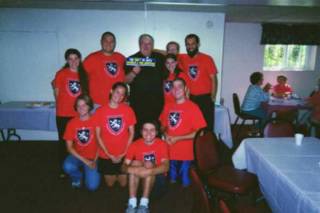
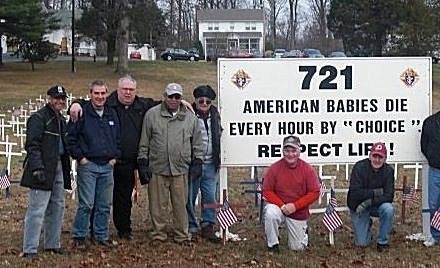
Here is a picture of me and the Knights of Columbus who set up 721 crosses that represent the children lost to abortion in one hour of one work day.  This MEMORIAL OF THE INNOCENTS was set up at Holy Family Church in Mitchellville in 2009 and every year since then.  We often have it up until the annual March for Life in Washington, DC.  We received a lot of support although there were a few complaints.  One lady argued against putting such a thing up at Christmas time.  I explained that Advent and Christmas was the perfect time.  During Advent we recall the Christ-child in the womb and on Christmas he is born.  We are reminded that every child is a reflection of the Christ-child.  Another person argued that it was insensitive as she was a pro-choice Catholic.  I told her that she was deceived.  There is no such thing as a pro-abortion Christian; abortion attacks the central mystery of the Incarnation.  Abortion is murder and as such it is a repudiation of Christ’s Gospel of Life.

One of my favorite memories is working with the American Life League back in 2005 and the CRUSADERS FOR LIFE.  Here is a reposting of the news around that event at my old parish, Holy Spirit Church:

A.L.L. Crusaders Come to Washington 2005

A dozen young people from colleges across the country walked from Augusta, Maine to Washington, DC in “Defense of the Catholic Church” and to spread the message that you cannot be Catholic and pro-abortion. Nevertheless, while many have applauded young people for taking up the “right to life” cause, this group of remarkable crusaders was purportedly banned from speaking in churches by several dioceses like Philadelphia and Baltimore.

Myself, Dr. Grier & a Crusader

10_10

The American Life League ran a series of stinging ads challenging the American bishops to enforce canon law and to protect the Eucharist from sacrilege when pro-abortion politicians and others (who have made such “public” stands) take it upon themselves to receive Holy Communion. The young people have shown no spite or anger, only sadness that some of the nation’s shepherds have chosen to remain on the sidelines. One priest remarked that the ads in protest were so severe that the American Life League owed the leaders of the Church an apology. However, others thought that these good men should at least have shown the same respect and hospitality to the young marchers for life as they have in the past to the high profile anti-life politicians. While they were able to find lodging in the city, they attended 9:00 AM Mass at Holy Spirit Church on Friday, July 30 and were invited to say a few words afterwards. I contacted the archdiocese’s Pro-Life Office several weeks earlier about the matter to insure a level of approbation and to insure proper discretion.  (Although the ads pained him, to his credit, Cardinal McCarrick did not formally forbid the young people to speak in his churches. Throughout, nothing the young people said violated the archdiocese’s rules against participation in partisan politics– they did not name politicians by name, did not tell people for whom they should vote, and spoke with respect in regard to the Church’s shepherds.)  Following the celebration, a reception was held in the Parish House were the young people had a hearty breakfast and got to meet parishioners. Also in attendance was SK Reginald Grier, a parishioner, a fourth degree Knight of Columbus and volunteer member of the archdiocesan Office for Black Catholics. John Stakem, a Knight of Columbus from St. Pius X Council, and past parishioner was present, too. John Stakem and Joseph Markauskas were long-time pro-life volunteers and were involved with the local pregnancy center. Joe and Betty Markauskas had even offered to give the young people housing while in town. We were very pleased that the director for the Forestville Pregnancy Center was present, Chyllene McLaughlin, along with her assistant. We wanted to communicate to these young people that they were not alone. Holy Spirit Parish, the Knights of Columbus, and the Pregnancy Center in the larger pro-life community, was very much behind them.

ALL Crusaders at Holy Spirit Parish

13_13

May God bless them for their sacrifices and may their witness bear fruit.

DISCUSSION

FRANK:  News releases indicate that the Church after Vatican II had converted the Kennedys and other Catholic politicians into believing that the liberal backing of the culture of death is acceptable.

FATHER JOE:  What news releases were these? Cite them; I would like to read further. As far as I recall, John Kennedy was chastised by churchmen for his liberal response about how little his faith would inform his work as president. As for the other Kennedys and the issue of abortion, I fail to see how Vatican II can be blamed for their pro-abortion stances. I have read and studied all the Vatican II documents and post-conciliar documents. Nothing comes to mind that would condone such thinking against the Gospel of Life. Are we throwing mud again? Give me specifics, please.

FRANK:  Having attended the seminaries after Vatican II where the divinity of Christ was challenged, as well as the papacy, and all that was to be infallible before the “Catholic reformation” of 1962-1965; what is your take on recent developments and the continued blasphemies to this day condoned by the Church where the USCCB still can’t come to a consensus to deny our Lord to baby-killing Catholic politicians?

FATHER JOE:

Certainly there was a heightened stress upon the humanity of Christ in many theological schools after Vatican II. However, I do not recall ever being taught that Jesus was not a divine Person.

Fr. Patrick Granfield taught my class on the papacy at Catholic University and his lectures defended the Holy Father’s authority with a great deal of explanation.

Those things that were changed were not deemed infallible but rather mutable accidentals. This thinking was even shared by Pope Pius XII prior to Vatican II on matters like the prehistoric generation of human beings and the liturgy.

A revision of the liturgy was in the working stages going back to the 1930′s and 40′s. The reformed liturgy we have now has lasted a few decades and will probably remain for many more, although with the old liturgy alongside and with continuing adaptations by the Holy See. We have had to suffer the experimental phase, but Pope Benedict XVI said that such has come to an end.

As for the passivity of churchmen in reference to Holy Communion and the standing of pro-abortion politicians, such is also not attributable to Vatican II. The Church has gone through periods in the past where it was the lackey for parliaments, kings and queens. The Popes made clear statements from the 1600′s onward that slavery was detestable and should be abandoned. However, Catholics owned slaves in the colonies and later in the United States of America. The Jesuit landowners of Maryland had slaves. Bishops were often mute on the subject, except for admonishing their baptism in the faith. Dissent is not something new but something very old.

PADRE XYZ: 

Father Joe, Your welcome to the pro-life young people did not go unnoticed. I know it cost you personally.  I think you can be rude and you definitely lack tact, but it did take some nerve to stand virtually alone and make the challenge against silence or business as usual.  You honestly shared your heart to the bishops and your brother priests.

You asked…

Would you give communion to Nazis who promoted the murder of Jews?

Would you give communion to White Supremacists who incited the lynching of Blacks?

Why should we prize the life in the womb any less or their murders as somehow less grievous?

Silence befell all the big guns. You lost a lot of friends that day. If you had career hopes in the church, they were suddenly shattered. Hushed and whispered voices were the only response, “How do we shut this priest up?”

You became an embarrassment. I could not do what you did. You angered a lot of people. You took a promise of obedience and you were reprimanded for your slight as an act of betrayal. Some of us witnessed it, although you were left unnamed.

You changed after that, became quiet, even sullen. It was as if something died in you. You gained weight.

I know you were disappointed in me. But to be frank, I was afraid. Who are we to question the shepherds over us? What happens if we tell the majority of Catholic politicians they are no longer welcome at the altar?

Take care of yourself.

FATHER JOE:  I was going to erase this comment. I still might. If you are who I think you are, email me. Peace!

(I am not really brave.  I speak my mind and I love the Church.  When all is said and done, I do as I am told.  I am the Church’s man.  Some would contend that I am too conservative or right wing.  But how can we be too committed to the Gospel of Life?  Every day I work to control my temper.  As long as I can remember, I have been very passionate about our faith and its values.  Am I ambitious?  Like most priests, it is nice to know that one is appreciated and that one’s talents are acknowledged.  However, by comparison to most priests that I know, my rating would be very low.  It is not false humility but the truth when I say that I count myself as the least of my brothers.  As for the bishops, it must be a frightful responsibility they carry.  Who would want it?  They are criticized from every side.  It is easy for us to judge, but we do not walk in their shoes.  Pray for priests and pray, especially for our bishops.  They are Christ’s apostles in the world today.)

DR:  I nominated you for a pro-life blog award (FATHER JOE Blog).

JOHN:  Fr. Joe, abortion is murder. These babies can’t speak for themselves. Other bishops have stood up and said priests should not give communion to pro-choice politicians as they have the power to stop the murder (Bishop Burke-former bishop of St. Louis archdiocese and Bishop Finn of Kansas City diocese, for instance.) I’m glad priests like you and Fr. Frank Pavone speak out on this issue. It’s a serious matter and it should be treated as such. Thanks for all you do.

LENBER:

“President Bush has had a very cozy relationship with the Vatican, and set a presidential record by meeting with the Pope six times.”

Very cozy indeed, sometimes for the good, and at other times for utterly and criminally contra-productive [things], such as siding with Bush in Criminal Wars (for the Vatican just Abortion is a Crime) or siding with Israel on their Criminal Occupation of Palestine.

All Thanks to Vatican II Double Crossers.

FATHER JOE:  I am not sure I would coin the Bush Doctrine or International efforts in such negative terms. However, as for the Pope, you seem to be terribly deceived. The Vatican opposed the invasion of Iraq. Tarek Aziz (the former president) was a Catholic. He made a retreat in Rome and saw the Pope (John Paul II) the week prior to the invasion. The state of Israel is also not entirely happy that the Vatican, again and again, sides with Palestinians (who are largely Islamic but include an ancient Christian community). Formal recognition and diplomatic ties were held up because of Vatican concerns for the Palestinian people. The late Arafat, at the end of his life, remarked that he saw the Vatican as his ally in the conflict for Palestinian rights. Zionism was condemned by both the UN and by the Church. Arafat used to attend the Christmas Mass in Bethlehem with his wife (who is a Christian). The Catholic Church is no one’s stooge, not for Bush and not for Israel. The Holy Father (both JPII and BXVI) has spoken to President Bush, (he meets a lot of people) and they share much in regard to the unborn, however on matters like the Middle East and capital punishment, there is a great divide.

MICHAEL:

Tomorrow marks the 36th anniversary of Roe v. Wade.

Think of the millions of lives that were snuffed out in this “free” country.

May God have mercy on us!

GENUS LILIUM:

I am completely against abortions. I have children and I have learned that some vaccinations are grown off of human diploid cells from aborted fetal tissue, not to mention all the other chemicals, heavy metals, and animal products. That seems like it might be a problem to me. Now that I know this, would it be wrong for me to continue to vaccinate my children? Is it just a money scheme? I really don’t want that stuff in my kids.

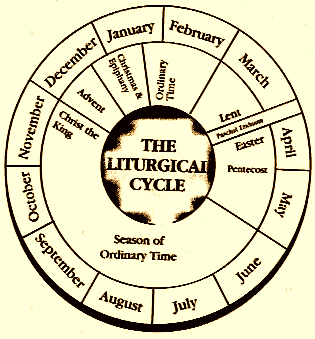
Questions & Answers About the Church Year

What is the meaning of Advent?

This season of four weeks before Christmas represents the four thousand years (according to the Scriptural reckoning) that mankind had to wait for the coming of the Redeemer.

What is the object of Advent?

We become aware of ourselves as spiritual Jews, recalling the advent of Christ’s first appearance while awaiting his Second Coming. It should light the spark of desire for this definitive encounter and for the graces he gives us as our Savior and Redeemer. Advent prepares us for the birth of Christ.

Why do we call Jesus’ birthday Christmas?

It is because the Church celebrates the festive day with Masses that specially commemorate the birth of our Lord.

Why do we traditionally offer three different Christmas Masses?

It is seen as a threefold act of thanksgiving to the divine persons of the Blessed Trinity who participated in our redemption.

What is the feast of the Presentation of the Lord?

On the fortieth day after Christ’s birth, Mary, in obedience to the law, offered her divine Son to his heavenly Father. It was once called the Purification because Mary offered the required clean oblation in the temple.

Why is it also called Candlemas Day?

It is because the priest blesses candles on this day. Candles are symbols for Jesus who is the Light of the World. Simeon proclaimed him to be the light of enlightenment of the Gentiles (Luke 2:32). Candles are blessed on this day with beautiful prayers and hymns: “May we who carry them to praise your glory walk in the path of goodness and come to the light that shines forever.” A procession is made to the church where Mass will be offered.

What is done on Ash Wednesday?

Ashes are blessed by the priest and placed on the heads of the faithful.

What makes up the ashes?

They are the remnants from blessed palm used the previous year. The ashes remind us that our bodies are destined to soon return to dust. That is why the priest says: “Remember, man, you are dust and unto dust you will return.

What are the ceremonies of Passion (Palm) Sunday?

It is a pious custom to cover the crucifix, statues, and pictures in violet to represent the brief time before the passion that Jesus hid from the Jewish authorities, following his terrible humiliation by them in the temple. Since it is also Palm Sunday, we also celebrate Christ’s triumphant entrance into Jerusalem. Palms are blessed in the church. The Jewish people greeted Jesus with palm branches and hailed him as their king. We know, of course, that he was not the kind of king they wanted and that Jesus really came to Jerusalem to die.

Why is the last week of Lent called Holy Week?

It is because we specially commemorate the events making up our redemption. Many graces are given us in this most holy time.

What takes place during Mass on Holy Thursday?

The Church commemorates the institution of the Eucharist (and the Priesthood). As a special sign of joy, the Gloria is sung and bells are rung during its recital. Extra hosts are consecrated for special reservation that evening and for communion on Good Friday. The Eucharist is carried in procession to the repository at a side altar. The organ and bells are now silent until the Gloria on Holy Saturday. This expresses the deep bereavement of the faith community over the passion and death of Christ.

Why is this the customary day for the consecration of holy oils?

Although sometimes moved to another day like Monday or Tuesday (for practical reasons) of Holy Week, the bishop consecrates the oils that are used at baptism, confirmation, anointing of the sick, and certain consecrations. Holy Thursday is chosen since it is the day that Jesus instituted the priesthood and made the apostles dispensers of his graces through the sacraments. Priests renew their promises.

Why are the altars stripped after Holy Thursday Mass?

This indicates our sorrow at the pitiful exposure of our Lord during his scourging and crucifixion.

What does the washing of the feet signify?

It is connected to the calling of the apostles as the first priests. The deep humility of Christ must also be found in his servants and ministers. St. Augustine associated it to our faith and baptism. Jesus washed the feet of his apostles before instituting the Eucharist. This reminded them of the purity and humility of heart that should be theirs before receiving and distributing Holy Communion.

What are the observances for Good Friday?

This is not a feast day, and no Mass is said. There may be special readings of the passion, Stations of the Cross, and Veneration of the Cross. We remember the death of Jesus. Various supplications are prayed.

Why do priests prostrate themselves at the foot of the altar on this day?

It expresses our profound grief at the suffering and death of Jesus.

What does the Church pray for in the great Supplications?

In the context of solemn petitions, the priest prays for the Church, the Holy Father, the bishops, the clergy and laity, the country, those preparing for baptism and/or reception, the suffering, separated brethren, Jews and other non-Christian people of faith, etc. We actually dare to pray that they might share in the fruits of Christ’s saving death. After all, our Lord died for all men and women.

How is the Veneration of the Cross conducted?

The priest or deacon holds up a Cross at three areas in the church: the back, middle, and front. If veiled, he reveals another of its three points as he moves toward the sanctuary. He proclaims: “This is the wood of the Cross on which hung the Savior of the world.” The people respond, “Come, let us worship.

How is the Cross worshipped or adored?

The priest lays the uncovered Cross before the altar, and then he kneels and kisses it. Traditionally, he would kneel three times at different distances and would finally kiss the wounds on the figure (corpus).

What does the choir traditionally sing?

They sing the reproaches that Christ must have made to his ungrateful people on this day.

Why is no Mass celebrated on Good Friday?

It would be unbecoming to celebrate the UNBLOODY renewal of the sacrifice of the Cross on the day we commemorate the BLOODY sacrifice of the Cross.

Also, every Mass makes really present the saving activity and presence of our RISEN Lord. Today we remember the shadows and not the light directly.

What does Holy Saturday bring to mind?

Many things come to mind. The darkness, candles, sacred silence and repose brings us to the Lord’s borrowed tomb and his descent to the limbo of the fathers (the righteous dead who awaited their Savior). But also, the festivities of the evening press upon us. We will soon celebrate our Easter joy.

What are the services for Holy Saturday?

The most elaborate liturgy of the year it is also the most beautiful and profound. There is the blessing of the new fire and the lighting of the Paschal Candle. There are a whole series of readings that trace our salvation history. There is also an incredible Easter Proclamation called the Exsultet. The Litany of the Saints is recited and baptismal faith is reaffirmed. A blessing is made over the baptismal water in preparation for the initiation and reception of new members into the faith.

What does the blessed fire of the candle signify?

The Paschal Candle is a symbol for Christ. Extinguished on Good Friday, it is restored brand new (resurrected) on Holy Saturday. The fire of the candle, from which other candles in the church are lit, signifies Christ as the Light of the World who dispels the darkness and gives warmth against the cold world and sin. Five incense grains are pressed into the candle representing the five wounds of Christ.

How is the baptismal water blessed in this celebration?

A whole series of Old Testament prophesies that point to baptism is read and prayers are made for the neophytes and those who reaffirm their faith. After the blessing and renewal of baptismal promises, the priest sprinkles the people. During the blessing, the Paschal Candle is dipped three times into the water as an invocation is made to the sanctifying power of the Holy Spirit. The water reminds us that the waters of baptism cleanse the world of sin.

What does the Church celebrate at Mass on this day?

The Church celebrates the resurrection of Christ. The Gloria is chanted, bells are rung, and the solemn Alleluia is sung.

What does the word Easter mean?

Easter or “East star” is derived from the rising of the sun or the resurrection of Jesus. It has also been called Pascha, a name taken from the Jewish festival when a lamb was slain in memory of the blood of the lamb that saved the first born of the Israelites. Jesus is the new Lamb of God who was slain on the cross and whose blood will save us.

What is the Ascension?

Forty days after Easter we commemorate Christ’s triumphant ascent into heaven.

What ceremony is peculiar to this day?

It is customary to extinguish the Paschal Candle, symbolizing the departure of Christ from earth to his Father in heaven.

What is Pentecost?

This is the commemoration of the descent of the Holy Spirit and it traditionally occurs ten days after the Ascension, or fifty days after Easter. We celebrate it on Sunday.

What are the Holy Days of obligation?

In the United States they are as follows:

  • Solemnity of Mary – Jan. 1
  • Ascension Thursday – (40 days after Easter)
  • Assumption of Blessed Virgin Mary – Aug. 15
  • All Saints – Nov. 1
  • Immaculate Conception – Dec. 8
  • Christmas – Dec. 25

Canada: Holy Days are Christmas and Solemnity of Mary, Mother of God

What is Ordinary Time?

This is a name given to the liturgical time outside of the seasons of Advent, Christmas, Lent, and Easter. Of course, in a sense, no time is ordinary. Every day and every liturgy is a wondrous opportunity to grow closer to the Lord and to live out our discipleship.

For more such material, contact me about getting my book, CATHOLIC QUESTIONS & ANSWERS.