• Our Blogger

    Fr. Joseph Jenkins

  • The blog header depicts an important and yet mis-understood New Testament scene, Jesus flogging the money-changers out of the temple. I selected it because the faith that gives us consolation can also make us very uncomfortable. Both Divine Mercy and Divine Justice meet in Jesus. Priests are ministers of reconciliation, but never at the cost of truth. In or out of season, we must be courageous in preaching and living out the Gospel of Life. The title of my blog is a play on words, not Flogger Priest but Blogger Priest.

  • Archives

  • Categories

  • Recent Posts

  • Recent Comments

    Josh's avatarJosh on Mixed Signals about Homosexual…
    gjmc90249's avatargjmc90249 on Marian Titles & the Mantle…
    Jeremy Kok's avatarJeremy Kok on Ask a Priest
    Anonymous's avatarAnonymous on Ask a Priest
    forsamuraimarket's avatarforsamuraimarket on Ask a Priest

The Devil Dances on the Graves of Priests

suicide

I have this mental image of the devil dancing wildly on the graves of priests? Why is this? Do the eyes of the soul see the true agent behind our many troubles? Within a lifetime we have witnessed a terrible collapse of the Church… almost unbelievable scandal, massive defection, the end of a society with Christian values and a priesthood that has gone from being deeply revered to widely scorned. The character John Adams in the musical 1776 sings, “Is anybody there? Does anybody care? Does anybody see what I see? … Come what may, come what may– Commitment!” Many good priests share such sentiments, albeit for the Church. We will continue to love and care for our people. We will pray for the children who were catechized and forgot us. We will do our duty.

The Rights of the Accused: Innocent Priests

tom

This is an insightful article that every priest AND BISHOP should read from my old friend Fr. Tom Guarino.

Rolling Stone, Alan Dershowitz and Catholic Priests by Thomas Guarino

The Conspiracy:  An Innocent Priest by Msgr. William McCarthy

Sacrificing Priests on the Altar of Insurance by D. Shaneyfelt & J. Maher

Slavery in the World Today

slave

I borrowed this link from a priest-friend. It is an incredible story. The article is written by the late Alex Tizon.  Human trafficking or slavery has reached historic high numbers.  It is estimated that almost 30 million people throughout the world are currently reduced to slavery.  As many as 60,000 people might be victims of secret bondage in the United States.

Twelve Easter Insights

jesus-clip-art-90(1) A new day has dawned.

(2) The promise of old has been fulfilled.

(3) The breech is healed.

(4) The salvific work of Christ has redeemed us from the devil.

(5) While the primordial trespass brought suffering and death into the world– Christ’s fidelity ushers forth healing and life.

(6) Nothing will ever be the same again.

(7) Death is conquered if not entirely undone.

(8) We no longer need fear the specter of death.

(9) The grave will not consume us.

(10) No one need live in vain.

(11) Like the apostles we are called as witnesses to the saving truth.

(12) Christ becomes the pattern of our discipleship: we must die with Christ if we hope to live with him.

Is There Evidence to Convict Us as Christians?

marauders

Our witness as Christians is compromised by those who say they believe in Jesus but whose lives reflect nothing of conversion or the love mandated by the Gospel of Life.

Eye for an Eye or Love & Forgiveness?

QUESTION

Father,

We read in Leviticus 24:17-22:

“Anyone who takes the life of a human being is to be put to death. Anyone who takes the life of someone’s animal must make restitution—life for life. Anyone who injures their neighbor is to be injured in the same manner: fracture for fracture, eye for eye, tooth for tooth. The one who has inflicted the injury must suffer the same injury. Whoever kills an animal must make restitution, but whoever kills a human being is to be put to death. You are to have the same law for the foreigner and the native-born. I am the Lord your God.”

However, in contrast we read in Matthew 5:38-42:

“You have heard that it was said, ‘Eye for eye, and tooth for tooth.’ But I tell you, do not resist an evil person. If anyone slaps you on the right cheek, turn to them the other cheek also. And if anyone wants to sue you and take your shirt, hand over your coat as well. If anyone forces you to go one mile, go with them two miles. Give to the one who asks you, and do not turn away from the one who wants to borrow from you.”

These passages directly contradict each other.  How can the Bible be God’s inspired Word if it be inconsistent?  How are we supposed to know which to follow?  What do we believe?

Thank you.

RESPONSE

Remember that for the Christian it is a question not only of what we believe but WHO we believe.  Jesus is God’s Incarnate Son.  As such, he has the authority to abrogate or change elements of both Levitical and Mosaic Law.  He does this clearly in regard to the Writ of Divorce.  He says that from Genesis (natural law) this was not the way things were supposed to be.  Moses allowed divorce because of the hardness of hearts.  Jesus disallows it.  The weight is with Jesus because as divine, he is the formal lawgiver.  Note the scene of the Transfiguration.  He is viewed conversing with Moses and Elijah.  Jesus is the fulfillment or consummation of the Law and the Prophets.

One must not read the Bible as if it were a Morality Manual.  It is a collection of different types of literature over many centuries.  God’s revelation comes through the prism of changing cultures and situations.  While there are certain teachings that will always apply because of our fixed human nature; there are other disciplines and laws that change with the seasons of history, particularly because of spiritual and material advancement.  I was going to say “maturity” but given terrorism, war and oppression, I am not convinced that men and women are any better (morally) today than in the past.  Just as our capacity for good has expanded, so has our ability to commit the most repellant evils.

While the commandments retain their force (it is wrong to steal, murder, etc.), the disciplinary laws of Leviticus do not apply to Christianity. We must distinguish between the divine law and man’s interpretation of the law. St. Paul makes it very clear that we are no longer under the yoke of the old Jewish law. Rather, we are given by Christ the two-fold commandments of love. Again, just as Jesus could rescind the Mosaic Law about a writ of divorce, his teachings and practice mitigated any response of vengeance. Indeed, following the precepts of Christ, the Church nullifies the law for ritual circumcision.  Faith and baptism is the manner we enter this new People of God.  Justice is still real but ultimate punishment belongs to God. Jesus urges us to practice mercy. We would no more seek to enforce Levitical laws than we would want Muslims to enforce Sharia laws.

Witness in Hollywood: McDonough

tin-man-zooey-deschanel-alan-cumming-neal-mcdonough-kathleen-robertson-richard-dreyfuss-trujillo-keith-rennie-dvdbash09.jpg

The actor Neal McDonough (pictured here on the right from TIN MAN) was fired from the ABC drama Scoundrels, because he refused to do sex scenes with Virginia Madsen. A Catholic and family man, he’s turned down many roles or requested parts be rewritten to accommodate his refusal to do scenes that even hint of sexual intercourse.

LINK:  Acting on moral convictions

Witness in Hollywood: Caviezal

person-of-interest-001.jpg

Jim Caviezel (pictured here on the left from PERSON OF INTEREST) is well-known as a practicing Catholic. He asked the director of ANGEL EYES, one of his first big roles, if he could change the sex scene in the movie to simply him kissing Jennifer Lopez, because he felt uncomfortable with it and thought the scene was unnecessary. The director agreed. He would become famous as Jesus in THE PASSION. It was reported recently in the news that he gave up the lead role in CBS’ upcoming Navy SEAL drama pilot over “creative differences.”

LINK:  Acting on moral convictions

Appreciate Priests & Look to Saints

“Today as then, the infidelity and ingratitude of Pastors has repercussions on the poorest of the faithful people, who remain at the mercy of strangers and idolaters.”

01popenews

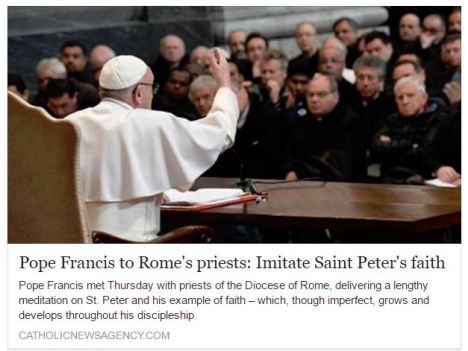
Pope Francis to Rome’s priests: Imitate Saint Peter’s faith

He might get his point across but his attacking-style does not help morale. Instead of always criticizing or even insulting clergy for their faults, he might have better fruits in his reform efforts by showing appreciation for their good works and by highlighting the witness of priestly saints.

Reflecting on a Papal Homily

I wanted to give some extended thoughts about the papal homily on Friday.  The Gospel reading was from Mark 10:1-12:

“Jesus came into the district of Judea and across the Jordan. Again crowds gathered around him and, as was his custom, he again taught them. The Pharisees approached him and asked, ‘Is it lawful for a husband to divorce his wife?’ They were testing him. He said to them in reply, ‘What did Moses command you?’ They replied, ‘Moses permitted a husband to write a bill of divorce and dismiss her.’ But Jesus told them, ‘Because of the hardness of your hearts he wrote you this commandment. But from the beginning of creation, God made them male and female. For this reason a man shall leave his father and mother and be joined to his wife, and the two shall become one flesh. So they are no longer two but one flesh. Therefore what God has joined together, no human being must separate.’ In the house the disciples again questioned Jesus about this. He said to them, ‘Whoever divorces his wife and marries another commits adultery against her; and if she divorces her husband and marries another, she commits adultery.’”

The Holy Father stressed in his homily that Jesus “doesn’t respond as to whether it’s licit or not; he doesn’t enter into casuistic logic.”  We are told that the question was a trap.  It had previously circulated what Jesus would say.  At the Sermon on the Mount where he gave us the Beatitudes, he had already stated:  “It was also said, ‘Whoever divorces his wife must give her a bill of divorce.’ But I say to you, whoever divorces his wife (unless the marriage is unlawful) causes her to commit adultery, and whoever marries a divorced woman commits adultery’” (Matthew 5:31-32).  The rejection of the authority of Moses might be interpreted as opposition to God.  Our Lord avoids the trap of this charge (their “casuistic logic”?) by placing the question in the context of creation and not the Mosaic Law.  Divine authority has precedence over that of Moses, who makes a human decision to allow a writ because of their hardness of hearts.  Our Lord, as he so often does, re-frames the question, “Is it lawful for a husband to divorce his wife?” Much more fundamentally, he answers that marriage is the enduring reality or truth and that there is no such thing as divorce.  That is why he can so immediately associate divorce with adultery.

Is this faithful to the text?  It seems clear here and even more so in the Gospel of Matthew that while Jesus does not fall for the tricky question, he does render a response that goes beyond the given parameters— beyond Mosaic or Church laws— adding his voice to natural law.

When I reflected on the Scripture text, I had to wonder if Moses did what many of the bishops and theologians are trying to do today— to sidestep a teaching that seems too difficult and arduous for many to follow.  I do not believe that the various requests for clarification from the Holy See are attempts to trick Pope Francis.  The requests are coming from his friends who likewise love him, the Church and Christ.  The question was “Is it lawful for a husband to divorce his wife?”  Jesus’ response was clear.  He cannot abandon her because there is NO such thing as divorce!  When his apostles ask about it, Jesus is blunt— the human construct of divorce leads to adultery.  Note that our Lord does not shy away from using the word, “adultery,” a biblical term that certain churchmen are insisting we avoid so as not to hurt feelings; thus we now speak of couples in “irregular unions.”  I hate to say this but the casuistry seems to be on the other side.

The new question can be framed very simply.  “Can and should couples who are cohabiting and/or living in adulterous situations be invited to receive Holy Communion and be given absolution in the sacrament of Penance?”  There are only a few responses that respect the constant truth and teachings of the Church:

(1)  If the care of children or the needs of the partner demand that the couple remain together, and if there would not be dire scandal, an internal forum solution might be permitted where the couple live as brother and sister.

(2)  While it might seem severe or heartless, given the gravity of adultery, the Church could rightly insist that the couple separate.

(3)  The members of the irregular union might seek an annulment of the prior bond; if granted, the union could be regularized with a convalidation.

(4)  If an annulment is not possible and the couple cannot separate, they would be urged to attend Mass but not invited to take Holy Communion.  If the prior spouse should die then the marriage could be convalidated.  If the irregular partner should die, the remaining member could be absolved in Penance and again take Holy Communion.

The option being argued the Malta bishops and by Cardinal Coccopalmerio is not one that reflects the perennial teaching of the faith, or more recently that of Pope John Paul II.  The Cardinal directly teaches that if the adulterous and/or cohabitating couple means well, then they could be invited to take Holy Communion.  While this might appease the subjective and make people happy at the moment; objectively it would constitute the sin of sacrilege as the couple in mortal sin are not disposed to the graces of the sacrament.  There must be contrition and amendment of life.  Both here are compromised.  While adultery might still be regarded as sin, such a change in discipline would wrongly indicate that it was no longer regarded as serious or even mortal.  Given the growing dissent, we need Pope Francis to give a magisterial answer to the confusion that emerged from his exhortation.  That answer should also reflect continuity in discipline and teaching.  Indeed, all he has to do is assert that Cardinal Müller has spoken for the Holy See.  The good Cardinal recently asserted that those in irregular unions who want to receive the sacraments must practice “perfect continence.”  He further stated:

“For us marriage is the expression of participation in the unity between Christ the bridegroom and the Church his bride. This is not, as some said during the Synod, a simple vague analogy. No! This is the substance of the sacrament, and no power in heaven or on earth, neither an angel, nor the pope, nor a council, nor a law of the bishops, has the faculty to change it.”

Adultery is serious, not simply because of infidelity between spouses; it spiritually ranks up there with idolatry.  Christ identifies himself with the beloved.  Betrayal of a spouse is betrayal of Christ.