• Our Blogger

    Fr. Joseph Jenkins

  • The blog header depicts an important and yet mis-understood New Testament scene, Jesus flogging the money-changers out of the temple. I selected it because the faith that gives us consolation can also make us very uncomfortable. Both Divine Mercy and Divine Justice meet in Jesus. Priests are ministers of reconciliation, but never at the cost of truth. In or out of season, we must be courageous in preaching and living out the Gospel of Life. The title of my blog is a play on words, not Flogger Priest but Blogger Priest.

  • Archives

  • Categories

  • Recent Posts

  • Recent Comments

    Josh's avatarJosh on Mixed Signals about Homosexual…
    gjmc90249's avatargjmc90249 on Marian Titles & the Mantle…
    Jeremy Kok's avatarJeremy Kok on Ask a Priest
    Anonymous's avatarAnonymous on Ask a Priest
    forsamuraimarket's avatarforsamuraimarket on Ask a Priest

Jesus, Mary & the Apostles

A discussion with Paul on some matters about which he has a dispute.

PAUL: What is the true meaning and definition of being an Apostle of Jesus?

FATHER JOE:  There are varied definitions given but Catholicism would tend to restrict the term to the chief Disciples of Christ.  The Church is apostolic in the succession of Holy Orders through the “laying on” of hands, in the perpetuation  of Jesus’ ministry and in our constant teaching from the deposit of faith revealed to the early Church and passed down to us.

PAUL: Doesn’t it mean walking with and following the actual person you are trying to emulate?

FATHER JOE:  Yes, but that is a generic dictionary definition of the word apostle, not a theological or doctrinal distinction.

PAUL: I think that we have been called disciples and based on the true meaning of apostle, no one on earth, at least present day earth, can be called an apostle.

FATHER JOE:  The Catholic Church believes the authority of the Apostles is passed to the Bishops of the Church.  Pope Francis is singular among the Bishops because he is viewed as the Successor of Saint Peter (and for that matter, Saint Paul).

PAUL: So if Jesus, as the Catholic Church says, interchangeably meditates/intercedes for us to the Father then why do we also need Mary to pray/intercede/meditate for us? In regard to Jesus this is biblically based as is the fact that the Holy Spirit speaks to the Father in groans that words cannot express. Both Jesus and the Holy Spirit are in full nature also God.

FATHER JOE: 

(I think by “meditates” you actually mean “mediates.”)

The problem with your statement is that it does not sufficiently express Catholic teaching.  The Word became flesh and in his mortal life Jesus revealed to us the face of God, how to pray and how to live out our discipleship.  He prayed in his humanity because it is an essential element to the incarnation and our humanity.  However, after his Paschal Mystery (suffering, death and resurrection), Jesus the Lord ascended to his place at the right hand of the Father.  He transforms and facilitates our approach to the Father.  We do not ask Jesus to pray to God for us because he is God.  We address our prayers to the Father in Jesus’ name.

Jesus is a divine Person, as is the Father and Holy Spirit.  There are three eternal generations in the Blessed Trinity.  Remember the classical definition from the councils of the Church:  there are three divine Persons but one divine Nature in God.  God is still one.

We can intercede and pray for each other.  Indeed, Mary and the saints in heaven can do so for us still in earthly pilgrimage.  God is still the direct object of all prayer, even intercessory.  Asking others to pray for us does not displace God from his dais.  We are all creatures, even the angels, although they are spiritual and not composites like ourselves.  The saints of heaven share in our Lord’s risen life and continue to love us and to pray for us

The mediation of Christ is not interchangeable with sanctoral intercession.  Christ is the Mediator, Lord, Redeemer and Savior.  We approach him both individually and with a communal faith.  The latter is very much the purpose for which he instituted the Church.  We do not approach God alone.  Just as God called to himself an Old Testament people— so too does he claim the Church as a new People of God.  Church membership includes the faithful on earthly pilgrimage, the souls in purgation and the saints of heaven.

We offer our prayers to the Father, through the Son and in the Holy Spirit.  Christ is the bridge between heaven and earth.  He is the Way and the Truth and the Life.  If it were not for the Holy Spirit there could be no faith and no prayer.  We could not say “Jesus is Lord” if it were not given us by the Holy Spirit.

PAUL: By the way, I find NO biblical reference to Mary being our spiritual mother. Thank you.

FATHER JOE:  I have already written at great length about the Blessed Mother and would invite you to search the pages of my site.  Mary is given to us as our Mother at the Cross through our emissary Saint John.  A phrase I repeat again and again is that “the Mother of the Redeemer becomes the Mother of all the Redeemed.”  Mary will always be the Mother of Jesus.  Believers are members of the Mystical Body of Christ (which is extremely biblical).  Mary is the Mother of Christ where ever he should be found.  If we are grafted to Christ and have been transformed by grace into his likeness then she sees something of her Son alive in us.  We imitate Christ’s filial relationship of love to Mary.  We are made members of the royal household of God.  Through faith and baptism we are made adopted sons and daughters of the Father.  Thus, Christ the King becomes our elder brother in faith and Mary assumes her crown as the Queen Mother.  Peace!

Finding Hope & Not Despair in the Synod

I am troubled that otherwise orthodox Catholic critics are suggesting that the Synod on the Family in Rome will signal a fall into apostasy.  While there may be a number of wrong-thinking priests and bishops, I have confidence that nothing of the Church’s doctrinal integrity will be sacrificed to pastoral expediency.

While the deposit of faith is both fixed and develops, there can be no revocation of objective truths.  Those couples living in second marriages or irregular unions cannot be uncritically invited to receive Holy Communion.  They may come up without our invitation; but we cannot encourage people to commit either mortal sin or sacrilege against the Eucharist.  No degree of penance would suffice unless there is genuine repentance and a firm amendment of life.  Any projected change in discipline or a so-called pastoral provision cannot justify regularizing church life for recalcitrant adulterers.

Despite the derision by angry critics that many priests are spineless wimps, most men in ministry are dedicated and courageous in their service.  Priests who seem to turn a blind eye to scandalous behavior are often in the dark or uncertain about the marital status of others.  The opposite may also be true.  Their apparent passivity may consist of knowing too many facts about which they are duty bound to keep within professional secrecy and/or the seal of Confession.  A priest may do nothing by word or gesture or intimation based upon what he learns in the sacrament of Penance.  This is the case even when absolution is withheld.  Such a predicament does not prevent others from condemning faithful priests who are already suffering when they must treat adulterers, active homosexuals and child-murderers as if they are Catholics in perfectly good standing.

Of course, it is no wonder that many of the laity might expect churchmen to invite blasphemy against the Eucharist when ministers are generally forbidden by their bishops to refuse the sacrament to others for fear of negative publicity or scandal.  We have witnessed for many years the tension of various pro-life groups with certain U.S. Bishops demanding that they turn away from the altar pro-abortion politicians and others who enable the murder of the unborn.  This conflict has yet to be resolved and continues to alienate those who should be on the same side and working together.  In any case, there is a vast difference between a general passivity and a universal invitation.

The Holy See and the Church are servants of the Word, not its master.  The words of St. Paul about fornicators, homosexuals and adulterers cannot be stripped from Scripture or from the constant tradition of the Church.  Similarly, the notion of the “closed-table” finds it roots in St. Paul and the censures of the early Church:  “And therefore, if anyone eats this bread or drinks this cup of the Lord unworthily, he will be held to account for the Lord’s body and blood. A man must examine himself first, and then eat of that bread and drink of that cup; he is eating and drinking damnation to himself if he eats and drinks unworthily, not recognizing the Lord’s body for what it is” (1 Cor. 11:27-29).  While there are different theologies in the Church, they must speak to the same doctrinal truths.  Disciplines and pastoral practices are not geared to circumvent doctrine but to help express and realize them.

What can we expect from the Synod on the Family in Rome?  Compromise would precipitate acceleration in the breakdown of marriages.  I foresee a reaffirmation of the timeless faith with suggestions to redouble our efforts to welcome and bring healing into the lives of our people.  Let us trust our bishops.  Let us work with our people and not against them.  Let us put aside the silly sensationalism in the news and give the living Church the opportunity to teach and minister as she should.  There will be discussion and debate in Rome.  But we have confidence in the Holy Spirit and the Magisterium.  The process can be messy but so is life.  The truth will prevail.

Pope Francis Presents a Rosary to Mary

12045492_10153193440053435_1377249926146882169_o

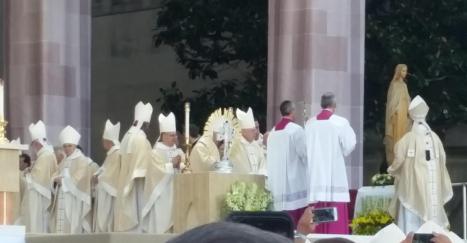
I took this picture at the end of the canonization Mass at the Shrine last week. Pope Francis is presenting a rosary to a statue of the Blessed Mother. I had a good seat with the other priests but got a mean sunburn for the effort. Nevertheless, the weather was pleasant.

The Pope Meets Patrick & Philip Jenkins

This is my current screen saver on my computer. It is a video grab photo of my nephews Patrick and Philip (the two African-American boys) having a close encounter with Pope Francis at the US Nunciature.  Both were touched, blessed and one got his head rubbed!  It was carried on ABC News and on C-SPAN. 12034215_10153197439093435_4606405033964439681_o

Synod of the Family: Revisionist Proposals, part 2

men_1_sm

Cardinal Christoph Schönborn of Vienna echoes a few points that will no doubt be discussed at the upcoming Synod on the Family.  (No disrespect is intended to this brilliant man who was the secretary that helped assemble the universal catechism.)

A stable gay relationship is “an improvement” over temporary relationships.

This position reminds me of what my old professor taught at CUA many years ago. It was wrongly argued that Fr. Charles Curran supported the promiscuous lifestyle that was lived out by so many homosexuals. In fact, he only argued, (while still wrongly), that the Church should support homosexuals who lived out faithful monogamous relationships. The difficulties I saw were the twofold condemnations from both natural law and divine positive law. There is no Scriptural qualification that same-sex behavior is okay if not promiscuous. Today, no matter what label we might impose upon it, we have no authority to change reality or what actually constitutes marriage. How then is a stable relationship better? Is it better concealed? Does it inhibit the transfer of deadly viruses? Is there a value in how it mimics heterosexual bonds? Spiritually, I am concerned about the forgiveness of sins and saving souls. Given that homosexual acts constitute the matter of mortal sin, is one not damned with either one partner or dozens of partners? Jumping from one ledge to another on a mountainside might make an appropriate analogy. One might miss the ledge by five feet or one inch, but the resulting fall is the same. Where is the improvement?

Sharing a life, “they share their joys and sufferings, they help one another. They took an important step for their own good and the good of others, even though it certainly is an “irregular” situation in the Church’s eyes.

The irregularity is not simply in the eyes of the Church. This makes the situation sound like it can be corrected with the quick change of an ecclesial rule or guideline. The problem is too deep for such a shallow response.

A shared life might precipitate a degree of needed solidarity and intimacy, but is that enough? I remember a college reporting to alumni that they had a very loving and supportive community. However, this did not dispel fears that the school had lost its Catholic identity. The ancient pagans had instances of wonderful comradery and unity; however, this affiliation was not Christian. Are we not facing a similar situation here?

I have known homosexuals who struggled with their sexuality and were discrete about their disorientation. They regularly went to Confession and those with partners tried earnestly to make the walk of faith with their special friend. Sometimes they failed. But they respected the teachings of the Church and loved the Lord. I knew men and women who took care of their beloved friend even as he or she was dying from diseases like AIDs or cancer. They lamented militants spitting the host into the face of churchmen like the late Cardinal O’Connor in New York. They retreated with disgust from vulgar exhibitions in rallies and parades. They were faithful to love while knowing that there was something broken in their attractions and genital life. Many joined Fr. John Harvey’s COURAGE and sought to share love in celibate service to others and in prayer to God. I lament that we seem to pamper those who demand approbation while neglecting these heroic men and women.

While a negative verdict from the Church about homosexual acts remains, “the Church should not look in the bedroom first, but in the dining room! It must accompany people.”

The negative verdict arises from the sources of revelation. How should one surmount a consistent teaching from both the Old and New Testaments that later finds confirmation in two thousand years of Christian tradition? Until recently, homosexual acts were criminalized in many places. This assertion about accompanying people sounds nice, but are we all walking in the same direction? I would not want to go to hell with other sinners just to appease the niceties of toleration and good manners.  Would the good Cardinal make the same argument if we were discussing polygamy and mistresses? What about those who promote promiscuity, prostitution and orgies? What about the practitioners of bestiality, pedophilia and pederasty? No, I suspect then he would want to put his foot down. I am left wondering.  Could it be that some churchmen just do not believe that homosexuality is all that serious a sin? Our Lord’s house or mansion has many rooms; what we do matters in all the rooms of his house!  No one should be excused from the need for contrition and repentance. Do we really want to throw away this vital component to heralding the Gospel and transformation in Christ?

Pastoral accompaniment “cannot transform an irregular situation into a regular one, but there do exist paths for healing, for learning.”

This leaves me befuddled. He says the irregular situation remains but there are “paths for healing, for learning.” What does this mean? How will making them comfortable with error bring them to the truth?  Or is he addressing the Church?  Is the Church supposed to learn that we were mistaken about a basic issue of human sexuality? Is it wrong to expect the homosexual or lesbian to embrace a non-genital way of loving? Are not our ears being bombarded by the same deviant sex advocates who are demanding acceptance and approval, not just toleration? When asked about the issue, Pope Francis responded, “Who am I to judge?” What he meant was that only God can judge the individual soul. However, as the Vicar of Christ, he can affirm (as he did recently) what is viewed as right and wrong by our Lord and his Church. As sinners, we all need to grow in the truth and to experience genuine forgiveness and healing.

Synod of the Family: Revisionist Proposals, part 1

144201609311261

Cardinal Christoph Schönborn of Vienna echoes a few points that will no doubt be discussed at the upcoming Synod on the Family.  (No disrespect is intended to this brilliant man who was the secretary that helped assemble the universal catechism.)  Here is one of the controversial points:

A civil marriage is better than cohabitation because it signifies “a formal public commitment.”

I am not sure about this statement.  Both, in my estimation, are bad.  Might we say that one is worse than the other?  And which is worse?  Cohabitation might leave emotional strings, but after a breakup there would be no civil or ecclesial ties to unravel.  The good cardinal seems to think that people are thrown together chiefly because of financial worries; I suspect he is too quick to dismiss the carnal elements and the attitude that “living together” constitutes either a trial marriage or a viable alternative.  He asserts that civil marriages are better, but for the Catholic, what is it really?  Sure, the state would recognize the bond.  Two Protestants or non-believers married in such a way would be truly married, even if only in terms of a natural bond.  However, the Catholic has turned his back on marriage as a sacrament of the Church.  Indeed, in this age of same-sex marriages, we would not even define marriage as does our secular culture.  The bond is not recognized by the Church and thus has no standing before almighty God.  If the marriage fails, a quick declaration of nullity because of lack of canonical form proves this point.  The bond is not worth the paper it is written upon.  Their sexual congress still constitutes fornication and if there were a prior bond, adultery.  How is this good or better?  Will the Church now seek a demarcation within mortal sin?  If the soul is darkened or dead, the persons are no longer disposed to saving grace.  The role of the Church is not simply to help people feel happy or whole but to give them true mercy and joy in the Spirit.  Our mission is to save souls, not to pamper people who have turned their backs on the Church, her sacraments and basic values.  It may be too harshly said, but where Catholics are involved, civil marriages are to cohabitation what Nevada houses of ill repute are to prostitution.  It might give the profession a certain public recognition and standing, but it is no less damning.

Here is another point listed by the cardinal:

“Instead of talking about everything that is missing, we can draw close to this reality, noting what is positive in this love that is establishing itself.”

The good cardinal applies this, not only to cohabitation and civil unions, but also to second unions and same-sex unions.  I will neglect the last possibility in this reflection because I think there is sufficient cause already to reject the assertion for heterosexuals.  That which is missing is paramount and ignoring or excusing its absence leads to a false analysis of the problem.  The fact remains that sexual activity outside of marriage is immoral and sinful.  Marriage is an institution to foster both spousal fidelity and the propagation of the species.  If you are not married, then you have no right to these goods, even if they are feigned.  What do I mean by feigned?  Pretending to be husband and wife does not make one husband and wife.  Similarly, even in marriages, the marital act is what it is.  If distorted by violence or lust, it becomes a parody.  If couples are made sterile through contraception then the basic meaning of the marital act is short-changed and it no longer signifies the bond or renews the marital covenant.  Let me attempt a silly analogy.  A cowboy facing bandits will be thankful for his gun.  However, he will be intensely disappointed when the fighting starts to find that he has no bullets.  Again, that which is missing can be crucial to any scenario.

This notion of finding the positive in sin or wrongful relationships can lead to a distortion in values.  We can say that such tolerance will not affect doctrine, but this has not yet been proven.  Usually the praxis or discipline is imposed to insure a doctrinal teaching.  Certainly I can appreciate compassion and mercy.  We might also admit that certain relationships will take time to correct and heal.  But the problem that many refuse to acknowledge is that there are some relationships and actions that can never be made right.  If a person is married in truth, a second union is adultery— yes, no matter how satisfying and loving is the irregular union.  Living together and sharing sexual congress outside of marriage is not only wrong, it is the cooperation in another’s sin or a spiritual exploitation.  Many couples acknowledge that they cohabitate because this makes sexual activity more convenient.  Is this the positive element we are seeking?  No!  Civil unions provide little extra in terms of foundational substance, especially when there is “no fault” divorce and half of such unions fail.  Couples might say they grew apart, but increasingly the unstated cause of marital breakup is adultery.  Would not kindness to adulterers be demeaning to spouses who struggle to maintain fidelity?

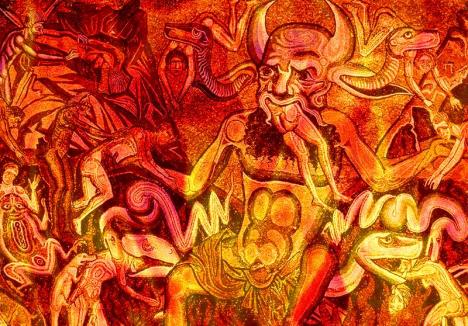
If we look hard enough, we might imagine something positive in the most tragic of situations.  Indeed, I was asked one time about this in regard to hell.  My response was that it was unlikely the devils would find fulfillment in simply torturing damned souls for all eternity.  I suspect that if there be one positive element it might be the intellectual life.  The demons have incredible intellects, albeit without divine illumination.  As creatures without bodies there would be nothing that corporeal pleasure could offer them.  They would probably seek an escape into their minds.  Of course, no matter how high calipered the debates, hell would still be hell.

The love of fornicators and adulterers might be very tender and gentle.  It might be incredibly affirming and life-giving.  The problem is both what is missing and what is supplied instead.  The sacrament is absent and that which should sanctify them brings scandal and grievous sin.  Their union is built upon a foundation of broken promises and a basic deception.  They give what belongs to another.  They give what they have no right to give.  Like a thief, they steal what does not belong to them.

This proposition collapses entirely with a proper definition of love.  Love is ever so much more than feelings.  Love is sacrificial.  Love is a promise kept.  Love is consecrated by God and such lasts a lifetime.

Increasing numbers cohabitate because of financial insecurity.  The bishops should ask, “Are we here to deplore this phenomenon instead of asking ourselves what has changed?”

It is true that there are financial issues that drive couples to live together, although formerly men and women took housemates of the same gender to share a home. Are they less likely to do so today because others will suppose they are gay when they are really straight? I think too great an emphasis is placed on economics as an excuse or rationale for what is happening. In truth, I think there has been an erosion of the meaning and importance of marriage. Many times I have heard young people, particularly those estranged from the Church, say that marriage is “just a slip of paper.” Boys and girls living together do so largely for what the good cardinal might demote as mere fringe benefits. It makes sexual intimacy easier. When young people start spending time with each other their friends will invariably ask, “When are you going to move in together?” A situation that was once judged as scandalous is now judged as routine or expected.

The good cardinal poses “either-or” questions when there should be a two-fold focus.  We are talking about more than living together or cohabitation, but rather about variations of sexual concubinage. The bishops by necessity should “deplore this phenomenon.” Nothing should deflect their disdain. Too often I hear the complaint that we should not shame the girl or couple, especially if they should conceive an illegitimate child. While the Church is pro-life and the baby is innocent; the parents are not. They should be ashamed of themselves, and this goes back to their living arrangements. These are situations where the rights of children are not properly served and there is a heightened likelihood of abortion. The Church’s moral outrage immediately focuses upon what has changed— a lack of shame and a diminution in the meaning of marriage. Of course, then the Church is attacked as intolerant and mean-spirited. We hear echoed a rhetorical question that emanates from those who have no respect for the Church or her authority, “Who are you to judge?” This repudiation of ecclesial moral assessment is then backed up with a listing of all the latest scandals in the Church, particularly regarding pedophilia and pederasty. By comparison, the Church is imaged as the biggest sinner and a hypocrite as well. Critics say we are looking for splinters while we have planks jabbed in our eyes. Unfortunately, objective truth and genuine moral scrutiny is the victim of this back-and-forth. Right and wrong remain what they are even if the one who cites the misdeed is the greatest reprobate on the planet.

Are we really being helpful?  “There is a risk of easily pointing a finger at hedonism and individualism, when it takes much more effort to observe the realities carefully.”

It may be that the good cardinal is critical of the bishops and the Church for making abstract moral judgments without a regard for how the practical situations of people make difficult any fidelity to the divine moral law.  However, the place for pastoral accommodation is in the Confessional, not in general statements of faith.  There has to be a universal standard.  The Church teaches us what ought to be.  The priest in the trenches deals in a proximate way with what is and the effects of original sin.  Saint John Paul II understood this.  He was concise and clear about questions in the moral order.  His theology of the body was the mastery of his genius.  And yet, this same Pope urged priests to show gentleness and compassion to penitents who struggled with the sin of artificial contraception and the manner of their sexual intimacy.  He urged ministers to take people where they found them.  Jesus ministered similarly.  He brought healing and forgiveness to others but nothing of the Decalogue lost its compelling power.  Indeed, some commands became more intense.  The mere hatred of another makes one guilty of violating, “thou shalt not kill.”  The woman caught in adultery is guilty but he saves her from stoning and opts himself not to condemn her.  Rather he forgives her with a warning to avoid this sin in the future.  The writ of divorce is dismissed and those who do so are charged with adultery.  This sounds harsh but it protected the rights of women who were often abandoned and left destitute.

Each case may have complications that surface.  But one would have to be blind not to see how our society is saturated by hedonism.  The natural desire for happiness and the avoidance of pain is amplified to the level where the pursuit of pleasure becomes everything.  While much of the planet suffers squalor and poverty, Western society is enraptured by self-indulgence.  Alcohol, drugs, sexual promiscuity, pornography, and lurid entertainments saturate our environment.  Keeping the proper custody of the eyes becomes virtually impossible.  Everyone from the elderly to the small child is touched by it.

A stark individualism is often praised in American circles and yet while we delight in freedom, often this can come at the price of another’s rights and the cohesion of duty or obligation for family, for community, and for church.  The slogan for the mentality, at least when it becomes terminal, is the cry, “No one can tell me what to do!”

Three Random Questions

WAYNE

Three questions please:

1) May a Priest attend services at, say, a Baptist Church?

FATHER JOE

Yes, but he cannot take an active part in the order of service.  With permission of the bishop, he might be permitted to preach at a special service.  However, such invitations are highly unlikely.

WAYNE

2) If so, would it be acceptable for him to do so wearing his cassock?

FATHER JOE

Yes, he would be expected to identify himself by his clerical garb.

WAYNE

3) I know a priest who rarely wears that “beanie” cap as it frequently falls off, is this acceptable? If not, how do you keep it on?

FATHER JOE

Most priests these days do not wear the black zucchetto and it is not worn with a suit.  Worn with the cassock or other vestments, it sits under the biretta.

Clarfication on Intercessory Prayer & Salvation

Praying to Mary
Intercession of Mary & the Saints
How is Praying to a Saint NOT Like Praying to God?

BUIMIRA:  Here is a crucial point which should be clearly understood. With respect to the older posts, if we have a good relation with Jesus, and pray ONLY to Christ, and not to any saint, angel, or even to Mary, then we can count ourselves still confidently saved! This is the point that you missed, or did not make it clear. You shouldn’t have missed it in your articles.

FATHER JOE:  No, this is not Catholic teaching. While all prayer is directed to almighty God, we do invoke Mary, the angels and the saints to assist us and to intercede before God. This is reflective of a “corporate” relationship we have with each other and God. Certain Protestant sects wrongly privatize or overly personalize faith. We are called to both a personal and communal relationship with the Lord. As for being saved, Catholics do not subscribe to the Protestant understanding of Blessed Assurance which flows from a rigorist Lutheran view of justification by faith. Such relies upon a notion of juridical imputation while Catholicism insists upon being born again as a new creation. While there is life, we can abide in the sure and certain hope of our salvation. The problem is that genuine faith can sour. We pray that we will faithful endure until the race is over. This is different from the presumption which you seem to espouse.

Once Saved, Always Saved?

KATHLEEN:

Hello, I am a “catholic.” I firmly believe that through my faith in Jesus he has saved me. I, along with everyone else who believes in Jesus already has salvation. We are not going to hell. So my question is why would a “catholic” want or need to wear a scapular? How can one save what is already saved? And isn’t their belief in Jesus enough for salvation?  Thank you for input.

FATHER JOE:

You may be a Catholic, but your assessment of “blessed assurance” is representative of a Protestant view. Indeed, it is the sin of presumption for a Catholic to view himself as irrevocably saved. Certain evangelicals believe in the “once saved, always saved” interpretation that emerged from Martin Luther’s teaching of juridical justification through imputation. Simply put it means that after a faith profession in Christ one is saved regardless of personal sins and weaknesses. Supposedly, we are masked by Christ when the Father looks upon us. The Catholic understanding is different. The ancient Catholic truth has to do with being born again as a new creation. We must be transformed. Faith and baptism makes us members of God’s people, but just as faith can grow, it can sour. The Evangelical would say that if a person becomes a grievous sinner that their earlier faith was counterfeit. Catholics would not nullify or doubt such faith. Instead, we argue that we must grow in the life of grace.

Your view would dismiss a lot more than scapulars. If you are already saved then you would need no sacraments, no Mass, no Eucharist and no Church. That is why those who hold such ideas reject the divine mysteries and reduce the “Church” to a place for fellowship and making converts. Catholicism is the true Bible Church and views salvation in terms of faith and obedient works in charity.

I would recommend that you attend a Parish RCIA program and relearn your Catholic faith.

Catholics live in the sure and certain HOPE of their salvation in Christ. Salvation is God’s free gift to us. But faith is defined as more than believing with our heads. The apostles understood faith as something lived out in faith and obedience. It is in this manner, and the reception of the sacraments, that the life of grace grows within us. The spiritual life is not stagnant but dynamic. We must always be properly disposed to God’s mercy and strength.

Here are some passages for spiritual reflection:

Matthew 7:21 – “Not everyone who says to me, ‘Lord, Lord,’ will enter the kingdom of heaven, but only the one who does the will of my Father in heaven.

John 5:28-29 – Do not be amazed at this, because the hour is coming in which all who are in the tombs will hear his voices and will come out, those who have done good deeds to the resurrection of life, but those who have done wicked deeds to the resurrection of condemnation.

Philippians 2:12 – So then, my beloved, obedient as you have always been, not only when I am present but all the more now when I am absent, work out your salvation with fear and trembling.

Hebrews 5: 7-10 – In the days when he was in the flesh, he offered prayers and supplications with loud cries and tears to the one who was able to save him from death, and he was heard because of his reverence. Son though he was, he learned obedience from what he suffered; and when he was made perfect, he became the source of eternal salvation for all who obey him, declared by God high priest according to the order of Melchizedek.

Hebrews 10:26-27 – If we sin deliberately after receiving knowledge of the truth, there no longer remains sacrifice for sins but a fearful prospect of judgment and a flaming fire that is going to consume the adversaries.

James 2: 17-24 – So also faith of itself, if it does not have works, is dead. Indeed someone might say, “You have faith and I have works.” Demonstrate your faith to me without works, and I will demonstrate my faith to you from my works. You believe that God is one. You do well. Even the demons believe that and tremble. Do you want proof, you ignoramus, that faith without works is useless? Was not Abraham our father justified by works when he offered his son Isaac upon the altar? You see that faith was active along with his works, and faith was completed by the works. Thus the scripture was fulfilled that says, “Abraham believed God, and it was credited to him as righteousness,” and he was called “the friend of God.” See how a person is justified by works and not by faith alone. So faith by itself, if it has no works, is dead….You see that a man is justified by works and not by faith alone.

The Pope & Questions About Poverty, Politics & Popularity

SIMON: Hello, Father!  In the beginning I have to mention that I try to be a devout Catholic every day. I believe the Pope is the Father of the Church appointed by Christ. But sometimes I have those thoughts, which keep eating at me inside. I’m very sorry in advance as I know these are not appropriate thoughts for a Catholic to have. I feel guilty for that. I pray that these thoughts would go away and leave me alone; but they keep coming back (sometimes even during the Mass, which is quite frightening for me).

FATHER JOE: It is okay to ask questions.  As believers, we should focus on matters of faith and seek to grow in the Lord.  As for attending to the Mass and better participation at worship, maybe a better understanding of the elements and prayers of the liturgy would help keep your mind from wandering?

SIMON: I sometimes think: 1)  If we are followers of Christ then as the Church teaches, we should try becoming more like Christ every day. Christ lived modestly, as we know, and even in poverty. How is it that so many people today are in hunger and poverty while Pope is an extremely rich man provided with everything that he needs. He even has (or had) a Harley-Davidson. Many people could feed their children from the money of Vatican administration. People in poverty could live for a year from the money you would get by selling a Harley-Davidson bike.

FATHER JOE: First, the Pope is “personally” very poor and most everything he has belongs to the Church. Pope Francis, in particular, has very simple tastes. Second, the motorcycle was given the Holy Father from the Harley-Davidson Company to celebrate their 110th Anniversary. The Pope sold it at auction for the Caritas Roma Charity. It went for $327,000. In addition, a Harley-Davidson motorcycle jacket signed by the pontiff sold for $77,485. Money from the sale of the two items went to benefit a hostel and soup kitchen at the Termini train station in Rome. We must be careful not to make allegations that would misjudge the Holy Father. We would not want to add our voices to those who wrongly condemn. Third, the Church is a worldwide organization and as such she must have income to sustain buildings, pay salaries and operate. While there are isolated cases of hypocrisy, many critics wrong the Church which does more globally for the oppressed, poor and hurting than any other institution.

SIMON: 2) Christ was open to everyone he met. How come it is almost impossible to meet the Pope? It seems sometimes like his time is only reserved for “more important” people. In front of God and Christ, shouldn’t every life be equally worthy?

FATHER JOE: I am perplexed by this assertion.  This is the Pope that takes great personal risks in going out to people. He is only one man and there are a billion Catholics. He could never knock on every door.  Are you upset that you have not met him?  Do you feel that this somehow makes you unimportant?  I can assure you that the Pope and the Church cares about you and everyone else.  Everyone has value.  All life is incommensurate.  This is the Pope that washed the feet of juvenile delinquents for Holy Thursday. This is the Pope that served food at a shelter. Similarly, other Popes reached out to the crowds, kissed babies and showed that they care. The late Saint John Paul II even got shot because he wanted to be visible to his flock. Do you understand how vulnerable this makes them? As for our Lord, he did go out to the marginalized, the poor and the oppressed. But he was also silent when placed before Herod. His words might mean conversion, mercy and life. His silence passed a deadly judgment upon the tetrarch. We will all be judged.  Because of this, we must all be careful in judging others.  Do we have the mind and heart of Christ?  Are we unselfish?  Can we see past our own sins?  Is our own posture that of utter humility?  I would not want to judge the Holy Father either from ignorance or malice. He is Christ’s Vicar on earth.

SIMON: 3) Why is Pope dealing with politics? I understand his intentions for a better and more peaceful world but isn’t it bit unfair— in front of God’s face— to take sides? Jesus never dealt with politics— did he?

FATHER JOE: What do you think got Christ crucified? The charge is even placed over his head on the Cross, “Jesus of Nazareth, King of the Jews.” The crowd disowned him and shouted, “We have no king but Caesar!” Pilate was not the servant of the Jews but the procurator for the empire of Rome. When Jesus told them to love their enemies and to forgive those who hurt them, he was speaking a morality that was immediately translated into politics. After centuries of persecution, the Church would arise as the religion of the state. The Pope is the sovereign leader or head of the smallest country on earth, the Vatican, which rests in the heart of Rome. He even has his own representatives at the UN. More importantly, he is the visible head of the Catholic Church and it is vital for Christianity to make an impact upon world politics. The Church speaks against persecution, slavery, abortion, injustice, unwarranted aggression, poverty and oppressive economic systems, etc. She defends human rights, including religious liberty. Our faith must touch all the elements of human existence. We are not just Christians when within the walls of our churches. Ours is a jealous God. The testing of the coin is often misunderstood. Christ is asked if it is right to pay the tax to Rome or not. Rome was the occupying power and government. Jesus never answers the question but takes a coin and asks, whose face is upon it? The people answer, “Caesar.” He says, “Then give to Caesar what belongs to Caesar but give to God what belongs to God.” Ask yourself, what belongs to God? The answer is everything. It is wrong to expect the Pope and the Church to stay out of politics. There may be a separation of Church and state (in terms of a national religion), but they should still work for the common good. It would make no sense for the Church to remain passive or silent, especially as our religious liberty is being compromised both here in the U.S. and around the globe. The Church must have a voice and a part to play in the public forum.

SIMON: 4) Pope should be a servant like Christ used to be and actually on that one I am quite happy with current Pope Francis who seems to be very humble and willing to serve. But still, the Pope is being praised like a rock star. Is that really something that Jesus or St. Peter would have wanted?

FATHER JOE: Jesus was pursued by vast crowds and they cried Hosanna when he entered Jerusalem. While some would turn against him, he was the celebrity or rock star of his time. Thousands wanted to see and hear him. Vast throngs of people sought him for healing. Have you never read the Gospels? Jesus called Peter or the ROCK of his Church and gave him the keys to the kingdom.  He is made the chief shepherd.  Tradition gives him the title, “Servant of the Servants of God.”  As this unique shepherd, the honor given the Pope reflects upon the dignity and place of our Lord, Jesus. The Pope is Christ’s instrument of universality and order in the world.

SIMON: As I mentioned earlier, I know that those thoughts are condemned.

FATHER JOE: I would not use the word “condemned.” Ours is a faith seeking understanding.  We seek to root out ignorance and bigotry.  Only you can answer the quandary as to whether there is a hidden animus against the Holy Father and the Church? If there is resentment, from where does it originate?

SIMON: But I can’t seem to get rid of them. Maybe if I could get rational answers for these questions, then perhaps with the help of God those would leave me alone.

FATHER JOE: I cannot say what the cause of your issues might be.  But we should never be a people who resent the authority and popularity of the Pope. Critics of this sort often display a poor sense of self-worth and want to feel more important themselves. Maybe they are rash and quick to judge others? In any case, I hope the response here helps.

SIMON: Thank you, Father! And please pray for me! Sincerely yours, Simon

FATHER JOE: You are welcome.  Peace!