• Our Blogger

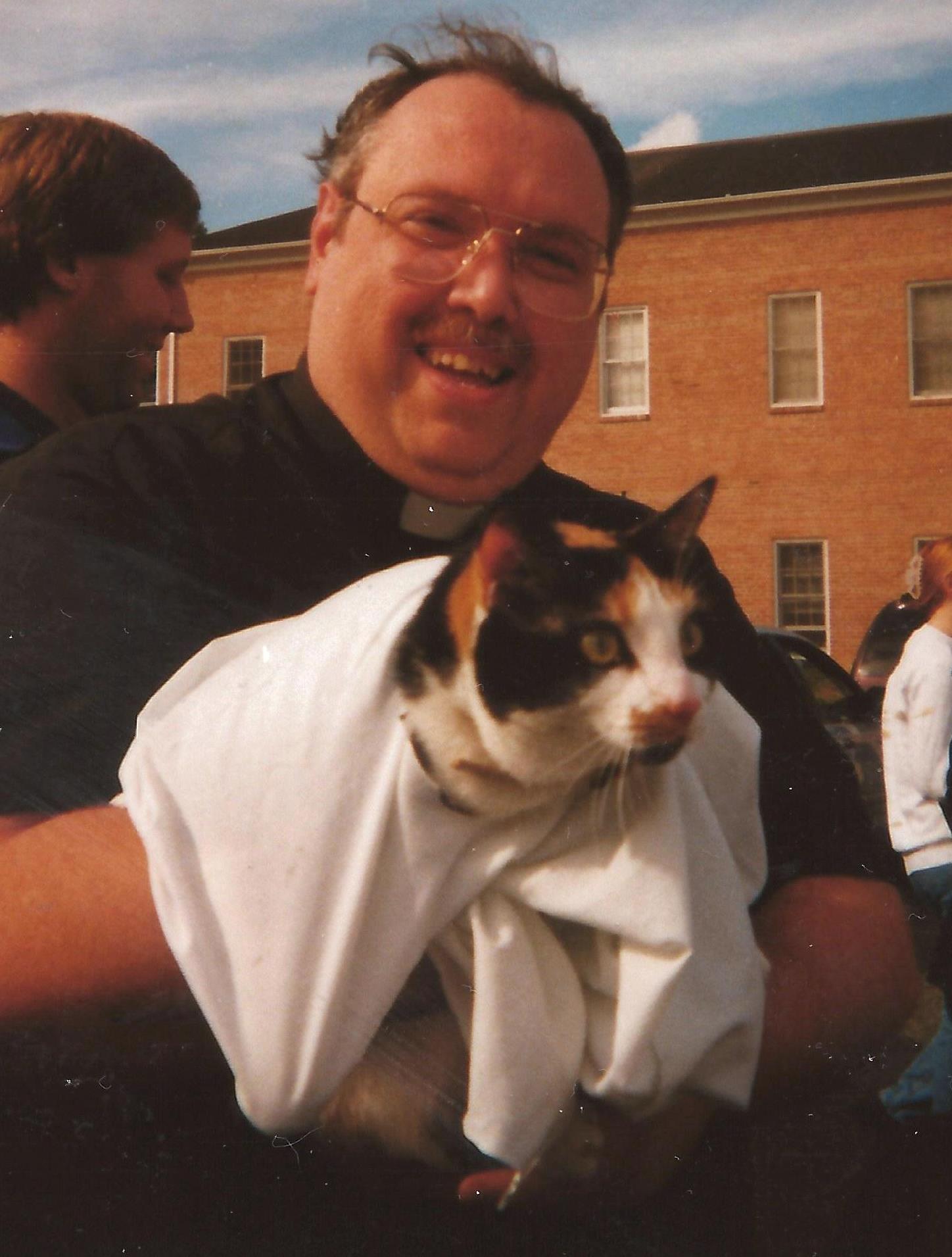
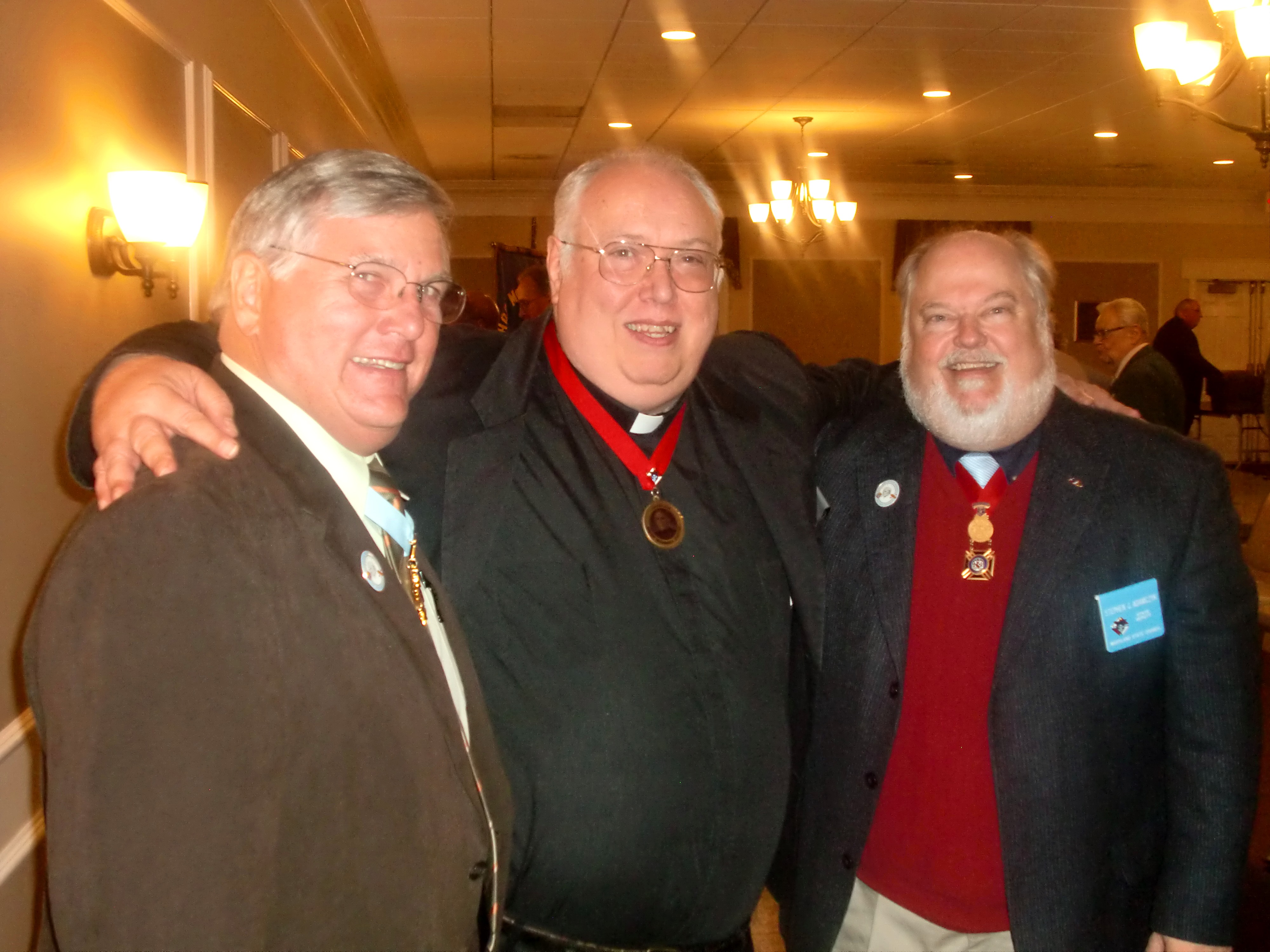
    Fr. Joseph Jenkins

  • The blog header depicts an important and yet mis-understood New Testament scene, Jesus flogging the money-changers out of the temple. I selected it because the faith that gives us consolation can also make us very uncomfortable. Both Divine Mercy and Divine Justice meet in Jesus. Priests are ministers of reconciliation, but never at the cost of truth. In or out of season, we must be courageous in preaching and living out the Gospel of Life. The title of my blog is a play on words, not Flogger Priest but Blogger Priest.

  • Archives

  • Categories

  • Recent Posts

  • Recent Comments

    Barbara King's avatarBarbara King on Ask a Priest
    Ben Kirk's avatarBen Kirk on Ask a Priest
    Jeremy Kok's avatarJeremy Kok on Ask a Priest
    Barbara's avatarBarbara on Ask a Priest
    forsamuraimarket's avatarforsamuraimarket on Ask a Priest

What is with the Angels in the Cherubic Hymn?

QUESTION:  The Catholic Melkites include in their liturgy a Cherubic Hymn where the Cherubim are called “many eyed” and the Seraphim are “six winged” and soaring on their “pinions”. Can you please take some time and explain some of the meaning?

ANSWER:

As for the Cherubic Hymn, the emphasis is that we enter into the angelic praise and glory to Almighty God. The Sanctus serves a similar purpose in the Roman Catholic liturgy: Holy, Holy, Holy. The more traditional Trisagion is found in our Good Friday Liturgy and is a component of the Divine Mercy Chaplet.

“We, who mystically represent the Cherubim, and chant the thrice-holy hymn to the life-giving Trinity, let us set aside the cares of life that we may receive the King of all, who comes invisibly escorted by the Divine Hosts.”

Holy God, Holy [and] Mighty, Holy [and] Immortal, have mercy on us.

Glory be to the Father, and to the Son, and to the Holy Spirit, both now and ever and to the ages of ages. Amen.
Holy and Immortal, have mercy on us.

Holy God, Holy and Mighty, Holy and Immortal, have mercy on us.

While the gravity is with God and not the angels, the description of the angels is taken from Isaiah 6:1-3.

“In the year King Uzziah died, I saw the Lord seated on a high and lofty throne, a with the train of his garment filling the temple. Seraphim were stationed above; each of them had six wings: with two they covered their faces, with two they covered their feet, and with two they hovered. One cried out to the other: ‘Holy, holy, holy is the LORD of hosts! All the earth is filled with his glory!’”

The references to wings and eyes are all symbolism. Seraphim are pictured with six wings and are associated with the purification that comes from fire. Cherubim are imaged as with four wings and many eyes or faces. They are understood as all seeing. Catholic tradition places seraphim at the first rank of the angelic hosts and cherubim at the second. St. John of the Cross writes that the seraphim covering its face with its wings symbolize “the darkness of the intellect in God’s presence.” He continues that the covering of the feet symbolizes “the blinding and quenching of the affections of the will because of God.” It thus constitutes humility of the creature before the Creator.

“With the two remaining wings they flew, indicating both the flight of hope toward things that are not possessed and the elevation above all earthly or heavenly possessions that are not God” (The Ascent of Mount Carmel, II, 6.5).

Phil Robertson & St. Paul Banned from A&E Network

A&E says it is a supporter of the LGBT community and will not tolerate a negative view about homosexuality.  Because of this, Phil Robertson is no longer welcome on the show “Duck Dynasty” and has been cast out from his television family.  But what the network is really saying is that upon this issue there can be no freedom of speech and that while gays are welcome, traditional Christians are NOT.

ph

We should not go out of our way to be mean-spirited or hateful; but the issue here is with inspired Scripture and Christianity.  The faith and God’s Word might challenge us on many subjects.  We might personally have hoped that Scripture or Church teaching were different on this or that subject.  But the creature cannot dictate to the Creator what should or should not be.

What the article should have been labeled is this:  “St. Paul Banned from A&E for His Homophobic Remarks!” Or, to take it one step forward,

MSN News – ‘Duck Dynasty’ star suspended over anti-gay comments

The Raw Story –  Conservatives rally around suspended ‘Duck Dynasty’ star

FOX News – A&E suspends ‘Duck Dynasty’s’ Phil Robertson

NBC – Catholic Governor Defends Robertson

“Duck Dynasty” star Phil Robertson has been suspended from the A&E reality series, following anti-gay remarks he made in an interview with GQ magazine.

Robertson caused controversy with his comments, in which he grouped gays with “drunks” and “terrorists,” and said that they won’t “inherit the kingdom of God.”

Asked what he considered sinful, Robertson told the magazine, “Everything is blurred on what’s right and what’s wrong. Sin becomes fine,” he said in the interview. “Start with homosexual behavior and just morph out from there. Bestiality, sleeping around with this woman and that woman and that woman and those men.”

New American Bible (Catholic Translation):

1 Corinthians 6:9-10

“Do you not know that the unjust will not inherit the kingdom of God? Do not be deceived; neither fornicators nor idolaters nor adulterers nor boy prostitutes nor sodomites nor thieves nor the greedy nor drunkards nor slanderers nor robbers will inherit the kingdom of God.”

Romans 1:26-27

“Therefore, God handed them over to degrading passions. Their females exchanged natural relations for unnatural, and the males likewise gave up natural relations with females and burned with lust for one another. Males did shameful things with males and thus received in their own persons the due penalty for their perversity.”

1 Timothy 1:8-11

“We know that the law is good, provided that one uses it as law, with the understanding that law is meant not for a righteous person but for the lawless and unruly, the godless and sinful, the unholy and profane, those who kill their fathers or mothers, murderers, the unchaste, sodomites, kidnapers, liars, perjurers, and whatever else is opposed to sound teaching, according to the glorious gospel of the blessed God, with which I have been entrusted.”

The Apostles’ Creed, the Righteous Dead & Hell

limbo

Bob brings up an interesting inquiry regarding the Apostles’ Creed.  He writes:

“During the celebration of the Mass and reciting the Creed we say, ‘He descended into hell.’ The classroom posters for the children say, ‘He descended unto the dead.’ Now I was taught that our Lord Jesus descended into hell to show Satan and his followers that he is the Light of the World and that he has the power over sin and death; but based on research, professors of theology are using the Greek word “Hades” meaning place of the dead and as I remember it was similar to purgatory. Please give your thoughts on this.”

Sorry to say, it sounds like Bob and others were taught wrong. The current translation of the Creed at Mass uses the word HELL. The poster has the previous liturgical translation of the Creed, UNTO THE DEAD. It changed with the newer and corrected translation of the Roman Missal. A translation that was popular in Anglican circles rendered it as UNTO THE QUICK. Hell is a more literal translation; unfortunately, it can also be misunderstood. It refers not to the hell of the damned but to the more generic abode of the dead, what the Church termed as THE LIMBO OF THE FATHERS. Such a place no longer exists. Sin had breached humanity from God; the gates of heaven were closed with the sin of Adam and Eve. None could enter true heaven until the coming of the Christ. The righteous dead (Jews and Gentiles) awaited their Savior. Jesus descends into hell or unto the dead or into the limbo of the fathers so that they might now be translated into heaven. The Eastern churches have an icon where Jesus flies from the flames carrying Adam and Eve out by the hair. Jesus is the Way and the Truth and the Life. There is no way to the Father except through him. He is the bridge or “pontifex.” His saving Cross makes possible our passage. We have been redeemed by the Lord. He pays the price for our entry. It is an affirmation that none are saved apart from Christ. As I said, the limbo of the fathers is not hell of the damned, not heaven of the saints and not purgatory. Those three realities still exist. However, at the final consummation and judgment, purgatory will also cease to be. The poor souls would have completed their passage to the heavenly shore.  Then there will be two realities, heaven (the victory of love) and hell (the frustration of hatred and the wrong kind of loving).

Happy All Hallows’ Evening

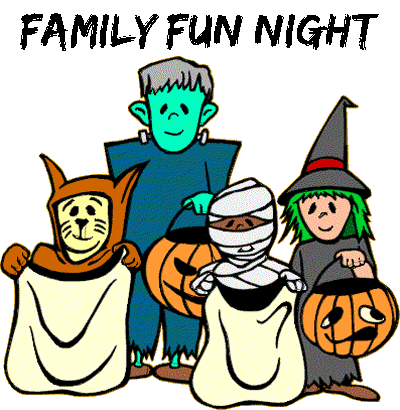
FamilyFunNight03

I was recently involved with a FACEBOOK discussion on the topic of Halloween.  A college student was challenged by his roommate that the celebration was “evil.”  His friend was a “born again” Christian.  He asked friends to shed light on the question.

A Catholic Reflection on Halloween

Halloween in a pluralistic society means various things to different people.  Indeed, given the contemporary fascination with vampires, werewolves, witches, ghosts and zombies, it might seem that Halloween is now a year-long celebration.  But the question at hand is a narrow one, does Halloween place superstition above authentic faith?  The dialogue is not only between Christians but must confront the values and meanings imposed by a liberal secular humanism and the emergence of modern paganism.

Questions of sectarian faith aside, we have also connected Halloween to the fall harvests, thus the symbols of pumpkins, apple bobbing, corn mazes, hay rides, scarecrows, owls, etc. Such a feast provides a fun dress up for children and the giving of candy, which reinforces the joy of childhood and the solidarity of the community in caring for them.

The Tension over Halloween

Certain reformed Protestants often object to Halloween because of its apparent preoccupation with the dead and their souls.  Remember, such believers reject purgatory and prayers for the dead. Other groups deny even the soul and hell, like Seventh-day Adventists.  Obviously, as Catholics, we cannot play along with arguments focused against our holy faith.  While we might regard ghosts as souls in purgatory, in their estimation the whole business is either a fantasy or a devilish deception.  Since Christ has destroyed death, any preoccupation with it is negatively judged as “popery.”  But Catholicism stresses both a personal and a corporate faith.  The saints live in a communion with Christ and one another.  The souls in purgatory are still part of the Church.  We pray for the poor souls just as we ask the heavenly saints to pray for and with us.  The bond of our unity is Christ, himself.

The so-called pagan foundation of Halloween (as in Samhain) is a modern exaggeration. The roots are actually Christian, or Catholic. The name Halloween is a derivation of All Hallows’ Evening or Eve. Neo-pagan religion, perverse occultists, and New Age believers would attempt to make it something else.  Catholic immigrants from countries like Mexico are also introducing the similar “Dia de los Muerto.”

Some have the peculiar notion that All Hallows’ Eve is a night where spirits or ghosts enact violence.  This is nonsense!  It is the made-up stuff of the occult and/or horror movies.  It probably has roots in the pranks played by juveniles while dressed up and moving from house to house.

Puritans and/or Calvinists associated prayers for the dead with witchcraft and necromancy.  Their religious descendants are still among us.  Today when we think of Puritans, the legacy of Plymouth Rock is tarnished by the legendary Salem Witch Trials.  Religious hysteria brought about the condemnation and execution of innocent women.  Each year witches, real and imaginary, pilgrimage to Salem, Massachusetts. Tourism soars as revelers come to celebrate the holiday.  This has even precipitated seasonal tension between Wicca or naturalistic pagans and those who perpetuate the caricature of witches on brooms. I recall that the Salem Knights of Columbus hall had to cancel contracts when they realized that renters were using their facility for genuine witchcraft, not the make-believe variety.  It is precisely because of such fears that a number of Christian communities have now utterly rejected Halloween.  Of course, certain Christian cults reject any holiday or special day that is not clearly scripturally based.  Others object just to be different from Catholics or to illustrate their disdain for Rome’s authority.  That means that a number of these faith communities do not celebrate Christmas, Easter or the Sunday Observance.

The fundamentalist Christian critic insists that Halloween is a capitulation of the Christian commission.  This seems to be a bit of a stretch, at least in terms of boys dressed as cowboys and girls as princesses.  My only regret is that I would have children yearn for Holy Communion as much as they race to fill their Halloween bags with candy.

While some Protestants politely agree to disagree with Catholicism and about the celebration of Halloween; other Christian groups condemn the festive day as devilish and pass out anti-Catholic “Chick Tracts” to the trick-or-treaters.  Still other Christians, like most Catholics, see nothing inherently wrong with children dressing up and collecting candy.  Certain Catholics and Protestants will pass out alternative treats, like crosses, prayer books, religious stickers, etc.  Concerned about the direction that Halloween is taking, a number of Catholic families and churches urge the children to dress up as saints.  I recall one little boy who was quite upset when Sister at school told him that he could not dress as a monster.  When Halloween came she pulled him aside, angry with his costume.  She lamented, “I thought I told you that you had to be a saint?”  He answered, “I am a saint, Sister— I’m John the Baptist… after the beheading!”

The weekend of our Halloween Party at Holy Family Parish, a lady rebuked me after Mass for celebrating the “devil’s holiday.”  If such were true then Christians could have no part of it.  But the case cannot currently be made.  Baptist and Catholic churches both have Halloween parties and trunk-or-treat activities in their parking lots.  As Christians our strength is in the Lord.  The children of light are in conflict with the darkness.  But the game is fixed.  There may be casualties who reject the Lord but the victory over sin and death is already accomplished.  We need no longer be the devil’s property.  We have been redeemed or purchased at a great price.  Jesus dies that we might live.  Prayer and the life of charity are the essential ways that we confront darkness.  God made the pumpkins, the spiders, the bats, the owls and us.  He made candy sweet and gave innocence to children.  God gave us the day and the night. Halloween belongs to God.

The negative critic feels that Halloween gives the devil a foothold in the lives and hearts of Christians.  However, as in our recent parish Halloween party, I saw selfless volunteers running games, cooking, and distributing goodies to children out of a Christian love for youth and their families.  The devil will have nothing to do with real love.

A Christian Understanding of the Symbols of Halloween

Some authorities trace the carved pumpkin to Irish folklore about a drunk who trapped the devil in a tree and carved a cross upon it.  Having made a deal with the devil never to be tempted again by drink, Jack was denied entry into heaven.  He was given a cinder of fire in a turnip for light.  Supposedly the turnip became a pumpkin in America.  The jack-o’-lantern became a visible against compromise with the devil.  It also serves the same function as the gargoyles on the Gothic cathedrals of Europe. They became a type of sacramental to invoke divine protection.

Scary costumes, like the carved pumpkins, fulfill a similar purpose.  These were cultural or folkloric ways in which simple people sought to ward off evil.  While it may be a bit silly, the notion that people had was that evil or dark spirits would be encouraged to pass over their homes and leave their communities undisturbed.  The assumption was that the demons might be fooled by the caricatures of themselves (kids in costume) into supposing that the area was already infested or occupied.  There is no real doctrinal weight to such a practice… just a desire to be holy and not molested by evil.  Today most people just dress up for fun.

The practice of trick-or-treating probably finds its roots in All Souls Day.  There used to be processions or parades on November 2nd.  Christians would beseech “soul cakes” (dried raisin/square bread) in return for saying prayers for dead family members.  They were mostly collected by children and the poor.  Each cake represented a soul being released from purgatory.  Dressing up and singing was often parting of “souling” from house to house.

Some Christians are unhappy with the symbolism of Halloween.  I recall one person angrily upset about skulls or skeletons.  However, this prejudice fails to appreciate that the skull is embraced by Catholicism as both an immediate sign of death and of our dependence upon God. It is used by the Knights of Columbus, in depictions of the crucifixion and even decorates certain European churches.   We do not worship death but are ever mindful of the price paid for our redemption.  Further, our time in this world is short.  The theme of death or mortality is one to which we return on Ash Wednesday. “Remember, O man that thou art dust and unto dust thou shalt return.”

It is unfortunate that venerable Christian symbols should be confused by the ignorant and bigoted as satanic.  I was in one parish where a shrine to St. Peter was vandalized, not by crazy kids or occultists, but by Christian fundamentalists.  They ripped the inverted cross from the ground and argued that it was a sign of Satan and of the antichrist.  You still hear such foolishness about the upside-down cross on the back of the papal chair.  But the bigots misinterpret an ancient symbol of martyrdom.  St. Peter did not feel worthy to die like his Lord so he asked his executioners to crucify him with his feet in the air and his head toward the ground.  Critics make a mockery of an inspiring witness to Christ.

Catholics also venerate the relics of the holy dead, wear medals and scapulars, carry and say rosaries and use holy water.  These are not talismans or the accidentals for magic.  Rather, they are visible signs of our faith in the incarnate God, the God made visible in Jesus Christ.

Keep Christ in Halloween

We read in Philippians 4:8-9:  “Finally, brothers, whatever is true, whatever is honorable, whatever is just, whatever is pure, whatever is lovely, whatever is gracious, if there is any excellence and if there is anything worthy of praise, think about these things. Keep on doing what you have learned and received and heard and seen in me. Then the God of peace will be with you.”  Christians are committed to the pure and the good.

This might make us reflective of the spiritual elements attached to the secular commemoration of Halloween. We cannot buy the entire package. However, it may yet be reclaimed for Christ. The Christian effort is to Christianize the world, not to run away or hide in a spiritual ghetto. Certainly, there is innocence about children dressing up and finding delight in sweets. My growing reservation is about where adults are taking the festivity. Catholics and significant numbers of other Christians offer alternatives to trick-or-treat and spend All Hallows’ Eve at church worshipping God and recalling the witness of the saints in Christ. I agree with the criticism that there are sinister undercurrents that are seeking to hijack the expanding season of Halloween. As a child I dressed as a clown, a cowboy, an astronaut and as a superhero. It troubles me to see children attired today as characters from “R” rated horror movies. Why do they even know anything about these murderous and blasphemous characters? I am repulsed “personally” by the sleazy costumes that cast derision upon priests and nuns. Adult costumes, especially for females, increasingly celebrate vulgarity and eroticism. If Christians cannot redirect the fun away from these elements then it is true (I would agree) we might have to opt out entirely. It may be that Halloween is escalating in the direction of the occult and vulgarity.  Maybe we as good Catholics and Knights need to campaign for Halloween as we would for Christmas?  We also need to keep Christ in Halloween.  All Saints’ assures us that we can have a share in Christ’s life and in the kingdom.  All Souls’ reminds us that while we are sinners, God is infinitely merciful.  What he has started in us, he will finish.

Priestly Celibacy – Awake for the Master’s Return

The bridal imagery sometimes worries us, particularly when connected to men. Of course, the female connection can also evoke nervous giggles, as if Christ is a patriarch who is awaiting his harem of many brides. The Church, as a whole, is the bride of Christ. It does not belong solely to the consecrated virgin or woman religious, individually or corporately. However, there is a spiritual sense in the context of the evangelical counsels that these virginal brides of Christ participate in the great mystery of betrothal just as the ordained priest participates in the high priesthood of Christ. The virginity of our Lord makes possible any and all Christian celibacy. Another bridal image that makes us nervous is that of Mary, who foreshadows all that the Church hopes to become. The difficulty here is the clash of titles. Mary is Mother and yet also reckoned Virgin and as spiritual Bride. Catechesis upon this point requires a degree of precision and discretion. The bridal image emphasizes that the woman’s hand has been given and that the marriage is certain. The bride belongs to the groom. The Church belongs to Christ.

A more common image that is applied to the celibate man is the biblical figure of a faithful servant, a steward or watchman, entrusted with his master’s business, awaiting his return. References in Scripture to the watchful sentinel refer not only to men who put off sleeping but who also dismiss the distraction of the marriage bed. While it has largely gone out of fashion, the use of a personal man-servant by wealthy men, like the comic book Alfred to Batman or the literary Jeeves to Wooster would help illustrate the point. He sacrifices his personal life for that of his master. The celibate priest is the ultimate man-servant, to Christ and to his holy Church. His is a radical response to the Gospel summons, ““Gird your loins and light your lamps” (Luke 12:35). He does not simply work a nine to five job; rather, his commitment is perpetual. He is always on call. Married clergy might do a fine job but they are forced by practical necessity to compromise this commitment. There are facets of their priestly service which they must departmentalize. As I heard one married priest explain, “When I am ministering to parishioners, I am pastor and Father with a capital ‘F.’  When I am home at the dinner table, I am husband and daddy or father with a small ‘f.'” It does not work this way with the celibate priest.

Rectory staff were surprised and amused years ago when my mother called and asked for me as “Father Jenkins,” but such was her respect for the priesthood. My brothers and sisters might call me by my first name, but no one else. It is even my preference that nieces and nephews call me Uncle Father Joe. I am always on duty. I keep a stole in my pocket and oils in the car. Like any good soldier, I keep my arsenal against sin close at hand. Continuing with a military connection, the Armed Services will often restrict volunteers for the most dangerous missions to single men without families. Similarly, the Church must engage in battle with the most dangerous enemy of all and so she calls forth celibate men to her priesthood. This minister of Christ is called to lay down his life for his flock. He belongs to no one woman but to a community of women and men. He belongs to Christ. Every time he processes down the aisle to the altar at Mass, he is Jesus entering Jerusalem to die.

Celibacy is about so much more than refraining from sexual activity, entering marriage and having children. It signifies the urgency of proclaiming the kingdom and the immediacy of Christ’s presence. The celibate priest is the genuine messenger who goes about his assigned task without looking back. Just as the apostles abandoned their father, the fishing boats and their nets to follow Jesus; he also wants to share Christ’s life and mission in a radical way. Our Lord promises to make them fishers of men.

Men are not angels but they can be angelic, an expression going back to the patristic period in the Church’s history. The word angel means messenger and thus, in mission but not nature, men can share with them the sublime duty of manifesting divine truth, glory and will. Angels are not hampered by weak bodies. They are free and move at the speed of thought. While men cannot match their metaphysical properties; the celibate priest is compelled not to tarry in God’s service because of any natural obligations proper to married men.

Priestly Celibacy – Eschatological Sign

When speaking about celibacy, St. Paul often becomes the point man in the argument. Nevertheless, the Gospels also give us much food for spiritual reflection.

Matthew 19:9-12 – “I say to you, whoever divorces his wife (unless the marriage is unlawful) and marries another commits adultery.” [His] disciples said to him, “If that is the case of a man with his wife, it is better not to marry.” He answered, “Not all can accept [this] word, but only those to whom that is granted. Some are incapable of marriage because they were born so; some, because they were made so by others; some, because they have renounced marriage for the sake of the kingdom of heaven. Whoever can accept this ought to accept it.”

Jesus explains that many misunderstand the true meaning of marriage. Next he talks about those who were born eunuchs, those made so by men, and those who embraced such a life for “the kingdom of heaven.” We hear angry debates these days about homosexuals and whether they were born with the disorientation or it was inflicted by others through trauma or seduction. At least for the so-called eunuch, both scenarios are true. Jesus is acknowledging that some men are naturally inclined to a negligible sexual drive. Some critics contend that he actually includes homosexuals in this category of eunuch since by nature or intervention, they can only live a moral or holy life if they abstain from improper sexual relations. Slaves who watched over harems were sometimes made into physical eunuchs by the removal of their testicles. A similar practice existed in the Western world where young boys were castrated to preserve their high pitched singing voices. Such a practice would rightfully be condemned today as a form of mutilation. Jesus did not approve of such procedures; he merely acknowledged that these interventions happened. His real emphasis was upon the spiritual eunuch or virgin or celibate. The celibate is a living and visible sign of what we shall become when this world passes away and sacramental signs make way for the beatific vision and divine unity.

Matthew 22:30 – “At the resurrection they neither marry nor are given in marriage but are like the angels in heaven.”

While we shall rise from the dead, like the angels, we will find our completion and union directly in God. There will be no more marriage or giving in marriage. We see this teaching also in Mark and Luke.

Mark 12:25 – When they rise from the dead, they neither marry nor are given in marriage, but they are like the angels in heaven.”

Luke 20:34-36 – Jesus said to them, “The children of this age marry and are given in marriage; but those who are deemed worthy to attain to the coming age and to the resurrection of the dead neither marry nor are given in marriage. They can no longer die, for they are like angels; and they are the children of God because they are the ones who will rise.”

Right now, in the mortal world, we must have children to insure the survival of the race. However, in the world to come there will be no more death. Like the angels, the number of men and women will be fixed. There will be no more propagation and thus no need for marriage. The celibate priest seeks a spiritual propagation through the conversion of souls. He finds his joy in the regeneration of new sons and daughters to the heavenly Father through spiritual adoption. Men and women will not become a homogeneous humanity in the risen life of the kingdom and neither shall we be strictly angels or ghosts. We shall share characteristics with angelic beings, no more suffering or death, friendship with God, etc.  But we shall be restored in body and soul.  Angels, properly speaking, were never born and have no physical bodies.  Just as not all angels are the same and they are ranked; it is my thought that maleness and femaleness will be ingredients in our demarcation. Of course, our matter has also been informed by our earthly life, our experiences, choices and perception. In other words, we will still have gender and our real selves will be resurrected; but it will be apart from marriage, the sexual drive and the generation of children. That plainly makes it all very different from how we currently understand, employ and struggle as physical-sexual ensouled beings. We count it as true because Christ has revealed it to us. Nevertheless, how it can be true and what it shall make of gender currently remains a puzzle to us. This is a far cry from the graphic and carnal afterlife imagined by many Moslem men in light of promises from the Koran. This makes the Catholic view one that is “in media res,” between a purely spiritual existence and one that merely mirrors, with some amplification, what we currently experience in the body.

The Primacy of Peter & the Council of Jerusalem

st-peter

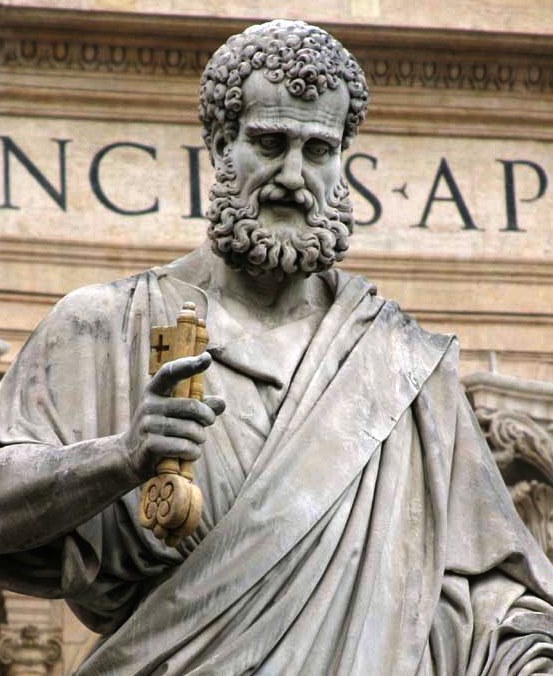
Regarding the first council of the Church in Jerusalem, note that after the debate about ritual circumcision, it is Peter who resolves the matter. The mere fact that Paul and Barnabas had come to Jerusalem illustrated their confidence in the apostolic authority there. As in any council, there was debate and dialogue; however, in the end it was Peter who stood up and supported Paul in his refusal to impose the Mosaic Law upon the Gentiles– they would not have to become Jews before becoming Christians. Citing the work of God’s Spirit in Cornelius and his household, whom they knew and accepted, Peter summarizes the core proclamation of salvation: “My brothers, you are well aware that from early days God made his choice among you that through my mouth the Gentiles would hear the word of the gospel and believe. And God, who knows the heart, bore witness by granting them the Holy Spirit just as he did us. He made no distinction between us and them, for by faith he purified their hearts. Why, then, are you now putting God to the test by placing on the shoulders of the disciples a yoke that neither our ancestors nor we have been able to bear? On the contrary, we believe that we are saved through the grace of the Lord Jesus, in the same way as they” (Acts 15:7-11). We are told that the whole assembly was reduced to silence. The issue was resolved. Paul and Barnabas then enthusiastically recounted how God had used them as instruments to reach the Gentiles.

Many distinctions need to be made about Peter. He is certainly much altered after the Christ has suffered, died, and risen. The Holy Spirit on Pentecost grants him a special charism of authority and infallibility. This did not mean that either Peter or his successors would be impeccable and unable to sin. The miraculous truth in the long history of the Church is that even weak and sinful men have seemed changed by the office of Peter. Without such an authority, we would suffer from the same endless fragmentation and deviation from Gospel truth that other religious communities experience. We believe we have Christ’s Rock to preserve and protect the deposit of faith. Given to Peter, this gift of infallibility is for the entire Church. This forum demands brevity, but we see it observed when the Holy Father makes a formal proclamation of dogma as the universal shepherd (the Vicar of Christ) on a matter of faith or morals. Neither the Pope, nor the bishops, nor an ecumenical council can manufacture new beliefs– they define something which has always been taught and believed, but reformulate it in a more concise and solemn way. A papal declaration along these terms is an exercise of his Universal Extraordinary Magisterium.

The unanimous teaching of all the world’s bishops in union with the Pope is called the Universal Ordinary Magisterium. This latter expression of infallibility is much more common. The laity and the religious of the Church also enter into this mystery. The Sensus Fidelium (sense of the faithful) among Catholics who have informed their consciences according to Church teaching and who live out the faith also touch upon this mystery of faith. (Admittedly this latter aspect is usually only mentioned by dissenters these days; however, they cite people who have largely rejected the deposit of faith and the Christian life– the ones to whom it does not really apply.)

The question arises, what is the significance of James’ input? As the bishop of the Jerusalem Church, he rose after Peter and directed that a letter be written and promulgated to the other churches. While a special charge is recorded as given to Peter, the apostolic community also respected the familial relationship of John and James to Jesus. James, John and Peter accompanied our Lord when Jesus raised Jairus’ daughter from the dead. These three also witnessed the Transfiguration. These “sons of thunder” remained close to Jesus in the Garden of Gethsemane. Peter’s unique authority was real and yet the structure by which authority was exercised was much more fluid during the apostolic period. Peter did not remain with the Jerusalem church but traveled elsewhere in exercise of his universal charge. James remained with the Jewish community in Jerusalem and became its bishop. Jerusalem is viewed as the Mother Church and James operated the council since it was within his jurisdiction.

Peter is listed as first among the apostles; he is given the new name Rock and our Lord said that he would build his Church upon this Rock; and he is named the chief shepherd by name. Jesus prays for him by name in order that his “faith may not fail” and that in turn he might “strengthen your brethren” (Luke 22:32).

Priestly Celibacy – A Preservation in Holiness

Some critics of celibacy felt bolstered by the scant references to married clergy in the New Testament, and yet such evidence was hardly conclusive. Were the children of priests conceived before or after the men were ordained? There is growing historical evidence that married men, in agreement with their wives, set aside a sexual life for the sake of the faith community and in respect to the Eucharist. This might seem nonsensical to us today but the Church, early on, placed a significant meritorious value in celibate discipleship. It is the witness of the apostles who abandoned their families and earthly work to follow Christ. It is the realization of the calling given the rich man to sell all he has, to give it to the poor and then to follow Jesus. It is a level of sacrifice that the world does not want to understand. We must be honest.  Many of our own people, baptized Catholics, are more formed by the world than by the Gospel. That is why they fail to understand and thus undermine the great gift of single-hearted virginal love.

Celibacy was not inflicted upon the Church simply to make life difficult. It was composed to substantiate the best form of ministerial discipleship and to bring errant men back to a holiness of life. Celibacy was not a medicine against marriage, because matrimony was no disease. Rather, it was an antidote to divided hearts, mistresses, illegitimate children, and other forms of wrongdoing and/or sin. The resources of the faith community were being exploited by unscrupulous men and wrongly passed on to their offspring. Celibacy was the Church’s way of shouting, enough! Similarly today, the problem is not celibacy but rather the failure to remain faithful to this chaste way of loving. It is no wonder that the ire of Christ was most raised by the evil of hypocrisy.

What Makes Catholicism So Special?

bvm_001

MARTA:  How long has Catholicism been around?  Why confess sin to a priest? How does Catholicism differ from Christianity?

FATHER JOE:

The Catholic Church is the “church” established by Jesus. All the bishops and priests are direct successors of the original apostles.  Jesus gave the Church and his apostles the power to forgive sins. Since priests cannot read minds and hearts, people confess to them so that the priests can give proper counsel and penance along with their absolution.  Catholicism is the original and most complete form of Christianity. East and West were one for a thousand years. Protestant churches only go back four or five centuries.

LILIANA:  With respect, I think what you say is contradictory; we should address God “directly” in prayer in the name of Jesus. The Bible doesn’t say we need saints.  God doesn’t need secretaries.  Everything is possible for him and he can listen to millions of people anytime.

FATHER JOE:

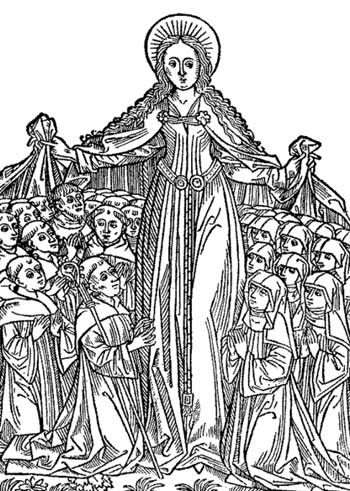
There is nothing contradictory about it. Such comes from an understanding of the Church as the new People of God and our relationship with one another and Christ. Those who discount the sacramental meaning of the Church and our corporate faith tend to make religion overly individualistic. We pray together, and for each other, as Jesus admonished; but we do not exclude the communion of the saints from our prayer. The Queen of the saints is Mary.

You really miss the point. It has nothing to do with what God needs, but about what we need as human beings and as a social people.

Intercession of Mary & the Saints

bvm_024QUESTION:  Why must Mary intercede? And what if she doesn’t want to? Does that mean your prayers are not heard by Jesus? I guess this question goes for praying to all the Saints.

Why? How can she not? If you are watching a football game and the receiver gets the ball, are you not rooting him on to victory? The crowd becomes like one unified whole— shouting, singing, doing the wave, etc. This analogy offers but a pale point of reference to the role of Mary and the saints. We are all in this together— the journey from mortal to eternal life. The very definition of a saint makes what the division you suggest impossible. The sanctity of heaven implies the utter transformation of one into a new Christ— of one mind and will with our Lord. What he wants, they want. A little girl in church was asked one time for the definition of a saint. She looked at the figures in the stained-glass windows and replied, “Saints are those who allow the light to shine through.” Quite right! And the Light of the World is Christ, dispelling the darkness of ignorance, sin, and death. This process of conversion begins in this life; we can and should be perfected in holiness by the grace of God. We can be ever remade into Christ’s image. Heaven simply brings this development to its full conclusion. People who knew Mother Teresa said that to be near her was almost like being in the presence of Jesus— so fully did she manifest the living Christ in her faith and life. We can also become saints if we allow God to so work in our lives. We need to seek a restoration of all things in Christ, including ourselves. The question about division between the saints and Jesus says less about the heavenly hosts than about ourselves— our own brokenness and bondage to sin— our own refusal to fully embrace the Gospel of Life. Sometimes selfishness and hatred invade our prayers; such is never the case for Mary and the Saints. They are immaculate windows to the divine. Further, they are a part of us. The Church in Glory is inextricably united to the earthly Church in Glory and the Church in Purgation. The Mystical Body (Eph. 1:23; 1 Cor. 12:27) remains intact. The saints intercede for us precisely as perfectly conformed elements in this wondrous union. Death is not the end of love. This is at the heart of Christ’s resurrection— his Father’s Love (the Holy Spirit no less) restored him back to life. The family of God in heaven has not forgotten those of us still facing the trial. Love compels them to remember us and to pray for us.