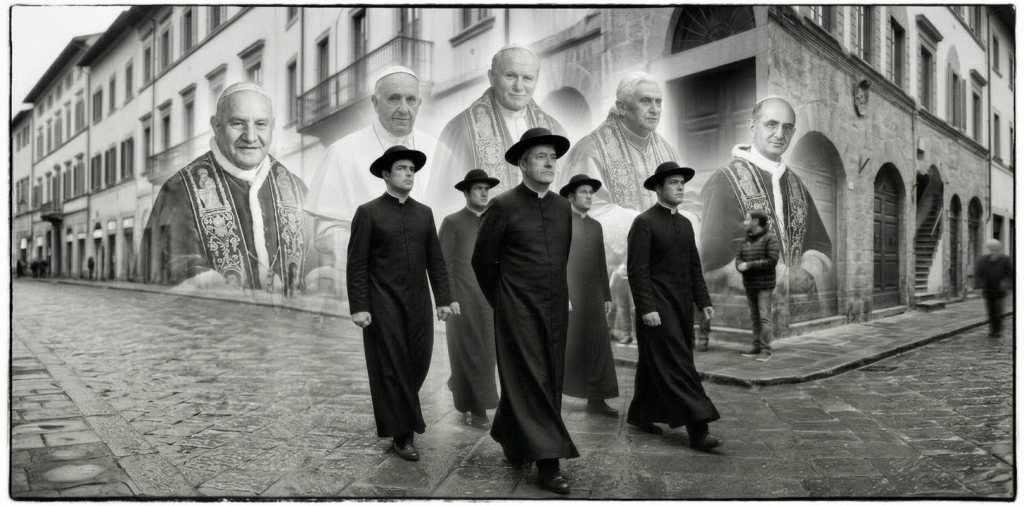
An important theme for this blog is the scene in the New Testament where Jesus can be found FLOGGING the money-changers out of the temple. My header above depicts a priest FLOGGING the devils that distort the faith and assault believers. The faith that gives us consolation can and should also make us very uncomfortable. Both Divine Mercy and Divine Justice meet in Jesus. Priests are ministers of reconciliation, but never at the cost of truth. In or out of season, we must be courageous in preaching and living out the Gospel of Life. The title of my blog is a play on words, not Flogger Priest but Blogger Priest.
The Christian humanism of Catholicism is an acknowledgment of God’s handiwork and the beauty of creation. Although humanity is fallen, there remains beauty to men and women as made in the “image of God.” As the stewards of creation, human beings are a composite of flesh and spirit. While we share with animals a material body, we have infused souls that possess intellect and will. We can know and love. Beyond the sentiment or appetites of beasts, we are self-aware and know that we know. Further, God has wired us for himself, and we reach out toward the divine and to each other. What we know— we can love. While it might sound ridiculous or dare I say blasphemous, even the man who is damned remains a masterpiece of intelligent design. As if this were not enough, the incarnation of Christ grants our human nature a far greater dignity. Creatures of God properly become his children. Divine grace restores what was lost and adds a unity with the living Word as the center of creation— we abide in the “sure and certain” hope of our salvation as adopted sons and daughters of the Father, kin to Christ and children of Mary. We are remade into the “likeness of God” wherein the heavenly Father sees his Son in us.
Pope Leo XIV’s encyclical, MAGNIFICA HUMANITAS, is addressed as a caution, not simply to believers, but to a larger world that does not share our faith or understanding of Christ. While targeting the challenges posed by artificial intelligence, it is a warning for us all not to lose sight of the humanity we all share. The Holy Father has not authored a treatise into the many intricacies of Christian anthropology. No one should interpret the encyclical as a denial of the Christocentric focus of the Church’s teachings. Indeed, the Pope writes in the very first paragraph of his letter, the following: “Whenever humanity is in danger of marring its true identity, we Christians lift our eyes to the Incarnate God, knowing that it is ‘only in the mystery of the Word made flesh that the mystery of humanity truly becomes clear.’ In Jesus Christ, this humanity in its grandeur becomes the Way, the Truth and the Life, opening the path for each of us to grow toward fullness.”
Certain dissenters on the left will not like the reference to the Tower of Babel since it insinuates a confrontation with modernity, which many of them make into an idol. Apologists for the hardliner traditionalists will reject it just as they did Vatican II, Pope Paul VI’s DIGNITATIS HUMANAE (religious liberty), Pope John Paul II’s EVANGELIUM VITAE and Pope Francis’ DIGNITAS INFINITA. One of the great failings of schismatic traditionalists is their resistance to granting human dignity an incommensurate value. The universal catechism offers us a wonderful corrective: “Being in the image of God the human individual possesses the dignity of a person, who is not just something, but someone. He is capable of self-knowledge, of self-possession and of freely giving himself and entering into communion with other persons. And he is called by grace to a covenant with his Creator, to offer him a response of faith and love that no other creature can give in his stead” (CCC 357).
Human dignity is rooted first in creation. This is a hallmark of the Gospel of Life. Made in the image of God, this standing comes with conception and cannot be stripped away from living persons. Second, the incarnation of Christ takes this dignity to the next step, elevating our common humanity. The offer of his life is expressive of the value that the Lord places in us. Jesus desires that we might share in his divine love and life.
The SSPX has from its beginnings been guilty of presumption in judging the Holy See and the heavy consensus of the many bishops who participated at Vatican II. Why they cannot see their terrible arrogance about this is a matter hard to understand. They suggest that there has been a break with the past when the best minds in the Church demonstrated organic development regarding essentials and needed changes to accidentals to respond to modernity. Had the issue only been the liturgy this impasse would have ended long ago. But it is so much more, particularly about ecclesiology and soteriology. They would reduce the magisterium to a political congress to which they alone would have an absolute veto. No, this cannot be permitted and their upcoming consecration of bishops will signify not merely the widening of a rift but the formal institution of a new offshoot or ecclesial reality like the Anglicans and the Greeks before them. They hide behind the abandoned artifacts of history, heralding tradition, while refusing to honestly engage with a changing world. They feign fidelity while dissenting from the authority of the living magisterium.
It is ironic that they appeal to “conscience” for their fractured communion when they formally reject the expansion of its definition at Vatican II. They accuse the Holy Father and the post-Vatican II Church of heresy, “destroying Catholic faith and morals.” If the reforms attest to the movement of the Holy Spirit, then they commit blasphemy against the Holy Spirit, a sin regularly committed in their attack against the Novus Ordo Mass as evil and dangerous. They spurn canon law as being used to undermine the holy faith. The law of just authority applies to all except themselves.
Fidelity to the Catholic faith is more than “devotion,” it is measured by obedience to the Pope and the living magisterium. The declaration reverses reality and presumes that the SSPX is the true Church to which the Holy See must be in communion. This is utter nonsense! What are their “indispensable” faith capitulations for juridical reunion?
One Covenant That Does NOT Include the Jews, YES or NO?
It is true that the Catholic faith is the one true Church instituted by Christ. But the SSPX refuses to acknowledge contemporary Jews as children of Abraham. As far as they are concerned, the old covenant first established with them as God’s people was rendered “definitively null and void” some two thousand years ago. The implication of their faith profession is that they are guilty of deicide and that by extension the Moslems (along with them) are now children of Satan who reject Christ as the Messiah. It is no wonder that this negative assessment includes allegations of collective guilt as enemies of the Church for the death of Christ, antisemitic slander about clandestine Jewish influence for world dominion and even denial of the Holocaust atrocities. The SSPX thoroughly rejects the Nostra Aetate declaration and interfaith dialogue.
The Catholic Church neither believes that God has severed his covenant with the Jews nor that there are two covenants, one for Jews and the other for Christians. The relationship with the Jews remains because God keeps his promises. The old covenant is fulfilled by the new in Jesus Christ. The Church is the New Israel and as such we would reject Zionism. Just as many of the Jews accepted Christ in the ancient church of Jerusalem, we pray that many of our Jewish brothers and sisters will today come to know and love him. The Jews are our elder brethren in faith, the first called, and they are still beloved of God. We read in Romans 11:25-29:
“I do not want you to be unaware of this mystery, brothers, so that you will not become wise in your own estimation: a hardening has come upon Israel in part, until the full number of the Gentiles comes in, and thus all Israel will be saved, as it is written: ‘The deliverer will come out of Zion, he will turn away godlessness from Jacob; and this is my covenant with them when I take away their sins.’ In respect to the gospel, they are enemies on your account; but in respect to election, they are beloved because of the patriarchs. For the gifts and the call of God are irrevocable.”
While we can argue a movement from the natural religion of Judaism (belief in the one true God) to a supernatural religion in Catholicism (the revelation of the Trinity), we share a common faith patrimony. The Christian Savior will always be the Jewish Messiah. None of this detracts from “Jesus” as the saving name— that none are saved apart from him— that he is our one Mediator and Savior— that none come to the Father except through him. We are redeemed by the saving work of his Cross which is re-presented to us in an unbloody fashion by the Eucharist. The significance of Christ and the sacraments remain what it has always been, but the SSPX declaration would intimate a change where there has been none.
Devaluation of Mary’s Role in Salvation, YES or NO?
While there has been a warning about misunderstanding certain Marian titles, it is still acknowledged that Mary cooperates in a unique way with the redemptive work of her Son. Nothing has changed in our teachings.
No Salvation Outside the Catholic Church – YES or NO or Qualified?
The SSPX profession next makes a subtle nod to Fr. Feeney’s literal interpretation of “Extra Ecclesiam nulla salus,” or no salvation outside the Church. Despite SSPX protestations to the contrary, this dogma of faith remains intact. Just as none are saved apart from Christ, the Church as his mystical body is also necessary for salvation. However, the SSPX would reject any nuances to this teaching. This would appreciably leave as damned, all non-Catholic “Christians” as well as all “Jews, Muslims, pagans, and atheists.” By contrast, we would resist making a verdict and leave ultimate judgment to God regarding those not in formal communion “through no fault of their own.” We would insist that the negative judgment is upon those who die knowing that the Catholic Church is the true Church and still refused to get baptized and join her. There is also ambiguity because of the reformation and Protestant faith communities. If their baptisms are judged as valid then are they not affiliated with the Catholic Church, even if tenuously? Will Jesus renounce those who have faith in him and love him? When the Protestant reformers broke away, they purloined many essential elements of the true Church. Would there not be salvific value to these elements, like baptism and the Bible, for those who were born into these sects? The SSPX says no, “Outside the Roman Catholic Church, and without the profession of Faith that she has always taught, there is neither salvation nor remission of sins.” Vatican II’s Lumen Gentium says yes, clarifying that those who, through no fault of their own, do not know the Gospel of Christ or his Church, but who nevertheless seek God with a sincere heart, may yet achieve eternal salvation. Ignorance does matter. God is neither capricious nor monstrous in his providence. Any who are saved are saved through the Church. About this there is no debate— where the SSPX and the Vatican part ways is over whether all the saved must be a visible part of the Church during their mortal lives.
Who is the Real Threat to the True Church?
The declaration asserts, “The denial of even a single truth of the Faith destroys faith itself and renders radically impossible all communion with the Catholic Church.” Given the SSPX misinterpretations, made clear by the Vatican, I would concur that the SSPX is not spiritually prepared for full reunion with the Church established by Christ. When they consecrate their illicit bishops, they will enter formal schism and face excommunication. While they may consider themselves to be the true Church, in fact they will stand condemned by their own reasoning— placing themselves outside the Barque of Peter.
The Pope is the Guardian of the Deposit of Faith, YES or NO?
The great commission has never been renounced. Continuity with our traditions has been maintained. The SSPX “doth protest too much.” We give no quarter to false worship and the reformed liturgy is both licit and valid as are all the seven sacraments. The Pope continues his role in history as the guardian of the deposit of faith. Unfortunately, some would wrestle this role away from him.
The Mass is an Unbloody Sacrifice for the Forgiveness of Sins
The Mass remains essentially a sacrifice for atonement or propitiation and yet this does not make it any less a sacred meal where the Lamb of God must be eaten. We would also affirm the real presence of the Eucharist.
We May Not Bless Gays but Should We Hate Them?
Threaded among the many things we have in common are the matters of ambiguity and deliberate misrepresentation. Outreach to gays can mandate no violation of the moral law and it is true that their unions “can in no way be blessed by ministers of the Church. This was recently reaffirmed by Pope Leo XIV. But we have always regularly blessed groups and individuals without interrogations about their state of life and sins. Blessings may be affirmations as over Christian marriages, but they might also be appeals for repentance, conversion and healing. The declaration makes no mention of this.
Should We Rescind Religious Liberty?
The SSPX declaration also makes more of a variable social teaching than I suspect it was supposed to mean. We read: “The submission of institutions and nations, as such, to the authority of Our Lord Jesus Christ flows directly from the Incarnation and the Redemption. Therefore, secularism of institutions and nations constitutes an implicit denial of the divinity and universal kingship of Our Lord.” What are we to make of this? The separation of church and state in the United States has allowed the Church to flourish. The right to religious liberty has protected the Church even as it has made space for others to freely exercise in conscience what they believe. Can we ignore a world that has changed around us? What sense would it make to speak of the divine right of kings when there are none? Should our teachings not reflect interaction with the current real world and not one that has disappeared? Many Americans might love the old Mass, but they would not be so happy to see their Protestant neighbors forcibly divested from their churches and forced to worship underground. Ecumenism does not mean we are all the same. It opens doors for Catholic reunion, yes; but it also allows separated brethren (not just heretics) to work together with us for a better world that reflects shared values about justice and charity.
Which Roman Catholicism is Truly Protestant?
The SSPX has long argued against what is seen as the Protestantism of Roman Catholicism. However, maybe they need to look at themselves? Davide Pagliarani’s declaration finishes with, “With the help of Our Lord, we would rather die than renounce them” (the listed articles of faith). I am reminded of Martin Luther at the Diet of Worms. He said, “My conscience is captive to the Word of God. I cannot and I will not recant anything, for to go against conscience is neither right nor safe. God help me. Amen.” He concluded, “Here I stand, I can do no other!”
This is the home of the AWALT PAPERS, the posting of various pieces of wisdom salvaged from the writings, teachings and sermons of the late Msgr. William J. Awalt.