Choosing the Woman over the Altar
 If any priest in a compromised situation with a woman attempts marriage then he places himself and a person he says he loves into a seriously sinful state. It angers or upsets me that men can reject Church law and teachings when it suits their selfishness. My upset or indignation is in reaction to the hypocrisy, dissent and scandal caused by fellow priests against the Church I love. I am not vindictive about it, only deeply disappointed. If he maintains a brother-sister relationship until (or if) laicization is offered, at least then he shows some respect to the Church and concern about her soul.
I have friends who are priests who left ministry to get married. I would not condemn them. But they would not seek to function without the legal faculties to do so.
Discussion with revisionists who have burned their bridges is very difficult. We may be destined to communicate at cross-purposes due to very divergent premises and convictions. However, everyone on the right or left of such issues should want to facilitate genuine healing in the lives of others. Priests and the women with whom they have had intimate relations or attempted marriages might confess to something of a love-hate relationship with the Church, owning up to their anger, reckoned by them as justifiable.
I wish priests who leave ministry well. Once a man has defected with his beloved, I would hope that such couples would love and be faithful to each other. Laicization and release from the promise of celibacy are important; otherwise, no marriage would be recognized as either valid or licit. I would hope that priests who leave for a woman would reserve their romancing until that time they are deemed free to do so. As for shame, what kind of woman could take a priest from his altar and from the confessional and not feel some sort of remorse? How could a priest, albeit a fallen one, ever really love a woman who took so lightly what he would give up for her?
Doing the Right Thing
Healthy heterosexuals, rightly ordered priests in their sexuality, are attracted to women. They make a promise of celibate love and by discipline, prayer and grace they live out this life of loving service. They might fall in love… heck, they might fall in love with a number of nice women in their lifetimes, but they remain steadfast. Older and wiser men recognize the signs and make distance, even becoming gruff or mean to women they particularly like. This is often misinterpreted. But it has to be done. If a priest falls deeply in love with a woman in a romantic way, he must abandon her friendship and any affiliation with her. He must not play games that will lead the both of them into disaster. He must say goodbye. Often he will not and should not tell the woman why they cannot remain associates or “friends.”
Certain dissenters, who might see some small value in celibacy for misanthropes, refuse to accept that such a mandatory discipline could be in concert with God’s will. My view is clear: “They have surrendered their intimacy and their sexuality to God— case closed.” A priest is not his own man. He belongs to God and the Church. Giving God his intimacy and sexuality means that he will not have an exclusive sexual or intimate relationship with another human being. Priests are still sexual human beings, but they love in a celibate way of service.
I can well understand how those who have become entangled with priests might suffer through my comments. I stand by my words. Celibacy is a sacrificial discipline which priests FREELY embrace. God does not return our gifts except as transformed. In this case, the priest belongs to God and to his congregation but not to a particular friendship or to an intimate sexual relationship. The salvation of souls is the fruit he seeks, not that of his loins.
Is it immature to be a faithful celibate? Is it misogyny to say that a man can be happy and fulfilled without a wife and family? Those who applaud fallen priests and their women are very quick to judge priests like me; they errantly place the greater maturity with those men who broke their promises, perhaps even committing mortal sin? I have many close friendships with women, but I am well aware of the boundaries and I do not play games with them. The trouble today is that many women mistake friendship and kindness as a summons to something more. Given the immaturity of men and women in our society, it is no wonder that there is a problem in this regard. Would we rate the men who stayed celibate as children and those who fooled around with women as the more well-adjusted and mature?
Defection and Redefining the Priesthood
Those who turn their bitterness against the so-called “institutional” Church, as if the properties of the Church can be practically dissected, often forfeit a sense of the sacred and the supreme importance of the sacraments. It is for that reason that renegades will often turn to ecclesial communities with dubious apostolic succession and a questionable or counterfeit priesthood and Eucharist. One critic referred to the sacramental role performed by a celebrant, his action at the altar “in persona Christi,” as an empty caricature of priesthood with no significant or enduring meaning. She would reduce the meaning of priesthood to show that it is a poor trade for a wife and family. Priesthood becomes less a vocation and more a job in this evaluation. But priests are more than clueless figureheads; they truly make Christ present in their own person and in their activity.
Every validly ordained priest shares in the one priesthood of Christ, this is where his ministry finds focus: in the sacrifice, in the consecration (real presence) and in the forgiveness of sins. Dissenters, renegade priests and the women, who run away with them, might embrace a defective religious confession and their rites or they might even brush off any definition of priesthood which places the gravity upon the dispensing of the sacraments. Poor lost souls, they lose a sense of basic Catholicism 101.
It may be that some women redefine the priesthood to blunt the blow that they have cost the Church a good priest. Of course, the priest has responsibility in all this, and must share culpability. One might feel less guilty if our vision of the priesthood is narrowed to activity that anyone might do. It is wrong to contend that when not saying Mass or hearing Confessions, he is no longer configured to Christ Jesus, the great high priest. A priest is always a priest. As a case in point and it might sound profane, I once heard a Confession in the stall of a bathroom, initiated by the penitent, not me. At the doors of the restroom I gave him absolution. Yes, I prefer Church confessionals, but if a person is in serious sin, there is no time to waste. Priests are never really off duty. And definitely, there is never time for illicit fun and games with the girls!
Priests who are celibate and expect other priests to keep their promises are not rigid and deliberately hurtful. Every priest is called to be a healer. But excusing or ignoring or offering approbation for failure is not to render true healing. Such activity represents a false compassion. The priestly confessor of souls serves many functions: physician or healer, father, teacher, prophet, and judge. I would not judge myself any less severely than I would any other priest. Such a role is necessary to insure proper guidance and repentance. We are all sinners. We are all weak and poor instruments. But, God’s grace can work the miraculous in our lives.
Truth versus Dissent
I can only speak for God when I echo the teachings and disciplines of faith. I claim no moral superiority over others. I make mistakes and even errors in judgment. We all do. But I do not think my views about this are in conflict with the Good News of Christ. Our Lord has given us an infallible Magisterium to guide and govern the Church. Dissenters cannot speak for God if they oppose the Catholic faith. Dissenters believe they have a special enlightenment in regard to the truth. They do not even seem to fear God in making themselves into little popes in deciding what they will and will not accept. Such a dilemma is clear when dissenters argue for a version of love unhampered by the restrictions of the Church (like vows or promises). Challenge their special enlightenment and they will go further in denying the Church’s charism of truth and the qualifications of faithful priests.
While speaking as if they are a competing or parallel Magisterium, critics insult the Church and every good priest, and yet, seem blind to what damage they are doing. Their rhetoric betrays an anger that moves from the matter of married priests to that of women priests or priestesses. They insist that the Church is depicting women as the enemy and dangerous. They demand that men and women be treated equally. Priests and their women who marry outside the Church and/or move into other denominations are stamped as heroes and not as sinners. There are a few cases where former Catholic priests allow their “attempted” wives to serve as priests alongside them. The first has no faculties to minister and the latter has a counterfeit priesthood severed from apostolic succession. An imaginary and false line is drawn between faith in the true Church and faith in the Lord.
The conflict in such discussions between sides is divergent views of ecclesiology and vocation. Those on different sides of this question place the weight in different areas. My emphasis would be upon the head and the spiritual power of will. I suspect that many women actively involved in an intimate way with priests would give the gravity to the heart and the corporal passions or emotions. On the other hand, I would stress the clear fact that the Church welcomes men to holy orders who promise or vow celibacy. The objective or external situation is that men do this and I feel they should remain faithful to their promises. There is no good escape clause. As far as I am concerned, that is where matters should end. They should behave themselves and if they should suffer emotionally, offer it up with Christ’s passion.
Those who later want out of their promises make all sorts of rationalizations. The business about the heart and/or emotions is only recognition that such seems to play a big part in the decision of priests and women who become romantically entangled. I may be wrong, but is this really such a large leap in reasoning? If this is overly presumptive, then I would apologize but I have dealt with many delicate situations regarding such things and it has been my experience.
We must not be naïve about the fierce physicality in men and the sexual drive which men must daily sublimate to stay chaste. I have never said that priests must hate or fear or universally separate themselves from the female gender. However, there will come times when a priest must break off certain relationships because his heart and fallen nature is taking him in a direction he must not go. A priest is always a living ICON for Christ. The full gravity or weight of his sacramental vocation is manifest at Mass where he operates “in the person of Christ, head of the Church.” He signifies Christ the groom and the Church is his bride.
Critics will insist that the Church and her defenders violate a number of values. However, a clarification has to be made. EQUALITY in grace is not any kind of egalitarian view of humanity. JUSTICE for others also includes following objective norms, of the State, of the Church, of Nature, and of Divine Positive Law. Today many things we call RIGHTS are really just made up excuses for license and sin. Women have no right to priesthood. Celibate priests have no right to either wives or concubines. People of one gender do not have rights to sexual contact with those of the same gender.
What Do Priests Know of Love?
One critic argued recently that priests generally knew nothing about love. She contended that they were ordained merely to fulfill family expectations. But there are many reasons and such anger cannot invalidate the calling of good men validated by the true Church. The truth be said, most priests today entered the seminary against the wishes of family and friends. God is love; however, it is wrong to equate this love entirely with the romantic. Such critics fail to acknowledge human weakness and sin; rather, romantic entanglements with priests are wrongly interpreted as God’s will. This is ludicrous. God never desires sin.
It is not my intention to give a comprehensive treatise on divine love and how we share that love. I believe God can forgive and that he showers mercy upon priests who leave active ministry to marry women. It is rather insulting and “mean spirited” that certain critics think many priests have no notion of love. I counseled a woman many years ago against flirting and trying to seduce a man in seminary formation. She walked out shouting that I had nothing to say to her because I had never been in love! I challenged her on this assumption and she crudely blurted out, “Unless you have gone to bed with a woman, you do not know what love is!” The very reason why I and so many of my brothers embrace our celibacy is out of love for God and his people. The harshest critics are essentially saying that they do not care and that it is a waste of our time. Love brought me to the priesthood. It is love that beckons me to the altar, to the confessional, to the baptismal font, and yes to the sick bed of the dying. I am sorry that such lost people cannot understand or appreciate that.
Attacks against the Church and Her Messengers
What has been my reward for speaking about the value of celibacy and for insisting that good priests keep their promises? I have been assaulted personally as a misogynist and my view of human sexuality has been condemned as immature. Such judgments were not the result of sharing a detailed appreciation of vocations and human sexuality; rather, I was labeled precisely because I placed a negative value on the illicit unions and/or liaisons of priests and their paramours. I am not naïve about priestly formation and human development. Truthfully, I believe clergy should be emotionally whole and integrated. Priests should be comfortable with women. However, and here is the great divide, celibate priests should NOT have sexual relationships with women.
I would certainly not want to generate unnecessary anxiety for others, but sometimes bravery means not denying or running away from our guilt. Ridiculing Church teaching and discipline, breaking the vows of priesthood and/or marriage, are not positive in any honest estimation. However, speak about sin, and there are always many who will insist that no one can judge such things, despite divine commandments and objective right and wrong. Prophets who speak the truth of God are castigated by false prophets who speak their own mind. Broken promises, fornication and adultery, attempted marriages, illegitimate children, scandal… yes, I would say that such sins should make people feel ashamed, particularly for the unrepentant and the guilty.
They want every faithful priest or so-called right-wing Catholic to be caricatured as an angry homophobic and chauvinistic white male. While they excuse their own venom, any use of hyperbole to make a point or indignation about fallen priests and their women is viewed as the most outrageous insult. They share this with certain radical homosexuals who condemn Church teaching as hate-speech. Both camps contend that you cannot judge the sin without condemning them as sinners. They think that faithful and traditional priests value institutions and laws more than people— and yet, must there be a disconnect? However, it is NOT the institutional Church that denies people access to grace. People do this to themselves by their sins and by failing to preserve a disposition receptive of grace. Critics wrongly dismiss the Church’s discipline as just man-made laws. But the Church is both a human and a divine institution. Celibacy is not a purely human fancy but is an element of the divine plan.
I would contend that it is a pretty poor and simplistic synthesis against supporters of the status-quo to say that those who disagree with revisionists on this matter and their agenda are all angry men with a punitive outlook. We can be upset or disappointed without desiring any kind of harm to others. Most priests try as confessors to keep emotions in check. We hear everything, from the lurid details of abuse to murder itself. Our response is that of Christ. The penitent expresses sorrow for sin, makes an act of contrition, and then receives our absolution. Sometimes that healing is enough and at other times, they are placed on the road to recovery. Any upset I feel is precisely because the priesthood means a lot to me and we should not give poor witness.
The Effect of Scandals
Scandals are always thrown into the face of those who argue for no change regarding our discipline. Lately, the recent scandals around Fr. Marciel Macial have been their ammunition of choice. It is true that many regarded him as a conservative, i.e. orthodox. Critics of celibacy are having a field day with revelations that he purportedly fathered a child. This is bad news for the Legionnaires and for the Church. The questions about abuse in his regard are even more serious. However, such poor witness is no absolute invalidation of priestly celibacy. Most priests are faithful to their promises.
Critics point to the scandals and the fallen priests and ask the rhetorical question as to whether or not compulsory celibacy is a fallacy or myth? They think it is. Some well-meaning voices play into their hands by recommending optional celibacy. They feel that celibacy should only be permitted to those who feel called to it. However, most priests in the West freely promise celibacy. No one is forcing them into the priesthood. If they do not feel called to celibacy then God in his wisdom would not ask them to be priests. God is not in conflict or battling his Church; rather, he works in concert with the authority he established. The struggle here is to do God’s will, not what our selfishness would ask and not what the dissenters demand. Optional celibacy might see its day; but it will not solve the vocations crisis and it will create new serious issues in itself.
Many of us have had concerns about the secrecy and ultra-regimentation of the Legionnaires. I wonder how much of it reflected the secrecy that Father Macial utilized to cover his own scandalous indiscretions? It is a very sad business. Hopefully Rome will bring reform and healing to the situation.
Celibacy is not a myth, despite what the cynics might say. I believe that God works with his Church and gives the grace of celibacy to any who are truly called to his priestly service in the Roman Catholic Church. Yes, the Church could change this discipline tomorrow and make it optional. But no one should seek ordination with such an expectation.
Why Should We Care?
Why would a faithful priest be upset about those who violated Church rules? Well, first, one can be both upset and still show compassion and empathy. Second, good priests have a responsibility to admonish and to guide people in the moral life. Breaking promises to God and the Church is selfish and wrong. Third, while it is true that no one can absolutely read the inner hearts of others; this does not mean that the Church cannot render judgment about external actions. If you make promises and break them, you commit an objectively evil act. This is more than a sentiment or a temptation hidden in the heart and will. We would suspect that priests, of all people, would be fully cognizant of their behavior and the repercussions. They cannot claim ignorance. Bad priests agreed to the rules but later wanted to change them. Women who become involved with priests, and here I mean actively involved as in sexual encounters, mistresses and attempted marriages, should know full well that they have fallen far from what God and the Church demands. Ladies who have the heartstrings pulled and then do the right thing are entirely different. This latter group deserves our respect and continuing support.
Fourth, a fallen priest’s promises were made to his bishop and before God, not to me personally or to other priests. The actions of one priest often affect all priests and thus, the misconduct of any one priest hurts all priests. That is why the abuse scandals have been so incredibly devastating to the morale of priests. It wounds every one of us personally. We are all sharers in the one high priesthood of Christ. We trust and look up to one another. We expect fidelity, courage, generosity, obedience and sacrifice. We believe all the jargon about the glories of the Roman Catholic priesthood. When men fall short, it pains us more than any of us could properly convey.
Every priest who keeps his promises feels hurt and betrayed by those who do not. This fuels the indignation, along with the insufferable arguments that question the teaching in hindsight. Often personal responsibility is minimized and the Church herself is made the culprit for making the celibacy requirement at all. Broken promises by priests are seen as a betrayal of our brotherhood. It breeches them from their spiritual father the bishop and their brother priests. Those who are not priests might not understand this element of family that is focused upon the presbyterate.
My indignation or upset or anger or resentment or whatever you want to call it is not misplaced, but justified. I may come across as somewhat judgmental, but such is often my response to dissent and attacks upon a celibacy which I believe is worthwhile and should be sustained as compulsory in the Western Church. I would and have supported men who left ministry. I see no contradiction in doing this quietly for individuals while taking a strong general position against romantic entanglements, defections, and laicizations.
Filed under: Adultery, Catholic, Church, Discipleship, Faith, Forgiveness, God, Jesus, Marriage, Priests, Prophets, Sacraments, Sexuality, Sin | 15 Comments »
















 There are still signs of hope and of the kind of life to which we aspire. My thoughts turn to the terrible high school killings at Columbine High School a few years ago. A killer pointed his gun at young Cassie Bernall and asked what would be a life or death question: “Do you believe in God?” This Christian girl had turned her life around and given herself to Christ. She paused. This was the classical situation that many of us once laughed about when sister posed such a question in CCD. I am reminded of the bumper-sticker slogan, “If Christianity were a crime, would there be enough evidence to convict you?” Here was a child in this difficult situation. Even the great Apostle Peter, in a similar dilemma, denied our Lord three times. What would this girl say? Looking at the gun, she replied, “Yes, I believe in God.” The gunman asked her, “Why?” but did not give her a chance to answer. His shot rang out and she collapsed lifeless to the floor. She came to the library as a 17-year-old girl to study during lunch. When she left the library for the world to come, she did so as a modern Christian martyr. I would submit that she was also a martyr for life. She trusted that whatever the world might take away, Christ could restore.
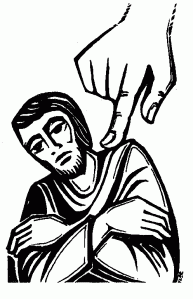 Jeremiah 31:7-9 finds the prophet Jeremiah sitting amidst the ruins of Jerusalem. He had opposed the return of idolatry with his whole being, but it was to no avail. Dismissing his warnings, the false prophet Hananiah got the upper hand with Zedekiah against Babylon. Judah would subsequently be conquered. The chosen people are sent into exile. When they trusted to their own might and made offerings to false gods, they lost everything. Jeremiah speaks a word of hope. If they return to fidelity with God, then God’s mighty arm will save them. Illustrating just how incredible the return to their homeland shall be, he speaks these words for God: “I will gather them from the ends of the world, with the blind and the lame in their midst, the mothers and those with child; they shall return as an immense throng” (Jeremiah 31:8). The most vulnerable among them will be counted with the returning exiles. No new army will accomplish it. Compared to the will and power of God none of the factors against them will matter. Sure enough, after that generation had passed away and his own people murdered Jeremiah, Babylon would not only let them return but function as a benefactor in the reconstruction of Jerusalem and the Temple. However, they would not be a great independent nation again, at least not until the establishment of the modern state of Israel.
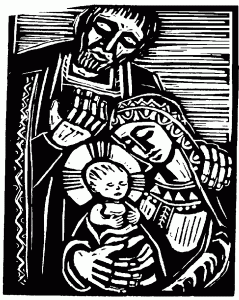 Every year we have a secular celebration of Father’s Day. While our culture finds much sentiment, expressed in verse and song for mothers, it does seem that fathers are sometimes cast to the side. The most noble of men find no insult in this, particularly in their children’s devotion to their mothers, because it confirms their good fortune and judgment in finding a companion for life. However, it does behoove us to spend a moment pondering upon the value of the man’s role in the family.
 One of my favorite feasts and dogmas is that of the Immaculate Conception, a teaching of the Church which has had a long and sometimes controversial history. There are even some contemporary critics of this dogma of faith who would argue that it overly separates Mary from the rest of us. Certainly, it is true that sinfulness is a reality ever present in our lives. We find it so difficult to be good. It is ironic that a few of the feminist theologians who image Mary as a strong and liberated woman, would then criticize this teaching and argue that Mary has been used as a device of oppression on the part of a male dominated hierarchy. It seems to me that quite the opposite may be true. The witness of Mary as the queen of the saints would emphasize that the greatest person to ever walk the earth next to the Lord, is this woman Mary. Genesis 3:9-15, 20 recalls the first Eve who with her husband turns away from God in disobedience. Psalm 98:1,2-3,3-4 might remind us that if Eve is the mother of all the living, Mary in her faithfulness is the mother of all who are reborn in her Son. She stands as a model of holiness for men and women alike. Her preservation from sin does not create an impassible chasm between her and us. Sin by definition adds nothing to us or to her. If anything, it is a lack of something which should be there — the grace and presence of Christ. Just as she carried the Lord, now we must avoid sin so as to be filled with his presence and life. Sin is that which divides and alienates. To wish this upon Mary would mean wanting separation from her and the Lord.
 Luke 11:27-28 has had a long and sometimes mangled tradition among those who call themselves Christians. I recall reading some years ago a believer of another Christian community using this very passage to deride Mary, the Mother of God. He criticized stringently the Catholic stress upon her cooperative role with Christ in our redemption. He insisted that we, because of our faith in Christ, are much superior to her. The impression was that she was a stupid girl of which God made use. Of course, if the text were taken simply in how it first impresses us, his argument might have a leg to stand upon. However, we who are called to see things with two-thousand year old eyes, view the text for what it truly is — an elevation of Mary’s dignity and a reaffirmation of Christ’s call for us to be like her.
 “Share your bread with the hungry, shelter the oppressed and the homeless; Clothe the naked when you see them, and do not turn your back on your own. Then your light shall break forth like the dawn, and your wound shall quickly be healed” (see Isaiah 58:7-10).
 The annual commemoration of Pentecost is to the Church what Christmas is to Jesus, the celebration of a birthday. Our Lord had compared the Church to a grain of mustard-seed, among the smallest of seeds. But, it grows into a great tree in which the birds of the air build their nests. Imbued with the hidden and fertile presence of God, what seems dead, little more than bothersome dust, blossoms into the mystical vine and branches of God’s holy people. Christ is the vine– we are the branches. What God initiates by the power of his Spirit, he joins to himself in permanent and life-giving intimacy. Watered by the blood of the martyrs, the Spirit of God continues to minister to the Church, preserving us in the truth of the Gospel and giving efficacy to the sacraments.
 The mission of the Church is to spread the Gospel and to baptize in the name of the Father and of the Son and of the Holy Spirit. As Christians, we are sent on mission at the end of Sunday worship each week: “The Mass has ended. Go in peace to love and serve the Lord.” We must take our role as missionary seriously. Where is our passion for the Gospel? Why are we not on fire telling people about it?

















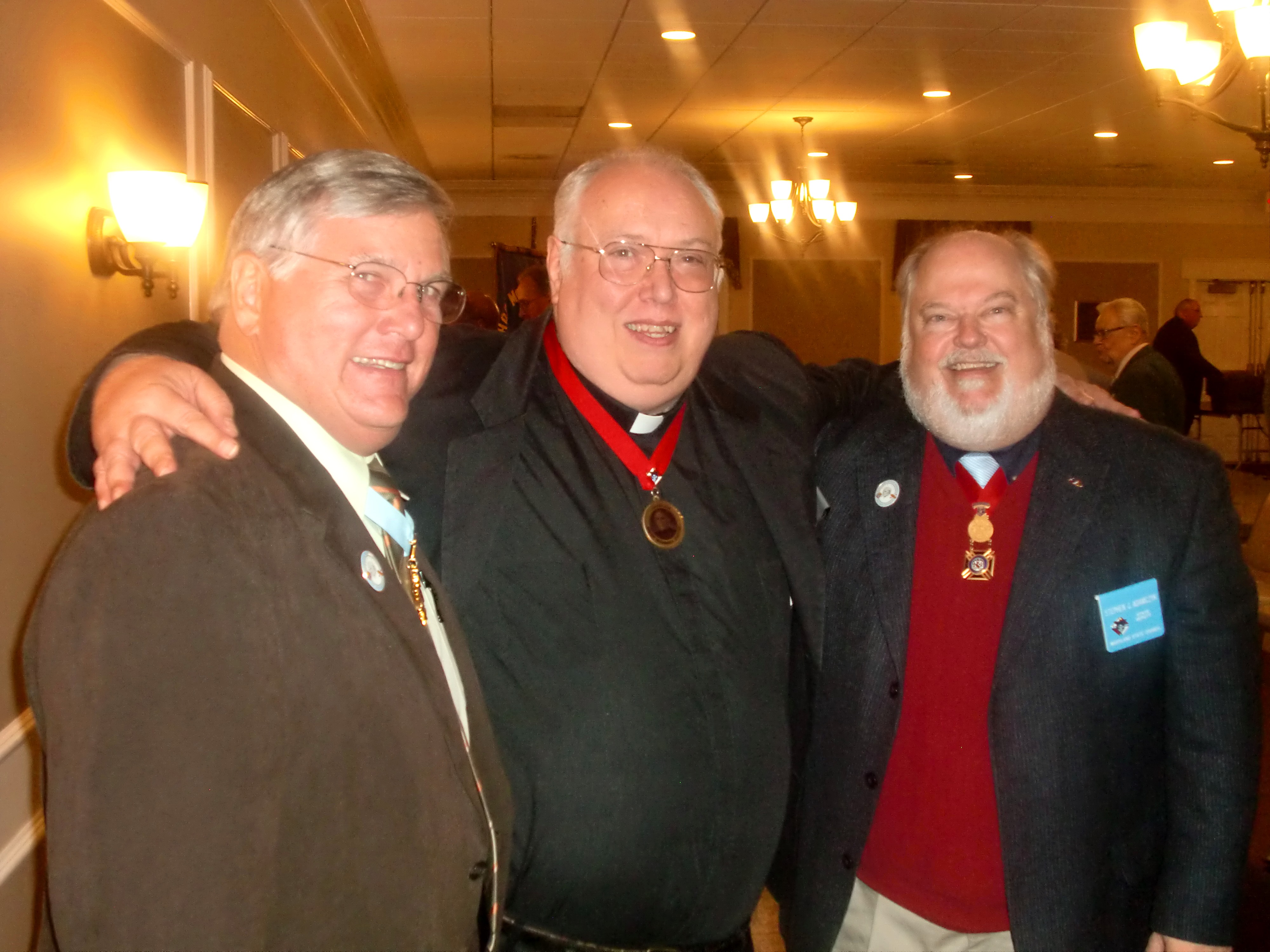
 Blogger Priest