
• Our Blogger

    Fr. Joseph Jenkins

  • The blog header depicts an important and yet mis-understood New Testament scene, Jesus flogging the money-changers out of the temple. I selected it because the faith that gives us consolation can also make us very uncomfortable. Both Divine Mercy and Divine Justice meet in Jesus. Priests are ministers of reconciliation, but never at the cost of truth. In or out of season, we must be courageous in preaching and living out the Gospel of Life. The title of my blog is a play on words, not Flogger Priest but Blogger Priest.

  • Archives

  • Categories

  • Recent Posts

  • Recent Comments

    Barbara King's avatarBarbara King on Ask a Priest
    Ben Kirk's avatarBen Kirk on Ask a Priest
    Jeremy Kok's avatarJeremy Kok on Ask a Priest
    Barbara's avatarBarbara on Ask a Priest
    forsamuraimarket's avatarforsamuraimarket on Ask a Priest

Our Belief & Unbelief

From the very beginning, there would be those who would doubt the resurrection of Christ. Indeed, even one of his disciples, Thomas, would have to be challenged by Jesus himself to touch his wounds before his skepticism could be swept away. However, the Gospel chronicles another type of rejection as well, one far more resistant to the truth (see Matthew 28:8-15). The chief priest has an inkling that the story of Christ’s coming back from the dead might bear some truth. It is this possibility which he and his cronies seek to hide behind lies. So, they bribe the soldiers to say that Jesus’ disciples had stolen the body at night.

When Jesus stood before the Sanhedrin, it was this same rigid rejection of his messiahship which catapulted him to the crucifixion. Despite the evidence of multiple witnesses, they later disregarded his resurrection. It was not so much that they doubted Jesus, but that they did not want to know who he was. His claims challenged their positions of prestige and power. His assertions about his own personhood shook their accepted norms in regard to monotheism. What did he mean when he said that he and the Father were one? What was this Spirit he would promise to send? Who was he to forgive sins, especially of those who had come nowhere near them in keeping all the precepts of the law?

Such a man was dangerous to them and had to die. And, what is more, he had to remain dead. We might ask, why did Christ not reappear immediately before the Pharisees and chief priests who had orchestrated his demise? If we look closely, this is already obvious for a couple of reasons. The first has already been mentioned; many of them were not interested in the truth of the situation. They hid it from themselves and tried to veil it from others. Back in 1977, George Burns played the deity in a film called Oh God! As proof, God appears before skeptics; but no sooner had God vanished from the courtroom that they began to explain him away as mass psychosis or illusion. Would these ancient figures have been any different? Probably not; the Scriptures would be fulfilled in their regard which says that they would not believe, even if one were to rise from the dead. The second reason is the most telling and we find it in the Gospel where John looked into the empty tomb — he saw and believed. Jesus would not appear or be present to those who did not believe in him. Even Paul, who had persecuted Christians, was only able to see Christ as a light. The reason he could experience the risen Lord at all probably had to do with the fact that he had been mislead about Jesus and yet was still a man very much in love with God. For those who had killed this love, no vision was possible and no witness credible.

The vast host of witnesses to the risen Christ in this period and the Church’s experience of the Holy Spirit throughout the ages stand for us as a most staunch underpinning to our faith. May we always be open to belief and struggle sincerely to help transform our unbelief.

For more such reflections, contact me about getting my book, CHRISTIAN REFLECTIONS.

A Word to Altar Girls

The presence and participation of girls as altar servers has become fairly commonplace since their official introduction in the 1990’s. Just as we would hope that our young men might be inspired to consider a vocation to the priesthood; it is desired that our young ladies might give some thought toward a calling to the religious life as either a sister or a nun. While it is only “private” revelation, I have routinely shared with our altar girls the following citation from Mary of Agreda’s CITY OF GOD about the Virgin Mary’s service in the temple:

“The priest also gave Her a rule for her occupations and said: ‘My Daughter thou wilt assist at the exercises of divine praise and song in honor of the Lord with all reverence and devotion, and always pray to the Most High for the necessities of his holy temple and of his people, and for the coming of the Messiah.” . . . The most holy Child remained on her knees, while She listened to the words of the priest and then asked his blessing; . . . In the performance of works not commanded Her our Queen and Lady distinguished Herself from other maidens by asking her teacher to be allowed to serve them all. . . . By means of her infused science She understood all the mysteries and ceremonies of the temple; but She was anxious to learn them also by study and practice, as if She were ignorant of them, nor did She ever fail in any ceremony or duty, no matter how small. She was most eager for humiliation and most submissive in her self-contempt; . . .” (pp. 130-132).

If our girls and women can in some small way imitate this kind of model, then the novelty of their service should prove no problem. Notice the word “maidens” in the text? Although not translated, the Roman Canon mentions God’s servants and handmaids. Considering the political climate, such an appreciation would be a wonderful counter-cultural sign of humility, not to men, but to almighty God.

Invitation to the Little Ones

“Father, Lord of heaven and earth, to you I offer praise; for what you have hidden from the learned and the clever you have revealed to the merest children. Father, it is true. You have graciously willed it so” (see Matthew 11:25-30).
We may remember, that long ago, when the Messiah at last came into the world, he was not all that well accepted. The stories of his rejection are numerous; indeed, they fill the entire Gospel. When he came into the world, he chose to be born like all the rest of us, as a child. In the quiet of a cold night he came, with only a small star shining above to herald this newborn king. But, if he were a king, the only mantle he wore was his swaddling clothes, and his throne, a meager manger among a court of animals. His mother and foster father were simple people, and yet a people made rich in their holiness and love for him. The first to see him were not the elite among his own people, but mere shepherds still covered in the dust and sweat of a hard day’s labor.

Perhaps they saw something of the lamb in him, in a city filled with wolves? And when the wise men or kings finally did come, they saw something akin to them in this child, for they were all strangers in an alien land. So much did they realize it that they fled instead of informing the Jewish king, Herod, of the Messiah’s presence. They did well, for Herod would be the forerunner of all those to come who would reject this child of promise. As a man, Jesus would even speak of himself as the prophet rejected in his own land. The zealots looked for a military general who would come with great blood-letting might and power. The Pharisees looked for one who would come hopefully in the distant future, one who would be like themselves and who would reaffirm their own legalism and security. It was no wonder that they were all terribly disappointed in this Jesus.

He ate with tax collectors and sinners. He associated with the poor and with the unclean. How could he really be important if he found it so easy to relate to these kinds of people. Perhaps, they thought, he was no better than the rest of the trash? He forgave sins — by what authority? He healed the sick — could it be by the power of demons? The so-called learned of Israel would charge him with this!

Messiah? How could he be? He traveled around; surrounded not by other learned scribes but by stupid men of the earth — dumb fishermen and traitoress tax collectors. The only one among them that showed some promise in his foresight and knowledge was the last to join him, that one they called Judas Iscariot. Jesus had virtually nothing more than the clothes on his back and lived essentially from the charity of others. Even the room in which he and his friends celebrated his last supper was simply on loan to them. He himself said one time that the son of man has nowhere to rest his head.

Jesus is the most shining example that just because people may have nothing, it does not mean they are nothing. His life and message has touched us like no other has.

We too need the same kind of humility. The Lord showed just how much when he reprimanded his disciples for keeping curious children away from him. Jesus told them that it was for such as these that his kingdom belonged. We need to become, not childish, but child-like in our lives and faith. It is in this kind of witness that God most brilliantly shines forth. Sometimes things like wealth, social position, and even religion (when they become self-righteous and snobbish), can get in the way of this kind of humility. Like a small child trusting his parents, no matter what — that is the trust we need in regards to our Heavenly Father. The disposition of humility makes us more aware and receptive to the needs of those who are small, weak, broken, and hurting. The irony of our faith, which shines in figures like St. Francis of Assisi and Mother Teresa, is that in Christ weakness can become strength, and adversity an opportunity for miraculous witness.

For more such reflections, contact me about getting my book, CHRISTIAN REFLECTIONS.

Our Pro-Life Commitment

The Cemetery of the Innocents

frjoeprolife

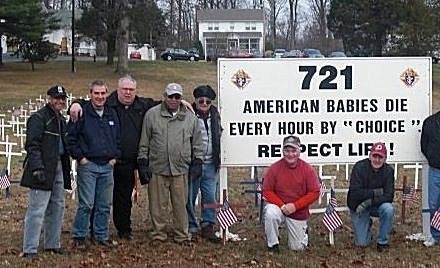
Here is a picture of me and the Knights of Columbus who set up 721 crosses that represent the children lost to abortion in one hour of one work day.  This MEMORIAL OF THE INNOCENTS was set up at Holy Family Church in Mitchellville in 2009 and every year since then.  We often have it up until the annual March for Life in Washington, DC.  We received a lot of support although there were a few complaints.  One lady argued against putting such a thing up at Christmas time.  I explained that Advent and Christmas was the perfect time.  During Advent we recall the Christ-child in the womb and on Christmas he is born.  We are reminded that every child is a reflection of the Christ-child.  Another person argued that it was insensitive as she was a pro-choice Catholic.  I told her that she was deceived.  There is no such thing as a pro-abortion Christian; abortion attacks the central mystery of the Incarnation.  Abortion is murder and as such it is a repudiation of Christ’s Gospel of Life.

One of my favorite memories is working with the American Life League back in 2005 and the CRUSADERS FOR LIFE.  Here is a reposting of the news around that event at my old parish, Holy Spirit Church:

A.L.L. Crusaders Come to Washington 2005

A dozen young people from colleges across the country walked from Augusta, Maine to Washington, DC in “Defense of the Catholic Church” and to spread the message that you cannot be Catholic and pro-abortion. Nevertheless, while many have applauded young people for taking up the “right to life” cause, this group of remarkable crusaders was purportedly banned from speaking in churches by several dioceses like Philadelphia and Baltimore.

Myself, Dr. Grier & a Crusader

10_10

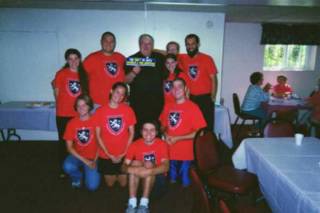
The American Life League ran a series of stinging ads challenging the American bishops to enforce canon law and to protect the Eucharist from sacrilege when pro-abortion politicians and others (who have made such “public” stands) take it upon themselves to receive Holy Communion. The young people have shown no spite or anger, only sadness that some of the nation’s shepherds have chosen to remain on the sidelines. One priest remarked that the ads in protest were so severe that the American Life League owed the leaders of the Church an apology. However, others thought that these good men should at least have shown the same respect and hospitality to the young marchers for life as they have in the past to the high profile anti-life politicians. While they were able to find lodging in the city, they attended 9:00 AM Mass at Holy Spirit Church on Friday, July 30 and were invited to say a few words afterwards. I contacted the archdiocese’s Pro-Life Office several weeks earlier about the matter to insure a level of approbation and to insure proper discretion.  (Although the ads pained him, to his credit, Cardinal McCarrick did not formally forbid the young people to speak in his churches. Throughout, nothing the young people said violated the archdiocese’s rules against participation in partisan politics– they did not name politicians by name, did not tell people for whom they should vote, and spoke with respect in regard to the Church’s shepherds.)  Following the celebration, a reception was held in the Parish House were the young people had a hearty breakfast and got to meet parishioners. Also in attendance was SK Reginald Grier, a parishioner, a fourth degree Knight of Columbus and volunteer member of the archdiocesan Office for Black Catholics. John Stakem, a Knight of Columbus from St. Pius X Council, and past parishioner was present, too. John Stakem and Joseph Markauskas were long-time pro-life volunteers and were involved with the local pregnancy center. Joe and Betty Markauskas had even offered to give the young people housing while in town. We were very pleased that the director for the Forestville Pregnancy Center was present, Chyllene McLaughlin, along with her assistant. We wanted to communicate to these young people that they were not alone. Holy Spirit Parish, the Knights of Columbus, and the Pregnancy Center in the larger pro-life community, was very much behind them.

ALL Crusaders at Holy Spirit Parish

13_13

May God bless them for their sacrifices and may their witness bear fruit.

DISCUSSION

FRANK:  News releases indicate that the Church after Vatican II had converted the Kennedys and other Catholic politicians into believing that the liberal backing of the culture of death is acceptable.

FATHER JOE:  What news releases were these? Cite them; I would like to read further. As far as I recall, John Kennedy was chastised by churchmen for his liberal response about how little his faith would inform his work as president. As for the other Kennedys and the issue of abortion, I fail to see how Vatican II can be blamed for their pro-abortion stances. I have read and studied all the Vatican II documents and post-conciliar documents. Nothing comes to mind that would condone such thinking against the Gospel of Life. Are we throwing mud again? Give me specifics, please.

FRANK:  Having attended the seminaries after Vatican II where the divinity of Christ was challenged, as well as the papacy, and all that was to be infallible before the “Catholic reformation” of 1962-1965; what is your take on recent developments and the continued blasphemies to this day condoned by the Church where the USCCB still can’t come to a consensus to deny our Lord to baby-killing Catholic politicians?

FATHER JOE:

Certainly there was a heightened stress upon the humanity of Christ in many theological schools after Vatican II. However, I do not recall ever being taught that Jesus was not a divine Person.

Fr. Patrick Granfield taught my class on the papacy at Catholic University and his lectures defended the Holy Father’s authority with a great deal of explanation.

Those things that were changed were not deemed infallible but rather mutable accidentals. This thinking was even shared by Pope Pius XII prior to Vatican II on matters like the prehistoric generation of human beings and the liturgy.

A revision of the liturgy was in the working stages going back to the 1930′s and 40′s. The reformed liturgy we have now has lasted a few decades and will probably remain for many more, although with the old liturgy alongside and with continuing adaptations by the Holy See. We have had to suffer the experimental phase, but Pope Benedict XVI said that such has come to an end.

As for the passivity of churchmen in reference to Holy Communion and the standing of pro-abortion politicians, such is also not attributable to Vatican II. The Church has gone through periods in the past where it was the lackey for parliaments, kings and queens. The Popes made clear statements from the 1600′s onward that slavery was detestable and should be abandoned. However, Catholics owned slaves in the colonies and later in the United States of America. The Jesuit landowners of Maryland had slaves. Bishops were often mute on the subject, except for admonishing their baptism in the faith. Dissent is not something new but something very old.

PADRE XYZ: 

Father Joe, Your welcome to the pro-life young people did not go unnoticed. I know it cost you personally.  I think you can be rude and you definitely lack tact, but it did take some nerve to stand virtually alone and make the challenge against silence or business as usual.  You honestly shared your heart to the bishops and your brother priests.

You asked…

Would you give communion to Nazis who promoted the murder of Jews?

Would you give communion to White Supremacists who incited the lynching of Blacks?

Why should we prize the life in the womb any less or their murders as somehow less grievous?

Silence befell all the big guns. You lost a lot of friends that day. If you had career hopes in the church, they were suddenly shattered. Hushed and whispered voices were the only response, “How do we shut this priest up?”

You became an embarrassment. I could not do what you did. You angered a lot of people. You took a promise of obedience and you were reprimanded for your slight as an act of betrayal. Some of us witnessed it, although you were left unnamed.

You changed after that, became quiet, even sullen. It was as if something died in you. You gained weight.

I know you were disappointed in me. But to be frank, I was afraid. Who are we to question the shepherds over us? What happens if we tell the majority of Catholic politicians they are no longer welcome at the altar?

Take care of yourself.

FATHER JOE:  I was going to erase this comment. I still might. If you are who I think you are, email me. Peace!

(I am not really brave.  I speak my mind and I love the Church.  When all is said and done, I do as I am told.  I am the Church’s man.  Some would contend that I am too conservative or right wing.  But how can we be too committed to the Gospel of Life?  Every day I work to control my temper.  As long as I can remember, I have been very passionate about our faith and its values.  Am I ambitious?  Like most priests, it is nice to know that one is appreciated and that one’s talents are acknowledged.  However, by comparison to most priests that I know, my rating would be very low.  It is not false humility but the truth when I say that I count myself as the least of my brothers.  As for the bishops, it must be a frightful responsibility they carry.  Who would want it?  They are criticized from every side.  It is easy for us to judge, but we do not walk in their shoes.  Pray for priests and pray, especially for our bishops.  They are Christ’s apostles in the world today.)

DR:  I nominated you for a pro-life blog award (FATHER JOE Blog).

JOHN:  Fr. Joe, abortion is murder. These babies can’t speak for themselves. Other bishops have stood up and said priests should not give communion to pro-choice politicians as they have the power to stop the murder (Bishop Burke-former bishop of St. Louis archdiocese and Bishop Finn of Kansas City diocese, for instance.) I’m glad priests like you and Fr. Frank Pavone speak out on this issue. It’s a serious matter and it should be treated as such. Thanks for all you do.

LENBER:

“President Bush has had a very cozy relationship with the Vatican, and set a presidential record by meeting with the Pope six times.”

Very cozy indeed, sometimes for the good, and at other times for utterly and criminally contra-productive [things], such as siding with Bush in Criminal Wars (for the Vatican just Abortion is a Crime) or siding with Israel on their Criminal Occupation of Palestine.

All Thanks to Vatican II Double Crossers.

FATHER JOE:  I am not sure I would coin the Bush Doctrine or International efforts in such negative terms. However, as for the Pope, you seem to be terribly deceived. The Vatican opposed the invasion of Iraq. Tarek Aziz (the former president) was a Catholic. He made a retreat in Rome and saw the Pope (John Paul II) the week prior to the invasion. The state of Israel is also not entirely happy that the Vatican, again and again, sides with Palestinians (who are largely Islamic but include an ancient Christian community). Formal recognition and diplomatic ties were held up because of Vatican concerns for the Palestinian people. The late Arafat, at the end of his life, remarked that he saw the Vatican as his ally in the conflict for Palestinian rights. Zionism was condemned by both the UN and by the Church. Arafat used to attend the Christmas Mass in Bethlehem with his wife (who is a Christian). The Catholic Church is no one’s stooge, not for Bush and not for Israel. The Holy Father (both JPII and BXVI) has spoken to President Bush, (he meets a lot of people) and they share much in regard to the unborn, however on matters like the Middle East and capital punishment, there is a great divide.

MICHAEL:

Tomorrow marks the 36th anniversary of Roe v. Wade.

Think of the millions of lives that were snuffed out in this “free” country.

May God have mercy on us!

GENUS LILIUM:

I am completely against abortions. I have children and I have learned that some vaccinations are grown off of human diploid cells from aborted fetal tissue, not to mention all the other chemicals, heavy metals, and animal products. That seems like it might be a problem to me. Now that I know this, would it be wrong for me to continue to vaccinate my children? Is it just a money scheme? I really don’t want that stuff in my kids.

Questions & Answers About the Church

What is the Church?

Put simply, the Church is a community of faith founded by Christ which celebrates and makes known her Lord through his teachings and sacraments. This Church is composed of the clergy, laity and consecrated religious.

Does the Bible speak of the Church?

Yes, it does, a fact that is quite disturbing to those who disavow any significant role for her and who reduce Christian faith to a personal experience with occasional Christian fellowship. Jesus said: “And I tell you, you are Peter, and on this rock I will build my church, and the powers of death shall not prevail against it.” (Matthew 16:18). St. Paul also speaks about “the church of the living God” (Timothy 3:15). In Hebrews 12:23, he calls her the Church or “the assembly of the first-born.” Revealing something of the intimacy between Christ and his people, St. Paul says in Ephesians 5:25, “Christ loved the church and gave himself up for her.” Jesus compares the Church to a flock of sheep: “So there shall be one flock, one shepherd” (John 10:16).

Does the Bible say anything about Christ founding a Church?

Our Lord chose twelve apostles and commanded that they teach and insure that believers observe all that he had given them. Christ, himself, admits to his own authority, “All authority in heaven and on earth has been given to me” (Matthew 28:18) and extends it to his apostles, “Peace be with you. As the Father has sent me, even so I send you.” (John 20:21). Christ appointed a visible headship or ultimate leadership among his apostles in Peter: “And I tell you, you are Peter, and on this rock I will build my church” (Matthew 16:18). This “rock” signifies that Peter should be the foundation stone and chief shepherd of the Church. Christ told him “Feed my sheep . . . Tend my lambs . . . Feed my sheep” (John 21:15-17). In other words, he was to lead the apostles and teach the People of God. He was to minister to them and insure the efficacy of the sacraments, particularly the Eucharist.

When did this Church really begin?

The Acts of the Apostles chronicles how the apostles were empowered and began to exercise their mission on Pentecost. The Church expanded and prospered. Bishops were appointed to assist and to be the successors to the apostles. This living legacy extends all the way to today.

Can the origin of the Church and its apostolic succession be proven?

Sure, history and Church documents themselves are evidence of Church leadership and activity throughout the ages. Significant are the lists of succession, especially that of the Pope which extends back to Christ and his appointment of Peter. There has also been a successive series of Church fathers and doctors who have explained and defended the faith in every century. We might point further to the Church councils, which have corrected and maintained teaching and discipline against error so as to be faithful to Christ.

Can we really be sure from biblical testimony that Christ gave Peter a special supremacy and power?

Christ asserted that Peter was the rock or foundation stone of his Church. He tells him to feed his flock, to teach and minister to clergy and laity alike. He makes no qualm in saying, “I will give you the keys of the kingdom of heaven, and whatever you bind on earth shall be bound in heaven, and whatever you loose on earth shall be loosed in heaven” (Matthew 16:19).Yes, the singular role of Peter is pretty clear.

Does the Bible assert that Peter was the chief apostle and that he exercised supremacy over them?

St. Peter personally presided over the election of Matthias. He was the first to address the crowd after the descent of the Holy Spirit. At the Sanhedrin in Jerusalem he took it upon himself to speak in the name of all the apostles. He presided in Jerusalem over the first Church council (Acts 15). He resolved disputed matters (Acts 15:7). St. Paul consulted Peter about certain practices. Indeed, early Christian history tells us that after Christ, Peter was considered the head and chief teacher of faith.

Can it be proven that the Catholic Church is the true Church?

Christ established the Catholic Church almost two thousand years ago. Her Christian teachings have remained consistent against the fads and fashions of time. Her saints have written our Church history in lives of holiness and sometimes even of martyrdom. She has spread throughout the world to the many nations of the earth. She has not deleted or compromised the teachings of Christ. She has an unbroken succession of leadership (that can be chronicled) going back to Jesus. The Catholic Church alone has weathered all the storms of dissension, schisms, paganism, and persecution.

How can it be said that no other denomination is the true Church?

Except for the special position of the Orthodox churches and their relationship, albeit fractured, with the Catholic Church, all other Christian denominations emerge from the personal opinions of certain men. These figures alter, add, and delete from the deposit of faith according to their own whim and private notions. Non-Catholic churches [properly called ecclesial communities] disagree with one another and only possess fragments of Christ’s teaching, not the whole truth. All saving truth “subsists” in the Catholic Church. These other ecclesial communities extend back a few centuries or merely a couple years, not two millennia like the Catholic faith. These denominations exist only locally or in a few countries and are not worldwide. Having not formed under the watchful eye and guidance of the apostles, non-Catholic Bible-Christians frequently and ultimately explain the Scriptures in ways to suit human opinion.

Does the Bible actually say that we should submit our opinion to the Church?

We read St. Paul in Hebrews 13:17: “Obey your leaders and submit to them.” Jesus said to the apostles: “All authority in heaven and on earth has been given to me. Go therefore and make disciples of all nations, baptizing them in the name of the Father and of the Son and of the Holy Spirit, teaching them to observe all that I have commanded you; and lo, I am with you always, to the close of the age” (Matthew 28:18-20). “He who hears you hears me, and he who rejects you rejects me, and he who rejects me rejects him who sent me” (Luke 10:16). Thus it is that we should hear the Church and submit our opinions to her.

But blind submission violates the freedom of human inquiry and thinking, does it not?

This submission is not blind. We are obliged, to the best of our ability, to study the reasons and background for Catholic teachings. But, should we encounter “mystery” and we will, then we should render a religious assent to the views of the Church, which received the command from Christ to teach and to explain the truth.

Does not everyone have a right to his or her own opinion?

Yes, but only so long as the facts admit to differing opinions. But if truth should be made manifest or decided by a competent authority (like the Church), then we must submit. Children have opinions; would we say that they are always mature and correct? The insane have views too, would we consider all truth relative so as to give them credence? No, of course we would not.

Could not Christ have made things a lot easier for us, just by spelling out his doctrines so that no confusion might develop?

Christ did provide for the eventuality of misunderstanding. He gave us a certain and infallible teacher for his doctrines. In cases of uncertainty, we have a means of discerning the truth. He principally gave this infallibility to Peter, the Bishop of Rome, and to his successors.

But, is not the Bible an infallible teacher?

No, because many texts require explanation. There are some Scriptures difficult to understand. The multiplicity of denominations in this nation alone is proof that the Bible is no infallible teacher.

Does the Bible really say that St. Peter has infallible teaching authority?

Christ said to St. Peter: “Simon, Simon, behold, Satan demanded to have you, that he might sift you like wheat, but I have prayed for you that your faith may not fail; and when you have turned again, strengthen your brethren” (Luke 22:31). In Matt. 16:17-19, Jesus said to Peter: “Blessed are you, Simon Bar-Jona! For flesh and blood has not revealed this to you, but my Father who is in heaven. And I tell you, you are Peter, and on this rock I will build my church, and the powers of death shall not prevail against it. I will give you the keys of the kingdom of heaven, and whatever you bind on earth shall be bound in heaven, and whatever you loose on earth shall be loosed in heaven.” This proves that Peter was empowered by Jesus Christ so that his faith would not falter and that he should insure and strengthen the faith of his brothers. Christ confided his Church to Peter as on a rock that will never be disturbed by false teachings or by the gates of hell. Christ said to Peter: “Tend my lambs . . . feed my sheep,” (John 21:15), which means to teach and care for the whole Church. If Peter was charged to teach the whole Church, then Christ had to insure that he would be able to teach without error. Otherwise, no one could be required to believe what he taught. Except for some window dressing and the development of our appreciation of doctrine, the Church has taught the same unchanging doctrine for two thousand years.

But if Peter swore that he did not know Christ, how could he be infallible?

This question emerges from a common misunderstanding between “infallibility” and “impeccability”. While St. Peter was infallible in teaching matters of faith and morals, he was not free from sin. Further, when Peter denied Christ, he had not received the Holy Spirit who would preserve him free from error in teaching the Church. Christ had yet to give him full and empowered charge of his flock.

What does “ex cathedra” teaching mean?

It is a technical term, which means literally from the chair; it signifies when the Pope speaks from his role, as the universal teacher, some matter of faith and morals which must be accepted throughout the world. He puts the full weight of the seat of Peter behind it. His private conversations and such are not infallible.

Does such a view of infallibility create an atmosphere for ignorance, making people passive in investigating the truth?

No, quite to the contrary, infallibility insures that we do not follow any false leads. The truth is studied on a firm foundation and in the light; those who have no such guide search for the truth in the dark. The fragmentation of Protestantism is evidence of this latter route.

But wait a minute; is not the teaching regarding infallibility of recent origin?

It was formally defined toward the end of the 19th century as a necessary retort to a world that was increasingly secular and dismissive of the role of the Church. However, even before it became a declared article of faith, the Popes were always infallible. Papal infallibility is not a new doctrine; rather, it is an ancient perpetual truth given a clearer definition.

But some Popes were terrible public sinners; does this not invalidate this business?

No, just as with Peter, infallibility does not mean an exemption from sin.

Could it be that Peter was infallible, but no Popes after him?

The guarantee from Jesus was that he would remain with his Church until the end of the world. Thus, the infallibility of Peter must endure as long as the Church exists and the teachings of Jesus have need of preservation from error. Anything less would be unjust. Every generation has a right to the truth. Remember, Christ promised he would send to his Church the Spirit of truth which would abide with her forever (John 14).

At the time of the reformation, about the year 1500, did not the Catholic Church fall into idolatry and superstitious practices?

No, her beliefs have remained essentially the same throughout all history, going back to the apostles and the first Christians. These charges are the result of bigotry and misunderstanding.

Were there not many abuses in the Catholic Church at the time of the reformation?

The Church is holy because Christ is holy. However, many individual members of every “church” may be guilty of sinfulness and abuses. The Church has never formally approved of religious abuses and has legislated “Church” penalties, including excommunication, to discourage such activities.

Is it correct to assume that Protestant denominations possess the same faith and teachings as the first Christians?

No, this would be a false presumption. Many cases of deviation can be documented, not to mention their breach with the Catholic Church. While the first Christians acknowledged baptism as necessary for salvation, many of these “new” churches dismiss its importance. Ancient believers also believed in the Church’s jurisdiction over the sacrament of penance and the value of confession to a priest; all the Protestant sects renounce this mystery of mercy. The early Christians made the Eucharist the center of their lives, trusting that in Holy Communion they received the real body and blood of Jesus Christ. Most Protestant sects denounce the real presence, spiritualize it, or reduce it entirely to ordinary bread. Early Christians also inherited from the Jews of Christ’s day the practice of praying for the dead; this also, the non-Catholic denominations have discarded.

What is so serious about a denomination changing or modernizing its tenets of faith?

Implicit in such an activity is the assumption that the previous tenets were incomplete or erroneous. Both cannot be right. The true teachings of Christ and the apostolic Church, the very matters of faith required for salvation, cannot be reversed or altered. Attempts to do so sever the connection between believers and the true Church of Christ. Of course, issues of discipline can be revised according to changing circumstances. Further, the many languages of men and the various societies in which the Church finds herself may also dictate reformulation in the expressions of changeless doctrinal truths. It could also be said that the full meaning and ramifications of certain teachings develop or are only realized over time.

Does the Catholic Church fabricate new articles of faith?

No, she does not have the authority to create new teachings. Rather, she sometimes defines matters of faith that have existed in the Church from the very beginning. As for discipline, she can create or revoke laws according to changing circumstances.

For more such material, contact me about getting my book, CATHOLIC QUESTIONS & ANSWERS.

Deacon Dr. Henry D. Dardy Passes Away

Presidential Rank of Meritorious Senior Professional
Dr. Henry Dardy, 2008

I lost one of my best friends, the parish deacon. His sister called me last Saturday to let me know that Deacon Hank collapsed while doing yardwork at his home. Hank was a great scientist and man of faith. He was instrumental in the creation of several corporations worth hundreds of billions of dollars. He ranked with Steve Jobs and Bill Gates. The only difference was that he was more interested in being a prophet than in making profits. Along with his lab and those who worked with and under him, he invented and perfected all sorts of things. He worked with Lucas over the computerization of the dinosaurs in Jurassic Park. He was behind high speed data transmission and in collaboration with ABC and Disney helped to perfect HDTV. He worked for his country and the Navy. He loved his Country, his Church, and his Community. I will never forget this quiet and good man. Last Friday he did the parish Stations of the Cross for me. He preached two weeks ago and gave one of the best homilies I had ever heard; I even said so from the altar. No task was too great or too small. This world-class scientist replaced my light bulbs and fixed the clocks. He set up for Masses, performed baptisms, and proclaimed the Good News. He believed. He was living evidence that there need be no contradiction between being a person of science and a man of faith.

Bishop Martin Holley presided at his funeral and I was honored to preach. Many of his deacon classmates attended. The church was packed with friends, family and colleagues.

I will miss him very much. Everyone loved him. Goodbye Hank, until we meet again in the Lord . . .

OBITUARY

549358 

Deacon Dr. HENRY D. DARDY “Hank” (Age 67)

On Saturday, February 27, 2010 in La Plata, MD, the beloved brother of Sr. Mary Ann Dardy and Anthony “Tony” Dardy; brother-in-law of Barbara G. Dardy; uncle of Lisa D. McGee and Mark D. Dardy; nephew of Anna M. Lindich.

Family and friends may call at Holy Family Catholic Church, 12010 Woodmore Rd., Mitchellville, MD 20721 on Wednesday, March 3 from 6 to 8 p.m. where Mass of Christian Burial will be offered on Thursday, March 4 at 10 a.m. Interment on Friday, March 5 at 11 a.m. in Calvary Cemetery in Cleveland, OH. In lieu of flowers, contributions may be made in his memory to either Holy Family Catholic church or John Carroll University, 20700 North Park Blvd., University Heights, OH 44118.

www.KalasFuneralHomes.com

Where Have the Churches Gone?

Bill and Susan are both baptized Catholics. But they rarely went to Mass. You might see them in the pews at Christmas and Easter, but that is about it. One Easter they came to Mass and had the surprise of their lives. The parking lot was empty. Going up to the church doors, they discovered that everything was locked. Confused, they almost decided just go home but it was Easter so they drove a little further to another church. Again, they were shocked. There was no one there, either. Now the mystery was intriguing them. What had happened? Had there been a revolution and the churches forcibly closed? Were the Protestants right and all the good Christians taken away by the rapture? They traveled outside of town to a third church. Here they found cars but services were ending. Although they had missed Mass, they entered the church for a quick visit and to find reassurance that nothing else had suddenly changed. Everything appeared to be in place, although the congregation seemed a bit small from the celebrations remembered in the past. They saw the priest and approached him with their puzzlement.
Susan spoke first, “Father, we are sorry about missing Mass but we had trouble finding an open church.”

Father Flynn responded, “I take it that you are new to the area. We would love to have you register here. We can always use new members.”

“No Father,” said Susan, “we have lived here all our lives. We were married at St. Margaret’s.”

“Oh my,” responded the priest, looking somewhat disturbed and maybe upset.

Bill entered the conversation, “We went to St. Margaret’s this morning and finding no one there went over to Holy Spirit. Both places were empty.”

“Yes,” lamented the priest, “I guess you both feel inconvenienced.”

“It certainly ruined Easter, what is going on Father?” asked Susan.

“You won’t like my answer. It might even make you angry,” added the priest.

The priest motioned for them to sit in a pew next to him.

“What is it, Father?” asked Bill.

“I will tell you,” said the priest, “it is your fault.”

Taken aback by the answer, they immediately insisted that he explain.

“You and so many people like you, killed St. Margaret, Holy Spirit, and almost a hundred other churches in the diocese. You want the church for a wedding, as if the building is only a decoration on a cake. You might ask for a baby’s baptism, when grandparents nag you. But then we have trouble finding a godparent who is not in mortal sin. Everyone who comes is a stranger. No one is practicing his or her faith. You come to Mass a couple times a year, throw a few dollars in the basket and expect the church to still be here waiting for you when you feel like coming back. Some only come to church twice in a lifetime, the day of baptism and the day of final repose. You did not know about those churches because they were not a part of your life. You did not support your parish through donations. You did not add to the parish life by your participation at Mass and in the various volunteer opportunities. You did not have children or if you did, you did not encourage vocations. How did you expect us to keep the churches open when we have no priests and empty pews? You broke the hearts of your priests who gave up the possibility of spouse and children to take care of the family of God. Priests weep over their people who neglect Confession and the Mass. Priests yearn to forgive your sins. You became comfortable with sin and made excuses. You said by your neglect that our sacrifices did not matter. Some of you were even vocal in arguing for married priests and condemning all celibate men as deviates and predators. In essence, your dissent and absence told the priests that we were wasting our time. Worst of all, you were saying that you did not need the Church. You forced God to the periphery of your lives, if he were there at all. The churches closed were wonderful places once. God lived in those houses and in the hearts and souls of the people. But when you stopped coming, things began to run down. Where there were once three priests, now there was one. Eventually even that one was shared between parishes. Many young people stopped coming. The congregations got older. The average parishioner age at Holy Spirit was around eighty! God called the faithful remnant home. Grandparents tried to give the faith to their grandchildren, but sometimes with opposition from their own children. They suffered terrible guilt. What had they done wrong? Why did their children stray? Bills started to grow and resources were strained. The new Bishop had to take action. Critics hated him and spouted condemnations when he closed beautiful old churches. Many of these same voices were those of fallen-away Catholics. They still had sentiment about their childhood parishes, but nothing of a deeper or lasting value. Catholics today are twice as populous as in the old days, but less than 15 to 20% go to weekly Mass. Back in 1960, that figure was 90 to 95%. Our schools are dying and increasingly expensive. Our churches are relegated to the status of museums instead of as places of worship and community life. You did not pray— you did not pay— and now you are upset that the churches did not stay. We are drowning in a sea of hypocrisy. A housing developer will be bull-dozing Holy Spirit within the month. Who knows what shall become of St. Margaret Catholic Church? There is talk that a Baptist group might buy it. Some of the churches have become condominiums with the guts torn out. What the enemies of the Church could not do, we have done to ourselves.”

The couple was silent. The priest reached into his pocket and pulled out a broken piece or marble or plaster made out as marble.

“See this,” said the priest, “this is a fragment from the altar at Holy Spirit. I was pastor there. On the morning I came by to pay my final respects, demolition men were hacking the altar to pieces. It was on that altar that bread and wine became the body and blood of Jesus. It was from that altar that the faithful received the bread of life and the cup of eternal salvation. I did everything I could think of to save the church. I went door-to-door in an attempt at outreach. But there was a bigger Catholic church down the road and we had no school. Even they were struggling. Most people of faith in the area were Protestants. Others spurned all religion. Many Catholics had moved away and those who remained did not come, except for my small faithful remnant. I buried most of them.”

Staring straight into the faces of the couple, he lamented, “I cried and cried after seeing that altar destroyed. Here, take this,” offering the altar fragment.

“It means too much to you Father, no, we couldn’t take that,” returned Bill.

Not taking no for an answer, the priest forced the fragment into his hand, and said, “It is okay, I really want you to have it. You are right, it meant a lot to me, but it is my hope that someday it might come to mean something to you and your wife.”

Reform & Believe

“The Reign of God is at hand! Reform your lives and believe in the gospel!” (Mk 1:14-15). The cry for men and women to reform their lives had long been one echoed in the history of God dealing with his people. With the coming of Christ, we for the first time can fully respond to this admonition.

In the days of Noah the people were also called to faithfulness and yet they remained in their debauchery. I recall a reproduction of a painting my parents used to have of the deluge. A young beautiful woman with long hair clung to a jagged rock while surrounded by heavy winds and thrashing tides. I recall staring at the picture and feeling deeply sorry for her. She was so beautiful. How could God be so cruel? As I have gotten older and hopefully wiser, still sometimes the actions of God in the Old Testament seem like such over-reactions to me. I suppose what we forget is that the more primitive the people, the less sophisticated had to be the ways to keep them in line and to guide them. The story of the flood is not one simply about destruction and disobedience; in Noah and his companions we see an image of God’s steadfast fidelity and love for mankind, despite our disobedience. God sets up a covenant with Noah and promises never to flood the world again; he even sets the rainbow in the sky as a sign of his promise. The words of Genesis convey here the deep love of God. Because of our sins, we deserved death. However, not only are a remnant rescued but later God would send us his Messiah to save us from our sins and eternal death.

I would probably be negligent if I failed to say a few words about the kind of literature which this text in Genesis represents (see Genesis 9:8-15). It is linked with the story of creation, even though there was no scribe or news reporter taking notes in the first days of humanity. It is a later reflection. When the Jewish people were in Babylonian exile surrounded by a people who followed false Gods, the story of the flood reaffirmed to them how much God loved them; and that no matter how desperate their situation became, God would not abandon them.

The story of creation and the flood also made up a kind of satire against the Babylonian gods. Much of the linguistic allusion is lost in English. The particular story which parallels ours is called the Gilgamish epic. In it, the hero is not Noah but Ut-napishtim. When the gods, notice the horrendous plural, decree the deluge, the pagan god Ea reveals their designs to Ut-napishtim by speaking secretly through a reed wall. You see, Ea did not want to let the other gods, who wanted to get rid of mankind, know what was coming. He is urged to build a cubical boat of ten cubits. This is not like the rectangular boat of Genesis, just a box. He is warned to take ample provisions, as well as a sampling of the beasts of the field and the wild creatures. This is like Genesis. However, he is also told to take craftsmen lest their skills be lost. For six days and nights the storm persists. Finally, the ark comes to rest on Mount Nisir. Like Noah, he sends forth a dove, a swallow, and a raven, leaving the boat when the raven fails to come back. Ut-napishtim offers a sacrifice to the gods who cluster around him like flies. Instead of a covenant as we see in our story today, there follows an angry dispute among the gods. Enlil, angry about the remnant which has escaped, inquires as to who leaked the secret of the flood. Ea confesses but questions the prudence of Enlil in sending the storm. Upon the sinner, he says, should be imposed his sin, and on the transgressor, his disobedience. Instead of a universal disaster, Enlil, he complains, should have simply sent a wolf or a lion or a famine or a pestilence which would not have wiped out the entire race. Because Ut-napishtim and his wife escaped destruction, they must now be given immortality and transplanted so that they would not mingle with mortals. This and similar stories question the wisdom and goodness of the providence of the gods. The Jewish people believed in one God who was all knowing and all good. The destruction is then not seen as the act of a whimsical god but rather was something which a disobedient people brought upon themselves. God’s response is to save a remnant from further depravity and have them start brand new. You can see from these two stories the resemblance. Father John McKenzie, a Scripture scholar, tells us that “The differences between the Mesopotamian and the biblical stories show how the Hebrews took a piece of ancient tradition and retold it in order to make it a vehicle of their own distinctive religious beliefs, in particular their conception of divine justice and providence” (Dictionary of the Bible, p. 189). Although this flood may not have actually wiped clean our planet, it could well be that both stories emerge from some common memory of a disastrous flood of prehistoric times — a recollection which has grown out of all proportions.

Having said this, theologically, the wisdom and faith of righteous man was praised for having followed God who saved humanity from his folly. Noah listened and obeyed God. This is the key. In 1 Peter 3:18-22, the deluge is reckoned an example of God’s patience and is compared to the waters of baptism. Water for us thus becomes a symbol of both life and death. In the history of salvation, it meant death to the peoples around Noah — it meant death to the Egyptians who chased the Jews across the Red Sea — and it even meant death for Jesus who once baptized by John would engage in a ministry which would demand the highest cost. It also meant life — it meant life and a second chance for Noah — it meant life and freedom for those fleeing Egyptian slavery — it meant life in the natural processes of the world where plants and animals perish without water. In baptism, by submerging and dying with Christ in those waters of regeneration, we are promised to rise with him. Like a seed which has flowered, we are born again and made brand new. Our sins are forgiven and we are made members of a new People of God.

Recall your baptismal promises often and allow Christ to live in you. Have Noah’s kind of faith. He trusted God even in the absurd task of building an ark. Living out our Christianity will sometimes seem absurd to others, but do not allow the storm of sin and death to drown you. Christ has given us a fine ship called the Church and if we remain faithful, it will take this Pilgrim People to the Promised Shore.

For more such reflections, contact me about getting my book, CHRISTIAN REFLECTIONS.

How Do We Understand Christ as King?

Every year we celebrate the feast of Christ the King. But, what does this feast mean to modern men and women? Contemporary civilization has largely rid itself of kings. It is true that the English and a few other nations maintain royalty, but the world democracies have reduced them to cosmetic and ceremonial roles. They are the subject of gossip and romantic fascination, not the masters of lives or the sources of true power. Americans fought a revolution, precisely to shed any allegiance to a king. Our corporate psyche has an inherent distrust in positing too much authority and power in any individual man or woman. We would rather reward ingenuity and ability with a leadership role than to grant it blindly because of an accident of birth and so-called noble blood. Checks and balances are incorporated into the system of government to insure that no individual becomes too strong. Indeed, the powers of the executive branch are constantly debated because of concerns that the presidency may become too independent and/or that its war powers are too great a responsibility for one man. Having said this, we acknowledge the strength of the individual and have a preoccupation with the so-called self-made man and the hero. Our politicians are often successful lawyers, businessmen, and veterans, even professional football players and wrestlers. We are also a people in love with the realization of a myth that the poorest person, subject to tremendous difficulties, can rise to prominence and even to the greatest office in this land of opportunity.

2 Samuel 5:1-3 presents us with the ultimate hero, David. The tragic power struggle with Saul is over. He was the great warrior who had saved Israel from her enemies. The elders anoint him as the king of Israel. It will be from his line that the Messiah will emerge. Generations to come will acclaim him as the model of a great king. Nevertheless, he made terrible mistakes and committed horrendous sins. He would take to himself the wife of one of his generals and then insure that the poor man would be killed in battle. When confronted with his sin and facing the judgment of God, he repents in sackcloth and ashes. The entire land does penance. David is acclaimed as the king who is willing to bend the knee to the true God and lay claim to his personal faults.

It may be useful for the Christian to appreciate that most earthly kings have been relegated to history. While there were saints among them; they were more often the worse of sinners. The image of Christ the King often had little in common with their abuse of power and their political intrigue. A British king took much of the English world out of the true Church. Many among the German nobility and princes divided the Church between Luther and Rome. When the King of Savoy sought the unification of the Italian peninsula, he confiscated the Papal States from the Church. Kings and emperors often had to validate bishop candidates. There are countless other examples that might be given. While it was traditionally argued that the ideal situation was a union of the Church and State, it must be acknowledged that the Church has thrived in the United States with its constitutional separation of the two entities. Of course, while no national church was recognized, we still maintained a real religiosity as “one nation under God.” Meanwhile, largely Catholic nations have often been the sources of the most severe persecution of the Church. This has usually occurred after bad governments, albeit somewhat sympathetic to the Church, have been overturned in elections or revolution. Mexico enforced abusive anti-clerical laws for many years. The French revolution secularized a nation with an accompanying bloodlust that cost thousands of priests and religious their lives.

Colossians 1:12-20 sounds like a creed. The divinity of Christ is proclaimed. Jesus is the kingdom. Since Jesus is also “head of the body, the church,” then by extension something of the kingdom is breaking into the world through the Church. His is a kingdom of light. Jesus is the Light of the World. He has “rescued us from the power of darkness.” We owe Christ everything. He redeems us and forgives our sins. The attributes of Christ’s kingship are narrated. He is the revelation of the Father, making visible that, which is invisible. Everything was created through him, the divine plan of creation. He is at the source of all that exists, “whether thrones or dominations, principalities or powers.” While his kingdom is not of this world, all earthly kings receive their authority from him. While used to defend the divine right of kings, it is also applied to modern democracies like ours. We even say as much on our money: “In God we trust.” The Christian sees this truth fully residing in Jesus Christ. Reconciliation is made possible through the blood of his cross. No one else can save us. His is the name that saves.

If the kingship of Christ is just window dressing with pretty crowned statues and empty words of praise, then we are wasting our time. Jesus does not want our flattery; he desires our humble submission. This feast and title of Christ the King reminds us that ours is a jealous God. We may be both citizens of a nation and subjects of a kingdom, but the claim of Christ must come first in our lives. When Jesus was asked as to whether it was legitimate to pay a tax, he requested a coin. He asked, whose head is on it? The answer came back, Caesar. Jesus answered, then give to Caesar what is Caesar’s, but give to God what is God’s. This response is often misinterpreted. His answer was really no answer, but a way to get around the trap that was being made for him. If he said not to pay the tax, he could immediately be arrested as an enemy of Rome. If he said, pay it, than those who looked to him as the Messiah might reject him as a crony of the occupying government. If we think about his response, the believer becomes alert to the fact that everything belongs to God. All that we have and everything that we are is a divine gift. This puts to shame the many politicians, and dare we say voters, who claim they can be Christian while advocating as public policy the murder of the unborn and the expansion of moral depravity. The suggestion that one can personally support the Gospel of Life while civilly aligning oneself with the constituents for the Culture of Death is a lie that strips one of genuine Christian discipleship. We either belong to the kingdom of God or we do not. The kingdom is in constant tension with the world and challenges business as usual.

Who is the master of our lives? The Lord, himself, says that we cannot serve two masters. Those who have sought to do so either compromise the demands of Christ or they ignore them completely. Dissenters against the truths of Scripture and the living Church often develop a rebellious spirit to authority. They purport to love Jesus but discount as historically conditioned or misconstrued anything he has to say that challenges them. Like any nation, the kingdom has its own laws. These laws run against the grain of what might be caricaturized as “normal thinking”. Only men are chosen as apostles and later as bishops and priests. This is rejected as patriarchal and opposed to equal rights for women. Jesus says that we must eat his body and drink his blood if we want a share in him and in his life. This is rejected as the peculiar cannibalistic thinking of the Roman Church. Jesus tells the woman caught in adultery that she is forgiven, but warns her to avoid this sin in the future. He also challenges the fornication of the Samaritan woman. This is rejected as the antiquated morality of right-wing extremists. Jesus says, if someone strikes you, turn and offer the other cheek. The world responds with petty wars. Three thousand people are killed every day by small arms fire alone. Jesus says, give without expecting repayment. The richer nations of the world retain a crushing debt against the poorer nations. A deaf ear has been given the Pope’s plea for debt forgiveness that would restore hope to the Third World and set the new millennium apart from past history. Jesus says love your enemies; forgive those who do you injury. The world executes them. The Chinese even resort to massive orchestrations of public rebuke and shaming prior to killing those ruled as criminals, especially those from the political opposition. During one three month period, they executed 1,751 people; that is 30 more than all the rest of the world over the past three years. Nevertheless, they are rewarded with “most favored nation” trade status and courted by world businesses. How can the demarcation between the world and the kingdom be any clearer?

Why are we afraid to speak out? Why are we so willing to accept excuses for the state of the world and our part in it? The prophets of the kingdom seem few in number and their message ignored. There are enough baptized believers in the world to change things if they wanted to do so. The trouble is that we have become complacent with the way things are. The problems around the world seem remote from our own lives. As for the society we live in, there is an unconverted part of us that secretly relishes in the new materialism and hedonism. Spiritually we have one foot in the kingdom and the rest is still in the world. Are we entering Christ’s kingdom or stepping out? Are we being converted or is our faith being corrupted?

Luke 23:35-43 gives us the scene at the cross. Jesus is mocked. The Jews are upset because he was not the kind of Messiah they wanted. He has let them down. The Romans mock him also, although they never placed faith in him initially. All they know is the sword and blood. This is what translates as power to them. The Jews are a beaten people. Perhaps some of their mockery was for the Jews who rebuked Jesus? They were all fools, as far as they were concerned, a defeated people. Pilate’s inscription rests above our Lord’s head: “This is the King of the Jews.”

While one criminal blasphemed against him; the other thief crucified with Jesus acknowledges his guilt and then professes his faith by asking Jesus to remember him in his kingdom. Although it is the darkest hour of the Gospel, Jesus comforts the good thief with the most wonderful words ever spoken to another: “I assure you: this day you will be with me in paradise.” What a strange king Jesus is. He gathers coarse fishermen and traitorous tax collectors to himself; he speaks with women of poor reputation and touches the unclean and leper. Now, at the cross, he tells an insurrectionist and true criminal that he should be with him in heaven, the capital of Christ’s kingdom. Even the devil with his vast but dark spiritual intelligence could not figure him out. He tempted Jesus with all that the world had to offer; but, to no avail. The cross should have been the devil’s shinning hour; however, even this will be turned into a parable, placing worldly wisdom on its head. A sign of defeat will be translated for all time as the symbol of victory. That, which previously ushered only death, will merit us a share in eternal life. Yes, what a peculiar king we have in Jesus; and yet how thankful we are for his infinite mercy.

All the parables speak about a kingdom that the world still does not understand. We are unwilling to sell everything for the treasure hidden in a field or the pearl of great price. We are unwilling to abandon a flock of concerns, to search out the one lamb that is lost and afraid. The treasure beyond measure is Jesus. We are called to serve him in heart-felt imitation. The kingdom of God has only two laws and yet they impact upon everything: love of God and love of neighbor. When will we learn?

For more such reflections, contact me about getting my book, CHRISTIAN REFLECTIONS.

China, Business & Human Rights

Laura Walker runs a great BLOG. I commented on her post, “Let Them Do Their Business.”  I made a few comments of my own.

For the whole thread visit her site at http://www.laurawalker.org:

Am I missing something fundamental? How does Chris Smith justify interfering in Google’s business?

The decision by Chris Smith, a Republican congressman from New Jersey who chairs a House subcommittee on Human Rights, to call for a February 16 hearing to examine the operating procedures of US internet companies in China, represents the first signs of what could become a serious backlash against Google and other internet companies in Washington that are perceived as capitulating to the Chinese government.

What are the hearings supposed to accomplish? Why not let Google incur the righteous wrath of the global market? Why should the government get involved?

Chris is a man of conviction who believes in justice and the right to life. He has even been critical of fellow Republicans who made too many compromises. I have heard him speak many times and have had several personal conversations with him, even on the steps of the Capitol (two women I know work in his office). He reminds me of Jimmy Stewart’s MR. SMITH GOES TO WASHINGTON.

If he ran for President, I would probably vote for him.

Chris Smith is a wonderful pro-life politician who is very concerned about the issue of human rights. He wants to send a sign to the Internet business community that it should not collaborate with governments that seek to silence and to oppress their people.

Back in 2002, China blocked access to Google from Chinese computers and attempted to create its own search engine, with limited results. In return for access, Google has created software to exclude content not approved by the Chinese government.

Although not mentioned here, Chris Smith no doubt also wants to send a message to Microsoft (MSN) that they are not exempt from such an investigation either. They also censor their search engine for the Chinese and have even taken down Chinese BLOGs deemed political by the government. I read of one case recently where the information provided about the identity of the Blogger was used by the Chinese government to prosecute the man responsible. That means that collaboration with the Communists by Internet companies in the U.S. could lead to the imprisonment or even the torture and execution of men and women in China.

I would say that was pretty important and given that Chinese slave labor provides many of our goods today; it is doubtful that the business community left to itself would do anything about it.

Of course, it was our government that has permitted trade with China, despite human rights concerns … and Chris Smith is only one man.

NOTES:

CHINESE TRADE
Smith, who is chairman of the Subcommittee on International Operations and Human Rights, continued, “Through the efforts of the Clinton Administration, we have abandoned the American ideals of freedom and democracy for the sake of marginally cheaper consumer goods from China. We have squandered our patrimony of liberty for the profit of corporations who want access to China’s inexpensive labor market. It is time to do an about face, to condition expanded trade relations upon respect for internationally recognized, fundamental human rights. If we can promote sanctions for video games and rock-and-roll, why can’t we do it to preserve human rights?”

CHINA & GOOGLE
“It is astounding that Google, whose corporate philosophy is ‘don’t be evil,’ would enable evil by cooperating with China’s censorship policies just to make a buck,” said Smith, who has been a leading human rights advocate since being elected to Congress. “China’s policy of cutting off the free flow of information is prohibitive for the growth of democracy and the rule of law. Many Chinese have suffered imprisonment and torture in the service of truth – and now Google is collaborating with their persecutors.”

GW’s old man, the first George Bush, would agree with arguments that it is better to allow unrestricted business cooperation with China. Although, it seems that we have become as dependent upon their goods as they are with our money. Many of the social changes about which we hoped have failed to materialize. As for myself, I would also argue for political and economic relations with them; but always with strings attached. Our treatment of Taiwan after the Nixon/Ford Administrations has always bothered me. As for Hong Kong, the British made a treaty with a China that no longer existed; they should have been given sovereignty. But those are my pet notions. While our country is no paragon of virtue, nations and the world community do have an obligation to insure that businesses and organizations do not trample upon basic human rights. Collaboration with evil makes one an accomplice, for which God will judge each and every one of us. Utilitarian arguments are out rightly rejected by the Catholic Church.

I recall the arguments about opening Western businesses to China when the first President Bush gave most favored status to China; and certainly no one wants to isolate China from the rest of the world. However, economics is the only wedge short of military intervention that we have with the Communists. Do we sacrifice human rights at the altar of consumerism and materialism, either of the Socialist or Capitalist variety?

This growing middle-class in China is still less than one percent of the population. Most of the wealth generated goes to a few hundred families among the upper Communist hierarchy. Middle-class in China translates to making between $3,000 to $12,000 a year, what would rate as the poverty level in the U.S. Many of these will themselves have a servant or maid that is paid $50 a month. 70% of the 1.3 billion population are peasants who earn about $100 a year!

Guess what? Finding computers in schools and coffee-houses, the majority of the bloggers and those questioning Chinese politics are from the poor! Religious persecution is still a predominate cause for Internet censorship and prosecution. This includes the Chinese who reject the Patriotic Catholic Church and accept the authority of the Pope. The Internet is giving people in China a voice to speak out about oppression. Big business left to itself does not care about this; even many in government do not. People who embrace the basic human values in government and business must work together, not only against oppression in lands like China, but also against the passivity and blindness of so many in the West.

I generally believe that government should not interfere with business; however, I qualify this with the exception of human rights. When Prell Shampoo a few years ago was purportedly adding human fetal material to shampoo as “animal protein”– individuals, organizations and government got involved and asked questions. We have fair labor laws that try to preserve safety and dignity to workers. Products produced by companies must face safety requirements. Again and again, when it comes to human rights, governments and other organizations must get involved.

China might be on the other side of the globe. But they are people too with basic human rights and dignity. We should not enable, either through inactivity or secondary collaboration, those who would silence the voice of the poor, those yearning to be free.

A television news report announced that because of contracts with companies like Matel, 90% of all toys sold in the U.S. are manufactured in China. Few Chinese children will ever play with such toys. Autom Catholic Religious Goods catalogues advertise inexpensive articles, almost all from China. However, all of it is reserved to foreign export and domestic circulation would be regarded a crime. Heck, even my DVD Player has “Made in China” on the back.

Dollar Stores came into existence because of this trade. Other nations could step in, but there is no underestimating its vast scope.

Critics are right, while it would cost us, the U.S. could flex its business muscle for the sake of human rights. But each year the interdependence seems to become more pervasive. There may come a day when such an action would be too costly.

To illustrate how things have so rapidly changed, it was only in the 1980’s that the last television set wholly manufactured in the U.S. was produced (ZENITH). Japan, Hong Kong, Korea and now also China produce them for us. When it came to clothing, many of us always looked for the “Union Label” and took pride in wearing shirts, pants, and dresses manufactured in the U.S. But the cost disparity became too much for the poor and the average working man. This started happening in the 1960’s. I recall my first concession to the trend when my mother bought me a new coat for school. It was the mid-1960’s and the coat’s label read, “This coat is manufactured by the free people of the Republic of SOUTH VIETNAM.” Evidently it was an effort to support our allies economically while in conflict with the Communist North. I wore that coat with pride, even though I was only in the fourth grade, because (in my mind) it symbolized freedom and justice.

By the way, there was an expose some years ago about Walmart where reporters followed shirts and pants from China sweatshops to the U.S. They found that they were sold at Walmart carrying the designation, “Made in the U.S.A.” When challenged about this, the executives at Walmart said that there was nothing deceptive for while the clothes were of Chinese origin, the attached label was indeed, made in the Unites States.

Not deceptive? The label? And these are the people who are supposed to stand up for human rights and justice?

The dilemma about the Internet is just the newest wrinkle in this situation: how far do you collaborate with thugs to make a buck? Where arguments might be made that trade helps the poor and middle class of China; for an American or Western company to assist in the restriction of information and free speech of Chinese dissidents is something else. And to hand over information that leads to the arrest, imprisonment, and maybe torture of such people is the worst case scenario.

I am not utterly opposed to trade with China.

But I do have problems with Google installing censorship software at the behest of the Chinese government that blocks religious sites like the Vatican and Free the Fathers and Blogs where men and women yearning to be free speak out.

The Chinese tried to create their own search engine back in 2002 and made a mess of things. We should not be helping them in this. It is a criminal act, at least in the eyes of God.

DISCUSSION

FATHER JOE:  

I am not an isolationist.  What one critic said to me was correct; we bargain with the devil every day.

We can hope that our relationships with the Red Chinese and Moslem extremists will make a difference; but we should never let down our guard and directly cooperate in human oppression. Communism is not dead, and instances of free enterprise can disappear tomorrow if the dragon awakens. Some of our so-called allies in the war against terror are themselves corrupt and oppress minorities, women and others. Is the pacified Westernized Islam that we see here at home the true faith of Mohammed; or is its genuine face really the Hamas and the extremism that we see in the Middle East and now parts of Africa and Asia?

Trade with China will not in itself prevent a new Cold War. Indeed, their military buildup is largely financed with our own money. Oil money in the Middle East can also translate into a fearful New World. I am not sure what we can do about much of this. Such questions will not be resolved by bloggers, but at least we have the freedom to speak, which some do not have. And Western and American companies should not help to silence voices.

I only wish people in all walks of life would more effectively engage these issues and that politicians would devise a clear plan about where our policies are taking us. We tend to be so short-sighted, instead of looking to the horizon.

ERIN:

I don’t disagree with the things you’ve posted either; in fact, I agree strongly with the statement that we should stand up for human rights, individually and as a country. However, I think if Google can get a working window to the internet into China, even with severe restrictions and censorship in place, isn’t it better than nothing? It’s a start – a way for the poor people of China to start looking around and seeing the possibilities of the internet. And hey, if the porn sites can so creatively sneak around our own censorship models and find ways to get their sites seen, can’t the Underground movements of China and other oppressed areas find ways to speak out and communicate with one another and the outside world?

FATHER JOE:

I guess it all depends upon how seriously Google cooperates with the Red Chinese government. While I am all for the censorship of pornography sites, the protection of children, and the prosecution of those who criminally exploit others; the Communists would use political and religious censorship to oppress their own people. Should Google cooperate in human oppression? What if the censorship software identifies dissidents who could suffer arrest or murder? People still disappear in China. Hackers might find their way around censorship software, but most poor Chinese Blog operators and general users only have elementary computer skills. The issue is bigger than Google. If the poor Chinese can get past the national portal to the Internet, they deserve protection within the international community. The Web can be a great tool for democracy; or we can ruin it like we did so much else of the media.