• Our Blogger

    Fr. Joseph Jenkins

  • The blog header depicts an important and yet mis-understood New Testament scene, Jesus flogging the money-changers out of the temple. I selected it because the faith that gives us consolation can also make us very uncomfortable. Both Divine Mercy and Divine Justice meet in Jesus. Priests are ministers of reconciliation, but never at the cost of truth. In or out of season, we must be courageous in preaching and living out the Gospel of Life. The title of my blog is a play on words, not Flogger Priest but Blogger Priest.

  • Archives

  • Categories

  • Recent Posts

  • Recent Comments

    Jeremykwanhong Kok's avatarJeremykwanhong Kok on Ask a Priest
    Maria's avatarMaria on Ask a Priest
    Diana's avatarDiana on Ask a Priest
    gjmc90249's avatargjmc90249 on Honey, You’re Not a Cath…
    Jeremy Kok's avatarJeremy Kok on Ask a Priest

The Matter of Concupiscence

We can only imagine what it would be like if we did not have to struggle with concupiscence. Sometimes it resembles a kind of schizophrenia or madness. Indeed, it often perplexes us as to how a person can seem so holy and moral and yet struggle with addictions and dark desires. This duality has been explored in Robert Louis Stevenson’s STRANGE CASE OF DR. JEKYLL AND MR. HYDE. While many speak of it as an allegory for good versus evil, in truth, it is not so simplistic. It is true that Hyde signifies the bestial, the lower nature, the part of us about which we are ashamed and seek to keep secret or “hide,” (note his name). But Jekyll is not the paragon of virtue. Rather, he is the ordinary man who earnestly seeks a place in civil society and to act appropriately.  In other words, Jekyll is “every man” struggling to keep rational control and to master his concupiscence.  The impulses he resists, Hyde follows.  The wicked designs he brushes aside as repugnant, Hyde celebrates. The passions he denies, Hyde fully realizes.  Hyde is evidence of what a person would become if human intellect and will were so damaged that no resistance could be mustered against base desires. While we might imagine that Hyde is the most free, such would be untrue. Hyde has lost control and thus his self-dominion and freedom are forfeit. The work is fiction and yet we live in a world populated by Jekyll and Hyde and those in-between. The most libertine parade a freedom that is a sham. They are slaves to their appetites.  Their passions own them instead of the other way around.   

Those who are closer to Hyde than Jeckyll would give greater weight to proximate ends over and against the supreme good and our ultimate end. The rapture of sensual gratification is wrongly preferred to general happiness and the joy of being in right relationship with God.  By contrast, Christian man and woman are called to self-discipline. The directives of Scripture, the moral formation of the Church, the pursuit of virtue over vice and the acquisition of grace are the factors in living our moral discipleship. We are part of the animal kingdom but we are not animals.

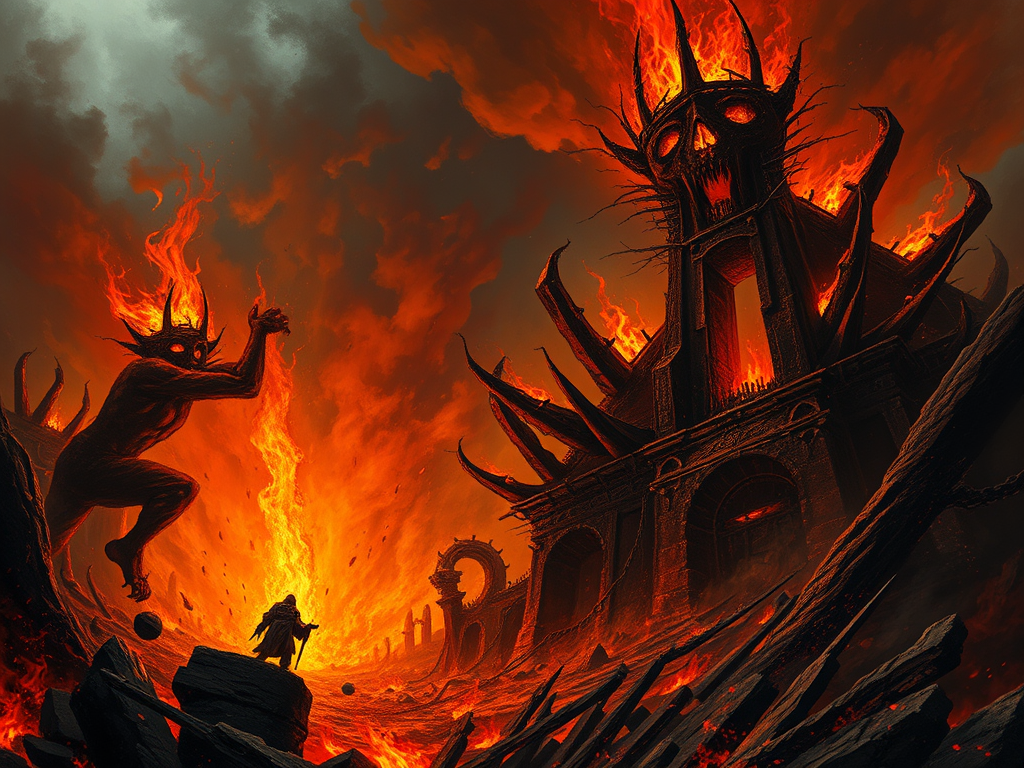
I am befuddled as to how all this will translate with perdition. If even the souls of the damned will be given back their bodies, then would this necessarily mean that the animalistic and the craving for sensual gratification would follow them into the afterlife? Is it possible that God would strip away the senses from the flesh, leaving the damned only with memory and imagination about the sensual? Might there be as many hells as there are damned— a colloquium for meaningless intellectual blabberings for some, a gluttonous feast for others and a licentious brothel for many more? I really cannot say. The usual description for hell refers to torment and fire. Maybe the fire or pain to the senses is eternal because what it seeks to cleanse refuses to be purified?  The sins of the flesh are rooted in pride. The question in my mind is what does God allow in hell? Will he permit blasphemous and lewd conduct?  If not, is this inhibition part of the price paid by the fallen? Is it akin to an alcoholic wanting a drink and never being able to have one? The sins of the flesh are readily connected to idolatry or false worship. But the afterlife forces one to see the truth.  I have a hard time imagining the damned and the demons worshipping Satan in an infernal parody of heaven. We might pretend to be God, but men are only weak creatures. The devil may play the part, but there is nothing truly creative about him.  He can only distort and corrupt. While God still loves him, it is not love that binds the damned to one another. What does provide for their union? I suspect it has to do with need and hunger and the divine withdrawal.  

What Had We Not Fallen?

A conundrum arises with the Virgin Mary. As the new Eve, she is preserved from sin and thus would possess the preternatural gifts.  Death is a consequence of sin and yet tradition suggests that at the end of her life in this world, Mary died.  The late Pope John Paul II believed she died to share the pattern of Christ on his Cross. The Eastern churches are so offended by this notion, that they call the Assumption by the title, The Dormition (Falling Asleep) of the Blessed Theotokos (Mother of God). Just as we drift off into dreams with sleeping, Mary is thought to drift from this world into eternity.

I am reminded of the three species of Martians (Malacandrians) in C.S. Lewis’ science-fiction trilogy. Having not fallen like humanity on the Silent Planet “Earth,” the Martians know something of death and yet there is nothing of mourning. Indeed, they speak and relate to the dead as if they were still alive. At the end of their mortal lives there is a smooth transition to immortality and a new state of being. They join closer to Maleldil or God. Their unity or communion with one another is sustained. Had Adam and Eve not fallen, it is suggested that death might have been as easy as opening a door and stepping from one room to another— it would lack finality or the darkness that threatens to consume us. Indeed, we might argue that this is not true death at all, at least as we know it. In any case, we experience no easy or casual transition. Death changes everything. We experience the absence of the deceased. The door closes quickly and we are fearful as to what awaits us on the other side.

What Chance Did We Have if Angels Could Fall?

While sins of the flesh might steer many men and women toward perdition; it should be noted that a third of the angels were cast out, and they did not have bodies at all. Their natural superiority did not make them morally better than ourselves. Sins of the intellect and will, define the angelic fall. Along with angelic beings, our first parents of flesh and spirit succumbed to the serpent’s temptation despite the availability of preternatural gifts. While our humanity is wounded, the benefit we have is a full store of divine mercy and the sacraments. But will we take advantage of what God offers us for salvation?  Will we use our freedom wisely or misuse it?

When pondering the ends of human beings, one must consider our origins and our current status in the created order. Catholicism would insist upon a definite Christian anthropology. Thus we reflect upon the following: the circumstance of our first parents, the effects of the fall and original sin, the scientific evidence for development of species, the question of preternatural gifts, and the current human condition. There is much dispute and argumentation about the manner in which we were made. Was our creation spontaneous with God’s word and his breath of life or did the first men and women develop from earlier life forms or proto-humans? God can do as he wills and there is increasing evidence for the latter. However, the Church would insist upon two points:  one, that the soul does not evolve but was immediately infused into the first man and woman; and two, we did not develop from multiple couples but from a single pairing of a man and woman. They set the trajectory for the entire human race. They could have remained faithful and, for all we know, the consummation of all things would have come earlier in history. As it is, they commit original sin and that rebellion has a disastrous impact upon them and their descendants.  Suffering, sin and death enter the world.

We often imagine Adam and Eve as naïve fools or children who are easily swayed by the serpent. The Scriptural account affirms this impression. Eve is definitely intimidated by the satanic dragon. Adam simply seems to feebly cave in to Eve in accepting the forbidden fruit. And yet the Church has discerned that humanity before the fall must have had some sense of its great calling and the wherewithal to live it out.  Unlike the creatures around him, the first man stood up on two legs and stared in awe at the creation around him.  He was aware of himself and of the one who had fashioned him.  Indeed, a residual memory (the fact that we remain wired for God) could be discerned after the fall in how tribes of men sought to worship or render sacrifice to the divine mystery.

What had humanity forfeited in the fall? The Church speaks of preternatural gifts: (1) infused science or knowledge (the opposite of ignorance); (2) physical integrity (the opposite of concupiscence); corporeal immortality (the opposite of death); and original righteousness (the opposite of original sin). Given these great gifts, it is indeed a mystery that our first parents fell at all. It may be that they did not have these gifts for long. The smallest spark of rebellion would have brought disgrace upon them. They hide themselves in shame because they are naked. They have been stripped of these wonderful gifts. As with the angels, there was likely some veil or separation that allowed them to turn against God as the greatest good. However, while each and every angel is a species unto himself; men and women belonged to a single unified species.  The choice they make would not merely impact upon them but upon the entire human family.  Fallen man prefers the path of the beast. One can imagine him falling to all fours, finding it easier to follow the flesh instead of the spirit— choosing ignorance over awareness— choosing rebellion in his members over self-control— choosing violence and death over peace and life— choosing to play God instead of humbly walking with him in the garden. Evolutionists have joked that monkeys became men. Christians had argued that in truth it was the other way around. Men and women became beasts! After the fall, we are not entirely abandoned. God promises a Messiah who will heal the rift between heaven and earth. We know him as Jesus Christ. He grants us sanctifying grace and actual graces. We become equipped with virtues to do battle with vice.

What is Wrong with Us?

Why do so many travel the wide road to hell and so few take the narrow path to heaven? Has God deliberately made the path to paradise too difficult or cumbersome?  Has he failed to plant signs to guide us on our way? Or has the devil turned the signs around to misdirect travelers? I suspect the sobering truth is that humanity is difficult to save. Jesus has redeemed us but many are resistant to grace and the gift of salvation. The measure is likely in how we treat the most vulnerable among  us.  If we can coldly destroy millions of unborn children, and celebrate with glee such choice or freedom, then it is no wonder that hearts lack contrition or remorse for sin, even though our disobedience was the catalyst for Christ’s horrific passion and crucifixion. The fact is that many do not care about what Jesus has done and this same callous attitude is imposed upon the neighbor. Some wrongly blame God and others. They may seek to mitigate personal blame by giving all the credit to the devil.  It is hard to face the ugly truth about a fallen human nature.  Even apart from the demonic, humanity is capable of the most atrocious wrongs. Betrayal, abuse, oppression, sadism, assault, murder, indifference, prejudice, rape, and an assortment of other iniquities define the darkness in human hearts.  Given this sobering understanding of fallen man, the query is not whether there is a hell or not; rather, the real question is rhetorical, how can there not be a hell? Divine justice demands the existence and populating of hell. 

I wonder what an angel or a rational extraterrestrial would think of us while visiting the earth for the first time? I suspect the visitor would wonder, what is wrong with us? He would be right to suppose we were somehow broken.  We want what we do not need and need what we do not want. We say one thing and do another. We celebrate both Mother’s and Father’s Day and then go about aborting millions of children each year around the globe. We prize love as an ideal but hate each other in practice. We develop mass media for communication and education and then fill the bandwidth with pornography and cheap live-action voyeurism. As a species and the stewards of earthly creation, we have moments of intense awareness where we penetrate the veil to the mysterious transcendent. But no sooner do we spy the face of God we return to wallowing in the mud like the pigs on a farm. We were made for God but why do there seem to be so few children of the Light and so many that prefer the darkness? God spells out what we need to do and yet we resist; we parade our disobedience. Indeed, the more serious the commandment, the more stringent our resistance.  Echoing the garden of Eden, we crave above all the forbidden fruit. We seemed to have lost something of the small child’s docility and trust. The old dog refuses to learn new tricks. Eyes are closed, ears are deafened, hearts are hardened, and minds are shut off. Such a mentality allows for no change of course, even if one is defiantly speeding to hell. 

Ever watch a cop show when one is pulled over for speeding or failing to stop at a stop sign or red light? Some immediately take out their license and say they are sorry. This is the posture of admission and contrition. It may bring punishment but there is the promise of redemption. Another resists the officer and may even reach for a weapon. This is the sinner who wants everything his way. He will not even admit he has done anything wrong. It is likely that he will die in his sins. Finally, there is the perpetrator who speeds up instead of stopping. A high speed chase ensues.  This is the sinner who tries to flee from God. He is reckless and endangers others in trying to run away. But ultimately, there is no escape. He has only made matters worse. There will be hell to pay. 

Sin, Judgment & Perdition

It is true that both the virtuous and the vile must wrestle with sin. Christ is what gives us the edge against the devil. The natural man has to make the best of the fight while inhibited by ignorance, impeded by Satan and lacking any supernatural protection. The fallen-away believer forfeits his alliance with heaven and shuns the one who desperately wants to save him. It is the new man, born again by grace into the likeness of Christ who can vanquish the devil and know reconciliation and peace in the Lord.  Christ’s victory is our victory. 

I cannot say how often I have heard a parent regret an adult child’s defection and apostasy. And yet, almost in the same breath, they take consolation that at least he or she still believes in Jesus or goes to a Protestant church or at the bare minimal, is a nice person. But there is no Gospel of Nice. We cannot get to heaven on our own.  While this will upset many, I suspect there is a “nice” section to hell, where maybe the flame is not quite so hot and the demons have padded pitchforks. A lapsed Catholic might still believe in “Jesus” but is he the real Messiah, the Christ that comes to us in the Eucharist? No, I suspect it is the caricature of Christ that one might get from movies or a popular but immature recollection of faith.  That cannot save us either.  As for those who find fellowship in Protestant churches, some which feign being non-denominational, there is no denying that there are elements of the Catholic faith purloined by these confessions. But while some solace and benefit might come to non-Catholics, those who were baptized Catholic will be kept to a higher standard and will be judged as Catholics.  If missing even one Mass is a mortal sin that damns a soul for eternity, then how about those who have missed hundreds or thousands of Sunday Masses. No deprecation of ecumenism intended, a faith-fellowship juice and cracker meal cannot compare with the Catholic precious body and blood of our Lord in the Eucharist.  If I sound fatalistic I am sorry. God can save whom he wills.  But this does not mean that he will necessarily save all those we desperately desire he would save.    

Those who count themselves as friends to Christ would have others join their company. They share something of the Lord’s desperation or burning desire for the salvation of souls. They take delight in being instruments of God.  They find satisfaction at the sight of sinners on bended knee, contrite and repentant for the wrongs they have committed. They invite the prodigal and reformed reprobate to join them in praising God.  Together, they walk hand-in-hand in keeping the commandments. But no matter how hard they try, there are some who will not listen. Indeed, they reject both the message and the messenger (Matthew 23:33-34). This is the legacy of prophets and missionaries. Ears are closed to what they do not want to hear. Voices are silenced. Martyrs are convicted for the crime of believing and urging others to faith. Some face trumped up charges for the sins of others, like the late Cardinal Pell. Reputations are destroyed and preachers are ridiculed as hypocrites. It is not simply that the Gospel finds rejection; there is a dark agency seeking to thwart the Word of God. We battle not just human ignorance and weakness but spiritual powers and principalities.  It is not enough that there are those who would damn themselves; they desire to take others down with them.

Saving Faith in Christ 

Certain evangelicals place much of their confidence in a faith profession in Jesus as their chief saving act. However, the Scriptures define “saving faith” in terms of loving obedience. Faith must be made real, not simply in a moment of inspiration but in a lifetime of witness.  Sanctifying grace comes along with faith and baptism but can be lost through mortal sin. A saving faith can sour. It is for this reason that the sacrament of penance is of paramount importance. But few seek out the priest’s absolution. Jesus has given his Church the benefit of his healing and mercy but too many shun the sacraments. What happens to a person obstinate in sin who takes his spiritual intransigence to the grave? As of this writing there are some 62 million Catholics in the United States.  Lapsed or defecting Catholics who are likely never to return is assessed at about 41%. Not counting the possible number of non-Catholics who will be counted among the damned, this means that around 25 to 26 million will be convicted by Christ for deliberately forsaking his Church. Maybe they blame the scandals or maybe the world was better with its message of greed, lust and power?  Warmongers make poor messengers of Christ’s peace. People who are angry with God have no room in their souls for grace. Those who hate, a political epidemic in our society, can know neither the love of neighbor nor of God. Disappointment in God and pointing the finger at others, while excusing ourselves of culpability, allows for no repentance and amendment of life. Those who delight in the excess of the senses, especially regarding lust, not only defile themselves but strip others of value and treat “persons” as “commodities.” Those who refuse to pray or worship God would not want any part of heaven’s constant adulation of the divine. Those who strip the innocent unborn of any right to life are enemies of the incarnate Christ Child— the God that comes to save.

Too many profess “Jesus” with their lips or claim incorporation in  Catholicism like a club membership, while not walking the walk with our Lord.  They live immodest lives of impurity. Their hearts are cold. They live like beasts, subject to the passions, but unmoved by the spirit. The idols of new age religion or confessions that reinvent Christ are given their loyalty. Some may literally worship the “almighty dollar.” All will have to render an account to the Lord (1 Peter 4:3-5).  While we speak of the Lord as judge, we will each convict ourselves. 

God Intervenes in Human History

Those that hate the light regard the existence of God and his saving intervention within human history as the most inconvenient truths. If the Gospel is genuine then all should repent and believe; but, there are some who do not want to change direction. They would rather claim a lie than the truth. Either everything changes or nothing changes!   That is why some deny the resurrection, despite testimonial witness. If God should be acknowledged then the devil loses his advantage. He knows that God does not play fair and that he has all the cards.  That is why the devil would have us steer clear of the “Great I AM.” We find ourselves in the posture of Moses, called to the burning bush. God declares to Moses, “I AM who I AM” (Exodus 3:14). It means, “I AM who was, I AM who is, and I AM who will be— I AM the one who saves you.” This deity is literally existence itself or the divine “to be.” He is the source for all things. God gives Moses this command, “This is what you will tell the Israelites: I AM has sent me to you.” Jesus takes the ancient name of God and applies it to himself, saying, “Amen, amen, I say to you, before Abraham came to be, I AM.” Jesus connects his identity with the divine (John 8:58). Hell can make no room for any such sovereignty. It must be denied at all costs, even if it forces the damned into a delusion about reality. But in truth, our Lord is the ground for all being. Nothing exists apart from him.  It is as Creator that he also has the power of re-creation. It is as God that he has infinite authority and can save whom he wills. The devil can only assure possession of the souls he steals away by having them deny the lordship and divinity of Christ. Indeed, if any reprobate should say the saving name with the most meager degree of faith then he or she could be saved. But cries of “Lord, Lord,” ring hollow and the lips of others remain closed and silent. Not believing in God is insurance of silence. It surpresses both invocations for help and shouts of praise. As for those who feign faith, Christ is not fooled. God responds, “I tell you, I do not know you.”  

We Battle with Powers & Principalities


The devil knows the truth about God and his gifts. But given his own estrangement, he has no bread, no wine, and no sacrament to offer. There is much that he knows; but he deliberately conceals, distorts and fabricates. He has placed a veil over consciences about the presence of God and even about his own existence. Separated from the Almighty and we are left without ammunition or real power to defend ourselves against evil. What better way to seduce humanity than to compel the rejection of our Lord’s authority by denying or doubting in his divinity and resurrection? We can neither love God nor invoke his powerful grace so long as we deny his existence. Unlike terrestrial human beings, neither angels (heavenly or demonic) nor the souls of the dead, can claim ignorance about the existence of God or the identity of Christ. However, the devil promotes deception, not only about the Lord but about his own existence. A failure to believe in God leaves humanity vulnerable, without any spiritual arsenal. Denying the existence of Satan is literally to step on a hidden landmine.  

The Blight of Atheism

Atheism is regarded as a sin against faith. It is not simply a matter of one not finding the evidence for God as intellectually satisfying; rather, it is an active impediment to credulity. It signifies a spiritual drought. Worst yet, it might be compared to the locusts that swarm to consume the awaited harvest. Rather than trusting in God’s providence and intervention, atheists lament that all their hard work is quickly undone. Their toil is in vain. The lack of lasting meaning tempts them to despair.

When it comes to Jesus, the disciple must possess a readiness to believe. The ground of the soul must be prepared as fertile and receptive for the seed. The crop must be watered by instruction, witness and grace. There is no naïve gullibility but rather an honesty in intellect and a willingness in consent. Jesus is the fulfillment of prophecy. He is the long-awaited Messiah (John 8:24-28). He confirms his power and identity by performing miracles. A claim is made for divinity by his acts of mercy. Only God can forgive sins.  He raises the dead. God alone is the author of life.  He walks on water. He is the God of nature or creation. The great precursor and prophet, John the Baptist, attests to who he is and to his mission. The hearts of believers, past and present, are burning with the truth.  Only those who are spiritually cold, not wanting to believe, are the ones to reject him and his message.  Hundreds will witness the aftermath of his revivification. The apostles who celebrate his victory over the grave will testify to his resurrection by their constant preaching and martyrdom. What sane person would die for a lie? No one! A refusal to believe constitutes a rejection of grace. Saving faith is made real not just in the mind but in the heart. 

The greatest remedy to atheism is the Eucharist. Along with the Word, it is the food that satisfies for the hunger of the soul. Non-believers go hungry. Those who deny the Eucharistic Christ are spiritually malnourished, starving for meaning and the life of grace. Believers become one with this Eucharist, part of the harvest of faith.

Salvation in Christ as the Light of the World

When it comes to salvation, the excuse of ignorance forfeits much of its weight after the incarnation. The covenant that God first forges is with a select people and much of the rest of the world is left in the dark about the true God. It is only with the coming of Christ that the covenant is expanded and consummated to include all who would believe in the Jewish Messiah. Membership among the elect is now not determined by blood and circumcision but by faith and baptism. Our Lord, who is the Light of the world, does not expose himself all at once but over time and in degrees.  This Light first emerges as a glimmering promise to an insignificant family and tribe. Later, having prepared a people for himself, we have the first of several theophanies. It is in the Epiphany with the wise men or kings that the Light is revealed as having entered the world. It will become the Light to the nations.  And yet, the hidden years of Christ conceal much of this illumination until the final three years of our Lord’s life and the instigation of his public ministry.  What he does during these final years will set the pattern for his apostles and for all who would evangelize. No longer would this Light be hidden. Indeed, Jesus as the burning paschal candle will sacrifice himself for all who would believe and love him.

The daybreak of Christ dispels the long night brought about by the devil and disobedience. Sin unleashes a storm of suffering and death upon the world. Christ institutes his  Church as a vehicle for his shining justification. The community of faith functions as a lighthouse, guiding wayfarers to safety lest they shipwreck against the rocks of ignorance, fear and hatred. The mission of the Church is always the same, to herald Jesus as the Light of Salvation. Jesus tells his listeners,

“You are the light of the world. A city set on a mountain cannot be hidden. Nor do they light a lamp and then put it under a bushel basket; it is set on a lampstand, where it gives light to all in the house. Just so, your light must shine before others, that they may see your good deeds and glorify your heavenly Father” (Matthew 5:14-16).

We can speak of “light” as something identified with our Lord and shared with his Church, allowing us to see or penetrate the darkness. What happens if a light is too brilliant and the eyes to the soul are not calibrated to bear its intensity? Like looking at the sun, our eyes might close or face blindness. Others do not like what they see and thus they turn their gaze. Do we really want to see God? Can we bear to see ourselves as we truly are, with all our sins and weaknesses, or do we shun the light?

The wicked are often not forthright with the truth. They may even count on others as not being disposed and ready to hear it. I am reminded of the actor Jack Nicholson as Colonel Jessep, when being questioned on the stand in the movie, A FEW GOOD MEN. A marine has died and a coverup ensues. He angrily responds to the prosecutor, “You can’t handle the truth!” The truth convicts the guilty but it often overwhelms the innocent. As for the saints, they see God— both within and before them. The light always brings with it a verdict (John 3:19-21).