• Our Blogger

    Fr. Joseph Jenkins

  • The blog header depicts an important and yet mis-understood New Testament scene, Jesus flogging the money-changers out of the temple. I selected it because the faith that gives us consolation can also make us very uncomfortable. Both Divine Mercy and Divine Justice meet in Jesus. Priests are ministers of reconciliation, but never at the cost of truth. In or out of season, we must be courageous in preaching and living out the Gospel of Life. The title of my blog is a play on words, not Flogger Priest but Blogger Priest.

  • Archives

  • Categories

  • Recent Posts

  • Recent Comments

    Barbara King's avatarBarbara King on Ask a Priest
    Ben Kirk's avatarBen Kirk on Ask a Priest
    Jeremy Kok's avatarJeremy Kok on Ask a Priest
    Barbara's avatarBarbara on Ask a Priest
    forsamuraimarket's avatarforsamuraimarket on Ask a Priest

God’s Fatherly Concern

Luke 11:5-13 has Jesus pointing toward the natural relationship of fatherhood as self-reflective of the Heavenly Father’s love. It begins by speaking of the Christian’s obligation to be charitable, even when it is inconvenient and difficult to do so. However, it then switches gears somewhat and refers to the kindness of earthly fathers to their children. This passage ends with the sentence, “If you, with all your sins, know how to give your children good things, how much more will the heavenly Father give the Holy Spirit to those who ask him.” Throughout the long history of the Church, it may be that we sometimes took the analogy too far in imaging God above as a stern, vengeful, and punishing Father. It is true that while he is a just Father, he is also merciful. There is something self-reflective about this most special Fatherhood. In his love we see something of who we are to be as fathers (and mothers) to one another. Conversely, in our love as Christians we need to find something of God’s fatherly concern for us. It is interesting to note that Christ uses the most familiar of relationships to reveal something of the God we follow. In the order of grace, Christ makes us adopted sons and daughters to the Father and shows us that he cares about us. In Christ’s relationship to us, we are reminded of the analogy of Christ as the groom and the Church as his bride. Between the pages of these two relationships, the whole story of salvation is written.

For more such reflections, contact me about getting my book, CHRISTIAN REFLECTIONS.

Reform & Believe

“The Reign of God is at hand! Reform your lives and believe in the gospel!” (Mk 1:14-15). The cry for men and women to reform their lives had long been one echoed in the history of God dealing with his people. With the coming of Christ, we for the first time can fully respond to this admonition.

In the days of Noah the people were also called to faithfulness and yet they remained in their debauchery. I recall a reproduction of a painting my parents used to have of the deluge. A young beautiful woman with long hair clung to a jagged rock while surrounded by heavy winds and thrashing tides. I recall staring at the picture and feeling deeply sorry for her. She was so beautiful. How could God be so cruel? As I have gotten older and hopefully wiser, still sometimes the actions of God in the Old Testament seem like such over-reactions to me. I suppose what we forget is that the more primitive the people, the less sophisticated had to be the ways to keep them in line and to guide them. The story of the flood is not one simply about destruction and disobedience; in Noah and his companions we see an image of God’s steadfast fidelity and love for mankind, despite our disobedience. God sets up a covenant with Noah and promises never to flood the world again; he even sets the rainbow in the sky as a sign of his promise. The words of Genesis convey here the deep love of God. Because of our sins, we deserved death. However, not only are a remnant rescued but later God would send us his Messiah to save us from our sins and eternal death.

I would probably be negligent if I failed to say a few words about the kind of literature which this text in Genesis represents (see Genesis 9:8-15). It is linked with the story of creation, even though there was no scribe or news reporter taking notes in the first days of humanity. It is a later reflection. When the Jewish people were in Babylonian exile surrounded by a people who followed false Gods, the story of the flood reaffirmed to them how much God loved them; and that no matter how desperate their situation became, God would not abandon them.

The story of creation and the flood also made up a kind of satire against the Babylonian gods. Much of the linguistic allusion is lost in English. The particular story which parallels ours is called the Gilgamish epic. In it, the hero is not Noah but Ut-napishtim. When the gods, notice the horrendous plural, decree the deluge, the pagan god Ea reveals their designs to Ut-napishtim by speaking secretly through a reed wall. You see, Ea did not want to let the other gods, who wanted to get rid of mankind, know what was coming. He is urged to build a cubical boat of ten cubits. This is not like the rectangular boat of Genesis, just a box. He is warned to take ample provisions, as well as a sampling of the beasts of the field and the wild creatures. This is like Genesis. However, he is also told to take craftsmen lest their skills be lost. For six days and nights the storm persists. Finally, the ark comes to rest on Mount Nisir. Like Noah, he sends forth a dove, a swallow, and a raven, leaving the boat when the raven fails to come back. Ut-napishtim offers a sacrifice to the gods who cluster around him like flies. Instead of a covenant as we see in our story today, there follows an angry dispute among the gods. Enlil, angry about the remnant which has escaped, inquires as to who leaked the secret of the flood. Ea confesses but questions the prudence of Enlil in sending the storm. Upon the sinner, he says, should be imposed his sin, and on the transgressor, his disobedience. Instead of a universal disaster, Enlil, he complains, should have simply sent a wolf or a lion or a famine or a pestilence which would not have wiped out the entire race. Because Ut-napishtim and his wife escaped destruction, they must now be given immortality and transplanted so that they would not mingle with mortals. This and similar stories question the wisdom and goodness of the providence of the gods. The Jewish people believed in one God who was all knowing and all good. The destruction is then not seen as the act of a whimsical god but rather was something which a disobedient people brought upon themselves. God’s response is to save a remnant from further depravity and have them start brand new. You can see from these two stories the resemblance. Father John McKenzie, a Scripture scholar, tells us that “The differences between the Mesopotamian and the biblical stories show how the Hebrews took a piece of ancient tradition and retold it in order to make it a vehicle of their own distinctive religious beliefs, in particular their conception of divine justice and providence” (Dictionary of the Bible, p. 189). Although this flood may not have actually wiped clean our planet, it could well be that both stories emerge from some common memory of a disastrous flood of prehistoric times — a recollection which has grown out of all proportions.

Having said this, theologically, the wisdom and faith of righteous man was praised for having followed God who saved humanity from his folly. Noah listened and obeyed God. This is the key. In 1 Peter 3:18-22, the deluge is reckoned an example of God’s patience and is compared to the waters of baptism. Water for us thus becomes a symbol of both life and death. In the history of salvation, it meant death to the peoples around Noah — it meant death to the Egyptians who chased the Jews across the Red Sea — and it even meant death for Jesus who once baptized by John would engage in a ministry which would demand the highest cost. It also meant life — it meant life and a second chance for Noah — it meant life and freedom for those fleeing Egyptian slavery — it meant life in the natural processes of the world where plants and animals perish without water. In baptism, by submerging and dying with Christ in those waters of regeneration, we are promised to rise with him. Like a seed which has flowered, we are born again and made brand new. Our sins are forgiven and we are made members of a new People of God.

Recall your baptismal promises often and allow Christ to live in you. Have Noah’s kind of faith. He trusted God even in the absurd task of building an ark. Living out our Christianity will sometimes seem absurd to others, but do not allow the storm of sin and death to drown you. Christ has given us a fine ship called the Church and if we remain faithful, it will take this Pilgrim People to the Promised Shore.

For more such reflections, contact me about getting my book, CHRISTIAN REFLECTIONS.

How Do We Understand Christ as King?

Every year we celebrate the feast of Christ the King. But, what does this feast mean to modern men and women? Contemporary civilization has largely rid itself of kings. It is true that the English and a few other nations maintain royalty, but the world democracies have reduced them to cosmetic and ceremonial roles. They are the subject of gossip and romantic fascination, not the masters of lives or the sources of true power. Americans fought a revolution, precisely to shed any allegiance to a king. Our corporate psyche has an inherent distrust in positing too much authority and power in any individual man or woman. We would rather reward ingenuity and ability with a leadership role than to grant it blindly because of an accident of birth and so-called noble blood. Checks and balances are incorporated into the system of government to insure that no individual becomes too strong. Indeed, the powers of the executive branch are constantly debated because of concerns that the presidency may become too independent and/or that its war powers are too great a responsibility for one man. Having said this, we acknowledge the strength of the individual and have a preoccupation with the so-called self-made man and the hero. Our politicians are often successful lawyers, businessmen, and veterans, even professional football players and wrestlers. We are also a people in love with the realization of a myth that the poorest person, subject to tremendous difficulties, can rise to prominence and even to the greatest office in this land of opportunity.

2 Samuel 5:1-3 presents us with the ultimate hero, David. The tragic power struggle with Saul is over. He was the great warrior who had saved Israel from her enemies. The elders anoint him as the king of Israel. It will be from his line that the Messiah will emerge. Generations to come will acclaim him as the model of a great king. Nevertheless, he made terrible mistakes and committed horrendous sins. He would take to himself the wife of one of his generals and then insure that the poor man would be killed in battle. When confronted with his sin and facing the judgment of God, he repents in sackcloth and ashes. The entire land does penance. David is acclaimed as the king who is willing to bend the knee to the true God and lay claim to his personal faults.

It may be useful for the Christian to appreciate that most earthly kings have been relegated to history. While there were saints among them; they were more often the worse of sinners. The image of Christ the King often had little in common with their abuse of power and their political intrigue. A British king took much of the English world out of the true Church. Many among the German nobility and princes divided the Church between Luther and Rome. When the King of Savoy sought the unification of the Italian peninsula, he confiscated the Papal States from the Church. Kings and emperors often had to validate bishop candidates. There are countless other examples that might be given. While it was traditionally argued that the ideal situation was a union of the Church and State, it must be acknowledged that the Church has thrived in the United States with its constitutional separation of the two entities. Of course, while no national church was recognized, we still maintained a real religiosity as “one nation under God.” Meanwhile, largely Catholic nations have often been the sources of the most severe persecution of the Church. This has usually occurred after bad governments, albeit somewhat sympathetic to the Church, have been overturned in elections or revolution. Mexico enforced abusive anti-clerical laws for many years. The French revolution secularized a nation with an accompanying bloodlust that cost thousands of priests and religious their lives.

Colossians 1:12-20 sounds like a creed. The divinity of Christ is proclaimed. Jesus is the kingdom. Since Jesus is also “head of the body, the church,” then by extension something of the kingdom is breaking into the world through the Church. His is a kingdom of light. Jesus is the Light of the World. He has “rescued us from the power of darkness.” We owe Christ everything. He redeems us and forgives our sins. The attributes of Christ’s kingship are narrated. He is the revelation of the Father, making visible that, which is invisible. Everything was created through him, the divine plan of creation. He is at the source of all that exists, “whether thrones or dominations, principalities or powers.” While his kingdom is not of this world, all earthly kings receive their authority from him. While used to defend the divine right of kings, it is also applied to modern democracies like ours. We even say as much on our money: “In God we trust.” The Christian sees this truth fully residing in Jesus Christ. Reconciliation is made possible through the blood of his cross. No one else can save us. His is the name that saves.

If the kingship of Christ is just window dressing with pretty crowned statues and empty words of praise, then we are wasting our time. Jesus does not want our flattery; he desires our humble submission. This feast and title of Christ the King reminds us that ours is a jealous God. We may be both citizens of a nation and subjects of a kingdom, but the claim of Christ must come first in our lives. When Jesus was asked as to whether it was legitimate to pay a tax, he requested a coin. He asked, whose head is on it? The answer came back, Caesar. Jesus answered, then give to Caesar what is Caesar’s, but give to God what is God’s. This response is often misinterpreted. His answer was really no answer, but a way to get around the trap that was being made for him. If he said not to pay the tax, he could immediately be arrested as an enemy of Rome. If he said, pay it, than those who looked to him as the Messiah might reject him as a crony of the occupying government. If we think about his response, the believer becomes alert to the fact that everything belongs to God. All that we have and everything that we are is a divine gift. This puts to shame the many politicians, and dare we say voters, who claim they can be Christian while advocating as public policy the murder of the unborn and the expansion of moral depravity. The suggestion that one can personally support the Gospel of Life while civilly aligning oneself with the constituents for the Culture of Death is a lie that strips one of genuine Christian discipleship. We either belong to the kingdom of God or we do not. The kingdom is in constant tension with the world and challenges business as usual.

Who is the master of our lives? The Lord, himself, says that we cannot serve two masters. Those who have sought to do so either compromise the demands of Christ or they ignore them completely. Dissenters against the truths of Scripture and the living Church often develop a rebellious spirit to authority. They purport to love Jesus but discount as historically conditioned or misconstrued anything he has to say that challenges them. Like any nation, the kingdom has its own laws. These laws run against the grain of what might be caricaturized as “normal thinking”. Only men are chosen as apostles and later as bishops and priests. This is rejected as patriarchal and opposed to equal rights for women. Jesus says that we must eat his body and drink his blood if we want a share in him and in his life. This is rejected as the peculiar cannibalistic thinking of the Roman Church. Jesus tells the woman caught in adultery that she is forgiven, but warns her to avoid this sin in the future. He also challenges the fornication of the Samaritan woman. This is rejected as the antiquated morality of right-wing extremists. Jesus says, if someone strikes you, turn and offer the other cheek. The world responds with petty wars. Three thousand people are killed every day by small arms fire alone. Jesus says, give without expecting repayment. The richer nations of the world retain a crushing debt against the poorer nations. A deaf ear has been given the Pope’s plea for debt forgiveness that would restore hope to the Third World and set the new millennium apart from past history. Jesus says love your enemies; forgive those who do you injury. The world executes them. The Chinese even resort to massive orchestrations of public rebuke and shaming prior to killing those ruled as criminals, especially those from the political opposition. During one three month period, they executed 1,751 people; that is 30 more than all the rest of the world over the past three years. Nevertheless, they are rewarded with “most favored nation” trade status and courted by world businesses. How can the demarcation between the world and the kingdom be any clearer?

Why are we afraid to speak out? Why are we so willing to accept excuses for the state of the world and our part in it? The prophets of the kingdom seem few in number and their message ignored. There are enough baptized believers in the world to change things if they wanted to do so. The trouble is that we have become complacent with the way things are. The problems around the world seem remote from our own lives. As for the society we live in, there is an unconverted part of us that secretly relishes in the new materialism and hedonism. Spiritually we have one foot in the kingdom and the rest is still in the world. Are we entering Christ’s kingdom or stepping out? Are we being converted or is our faith being corrupted?

Luke 23:35-43 gives us the scene at the cross. Jesus is mocked. The Jews are upset because he was not the kind of Messiah they wanted. He has let them down. The Romans mock him also, although they never placed faith in him initially. All they know is the sword and blood. This is what translates as power to them. The Jews are a beaten people. Perhaps some of their mockery was for the Jews who rebuked Jesus? They were all fools, as far as they were concerned, a defeated people. Pilate’s inscription rests above our Lord’s head: “This is the King of the Jews.”

While one criminal blasphemed against him; the other thief crucified with Jesus acknowledges his guilt and then professes his faith by asking Jesus to remember him in his kingdom. Although it is the darkest hour of the Gospel, Jesus comforts the good thief with the most wonderful words ever spoken to another: “I assure you: this day you will be with me in paradise.” What a strange king Jesus is. He gathers coarse fishermen and traitorous tax collectors to himself; he speaks with women of poor reputation and touches the unclean and leper. Now, at the cross, he tells an insurrectionist and true criminal that he should be with him in heaven, the capital of Christ’s kingdom. Even the devil with his vast but dark spiritual intelligence could not figure him out. He tempted Jesus with all that the world had to offer; but, to no avail. The cross should have been the devil’s shinning hour; however, even this will be turned into a parable, placing worldly wisdom on its head. A sign of defeat will be translated for all time as the symbol of victory. That, which previously ushered only death, will merit us a share in eternal life. Yes, what a peculiar king we have in Jesus; and yet how thankful we are for his infinite mercy.

All the parables speak about a kingdom that the world still does not understand. We are unwilling to sell everything for the treasure hidden in a field or the pearl of great price. We are unwilling to abandon a flock of concerns, to search out the one lamb that is lost and afraid. The treasure beyond measure is Jesus. We are called to serve him in heart-felt imitation. The kingdom of God has only two laws and yet they impact upon everything: love of God and love of neighbor. When will we learn?

For more such reflections, contact me about getting my book, CHRISTIAN REFLECTIONS.

Same-Sex Marriage or Adoption Services

The Archdiocese of Washington has been forced to follow the path of Boston in terminating (or in this case transferring) its foster care and adoption services. I have dear friends who received their boy and girl through Catholic Charities. It was always an impetus of the Church to insure that the children went to good, wholesome and loving homes of faith. The District of Columbia City Council refused to refer the matter to a public referendum and denied religious exemptions to the new same-sex marriage law. Gay advocates will no doubt argue that the Church is abandoning the poor. The truth is that the Church was forced out of a valuable service to children and potential parents by the city government. Our services and personnel are being handed over to the Child and Family Services Agency (CFSA) which has roots in the Baptist Church. How is it that they can do what we cannot? Does this mean that children for whom we formerly cared are now vulnerable to adoption by homosexuals?

Here is a portion of the press release from the Archdiocese:

Catholic Charities of the Archdiocese of Washington transitioned its foster care and public adoption program in the District of Columbia to the National Center for Children and Families (NCCF) on February 1, 2010. Catholic Charities remains committed to continuing to serve the vulnerable of the District of Columbia through the 82 programs the agency operates in the region.

Although Catholic Charities has an 80-year legacy of high quality service to the vulnerable in our nation’s capital, the D.C. Government informed Catholic Charities that the agency would be ineligible to serve as a foster care provider due to the impending D.C. same sex marriage law.

This is the only program Catholic Charities anticipates will be impacted by the law.

The Archdiocese had a choice to make, collaborate with sin or remain steadfast behind the moral teachings of the Catholic faith. It is a sad day. Our adoption services was a wonderful complement to our pro-life efforts. It demonstrated that we were both about saving the child in the womb and about helping children already born and potential parents to find each other. Where there was once a partnership between the City and the Church; the City government has now chosen to create an adversarial relationship.

Suffering Servant and Powerful Lord

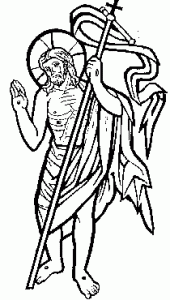
Isaiah 50:4-7 gives us a few lines about the suffering servant. This prophecy is directly connected to Christ. “I gave my back to those who beat me . . . My face I did not shield from buffets and spitting.” Our Lord has his flesh torn by scourging. He was mocked and spat upon. His own condemned him as a criminal and betrayed him. The selection concludes, “I have set my face like flint, knowing that I shall not be put to shame.” Jesus remained faithful to his Father to the last. His Father would restore him to life by the power of the Holy Spirit, and yet it was also by his own authority. The resurrection would overturn the false verdict and condemnation of sinful men.
Psalm 22 quoted by our Lord showed the depth of his agony, “My God, my God, why have you abandoned me?” (verse 2). And yet the psalm moves toward renewed conviction. Here the psalm parallels our Lord’s passion. “All who see me scoff at me . . . They have pierced my hands and feet . . . They divide my garments among them and for my vesture they cast lots” (verses 8, 17, 19). The psalm citation is fully realized. “I will proclaim your name to my brethren; in the midst of the assembly I will praise you: ‘You who fear the Lord, praise him; all you descendants of Jacob, give glory to him’” (verses 23-24). Since the psalm obviously refers to crucifixion, what can these words mean? There can be no doubt; they point to the resurrection. Our Lord would appear before his apostles in the Upper Room and they would give praise. More than this, we are the spiritual descendants of the apostles. The resurrected Christ is with us in the assembly of faith and makes possible our prayerful praise and glory to God at Mass.

Now, the emphasis is upon our witness and how the mystery of Christ changes us. Look at Philippians 2:6-11. It is literally a faith profession in Christ. God has come to save his people in Jesus Christ. The name of Jesus invokes saving power and mercy. He has redeemed us from the devil. We are his property. We belong to him.

For more such reflections, contact me about getting my book, CHRISTIAN REFLECTIONS.

Our Sins Assault Christ

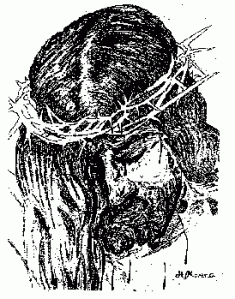
Many of my reflections touch upon the liturgical year. We can learn a great deal in our ritual, worship and the Church readings. Lent is probably my favorite time for pondering the things of faith. We have so many worthwhile opportunities. Take for instance the reading of the Passion and the ceremonials of Palm Sunday. They are so powerful that many if not most priests do not offer homilies on Palm Sunday. However, in a few words or in bulletins, much can be added to help people in their Lenten reflection. Our Lord is acclaimed with palm branches and cries of Hosannas. Nevertheless, many of the same voices that praise him will eventually cry, “Crucify him!” The drama is glorious and frightful. While we are given the ultimate example of that love of which there is none greater; we are also given a terribly real picture of human fickleness and treachery. What makes matters more intense is that we see ourselves in the Christ-story. Jesus reveals the self-sacrificing love of God. However, our own sinfulness and faithlessness is put up against the mirror. When done in a dialogue style, the reading itself puts Christ’s rejection as a criminal upon our own lips. Sometimes people object to this or remain silent. But, there is no running away from it. The Apostles tried running away, but our Lord would catch them hiding in the Upper Room after his resurrection. There is no fleeing the truth. There is nowhere to which we can run. Every sin we have ever committed, both large and small, was a denial of Christ and a hammer blow to his crucifixion. We are guilty, not just the Jews or the Romans or the few living in Palestine two thousand years ago. All of us have blood on our hands. The Church deliberately intensifies the readings and rituals to bring this home to us. Unless we come to a genuine realization of our sinfulness, then true repentance would be impossible.

The mystery of Christ’s passion and death is that he did not deserve to die. Jesus was the innocent one. As the Son of God, he was the very one slighted by the primordial sin of our first parents and by all subsequent ratification of their rebellion in our own transgressions. Finite creatures utterly dependent upon the Almighty had violated the infinite dignity of God. Instead of damning us eternally, we were promised a Redeemer. God called to himself a particular Semitic people and promised them a Messiah. They looked for the restoration of their nation. Christ would come to establish an entirely new kingdom. God himself would pay the debt we owed and could not pay. He would redeem us with his own life. Jesus had every right to curse us from the cross, instead, he would say, “Father forgive them, they know not what they do” (Luke 23:34).

The absolution of Christ from the Cross, actualized in faith and the sacraments is a great consolation to us. But, there is a qualification about which we must be alerted. Are our sins not of an entirely different caliber since we are believers? Do we not know what we are doing? Lips that have offered responses at Mass and recited the Lord’s Prayer, have also cursed, gossiped, and told dirty jokes and stories. Eyes that have looked upon the elevated host, literally our Lord raised high on the cross, have also been windows to shameful entertainment and temptations designed to arouse lust and covetous desires. Hands that grasp others in the sign of peace and receive our Lord have also engaged others in derogatory gestures, fighting, and unlawful pleasures. Minds that were gifted with intelligence that we might know God have neglected him for profane and idle learning. Hearts that were made for God alone have displaced him for a love of the things in our passing world. Palm Sunday and all of Holy Week attempts to strip away our hypocrisy and self-deceit. It is imperative that we center ourselves on that which most matters, our relationship with the God who has redeemed us in Jesus Christ. Not just for a day or season, but all year long, we should be mindful of our high calling and the price of our sins.

For more such reflections, contact me about getting my book, CHRISTIAN REFLECTIONS.

Three Hour Lunch with Priest Friends

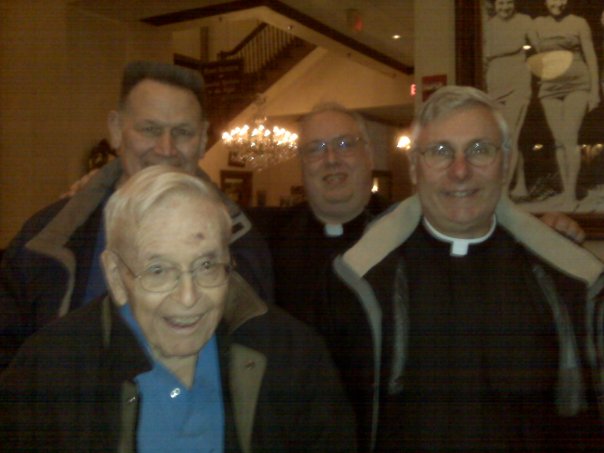
Today Fr. John Putka invited me, Fr. Joseph Pierce and Msgr. William Awalt to the Maggioni Restaurant in NW Washington. It was a great meal with wonderful friends.

Snow Buries Holy Family Parish!

Ice and snow are everywhere. Trees are broken and the power lines are sparking.

The trees are beautiful, at least the ones which survived.

Fortunately there are no rentals, actually one was cancelled, as was a funeral and a wedding. Tons of snow separate the hall from the church and rectory.

Happy Advent & Merry Christmas!

Finishing Up the Archbishop Milingo/Married Priests Debate

FATHER JOE

Exorcists are usually quiet and humble men. Archbishop Milingo was a sensationalist and evidently relished the attention he got as a spiritual healer. He left himself open for this kind of fall; indeed, in uniting with George Augustus Stallings, he has found a man with an enormous ego to match his own. Are they Catholics of any sort now, or just a branch of the Moonies? Stallings has women priests, condones all sorts of immoral practices (sexual in particular), combines Christianity with teachings and practices from Kwaanza, the Koran, and the various pagan teachings of the East. As soon as he started his own Church, he eradicated the sacrament of Penance. His religion is pelagian, pagan and utterly religious relativism. His doctrine of the Trinity is modalistic and the first person of the Trinity is called MOTHER-FATHER. The twisted version of the Creed he uses at services speaks of Christ’s birth (while the Latin of the Mother Church in Rome speaks of our Lord becoming “incarnate” which implies in the womb. He also says that Christ “becomes” a person; however, while he became MAN, he had been the Second PERSON of the Blessed Trinity from all eternity.

The issue here is more than a demand against the discipline of celibacy for priests. We see with the archbishop a profound shift away from the orthodox faith and a renunciation of magisterial authority.

CHIA

Will Archbishop Milingo surprise us next by becoming a Muslim?. As an Exorcist he could be under attack by Stan. Other Exorcists should exorcise him.

FATHER JOE

“…by STAN?” You no doubt mean Satan, although I always suspected that Stan Laurel had a dark side, not to mention Oliver Hardy. Peace!

NAZARENE

I am more than shocked to read his self-defense [from the archbishop]. How could anyone say that he loves and obeys Jesus without obeying His Church? Does Archbishop Milingo’s new discovery of marriage in his late 70’s hold water? Come on! He should be preparing for a good death (this age is biblically a bonus), not engaging the Church with his confusion.

BRUNO

The Church seems to care less about the flock entrusted to her care.

FATHER JOE

What do you mean?

The Church still ministers the sacraments and helps the poor. The Church still proclaims the Gospel, both in and out of season. And as much as it pains us in the Church, those that breech the discipline and the teachings of the living Church need censure, so that others will not be led astray.

The current story about Stallings and Milingo is less about faith and charity as it is about selfish ego and greed.

MWENYA

You have no idea how we in Zambia feel about such a great man as Milingo. We will always love him not matter what you and your cohorts say.

FATHER JOE

It is inconsequential how people in Zambia feel about the renegade archbishop.

You can love whomever you want, the fact is that the archbishop is now excommunicated from the Church and is in a new union with formal heretics.

He attempted marriage outside the Church in a ceremony conducted by the Moonies, a Church that insists that a Korean fanatic is the Messiah (and according to some sources, God).

If he has sex with the woman, then that also makes him a fornicator since he is not free to marry. May God have mercy on his soul, and all those who follow him.

DAVID

My soul is in partnership with the beloved LUTHER of our times, the beloved Archbishop Milingo. Unlike you, he sees the will of God instead of the will of man.

“YOU are JOSHUA! Let the Lord’s own enter the Promised Land under your guidance. Thanks and thanks in Jesus name. Amen.”

FATHER JOE

There must be a translation issue, for while I might associate Milingo with Luther; I would tag neither as “beloved” given their rebellion against the See of Peter and their arrogance to the Church’s teachings and disciplines. I am convinced that the errant Archbishop is not complying with God’s will, but rather is following another spirit entirely. He has undermined the sacrament of marriage by his “attempted marriage” before the false messiah Moon and any physical congress is equivalent to fornication. He takes his followers, not to the promised land of Jesus, but to the false kingdom of insurrection and dissent. Given his peculiar behavior, I have to wonder if the once famous exorcist is not now possessed by the very entities he once combatted. No thanks, is my response to his appeal, I remain with Peter and Christ, not with Milingo, Stallings or Luther!

FIDELIS

Let the Catholic faithful pray for all those who spread errors in the Catholic faith. This is unthinkable in Nigeria, and can never be supported by any of the Catholic faithful in Nigeria. Rome is the center of our faith, and we must obey the Church. Satan is at work, and we must rise up to stop the enemy from destroying the Church. May we all pray for our separated brethren— pray that they come back to the fold.

DAMIAN

Miligo is in great error— may God pardon him.

FATHER FANO (NGCOBO)

With the Archbishop Milingo saga, the whole of the African Continent is slowly but surely waking up from its theological slumber. Milingo is the kind of a bishop-theologian for which the Continent of Africa has been looking. We all know that Rome and her Fathers care much less about the Continent in all matters African. In this day and age to argue that the Roman Catholic Church has absolute truth in everything borders on ignorance and blind theological pride. Our Continent will never be the same with bishop-theologians such as Milingo and others.

FATHER JOE

Archbishop Milingo had an arranged marriage witnessed by the cult-leader Moon, and you would recommend his judgment? You are being silly. The poor man betrayed his promises to God and the Church. Indeed, Father Fano, so have you. You counted race as more important than membership in the true Church established by Christ.

You make much of your not being affiliated with Rome. Well, so be it, run away from the ROCK all you want, there really is nowhere else to go. I grieve for your parishioners. You feign Catholic Christianity and yet you are only a pernicious kind of Protestant, and one who would steal from the Roman Catholic flock. The Holy Father is the ultimate bishop-theologian, and he has begged for Archbishop Milingo to come back to his senses. He has prayed for him, too. For all we know, this renowned exorcist may have been snagged by some spiritual evil that went under the radar of his discernment. The truth of the Gospel is for all men. There is no African Church or American Church. There is only THE CHURCH in Africa or in America. The difference is important. You are nothing new. You have made yourself a would-be pope. Nationalist churches have long been on the scene and they all suffer from a narrow perspective. The Catholic Church is still growing in the Third World, despite your castigation against the good priests and religious who have ministered and even sacrificed their lives to bring the truth of the Gospel to the sheep needing a shepherd. You are NOT that shepherd. You should go back to your religious community and renew your promises. We do not need priests who chase women or the disobedient who are more wolf than shepherd.

FATHER FANO

For too long, both the Western and European theologians have sought to define us and to force us into the mold of their disciplines.

FATHER JOE

The Catholic faith allows for enculturation. However, the deposit of faith must be preserved. Discipline must be upheld. The answer is not separation or dissent. Rather, The Church in Africa is called to weave their stories and lives into that of the universal Christian faith. You cannot properly do this as a Catholic by rupturing your link to the See of unity established by Christ. You should not lie. The problem is that you, not Africans, YOU do not like to be told what to do. Poor priest, you should learn personal humility and absolute dedication to the teachings of the faith. A priest is not his own man. He belongs to the Church. You forgot that. Father Cutie defected to another faith community. You tried to start your own church. I regularly do penance for my faults; but priests like you refuse to kneel— will not submit— will not serve. There is way too much of Milton’s Satan about such fallen priests and too little of Christ.

FATHER FANO

The question is not whether the good Archbishop is excommunicated by the self-righteous Roman Catholic Institution – but the kind relevance or irrelevance the Roman Catholic Church is continually depicting in this day and age of the freedom to belong.

FATHER JOE

The Roman Catholic Church is the BRIDE OF CHRIST. She is holy because Christ is holy. Have you forgotten your first year theology about the marks of the Church? There is plenty of freedom, Father, but it can also be misused. This is behind the nature of sin, abusing our liberty and making the wrong choices, selecting apparent goods which are really evil or just not good for us. You call the Roman Catholic Church “self-righteous” because you have spurned her authority over you. If your judgment is wrong, and I am convinced this is the case, then the self-righteousness is yours. By seeking to justify yourself, you make justification from Christ impossible. You stand outside the community of salvation.

FATHER FANO

Surely, God is not identical to the Roman Catholic Church. God is God, period! So no matter whether one has membership in the Roman Catholic Church, Methodist Church, Zionist Church, etc. – is not an issue. What is vital is that one has a good relationship with his/her God.

FATHER JOE

Certainly, there is an identity between the Roman Catholic Church and the Mystical Body of Christ. In this sense, Christ shares his divinity by grace with the Church. The Pope is the Vicar of Christ and the visible head of Christ’s Church. Jesus is the invisible head. He extended his authority to Peter and promised to be with him until the final consummation. Like a good fundamentalist Protestant, you stress a PERSONAL relationship with God. And yet, while this is important, the Catholic stress upon a CORPORATE RELATIONSHIP with Christ is very much what the word “Catholic” or “Universal” is all about. Your little breakaway church and the few sects loosely affiliated with you cannot make this claim. Neither in scope nor in history can they represent the house Jesus built. We do not come to God alone. He has given us each other and the Magisterium (teaching authority) to preserve us in the truth. Yours would be capricious religion based upon human whim and African eccentricities and maybe burning loins. This is all too bad for you. I would want no part of it and most of Africa would agree with me.

FATHER FANO

There are more serious issues to address in the churches, as with racism and poverty.

FATHER JOE

Avoidance solves nothing. I am reminded of the pro-life fight. We often hear that there are other important issues. Well, it is true. But if I am a dead baby, I have no more issues. Similarly, when it comes to faith, we are dealing again with life, albeit eternal life. Should I really place social justice matters ahead of whether I will go to heaven or hell— and who I might take with me?

FATHER FANO

God bless the Archbishop!

FATHER JOE

Yes, and I pray every day that he will repent before it is too late.