An important theme for this blog is the scene in the New Testament where Jesus can be found FLOGGING the money-changers out of the temple. My header above depicts a priest FLOGGING the devils that distort the faith and assault believers. The faith that gives us consolation can and should also make us very uncomfortable. Both Divine Mercy and Divine Justice meet in Jesus. Priests are ministers of reconciliation, but never at the cost of truth. In or out of season, we must be courageous in preaching and living out the Gospel of Life. The title of my blog is a play on words, not Flogger Priest but Blogger Priest.
(Please note this is an archival post that is decades old. Msgr. Awalt passed away a number of years ago.)
Let us consider a drop of water. I have already mentioned blessing yourself with water as you enter the church. Sometimes the Penitential Rite is conducted with the sprinkling of water upon the congregation, again reminding them of both baptism and as we beseech God for mercy and forgiveness. Mercy does not mean just forgiveness; rather is is also asking for God’s help and presence in our lives– in living out the vocation He has given us.
While many drops are scattered in the sprinkling, there is a single drop of water placed into the wine of the chalice just prior to the offertory prayer. The drop of water in the wine along with the bread will be consecrated into the body and blood of Christ. The drop of water is symbolic of our union with the person of Jesus (His presence) at Mass as we go to the Father. The prayer used at the mingling of water and wine is pregnant with meaning: “Through the mystery of this water and wine may we share in the divinity of Christ who humbles himself to share in our humanity.”
What an incredible journey for this little drop of water… what a journey for us as we approach the Father through Christ!
(Please note this is an archival post that is decades old. Msgr. Awalt passed away a number of years ago.)
Incense is composed of granules that when ignited by fire from burning charcoal give off a pleasant odor, along with smoke. The prayer that is said when it is used on solemn occasions gives insight into why it is used. “May our prayer arise to you (God) with a pleasing fragrance.” Our prayer comes from lifting up our minds and hearts to God. The rising smoke reminds us of this. The sweet fragrance tells us of God’s and the acceptance of our prayers. The use of incense has taken on the added sign of honor for what and who is incensed. It may be the corpse at funerals, the Gospel book at Mass, the host in the Blessed Sacrament, or the people at Mass. Incensing reminds us of the honor and dignity of those who are incensed. “You are a chosen race, a people set part, a royal priesthood.” Incense reminds us of who we are– the delight we give the Lord with our prayer rising to His throne.
(Please note this is an archival post that is decades old. Msgr. Awalt passed away a number of years ago.)
A visitor to a Catholic church recently asked about the gesture made by the congregation and the celebrant prior to the proclamation of the Gospel. What is it? The gesture is the sign of the cross made with the thumb on the forehead, the lips and the heart. Following the Gospel announcement, it is preceded by the people’s response: “Glory to You, O Lord.” It recognizes God’s presence in the reading of Scripture. Made thoughtfully upon the forehead, the gesture means that we want to know the Word of God. When made on the lips, we indicate that we will proclaim the Word of God. Finally gestured over our hearts, it means that we will love the Word of God. The cross reminds us that sometimes to know. to proclaim and to love what we believe will entail a cost. It entails the Cross. The Cross also reminds us of the ultimate and enduring triumph of Christ. (It would help for us to look over the readings prior to Mass, and of course, to be on time to listen so that we can truly know, proclaim and love what we hear.)
(Please note this is an archival post that is decades old. Msgr. Awalt passed away a number of years ago.)
One of the first gestures you should make on entering the church is to dip your hand into the holy water and reverently bless yourself in the sign of the cross and with the appropriate words: “In the name of the Father and of the Son and of the Holy Spirit.” This is to remind us of our Baptism as we enter our Father’s house to sing His praises in the Eucharist through His Son, Jesus Christ, moved by the Holy Spirit. Our baptism is our gateway to the Eucharist. We receive Christ himself that He may strengthen the grace that we received in Baptism and provide us with the help and His companionship that we need in our journey to our Father’s house in heaven.
It is remarkable how the layout of St. Ann Church was envisioned. As you enter the church from the Wisconsin Street door, the first thing that catches the eye is the altar. Here is where the summit and source of of our Catholic faith meet. Here we see the prominent place given to what re-presents where Christ’s death-resurrection is actualized.
Behind the altar and above it comes into our vision the tabernacle. There, consecrated hosts are kept for distribution to the sick who cannot attend services. That presence has also led to the practice of adoration of Christ in the Blessed Sacrament that is growing across our country .
Above the altar and tabernacle is the large crucifix that shows us the price for our redemption. While Christ suffers no more, we are reminded of what Christ did to show us the gravity of sin and the measure of His love as represented in the figure on the Cross.
But our vision should not end on a sad note. High above the altar is the image of the triumphant Christ, the Lamb of God, who carries the banner of victory because He has conquered sin and death.
Along with the saints and angels, we and all creation come together in this beautiful church as our voices at prayer join the heavenly chorus in giving praise to God.
The city of Washington is famous for the monumental beauty of its architecture, the natural beauty of its parks and waterways and the man-made beauty found in its many museums and public buildings. Often lost among this catalogue of the city’s treasures are her churches. As befits a national capitol, especially that of a nation dedicated to the freedom of religion, many faiths have graced her skyline with spires, steeples and minarets.
Even among the smaller churches and houses of worship in the city and its environs, there are unexpected gems, symbols of the faith and devotion of the congregations that built them and worship there. One such jewel is the parish church of St. Ann on Wisconsin Avenue’s Tenley Circle. Looking to the outside, St. Ann is an impressive modern Gothic style building, calling to mind the churches of late-medieval Northern Italy. Within, the visitor perceives a breathtaking combination of architecture and decoration uncomplicated in form, and yet unmistakable in design. Through combination of stone and glass, light and air, magnificence and simplicity are as one. This is not merely a place of worship, but a place of communion for God with His people.
It might be of interest to know that the architect of the present church was Henry D. Dagit. The first church of St. Ann’s was built of wood in 1898. The second church was built of stone in 1903. There was an interim church made of stone which now serves as the parish hall built in 1938. The present church was built under the pastorate of Msgr. Henry D. Collins. It was built of stone in 1948. The third church was renovated after Vatican II when the main altar was moved down to the present position. Marble saved at that time was used to erect a support for the tabernacle. The baptistry, originally in the confessional room, was moved out and a wall was built behind it so that it would be near the main altar. This shows the the connection of Baptism as the gateway to the Eucharist. Given its present position, it also dovetails with funerals that are brought in the Yuma Street door and the words used in the service, referring to Baptism and our hope at funerals. The pulpit (ambo) was moved slightly away from the wall to its present position. The celebrant’s chair was repositioned to the side of the altar. This was done under the pastorate of Msgr. William H. Awalt.
The beautiful stained-glass windows of St. Ann Church are among the main attractions. These windows were designed by the internationally renowned stained-glass artist, Marguerite Gaudin, and manufactured at the Willet Stained Glass Studios in Philadelphia. Some of Miss Gaudin’s notable works include windows in New York’s Cathedral of St. John the Divine, the entire fenestration in the National Presbyterian Church in Washington, DC, facade windows for St. Anselm’s Meguro Church, Tokyo, Japan, and one of the largest stained-glass installations of 30,000 square feet for the Museum of Science in New York City.
(Please note this is an archival post that is decades old. Msgr. Awalt passed away a number of years ago.)
George Weigel points out in his wonderful book, Witness of Hope, page 446, that Pope John Paul II beatified (last step until canonization) 805 men and women and canonized 205 during the first twenty years of his pontificate. This is more than any other Pope in the history of the Church. A great many of these declarations were made on his trips around the world to various countries. The large numbers are partially because of his canonizations of groups of people, such as the martyrs of Vietnam.
The Church does not make saints. The Pope does not make saints. God makes saints. Our recognition of God’s work is a long process in which the lives of potential saints are studied thoroughly and in detail. Their writings are analyzed. Their reputation for sanctity is scrutinized. Miracles have to be attributed to their intercession alone and also submitted to medical and scientific study of the highest order. God is wonderful with His graces among all ages, genders, nationalities, and occupations, among the married, single and religious. Martyrdom has led to the declaration of large numbers of candidates as saints in many countries.
This is the message of Pope John Paul II– that we are all called to holiness, not just the religious and the clergy, monks and nuns. Holiness is the vocation of every baptized Christian.
Pope John Paul II’s ideal of sanctity is the martyr — the witness — to self-sacrificing love. But there are many other saints among us who will not be beatified or declared saints. They are only known to God. Nonetheless, they are still saints.
The twentieth century has just ended and according to Pope John Paul II, it was the greatest century for martyrs. Mothers and fathers, priests and religious, bishops, popes and scholars have lived in such a heroic way that the Church wants them to be recognized as saints.
(Please note this is an archival post that is decades old. Msgr. Awalt passed away a number of years ago.)
Lord is not Jesus’ first name as in Lord Jesus Christ, although we may inadvertently assume it is. “Lord” is not who Jesus is but what He is. It helps to keep this in mind in our prayers, especially at Mass and in the Liturgy. The Holy Spirit moves us to prayer. We pray to the Father and we pray in, with and through Jesus Christ. It is good to keep that direction in mind.
For instance, in the Offertory prayer of the bread, we say, “Blessed are you, Lord God of all creation.” We are speaking to God, not to Jesus as such. Usually when we invoke in our prayers, “the Lord,” we are referring to God. Jesus is Lord, the Scripture tells us, meaning that Jesus who is man, in virtue of the Incarnation, is also God. As a man, He prays for and with us and as the Second Person of the Blessed Trinity, He receives our prayers of petition, thanks and adoration, etc. Does this mean it is incorrect to pray directly to Jesus? Of course not! It is the fine distinction that every time the word “Lord” occurs in our liturgical prayers, “Lord” does not apply to Jesus, but is a prayer directed to the Triune God. Making it absolutely clear, “the Lord” does not refer to Jesus’ identity, but to what He is– “Lord.”
Keep this in the back of your mind and you will be surprised at your awareness of the Father, Son and Holy Spirit in the Liturgy. Obviously, when we use “Father” as in the Our Father or “Holy Spirit” we are directing our prayers to a person. When we use “Lord” it is usually to the Godhead, not to Jesus individually.
(Please note this is an archival post that is decades old. Msgr. Awalt passed away a number of years ago.)
Recently in speaking to theologians through the Congregation for the Doctrine of the Faith, the Holy Father (Pope John Paul II), underscored the unique role of Christ and the Church in human salvation. Given this age’s emphasis upon diversity, relativism and ecumenism, an old error may be creeping into our thinking that religious profession does not really make any difference as we all worship the same God. The Unitarians deny the Son and the Holy Spirit. Others deny the divinity of Christ. How can it make no difference? Our supreme teacher, Pope John Paul II, said that Christ’s Church is the universal sacrament of salvation. In saying this, he was only emphasizing what Vatican II taught, that the fullness of revelation is found in the Catholic Church. Christ’s unique role in salvation is the Church’s own uniqueness. “The Church is the sole means of salvation because it is Christ’s body, by means of which (Christ) himself works salvation throughout history.” Those in the Church have the fullness of salvific means. The Second Vatican Council’s document on ecumenism explicitly spoke of unity “which we believe subsists in the Catholic Church as something she can never lose.
Does this mean as Catholics we are better than others? That is for God to judge according to the grace He gives. Does it mean we are more correct than others? Yes. Does this mean we have to conscientiously look for the one true Church? Yes. Does the phrase “as long as you are happy” become an excuse for not following the teachings of Christ as prescribed by the Catholic Church? Of course not!
Let us be grateful to God for the undeserved grace we have been given to be faithful members of our Church. Let us pray that others may find the light of truth and work towards unity in the Church.
Fr. Kenneth Roberts died Thursday, December 20, 2018 around 4:50 ET in Cincinnati, Ohio. Born and raised in England, he later became an American citizen. He was 89 years of age. A charismatic and articulate priest, he easily made his early reputation as a stark defender and teacher of Catholic teaching. (Back in 1989, I got to meet him over a dinner in Birmingham, Alabama.) At the time he was filming programs locally for Mother Angelica and EWTN. His book PLAYBOY TO PRIEST was one of the works that influenced many young men to discern a vocation to the priesthood, myself included. Another notable book was NOBODY CALLS IT SIN ANYMORE. He is well remembered for his books, tapes, television appearances, retreats and support for the Medjugorje apparitions and messages.
His defunct website noted the following: “Throughout his life, Father Ken has been especially devoted to our Blessed Mother, realizing that the love and graces of her Immaculate Heart are the surest and most expedient way into the saving Sacred Heart of her son Jesus Christ. Father Roberts has dedicated his priesthood to the Blessed Virgin Mary.”
Although he traveled a great deal, he was a priest (ordained in 1966) from the Diocese of Dallas, Texas. Given credible charges of misconduct with minors, he was suspended from ministry in 1998 (November 13) by Bishop Charles Grahmann and incurred serious restrictions (such as not being able to wear clerical garb and from presenting himself as a priest in good standing). Although ordered to do so, he was hesitant or slow to terminate his national online ministry. He was especially popular with young people and his site got as many as 50,000 hits a day. When the revelations of misconduct were made public, his supporters were in utter disbelief and rallied to his defense. Unfortunately, accusations of improper behavior dated back to the 1970’s. Since 1995 he had been directed to avoid ministerial contacts with youth and men thirty years of age or younger. He disappeared into retirement, stripped of all the trappings of priesthood, even the title, FATHER. An official monitum or Church warning went out in 2007 that he was allegedly celebrating home Masses and was associating with children and teenagers in violation of his suspension and earlier restrictions. I recall one vocal critic who complained when she spotted the elderly Roberts praying quietly in the rear corner of a parish church. It looked to her that he was wearing a clerical shirt, albeit not black and without the tell-tale Roman collar. If I recall the correspondence correctly, someone may have even called him “father,” although I suspect that he was also called many other things of a far more offensive nature. My response was to remind the critic, who had every right to be upset and disappointed in the wayward priest, that we are all sinners and the Church will never close her doors to any soul seeking to make reparation for wrongs and to find healing in Christ. Given that the charges were true, maybe he was bringing the many victims to prayer? We leave ultimate judgment to God.
I was a big fan of his YOU BETTER BELIEVE IT program on EWTN. It was a wonderful show which he co-hosted with a Catholic and Protestant teenager. It spoke to the youth in a non-threatening language that they could understand. His small booklet in response to the anti-Catholicism of Jimmy Swaggert was also right on the mark. Of course, the misconduct soured or ruined the positive impact of much of what he did.
As with the many other scandals facing the Church, it is all so terrible and hard to believe. How must we respond? We must pray for victims and their perpetrators. We must seek transparency in our discipleship and shed any duplicity. We must seek justice and healing for those harmed.
His family and friends kept his passing quiet so as to avoid sensationalism. That is as it should be. The reason I posted this information was to urge all his past fans, friends and critics to pray for the repose of his soul. He was buried from Holy Cross-Immaculata Parish in Cincinnati on December 27, 2018. The Mass was celebrated by Fr. Timothy Reid. He was buried at Gate of Heaven Cemetery (11000 Montgomery Road, Cincinnati, OH 45249).
He very much believed in the power of prayer and frequently urged that we remember the poor helpless souls in purgatory. I suspect that he has now joined their company.
Funeral Mass Program – Fr. Kenneth J. Roberts
Eternal rest, grant unto him/her O Lord and let perpetual light shine upon him. May he rest in peace. Amen.
May his/her soul and the souls of all the faithful departed, through the mercy of God, rest in peace. Amen.
Remembering Father Ken… I hope and trust that he knew the graces that come with repentance. REST IN PEACE.
This is the home of the AWALT PAPERS, the posting of various pieces of wisdom salvaged from the writings, teachings and sermons of the late Msgr. William J. Awalt.





















 Notes from the Pastor [4]

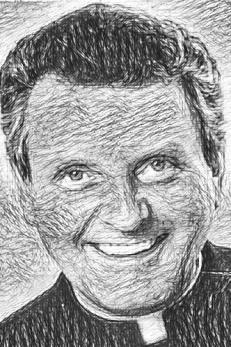 Fr. Kenneth Roberts died Thursday, December 20, 2018 around 4:50 ET in Cincinnati, Ohio. Born and raised in England, he later became an American citizen. He was 89 years of age. A charismatic and articulate priest, he easily made his early reputation as a stark defender and teacher of Catholic teaching. (Back in 1989, I got to meet him over a dinner in Birmingham, Alabama.) At the time he was filming programs locally for Mother Angelica and EWTN. His book PLAYBOY TO PRIEST was one of the works that influenced many young men to discern a vocation to the priesthood, myself included. Another notable book was NOBODY CALLS IT SIN ANYMORE. He is well remembered for his books, tapes, television appearances, retreats and support for the Medjugorje apparitions and messages.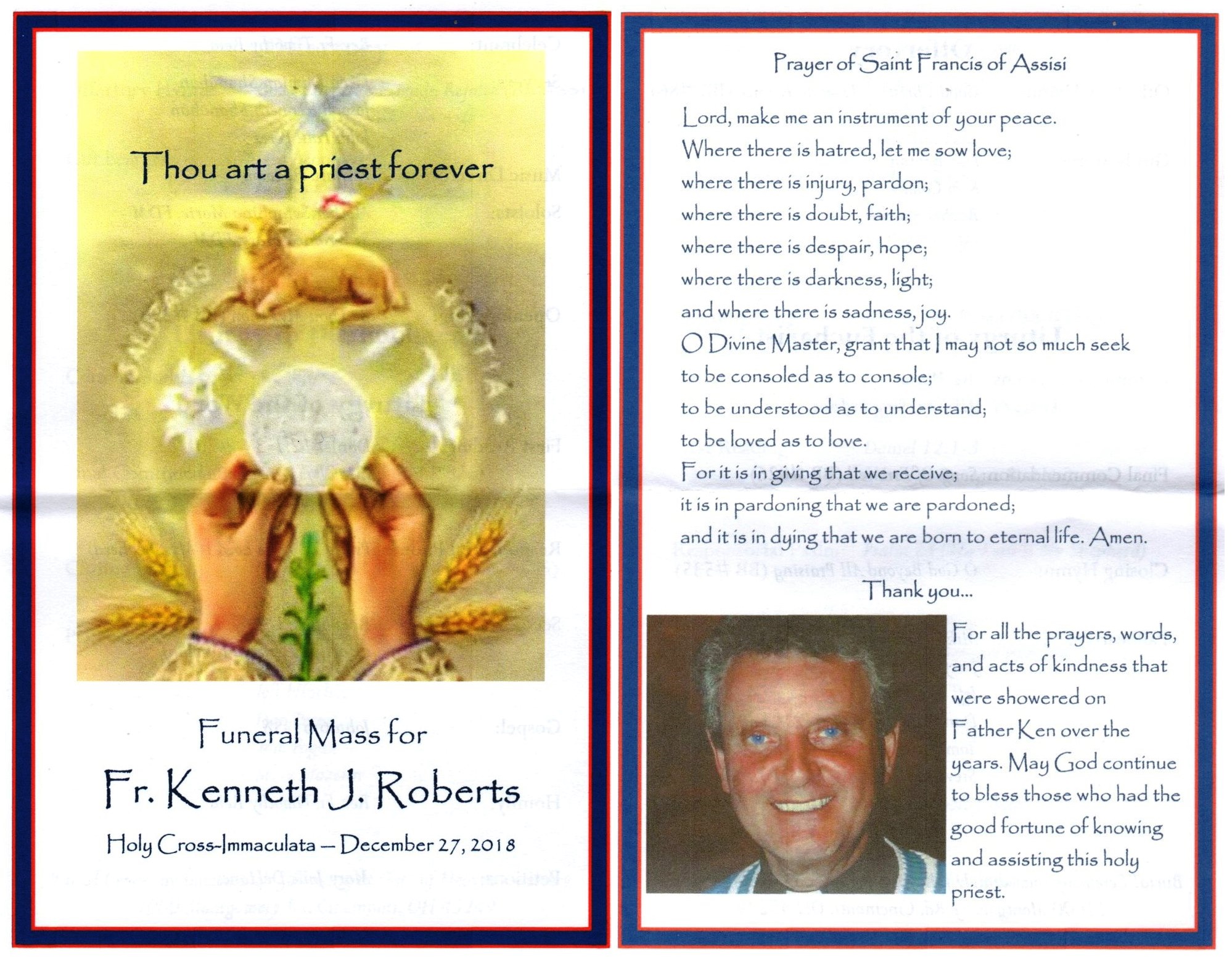




















 Blogger Priest