• Our Blogger

    Fr. Joseph Jenkins

  • The blog header depicts an important and yet mis-understood New Testament scene, Jesus flogging the money-changers out of the temple. I selected it because the faith that gives us consolation can also make us very uncomfortable. Both Divine Mercy and Divine Justice meet in Jesus. Priests are ministers of reconciliation, but never at the cost of truth. In or out of season, we must be courageous in preaching and living out the Gospel of Life. The title of my blog is a play on words, not Flogger Priest but Blogger Priest.

  • Archives

  • Categories

  • Recent Posts

  • Recent Comments

    Barbara King's avatarBarbara King on Ask a Priest
    Ben Kirk's avatarBen Kirk on Ask a Priest
    Jeremy Kok's avatarJeremy Kok on Ask a Priest
    Barbara's avatarBarbara on Ask a Priest
    forsamuraimarket's avatarforsamuraimarket on Ask a Priest

Realizing the Love of God

Read Matthew 7:7-12 and you will find a line which should never fail to touch us with the absurdity of being harsh to those whom we love. “Would one of you hand his son a stone when he asks for a loaf, or a poisonous snake when he asks for a fish?” Jesus goes on to tell us that if we who are a sinful people know how to give that which is good to our children, just imagine what our Heavenly Father has in store for us.

I wonder though, whether or not Jesus would use this analogy today? It seems that the depravity among men and women has reached such a monstrous point that even the children are no longer safe. Abortion in our society is well into its fourth decade, so commonplace that most of us hardly give it a thought. The papers and television are filled with the news of children being abused both by their parents and by those in whose care they are placed. Recently there was a story about a woman who hired a hit man to kill her husband. Another story told about children placed into animal cages. We are not talking about minor squabbles in families. All these concerns involve murder and abuse. This does not make matters easy for us who try our best in living out Christianity. Jesus taught his friends how to call God, our Father, in the Lord’s Prayer. How do we teach children about a loving Father with situations so bad, with divorce plaguing half of all marriages, or where the mother gives her favors to a different man on any given night? It is not easy.

I would encourage you all, as parents and grandparents, as uncles and aunts, as brothers and sisters, and as friends in Christ, to give the kind of witness which will make the Father’s love believable. Allow that love to shine out and to touch others through you. Do this especially for the children. God knows it is a tough enough world. We can help make it easier for them. They are the future of our nation and Church. We have to invest in them. Jesus understood this well when he said, “Treat others the way you would have them treat you: this sums up the law and the prophets” (Matthew 7:12).

For more such reflections, contact me about getting my book, CHRISTIAN REFLECTIONS.

The Pope, Condoms & Stupid People

The devil must really be laughing today. He delights in ignorance and sin. He  assuredly has had a hand in the miscommunication of the Pope’s words on condom use. The Pope seemed pretty clear to me in his opposition. But Satan delights in dissent and the numbing of consciences.
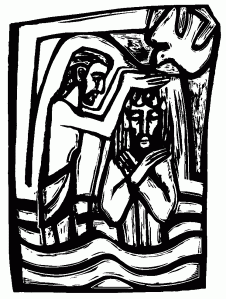
WHAT DID THE POPE ACTUALLY SAY?

The Holy Father responded to a series of questions in a book entitled LIGHT OF THE WORLD by Peter Seewald. An over-sexed world latches upon a few remarks about condoms and reads far too much into them.

When asked about the Church’s view of condom use, Pope Benedict XVI replied: “It of course does not see it as a real and moral solution.”

The Pope answered: “In certain cases, where the intention is to reduce the risk of infection, it can nevertheless be a first step on the way to another, more humane sexuality.”

He grants that the use of condoms might reflect the first stirrings of a MORAL SENSE and the desire not to harm or kill others through the spread of infection. He is not giving approval to condom use, merely to a movement away from selfishness and irresponsibility to a more mature regard for the needs and rights of others. Notice that he says this might be the “first step.” Later steps would have such a person come to awareness that condoms are an insufficient answer and that marital monogamy and/or abstinence is the way to go.

He clarifies this with an example: “There may be justified individual cases, for example when a male prostitute uses a condom, where this can be … a first bit of responsibility, to re-develop the understanding that not everything is permitted and that one may not do everything one wishes. But it is not the proper way to deal with the horror of HIV infection.”

The Pope is very clear, despite misrepresentations in the news media, that condom use is “not the proper way” to deal with the HIV epidemic.

The popular misunderstanding of his remarks reflects this papal assertion: “Becoming simply fixated on the issue of condoms makes sexuality more banal and exactly this is the reason why so many people no longer find sexuality to be an expression of their love, but a type of self-administered drug.”

WHAT DOES IT MEAN?

The remarks from the Holy Father have been sensationalized and misconstrued. The Church’s moral stand on condom use has NOT CHANGED. Condomistic intercourse is always and everywhere intrinsically immoral.

The press seems to think that the Church has changed its moral teaching, at least allowing male prostitutes to use condoms. Some idiots are actually complaining and questioning that if male prostitutes can use condoms then how about female prostitutes and those who live and act like prostitutes? One writer was upset that condoms were now permitted to all except married couples. But the Pope did not say that condoms were okay; indeed, he argued quite the opposite. He merely says that such usage might indicate the beginnings of a moral reflection. What they are actually doing is still condemned as a matter of mortal sin.

Cynics might argue that if you are going to sin then sin wisely. But the Church will never recommend sinful behavior, even to avoid other evils.

God save us from stupid people!

We pray to the Lord… LORD, hear our prayer!

I doubt you will hear this petition any time soon in our churches, but among faithful learned Catholics, it is certainly a plea we make in our personal prayers.

Media analysts and even governments need to be added to this plea. A similar ignorance led to an Islamic uproar over the Pope’s academic remarks back in 2006 in Regensburg, Bavaria when he urged a disavowal of violence as a dictated in the Koran for forced conversions. Protestors proved his point by murdering a nun and chanted, “Death to the Pope!” The Pope makes a subtle qualification about condom use and extremists on one side demand “further” compromise and on the other, chastise the Holy Father for heretical deviation. Even the Spanish government ridiculed the Pope for not going far enough, and yet the papal responses represent no retreat from the moral law. The Pope does not have the authority to declare right something which is objectively wrong. Pope Benedict XVI carefully nuances his words and many today do not have the intellectual savvy to parse his statements.

A United Nation’s top AIDS official said, “This move recognizes that responsible sexual behavior and the use of condoms have important roles in HIV prevention.” It was nothing of the kind. The Pope still rightly condemns the use of condoms as an unacceptable solution. Activists in South Africa judged the statement as a “step in the right direction.” But I repeat, there has been no change of direction. Other enthusiasts for condomistic contraception wrongly rejoiced that this will allow for population control. The Holy Father will most certainly have to offer a grade-school-level explanation of his words to these thick-headed fools. Otherwise, they will spread the lie that we shall see Church approved artificial contraception. Indeed, some voices in the press are talking about this as I speak.

God save us from stupid people!

God save us from the manipulation of truth and the oppression of Satan!

The Price of Truth

We dispose ourselves for the ever-flowing presence of Christ into our lives in the form of grace, which makes Christ alive inside us. Some thought should be given to the quality of our integrity and the substance of our fidelity.

The Gospel informs us that it was John the Baptist who fulfilled the words of the prophet Isaiah: “A herald’s voice in the desert, crying, ‘Make ready the way of the Lord, clear him a straight path’” (Mark 1:2-3; see Isaiah 40:3). The Baptizer knew well that the only path which failed to get lost in detours — the only sword which could cut through the web of men’s lies — the only life-preserver able to preserve us from drowning in our sins — was the commanding authority of the truth. Later, Jesus himself would admit to the Roman procurator Pilate that “The reason I was born, the reason why I came into the world, is to testify to the truth. Anyone committed to the truth hears my voice” (John 18:37). War weary and perhaps tired of governing a rebellious people, Pilate answered as only a stoic could, “Truth, what does that mean?”(see verse 38). And yet, despite his cold manner, he would later admit that he could find no case against this man Jesus. Had the truth begun to break through his armor of indifference or was it merely the plea of a man who no longer cared? Let truth be whatever you want it to be? So many different lands — so many different peoples and gods — so many voices — and so many varying versions of the truth; how could they all be right? Might they all be wrong? Like John the Baptist before him, the peculiar truth of this emerging God would be rejected by most, accepted by a few, and would cost Jesus his life.

The Baptizer before Christ would not easily be silenced. Learned men were sent out to spy upon him and to attempt to trick him. Herod pleaded that he would be finished with his ceaseless mutterings against his adultery with his brother’s wife. However, if the conscience of Herod had been softened by lust and ambition; the voice which stirred from the Baptizer’s soul was a reminder that the sin remained. Eventually, the wild dance of a young girl would so clutter Herod’s reason that he would make an irresponsible pledge of evil, and John’s head would be served on a platter. Jesus, the one foretold by the Baptizer, would also seek to remove the blinders from peoples’ eyes; indeed, so similar were they, that some speculated that he was John raised from the dead. The irony of those words had yet to be realized.

The only sin which would raise Christ’s ire, would be the sin of hypocrisy. His anger erupting in the temple, he called the Pharisees “blind guides!” Supposedly, they were the ones who knew the truth of God and lived it; instead, they sought to distort it in order to preserve their comfortable and respected position in society. The message which Christ preached threatened their safe and elitist life. The multiplicity of laws made it impossible for any save themselves to follow them to the last iota. Nevertheless, if they enforced a cruel scrupulosity upon everyone else; they were lax upon themselves. They failed to recall or reserved to themselves that the spirit of the law was love. Messiah or not, this Jesus had to be eliminated — this truth of his had to be silenced!

That voice in the desert and the truth of Jesus did not perish with them. Christ’s resurrection from the dead vindicated him and his prophet. His message prevailed against the verdict of sinful man. His truth would remain alive and because of its great compelling power, even take root in some of those who betrayed or sought to destroy him and his followers. Peter who denied with his lies three times ever knowing Christ, would one day witness to the truth, at the cost of taking up his own cross. Fear would no longer paralyze his thoughts and actions. Paul who had been so closed-minded to Christ that he approved of the stoning of Stephen, would be wondrously blinded by the light of truth. He would join his words to the truth of Christ: “My prayer is that your love may more and more abound, both in understanding and wealth of experience, so that with a clear conscience and blameless conduct you may learn to value the things that really matter, up to the very day of Christ” (Phil. 1:9-10). It is for that day of Christ that we prepare. To do so, we must also testify to the truth of Christ.

For more such reflections, contact me about getting my book, CHRISTIAN REFLECTIONS.

Continuing the Prophetic Witness

Someone asked me once if there were any Scriptures where a relationship between a mother and daughter was pivotal. The one that came immediately to mind was in the tragic story of John the Baptist and his execution (Mark 6:17-29). This was hardly something for emulation. Living in an age where so many teenage girls crave things like digital music, computers, shoes, cars, clothes, and jewelry — this figure of Herodius’ daughter is a peculiar one — at her mother’s urging, she wants the head of John the Baptist. I suppose times do change, if just the externals, but this seems a bit over the top to say the least.

I spoke about how the Lord gave his disciples a long list of sins to avoid. He challenged them not to be hypocrites but to be a genuine people in love with the Lord. I mentioned that such lists, if preached upon, can make us angry, the reason being that most of us do not like to be reminded of our sinfulness and weakness. We even try to keep it from ourselves. Herodias was like this, too. John the Baptist would not allow them to forget or to ignore the great sin with which she and Herod had become involved. She soon discovered that the only way to silence him was to have his head on a platter, to force her lover to kill him.

We need to be, not like Herodias, but like John the Baptist. He fully realized that we were all sinners, needing to admit this reality to ourselves and to repent. Indeed, the baptism he offered in the desert was one of repentance and conversion. We should face up to what we do and to who we are, both to the beautiful and to the ugly. If we are not honest to ourselves, how can we dare face ourselves, our neighbor, and our God with any semblance of integrity?

Sometimes to be a prophetic witness like John the Baptist will require hardship for us as well. It might mean that we will also have to die. If not physically, we may have to endure the little dyings that come when we challenge others to a more moral life and one which places God in a central position.

For more such reflections, contact me about getting my book, CHRISTIAN REFLECTIONS.

Our Call as Prophets

Ez. 2:2-5 has many interesting elements for us to consider. The Spirit of God moves Ezekiel; he says it “set me on my feet.” In other words, the Spirit compels or moves him to action. He stands before God and must be on his way to the Israelites. God, himself, admits that they are an obstinate and hard-hearted people, but this makes no difference. Come what may, Ezekiel will be the mouthpiece of God and “they shall know that a prophet has been among them.”

It is a wonderful image of the prophet for us who follow that other “son of man,” Jesus, who is also the Son of God. God calls us in our baptism to be prophets to the world. However, do we stand up and take action and speak prophetic words? Or, do we remain at rest and hope that God will change his mind or get tired of summoning us?

How are we called as prophets today? Four thousand unborn babies die in our nation each day through abortion. Do we raise our voices in protest? Do we support the local pro-life efforts and pregnancy centers? Do we lobby our elected officials and hold them accountable? Have we considered peaceful civil disobedience and marching? This is the first and most important issue facing us today, although there are others as well. Do we stand for racial integration and social justice? Do we promote marriage by our lifestyle and counsel over promiscuous and/or disoriented behavior? Do we take the high ground in avoiding and not patronizing pornography in films, television, magazines, Internet, and books? Do we dress, act, and speak modestly? Do we use language worthy of the children of God or instead use words from the gutter that corrupt lips that should praise God? Do we respect the Church’s teaching about the transmission of human life and birth control? Do we worship regularly and support our struggling churches? Do we honor our bishops, priests, and religious or do we mock and joke about the special messengers of God? Do we pray when there seems no time or we find ourselves busy? Do we defend our Church against ridicule or do we ourselves become sources of defamation against the Rock of Christ? Do we speak the truth in love to our families or smother the message under empty human affection? Have we been our brother’s keeper or have we exploited others for our own selfish purposes? If we stand up for what our faith tells us is right, then no matter whether others approve of us or not, they will know that prophets have been in their midst. If we have sometimes failed, we can follow the late Pope’s lead in making a “mea culpa” for the past and in becoming true signs of contradiction in the present. As the psalm response tells us on the 14th Sunday Mass of Ordinary Time (B), we can say: “Our eyes are fixed on the Lord, pleading for his mercy.”

Like Ezekiel, Paul is called by God and, along with a thorn in the flesh against pride, is told that divine grace is sufficient for his witness. All that matters is that we are faithful. Everything else belongs to the providence of God. The true prophet will know persecution. Paul says, “Therefore I am content with weakness, with mistreatment, with distress, with persecutions and difficulties for the sake of Christ; for when I am powerless, it is then that I am strong” (2 Corinthians 12:10). We have Catholics in Chinese prisons for their loyalty to the Pope. We have murdered Christians in parts of Africa and the Orient for daring to make converts. We have believers in American jails for saying rosaries outside abortion clinics. We have nurses, interns, and pharmacists who have lost their positions because of their fidelity to the Gospel of Life. We have children who have been silenced from mentioning God in prayer or listing the commandments in school. We have brothers and sisters in the military that have been passed over for promotion for speaking their mind in disagreeing with the liberal policy on active homosexuals in the ranks. We have Christian friends who have been punished for putting a bible or religious image on their workplace desk. Christians are fined or litigated against for wanting public religious displays of faith during the seasons of Christmas and Easter. Coalitions of Catholic and Protestant Christians are ridiculed as “far right” or “fascist,” sometimes even by those who are supposed to be Christian. The issues are many, and yet the Christian posture should always be the same: fidelity to God in the face of the faithlessness of a civilization that has turned its back on him.

It is a shame that while television programs advertising the possible winning of a million dollars or marrying a millionaire get high ratings, religious programming has virtually disappeared from the commercial and public stations. Indeed, marriage is reduced to sex and money; that which is supposed to be a sign of the covenant between Christ and his Church. The world and certain televison networks minimize it to primetime prostitution. Where are the prophets? Where is the outcry?

Mark 6:1-6 has Jesus going home and speaking in the synagogue. He laments that those who think they know him really know nothing. Their lack of faith reduced his effectiveness among those to whom his heart most wanted to embrace. He healed a few and then went to the neighboring villages instead. We have prophets in our midst, too. However, sometimes we call them fools or fanatics. People who really speak and live their faith make most of us uncomfortable. They remind us about what we would prefer to forget– our own impoverished discipleship. The great Catholic sin comes to mind, not what we have done, but what we have failed to do. Jesus is in our midst, do we recognize him?

For more such reflections, contact me about getting my book, CHRISTIAN REFLECTIONS.

Modest Swimsuits at Last!

This is a REPOSTING of a post I made back in 2007.  It is amazing how many hits the MODEST SWIMSUITS post received (30,667 hits as of today). I guess that topic is something virtuous people regularly plug into search engines in the desperate hope of finding something for themselves and for their children to wear.

My earlier post was done somewhat tongue-in-cheek and yet the concern is a real one for people. Good Christian girls might not want to disguise their beauty to the extent of some of the Moslem styles, but neither do they want skimpy outfits that are little better than all-out nudity. I suppose more mature women want suits that stress their femininity while not exaggerating the few pounds that come with age and childbirth. Given his celibacy, I joked about priests unable to go to the beach, but have things reached such a point that the beach represents a real danger to any Christian and the family? 

One final qualification, while this posting does poke a little fun, the subject matter is serious and the good Muslim ladies are a wonderful witness to modesty, with all kidding aside.  I understand that a number of people even followed the links here and gave them some swimwear business.  While I might think there coverage is a bit much, they have earned my respect for daring to be counter-cultural and cherishing both modesty and chastity. 

wildbeachgals.jpg

Yes, I am talking about the weaknesses of the flesh and acts of passion, but also about possible abuse and assault. Spiritually, there is the matter of the soul, too. Can a man admire bikini clad young girls and simply praise God for the goodness of creation? Or is a man more likely fantasizing about them? When plenty of flesh is literally delivered to the senses on a platter, a person might not need a wild imagination or much further motivation for sinful thoughts.

Similarly, women are increasingly joking about male bulges and butts. They are not immune to sexual fantasies either, and such can constitute immodest thoughts and, as with the men, even adultery in the heart. When was the last time any of us heard someone teach about the moral imperative to maintain a “custody of the eyes”?

FOLLOWING IS THE ORIGINAL POST.  I HOPE YOU HAVE A SENSE OF HUMOR.

swimm1.jpgTraditional Catholics and Homeschooling parents are always lamenting the fact that they cannot find modest swimsuits for the young women in the family. Everything is designed these days to show ballooning cleavage and legs extended past the waistline, or so it seems. It is all a very scary business, especially if there are young men and teenage boys on the beaches too. Remember, the most dangerous thing for a teenage girl is a teenage boy! Many of us have not visited beaches in years so as to preserve the custody of the eyes. Well, if you are tired of parading your young daughters to the ravenous beach wolves, there is hope in sight. It comes from a highly unlikely place, the Muslims.

Less willing to go naked as many so-called Catholics and other Christians these days, these girls also want fun in the sun, laying on the beach, and swimming in the surf. But, they do not want to forfeit their virginity or be prey to voyeurs in doing it. It is here that we can take a lesson from their book.

moslemsuit1.jpgSPLASHGEAR MODEST SWIMWEAR has been designed with loose-fitting swim shirts (yes, even that pretty neck is covered!), swim pants (legs, what legs?) and hair covers (which she can use at Mass, too!). Why these girls look almost like boys they are covered so effectively. Fathers will no longer have to worry, indeed, they can get modest swim-gear for their wives too (they come even in jumbo sizes!).

An article about these wonderful swimsuits ran in an AP (Feb 18, 2007) article by Peter Prengaman that you can read in full at the Splash Gear site:

“America is predominantly coed, and increasingly the norm is skimpy swimsuits. Enter the new-and-improved all-body suit. The suits are also increasingly stylish, with aqua to purple to hot pink colors, intricate sequin designs and miniskirts that go over long pants. ‘We want to be modest, but we also want to be fashionable,’ said Shereen Sabet, who last year founded Splashgear, an online swimwear store for Muslim women based in Huntington Beach.”

moslemsuit4.jpg

The flipside to all this is that it will help us save our young Catholic boys from corruption, too. No matter how we raise them, let us be honest, when it comes to the flesh, the male of the species is weak. Girls flirt and shamelessly show themselves off to boys, arguing that it is okay as long as they do not get the boys’ engines running. Silly silly girls, boys are born with their motors running. Sexual morality will always be what young women want it to be. If most girls set limits and said “NO!” more often, boys would accept it and be better off. These swimsuits will help…out of sight, out of mind. All the bumpy parts are covered, even down to the ankles. Strategic scarves cover necks and chins and the headgear on other outfits goes all around the chin. Some might regard the hair-guard as optional, but don’t you chance it! Who knows what a pretty neck or a rosy cheek might do to a hormonal crazy boy! The Bible talks about the allure of a woman’s hair, best to keep that under cover as well.

moslemsuit3.jpgmoslemsuit2.jpgThe Church should start its own line, and we could sell to “good” Catholics and Muslims alike. But until then, the Muslims have online and mail-order catalogues! If our kids are afraid that others might make fun of them, we can start groups that will go to pools and beaches together. Catholic homeschoolers and Muslim girls can swim together and urge authorities to force those nasty boys to go somewhere else! With strength of numbers, our families and girls can admonish the other so-called Catholic females on the beach: “Have you no shame for exposing yourselves in underwear? Protestants, I mean Prostitutes wear more clothes than you! Why don’t you save money and just wear a couple pieces of cotton thread instead of that $500 string-bikini! Your butt is fat! My newborn baby sees you and all he wants to do is nurse!” You’ll have those immodest sirens running from the beaches in tears.

swimm3.jpg

Compare this girl to the ones shown in modest-wear above! It is no comparison! This girl is nothing but temptation and sin looking for trouble. Look at her with that “come-hither” stare–disgusting!

Let us make a revolution for purity and modesty today!

On the Net:

Splashgear: http://www.splashgearusa.com/

Primo Moda http://www.primomoda.com/

Ahiida: http://www.ahiida.com/

If everyone starts wearing these new outfits, we will finally be able to take our clergy on beach vacations and not have to be embarrassed by the local sights. Take back the pools and beaches for the Lord and for us modest believers. We can make a difference! Finally we have found something worthwhile we can do with our Muslim neighbors!

CLICK HERE for Discussion About Modest Swimsuits #2

Facing the Sins of Our Lives

The message which emerges from our Gospel is sometimes quite unsettling. Take for instance Mark 7:1-8;14-15;21-23. Preachers might even be afraid to bring further attention to it because of the possible angry reactions it might evoke. None of us, myself included, like to be reminded of how imperfect, weak, and sinful we are. We create all kinds of barriers in our lives to protect ourselves from this realization. We try earnestly to project images of wholesomeness and sanctity, even when we realize that we have a long way to go.
We need to be careful not to become a people of pretense, but rather a people of true purity and holiness. This is not some goal reserved to those of past history or to those outside our materialism in poorer nations as in Eastern Europe or Latin America. We here in the capitol of one of the richest, most technological, and powerful nations in the world, we too need to place our trust completely in God, despite the distractions. Christ condemns the Pharisees by using the words of the prophet Isaiah against them, “This people pays me lip service, but their heart is far from me.” Our hearts need to belong to God. It is the only response from us that makes sense. After all, Christ in the Mass comes to live in our hearts by way of the sacrament of his very self, the Eucharist. How contradictory is this miraculous gift to the kind of sad things by which many people are enslaved.

The Lord gives us a long grocery list of the type of wicked designs which emerge from the core of the heart, things which would never allow room for Christ’s presence to reside there. In our prayer and in the sacraments, especially reconciliation, we need to root out these foreign loyalties so that there will be room for Christ to live in us. But to do this, we must also be sensitive to that which does not belong to God.

We need to be on the alert lest we deaden ourselves to the tragic infestation of sin. Throughout this great land, people of all ages flaunt a lifestyle of fornication that Christ noted as the first wicked design to condemn on his list. Perhaps this shows us how serious it is? Elsewhere in Scripture, it is said that no fornicator can have any part of the Kingdom of God. The Church could no more retract this teaching than it could reject Christ’s divinity or his resurrection. People, especially the young, give away their very persons before they even know what they are relinquishing. Our identity is a precious gift. Christ would have any who would share it in the most intimate way, to do so within the secure confines of a holy marriage — a life open to fidelity and receptive to new life.

Also on the list is adultery. If marriage is that special covenant by which the deep relationship of Christ is revealed in regard to his bride the Church, then this is a most serious transgression indeed. It is idolatry. Instead of loving Christ in your spouse, you have turned elsewhere. It undoes everything the Christian is about.

The other sins Christ mentions are also things which should send off warning lights in our lives.

Theft — how many ways, both petty and major, have we stolen during our lives? How often have we taken more than what was our due? How often have we even robbed others of their good name and dignity?

Murder — how many have never lifted a hand to prevent a young woman from destroying her unborn child? How many of us in our words and actions have killed the spirit of such women by not forgiving them afterwards? How many times have we killed others by taking away their hopes and dreams, making them a walking dead?

Greed and Envy — why must we always keep up with the Joneses and decide to insure our lifestyle even at the cost of having children? How often have we made material things into our goal instead of Christ and salvation?

Maliciousness — why is it that sometimes we look back on our behavior and try to justify our meanness?

Deceit — from the white lie and minor alteration to the black and complete dishonesty, how can we justify this as a people who follow a Savior called, “the Way, the Truth, and the Life?”

Sensuality — while not denying our sexuality, why is it so often used as bait for sinful pleasure instead of as an integral part of us? Why do we allow the passions such a free reign in our life, forgetting to mortify ourselves?

Blasphemy — how can it be that our faith and God can be insulted and so many of us fail to be agitated? Why is it that blasphemous movies can be made which distort the image of Christ as a wimpish fool and mock the priesthood and so few seem concerned?

Arrogance and Obtuse/Insensitive Spirit — why is it today that the Word of God and Tradition as interpreted by the teachers in the Church can all be ridiculed with impunity?

How is it that we can show disrespect to sacred images, articles, places, and persons? Why is it that so many of our brothers and sisters can make time for television, movies, dances, sports and other such things, and find no time for God or the Mass? Why is it that we can become callous and cold, even to the needs of others?

If these things convict us of sin, then we must be willing to recognize it and to ask for God’s pardon. He loves us all more than we will ever know. With the gift of his pardon, we will also receive his grace to avoid sin and to become more like that figure in the psalm “Who walks blamelessly and does justice; who thinks the truth in his heart and slanders not with his tongue. Who harms not his fellow man, nor takes up a reproach against his neighbor; . . .” (see Psalm 15:2-3; 3-4; 4-5).

I know a young girl who has just returned to college. To use an old term, she really is a “nice girl.” Some of her friends, especially a few boys she really likes have mocked her values and have alienated themselves from her because of what she believes. She went to church Sunday and they made fun of her. She is decent and they harass her. She called home to her folks and asked, “Mom, why are they doing this to me?” She asked this in tears because she had thought these people were her friends.

We need to pray for such young people who struggle courageously to maintain their faith and values. We know how deeply it can sometimes hurt. It would be good for us in word and example to continue our prophetic witness of Christ’s kingdom breaking into the world; and to pray for ourselves and such young people who need our love and encouragement.

For more such reflections, contact me about getting my book, CHRISTIAN REFLECTIONS.

Conscience and Conduct

Many parishes celebrate “Come Home for Christmas” and “Come Home for Easter” reconciliation services. Of course, Confession is available all year long. Priests delight in being ministers of reconciliation. The Christian regularly needs to examine his conscience and behavior.

We do this, not in light of some nebulous feeling or even according to the values of the majority of our peers; we do so in comparison to the standard of Christ and his Church. In season and out, popular or not, the truth is proclaimed.

The first realization which must dawn upon us is that we are all sinners. From the last harsh word we uttered to the little lies we tell; from our lack of preoccupation in the liturgy to our passivity regarding the murder of the child in the womb — we are sinners. We need to be honest to ourselves and to God about that fact. In our consciences, we very often try to run away from this reality; after all, it is an admission of imperfection. However, humility requires this acknowledgment, even if satanic pride would deny it.

I use the word “satanic” here because I believe it is all too easy in our lax consciences to reduce all sin to the level of a simple fault, a mistake, or a stumble. All of these words fail to take into consideration that sin is more than our merely tripping over our own feet. We sin because there is a part of us that chooses to do it, likes doing it, wants to do it some more, and will seek to hide it. There is a malicious and wicked quality to it. Sometimes we might be so good at hiding our sins that we even hide them to ourselves. We rationalize that “everybody’s doing it” or “that I am not a saint.” And yet, if we are following in Christ’s footsteps, it was for going against the former that Jesus was put to death and for the latter that he allowed his passion and death. We are all called to be holy and his grace can make this seemingly impossible goal obtainable.

This leads us to our second realization, that if we are sinners, we have not been left to despair and to die in our sins; Jesus offers us the grace of his presence, a presence of healing, peace, and forgiveness. Here too our consciences must not collapse between the tension of either being lax or scrupulous. Our appreciation of sin and the sense of guilt or remorse which brings us to confess and seek pardon is a noble human gesture. However, once that forgiveness of God is given, we must forgive ourselves as well. We need to believe that God does what he claims to do. When Christ forgives our sins through the instrumentality of the priest, healing us and dissolving our breach with God and the community, the slate of our lives is wiped clean. Like a newborn baby we are made new. Temporal punishment may remain and so we are given a penance; but our standing in the Church and before God is healed and restored.

Although the seal of confession prevents me from naming particulars, the habit (no matter how rare these days) of keeping mental or written lists containing hundreds of particular sins, big and small, throughout the week, demonstrates an obsession with one’s sins, a sense of inferiority and depravity. We need to believe that God has made us wondrous creatures to behold, a little less than angels. When I was a teenager, I was so scrupulous that I even thought my feelings, beyond my control, were sins calling for remission.

Our sexuality, one of God’s greatest gifts to us, is sometimes cursed among supposedly chaste people because of the intensity of an attraction to others. Can we not praise God for his creation and leave evil thoughts behind? Even at Saint Peter’s in Rome itself, the beauty of the human form is displayed in great works of art. Having said this, it occurs to me that sexuality is one of those issues which we have to keep in tension. If we are not to be scrupulous about it, we must also not be lax. The commandments of Scripture and the natural law more than suggest an objective norm in living out our sexuality, reserving its fullest expression to marriage and in mandating that it always nurture fidelity and new life. I could have spoken at length this way about any of an assortment of concerns and sinful extremes, but it does seem that sex is the most popular topic these days.

If the lax conscience sins by presumption of God’s will and mercy; the scrupulous sins by questioning and even rejecting his forgiveness. We may fall into certain regular or habitual sins that need to be confessed; but, why tell the same sin committed many years and tears ago, over and over again? [I am not talking here about a general confession which seeks to examine the general thrust or orientation of our life.] Could it be that sometimes we do not believe that God can do what he claims? God does not forgive as we often do. Frequently, our offer of forgiveness is tainted by a threat or warning, “Okay, I’ll forgive you this time, but next time, pow!” When God forgives, he acts like he forgets. The all-knowing God puts our sins behind him, and no longer looks upon them. Perhaps we would do better if we tried to forgive in the same way? Years ago, I was watching the 700 Club on TV and there was an interview with a couple whose teenage son was ruthlessly murdered by another boy for what little pocket change he carried. In our own hearts, how many of us would have wanted to respond with violence in kind? They did not; instead, this young murderer, an orphan of the streets, was regularly visited in jail by only two people, the murdered boy’s parents. They prayed and even forgave him. The youth accepted Christ. They fought for his release and when that day came, they took him home and made him their own. How many of us could have done that? Perhaps that shows how much more conversion we still need?

We killed God’s Son by our sins, and yet he forgives us. Oddly enough, no matter how prayerful and devout, the failure to forgive ourselves may be the most dangerous kind of sin of all. How some people must hate themselves! I mean that. Only hate could make people rehearse their past transgressions in their minds over and over. Have they grown to desire the pain it brings? I do not know. If the lax have made themselves fools to their passions of self-love; the scrupulous have become slaves to their own self-loathing. Christ would have us be free. He would have us responsibly love ourselves as precious in his eyes because he has first loved us. Indeed, unless we love ourselves in this way, what becomes of the commandment, “To love your neighbor as yourself?”

I would like to say a few more precise things about conscience. It is neither the comical stereotype of an angel whispering on one shoulder and a devil on the other nor an arbitrary feeling that something is either good or bad. Conscience is an attempt of the mind to make an appropriate judgment about whether an action is either right or wrong. True judgment demands knowing the facts and deliberation over them prior to action. Odd as it may seem, we are obliged to follow our conscience even when a false judgment is made. However, as soon as we learn otherwise, we must accordingly adjust to agree with a now properly formed conscience. Judgment can be flawed for all sorts of reasons; we might be perplexed, coerced, scrupulous, lax, etc. We suspend judgment when in doubt and do not act until a certain conclusion has been reached. The Church maintains that conscience needs to be properly informed and a judgment must be made according to the appropriate law, i.e. natural law, Ten Commandments, and the law of love.

In all visible creation, only human beings have been called by God to accept responsibility for their actions. Neither pre-programmed robots nor animals of blind instinct; we have been given free will and an intellect capable of discerning God’s design from the natural order and revelation. Unhealthy extremes in conscience would include the static which would have the Church spoon feed everything, dismissing the enlightening power of God’s Spirit and responsibility; and the dynamic conscience which would go to the other side in embracing revolution or even rebellion in actions. These are the people who think the Church and its bishops are always wrong until they say something about which they agree. No one can tell them what to do, even God and his Church! The true path of conscience is between these two and is surmised by a 1973 document from the Canadian Bishops: “We can qualify this as the dynamic Christian conscience. This is the conscience which leads us to have a responsible attitude to someone, to Jesus, to the community, to the Church, etc. Every person who fits into this category feels a responsibility for a progressive search and striving to live out a life ideal according to the mind of Christ” (Statement on Formation of Christian Conscience #22).

We need to examine our consciences. Look at the blind spots in your life. Only you can make the resolution to change for the better. The power to loose and bind from sin, given to the Apostles, is not a principle of enslavement but of freedom. “The truth will make you free” (John 8:32).

For more such reflections, contact me about getting my book, CHRISTIAN REFLECTIONS.

Muslim Cleric Says Rape Impossible in Marriage

Muslim cleric  Sheikh Maulana Abu Sayeed tells a reporter on THE SAMOSA website:

“It is not an aggression, it is not an assault, it is not some kind of jumping on somebody’s individual right. Because when they got married, the understanding was that sexual intercourse was part of the marriage, so there cannot be anything against sex in marriage. Of course, if it happened without her desire, that is no good, that is not desirable. But that man can be disciplined and can be reprimanded.”

We as Christians often speak about our beliefs and our witness as signs of contradiction on behalf of the Gospel. Where the Judeo-Christian faith once heavily informed Western culture, there is today increasing tension and conflict. Scandal has made the situation even more critical, not only the past presence of predators among certain clergy but the passivity of many of the laity toward deviant lifestyles and the mass destruction of the unborn. However, although individual Catholics fail to be everything they are supposed to be, the Church stands for the dignity of the person and for justice. More aberrational and sometimes in conflict with our views from another angle is the rise of Islam in our society. The tendency toward religious relativism is hard-pressed to sustain itself in light of a religion where many still espouse forced conversions and the subjugation of women. As one secular critic remarked, “In light of Muslim rigidity, maybe we did not have it so bad under the Church and the Pope?” I would contend that the best of our values and the most objective truths about things are gifts from the Church and developments from the Good News of Christ. We should be careful not to stereotype religions and their adherents, but there should also be a critical honesty in reference to them.

This morning there was a MSNBC headline which brought this point home: “U.K. cleric: Rape is impossible within marriage.” I can imagine some readers looking at this and immediately asserting about the danger of Islam, “I told you so!” The topic itself is a difficult one to discuss. Over the years I have had to counsel women who were assaulted. Many think it is all about sex. Actually, it is more about violence and wrongfully asserting power over another. Such crimes are extremely serious and should not be taken lightly. Many women take years to heal and some scars may well be permanent. It is a sin that might leave bruises, but more than this, it wounds a person’s soul and destroys trust. It is also a very prevalent crime, often unreported.

Given the many sexually laden influences around us and massive promiscuity, it is often hard or impossible to prove that such encounters were not consensual. When purity was more of a premium, the righteous anger and justice of society against the violation of a virgin and another’s wife was swift and severe. Today, it is suggested that a third of teenage girls under 18 have endured attempted date rapes. Forgive me for a moment more, as my mind frequently wanders, but I also recall a situation where a diminutive young man was ridiculed for bringing up charges against a woman for raping him. He became the butt for all sorts of jokes. As one sick person remarked, “Men might be rapists, but outside of gay sex, men cannot be raped.” I would categorize such a critic as “sick” because he can envision a man as an abuser but not as a victim. Such a person is very dangerous.

Looking at the news article today, I suspect there are many other “dangerous’ people as well.

The Imam in question is not a wildcard or a rare fanatic. Sheikh Maulana Abu Sayeed is the president of the Islamic Sharia Council. He is a leading Muslim cleric in London. We are often told that we have nothing to fear from the “real” Islam, well the rape of human beings is pretty serious and word games make it no less so. The controversy is simple. Speaking as a teacher of his faith, he argues that it is impossible for a husband to rape his wife. Consequently, he says that the husband should never be prosecuted by law for raping his wife. The most we can request, he continues, is that the husband ask her forgiveness for any roughness. He concludes that should be enough. He is right that “sex is part of marriage,” but as I said earlier, this is a crime of violence. He explains on the Samosa website, “Maybe aggression, maybe indecent activity… Because when they got married, the understanding was that sexual intercourse was part of the marriage, so there cannot be anything against sex in marriage. Of course, if it happened without her desire, that is no good, that is not desirable.” He qualifies his remarks, but take note of the use of “maybe.” There is NO MAYBE about it. He does not believe a husband can rape his wife— period. He would have it that women should have no recourse to the authorities for justice and protection!

Illegal in Britain since 1991, this basic protection for married women would probably be stripped away by Islam. Proof of such an eventuality is in how Islamic countries so often treat their women. We have read the stories. Apologists would say that we do not understand and that they are isolated incidents. But the fact is that the problem is systemic and that even one such tragedy is too many. Women, married are not, are not property but persons with a sacred dignity, worth and calling. Husbands and wives are helpmates and companions. While they have different roles in the home, there is never an excuse for brutality or for oppression. Christians may view the husband and father as the head of the home but the wife is the loving heart. That heart must always be treated with respect and gentleness. They give each other to one another. They belong together. They are as the Scriptures remind us, one flesh. One commentor observed, “A religion which permits multiple wives and utterly subjugates them under the husband’s authority is jarring to our culture but also to the sensibilities of Christians.”

The cleric continued, that if the husband “does something against her wish or in a bad time,” he “may be disciplined, and he may be made to ask forgiveness. That should be enough.” Again, look at how carefully he couches his language. The conditional “may” is used again and again. These are hesitant allowances, but really he is giving up nothing about his view.

He is really saying that husbands have a right to rape their wives, but afterwards, if they feel like it, they can say they are sorry. Maybe they can give them flowers? Of course, they can rape them again tomorrow, and do so with impunity. But you wait and see, there will soon be people defending the cleric and brow-beating “intolerant” secularists and infidel Christians for criticizing him, the Koran and Islam.

Islam is a religion of the LAW. What the cleric is giving us is a legal definition and interpretation of rape under Muslim law. He told The Independent, “In Islamic sharia, rape is adultery by force. So long as the woman is his wife, it cannot be termed as rape. It is reprehensible, but we do not call it rape.” At least he calls it “reprehensible,” but still it is regarded as not something that can be prosecuted.

Although I am increasingly tempted toward cynicism, I am still hopeful that we will hear sane voices from Islam, Christianity and the secular world about this question.

Out of curiosity, I went to DICTIONARY.COM and looked up the definition of rape. The first entry reads: “the unlawful compelling of a woman through physical force or duress to have sexual intercourse.” A secondary entry omitted the reference to gender. I would elaborate that it also refers to a lack of consent. Husbands and wives should want to share the marital act, but sometimes because of the spacing of children, fatigue and illness, there should be a measure of restraint and understanding. The marital act is a duty of their state and hopefully a joy open to the generation of new human life. Respecting human dignity, consent needs to be present.

Apart from the question of married couples, it should be added that some like children and those mentally challenged need to be protected because they cannot lawfully give consent and get married.

A Modest Wife