• Our Blogger

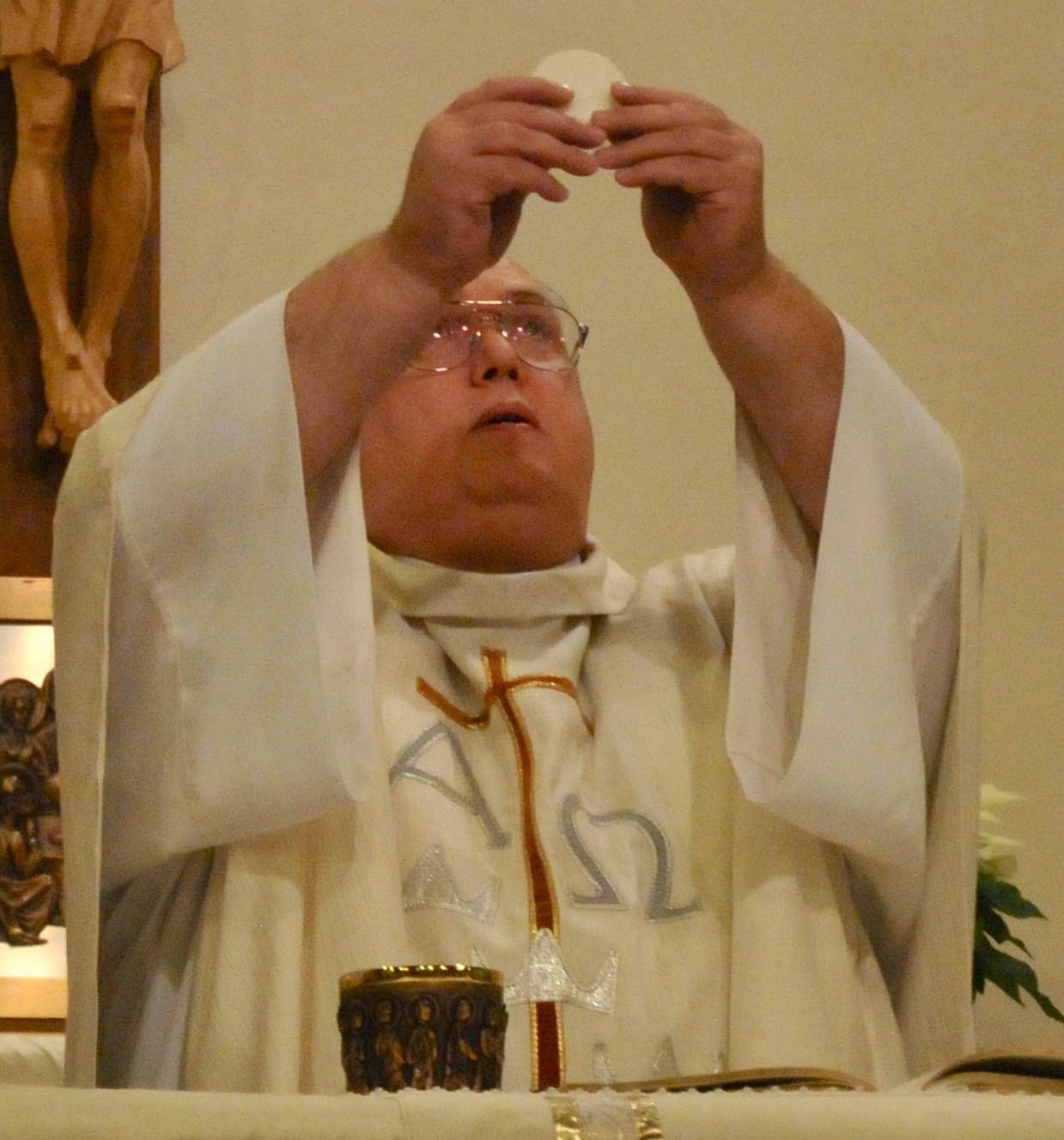
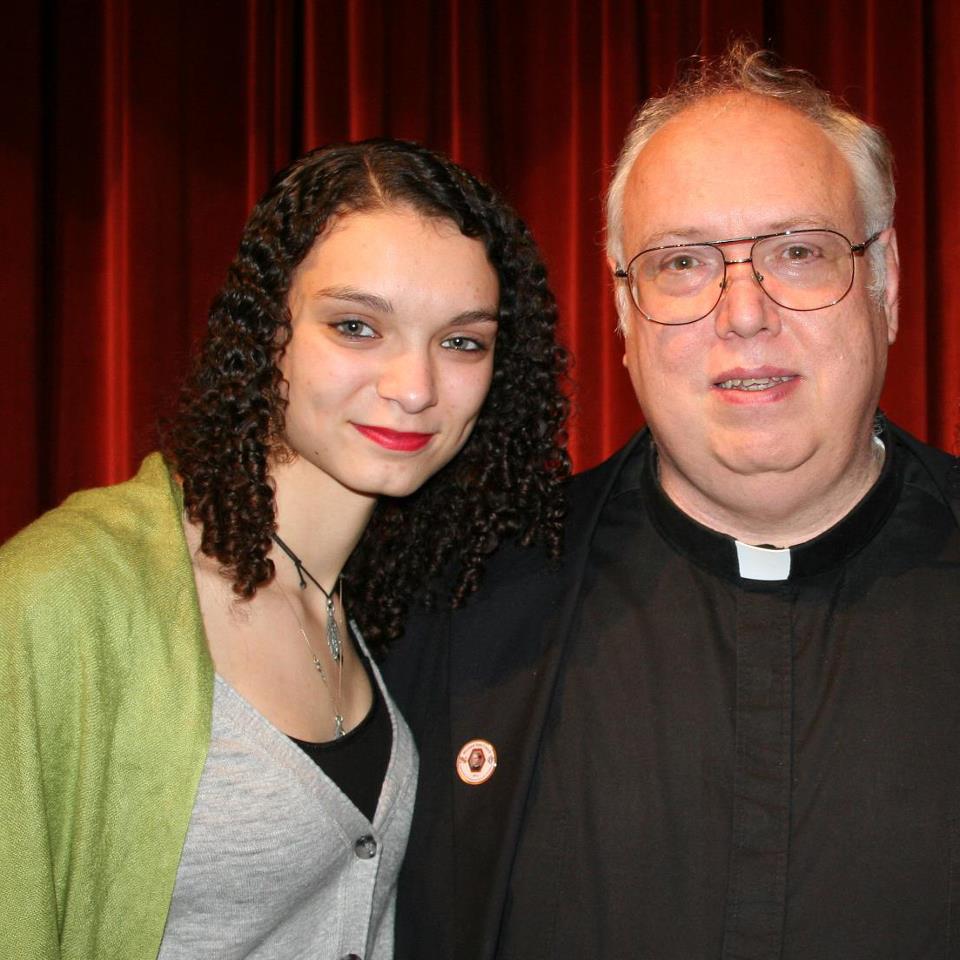
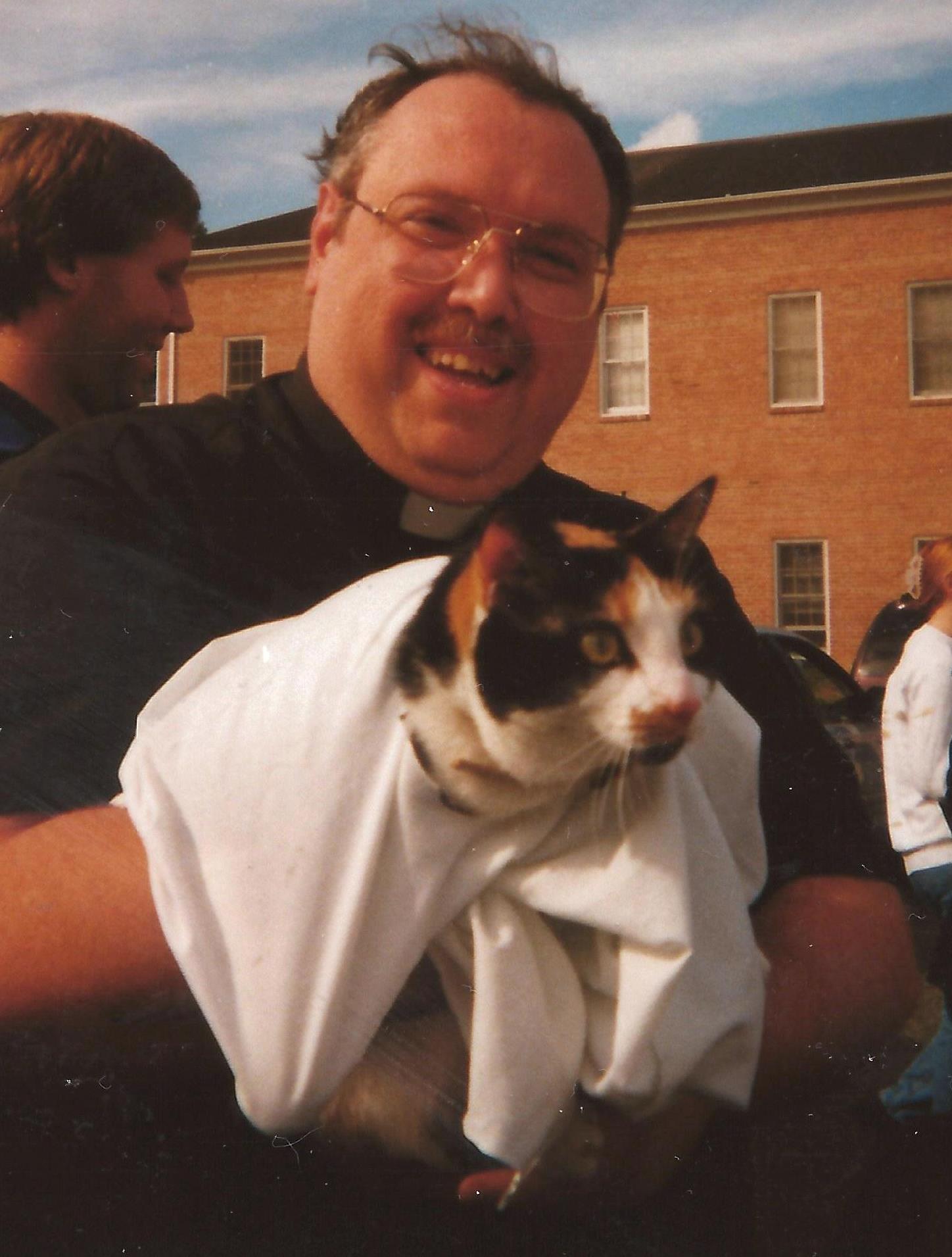
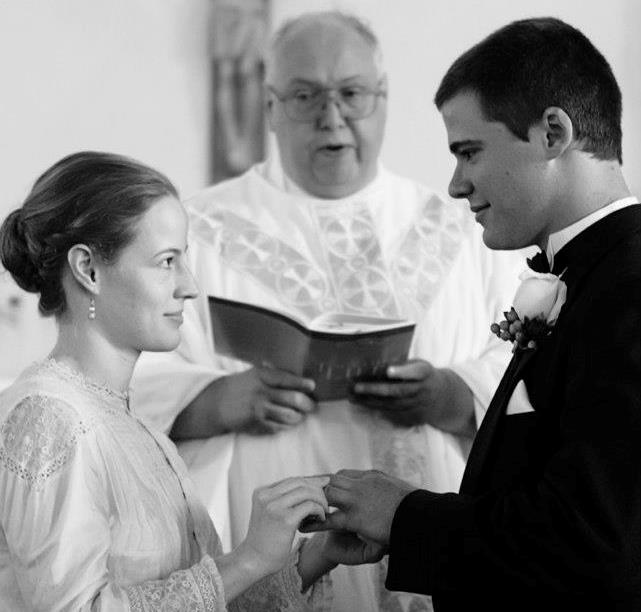
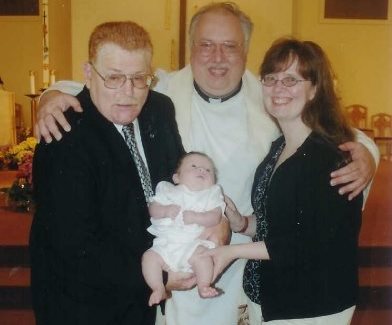
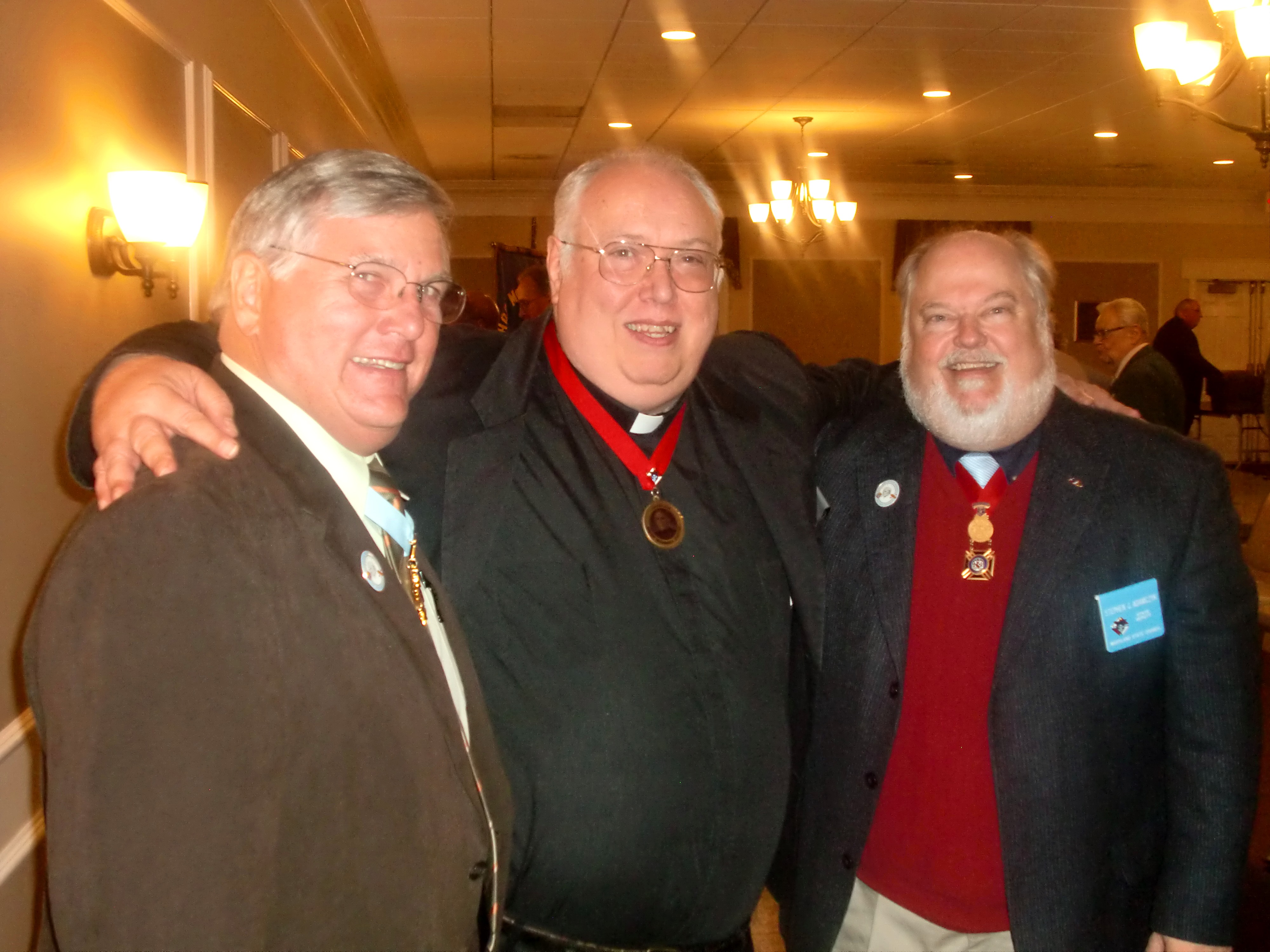
    Fr. Joseph Jenkins

  • The blog header depicts an important and yet mis-understood New Testament scene, Jesus flogging the money-changers out of the temple. I selected it because the faith that gives us consolation can also make us very uncomfortable. Both Divine Mercy and Divine Justice meet in Jesus. Priests are ministers of reconciliation, but never at the cost of truth. In or out of season, we must be courageous in preaching and living out the Gospel of Life. The title of my blog is a play on words, not Flogger Priest but Blogger Priest.

  • Archives

  • Categories

  • Recent Posts

  • Recent Comments

    Anonymous's avatarAnonymous on Ask a Priest
    Michael J's avatarMichael J on Ask a Priest
    Jeremy Kok's avatarJeremy Kok on Ask a Priest
    Mike Zias's avatarMike Zias on Ask a Priest
    Jeremy Kok's avatarJeremy Kok on Ask a Priest

Appreciate Priests & Look to Saints

“Today as then, the infidelity and ingratitude of Pastors has repercussions on the poorest of the faithful people, who remain at the mercy of strangers and idolaters.”

01popenews

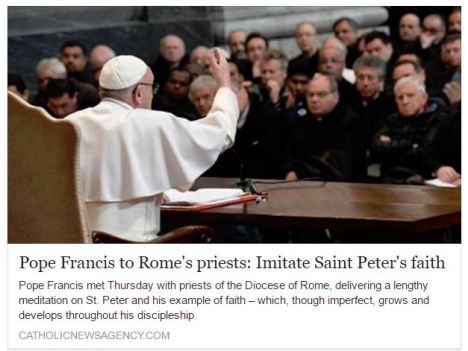
Pope Francis to Rome’s priests: Imitate Saint Peter’s faith

He might get his point across but his attacking-style does not help morale. Instead of always criticizing or even insulting clergy for their faults, he might have better fruits in his reform efforts by showing appreciation for their good works and by highlighting the witness of priestly saints.

Reflecting on a Papal Homily

I wanted to give some extended thoughts about the papal homily on Friday.  The Gospel reading was from Mark 10:1-12:

“Jesus came into the district of Judea and across the Jordan. Again crowds gathered around him and, as was his custom, he again taught them. The Pharisees approached him and asked, ‘Is it lawful for a husband to divorce his wife?’ They were testing him. He said to them in reply, ‘What did Moses command you?’ They replied, ‘Moses permitted a husband to write a bill of divorce and dismiss her.’ But Jesus told them, ‘Because of the hardness of your hearts he wrote you this commandment. But from the beginning of creation, God made them male and female. For this reason a man shall leave his father and mother and be joined to his wife, and the two shall become one flesh. So they are no longer two but one flesh. Therefore what God has joined together, no human being must separate.’ In the house the disciples again questioned Jesus about this. He said to them, ‘Whoever divorces his wife and marries another commits adultery against her; and if she divorces her husband and marries another, she commits adultery.’”

The Holy Father stressed in his homily that Jesus “doesn’t respond as to whether it’s licit or not; he doesn’t enter into casuistic logic.”  We are told that the question was a trap.  It had previously circulated what Jesus would say.  At the Sermon on the Mount where he gave us the Beatitudes, he had already stated:  “It was also said, ‘Whoever divorces his wife must give her a bill of divorce.’ But I say to you, whoever divorces his wife (unless the marriage is unlawful) causes her to commit adultery, and whoever marries a divorced woman commits adultery’” (Matthew 5:31-32).  The rejection of the authority of Moses might be interpreted as opposition to God.  Our Lord avoids the trap of this charge (their “casuistic logic”?) by placing the question in the context of creation and not the Mosaic Law.  Divine authority has precedence over that of Moses, who makes a human decision to allow a writ because of their hardness of hearts.  Our Lord, as he so often does, re-frames the question, “Is it lawful for a husband to divorce his wife?” Much more fundamentally, he answers that marriage is the enduring reality or truth and that there is no such thing as divorce.  That is why he can so immediately associate divorce with adultery.

Is this faithful to the text?  It seems clear here and even more so in the Gospel of Matthew that while Jesus does not fall for the tricky question, he does render a response that goes beyond the given parameters— beyond Mosaic or Church laws— adding his voice to natural law.

When I reflected on the Scripture text, I had to wonder if Moses did what many of the bishops and theologians are trying to do today— to sidestep a teaching that seems too difficult and arduous for many to follow.  I do not believe that the various requests for clarification from the Holy See are attempts to trick Pope Francis.  The requests are coming from his friends who likewise love him, the Church and Christ.  The question was “Is it lawful for a husband to divorce his wife?”  Jesus’ response was clear.  He cannot abandon her because there is NO such thing as divorce!  When his apostles ask about it, Jesus is blunt— the human construct of divorce leads to adultery.  Note that our Lord does not shy away from using the word, “adultery,” a biblical term that certain churchmen are insisting we avoid so as not to hurt feelings; thus we now speak of couples in “irregular unions.”  I hate to say this but the casuistry seems to be on the other side.

The new question can be framed very simply.  “Can and should couples who are cohabiting and/or living in adulterous situations be invited to receive Holy Communion and be given absolution in the sacrament of Penance?”  There are only a few responses that respect the constant truth and teachings of the Church:

(1)  If the care of children or the needs of the partner demand that the couple remain together, and if there would not be dire scandal, an internal forum solution might be permitted where the couple live as brother and sister.

(2)  While it might seem severe or heartless, given the gravity of adultery, the Church could rightly insist that the couple separate.

(3)  The members of the irregular union might seek an annulment of the prior bond; if granted, the union could be regularized with a convalidation.

(4)  If an annulment is not possible and the couple cannot separate, they would be urged to attend Mass but not invited to take Holy Communion.  If the prior spouse should die then the marriage could be convalidated.  If the irregular partner should die, the remaining member could be absolved in Penance and again take Holy Communion.

The option being argued the Malta bishops and by Cardinal Coccopalmerio is not one that reflects the perennial teaching of the faith, or more recently that of Pope John Paul II.  The Cardinal directly teaches that if the adulterous and/or cohabitating couple means well, then they could be invited to take Holy Communion.  While this might appease the subjective and make people happy at the moment; objectively it would constitute the sin of sacrilege as the couple in mortal sin are not disposed to the graces of the sacrament.  There must be contrition and amendment of life.  Both here are compromised.  While adultery might still be regarded as sin, such a change in discipline would wrongly indicate that it was no longer regarded as serious or even mortal.  Given the growing dissent, we need Pope Francis to give a magisterial answer to the confusion that emerged from his exhortation.  That answer should also reflect continuity in discipline and teaching.  Indeed, all he has to do is assert that Cardinal Müller has spoken for the Holy See.  The good Cardinal recently asserted that those in irregular unions who want to receive the sacraments must practice “perfect continence.”  He further stated:

“For us marriage is the expression of participation in the unity between Christ the bridegroom and the Church his bride. This is not, as some said during the Synod, a simple vague analogy. No! This is the substance of the sacrament, and no power in heaven or on earth, neither an angel, nor the pope, nor a council, nor a law of the bishops, has the faculty to change it.”

Adultery is serious, not simply because of infidelity between spouses; it spiritually ranks up there with idolatry.  Christ identifies himself with the beloved.  Betrayal of a spouse is betrayal of Christ.

Is It Only a Matter of Legal Casuistry?

1907663_articolo-1

Pope Francis: In God there is both justice and mercy

The Pope in his homily of February 24, 2017 said that we should not become obsessed with the “fine points of legal interpretation.”  What were these objectionable fine points?  When I asked a local churchman whom I admire, I was lectured on how canon law was only about a hundred years old and not integral to the lasting faith of the Church.  But I never mentioned canon law.  I just wanted reaffirmation about basic right and wrong.  The Catholic definition of faith was always in terms of charity and obedience.  Thus the laws of God will always be crucial to our overall discipleship.  Jesus might have said, “Woe to lawyers,” but his ire was the gravity given human laws above divine laws and placing unwieldy burdens upon people who were struggling to be faithful.  It was not a renunciation of the Decalogue or Christ’s two-fold commandment or his singular treatment of the divorce question.  It is true that Jesus sometimes seemed to raise the bar but always with the assurance that his grace would lighten the load, even as we took up our crosses to follow him.

Perplexed by the Pope

popehomily

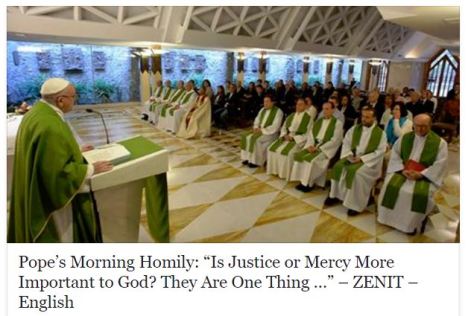
Pope’s Morning Homily: “Is Justice or Mercy More Important to God? They Are One Thing …”

Today the Holy Father preached on Mark 10:1-12. Many of us had hoped the homily would give clarification to questions about Amoris Laetitia. The Pope was both technical and obscure (difficult to decipher.)

He said that the path of Christ was integration of mercy and justice, not legal reasoning. What did this mean? Here are some quotes:

  • “When temptation touches the heart, this path of exiting from casuistry to truth and mercy isn’t easy, it needs the grace of God so we can go forward in that direction.”
  • “A casuistic mentality would ask, ‘What’s more important to God, justice or mercy?’ That’s a sick way of thinking. There aren’t two things, only one. For God, justice is mercy and mercy is justice.”
  • “The Lord helps us understand this path, which isn’t easy, but it will make us happy, and will make lots of people happy.”

He connects justice and mercy and yet they are distinct concepts. Christ will bring both judgment and salvation. There will be the separation of the lambs and the goats.

What exactly is this path he is talking about? Is it life in general? Is it accompanying couples in irregular unions? More than whether it is easy, is it a valid path? Why will we all be happy about it? Our Lord talks about the path to life and the road to perdition. The Church has always taught that we need to be cognizant about our footsteps or direction, following Christ on the so-called “road less traveled.”

Amoris Laetitia, Recent Synods & Teaching on the Family

Cardinal Donald Wuerl, Archbishop of Washington and Chancellor of The Catholic University of America, addresses students on Wednesday, April 27, as part of University President John Garvey’s class on “The Virtues.” In the talk, “Amoris Laetitia: The Recent Synods and the Church’s Ancient Teaching on the Family,” Cardinal Wuerl discusses Pope Francis’ recent exhortation on the family, specifically the many challenges contemporary families face and the Church’s pastoral response.

Good Seminarians Expelled, Say It Isn’t So!

sem

Malta’s Archbishop: Seminarians Can Leave if They Don’t Agree With Pope Francis

I never thought I would see the day when men of true faith and obedience, and yet struggling to understand the interpretation of a “progressive” pope, would be shown the door.

In a World of Violence the Holy Father Targets Texting?

popetext

Pope Francis Warns Young People: Texting During Meals Is the ‘Start of War’

Huh? Rude yes, but the start of war? The stronger case would be made by Mother Teresa, and not about texting, but about abortion. She stated: “Any country that accepts abortion is not teaching its people to love, but to use any violence to get what they want.” Similarly, she told us, “The greatest destroyer of peace today is abortion, because it is a war against the child.”

There are many disconnects that I fail to follow. Large scale Islamic terrorism is denied and yet impolite kids texting at the table is critiqued as threatening war. Greater gravity is apparently given to theories of ecology and global warming than to the perennial praxis of the Church in support of Christ’s commands about fidelity in marriage. If the news is to be believed (and that is a major assumption) then orthodox churchmen are being censured while dissenters are promoted and leniency is shown reprobates, notorious sinners and the hardened enemies of the Church.

I love the Holy Father and the Church… but he has to make a clearer and more coherent case.

Battling Churchmen, Confusion & a Seismic Shift in the Church

muller

Cardinal Müller: Communion for the remarried is against God’s law

Cardinal Müller, German bishops clash on interpretation of Amoris Laetitia

Cardinal Müller stands up for the truth! “For us marriage is the expression of participation in the unity between Christ the bridegroom and the Church his bride. This is not, as some said during the Synod, a simple vague analogy. No! This is the substance of the sacrament, and no power in heaven or on earth, neither an angel, nor the pope, nor a council, nor a law of the bishops, has the faculty to change it.”

comp

Vatican’s top legal aide says divorced-and-remarried may receive Communion

Cardinal Müller and Cardinal Coccopalmerio seem diametrically opposed. Do we need further proof of confusion?

I am increasingly disheartened about this. It makes me want to run to a monastery and turn my back on the whole business. I am sorry but I cannot see how such convenient semantics can possibly serve the truth that comes from Christ’s lips. Is it not a slap in the face to heroic Catholics who embraced the moral life despite great sacrifice and loss? I feel Muller is right but will he win the day? The interpretation of this cardinal directly clashes with Muller and is light years away from Cardinal Burke. He points to paragraph 301 of Amoris Laetitia: “it can no longer simply be said that all those in any ‘irregular’ situation are living in a state of mortal sin and are deprived of sanctifying grace.” How can this be? Human nature has not changed… Christ has not revoked his words about divorce and adultery. Did we needlessly allow King Henry VIII to walk away with a whole nation on this point? We can say the doctrine is unchanged but the shift in praxis threatens to distort the teaching beyond recognition. How is this not a surrender to modernity?

Are other priests troubled in conscience about this? Have I taught people wrong for 30 years? No, I will not believe it.  I am too young to retire and not yet sick enough to die. We all better keep praying about this!

Muslim Terrorism Does Not Exist?

popemuslim

Muslim terrorism does not exist

Is it true?

Back in 2006 Pope Benedict XVI urged that the concept of holy war or conversion at the edge of the sword be repudiated. Immediately the summons went out for Muslims to kill the Holy Father. Even the more liberal critics were surprised at the apparent millions of enemies of Western civilization and our cherish rights and freedom. The call went out for the execution of the Pope. Many moderate Muslims remained quiet or on the sidelines. Salman Rushdie could go into hiding, but Pope Benedict XVI could not. He showed his courage, with an abiding faith and confidence in Christ.

It was not a few words taken out of context that caused all this turmoil. This was a volcano growing beneath us for some time. Christianity and Islam never made a true peace, but rather had maintained a truce centuries long. The problems and conflicts remained. Both are missionary faiths. While they share certain religious elements, with each other and the Jews, they are in their core identities quite different. The Church has learned the hard lesson of tolerance and patient endurance; many in world-Islam have not. A Christian martyr dies for the faith loving and forgiving his murderers. A Muslim martyr sacrifices his life as well; however he is driven by hatred to take his enemy with him. There is a physicality and coarseness to Islam that distresses Christians, especially things like the seven virgins that wait to be despoiled in the afterlife as a reward to righteous Islamic male adherents. There are many personal things about Mohammad that repulse Christians, and yet any honest historical appraisal (not to mention real criticism) earns immediate rebuke, threats and maybe even death. This makes dialogue very difficult, if not impossible.

The Pope spoke about the Muslims as our brothers and sisters, and fellow sons and daughters of Abraham. He said that violence cannot be used in the cause of furthering religion. There was no way radical Muslims could agree to this. The signs they carried in protest said it all, Jihad was a basic tenet of Islam as they understood it. Despite the naysayers, the worldwide protests seemed to indicate that it was this form of Islam, and not the tempered version we usually see in the U.S., that was the true face of this worldwide religion.

Despite apologies from the Holy Father for any misunderstanding, events escalated. There was no more pretense. While men gathered at the mosque in Southern Mogadishu, a powerful Islamic cleric of Somalia, Sheikh Abubukar Hassan Malin, declared on a Friday night at prayers: “We urge you Muslims wherever you are to hunt down the Pope for his barbaric statements as you have pursued Salman Rushdie, the enemy of Allah who offended our religion. Whoever offends our Prophet Mohammed should be killed on the spot by the nearest Muslim. We call on all Islamic Communities across the world to take revenge on the baseless critic called the pope.” The Mujahideen Army of Iraq threatened a suicide attack on Pope Benedict XVI. They wanted revenge for his daring to quote a historical figure that criticized their religion and the violence of Jihad. Their website posted this command, “smash the crosses in the house of the dog from Rome.”

Given current tension and this crisis of a decade ago, is Pope Francis right in his assertion? What is his evidence in a terrorized world that “Muslim terrorism does not exist”?

SCRIPTURAL LITANY OF MERCY #2

Litany Composed by Fr. Peter John Cameron, O.P. (MAGNIFICAT)

DSC00546

Offered at the 9:30 AM Mass at Holy Family 12-20-15

Throughout the ages, almighty God has manifested his unfailing mercy.
Oh infinite, divine mercy, you are:

Response: Lord, have mercy on us.

Elijah’s unlimited jar of flour feeding the widow.
Elijah’s victory over the prophets of Baal.
The tiny whispering sound Elijah heard on the mountain.
The cure of Naaman the leper.
The new eyesight given to Tobit.
The conquering might of Judith.
The intervention of Esther that saved her people from destruction.
The valor of the mother with her seven martyred sons.
The compassion shown to Job.
The shepherd sung of by the Psalmist.
The lover sought in the Song of Songs.
Divine Wisdom, overlooking sins so that people may repent.
The comfort proclaimed by the Prophet Isaiah.
The expiation of guilt proclaimed by the Prophet Isaiah.
The wolf and the lamb grazing together.
The voice that formed us in our mother’s womb.
The new law within us, written on our heart.
The new heart and new spirit replacing our stony heart.
The spirit and flesh put on once-dry bones.
The rescue of the young men from the fiery furnace.
The espousal of the Lord of the unfaithful wife.
The fish that swallowed Jonah, saving him from drowning.
The preaching of Jonah, converting the great city of Nineveh.
The Day of the Lord foretold by the prophets.

Fourth Sunday of Advent

December 19 & 20, 2015

Celebrant: Almighty God and Father, You have created all things and know the desire of every heart. In this Year of Mercy, we reflect on your great love for us, and acknowledge our sinfulness and need for your healing mercy. Trusting that you never tire of forgiving us, we open our hearts to receive your forgiveness and love. Having encountered you, Mercy itself, and guided by the Holy Spirit, may we witness to the love we have received by sharing it with those most in need: the hungry, the homeless, the afflicted, and the oppressed. We ask this through Jesus Christ our Lord. Amen.

(Archdiocesan Prayer for Mercy)