• Our Blogger

    Fr. Joseph Jenkins

  • The blog header depicts an important and yet mis-understood New Testament scene, Jesus flogging the money-changers out of the temple. I selected it because the faith that gives us consolation can also make us very uncomfortable. Both Divine Mercy and Divine Justice meet in Jesus. Priests are ministers of reconciliation, but never at the cost of truth. In or out of season, we must be courageous in preaching and living out the Gospel of Life. The title of my blog is a play on words, not Flogger Priest but Blogger Priest.

  • Archives

  • Categories

  • Recent Posts

  • Recent Comments

    Anonymous's avatarAnonymous on Ask a Priest
    Michael J's avatarMichael J on Ask a Priest
    Jeremy Kok's avatarJeremy Kok on Ask a Priest
    Mike Zias's avatarMike Zias on Ask a Priest
    Jeremy Kok's avatarJeremy Kok on Ask a Priest

Knowing & Loving in God

God the Father exists of himself from all eternity. God the Son is eternally begotten of the Father. Using an analogy from human consciousness, the Father perfectly knows himself. While we have many fragmented and imperfect ideas, God has only one idea and it encapsulates the identity of God and all that is. We speak or write our ideas for others to share. God’s one idea is called the Word and it is written upon human flesh, Jesus. God’s “knowing” perfectly mirrors who he is and thus the second Person of the Blessed Trinity must by definition be divine. The Father and the Son share an infinite love which brings both mortal life and eternal life to believers. This procession or generation of “Love Personified” also perfectly reflects God’s identity and constitutes the third Person of the Blessed Trinity. We call him the Holy Spirit. This divine love is poured into our hearts. He is the Helper (Paraclete) whom Christ promises to send to assist the Church, to sanctify her, and to preserve her from error. Distinctions between the Persons can only be made according to the various relations and generations. They are joined into a perfect unity. The Holy Spirit proceeds from the Father and the Son with whom he is equal. The mystery of the Trinity is not easy to understand, and every analogy, including this one, becomes erroneous if taken too far. It is ultimately beyond the full grasp of finite mortals. However, we know it is true from the testimony of Scripture and the teaching Church.

For more such reflections, contact me about getting my book, CHRISTIAN REFLECTIONS.

Questions & Answers About Mary & the Saints

Is it not wrong to honor saints and angels since the Bible says, “You shall adore the Lord your God, and him alone you shall serve” (see Lk 4:8; Mt 4:10)?

Certain critics misinterpret Catholic teaching on this matter. Catholics adore or worship God alone. He is the one we serve. The honor we show the saints is of a secondary order. It is no more an offense against God than the honor and respect we show our parents and friends.

How can Catholics rationalize such an attitude given the clear Scriptural prohibitions, as in Isaiah 42:8, “I am the LORD, that is my name; my glory I give to no other”?

There is no deep rationalization here, only common sense and courtesy. Of course, the mindset of those who have refashioned Christianity into a privatized sect, seeking a direct link with Christ while ignoring any semblance of a family of faith– living and dead– would have a hard time appreciating the communion of saints. As I said before, the highest honor and adoration goes to God alone; however, the very fact that we have natural bonds (with blood kin) and supernatural ones (in the family of the Church) demands some level of respect and affection.

What is the difference between showing honor and giving adoration?

Adoration is the term we properly use regarding the highest honor we show and this is directed to God. We recognize his Lordship over all creation. By honoring angels and saints we give glory to God who has worked wondrous deeds and has instilled divine virtues in them.

Does the Bible say that we should honor angels?

Most certainly, it does. Three angels appeared to Abraham. His response was to bow his face to the ground and to honor them (Genesis 18:2; 19:1). Similarly, Joshua raised his eyes and saw what he at first took to be a man, standing over against him, holding a drawn sword and proclaiming, I am “commander of the army of the LORD. . .” (Joshua 5:15). We read in Exodus 23:20-21, God saying: “Behold, I send an angel before you, to guard you on the way and to bring you to the place which I have prepared. Give heed to him and hearken to his voice, do not rebel against him, for he will not pardon your transgression; for my name is in him.”

But, does not St. Paul say, “To God alone is due honor and praise” (see 1 Timothy 1:17)?

The apostle means that the highest honor and praise is reserved to God. Note what he says in Romans 12:10: “Love one another with brotherly affection; outdo one another in showing honor.”

What does it really mean to pray to saints?

It is a particular kind of prayer. Ultimately, it is a prayer of supplication that finds its ultimate source in God, himself. We are asking the saints to pray for us and with us. Our prayers of adoration are reserved to God, all glory and praise is his.

Does the Bible say it is permissible to ask the saintsto pray for us?

Yes, it does. The Bible tells us that there is a real value in requesting the prayers of people on earth and the prayers of the angels in heaven. This being the case, it is only logical that the saints, who reign with Christ in heaven and who are still a part of our family of faith, can pray and intercede for us. St. Paul makes this request: “I appeal to you, brethren, by our Lord Jesus Christ and by the love of the Spirit, to strive together with me in your prayers to God on my behalf” (Romans 15:30). He said similar things in Ephesians 6:18 and Thessalonians 5:25.

Does the Bible say anything about angels and saints praying for people who walk the earth?

There is evidence for this. Zechariah 1:12 documents an angel praying for the Jewish people: “O LORD of hosts, how long wilt thou have no mercy on Jerusalem and the cities of Judah, against which thou hast had indignation these seventy years?” God heard and responded to the angel’s prayer, noting that his words were “gracious and comforting” and that he would have mercy on Jerusalem. Note these words from the chief apostle (2 Peter 1:15):

“And I will endeavour that you frequently have after my decease whereby you may keep a memory of these things” (Douay-Rheims).

“And I will see to it that after my departure you may be able at any time to recall these things” (Revised Standard Version – Catholic Edition).

While the language sounds a bit convoluted, one might claim that the apostle is saying, “And I will do my endeavor that after my death also you may often have prayers whereby you may keep a memory of these things” (2 Peter 1:15).

St. Peter wished to pray for his friends even after his death. The clincher that the saints pray for us is in the Book of Revelation where St. John saw four and twenty ancients who “fell down before the Lamb, each holding a harp, and with golden bowls full of incense, which are the prayers of the saints” (Revelation 5:8).

But how can angels and saints be mediators when St. Paul tells us that “There is one mediator between God and men,” and his name is “Christ Jesus” (see 1 Timothy 2:5)?

Jesus is our Mediator. However, this does not rule out secondary intercessors that are assisted and used by Christ. Remember, St. Paul, himself, asked for prayers from his brethren.

Why not pray to God in a direct way, according to the fashion that Jesus taught us?

There are many instances where we do pray directly to God. However, we acknowledge that we do not come to God alone. Just as God called to himself a People of God in the Jewish nation, so too he summons a new people in the Church. We pray with and for one another. Death is no barrier to this solidarity. We beckon the saints to pray for our needs. There is a great humility in this form of prayer. We recognize our unworthiness and ask the saints to obtain for us that which may be just out of our grasp. Both prayer forms are recommended.

But if the dead are either asleep or too far off to hear us, then what use are our petitions?

The saints know rest in the Lord, but this does not mean that they have been relegated, even temporarily, to oblivion. Further, the ties that bind us, particularly our faith and love in Christ, transcend the barrier of death. There is a legitimate mystery here and yet we trust the Word of God, which testifies that angels and saints do, indeed, hear us. “Just so, I tell you, there is joy before the angels of God over one sinner who repents” (Luke 15:10). The saints have joined the angels of heaven. They hear our voices.

But does not Jeremiah 17:5 say, “Cursed is the man who trusts in man”?

The prophet only meant that trust in men should not displace trust in God. Note that God himself told us to observe and trust his angel (Exodus 23).

Do not Catholics go too far in calling various saints “our hope, our mercy,” etc.?

These are merely signs of affection and thankfulness to our special friends among the saints. Such expressions should not be interpreted crudely as denying the singular place of God and his operation in our lives.

Why do Catholics pay special and heightened honor to the Virgin Mary?

She was chosen by God to be the Mother of our Savior. Should we not honor the mother of the one who has saved the world? Sure we should.

The appearance and the words of the angel honored Mary with titles befitting her dignity: “Hail Mary, full of grace, the Lord is with thee, blessed art thou among women.” Is it right to echo the salutation of a heavenly messenger? Certainly it is.

Jesus desired that we take notice of his mother and honor her, saying to John from the cross, “See your mother” (John 19:27). Are we obliged to carry out the last words of our crucified Lord? Without question, this is the case.

The first Christians honored Mary with a most intense and intimate love. Should we do the same as brothers and sisters to Christ, adopted children of the Father, and spiritual children to Mary? Yes, the pattern and connection is clear.

After God himself, Mary is the most perfect model of purity, justice, and holiness for us to imitate. If Mary is the queen of the saints, then is her spiritual perfection worthy of imitation? Quite so.

Those who have honored her have been wondrously rewarded by God; the lame walked, the blind regained their sight, the sick recovered, etc. Practically speaking, we would be fools to ignore such a person and the incredible manner that God continues to use her. In many ways, the miracles and messages attributed to her remind us that God is still very much aware and concerned about our plight.

Again, does it not defame God to give so many honors to a mere creature?

This honor we show her does not degrade God in the least. As a matter of fact, the respect and veneration we show Mary pleases God. We give glory to God in honoring the woman who was so wonderfully made free from sin and who said YES to God for all humanity.

Did the Virgin Mary have other children besides Jesus?

No, the Bible calls her “a virgin betrothed to a man whose name was Joseph, of the house of David; and the virgin’s name was Mary” (Luke 1:27). The Scriptures also tell us that she remained a virgin up to the birth of Jesus (Matthew 1:25). Her perpetual virginity was an accepted fact in the early Church community, taught by the Nicene Creed and the early fathers as “the glorious EVER virgin Mary.”

But does this conflict with what the evangelist actually says, that Joseph “knew her not until she had borne a son; and he called his name Jesus” (Mt 1:25)?

There is no conflict, just a problem with language and translation. The wording, “until” or “not till” does not mean that her virginity ended at that point or at some time after. It merely stresses again that Jesus was specially conceived by divine intervention. Given that Mary was a sacred vessel for the presence of God, Joseph would do nothing to defile her. After the birth of Christ, and knowing full well the identity of his foster Son, Joseph and Mary lived a virginal marriage. The language here shares some similarity with Genesis 8:7: “. . . and sent forth a raven; and it went to and fro UNTIL the waters were dried up from the earth.” The raven did not return at all. As with the virginity of Mary, it was a perpetual status. The same expression is used in 1 Kings 15:30.

But if Jesus is called Mary’s FIRST BORN, does not this readily imply other children?

No, and again, language is a serious issue in biblical interpretation. The term “first born” was applied to the FIRST BORN of every Jewish woman, regardless of whether other children followed. A case in point is Joshua 17:1. The frequent mention of the brethren of Jesus finds several reliable explanations. There is evidence that in some cases it refers to cousins (especially when a woman other than Mary is mentioned as their mother) and in other instances it may simply be an extension of referring to his followers as his brethren.

Does the Bible say that Mary was always free from original sin?

We read in Genesis 3:15: “I will put enmity between you and the woman, and between your seed and her seed; he shall bruise your head, and you shall bruise his heel.” The seed is interpreted as Christ Jesus, the woman is the Virgin Mary, and the serpent is Satan. Certain older Catholic renditions translated the last line here as “She shall crush your head.” Thus, in statuary and other imagery, she is often envisioned stepping upon a serpent. This translation peculiarity is fortuitous in that modern scholarship tells us that a more exact rendering would be, “They [all the descendants of the woman] will strike at your head.” The Mother of the Redeemer is now the Mother of the Redeemed. She is the image and model of the Church. The enmity between her sons and daughters against those in league with the devil is a perpetual one. Such an interpretation would not admit to even a momentary moment of reconciliation. She has always been, and always will be, the one made holy by Christ’s saving grace– a favor which reached from the cross backwards through history, to the very moment of her conception– all so that the divine and all-holy one might pass through a sinless vessel. The angel’s salutation affirms this truth, “Hail full of grace.” There is no space or vacuum in her for sin. The angel continues, “blessed art thou among women” (Luke 1:26,33). The holiness of Mary distinguishes her from all other women.

Are there any other reasons that might prove that Mary was free from original sin?

It would have been unbecoming of an infinitely pure God to be incarnated in a woman who was or had been under the dominion of sin, even if just for a moment.

Christ takes his flesh from the flesh of Mary; as God and as untouched by sin, he could not assume a sinful flesh.

The Holy Spirit has guided the Church on this matter and thus it can be trusted.

Mary appeared at Lourdes in France and declared herself the IMMACULATE CONCEPTION. As verification of this message, healing water sprung mysteriously from the ground and as a lasting testimony thousands have been cured by it from all kinds of diseases.

Questions & Answers About the Church Year

What is the meaning of Advent?

This season of four weeks before Christmas represents the four thousand years (according to the Scriptural reckoning) that mankind had to wait for the coming of the Redeemer.

What is the object of Advent?

We become aware of ourselves as spiritual Jews, recalling the advent of Christ’s first appearance while awaiting his Second Coming. It should light the spark of desire for this definitive encounter and for the graces he gives us as our Savior and Redeemer. Advent prepares us for the birth of Christ.

Why do we call Jesus’ birthday Christmas?

It is because the Church celebrates the festive day with Masses that specially commemorate the birth of our Lord.

Why do we traditionally offer three different Christmas Masses?

It is seen as a threefold act of thanksgiving to the divine persons of the Blessed Trinity who participated in our redemption.

What is the feast of the Presentation of the Lord?

On the fortieth day after Christ’s birth, Mary, in obedience to the law, offered her divine Son to his heavenly Father. It was once called the Purification because Mary offered the required clean oblation in the temple.

Why is it also called Candlemas Day?

It is because the priest blesses candles on this day. Candles are symbols for Jesus who is the Light of the World. Simeon proclaimed him to be the light of enlightenment of the Gentiles (Luke 2:32). Candles are blessed on this day with beautiful prayers and hymns: “May we who carry them to praise your glory walk in the path of goodness and come to the light that shines forever.” A procession is made to the church where Mass will be offered.

What is done on Ash Wednesday?

Ashes are blessed by the priest and placed on the heads of the faithful.

What makes up the ashes?

They are the remnants from blessed palm used the previous year. The ashes remind us that our bodies are destined to soon return to dust. That is why the priest says: “Remember, man, you are dust and unto dust you will return.

What are the ceremonies of Passion (Palm) Sunday?

It is a pious custom to cover the crucifix, statues, and pictures in violet to represent the brief time before the passion that Jesus hid from the Jewish authorities, following his terrible humiliation by them in the temple. Since it is also Palm Sunday, we also celebrate Christ’s triumphant entrance into Jerusalem. Palms are blessed in the church. The Jewish people greeted Jesus with palm branches and hailed him as their king. We know, of course, that he was not the kind of king they wanted and that Jesus really came to Jerusalem to die.

Why is the last week of Lent called Holy Week?

It is because we specially commemorate the events making up our redemption. Many graces are given us in this most holy time.

What takes place during Mass on Holy Thursday?

The Church commemorates the institution of the Eucharist (and the Priesthood). As a special sign of joy, the Gloria is sung and bells are rung during its recital. Extra hosts are consecrated for special reservation that evening and for communion on Good Friday. The Eucharist is carried in procession to the repository at a side altar. The organ and bells are now silent until the Gloria on Holy Saturday. This expresses the deep bereavement of the faith community over the passion and death of Christ.

Why is this the customary day for the consecration of holy oils?

Although sometimes moved to another day like Monday or Tuesday (for practical reasons) of Holy Week, the bishop consecrates the oils that are used at baptism, confirmation, anointing of the sick, and certain consecrations. Holy Thursday is chosen since it is the day that Jesus instituted the priesthood and made the apostles dispensers of his graces through the sacraments. Priests renew their promises.

Why are the altars stripped after Holy Thursday Mass?

This indicates our sorrow at the pitiful exposure of our Lord during his scourging and crucifixion.

What does the washing of the feet signify?

It is connected to the calling of the apostles as the first priests. The deep humility of Christ must also be found in his servants and ministers. St. Augustine associated it to our faith and baptism. Jesus washed the feet of his apostles before instituting the Eucharist. This reminded them of the purity and humility of heart that should be theirs before receiving and distributing Holy Communion.

What are the observances for Good Friday?

This is not a feast day, and no Mass is said. There may be special readings of the passion, Stations of the Cross, and Veneration of the Cross. We remember the death of Jesus. Various supplications are prayed.

Why do priests prostrate themselves at the foot of the altar on this day?

It expresses our profound grief at the suffering and death of Jesus.

What does the Church pray for in the great Supplications?

In the context of solemn petitions, the priest prays for the Church, the Holy Father, the bishops, the clergy and laity, the country, those preparing for baptism and/or reception, the suffering, separated brethren, Jews and other non-Christian people of faith, etc. We actually dare to pray that they might share in the fruits of Christ’s saving death. After all, our Lord died for all men and women.

How is the Veneration of the Cross conducted?

The priest or deacon holds up a Cross at three areas in the church: the back, middle, and front. If veiled, he reveals another of its three points as he moves toward the sanctuary. He proclaims: “This is the wood of the Cross on which hung the Savior of the world.” The people respond, “Come, let us worship.

How is the Cross worshipped or adored?

The priest lays the uncovered Cross before the altar, and then he kneels and kisses it. Traditionally, he would kneel three times at different distances and would finally kiss the wounds on the figure (corpus).

What does the choir traditionally sing?

They sing the reproaches that Christ must have made to his ungrateful people on this day.

Why is no Mass celebrated on Good Friday?

It would be unbecoming to celebrate the UNBLOODY renewal of the sacrifice of the Cross on the day we commemorate the BLOODY sacrifice of the Cross.

Also, every Mass makes really present the saving activity and presence of our RISEN Lord. Today we remember the shadows and not the light directly.

What does Holy Saturday bring to mind?

Many things come to mind. The darkness, candles, sacred silence and repose brings us to the Lord’s borrowed tomb and his descent to the limbo of the fathers (the righteous dead who awaited their Savior). But also, the festivities of the evening press upon us. We will soon celebrate our Easter joy.

What are the services for Holy Saturday?

The most elaborate liturgy of the year it is also the most beautiful and profound. There is the blessing of the new fire and the lighting of the Paschal Candle. There are a whole series of readings that trace our salvation history. There is also an incredible Easter Proclamation called the Exsultet. The Litany of the Saints is recited and baptismal faith is reaffirmed. A blessing is made over the baptismal water in preparation for the initiation and reception of new members into the faith.

What does the blessed fire of the candle signify?

The Paschal Candle is a symbol for Christ. Extinguished on Good Friday, it is restored brand new (resurrected) on Holy Saturday. The fire of the candle, from which other candles in the church are lit, signifies Christ as the Light of the World who dispels the darkness and gives warmth against the cold world and sin. Five incense grains are pressed into the candle representing the five wounds of Christ.

How is the baptismal water blessed in this celebration?

A whole series of Old Testament prophesies that point to baptism is read and prayers are made for the neophytes and those who reaffirm their faith. After the blessing and renewal of baptismal promises, the priest sprinkles the people. During the blessing, the Paschal Candle is dipped three times into the water as an invocation is made to the sanctifying power of the Holy Spirit. The water reminds us that the waters of baptism cleanse the world of sin.

What does the Church celebrate at Mass on this day?

The Church celebrates the resurrection of Christ. The Gloria is chanted, bells are rung, and the solemn Alleluia is sung.

What does the word Easter mean?

Easter or “East star” is derived from the rising of the sun or the resurrection of Jesus. It has also been called Pascha, a name taken from the Jewish festival when a lamb was slain in memory of the blood of the lamb that saved the first born of the Israelites. Jesus is the new Lamb of God who was slain on the cross and whose blood will save us.

What is the Ascension?

Forty days after Easter we commemorate Christ’s triumphant ascent into heaven.

What ceremony is peculiar to this day?

It is customary to extinguish the Paschal Candle, symbolizing the departure of Christ from earth to his Father in heaven.

What is Pentecost?

This is the commemoration of the descent of the Holy Spirit and it traditionally occurs ten days after the Ascension, or fifty days after Easter. We celebrate it on Sunday.

What are the Holy Days of obligation?

In the United States they are as follows:

  • Solemnity of Mary – Jan. 1
  • Ascension Thursday – (40 days after Easter)
  • Assumption of Blessed Virgin Mary – Aug. 15
  • All Saints – Nov. 1
  • Immaculate Conception – Dec. 8
  • Christmas – Dec. 25

Canada: Holy Days are Christmas and Solemnity of Mary, Mother of God

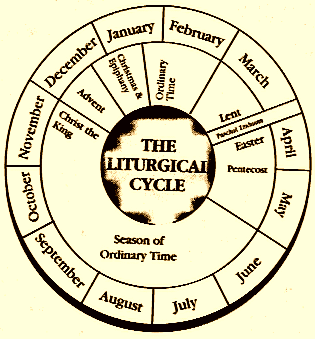
What is Ordinary Time?

This is a name given to the liturgical time outside of the seasons of Advent, Christmas, Lent, and Easter. Of course, in a sense, no time is ordinary. Every day and every liturgy is a wondrous opportunity to grow closer to the Lord and to live out our discipleship.

For more such material, contact me about getting my book, CATHOLIC QUESTIONS & ANSWERS.

Questions & Answers About the Bible

Is the Bible self-sufficient in teaching us all we need to believe in order to be saved?

Salvation truth is in the Bible; however, sufficiency fails upon the matter of interpretation and translation.

Can non-Catholic Christians be certain of possessing a fully authentic and complete Bible?

Unfortunately, they cannot as has been demonstrated by the various versions in use by Protestants. It should be said that ecumenical overtures have improved this matter, as many of their Bibles now possess the deuterocanonical books. Unlike many truncated Protestant Bibles, Catholic editions contain 72 books.

What prevents Protestants from having a certain set of biblical books?

History itself prevents them. Unlike the Catholic community, they were not present when the original copies were written and collected.

Why can Protestants not be certain of their biblical interpretations?

Their constant fragmentation into various divergent churches and sects is evidence that no universal sense of Scripture exists. They have no divinely protected mechanism of authority and tradition to insure fidelity to Biblical truth. Indeed, what authorities they do contain are at odds with one another, even if each claims a true sense of the Bible.

Would not modern translations from the original languages suffice in giving Protestants a true rendering of Scripture?

While very useful toward this end, there is still the dilemma that except for a few ancient fragments, we no longer have the means to re-examine the original texts. Further, biblical scholars themselves are often at odds with one another on certain points. Some Protestant groups even reject modern biblical scholarship altogether for a favorite and archaic English translation. There are few scholars versed in Hebrew and Greek, and knowledgeable of the dialects, expressions, and cultural circumstances of the biblical people.

Did God appoint an arbiter to preserve and to explain Biblical truth?

Yes, he did. The notion that Christ would establish a Church only to allow it to immediately fall into error is nonsensical. No, God chose St. Peter and his successors to be the supreme teaching authority in the Church. It was the promise of Christ that Peter’s faith would not fail and that the spirit of truth would abide with him forever.

Could it be said that the Holy Spirit inspires every individual in their personal understanding of the true meaning of biblical truth?

No, and there is no evidence for it. If the thousands of ministers in Protestant communities were truly inspired then they would all believe alike. There would be but one Church. Contradiction is not the fruit of the Holy Spirit.

What is the benefit of an infallible teacher to explain the Scriptures?

The benefit should be obvious. Doubts about certain texts and sections of the Bible are readily resolved. Unity in teaching precipitates oneness in the believing community. Without this leadership, there could be as many churches as there are heads. It dispels lingering doubts, maintains the faith, and casts off the errors of rationalism and atheism.

Are Catholics forbidden to read the Bible?

No, although Catholics are warned to avoid those Bibles containing errors. Also, care should be taken for the gullible and uneducated that they will not be led astray by false teachers or for a lack of good commentaries. The Bible can be used for our edification; however, used injudiciously, it can also cause much damage. St. Peter had such an experience. “There are some things in them hard to understand, which the ignorant and unstable twist to their own destruction, as they do the other scriptures” (2 Peter 3:16).

Is Bible reading encouraged in the Catholic Church?

Most certainly it is promoted. The Scriptures are proclaimed at Mass, make up the principal parts of the daily prayer or Liturgy of the Hours required of clergy and religious, taught in Catholic schools and religious education programs, and encouraged in the home and in study groups.

Are the teachings of the Catholic Church found in the Bible?

The truths of the Catholic faith are essentially found in the Holy Scriptures. There are some doctrines, while not explicitly in the Bible, come down to us through Divine Tradition.

Who explained the Scriptures to Jews during Old Testament days?

The High Priest and the Sanhedrin (a council of seventy-two civil and religious judges) fulfilled this role. Indeed, Deuteronomy 17:8 reveals that the Jews were required under pain of death to obey their decisions in doubtful matters.

When was the canon of biblical books established?

During the first three hundred years of the Christian era, the New Testament existed only as dispersed fragments. Complicating the situation, there were many books and letters in circulation which were named as scripture but which would be deemed otherwise. Such works included the spurious Gospel of St. Peter and the Gospel of St. James and of St. Matthias. In the year 397 AD, the Council of Carthage declared which books were canonical and inspired.

How do we know that the Catholic canon of the Bible is correct?

The present Catholic canon is the same as the list approved in the year 1546 by Pope Eugene at the Council of Trent. This in turn is the same canon published by Pope Gelasius in the year 494. His canon is the same as that of the Latin Vulgate compiled and translated by St. Jerome and approved by the Council of Carthage in 397. This continuity in the Catholic Church is a telling fact in favor of this particular listing.

How did St. Jerome and the Council of Carthage collect the texts and determine the biblical canon?

St. Jerome was one of the few Latin fathers who also knew Greek and Hebrew. He visited the places where the letters and writings of the apostles were preserved. He carefully collected as many as he could find, studied and translated them. His Latin Bible would come to be known as the Vulgate, the official Bible of the Catholic Church.

Why maintain a Latin translation of the Bible?

Actually, when first composed, the Latin Vulgate was written in a living language. However, the languages of men changed over time. The benefit of a so-called “dead” language is real, nonetheless. Such a translation with certain and unchanging word definitions insures a faithful source for all other renditions. It helps to preserve the Bible from erroneous or inexact interpretations.

Is not private interpretation of the Bible permitted?

The Bible should speak to our hearts and minds, finding particular application in our lives; however, as a universal concept, such private interpretation is fraught with dangers. It is responsible for giving us thousands of churches and sects all claiming to be the religion of Christ. The true voice of the Scriptures emerges from the Catholic Church, which has the authority to explain it. Our Lord said: “Go therefore and make disciples of all nations, baptizing them in the name of the Father and of the Son and of the Holy Spirit, teaching them to observe all that I have commanded you; and lo, I am with you always, to the close of the age” (Matthew 28:19-20).

Can a person be saved without reading the Bible?

Of course, in the first three centuries of the Christian era there was no complete collection of the New Testament books. During the first 1,500 years, before the process of printing, Bibles had to be copied with pen. It was not possible for everyone to have his or her own Bible. In any case, many people could not read. The command of Christ is not to take and read the Bible but to hear and respond to the preaching and teaching Church.

But did not Jesus tell us to “search the Bible”?

This was in response to the question of the Jews about his identity. Was he the long-awaited and true Messiah? He told them to search the Scriptures to see what the prophets said about him. Christ never explicitly told us to read the Bible; rather, he pointedly commanded us to hear the Church and to obey her teachings.

What language was used in the first Bible?

Books were variously written in Hebrew and Greek.

Who guarded the integrity of the Bible throughout the centuries?

Long before the reformation churches came into existence in the 1500’s, the Catholic Church preserved and guarded the Bible.

Was Martin Luther’s Bible the first to be printed?

No, a hundred years before the reformation a Catholic had invented the art of printing. This allowed at least fifty-six Catholic editions of the Bible to be published in the continent of Europe. Twenty-one of these were published in Germany, one in Spanish, four in French, twenty-one editions in Italian, five in Flemish, and four editions in Bohemian.

When was the Bible translated into the English language?

The venerable Bede translated the Bible into Saxon which was the language of England in the eighth century. Archbishop Arundle of Canterbury (1394) stated that Queen Anne diligently read the four gospels in English. Sir Thomas More speaks of an English Bible during his time.


Questions & Answers About the Church

What is the Church?

Put simply, the Church is a community of faith founded by Christ which celebrates and makes known her Lord through his teachings and sacraments. This Church is composed of the clergy, laity and consecrated religious.

Does the Bible speak of the Church?

Yes, it does, a fact that is quite disturbing to those who disavow any significant role for her and who reduce Christian faith to a personal experience with occasional Christian fellowship. Jesus said: “And I tell you, you are Peter, and on this rock I will build my church, and the powers of death shall not prevail against it.” (Matthew 16:18). St. Paul also speaks about “the church of the living God” (Timothy 3:15). In Hebrews 12:23, he calls her the Church or “the assembly of the first-born.” Revealing something of the intimacy between Christ and his people, St. Paul says in Ephesians 5:25, “Christ loved the church and gave himself up for her.” Jesus compares the Church to a flock of sheep: “So there shall be one flock, one shepherd” (John 10:16).

Does the Bible say anything about Christ founding a Church?

Our Lord chose twelve apostles and commanded that they teach and insure that believers observe all that he had given them. Christ, himself, admits to his own authority, “All authority in heaven and on earth has been given to me” (Matthew 28:18) and extends it to his apostles, “Peace be with you. As the Father has sent me, even so I send you.” (John 20:21). Christ appointed a visible headship or ultimate leadership among his apostles in Peter: “And I tell you, you are Peter, and on this rock I will build my church” (Matthew 16:18). This “rock” signifies that Peter should be the foundation stone and chief shepherd of the Church. Christ told him “Feed my sheep . . . Tend my lambs . . . Feed my sheep” (John 21:15-17). In other words, he was to lead the apostles and teach the People of God. He was to minister to them and insure the efficacy of the sacraments, particularly the Eucharist.

When did this Church really begin?

The Acts of the Apostles chronicles how the apostles were empowered and began to exercise their mission on Pentecost. The Church expanded and prospered. Bishops were appointed to assist and to be the successors to the apostles. This living legacy extends all the way to today.

Can the origin of the Church and its apostolic succession be proven?

Sure, history and Church documents themselves are evidence of Church leadership and activity throughout the ages. Significant are the lists of succession, especially that of the Pope which extends back to Christ and his appointment of Peter. There has also been a successive series of Church fathers and doctors who have explained and defended the faith in every century. We might point further to the Church councils, which have corrected and maintained teaching and discipline against error so as to be faithful to Christ.

Can we really be sure from biblical testimony that Christ gave Peter a special supremacy and power?

Christ asserted that Peter was the rock or foundation stone of his Church. He tells him to feed his flock, to teach and minister to clergy and laity alike. He makes no qualm in saying, “I will give you the keys of the kingdom of heaven, and whatever you bind on earth shall be bound in heaven, and whatever you loose on earth shall be loosed in heaven” (Matthew 16:19).Yes, the singular role of Peter is pretty clear.

Does the Bible assert that Peter was the chief apostle and that he exercised supremacy over them?

St. Peter personally presided over the election of Matthias. He was the first to address the crowd after the descent of the Holy Spirit. At the Sanhedrin in Jerusalem he took it upon himself to speak in the name of all the apostles. He presided in Jerusalem over the first Church council (Acts 15). He resolved disputed matters (Acts 15:7). St. Paul consulted Peter about certain practices. Indeed, early Christian history tells us that after Christ, Peter was considered the head and chief teacher of faith.

Can it be proven that the Catholic Church is the true Church?

Christ established the Catholic Church almost two thousand years ago. Her Christian teachings have remained consistent against the fads and fashions of time. Her saints have written our Church history in lives of holiness and sometimes even of martyrdom. She has spread throughout the world to the many nations of the earth. She has not deleted or compromised the teachings of Christ. She has an unbroken succession of leadership (that can be chronicled) going back to Jesus. The Catholic Church alone has weathered all the storms of dissension, schisms, paganism, and persecution.

How can it be said that no other denomination is the true Church?

Except for the special position of the Orthodox churches and their relationship, albeit fractured, with the Catholic Church, all other Christian denominations emerge from the personal opinions of certain men. These figures alter, add, and delete from the deposit of faith according to their own whim and private notions. Non-Catholic churches [properly called ecclesial communities] disagree with one another and only possess fragments of Christ’s teaching, not the whole truth. All saving truth “subsists” in the Catholic Church. These other ecclesial communities extend back a few centuries or merely a couple years, not two millennia like the Catholic faith. These denominations exist only locally or in a few countries and are not worldwide. Having not formed under the watchful eye and guidance of the apostles, non-Catholic Bible-Christians frequently and ultimately explain the Scriptures in ways to suit human opinion.

Does the Bible actually say that we should submit our opinion to the Church?

We read St. Paul in Hebrews 13:17: “Obey your leaders and submit to them.” Jesus said to the apostles: “All authority in heaven and on earth has been given to me. Go therefore and make disciples of all nations, baptizing them in the name of the Father and of the Son and of the Holy Spirit, teaching them to observe all that I have commanded you; and lo, I am with you always, to the close of the age” (Matthew 28:18-20). “He who hears you hears me, and he who rejects you rejects me, and he who rejects me rejects him who sent me” (Luke 10:16). Thus it is that we should hear the Church and submit our opinions to her.

But blind submission violates the freedom of human inquiry and thinking, does it not?

This submission is not blind. We are obliged, to the best of our ability, to study the reasons and background for Catholic teachings. But, should we encounter “mystery” and we will, then we should render a religious assent to the views of the Church, which received the command from Christ to teach and to explain the truth.

Does not everyone have a right to his or her own opinion?

Yes, but only so long as the facts admit to differing opinions. But if truth should be made manifest or decided by a competent authority (like the Church), then we must submit. Children have opinions; would we say that they are always mature and correct? The insane have views too, would we consider all truth relative so as to give them credence? No, of course we would not.

Could not Christ have made things a lot easier for us, just by spelling out his doctrines so that no confusion might develop?

Christ did provide for the eventuality of misunderstanding. He gave us a certain and infallible teacher for his doctrines. In cases of uncertainty, we have a means of discerning the truth. He principally gave this infallibility to Peter, the Bishop of Rome, and to his successors.

But, is not the Bible an infallible teacher?

No, because many texts require explanation. There are some Scriptures difficult to understand. The multiplicity of denominations in this nation alone is proof that the Bible is no infallible teacher.

Does the Bible really say that St. Peter has infallible teaching authority?

Christ said to St. Peter: “Simon, Simon, behold, Satan demanded to have you, that he might sift you like wheat, but I have prayed for you that your faith may not fail; and when you have turned again, strengthen your brethren” (Luke 22:31). In Matt. 16:17-19, Jesus said to Peter: “Blessed are you, Simon Bar-Jona! For flesh and blood has not revealed this to you, but my Father who is in heaven. And I tell you, you are Peter, and on this rock I will build my church, and the powers of death shall not prevail against it. I will give you the keys of the kingdom of heaven, and whatever you bind on earth shall be bound in heaven, and whatever you loose on earth shall be loosed in heaven.” This proves that Peter was empowered by Jesus Christ so that his faith would not falter and that he should insure and strengthen the faith of his brothers. Christ confided his Church to Peter as on a rock that will never be disturbed by false teachings or by the gates of hell. Christ said to Peter: “Tend my lambs . . . feed my sheep,” (John 21:15), which means to teach and care for the whole Church. If Peter was charged to teach the whole Church, then Christ had to insure that he would be able to teach without error. Otherwise, no one could be required to believe what he taught. Except for some window dressing and the development of our appreciation of doctrine, the Church has taught the same unchanging doctrine for two thousand years.

But if Peter swore that he did not know Christ, how could he be infallible?

This question emerges from a common misunderstanding between “infallibility” and “impeccability”. While St. Peter was infallible in teaching matters of faith and morals, he was not free from sin. Further, when Peter denied Christ, he had not received the Holy Spirit who would preserve him free from error in teaching the Church. Christ had yet to give him full and empowered charge of his flock.

What does “ex cathedra” teaching mean?

It is a technical term, which means literally from the chair; it signifies when the Pope speaks from his role, as the universal teacher, some matter of faith and morals which must be accepted throughout the world. He puts the full weight of the seat of Peter behind it. His private conversations and such are not infallible.

Does such a view of infallibility create an atmosphere for ignorance, making people passive in investigating the truth?

No, quite to the contrary, infallibility insures that we do not follow any false leads. The truth is studied on a firm foundation and in the light; those who have no such guide search for the truth in the dark. The fragmentation of Protestantism is evidence of this latter route.

But wait a minute; is not the teaching regarding infallibility of recent origin?

It was formally defined toward the end of the 19th century as a necessary retort to a world that was increasingly secular and dismissive of the role of the Church. However, even before it became a declared article of faith, the Popes were always infallible. Papal infallibility is not a new doctrine; rather, it is an ancient perpetual truth given a clearer definition.

But some Popes were terrible public sinners; does this not invalidate this business?

No, just as with Peter, infallibility does not mean an exemption from sin.

Could it be that Peter was infallible, but no Popes after him?

The guarantee from Jesus was that he would remain with his Church until the end of the world. Thus, the infallibility of Peter must endure as long as the Church exists and the teachings of Jesus have need of preservation from error. Anything less would be unjust. Every generation has a right to the truth. Remember, Christ promised he would send to his Church the Spirit of truth which would abide with her forever (John 14).

At the time of the reformation, about the year 1500, did not the Catholic Church fall into idolatry and superstitious practices?

No, her beliefs have remained essentially the same throughout all history, going back to the apostles and the first Christians. These charges are the result of bigotry and misunderstanding.

Were there not many abuses in the Catholic Church at the time of the reformation?

The Church is holy because Christ is holy. However, many individual members of every “church” may be guilty of sinfulness and abuses. The Church has never formally approved of religious abuses and has legislated “Church” penalties, including excommunication, to discourage such activities.

Is it correct to assume that Protestant denominations possess the same faith and teachings as the first Christians?

No, this would be a false presumption. Many cases of deviation can be documented, not to mention their breach with the Catholic Church. While the first Christians acknowledged baptism as necessary for salvation, many of these “new” churches dismiss its importance. Ancient believers also believed in the Church’s jurisdiction over the sacrament of penance and the value of confession to a priest; all the Protestant sects renounce this mystery of mercy. The early Christians made the Eucharist the center of their lives, trusting that in Holy Communion they received the real body and blood of Jesus Christ. Most Protestant sects denounce the real presence, spiritualize it, or reduce it entirely to ordinary bread. Early Christians also inherited from the Jews of Christ’s day the practice of praying for the dead; this also, the non-Catholic denominations have discarded.

What is so serious about a denomination changing or modernizing its tenets of faith?

Implicit in such an activity is the assumption that the previous tenets were incomplete or erroneous. Both cannot be right. The true teachings of Christ and the apostolic Church, the very matters of faith required for salvation, cannot be reversed or altered. Attempts to do so sever the connection between believers and the true Church of Christ. Of course, issues of discipline can be revised according to changing circumstances. Further, the many languages of men and the various societies in which the Church finds herself may also dictate reformulation in the expressions of changeless doctrinal truths. It could also be said that the full meaning and ramifications of certain teachings develop or are only realized over time.

Does the Catholic Church fabricate new articles of faith?

No, she does not have the authority to create new teachings. Rather, she sometimes defines matters of faith that have existed in the Church from the very beginning. As for discipline, she can create or revoke laws according to changing circumstances.

For more such material, contact me about getting my book, CATHOLIC QUESTIONS & ANSWERS.

The Doctrine on the Trinity

God makes himself known, as a Trinity, in the revelatory message of Jesus Christ. This truth is not simply academic, but relational. Despite our unworthiness, the eternal Son of God offers his Father to us as “our” Father. In contrast to the Cosmic Watchmaker of philosophical Deists, the Judeo-Christian God called a people to himself and established covenants with them. The same Spirit that hovered over the waters of creation would overshadow a Virgin in Nazareth and bring forth forgiveness, healing, and life in the ministry and life of Christ. God delivered his people from political oppression and slavery. He gave them both the Prophets and his Law. Finally, he gave them his Son. Ours is a God who never forgets us. This abiding reality is most forcibly expressed in the saving mission of Jesus Christ, the Son of God and Second Person of the Blessed Trinity. He is sent into the world as one of us. He comes to rescue us from the sin and death, which was of our own making. God the Creator offers us the opportunity of a re-creation and of a new life in Christ.

God is the Father of us all. He calls us into union with him. He is the Supreme Being, infinitely perfect, and the maker of all things, keeping them in existence. Created things reflect the glory of God, their Creator. As the source of all goodness, God willed certain things into existence so that they might enjoy his benefits and participate in his goodness. His infinite power brought all things out of nothingness into being and he keeps them in being. Otherwise, and it is against the divine economy, they would sink once more into nothingness. Above all creatures, he is self-existing; indeed, he is existence, itself. He is an infinitely perfect Spirit. All perfections find their eminent degree in him. All the goodness, beauty, truth, and power we appreciate in created things are but the merest shadows of the perfections found in their source, almighty God.

God is revealed through the laws of nature and, in a more personal way, through his revelation as assembled in God’s Word. Because of the limitations of human knowledge, many of the ways we know and speak about God are through analogies and stories. God identifies himself with Truth and with Love. He is all-good. He is mercy itself and ever forgiving. His is all-knowing. He is just. He is without limit. He is perfect and therefore, unchangeable. He is omnipotent (all-powerful) and present everywhere. He has no need of anything or anyone outside of himself. He creates freely, to give glory to himself, to share his life with his creatures, and to have them return thanks and praise to him. While there is ONE God, his identity is Triune: Father, Son, and Holy Spirit. These three Persons of the Trinity are not “persons” in the sense of contemporary usage dealing with psychology. Rather, it implies a sort of divine dynamism wherein there are three mysterious interlocked equal cores of God’s identity. The Scriptures never use the word “Trinity,” but the doctrine resonates there clearly in the New Testament.

Jesus calls upon God as Father. Jesus does the things that only God can do, like forgiving sins and making atonement. The Holy Spirit is experienced as God, giving life to the community just as he breathed life back into the crucified Christ. The Lord gives the command to go out to all nations and to baptize “in the name of the Father and of the Son and of the Holy Spirit.” Baptism in the name of a creature would be meaningless, thus all three Persons constitute the one God of faith.

We give thanks and glory to God in response to his gift of creation and the act of re-creation wrought by his Son through the power of the Holy Spirit. A sin offering had to be made and only one who was sinless could offer it. It is the teaching of the Church that the Lord’s human origin was the work of the Holy Spirit in the womb of the Virgin Mary. Jesus’ conception, unlike our own, is the miraculous work of the Holy Spirit and is untouched by original sin. The Holy Spirit can directly create nothing sinful. Further, the fact that Jesus is God would make the presence of sin an inner contradiction. Jesus is viewed in the incarnation as the eternal Son of God born in the flesh of Mary. This revelation of Christ’s identity is derived from a comprehensive look at the details of the Gospels. The early centuries of the Church was a pivotal time for debate and reflection where a precise appreciation of Christ’s identity emerged under the light of God’s guiding Spirit. A formula was issued which still applies today: Jesus is one divine Person, existing fully in two natures, divine and human.

For more such reflections, contact me about getting my book, CHRISTIAN REFLECTIONS.

God’s Fatherly Concern

Luke 11:5-13 has Jesus pointing toward the natural relationship of fatherhood as self-reflective of the Heavenly Father’s love. It begins by speaking of the Christian’s obligation to be charitable, even when it is inconvenient and difficult to do so. However, it then switches gears somewhat and refers to the kindness of earthly fathers to their children. This passage ends with the sentence, “If you, with all your sins, know how to give your children good things, how much more will the heavenly Father give the Holy Spirit to those who ask him.” Throughout the long history of the Church, it may be that we sometimes took the analogy too far in imaging God above as a stern, vengeful, and punishing Father. It is true that while he is a just Father, he is also merciful. There is something self-reflective about this most special Fatherhood. In his love we see something of who we are to be as fathers (and mothers) to one another. Conversely, in our love as Christians we need to find something of God’s fatherly concern for us. It is interesting to note that Christ uses the most familiar of relationships to reveal something of the God we follow. In the order of grace, Christ makes us adopted sons and daughters to the Father and shows us that he cares about us. In Christ’s relationship to us, we are reminded of the analogy of Christ as the groom and the Church as his bride. Between the pages of these two relationships, the whole story of salvation is written.

For more such reflections, contact me about getting my book, CHRISTIAN REFLECTIONS.

Arguing with a Crazy Man

LINK:  False Worship at John Paul II Cultural Center?

LINK:  Debate on IFC’s 2007 Bridge Builders Confusion, Part 1

JOHN:

You’re all morons!

FATHER JOE:

Well, starting a discussion that way certainly adds no points to your argument. You are saying that any religion that makes absolute truth claims can have its adherents ridiculed and mocked. Sorry, all you do is immediately show your irrational bigotry. Catholics and other Christians would take exception to other religions, maybe even see spiritual hazards, but hopefully we would not ridicule their believers as “morons.”

JOHN:

All religions are the same— period!

FATHER JOE:

This statement is so ignorant; I am not sure where to begin. Are you saying that all truth is relative? No, obviously not, because you are starting off by criticizing Catholic doctrine which condemns the heresy of “religious indifferentism.” Further, if all religions are the same (with conflicting truth claims), then what you seem to be saying is that all religions are equally false. This is also off the mark because Catholic Christianity puts much store into such things as natural law. In other words, even if you disagree with our faith claims, there are certain assumptions from the natural order that must be held unless you somehow reject objective reality. Certain religions reject such reality as illusion and thus, even from an atheist’s perspective, would probably be further removed from the truth.

JOHN:

Christians have been misled purposely.

FATHER JOE:

We have? By whom? Sorry, the history of salvation history shows a clear progression from Judaism to Christianity. You are wrong about this. We believe that the Holy Spirit has safeguarded the Magisterium of the Church and the inspiration and canonical selection of her Scriptures.

JOHN:

The word God in the old Geneva Bible was Elohim.

FATHER JOE:

Why are we talking about a Protestant bible that was not fully published until 1560? The Catholic Church resolved the issue of the biblical canon in 393 AD!

JOHN:

Elohim… meant male/female and also meant more than one! That means that God was Gods! And any true Jewish man will confirm this.

FATHER JOE:

No true Jew will confirm any form of polytheism. Hebrew did not capitalize the word (how would it) and this has led to your misinterpretation that it can refer to many gods. The word was sometimes substituted for the more formal YAHWEH. However, in either case, it is a reference to the one God of Abraham. There is nothing about combined gender as God is neither male nor female. He is an infinitely perfect spirit. Nevertheless, the Scriptures do suggest that there is something significant about the role of groom and father in terms of his revelation to men.

Wikepedia states: “Note that contrary to what is sometimes assumed, the word Eloah (אלוה) is quite definitely not feminine in form in the Hebrew language (and does not have feminine grammatical gender in its occurrences in the Bible).” Further, any royal plural does not signify multiple gods but is used as in the same manner as the royal and papal “we.”

JOHN:

So logic dictates that anytime you see God in the Bible it actually is Elohim or Gods!

FATHER JOE:

There is nothing at all logical about it.

JOHN:

Makes sense when you rationally look at Genesis: “….and let us make man in our own image.” If it were one “Old Man in the Sky,” then why the plural?

FATHER JOE:

Again, this is merely a linguistic use of the ROYAL PLURAL. The entity is still singular. Your literal fundamentalism that runs against the grain of both ancient Jewish and Christian teaching is indeed quite ridiculous. Note also that Catholics believe in a Trinity = one divine nature but three divine persons. Jews would simply stress the single godhead.

JOHN:

Angels had nothing to do with the fashioning of man, only God. So reason dictates (not religious dogma or lies) that there were more than one.

FATHER JOE:

Yes, angels perform no demiurge function. But you display no logical reason. I am tempted to call you the liar, but suspect that you are merely ignorant and incompetent.

JOHN:

In the Old Testament (Torah… the Old Testament is nothing more than the Torah with a different name), terms this to mean that Gods are everywhere in the Bible and you don’t know what God or Gods were really good and which ones were jerks!!!

FATHER JOE:

Now you have become incomprehensible and resort again to bigoted name-calling. Of course, even here you make factual mistakes. The Torah is part of the Old Testament or Hebrew Scriptures, but is not the entire Old Testament. The Torah is five books:  1. Genesis; 2. Exodus; 3. Leviticus; 4. Numbers; and 5. Deuteronomy.  There are 46 books in the Catholic Old Testament.

JOHN:

Also, it makes sense were somewhere later (can’t remember the Scripture) when Jesus says in the New Testament that “my God is not your God…” to the Jews.

FATHER JOE:

Huh? Like where does he say this? Do you make up everything you ramble about?  The scene is just the opposite from how you describe it.  The text is John 20:17 where the Risen Lord speaks to Mary Magdalene:  “Stop holding on to me, for I have not yet ascended to the Father. But go to my brothers and tell them, ‘I am going to my Father and your Father, to my God and your God.’”  We hear echoes of Ruth 1:16-17 in the Old Testament:

But Ruth said, “Do not press me to go back and abandon you!  Wherever you go I will go, wherever you lodge I will lodge. Your people shall be my people and your God, my God. Where you die I will die, and there be buried. May the LORD do thus to me, and more, if even death separates me from you!”

JOHN:

In two terms this means one… they are not actually worshipping God but Satan since they are money driven whore mongers and they could actually worship a whole totally different God!!

FATHER JOE:

Now you will offer exegesis on made-up verses? Pleeeease! Jesus is the one who is accused of healing with the power of demons, a false charge and a blasphemy against the Holy Spirit. The God of the Jews and that of the Christians is the same.

JOHN:

Some Jewish text clearly states (once again, ask an honest Jewish guy, probably not a brainwashed orthodox one but a more secular one) that Leviathan was an old Babylonian god worshipped by Jews in that time period and still to this day.

FATHER JOE:

You are willing to mock Jews, too? If you ask either an informed orthodox or a reformed Jew, he or she would tell you that your ideas are confused and erroneous. We do not worship the pagan deities or the false religion of ancient Babylon.

JOHN:

Look, it all boils down to either you use love, compassion, caring and understanding, and sometimes a little tough love or you wanna burn everyone, kill in the name of an unknowable God, yada, yada, yada… there are two philosophies plain and simple.

FATHER JOE:

What really matters is that the true God of the Jews has revealed his face in Jesus Christ. Divine mercy and divine justice are hallmarks of this revelation.

JOHN:

Take your pick.  I will take the Jesus-Buddha-Krishna-Tamuz pick and say live and let live.  Give some tough love when someone needs it.  Don’t pee on my door step and I won’t pee on yours!

FATHER JOE:

Jesus has nothing to do with false prophets or pagan gods. Idol worship as practiced by pagans was condemned by the Jews. Pagan worship is condemned in the New Testament. The early Church fathers saw the pagan gods as demons in disguise. Christianity and Judaism are not tolerant of polytheism and the false worship to which you subscribe. You applaud contradictions and, despite professions to logic, have embraced irrationality.

JOHN:

Be nice people and that’s it— stop all the debate and squabble.

FATHER JOE:

Look who is talking! You called us “morons” and “jerks”!

JOHN:

You’re caught up in the ritual and literal translation of things instead of the real meat of the point!!! Be nice!!!

FATHER JOE:

You are the one who has missed the whole point. Being nice and being saved are different things.

JOHN:

Grow up and be honest with yourselves.  Work on you and don’t worry about your neighbor!

FATHER JOE:

Charity and the mandate of the Gospel demand that we proclaim the Good News.  We must care for our neighbor. You would have us renege on the saving message of Jesus Christ. Who are you to tell us our faith? What nerve!

JOHN:

Stop the nonsense; everyone has the same value and worth.

FATHER JOE:

Yes, human dignity and personhood is incommensurate, but this is a wholly different matter than religious faith. Not all religions are the same. Some are closer to the truth and others are dead wrong. Yours is utterly incomprehensible.

JOHN:

No one person should make more money than anyone else.  Everyone in the world is important, everyone! In every second of everyday!!!

FATHER JOE:

What are you now, a communist? I say this as a poor priest.

Arguing with a Gnostic Fake Bishop

LINK:    False Worship at John Paul II Cultural Center?

+MOST REV. RICHARD SAINT JOHN:  (Fort Worth Texas USA)

You are insulting the legacy of St. John Paul the Great…

He did far more loving actions than the Bishop in the photo!!!!

Traditionalists of EXTREMEISM are being used by demonic forces as LIBERALIST…

The darkness will use ANY vehicle, even PIOUSness to wound the DIVINE HEART of JESUS…

WATCH OUT PEOPLE!!!!

FATHER JOE:

Bishop Kevin Vann is the genuine Bishop of Fort Worth, Texas. You sir, are an imposter!

The post here was never meant to tarnish the late Pope’s reputation. The problem is that mistakes have sometimes been made that cannot be easily excused. Christians can have no part in pagan prayer and worship. That is the long and short of it.

This so-called “bishop” feels differently, Bishop Richard St. John is a faker. Posting here under the guise of a Catholic bishop shows the depth of his deceit. He is nothing of the kind!

Who is he?

He writes this at an interfaith site:

His defective apostolic pedigree…

“We have a lot in common. I was communicating with the U.G.C. (Universal Gnostic) but I haven’t the cash to take all the lessons. We both are bishops from +Lewis K. who I’ve known for many years. I also know some other Gnostic Prelates: +Hoeller and +Rosamonde Miller. I also have been a Bishop in +Michael Bertiauxs Church.”

His heretical Gnosticism and occult involvement…

“I’m more on the “catholic side” of Gnosticism. I love comparative religion, metaphysics, shamanism, Wicca, and psychic development.”

He is unemployed but should go out and get a job…

“At this time I don’t have an active pastoral ministry or sacramental apostolate.”

He sits around all day and plays on the computer…

“I enjoy e-mail or snail mail with other kindred souls who Spirit brings upon my path.”

He is very gay…

“I’m going through a lot of changes right now regarding work etc. I’m a single gay guy, who is a Super-Uncle of my sis: 5 kids and one great-niece!!!”

He uses the Wiccan closure…

“Blessed Be.”

What does the utterly heretical Universal Gnostic Church says about itself and him?  He is aligned with an occult group that calls itself the Universal Gnostic Fellowship. It claims to trace its apostolic lineage not simply to Jesus but to Adam. They claim their holy orders were initiated by a host of Gnostic masters, including Mary Magdalene. While they claim a doctrine of the one, it is really a form of pantheism where everything is seen as divine. They argue that Old Testament prophets and Christ were occult shamans or witch-doctors. They reject all other doctrines.  This group is not really even Christian, but is pagan in nature. Instead of a unique creation, they claim that all people are merely fractured bits and pieces of the divine.  They repudiate, absolutely, the following teachings: “original sin, damnation, hellfire, virgin birth, tithing, and “others whose purpose is to subjugate the masses for the benefit the priesthood.”  They subscribe to a long list of sacraments, some quite peculiar and others redefined, like “Child birthing, Naming, Coming of Age, Initiation, Manhood, Womanhood, Handfasting, Exorcism, Elderhood, and Burial of the Dead.”

They impose their counterfeit ministries upon the Ordinate and the Episcopate. Ordination to the Ordinate is conferred upon qualified candidates regardless of age, class, race, color, religious preference, creed, gender or sexual orientation.  Just as we apparently saw at the JPII Center, they suffer from a chronic syncretism with deacons, ministers, priests, rabbis, swamis, canons, deacons, deans, deaconesses, and priestesses.

WE SHOULD INDEED BE ALERT, THIS MAN IS NO BISHOP AND APPARENTLY NOT A CHRISTIAN! HE IS PLAYING AT BISHOP AND WOULD LEAD SIMPLE PEOPLE ASTRAY! IF HE WAS EVER A CHRISTIAN, HE IS NOW A GENUINE HERETIC! THERE IS NO GENTLE WAY TO RESPOND TO HIS COMMENT.

+MOST REV. RICHARD SAINT JOHN: 

Father Joe, I AM NOT nor EVER said I was the ROMAN Bishop of Fort Worth or anywhere…. I am not an imposter/fake or phony anything.  I am one of the most honest/kind/loving/sweet-natured/unselfish people you could EVER meet.  I AM in Fort Worth, born here.  I AM a valid consecrated prelate in the apostolic succession (from Roman-Greek-Russian-Coptic-Armenian-Melkite-Atiochian-Anglican-Utrech). The Holy See/Holy Father whom I revere, upon studying/knowing of me would 100% respect me as a real/valid/legitimate apostolic bishop…..PERIOD!  Our Divine Lord said not to bear false witness so you either read into my email what you humanly wanted (no sin) or you sinned against the Holy Ghost against my holy orders…. mea culpa, mea culpa, mea maxima culpa!

NOT ROMAN— with all humility and reverence to His Holiness Benedict 16, Supreme Pontiff.

FATHER JOE:

You sir, in my reckoning are not even a true Christian. That makes any claim to being a bishop a sham. Note that you speak of yourself as “the most honest/kind/loving/sweet-natured/unselfish people you could EVER meet.” Ah, evidently humility is NOT one of your virtues, either.  The Church you describe does not really exist; it is a bogus as you are.  Pope John Paul II would have nothing to do with you. Indeed, from the way you express yourself, I am becoming concerned that you might not be quite well.  If you had “all” humility and reverence to the Pope, you would put away your charade and seek membership in the Catholic faith. As things stand, you are not Roman, not Catholic, not Christian, and not a true bishop.  You belong to an occult sect that only masquerades as Christian. Even genuine Orthodox churches do not recognize you or your so-called apostolic orders.  I will try not to laugh. I will offer prayer for your healing instead.

+MOST REV. RICHARD SAINT JOHN: 

Reverend Father, I posted via your reply without having scrolled down to read all you said.

John Paul received the marking on the forehead of Shiva in India (PHOTO on INTERNET).

John Paul KISSED the KORAN!!!

John Paul received the blessing of VOUDON PRIESTS or Hougans in AFRICA.

JOHN PAUL let Dali Lama priests put statue of BUDDAH on the TABERNACLE in ASSISI.

I AM NOT ROMAN CATHOLIC!!!!!!!!!!!!!

I would NEVER disrespect your priesthood!!!

YOU pulled a FBI search on me like a Gestapo Nazi.

I AM not unemployed… thank you!

I have a real job and work my ass off!

I don’t use my holy orders to put a roof over my head.

I live in the REAL WORLD, not a damn rectory with a pious Irish lady cleaning my undies.

I AM a CATHOLIC CHRISTIAN. I profess in “humiltas” the Blessed Trinity and The DIVINITY OF JESUS CHRIST ONLY. I respect other faiths… you don’t!  JOHN PAUL did.  I AM GAY….so are thousands of Roman laity, priests, religious, bishops, cardinals and many popes (some were adulterous murderous [deleted] AND STRAIGHT!!!!) You can insult me, slander me, and hate me; but you have INSULTED THE HOLY GHOST— Third Person of The Divine and Blessed TRINITY.  You have insulted the dignity of my holy order’s witch have nothing to do with so-called heresy/personal sin/lack of JOB. YOU DONT KNOW ANYTHING about ME. You jumped in the cesspool of SATAN and drank it up.  YOU ARE A REAL PRIEST but as a human you have shown your feet of clay!  Oh how Glorious the Precious Blood of Our Divine Lord Incarnate on Calvary that froggives ME and YOU.  May the Divine Mercy heal your HATRED!!!!!!!!!!!!!!  St. Therese the Little Flower, “ora pro nobis.” St. Padre Pio, “ora pro nobis.” Sancta Maria Mater Dei, “ora pro nobis.”  Saint John Paul, “ora pro nobis.”  + Richard Saint John baptized Roman with reverence to His Holiness Benedict.

FATHER JOE:

Actually, Pope John Paul II was very compassionate to those who should have been disciplined for making liturgical blunders. The bird poop was an error not orchestrated. The Koran kiss was honor to the givers, not to the gift. The pagan priests gave a blessing on their own initiative. The Buddha statue was a disgrace that Cardinal Ratzinger (now the Pope) was quite upset about in Assisi. No one wanted to give offence, but the idol should have been thrown to the grown and crushed underfoot.

What FBI search? You are being paranoid. Everything I posted, you have already shared “yourself” on the Internet! You say you do not disrespect my priesthood but you call me a Nazi and make up a fictional cleaning woman in my rectory. I wash my own clothes at Holy Spirit! And by the way, being a REAL priest is being in the REAL world. You are a weekend bishop who treats religion like a hobby. You are into the occult and cannot claim to be a true Christian or Catholic. Ours is a jealous God. You cannot worship the idols of demons and honor Jesus.

You more than respect other faiths— you fully embrace them, no matter how incompatible with Christianity.

Like so many active gays you cannot speak about your disorientation without a vulgar slur.

I see a contradiction here. You speak of your “holy order’s witch” but contend that I am the one who has blasphemed against the Holy Spirit. Pleeease, I do not know what “spirit” moves you, but it is not the Advocate sent by Christ!

All I know about you is what you broadcast to the world, and in that respect, the “cesspool of Satan” is yours.

May your “frog” give you forgiveness, but I prefer my reconciliation with God. I suspect the saints pity you.

+MOST REV. RICHARD SAINT JOHN: 

I LIVE in FORT WORTH….THANK YOU— BORN HERE, WORK HERE AND my ADDRESS is SUNSET ROAD, FORT WORTH.  GET YOUR FACTS OF HATRED STRAIGHT! LYING/FALSE WITNESS is A MORTAL SIN!  (St. Joseph Baltimore Catechism) MEA CULPA, MEA CULPA, MEA MAXIMA CULPA— ohhhh if you’re a post Vat. 2 Kumbaya-Priest, that means “through my fault, through my fault, through my grievous fault!!!!!!” That bishop of the Roman diocese has a priest at my baptismal parish that is more liberal than me. I’ve gone to his Mass (MESS) and wanted to cry cause of what’s going on there ain’t no HOLY SACRIFICE of the MASS. SO GO THROW STONES in your own Roman backyard, padre!

FATHER JOE:  Without real holy orders any celebration you give is no Eucharist. Even a liberal priest with the right intention can say Mass and forgive sins. You cannot do this much. You are just playing dress-up. As for the facts, I simply posted what you told everyone.

Debate on IFC’s 2007 Bridge Builders Confusion, Part 1

LINK:  False Worship at John Paul II Cultural Center?

LINK:  Debate on IFC’s 2007 Bridge Builders Confusion, Part 2

There were many comments in the discussion regarding charges of false worship by a Vatican official at the John Paul II Cultural Center.  While I also had questions, and viewed the lighting of the Hindu religious candle as a misstep, it was and is my conviction that the charges from critics are ridiculous.  Catholicism does not subscribe to religious indifferentism.  However, the Church in the modern world is dedicated to mutual understanding and social cooperation for purposes of justice and peace.  We have to share the world in which we live.  There is nothing wrong with acknowledging the good works of brothers and sisters from other faith traditions and philosophies of life.

As I look over the posted picture again this morning, there are tears in my eyes. I have to think that maybe the archbishop was not aware of the religious significance of the candle-lighting. It could be that they imposed upon him without warning to light it and he did so without giving the action sufficient reflection. Given tension and recent hostilities of Hindus toward Catholics in places like India, the archbishop may also have found himself with a no win situation. While such events as this are rarely reported in the American press, they constitute headline news back in Hindu countries. The reverberations for refusing to light the candle would have been colossal. It should have been made clear what the archbishop could and could not do as a Catholic clergyman. Guidelines preventing the candle-lighting should have been contracted in the use of the JP II Center.

[It is worthy of note that Pope Benedict XVI would also meet with non-Christian religious leaders at the center when he came to the U.S.  His words were very carefully chosen to emphasize religious dialogue for purposes of social harmony and to better society.  There was nothing that sacrificed the unique salvific significance of Christ and the truths taught and passed on by Catholic Christianity.  Many of us saw this event as an attempt to correct and heal any wound of confusion opened by the earlier event.]   

Here is my blog discussion record, good, bad and confused, of those who commented on the pictures that went viral in the (unfortunately) somewhat unforgiving religious world.

SHARON:

Father is it possible that the archbishop didn’t understand the significance of the lamp? Is it possible that you are overestimating the significance of the lamp? Maybe you should give the archbishop some feedback.

FATHER JOE:

I thought about that possibility too, and yet Catholicism is quite restrictive and clear about such matters. Remember, Catholics cannot even engage “actively” but only “passively” in the Sunday worship of Protestants. Hymn singing is permitted, with reservations, but many worship elements and Holy Communion are forbidden to Catholics. Further, such participation does not fulfill one’s holy day obligation or duty. I am just a poor priest in a small parish. The archbishop represents the Holy See and has had special training in the foreign service of the Church. He should know better than me what is right and wrong. Catholics light candles as well, and the votive lights symbolize our prayer intentions. We also have the vigil light before the reserved sacrament of the Eucharist and the Easter or Paschal Candle. Catholics know the value and place of candles and fire in worship. The archbishop would be the first to appreciate such things. That is why I am pained and befuddled by it all.

CATHOLIC WRITER:

Hi Father Joe, if Catholics worship one God in the Holy Trinity, and the Hindus worship one God in Brahma, isn’t it common sense that both are worshipping the same God, but in different ways? (Curious)

FATHER JOE:

The problem is the presumption of monotheism that you make. Except for certain modern Hindu apologists who argue that all the Hindu deities are expression of a single one; Hinduism is traditionally regarded as a polytheistic religion. In other words, they are not worshipping ONE god but many gods. This is usually their understanding as well. The Trinity is quite different. Catholics believe that there is ONE divine nature (one God) but three divine Persons. While the mythology is quite different, the multiple gods of Hinduism is similar to the ancient pagan gods of the ancient Greeks and Romans. Tertullian and others in the early Church claimed that these false gods had substance and were in actuality, demons. Christians were warned, even in the Bible, that they should not eat of the food offered to idols, to the demons.

The Jewish Decalogue forbids the fashioning and worshipping of idols. Catholics use statues to remember Jesus, Mary, Joseph and other saints. But we do not worship them as idols.  However, the Hindu usage of statues is indeed the kind of idolatry condemned by the commandments given to Moses.

Are you beginning to see why this is a pretty big deal and a source of growing embarrassment and scandal?

HELEN:

Right or wrong, “Catholicism is quite restrictive” is the reason for your pain. That much is clear. Believing as you do, this must upset you a lot.

You mentioned that lighting the lamp had different meanings at different times. I sincerely hope that in this instance its meaning is something that does not compromise Christian faith in one God. Protestants share the belief of one God in three Persons with Catholics. That is one thing we do not debate.

CATHOLIC WRITER:

Hi Father Joe, I see what you mean. Based on the interreligious dialogue that’s taken place in my country between representatives of various religions, I’ve always understood Hinduism to be monotheistic with the other deities to be manifestations of Brahman, while the deities are given the same kind of respect that Catholics give to saints. Like some Catholics mistakenly turn to worshipping saints, some Hindus mistakenly turn to worshipping these deities, but these should not be seen as what the religion is really about.  God bless.

BEE:

Stay away from those wacko conservatives like the “catholic” cavemen. Lighten up. If Jesus were here he wouldn’t be filled with righteous anger at someone lighting a candle and dialoging with pagans. Surely St. Paul probably reached out amongst similar sorts of things even as he upheld the truth of Christ. Beware wrath and a lack of charity— surely more insidious then a misstep in lighting a candle.

FATHER JOE:

Dialogue is fine by me, but the question is false worship. You suggest that St. Paul would not be concerned, and yet he definitely condemned idolatry. Remember, ours is a jealous God.

4HISCHURCH:

I’ve been reading about the alleged apparitions at Damascus in Syria (apparently approved by the local bishop— I stay away from those that aren’t). The main message there seems to be one of unity (especially between Catholics and Orthodox.) Jesus is reported to have said, “Tell my children, it is from them I ask unity. I will not accept it from those who are only acting; pretending they are working for unity.” When I read your post about the archbishop that was the first thing I thought of— pretending to be working for unity instead of working for true unity.

LAURA:

Remember, Sr. Lucia of Fatima told us not to wait for the bishops to lead us in lives of prayer and mortification. These types of gross errors are so commonplace now. The sad part is that so many Catholics are so poorly catechized that they wouldn’t even be able to tell you why the actions of the Bishop were scandalous. I weep with for my children who have such reckless shepherds.

WENDY: 

AMEN, Father.  It seems to me that some folks “just ain’t gettin’ it.”  This is some serious stuff. Perhaps we should give him the benefit of the doubt?  But, come on, he’s an Archbishop for crying out loud!  I would think that he would be more knowledgeable than us lay folk. If not, I’m truly scared!

MARTHA:

Which bishops can we trust?

CAROL:

Father Joe, Ugh, I had hoped this Nuncio would avoid the “Be nice, don’t litter” phenomenon that has stolen our religion.  You ask whether he realizes he is paying homage to a false god. “Be nice and don’t litter” is borne from the violations of the first and second commandments— priests and bishops who want the flock to adore them. They place the importance of people loving them above everything else, including the vocation of salvation of humanity.

Who among us sits in the pews and knows the last time words were said to provoke the people in line to get the Sacred Body and Blood of Christ to go to confession and wipe their souls of their sins? If they’re unaware that their path has taken this earth into a spiritual tailspin, then they are perishing. The vocation of priesthood is a spiritual fatherhood. The photo of a papal nuncio lighting a candle to pay homage to a false god is about as sane as a mother and father who set up false images and pay homage to them before they tuck their kids into bed.  Take another look at the picture (previous post)— he’s laying the salvation of Christ’s people at the foot of a false god and everyone in the picture is as happy as a lark— spiritual insanity!

“Which bishops can we trust?”  A handful, perhaps a dozen, like + Vasa, + Bruskewitz, + Chaput, + Burke, to name a few.

MATTHEW:

Although I don’t agree with everything Fr. Malachi Martin said, he was right concerning the actions of certain bishops and equating it with unbelief. How can someone do something like this and be a believer of the Gospel? I will pray that the Archbishop is stupid rather than a baptized pagan.

FATHER RICHARD:

St. Teresa said, “I do not understand the fears of certain persons, who say, “The devil, the devil, so long as we can say, God, God, and make Satan tremble.” Relax; the bishop did the right thing. If he had refused to light the candle he would have been no different than those people who cry the devil, the devil— as you and many of your readers sadly sometimes do.  God bless.

FATHER JOE:

Dear Father Richard, I would tend to give the benefit of a doubt to the nuncio, however, it is possible that he made a mistake. I believe he is fully Catholic and that there was no intent, whatsoever, on his part to do something wrong. I would not want to say that he did nothing “inadvertently” wrong, as the lighting of a candle in certain instances signifies “worship” for the Hindus. The Hindu deities in my estimation are false and if they have any real distinct existence it would seem likely they are demonic. Such an attitude was reflected in the early Church to the pagan gods and I see no reason to second-guess their interpretation. You seem to infer upon me a level of anxiety about Satan’s power that I do not in fact have. I may mention him from time to time, particularly in mockery and humor, but I fully trust the power of Jesus Christ to vanquish evil. As my departed father once said to me, the devil cannot stand humor. You seem to render me, a fellow priest, a small slight by your comment, but you are free to have your own opinion about such things and even about me.

I see from your website that you are part of the Charismatic renewal and have a healing ministry. I will offer a prayer for you and your ministry that many will come to know both spiritual and physical healing through the Lord working in you. The priest who baptized me also had a healing ministry and Father John Lubey regularly prayed over people who would then rest in the Spirit. He was a gentle and good man whom I miss very much.  Christ’s peace with you always.

AGNES: 

Dear Fr. Joe, I feel a mixture of emotions when I see what this bishop is doing, mostly a deep sadness. Really, he is betraying Jesus?  He is a shepherd who is supposed to be guarding and leading his sheep towards our Savior. How are his flock supposed to react-follow him?  I believe totally in love of neighbor, and the Jewish and Muslim faiths certainly worship one God as we do, and we owe a great respect to them, even though we have differences. But I am not afraid to say this, Hinduism is dangerous and the worship of false gods is totally against our faith. Please be wise, our very souls are at risk. I live in England and our faith is being battered, please proclaim Jesus as our only Lord and Savior.  May God bless you all.

STEPHEN:

It is hard for me to tell if the Archbishop really knew that he was lighting a candle for idols. Maybe the Archbishop didn’t know. From looking at the picture, the candle looks kind of funny, but it does not appear to be idolatrous. In the bottom picture, there are two dark forms on the right and the left that are hard for me to see that could be some kind of statues. If they are statues, he probably did not recognize them as idols. Some idols seem like harmless statues unless you have been educated as to what they really are. His intention could have been limited to the lighting of a candle, not actually performing an act of worship. At best, this is a case of ignorance coupled with poor judgment. At worse, this is a case of go along to get along idolatry. (If you think about it, it is a form of double idolatry.)

JOAN:

Wouldn’t it be prudent to request a private audience with the Papal Nuncio and ask him privately, telling him of your concerns, before making this information, together with your opinions, known to the public? We desperately need unity in the Magisterial teachings of the Church.  I have not looked back at your previous blogs, but did you let your readers know that the Papal Nuncio, in union with the Bishops of the United States, re-consecrated the United States of America to the Immaculate Heart of Mary, on November 11, 2006.  Are we not a Church of Unity in truth and love?

FATHER JOE:

Dear Joan, I hear what you say, but this is not a general news blog. The pictures from the interfaith group were online and other blogs were already reporting about the event at the JP II Cultural Center. I posted about it as a “Johnny Come Lately” with important questions, and as I have said, feel that some mistake must have been made. Never did I suggest that the archbishop was intending to offer false worship. I would distance myself as a Catholic priest from any comments that suggested otherwise. My concern is the “sign” value of the picture and maybe whether or not it was prudent to participate. The questions that Christians are entitled to ask are as follows: What actually did happen? And, how do we resolve the subsequent scandal? I am a pretty small fish to tell the archbishop his business and I am sure that some response will be forthcoming without my intervention. In any case, the scandal was not my doing and any resolution will have to be accomplished in the public arena. If you think I am not charitable you should visit some of the Traditionalist Catholic and Protestant anti-Catholic sites.  My remarks were very tame and non-committal by comparison. As of right now, I am positing the whole event as an error of some sort. I could not agree with another priest who suggested that it was okay to light such a lamp and that this should be a non-issue for Christians. But, that is my opinion.

As for the re-consecration of the U.S. to the Immaculate Heart, I said nothing about it because, frankly, I heard nothing about it until now. But, as I said, I do not doubt the archbishop’s Catholic faith. I am sure he is a faithful son of the Church. It is only this particular event with the Indian lamp that puzzles me.

Thank you for visiting the Blog and may the good Lord continue to bless you and your family.

ELLEN:

The real issue is the JPII Center. They are the hosts. It is their responsibility. If they had been on the job, this wouldn’t have happened.

FATHER JOE:

Point well taken!

ATHANSIUS:

“The Brahmins eat sumptuous meals to the sound of drums, and make the ignorant believe that the gods are banqueting. When they are in need of any supplies, and even before, they give out to the people that the gods are angry because the things they have asked for have not been sent, and that if the people do not take care, the gods will punish them by slaughter, disease, and the assaults of the devils. And the poor ignorant creatures, with the fear of the gods before them, obey them implicitly. These Brahmins have barely a tincture of literature, but they make up for their poverty in learning by cunning and malice. Those who belong to these parts are very indignant with me for exposing their tricks. Whenever they talk to me with no one by to hear them they acknowledge that they have no other patrimony but the idols, by their lies about which they procure their support from the people. They say that I, poor creature as I am, know more than all of them put together.”

“They often send me a civil message and presents, and make a great complaint when I send them all back again. Their object is to bribe me to connive at their evil deeds. So they declare that they are convinced that there is only one God, and that they will pray to Him for me. And I, to return the favor, answer whatever occurs to me, and then lay bare, as far as I can, to the ignorant people whose blind superstitions have made them their slaves, their imposture and tricks, and this has induced many to leave the worship of the false gods, and eagerly become Christians. If it were not for the opposition of the Brahmins, we should have them all embracing the religion of Jesus Christ.”

“The heathen inhabitants of the country are commonly ignorant of letters, but by no means ignorant of wickedness. All the time I have been here in this country, I have only converted one Brahmin, a virtuous young man, who has now undertaken to teach the Catechism to children. As I go through the Christian villages, I often pass by the temples of the Brahmins, which they call pagodas. One day lately, I happened to enter a pagoda where there were about two hundred of them, and most of them came to meet me. We had a long conversation, after which I asked them what their gods enjoined them in order to obtain the life of the blessed. There was a long discussion amongst them as to who should answer me. At last, by common consent, the commission was given to one of them, of greater age and experience than the rest, an old man, of more than eighty years. He asked me in return, what commands the God of the Christians laid on them. I saw the old man’s perversity, and I refused to speak a word till he had first answered my question. So he was obliged to expose his ignorance, and replied that their gods required two duties of those who desired to go to them hereafter, one of which was to abstain from killing cows, because under that form the gods were adored; the other was to show kindness to the Brahmins, who were the worshippers of the gods. This answer moved my indignation, for I could not but grieve intensely at the thought of the devils being worshipped instead of God by these blind heathen, and I asked them to listen to me in turn. Then I, in a loud voice, repeated the Apostles’ Creed and the Ten Commandments. After this I gave in their own language a short explanation, and told them what Paradise is, and what Hell is, and also who they are who go to Heaven to join the company of the blessed, and who are to be sent to the eternal punishments of hell. Upon hearing these things they all rose up and vied with one another in embracing me, and in confessing that the God of the Christians is the true God, as His laws are so agreeable to reason.”

–Saint Francis Xavier

Letter from Goa to the Society of Jesus (Rome), 1543

I think the Nuncio needs to read the lives of the saints before walking into another useless Ecumenical social event. Perhaps he’ll be inspired to preach the Gospel as Our Lord commanded?

JOAN:

Dear Fr. Joe, thank you for your kind reply. I am definitely out of my league in knowledge, etc. to be commenting on this. It sounds like it is possible that good Papal Nuncio may have been set up for someone’s agenda, but the Roman Curia are usually extremely wise when it comes to things like that.

Perhaps it was the Papal Nuncio who ministered to him as St. Francis Xavier did. We only know what the picture shows, we are not privy to their private conversation.

I can only imagine what the Traditionalists and anti-Catholic Protestants would make of this event. I am a convert myself. I have found that Traditionalists are pretty hateful about everything, and few anti-Catholic Protestants are exceptionally kind to anything Catholic. There are many more very good Protestants who are, however. I have recently been dumped by anti-Catholic relatives who held out hoping I would become Baptist again. I know that not all Baptists are like that. I offer up my heartache for their conversion and I pray for them. I know that good Protestants go to Heaven as well as Catholics. They suffer from ignorance and not malice.

However, as a lay person I would not want to second guess the Papal Nuncio. My husband and I attended Mass at the Basilica of the National Shrine of the Immaculate Conception in Washington DC on November 11, 2006. The Papal Nuncio re-consecrated the United States to the Immaculate Heart of Mary, in solidarity with the Bishops of the United States at that time. Fr. Andrew Apostali was the homilist and the Cardinal from Philadelphia was there also. It was an incredible event. It was also our 34th wedding anniversary so that made it even more special for us.

Thank you again for your kind response, Fr. Joe. I will keep you in all of my prayers and I humbly ask for your prayers also.

FATHER JOE:

Thanks again for your comments, Joan, and many congratulations on your marriage and strong faith. I live only a few minutes from the Shrine, I must have been very busy to have missed the re-consecration. I regularly visit the Shrine and have attended lectures at Catholic University where my god-daughter is a student. Returning to the subject of the post, my suspicion is that the nuncio was invited to the interfaith awards event and was not informed about the candle-lighting until the last moment. He might have been desperately afraid of insulting his hosts and understanding that the lamp lighting possessed cultural but not spiritual symbolism, participated without much deliberation. The Hindus are used to Christians who give such matters little reflection and they may have innocently presumed that there would be no problem with a Catholic representative. The Holy See has been walking on eggs given the heightened sensitivity of others: the Moslems over a historical reference to violence in the Koran and the Brazilian Indians over their purification by Christianity. Lately, Hindus in India have been increasing their persecution and intolerance toward Christians. It would not take much to set them off. Who knows what the headlines would have been had he refused to light the lamp. In any case, the picture is unfortunate and I suspect we will be hearing about it for some time to come. God bless you!

CATHERINE:

Imagine all the martyrs who went to their deaths, being eaten by lions, raped, tortured, grilled on spits, beheaded, thrown on freezing ponds, etc. rather than “offer homage” to idols as this bishop is doing. How is it that the same Faith that condemned paying homage to idols, asking its people to go to their death rather than light a candle, offer a sacrifice or bow before a false deity?  How can the Church now not only allow but approve of a BISHOP no less, doing the same?

If Christ was righteously angered at the money changers in the temple, what would he do to the idol bringers?

And to those who say “maybe he didn’t know,” let me ask you which is worse… to have a teacher/leader purposefully go against Christianity or have one in authority not know the most basic Judeo-Christian tenant?

May heaven have mercy on us!

SUTEMOS:

We pray for the blind and those who deceive.  We offer prayers for those, with their public mouth bound, must endure (in these times) the Crucifixion of the Church.  Again, let our not knowing be the reason for our transgressions.

HECTOR:

Dear Father Joe, as to the nuncio question, for one to be heretical, one would have to have intent and forethought.  Did he make a mistake?  It is more than likely; but a mistake leaning towards the good.  If his Hindu hosts intended him to worship, they erred, as worship can only be valid if the person intends to worship… which I don’t think the nuncio did.

FATHER JOE:  

I would never say he purposely committed a heretical act. It may have been an accident, something unplanned. The trouble is the scandal it gives. My reference to Hindu worship was generic, restricting itself to ritual and ceremonial. I doubt a bishop and priest would personally intend any spiritual efficacy behind such a gesture as lighting candles before an idol.

WILL:

I fail to see or to understand the concern here? Roman Catholicism was invented by a pagan (Constantine) and is full of idol worship which is forbidden by Biblical Christianity.

FATHER JOE:

No, Constantine legalized Christianity within the Roman Empire. Catholicism (the first Christians) suffered persecution for centuries and martyrdom. Read the writings of these suffering men and women and they talk about their bishops, priests, deacons, and the Eucharist. Jesus instituted the Catholic “Christian” Church!

As for idol worship, Catholics did not worship idols. Indeed, many pagan idols were destroyed. Statues of Mary, Jesus and the saints would be venerated, but this is not the same as worship… not any more than a person keeping a picture of his spouse and kids on the desk. They remind us of those whom we love.

WILL:

It is my understanding that Roman Catholics believe God left them in charge of truth, etc.  Thus they are free to define and redefine truth any way they choose.

FATHER JOE:

This is false. Revelation ended with the death of the last apostle, John. The Magisterium (Pope and bishops) interpret and define the faith; however, they cannot make it up. For instance, Jesus rose from the dead. No one is free to say otherwise… not the Pope… and not you. Our Catholic teachers are at the service of the truth; they are not its masters!

WILL:

This being the case, how could the nuncio make a mistake?  Am I wrong?

FATHER JOE:

Yes, you are in gross error about Catholic history and belief. You have also been led down the road of bigotry.

JEFF:

Pastor Joe, I am astonished that you are bothered by this? The Catholic Church was founded on the principles of absorbing other religions, adopting their pagan idols and simply renaming them to religious names. The archbishop is being a good Catholic here. Your own statue of Peter at the Vatican was once Jupiter. And the history behind the icons of Mary, holding the infant Jesus, strangely resembles Babylonian Seramis and her infant ‘god’-child Tamuz. Give the archbishop a break, he’s setting a good Catholic example by worshipping at an idol – could be that in his mind he is calling it something else.

FATHER JOE:

It is true that the Church appropriates what she can from the indigenous cultures where she finds herself. However, there are limits, particularly when there are elements that run contrary to the basic kerygma of salvation.

I would recommend the book SILENCE, a historical novel about the efforts of Spanish missionaries in Japan. Because the core teachings of Christianity resisted any amalgamation with the practices and beliefs of various Eastern or Oriental religions, it found itself at odds with Japanese culture and eventually even with the warlords. It remained something foreign and seemingly threatening to the powers that be.

It must also be said that the pagan religion of the ancient Romans and Greeks lacked a certain sophistication and was largely ridiculed even by so-called adherents. Christianity absorbed certain things while others had to be dismissed. Archeologists and others often lament the vast amount of art and writing that was destroyed by Church believers.

As for the statue of St. Peter at the Vatican: “In the northwestern (right front) corner of the nave is the bronze statue of St. Peter Enthroned, now attributed to late 13th-century sculptor Arnolfo di Cambio (some still date it back to the 5th century). It is robed and crowned on high festivals, and its outstretched foot is smoothed down due to centuries of pilgrims’ caresses.”

There is no arguing or debating with you. Your comment is meant in an anti-Catholic and mocking way. The archbishop may have made a mistake. The Church sought to “Christianize” elements of pagan art and philosophy. You, no doubt, in a fundamentalist manner, see things the other way around— the wrong way.

BAL RAM SINGH:

Father Joe, with the advent of 21st century and the availability of free knowledge, it should help the public (of all faiths) to develop a better understanding of symbolism used in different traditions, and hopefully imbibe a united appreciation.

However, I wanted to convey a clarification of the two statues on either side of the lamps, we sometimes use even on our university campus for programs. Those statues are more like courtiers welcoming guests than a symbol of the goddess Lakshmi you are mistaking due to your limited knowledge of the Diwali ceremonies.

I hope this helps many of your readers feel better about their archbishop and faith, which I think needs to move forward with the times representing a true spirit in which Jesus Christ himself believed in changing ritualistic ideas.

FATHER JOE:

Thank you for your comments. I beg to disagree, though. No, it does not wash. I still feel that it was a mistake to light candles or make any kind of offering. I hope no one makes the same error with the Pope when he visits in April. [Addendum:  It was carefully avoided!] I doubt that Pope Benedict XVI will go along with it. The statues are still pagan deities, idols, and idolatry is still a grievous sin… for both Jews and Christians. I would call your so-called “true spirit” a counterfeit or BAD ECUMENISM. We will have to agree to disagree. The problem here is not my ignorance about false religion, but your ignorance about Catholicism. God bless you.

PHILDAS BHAKTA:

Here we go again, the narrow minded, fanatical, arrogant and spiritually ignorant Catholics at work.

FATHER JOE:

The post remarked about a mistake made by a representative of the Holy See who was himself a good, holy and faithful bishop of the Church. I suspect that he found himself in a predicament about which his hosts themselves did not understand the severity under our Catholic teachings and practices. The reason why I made comment was precisely to offer a corrective to those voices that claim such things are permissible and to assure good Catholics that idolatry and false worship are still very much forbidden. Catholics can show the proper human respect to the followers of false religion, like Hinduism, as well as applaud those elements which are akin to Christian truths and values, but we are absolutely forbidden to compromise ourselves or to promote religious relativism. However, even if we should show human respect to others, the critic him or herself impugns as “narrow minded,” “fanatical,” “arrogant,” and “spiritually ignorant” any respect he or she should give to traditional Christianity or to the person of a priest who knows what he is talking about. Is the critic Hindu or a Catholic who fails to fully appreciate the parameters of Catholic Christianity? It is the sort of disrespect for Catholic and Christian values one often sees from a rigid secularism that tolerates anything except what it views as intolerant. It is also symptomatic of lapsed Catholics who practice New Age cults sympathetic to the Eastern Oriental religions.

PHILDAS BHAKTA:

First of all, the 2 “idols” on each sides of the Rangoli are not Hindu Deities, but 2 ladies in a welcoming posture, sometimes used as a welcoming prop.

FATHER JOE:

Sorry, I checked on the matter, and the images do indeed fit within the pantheon of Hindu idols. They are not images without substance and neither are they quaint decorations (props) like figures of the Easter Bunny and Santa Claus. Having said this, those of other religions are free to practice as they wish; the problem here is how far one might go at religious collaboration when it comes to ritual. I would argue that we can pray in close physical proximity but that our individual prayers and ceremonials must remain distinct.

PHILDAS BHAKTA:

The Rangoli itself is a Holy diagram (yantra) representing the Universe /Creation, which is the Divine in Manifest form.

FATHER JOE:

Yes, I am aware of much of this. However, given that Christians have a very different worldview, even the use of this so-called “holy diagram” is problematical for Christians. We do not believe in such pantheism where creation and divinity are mixed or immediately expressive. We can find something of the divine fingerprint in creation but creation in no way is identified with the one true God.

PHILDAS BHAKTA:

Also, the Catholics are indeed idol worshippers as well, bowing and praying to saint statues, the Virgin Mary statues and Crucifixes.

FATHER JOE:

Catholics use iconography (sacred images) to remind us about our heroes in faith and about Jesus and Mary. But, we are not idol worshippers. We do not worship statues. We reverence holy objects and use sacramentals. There is a big difference between this and the use of idols by Oriental polytheists. The economy of images is changed from Hebrew usage because of the incarnation of Christ. No longer is the prohibition against images found in the Decalogue an absolute one. But, it has not been utterly erased.

PHILDAS BHAKTA:

In fact, no religion is not worshipping idols.

FATHER JOE:

This is not true. Various Oriental religions practice forms of idolatry forbidden to Christians. The ancient pagans, Greek and Roman, also did such and it was condemned by the Church.

PHILDAS BHAKTA:

Christians of all denominations are worshipping the Cross, a “graven image” and the Bible, a book.

FATHER JOE:

It may be that some sects of Christianity seem to stress the book of the Bible over the message and messenger, but ultimately it is faith in Jesus that is pursued. The Word of God brings us into a living relationship with Jesus. As for the Cross, there is no symbol as evocative of the price Jesus paid for the remission of our sins. Catholics and other Christians reserve true divine worship to God. Honor paid to the saints and to Mary is meant to draw us closer to the Lord Jesus.

PHILDAS BHAKTA:

Even the Mohammedans worship and idol, the Kaaba and its black stone inside, as well as worshipping a book, the Koran. So don’t be hypocrites!

FATHER JOE:

I am the last one to defend Islam, but I would not regard as idolatry or divine worship the respect they show the black stone or their holy book. Christians and Muslims are regarded as monotheists; Hinduism is regarded as polytheistic, although certain scholars (contaminated by the West?) are arguing that the many Hindu deities are all manifestations of one God. It must also be said that their view of idols (images) is not the same as that held by Catholicism. That may be part of the problem here. How you interpret the use of symbolic language and ritual is incompatible with the Catholic appreciation.

PHILDAS BHAKTA:

The “idol” is used as a medium through which one focuses and address the limitless Divine Reality.

FATHER JOE:

While iconography reminds us of sacred persons and mysteries (something about which certain fundamentalist Christians object), the Church is ever mindful that ours is a jealous God. I am not convinced that any divine reality worshipped by the pagans is one and the same as the Jewish Yahweh or the Father of Jesus. The Sacred Heart symbolism and the Cross or Crucifix are particularly valuable for drawing the Christian believer to a relationship with the divine mystery. However, the most important and immediate “medium” for Catholics is the Eucharist. Here is no empty sign but that which is signified has been made present—Jesus Christ, divinity, soul and humanity, body and blood! Ultimately there is only one “medium” for Catholics, and we use a similar word to describe it, MEDIATOR. Jesus is the way to the Father. His is the only saving name. He is the one who redeems all humanity. No one can know salvation apart from Christ.

PHILDAS BHAKTA:

It is natural to Humanity, as seen in every religion. It is like when you speak to someone on the telephone, you do not speak TO the telephone, but to someone THROUGH the telephone. Idols/symbols serve that very purpose.

FATHER JOE:

All this sidetracks the problem for Catholics. We cannot use symbols or idols from other religions (which possess meanings incompatible with Christian beliefs). We have our own means of communicating with the divine. Jesus has revealed to us the face of the Father and the Church gives us the sacraments and especially the Mass to celebrate our unity with God and with the communion of the saints. Using the critic’s analogy here, substituting the worship and rituals of pagan religions would be like putting down the telephone to use two cans attached by a string. One assuredly works for us, the other is highly dubious.

PHILDAS BHAKTA:

The Human mind needs symbols, through which to communicate with the Divine Reality, in all the infinite forms it reveals itself through.

FATHER JOE:

Yes, we need symbolic language, and Catholicism uses plenty from ritual to art to music. However, while God is by definition infinite in majesty and essence, this does not mean that he can be communicated through endless material or earthly forms. Some forms are antithetical to the divine, particularly those which speak of the demonic. What if there is a miscommunication and demonic forms are substituted for those that truly point to the one true God? Various Eastern deities look more like devils than either God or angels to Western Christians.

PHILDAS BHAKTA:

The Divine Reality is too big, too much above our limited comprehension and therefore, being limitless (something the human mind cannot comprehend), it reveals itself through everything in the universe/creation, which is the Divine in manifest form. So it’s mercy for our limited abilities of comprehension, it can be experienced through many Gods/Goddesses, Gurus, Spirits, etc.

FATHER JOE:

This may be the case with you, but the omnipotent, omniscient, omnipresent and all loving God has revealed himself to us through Jesus Christ. We are granted analogies to scratch at the divine mystery and call upon God as Father, Son and Holy Spirit. God has one divine Nature but three divine Persons. Jesus is a divine Person with a complete human and divine Nature. God gives us the terms by which we are to know him. No mythical Eastern anthropomorphism will do the trick. There is only one God. Christianity has no goddesses and while there are maternal elements to the divinity, the notion of goddess is spurned as heinous to the ears of orthodox Christians. Catholics love the mother of Jesus and implore her intercession, but divine worship is reserved to God alone. God revealed himself to us as Father and not Mother. That means the traits associated with fatherhood best apply to the godhead. Gurus and spiritualism are condemned by the Church and are also condemned as false religion. The first part of the Ten Commandments will not allow us to compromise the prerogatives of the one true God.

PHILDAS BHAKTA:

Anyone who claims to be the only repository/channel of the Divine Reality, its final prophet, etc., is putting limits on the limitless and is deluded by the messianic syndrome, delusion caused by the uncontrolled ego. The Divine is one; but the ways to it are many. All the rivers go to the ocean, even though they take different paths.

FATHER JOE:

No, some of the rivers may only end up in sewers and cesspools. Not all religions are the same. Actually, you admit as much because you would have Christianity betray itself and become what you espouse. I knew such a perspective many years ago in academia. They officially espoused a religious relativism, but what they really meant was that you could embrace any religion as long as it was liberal and not Catholic. Yours is the true problematical “ego” in this discussion. While we Christians would allow you to go your own way, you insist that we must give up our revelation and Church and embrace your nonsense. Sorry, but you do not speak for me and I renounce your role as prophet. The divine is indeed one. And yes, there are many paths in the one way to the holy. However, not all paths are true and some are dead ends. Our Lord tells us that he is THE WAY AND THE TRUTH AND THE LIFE. I would rather go his way than yours.

PHILDAS BHAKTA:

Renounce the gross spiritual ignorance of monotheism, caused by delusions of ego, and surrender the ego to the All-encompassing One through the Many! The goal of like is enlightenment, and not so called salvation, which is only necessary for the misguided soul which falsely believes in a tyrannical jealous “god” who curses people to eternal damnation because that dictator cannot stand having others worshipped. That jealousy and anger is nothing but very HUMAN FLAWS, nothing Divine at all. WAKE UP!

FATHER JOE:

At last the subterfuge has ended! You show your true colors! This whole exercise was to get Catholics to embrace heresy or even to commit apostasy! No faith has tried to dialogue both with the world and with God like Catholicism. You offer hocus pocus; we offer spiritual truth. There is no need for our good Christian and Catholic people to look to Hinduism and Buddhism and New Age religions. There is plenty in the West to feed us, and there is no poison mixed in with the food. We have wonderful spiritual guides in Bernard of Clairvaux, Bonaventure, Catherine of Genoa, Catherine of Siena, The Cloud of Unknowing, Francis and Clare, Hildegaard of Bingen, John of the Cross, Thomas Aquinas, Thomas Aquinas, Augustine, Thomas a Kempis, Teresa of Avila, Therese of Liseux, Ignatius Xavier, Francis de Sales, etc. Christians can trust the Bible and the teaching Church. You, we cannot trust!