• Our Blogger

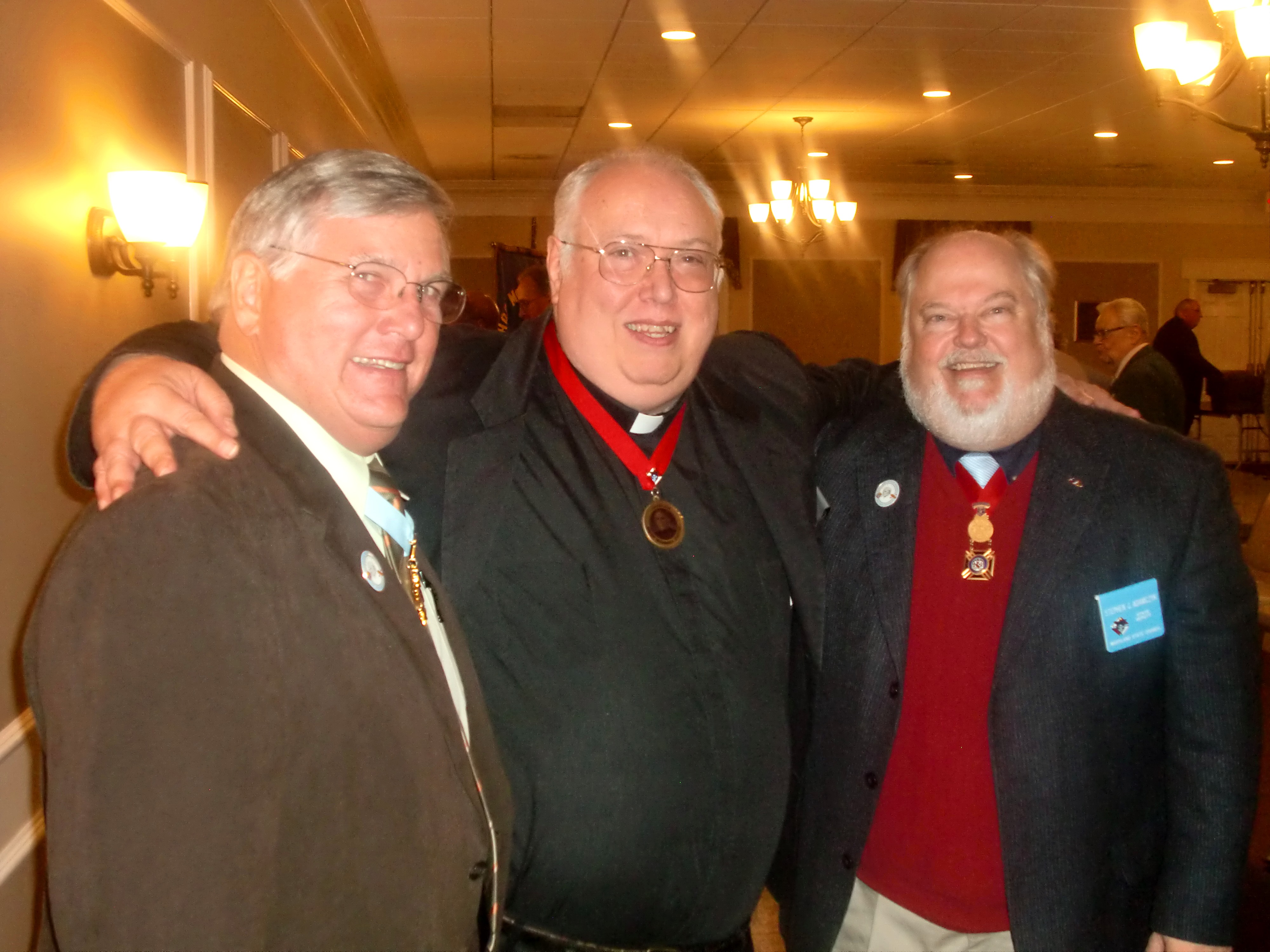
    Fr. Joseph Jenkins

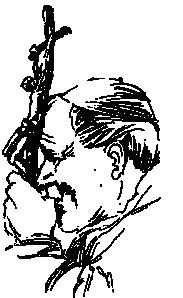
  • The blog header depicts an important and yet mis-understood New Testament scene, Jesus flogging the money-changers out of the temple. I selected it because the faith that gives us consolation can also make us very uncomfortable. Both Divine Mercy and Divine Justice meet in Jesus. Priests are ministers of reconciliation, but never at the cost of truth. In or out of season, we must be courageous in preaching and living out the Gospel of Life. The title of my blog is a play on words, not Flogger Priest but Blogger Priest.

  • Archives

  • Categories

  • Recent Posts

  • Recent Comments

    Barbara King's avatarBarbara King on Ask a Priest
    Ben Kirk's avatarBen Kirk on Ask a Priest
    Jeremy Kok's avatarJeremy Kok on Ask a Priest
    Barbara's avatarBarbara on Ask a Priest
    forsamuraimarket's avatarforsamuraimarket on Ask a Priest

Sinners & Christ’s Church

2 Corinthians 5:15: And he died for all, that those who live might live no longer for themselves but for him who for their sake died and was raised.

Romans 5:6-21: While we were yet helpless, at the right time Christ died for the ungodly, etc.

1 John 2:2: . . . and he is the expiation for our sins, and not for ours only but also for the sins of the whole world.

1 Timothy 2:4: . . . who desires all men to be saved and to come to the knowledge of the truth.

Christ died to redeem all men and women. Some Protestant groups contend that he only died for a select few predestined for salvation. A radical variation of Calvinism claims as much. Theirs is an angry God who has also predestined many for hell. They are even punished in this world by misfortune, poverty and sickness as a sign of their eternal depravity. Catholics, on the other hand, acknowledge that while Christ has died for all, human freedom still gives us the ability to accept or reject the gift of salvation. God’s passive will allows this, but his direct will makes salvation available to all. Poverty and sickness in this world is not a sign of our status with God; indeed, many have chosen to be poor in the sight of men so as to be rich in the eyes of God. The most wicked war criminal, psychotic serial killer, and abortionist are given God’s fatherly attention and, if they should want to avail themselves of it, can claim the boundless mercy of Christ. It may be that many follow the example of the good thief Dismas on the cross.

Matthew 22:1-14: The parable of the king who made a marriage for his son.

Matthew 13:24-32: The parable of the field in which grew both grain and cockle.

2 Timothy 2:20: In a great house there are not only vessels of gold and silver, but also of wood and earthenware, and some for noble use, some for ignoble.

Matthew 18:15: “If your brother sins against you, go and tell him his fault, between you and him alone. If he listens to you, you have gained your brother.”

Matthew 13:47-50: Parable of the net that was cast into the sea, and gathered every kind of fish, savory and unsavory.

Membership in the Church is retained for the righteous and sinners alike. Thus, it is possible for both good and evil men to claim to be Catholics. Of course, such Christianity for wicked men and women would be in name only. It is such a terrible tragedy. Some of the saints have claimed that there are even priests in hell. It is a prospect that sickens us. But, it is a possibility.

For more such reading, contact me about getting my book, DEFENDING THE CATHOLIC FAITH.

The Father Cutie Scandal

cutie9Given the recent publication of Fr. Cutie’s self-justifying book, I thought it worthwhile to publish these revised reflections at my BLOGGER PRIEST site:

There are some critics who contend that the scandal in Miami with Father Alberto Cutie is providential. While God can certainly write straight with our crooked lines, I would stress that he never directly intends evil. There I have said it. I have used the big “e” word, EVIL. I am not judging anyone’s soul. However, I can make a judgment upon scandal and the actions of people in the public square that might lead good Catholics astray. I am not entirely sure what happened with Father Alberto Cutie. He appeared on the news with details we did not need but which have further confused and complicated matters. Now he writes a “tell all” book which attacks the teachings and disciplines of the Catholic Church.

He insisted that for twenty-one years he absolutely preserved his celibacy intact and was not sexually intimate with anyone. That is fine and dandy. But then, what happened? During one TV interview he said he “believes” he has fallen in love. He said he “believes” that God might be calling him to marriage. He said he “believes” that celibacy is a good thing and does not want to be the poster boy for married priests. He denied a sexual relationship, told one interviewer he had been intimate with the woman in the photographs, but not sexually and yet he apparently said in another news program that he had been sexually intimate with her. He said that he did not go out of his way to make trouble for the Church. He said that he and the woman he cared about were almost alone on the beach and that they were not there long. But the compromising photos were taken, despite attempts at stealth. Okay, but still he sought to hide a romantic relationship to which he had long ago given up any right to have.

He preached and gave one message in his parish and on radio and television; but he lived another. Had he been an ordinary parish priest, there would have been a local scandal, but it would not be international news. It would not be the stuff of tabloids and anti-Catholic videos. After he was censured, this priest continued to speak about the matter in public. The problem grew. He gave countless interviews in both English and Spanish. He just would not stop talking. He still has not stopped.

A Reflection on Celibacy

What can we say to the enemies of compulsory celibacy for priests? Priestly celibacy is not outdated. It is a powerful sign of contradiction that neither the devil nor the hedonists of the present age can stand. They malign it as a fantasy or cover-up for hordes of homosexual and/or pedophile clergy. Priests forgive the sexual transgressions of other men and women all the time. However, if a priest should fall, there is only recrimination and exile.

There is nothing wrong with men and women expressing love to one another. It is natural and beautiful. But sexual congress belongs to the state of marriage alone. Priests like all men can make mistakes; but, unlike most men, the majority of priests in the Roman Rite are pledged to a lifetime of celibate love. Yes, while celibacy is a discipline, it is also a manner of loving others, albeit in a single-hearted way. The celibate priest knows a special solidarity with the brokenhearted, the poor, the suffering and those who are alone. His celibacy says that he belongs to the people he serves, without reservation or distraction. He does not belong to another person or even to himself. He belongs to the Church in which he serves. He demonstrates his love for God in how he pours out his life for others.

One early interview was particularly disturbing when it was asked if he would stay or leave the Catholic Church. He admitted that he was currently weighing his options. I was saddened. I thought to myself, if a charismatic priest, regarded by some as the Oprah of the Church, should defect, the harm he would inflict upon the Church could be enormous. He had been instrumental in drawing many people back to the practice of their faith. This scandal could further explode and cause an exodus of souls from the true Church.

He was handsome and seemingly filled with vigor and love of the Church. Such things are contagious in a good way. But hero-worship of any sort, particularly with celebrities, has a dangerous flip-side. They can do much good. But, they are also capable of terrible wrongs and damage. Younger people who easily related to him might now view the rules of the Church as arbitrary and heartless. They might say to themselves, if someone like Father Cutie can no longer tolerate the Church, then why should I?

Critics contend, “Isn’t the Father Cutie scandal just further evidence that it is wrong and dangerous for Catholic priests to suppress their natural desires for sexual intimacy with women?”

The priest in question admitted he had a long-standing serious struggle with his sexuality and need for a wife and family. It may be that he sought ordination without open full deliberation and resolution of this concern with those to whom he was entrusted for formation. He may have been chaste in his behavior for many years but failed to surrender dreams and hopes for a family of his own. The man who would be a priest must let these things go. His hopes and aspirations should revolve instead around his prayer life and his goals and service as a pastor of souls. Men in seminary must also be realistic about their drives. As St. Paul reminds us, it is better to marry than to burn. Priests must also be very wary of their fantasies regarding choices not made and how other men might live. The grass might seem greener on the other side of the fence; but priests must not trespass where they do not belong. They freely embraced celibacy so as to enter into holy orders and become priests. Had they become married deacons, they would still be clergy in the Church. They could have lived saintly lives as laymen. But they made a choice. They made promises. These promises should be kept. Before ordination is the proper time for deliberation and soul searching, not afterwards.

The business about Father Cutie should have no meaning beyond this one poor priest, himself. He is not representative of the thousands of other priests in the United States who have never compromised their promises or their celibacy. The impression from the question is that men cannot be expected to have any semblance of self-control. This is silly and shows just how far our society and its views have been contaminated and distorted by excessive nudity, immodesty, and eroticism. We even dress our little girls like whores and then wonder why there is child abuse. Teenagers have their bellies exposed and shorts up to their crotches. Parents sometimes object but then cannot find decent stuff in stores. Television and movies celebrate fornication and give us scene after scene of simulated sex acts. Pornography has gone main stream and sexual gratification is viewed as a necessary rite of passage. It is into this mix that we find the celibate priest. Mothers want their sons married because they cannot see how a man might otherwise be happy. Fathers want their sons married because otherwise everyone will think they are gay. The truth is that celibacy can be very rewarding and liberating. Celibacy is not a denial of love but a special way of loving.

The priest promises perpetual celibacy but even married men promise a fidelity to a spouse which will require periodic chastity. Those who follow Natural Family Planning would understand how one must be creative in love, perhaps reverting back from time to time to the romantic and chaste acts of courtship during fertile periods. Celibacy is not merely a matter of priests suppressing their sexuality; rather, it is redirected to a love of God and a love of neighbor in sacrificial service. Priests, who say their prayers and stay busy, have neither the time nor the interest to pursue an exclusive relationship. If men in general cannot be expected to control themselves, then what happens when a spouse is sick or incapacitated or away? If the husband has military duty abroad or the wife has to travel back home to care for an ailing parent or there is an extended business meeting, would the man control his sexual urges or be compelled to commit adultery? If his wife is sick and cannot have sex with him, does he necessarily turn to her pretty nurse as a proxy? An over-sexed society suffering from an epidemic of fornication, perversion, adultery, pornography, prostitution and child endangerment can hardly speak in a credible way about priestly celibacy and marriage. The trouble with these fallen priests is not the Church but the fact that they themselves are formed and affected more by the fallen world around them than by the Gospel. Secularists and hedonists criticizing priestly celibacy are like inebriated boozers telling teetotalers to take a drink.

Where Does a FIRED Catholic Priest Go?

Before he made his jump, I read one critic who argued that Father Cutie could defect to the Episcopalian Church, get married and continue his parish and media ministry. I wrote: “Yes, he could do this, but he might forfeit his soul in such a move. The moral state of people who were raised in the Episcopal or Anglican Church is one thing; the state of those who abandon Catholicism to join their ranks is another.”

The original Protestant reformers may have paid a terrible price in their break from Rome. They should have known better. The same cannot be said for those who were raised in the Protestant traditions. This is all they know. Those elements of Catholic faith preserved after the break may very well be meritorious for our Protestant brothers and sisters. However, those very same elements may convict former Catholics who were supposed to remain steadfast within the body of the Church and in the profession of all that we believe as true. Ignorance of the truth does provide some measure of excuse. Catholics in general and priests in particular, would have a more difficult time. They were one with the true Church. They professed its faith and received its sacraments. The conviction from the Fourth Lateran Council, Trent and in the margins of Vatican II cannot be escaped: there is no salvation outside the Church. Those who know, perfectly well, that the Catholic Church is the true Church, and then refuse to join or leave its ranks, might lose their place in the heavenly kingdom. In addition, the Holy Father has insisted that Protestant churches are ecclesial communities but not churches in the full Catholic sense. The Anglicans like to see themselves as a branch of Catholicism, but this sentiment is not shared by the successor of St. Peter. There are serious questions about apostolic succession and its priesthood and Mass. Non-Catholic communities suffer from many dire errors in teaching. Yes, the Episcopalians have married priests, but they also have openly gay clergy and (women) priestesses. They tolerate abortion, sodomy, fornication, contraception, divorce and remarriage, etc. I doubted Father Cutie could stomach such a so-called church for long; I guess he is proving me wrong.

Father Alberto Cutie Defects to Episcopal Church

I grieve for the Church. It was bad enough that Father Alberto Cutie was living a secret life. He seemed more apologetic about being caught than about having his scandalous doings with his lady-friend photographed on a Florida beach. But next we are told that he joined the Episcopal Church. My heart droped at the news.

The wayward priest spent his designated “retreat” time hanging out with his girlfriend. He did not even try to reform. We have all been deceived. While he asked forgiveness and said that he did not want to be the poster-boy for married priests, he has abandoned the true Church entirely. He has done the very thing which he promised he would not do. He has brought both Church doctrine and discipline to ridicule. He has hurt the faith of simple people. Given his popularity as a pastor and as a widely-known media priest, the danger of his defection is incalculable. Who knows how many will follow him out of the Catholic fold?

The Episcopal Bishop Leo Frade should be deeply embarrassed by his disrespect to the priest’s legitimate bishop, Catholic Archbishop John Favalora. Bishop Frade was not Father Cutie’s true spiritual father, but rather of a robber who came to steal from the flock. In this case, he did not get away with sheep but with the shepherd. Ecumenism was dealt a serious set-back. I was surprised not to see lightning bolts from heaven about this travesty. The good Archbishop would have us pray for his prodigal son in the hope that he might return to the fold.

Quickly defecting after the news of his infidelity broke, he was unwilling to give the matter the proper amount of time and distance for sober reflection. I have to wonder how much of this was premeditated. There was even speculation that his girlfriend may have had some prior involvement with the photographer on the beach. But I think it is reaching to suppose he was setup to force his hand. Regardless of the machinations behind the scenes, the blunt of the blame must be borne by Father Cutie.

Although supposedly orthodox in his teachings, this latest act shows quite the opposite. He broke trust with his bishop and brother priests but now refers to Episcopalian priests as his “many brothers… [who] serve God as married men and with the blessing of having their own families.” This act sickens me. Episcopalian priests may be good Christians, but he sees no difference between the authentic priesthood of Catholicism and the empty shell of Anglicanism. He is not the first. But, almost every one of them abandoned Roman Catholicism, not for deep-seated doctrinal reasons, but because of the desire to bed a woman and still retain a public or ministerial persona as a spiritual guru.

Catholicism receives many Episcopalian priests into her ranks, but they are drawn by doctrinal permanence over fluctuating instability, moral absolutes over relativism and humility coupled with obedience to God and his Church over a selfish and earthbound liberalism. Those who become Catholic often sacrifice much in the way of salary, standing and home. While a few married Episcopalian priests have been ordained in the Catholic Church; many have sacrificed their ministries entirely to be a part of the Catholic family. They placed a higher premium on divine truth than upon a capricious religion easily swayed by the fads and fashions of the day.

How could he give advice about faith and relationships to others on television, radio and in writing when he was so personally messed up? People came to him for life-giving water; but he was really an empty well. Many of his supporters seemed more “on his side” than in harmony with the mind of the Church. He made disciples, inadvertently I suppose, less for Christ and his Church and more for himself. Sometimes I think the Church should rotate clergy in media settings. Left too long in front of the camera or on the radio– and a personality cult frequently develops. We should not hero-worship our clergy. If a popular priest should fall, he might take many souls with him. This business with Father Cutie has re-ignited the married priest debate even though most active priests prefer the status-quo in favor of compulsory celibacy. Who knows how dire this will continue to be for the Church in Miami?

A television station showed parishioners of St. Francis de Sales Parish marching around their church in support of their former pastor. Evidently they did not care that their pastor had broken his promises and had lived a lie. When interviewed they compared Father Cutie’s transgressions favorably against the terrible crimes of pedophiles. The real comparison is with good and faithful celibate priests.

The situation was intensely precarious. Later it became a great deal worse. The woman was identified as Ruhama Canellis. She stood by his side at Trinity Cathedral where they both entered the Episcopalian church. The Episcopal bishop and priests in attendance dressed up for the event. They pulled all the stops. Even priestesses were in attendance. He was planning to marry his lover and to become an Episcopalian priest. He has now realized these aspirations. I suppose it is fitting. King Henry VIII stole the English people from the Catholic Church so that he might divorce and remarry. Canellis is a divorced woman. Did Father Cutie miss the class in seminary on basic Christian morality? Are not fornication and adultery still sins? This should matter to them both. In addition to these concerns, he is now a renegade Catholic priest. If he accepts Protestant teaching, and plans to expound upon it, then he will be a heretic as well. He is digging a big hole for himself. My fear is that thousands might fall into it with him.

Well, it is a sad thing, but if the Episcopalian church wants our rejects then that is their trouble. Look how quickly they grabbed this fallen priest. We would have taken more time with one of theirs. His legitimate Catholic bishop was not even notified about his reception into the Episcopal “church.” That shows how little respect Father Cutie had for him and the ROMAN Catholic Church. The Episcopal diocese should be ashamed of itself. But given the current fragmented status of the Episcopal communion, are they even capable of shame? This was all quite sleazy and I suspect it was in the works for some time. I have no respect for men who do such things.

Father Cutie described his new faith affiliation as “a new family” and yet we do not subscribe to any form of religious relativism. Father Cutie disowned his family. That should be the real headline. All churches are not the same. The Holy Father was clear. The Catholic Church is the true Church; Orthodoxy is a defective church; and all Protestant groupings are ecclesial communities, but not properly CHURCH. Many Protestant communities claim no priesthood or Eucharist; Episcopalians claim both but the Catholic Church judged their orders invalid and their Eucharist as false.

SEE APOSTOLICAE CURAE (Pope Leo XIII, 1896)

They are not a branch of Catholicism but a foreign misbegotten creature that has delusions of grandeur while feigning a pedigree it does not really possess.

What clouds the issue is the presence of former Catholic priests in the Episcopal community. They are still priests, even if in mortal sin and excommunicated. Father Cutie says that he will continue to proclaim God’s Word; but what is a Catholic priest apart from the Catholic Church? Will he preach the Word of God or the word of Cutie? Father Cutie is rejecting the Pope, the authority of his lawful bishop, the seven sacraments as clearly defined by Catholicism, our view of priesthood, our moral teachings on sexuality and marriage, the prohibition against divorce and remarriage, and the basics of Catholic ecclesiology. Will he be happy? Can he close his mind and heart to the many differences we have with Episcopalians? He will be obliged to accept women priests, gay bishops and same-sex unions, a tolerance for abortion, artificial contraception and divorce with remarriage. He is leaving the Church of commandments for the church of anything goes. He says, “I will always love the Catholic Church.” But, he did not love her enough. The Church was his bride. Now he has traded her for two paramours: the divorcee and the mistress church of Henry VIII and Cranmer the despoiler.

Fallen Priests & Their Women

Choosing the Woman over the Altar

fallenIf any priest in a compromised situation with a woman attempts marriage then he places himself and a person he says he loves into a seriously sinful state. It angers or upsets me that men can reject Church law and teachings when it suits their selfishness. My upset or indignation is in reaction to the hypocrisy, dissent and scandal caused by fellow priests against the Church I love. I am not vindictive about it, only deeply disappointed. If he maintains a brother-sister relationship until (or if) laicization is offered, at least then he shows some respect to the Church and concern about her soul.

I have friends who are priests who left ministry to get married. I would not condemn them. But they would not seek to function without the legal faculties to do so.

Discussion with revisionists who have burned their bridges is very difficult. We may be destined to communicate at cross-purposes due to very divergent premises and convictions. However, everyone on the right or left of such issues should want to facilitate genuine healing in the lives of others. Priests and the women with whom they have had intimate relations or attempted marriages might confess to something of a love-hate relationship with the Church, owning up to their anger, reckoned by them as justifiable.

I wish priests who leave ministry well. Once a man has defected with his beloved, I would hope that such couples would love and be faithful to each other. Laicization and release from the promise of celibacy are important; otherwise, no marriage would be recognized as either valid or licit. I would hope that priests who leave for a woman would reserve their romancing until that time they are deemed free to do so. As for shame, what kind of woman could take a priest from his altar and from the confessional and not feel some sort of remorse? How could a priest, albeit a fallen one, ever really love a woman who took so lightly what he would give up for her?

Doing the Right Thing

Healthy heterosexuals, rightly ordered priests in their sexuality, are attracted to women. They make a promise of celibate love and by discipline, prayer and grace they live out this life of loving service. They might fall in love… heck, they might fall in love with a number of nice women in their lifetimes, but they remain steadfast. Older and wiser men recognize the signs and make distance, even becoming gruff or mean to women they particularly like. This is often misinterpreted. But it has to be done. If a priest falls deeply in love with a woman in a romantic way, he must abandon her friendship and any affiliation with her. He must not play games that will lead the both of them into disaster. He must say goodbye. Often he will not and should not tell the woman why they cannot remain associates or “friends.”

Certain dissenters, who might see some small value in celibacy for misanthropes, refuse to accept that such a mandatory discipline could be in concert with God’s will. My view is clear: “They have surrendered their intimacy and their sexuality to God— case closed.” A priest is not his own man. He belongs to God and the Church. Giving God his intimacy and sexuality means that he will not have an exclusive sexual or intimate relationship with another human being. Priests are still sexual human beings, but they love in a celibate way of service.

I can well understand how those who have become entangled with priests might suffer through my comments. I stand by my words. Celibacy is a sacrificial discipline which priests FREELY embrace. God does not return our gifts except as transformed. In this case, the priest belongs to God and to his congregation but not to a particular friendship or to an intimate sexual relationship. The salvation of souls is the fruit he seeks, not that of his loins.

Is it immature to be a faithful celibate? Is it misogyny to say that a man can be happy and fulfilled without a wife and family? Those who applaud fallen priests and their women are very quick to judge priests like me; they errantly place the greater maturity with those men who broke their promises, perhaps even committing mortal sin? I have many close friendships with women, but I am well aware of the boundaries and I do not play games with them. The trouble today is that many women mistake friendship and kindness as a summons to something more. Given the immaturity of men and women in our society, it is no wonder that there is a problem in this regard. Would we rate the men who stayed celibate as children and those who fooled around with women as the more well-adjusted and mature?

Defection and Redefining the Priesthood

Those who turn their bitterness against the so-called “institutional” Church, as if the properties of the Church can be practically dissected, often forfeit a sense of the sacred and the supreme importance of the sacraments. It is for that reason that renegades will often turn to ecclesial communities with dubious apostolic succession and a questionable or counterfeit priesthood and Eucharist. One critic referred to the sacramental role performed by a celebrant, his action at the altar “in persona Christi,” as an empty caricature of priesthood with no significant or enduring meaning. She would reduce the meaning of priesthood to show that it is a poor trade for a wife and family. Priesthood becomes less a vocation and more a job in this evaluation. But priests are more than clueless figureheads; they truly make Christ present in their own person and in their activity.

Every validly ordained priest shares in the one priesthood of Christ, this is where his ministry finds focus: in the sacrifice, in the consecration (real presence) and in the forgiveness of sins. Dissenters, renegade priests and the women, who run away with them, might embrace a defective religious confession and their rites or they might even brush off any definition of priesthood which places the gravity upon the dispensing of the sacraments. Poor lost souls, they lose a sense of basic Catholicism 101.

It may be that some women redefine the priesthood to blunt the blow that they have cost the Church a good priest. Of course, the priest has responsibility in all this, and must share culpability. One might feel less guilty if our vision of the priesthood is narrowed to activity that anyone might do. It is wrong to contend that when not saying Mass or hearing Confessions, he is no longer configured to Christ Jesus, the great high priest. A priest is always a priest. As a case in point and it might sound profane, I once heard a Confession in the stall of a bathroom, initiated by the penitent, not me. At the doors of the restroom I gave him absolution.  Yes, I prefer Church confessionals, but if a person is in serious sin, there is no time to waste. Priests are never really off duty. And definitely, there is never time for illicit fun and games with the girls!

Priests who are celibate and expect other priests to keep their promises are not rigid and deliberately hurtful. Every priest is called to be a healer. But excusing or ignoring or offering approbation for failure is not to render true healing. Such activity represents a false compassion. The priestly confessor of souls serves many functions: physician or healer, father, teacher, prophet, and judge. I would not judge myself any less severely than I would any other priest. Such a role is necessary to insure proper guidance and repentance. We are all sinners. We are all weak and poor instruments. But, God’s grace can work the miraculous in our lives.

Truth versus Dissent

I can only speak for God when I echo the teachings and disciplines of faith. I claim no moral superiority over others. I make mistakes and even errors in judgment. We all do. But I do not think my views about this are in conflict with the Good News of Christ. Our Lord has given us an infallible Magisterium to guide and govern the Church. Dissenters cannot speak for God if they oppose the Catholic faith. Dissenters believe they have a special enlightenment in regard to the truth. They do not even seem to fear God in making themselves into little popes in deciding what they will and will not accept. Such a dilemma is clear when dissenters argue for a version of love unhampered by the restrictions of the Church (like vows or promises). Challenge their special enlightenment and they will go further in denying the Church’s charism of truth and the qualifications of faithful priests.

While speaking as if they are a competing or parallel Magisterium, critics insult the Church and every good priest, and yet, seem blind to what damage they are doing. Their rhetoric betrays an anger that moves from the matter of married priests to that of women priests or priestesses. They insist that the Church is depicting women as the enemy and dangerous. They demand that men and women be treated equally. Priests and their women who marry outside the Church and/or move into other denominations are stamped as heroes and not as sinners. There are a few cases where former Catholic priests allow their “attempted” wives to serve as priests alongside them. The first has no faculties to minister and the latter has a counterfeit priesthood severed from apostolic succession. An imaginary and false line is drawn between faith in the true Church and faith in the Lord.

The conflict in such discussions between sides is divergent views of ecclesiology and vocation. Those on different sides of this question place the weight in different areas. My emphasis would be upon the head and the spiritual power of will. I suspect that many women actively involved in an intimate way with priests would give the gravity to the heart and the corporal passions or emotions. On the other hand, I would stress the clear fact that the Church welcomes men to holy orders who promise or vow celibacy. The objective or external situation is that men do this and I feel they should remain faithful to their promises. There is no good escape clause. As far as I am concerned, that is where matters should end. They should behave themselves and if they should suffer emotionally, offer it up with Christ’s passion.

Those who later want out of their promises make all sorts of rationalizations. The business about the heart and/or emotions is only recognition that such seems to play a big part in the decision of priests and women who become romantically entangled. I may be wrong, but is this really such a large leap in reasoning? If this is overly presumptive, then I would apologize but I have dealt with many delicate situations regarding such things and it has been my experience.

We must not be naïve about the fierce physicality in men and the sexual drive which men must daily sublimate to stay chaste. I have never said that priests must hate or fear or universally separate themselves from the female gender. However, there will come times when a priest must break off certain relationships because his heart and fallen nature is taking him in a direction he must not go. A priest is always a living ICON for Christ. The full gravity or weight of his sacramental vocation is manifest at Mass where he operates “in the person of Christ, head of the Church.” He signifies Christ the groom and the Church is his bride.

Critics will insist that the Church and her defenders violate a number of values. However, a clarification has to be made. EQUALITY in grace is not any kind of egalitarian view of humanity. JUSTICE for others also includes following objective norms, of the State, of the Church, of Nature, and of Divine Positive Law. Today many things we call RIGHTS are really just made up excuses for license and sin. Women have no right to priesthood. Celibate priests have no right to either wives or concubines. People of one gender do not have rights to sexual contact with those of the same gender.

What Do Priests Know of Love?

One critic argued recently that priests generally knew nothing about love. She contended that they were ordained merely to fulfill family expectations. But there are many reasons and such anger cannot invalidate the calling of good men validated by the true Church. The truth be said, most priests today entered the seminary against the wishes of family and friends. God is love; however, it is wrong to equate this love entirely with the romantic. Such critics fail to acknowledge human weakness and sin; rather, romantic entanglements with priests are wrongly interpreted as God’s will. This is ludicrous. God never desires sin.

It is not my intention to give a comprehensive treatise on divine love and how we share that love. I believe God can forgive and that he showers mercy upon priests who leave active ministry to marry women. It is rather insulting and “mean spirited” that certain critics think many priests have no notion of love. I counseled a woman many years ago against flirting and trying to seduce a man in seminary formation. She walked out shouting that I had nothing to say to her because I had never been in love! I challenged her on this assumption and she crudely blurted out, “Unless you have gone to bed with a woman, you do not know what love is!” The very reason why I and so many of my brothers embrace our celibacy is out of love for God and his people. The harshest critics are essentially saying that they do not care and that it is a waste of our time. Love brought me to the priesthood. It is love that beckons me to the altar, to the confessional, to the baptismal font, and yes to the sick bed of the dying. I am sorry that such lost people cannot understand or appreciate that.

Attacks against the Church and Her Messengers

What has been my reward for speaking about the value of celibacy and for insisting that good priests keep their promises? I have been assaulted personally as a misogynist and my view of human sexuality has been condemned as immature. Such judgments were not the result of sharing a detailed appreciation of vocations and human sexuality; rather, I was labeled precisely because I placed a negative value on the illicit unions and/or liaisons of priests and their paramours. I am not naïve about priestly formation and human development. Truthfully, I believe clergy should be emotionally whole and integrated. Priests should be comfortable with women. However, and here is the great divide, celibate priests should NOT have sexual relationships with women.

I would certainly not want to generate unnecessary anxiety for others, but sometimes bravery means not denying or running away from our guilt. Ridiculing Church teaching and discipline, breaking the vows of priesthood and/or marriage, are not positive in any honest estimation. However, speak about sin, and there are always many who will insist that no one can judge such things, despite divine commandments and objective right and wrong. Prophets who speak the truth of God are castigated by false prophets who speak their own mind. Broken promises, fornication and adultery, attempted marriages, illegitimate children, scandal… yes, I would say that such sins should make people feel ashamed, particularly for the unrepentant and the guilty.

They want every faithful priest or so-called right-wing Catholic to be caricatured as an angry homophobic and chauvinistic white male. While they excuse their own venom, any use of hyperbole to make a point or indignation about fallen priests and their women is viewed as the most outrageous insult. They share this with certain radical homosexuals who condemn Church teaching as hate-speech. Both camps contend that you cannot judge the sin without condemning them as sinners. They think that faithful and traditional priests value institutions and laws more than people— and yet, must there be a disconnect? However, it is NOT the institutional Church that denies people access to grace. People do this to themselves by their sins and by failing to preserve a disposition receptive of grace. Critics wrongly dismiss the Church’s discipline as just man-made laws. But the Church is both a human and a divine institution. Celibacy is not a purely human fancy but is an element of the divine plan.

I would contend that it is a pretty poor and simplistic synthesis against supporters of the status-quo to say that those who disagree with revisionists on this matter and their agenda are all angry men with a punitive outlook. We can be upset or disappointed without desiring any kind of harm to others. Most priests try as confessors to keep emotions in check. We hear everything, from the lurid details of abuse to murder itself. Our response is that of Christ. The penitent expresses sorrow for sin, makes an act of contrition, and then receives our absolution. Sometimes that healing is enough and at other times, they are placed on the road to recovery. Any upset I feel is precisely because the priesthood means a lot to me and we should not give poor witness.

The Effect of Scandals

Scandals are always thrown into the face of those who argue for no change regarding our discipline. Lately, the recent scandals around Fr. Marciel Macial have been their ammunition of choice. It is true that many regarded him as a conservative, i.e. orthodox. Critics of celibacy are having a field day with revelations that he purportedly fathered a child. This is bad news for the Legionnaires and for the Church. The questions about abuse in his regard are even more serious. However, such poor witness is no absolute invalidation of priestly celibacy. Most priests are faithful to their promises.

Critics point to the scandals and the fallen priests and ask the rhetorical question as to whether or not compulsory celibacy is a fallacy or myth? They think it is. Some well-meaning voices play into their hands by recommending optional celibacy. They feel that celibacy should only be permitted to those who feel called to it. However, most priests in the West freely promise celibacy. No one is forcing them into the priesthood. If they do not feel called to celibacy then God in his wisdom would not ask them to be priests. God is not in conflict or battling his Church; rather, he works in concert with the authority he established. The struggle here is to do God’s will, not what our selfishness would ask and not what the dissenters demand. Optional celibacy might see its day; but it will not solve the vocations crisis and it will create new serious issues in itself.

Many of us have had concerns about the secrecy and ultra-regimentation of the Legionnaires. I wonder how much of it reflected the secrecy that Father Macial utilized to cover his own scandalous indiscretions? It is a very sad business. Hopefully Rome will bring reform and healing to the situation.

Celibacy is not a myth, despite what the cynics might say. I believe that God works with his Church and gives the grace of celibacy to any who are truly called to his priestly service in the Roman Catholic Church. Yes, the Church could change this discipline tomorrow and make it optional. But no one should seek ordination with such an expectation.

Why Should We Care?

Why would a faithful priest be upset about those who violated Church rules? Well, first, one can be both upset and still show compassion and empathy. Second, good priests have a responsibility to admonish and to guide people in the moral life. Breaking promises to God and the Church is selfish and wrong. Third, while it is true that no one can absolutely read the inner hearts of others; this does not mean that the Church cannot render judgment about external actions. If you make promises and break them, you commit an objectively evil act. This is more than a sentiment or a temptation hidden in the heart and will. We would suspect that priests, of all people, would be fully cognizant of their behavior and the repercussions. They cannot claim ignorance. Bad priests agreed to the rules but later wanted to change them. Women who become involved with priests, and here I mean actively involved as in sexual encounters, mistresses and attempted marriages, should know full well that they have fallen far from what God and the Church demands. Ladies who have the heartstrings pulled and then do the right thing are entirely different. This latter group deserves our respect and continuing support.

Fourth, a fallen priest’s promises were made to his bishop and before God, not to me personally or to other priests. The actions of one priest often affect all priests and thus, the misconduct of any one priest hurts all priests. That is why the abuse scandals have been so incredibly devastating to the morale of priests. It wounds every one of us personally. We are all sharers in the one high priesthood of Christ. We trust and look up to one another. We expect fidelity, courage, generosity, obedience and sacrifice. We believe all the jargon about the glories of the Roman Catholic priesthood. When men fall short, it pains us more than any of us could properly convey.

Every priest who keeps his promises feels hurt and betrayed by those who do not. This fuels the indignation, along with the insufferable arguments that question the teaching in hindsight. Often personal responsibility is minimized and the Church herself is made the culprit for making the celibacy requirement at all. Broken promises by priests are seen as a betrayal of our brotherhood. It breeches them from their spiritual father the bishop and their brother priests. Those who are not priests might not understand this element of family that is focused upon the presbyterate.

My indignation or upset or anger or resentment or whatever you want to call it is not misplaced, but justified. I may come across as somewhat judgmental, but such is often my response to dissent and attacks upon a celibacy which I believe is worthwhile and should be sustained as compulsory in the Western Church. I would and have supported men who left ministry. I see no contradiction in doing this quietly for individuals while taking a strong general position against romantic entanglements, defections, and laicizations.

Sinless Mother Mary

One of my favorite feasts and dogmas is that of the Immaculate Conception, a teaching of the Church which has had a long and sometimes controversial history. There are even some contemporary critics of this dogma of faith who would argue that it overly separates Mary from the rest of us. Certainly, it is true that sinfulness is a reality ever present in our lives. We find it so difficult to be good. It is ironic that a few of the feminist theologians who image Mary as a strong and liberated woman, would then criticize this teaching and argue that Mary has been used as a device of oppression on the part of a male dominated hierarchy. It seems to me that quite the opposite may be true. The witness of Mary as the queen of the saints would emphasize that the greatest person to ever walk the earth next to the Lord, is this woman Mary. Genesis 3:9-15, 20 recalls the first Eve who with her husband turns away from God in disobedience. Psalm 98:1,2-3,3-4 might remind us that if Eve is the mother of all the living, Mary in her faithfulness is the mother of all who are reborn in her Son. She stands as a model of holiness for men and women alike. Her preservation from sin does not create an impassible chasm between her and us. Sin by definition adds nothing to us or to her. If anything, it is a lack of something which should be there — the grace and presence of Christ. Just as she carried the Lord, now we must avoid sin so as to be filled with his presence and life. Sin is that which divides and alienates. To wish this upon Mary would mean wanting separation from her and the Lord.

Like us, she is totally a creature. The saving grace which washes over us in baptism reaches from the Cross backward to the moment Mary is conceived in the womb. The Messiah whom himself is sinless would enter our world through the sinless portal of Mary.

Rarely do preachers mention how the mystery of the Immaculate Conception celebrates the beauty and holiness of marital love. Nevertheless, this is true when we look at the actual history of God’s intervention. Although Mary would conceive Christ through the overshadowing power of the Holy Spirit (see Luke 1:26-38); Mary’s conception as sinless elevates the significance of marital and sexual love as shared between Joachim and Ann. Couples raising families in this age would do well to recall that their children in baptism become as Mary, and even though they struggle to remain holy; they may be perfected as saints. As Mary is, we may become.

For more such reflections, contact me about getting my book, CHRISTIAN REFLECTIONS.

Share Your Bread with the Hungry

“Share your bread with the hungry, shelter the oppressed and the homeless; Clothe the naked when you see them, and do not turn your back on your own. Then your light shall break forth like the dawn, and your wound shall quickly be healed” (see Isaiah 58:7-10).
“You are the light of the world” (see Matthew 5:13-16).

These passages are very meaningful and challenging, maybe more so than is immediately evident. In the seminary I was a member of a social justice committee and such passages as found in Isaiah inspired us. We really are called to share our bread with the hungry, to shelter the oppressed and homeless, to clothe the naked, and definitely NOT to turn our back on our own. But even if we were to be advocates of all the social justice platforms offered today, this alone would not make us faithful to this passage or a true light to the world.

Jesus and Jesus alone is the true light. Apart from him any flicker of light we might offer to others would be swallowed by the shadows. Sharing your bread with the hungry is a noble task, but the trouble is, the one given bread today will be hungry again tomorrow. We have many good-natured fellows who make others dependent upon them, unable to stand up for themselves with full human dignity. Or, we have just the opposite, those who feed their brothers and sisters once and feel no further obligation. And, on top of all this, we can forget the real hunger that is out there– that needs to be fed– that can only be satisfied in Christ. Christ comes to us in the bread of life, the Eucharist; he transforms us into himself, a bread which must be broken if it is to be given to others. It is not enough simply to care for the hungry; we have to LOVE them– some of whom are in our very families or groups of friends. Not all the hungry are on the street. They know who they are. Some may be in our midst right now. Do any of you sense it? Is there emptiness inside you? Is the belly of your soul crying out for nourishment? Don’t be afraid to ask for help, come– be fed– there are priests and other Catholics waiting to hear from you– to help you, come. Christ is waiting.

Isaiah also speaks of sheltering the oppressed and homeless. That is what the house of God is about. Sometimes when I am in church, I imagine I can feel an external oppression. I envision it pressing upon the outer walls. When our values of action and of belief are openly ridiculed and distorted, then we are oppressed.

Our Church is a shelter from all the wiles of a world intent upon our destruction. There are hurts out there– come in and be healed. There are lies out there– come in and hear the truth. There is violence out there– come in and receive peace. There is coldness out there– come in and be warmed by the flame of Christ’s love. There is darkness out there– come in and become a part of that light which is the Lord.

It is sad when someone hears the call of Christ and misinterprets it or only goes part way. There was a man in Washington, DC, who generously devoted his life to the care of the homeless. That is to be applauded. But, like so many, I have to wonder if he heard the call clearly. Why? He sold all he had, gave up his job, and did things reminiscent of what our Lord asked of the rich man in the Gospel. However, he also abandoned his wife and family to enter upon his crusade. He was my friend, but this always bothered me. Can we renounce one responsibility for another? Can we exchange one set of mouths to be fed for others? Can we cause homelessness in order to give a home for others? I do not want to judge anyone, but the very Scriptures which speak of so many deeds of mercy also remind us not to turn our back on our own. In Christ, and only in Christ, you are the light of the world. When does this light shine? It shines when a husband and wife love each other unselfishly, open to the gift of new life. It shines when a brother tells his sister, “I’m sorry, forgive me.” It shines when a father welcomes his alienated son back home. It shines when a couple loves each other so much that they discipline their love in chaste giving. It even shines when one friend gives another a scarf or sweater for Christmas. Done in Christ, all things great and small make the light of Christ shine all the brighter.

For more such reflections, contact me about getting my book, CHRISTIAN REFLECTIONS.

Out of Prison

Imagine that you are in prison. You are afraid. You have been whipped and mocked. Your feet are bound down in chains. A guard is at the door and there seems no way of escape. Who knows, maybe they will beat you more tomorrow? Maybe they will go even further? Can you imagine how desperately you might want to escape and run away?

Paul and Silas find themselves in this situation (Acts 16:22-34). However, instead of betraying their cause or crying out in despair and fear — they sing songs. They pray and sing hymns to God. The other prisoners listen and maybe find some consolation in their hymns. Suddenly, there is an earthquake. The guard is asleep. The doors fly open. The chains are pulled loose. Run! Run! This is the natural human sentiment. It is probably what most of us would do. Get out of there quick! Hide! Escape! Freedom!

The guard awakens and thinking that the prisoners have escaped, he draws his sword to commit suicide. He is like us. He feels that he has run out of options. If he takes his life, the authorities may spare his family. However, Paul shouts out, “Do not harm yourself! We are still here.” The jailer cannot believe it. He calls for a light, and there in the shadows are Paul and Silas. He falls at their feet. Why did they not escape? They speak to him and he asks them what he would have to do to be saved. Their action is changing him.

Suddenly he is more concerned about the salvation offered from God then simply avoiding the punishment from his superiors. His fear evaporates. He himself takes them out of the prison and to his household. He bathes their wounds and then Paul bathes him and his family in the waters of baptism. With a table spread out, they all then celebrate the newfound faith.

A jailor, whom many of us would have thought about murdering, was himself saved by God. There have been similar stories during our own age, where the witness of Christians in prison has lead to the conversion of their persecutors. We may not find ourselves behind bars for our faith, but we may sometimes be prisoners nonetheless. We can hide our faith behind the bars of indifference, prejudice, or even just laziness. We often fail to try to move people we love to greater faith in Jesus and we practically forget about those we dislike. Indeed, instead of praying and working for the conversion of all, we might be very selective in whom we choose to confide about Christ. Paul was not. Friend or foe, male or female, Jew or Gentile, slave or free, ugly or beautiful— the Gospel is meant for all.

For more such reflections, contact me about getting my book, CHRISTIAN REFLECTIONS.

Peter & the Papacy

Every year we celebrate the feast of the Chair of Saint Peter the Apostle. It is an occasion of great joy for us in the Western Church. Twenty centuries have passed and still this central chair of our Church stands firm. However, the sadness of this celebration and teaching is that Peter who should be for all Christians a focus of unity has instead become a point of controversy and division. Our Orthodox brothers and sisters, while willing to recognize him with their bishops as the first among equals, cannot yet work out among our churchmen a mutually acceptable view of his primatial authority. The Lutherans are willing to admit some sort of role for him as the ecumenical seat of the Church but not as one who could officially and infallibly teach. The Anglicans find difficulty in regards to the tension between the papacy and the role of their conferences and nationalist leadership. And some of our Baptist friends, like the late Pastor Jerry Falwell would not accept him as a full associate unless he dressed in business suits, got rid of the rituals and “costumes,” and slid down slides for money at amusement parks. (Pastor Falwell did that stunt when he took over operation of an amusement park once owned by Baker’s PTL ministry.) I mention all this lest we forget how others sometimes see us and the one whom we discern as Christ’s Vicar on earth.
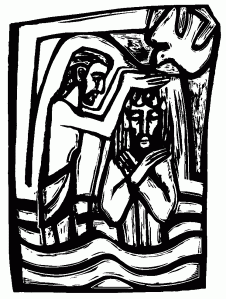
As a fan of history I cannot help but remark about that title “vicar.” At first, those who were the bishops of Rome were actually called the Vicars of Peter and only later was this term redefined as the Vicar of Christ. After all, he is the one who is visible on earth replacing or better, representing Christ to the Church in the See or Chair of Peter. Of course, Peter had not always been in Rome. Even though he founded his see there, it was the place of his death. Earlier he founded the See of Antioch which was then the capital of the East. Saint Gregory the Great claimed that Peter was Bishop of Antioch for seven years. It is because of this that this feast was formerly commemorated on January 18 in honor of the Roman Pontificate and on February 22 in honor of his governance in Antioch.

Peter in 1 Peter 5:1-4 admonishes his friends to be examples to the flock in their generosity and humility. It is no wonder that the successors of Peter, despite all their worldly titles should still cling to the most humble title imaginable in being called “the Servant of the Servants of God.” Peter learned well his lesson when he at first had refused to allow the Master to wash his feet. The Lord told him that unless he allowed it, he could have no part of him. After the Paschal Mystery, it is Peter who would emerge as the one to most humble himself and to shepherd the People of God. Unlike Judas who betrayed the Lord and despaired; Peter recovered from his denial of Christ, and became the visible and humble bedrock of Christ’s Church. His are the keys of Christ which invite even the most grievous sinner to seek and receive forgiveness. This same Peter would follow Christ all the way to his own crucifixion on an inverted cross. Peter died, but his chair did not. Our Holy Father today wields the same keys to the kingdom which were used by Peter, keys which seek to open our hearts to God’s truth and mercy. The Church shows us the light of Christ in a world still stumbling in darkness. The Church is the compassion of God in a cold world. May we always see in the Chair of Peter the source of our historical and spiritual unity to the living legacy of Christ.

For more such reflections, contact me about getting my book, CHRISTIAN REFLECTIONS.

The Price of Truth

We dispose ourselves for the ever-flowing presence of Christ into our lives in the form of grace, which makes Christ alive inside us. Some thought should be given to the quality of our integrity and the substance of our fidelity.
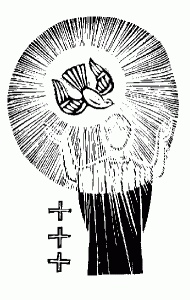
The Gospel informs us that it was John the Baptist who fulfilled the words of the prophet Isaiah: “A herald’s voice in the desert, crying, ‘Make ready the way of the Lord, clear him a straight path’” (Mark 1:2-3; see Isaiah 40:3). The Baptizer knew well that the only path which failed to get lost in detours — the only sword which could cut through the web of men’s lies — the only life-preserver able to preserve us from drowning in our sins — was the commanding authority of the truth. Later, Jesus himself would admit to the Roman procurator Pilate that “The reason I was born, the reason why I came into the world, is to testify to the truth. Anyone committed to the truth hears my voice” (John 18:37). War weary and perhaps tired of governing a rebellious people, Pilate answered as only a stoic could, “Truth, what does that mean?”(see verse 38). And yet, despite his cold manner, he would later admit that he could find no case against this man Jesus. Had the truth begun to break through his armor of indifference or was it merely the plea of a man who no longer cared? Let truth be whatever you want it to be? So many different lands — so many different peoples and gods — so many voices — and so many varying versions of the truth; how could they all be right? Might they all be wrong? Like John the Baptist before him, the peculiar truth of this emerging God would be rejected by most, accepted by a few, and would cost Jesus his life.

The Baptizer before Christ would not easily be silenced. Learned men were sent out to spy upon him and to attempt to trick him. Herod pleaded that he would be finished with his ceaseless mutterings against his adultery with his brother’s wife. However, if the conscience of Herod had been softened by lust and ambition; the voice which stirred from the Baptizer’s soul was a reminder that the sin remained. Eventually, the wild dance of a young girl would so clutter Herod’s reason that he would make an irresponsible pledge of evil, and John’s head would be served on a platter. Jesus, the one foretold by the Baptizer, would also seek to remove the blinders from peoples’ eyes; indeed, so similar were they, that some speculated that he was John raised from the dead. The irony of those words had yet to be realized.

The only sin which would raise Christ’s ire, would be the sin of hypocrisy. His anger erupting in the temple, he called the Pharisees “blind guides!” Supposedly, they were the ones who knew the truth of God and lived it; instead, they sought to distort it in order to preserve their comfortable and respected position in society. The message which Christ preached threatened their safe and elitist life. The multiplicity of laws made it impossible for any save themselves to follow them to the last iota. Nevertheless, if they enforced a cruel scrupulosity upon everyone else; they were lax upon themselves. They failed to recall or reserved to themselves that the spirit of the law was love. Messiah or not, this Jesus had to be eliminated — this truth of his had to be silenced!

That voice in the desert and the truth of Jesus did not perish with them. Christ’s resurrection from the dead vindicated him and his prophet. His message prevailed against the verdict of sinful man. His truth would remain alive and because of its great compelling power, even take root in some of those who betrayed or sought to destroy him and his followers. Peter who denied with his lies three times ever knowing Christ, would one day witness to the truth, at the cost of taking up his own cross. Fear would no longer paralyze his thoughts and actions. Paul who had been so closed-minded to Christ that he approved of the stoning of Stephen, would be wondrously blinded by the light of truth. He would join his words to the truth of Christ: “My prayer is that your love may more and more abound, both in understanding and wealth of experience, so that with a clear conscience and blameless conduct you may learn to value the things that really matter, up to the very day of Christ” (Phil. 1:9-10). It is for that day of Christ that we prepare. To do so, we must also testify to the truth of Christ.

For more such reflections, contact me about getting my book, CHRISTIAN REFLECTIONS.

Catching the Spirit

The Spirit of God descends upon Moses, and then as if contagious, upon the elders gathered in the tent, and even upon two who were not assembled with them (see Numbers 11:25-29). When some want to stop the two from prophesying, Moses cries that he would have them be a nation of prophets. This is precisely what Jesus seeks to make a reality. We are anointed in baptism as prophets of the Good News. The essential mission of the Church, in all her members, is to be a prophetic voice of Christ’s kingdom.
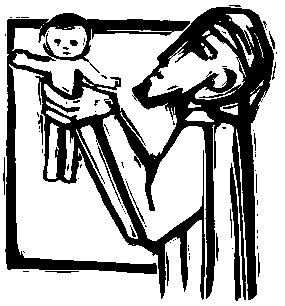
This prophetic role is utterly dependent upon the action of God. It is his word, and not our own, that moves the Christian disciple. Prophesy or the proclamation of the Gospel in our words and actions, is an expression of divine favor or grace. God gives his servants that which is necessary for the acquisition of our ultimate end, union with him. Toward this end, he infuses habits and/or virtues that assist us in our earthly pilgrimage. The Holy Spirit lives in us as in a temple, illumining our steps. We understand the significance of the Spirit’s presence as a participation in the divine nature. God extends something of himself. The one who is ALL HOLY sanctifies us. The one who is UTTERLY IMMACULATE washes us clean and grants us purity. The one who is ALMIGHTY makes the weakest of us into a soldier for Christ, a champion of faith. The genuine prophet surrenders himself into the loving hands of God. It is for this reason that Jesus seems to glorify poverty and the central role of charity. The widow’s mite is the secret to sanctity and to true prophecy. Everything we have is a gift. All must be surrendered, either to others in their need or by the strong hand of death and judgment. Jesus would have us opt for the former.

Nothing is ours. Like a burner on the stove, while the electricity courses through it, the ring radiates a red glow of heat. However, turn off the electricity, it quickly grows cold and dark again. Without the divine energy of the Spirit, we also grow cold and dark. Grace is like the electricity or a burning fire. It changes us and sets us aflame, but we are not consumed. We may put on Christ, but mortal men and women we remain. Sometimes we can be surprised by whom God chooses to move by his dynamic Spirit.

In terms of our relationship to the Holy Spirit, we all play the feminine role. Not taking the analogy too far, as a daughter to God’s Spirit and as a bride to Christ, we are refashioned as members of Christ’s Church. The prophet rejoices in the wedding gown given by the Spirit as Isaiah did in days of old: “I rejoice heartily in the Lord, in my God is the joy of my soul; For he has clothed me with a robe of salvation, and wrapped me in a mantle of justice. Like a bridegroom adorned with a diadem, like a bride bedecked with her jewels” (Isaiah 61:10). The gifts of the Holy Spirit adorn the soul. We are made pleasing to God and given fortification. We do not need Samson’s hair for strength, but the virtues that accompany the Spirit. God is our armor. Further, the actions– even mundane ones– of just men and women, bring merit, so long as sin is avoided. Christ’s whole life was a saving work. If Christ thoroughly lives in us then everything we do, not just extraordinary virtuous acts, become saving moments. Eating, drinking, sleeping, even taking care of the necessities of nature are viewed in the context of our Lord and know favor. They are part of the wondrous panorama of our lives. All is grace.

Christian prophets are adoptive children of God. Their names appear in the book of life and they are offered a share in eternal life. They proclaim the truth, not merely that others might be saved, but that they themselves might merit salvation.

The grace of God can bestow understanding just as the Spirit acted upon the elders and Moses. As Catholics such an illumination takes into consideration the public manner of revelation and lawful authority. The Holy Spirit inspires Scripture, making it truly the Word of God. As a guarantee of the authentic and accurate interpretation of revelation, this same Spirit guides our chief teachers of faith, the bishops in union with the Pope. It is in this context that the Spirit of God instructs us and makes us missionaries of the Gospel.

Except for Confirmations and the feast of Pentecost, we often neglect to speak about the Holy Spirit. It is an image hard for our minds to grasp. Certainly we are well accustomed to the theme of God as Father from the witness of our families. The figure of Christ on the Cross gives meat to our appreciation of the Son of God. But we struggle in appreciating the role of the Holy Spirit. People can relate easily to a notion of God as their heavenly Father and to Jesus as our elder Brother in faith who surrenders his life for us. But, look at the images of the Spirit. We use fire for light and warmth, but it is regarded as a thing. The dove, while beautiful and free in flight, is still just an animal. Wind might be felt against one’s face, but few of us would talk to it. The Holy Spirit is signified by non-personal elements, and yet, he is the Third Person of the Blessed Trinity and a fundamental catalyst and source of our life, faith, and sanctification. It is true that since the Trinity is a single God, devotion and worship rendered to any one applies to all three. But this does not resolve the struggle in our psychology to embrace the Spirit. It is no wonder that the charismatic movement in the Church exhibits so many elements that speak of mystery: the tongues, prophecy, interpretation, faith healing, etc. However, ecstatic external expressions of being moved by the Spirit need not be present.

The men of ancient Israel felt a need to surrender themselves to the divine movement. Their chanting, dancing, and prophesying uncovered that need. Such actions were in harmony with the times and culture, paralleling the manifestations among the pagans. The one difference was not the external actions but the substance behind them: the true God had shown his face and will to Israel. The truth has prevailed in Israel and the Church while the so-called prophetic messages to others around them have disappeared. If it were not from God, it could not last. Within the family of God, the distinction between a good and a false prophet is noted in Psalm 19:7, “The law of the Lord is perfect, refreshing the soul; The decree of the Lord is trustworthy, giving wisdom to the simple.” Such delineation is still valid today. Any voice that claims a divine mandate and yet violates the commandments is that of a false prophet.

We must be discerning so that we will not seek to silence the voice of God’s prophets and that we will not be led astray by false messengers. What are the false prophets saying today? We know all too well. “We love each other, how could something so wonderful be sinful? If we don’t live with each other, how can we know if we are sexually compatible or not? The Church is living in the dark ages; we have to use the pill! We can’t have this baby now; we have school and our careers to consider. Is it not better to get rid of it then to adopt it out to strangers? I am sure that if grandma were in her right mind she would tell us to pull the plug. Jim and Jack are sweet guys, why should they be punished for how God made them– especially since they use condoms? Everyone steals office supplies from work, it is expected. That was a great movie, even though they did take God’s name in vain a dozen times. These sexy dresses (what there is of them) will sure get Tom’s motor running. It doesn’t matter if you go to a Protestant or Catholic church– it’s the same thing– what matters is going. I’m not a bad person for sometimes missing Mass; it isn’t like I murdered someone. I only read Playboy for the articles. I wish the city would stop those beggars from annoying hardworking people like me. It would probably be best if their kind were sterilized. This is good stuff; take it, everyone’s doing it.”

Do you recognize any of these voiced statements? It is in the sea of lies that the true prophet raises his voice as a living sign of contradiction. He tells us to follow the commandments and the moral laws of the Church. He tells us to defend the dignity of all human life and the values that most respect human personhood and the family. He also tells us not to compromise the honor that is due to God alone. The true prophet encounters resistance, mockery, and sometimes even martyrdom. The New Testament acknowledges this eventuality: “The shouts of the harvesters have reached the ears of the Lord of hosts. You live in wanton luxury on the earth; you fattened yourselves for the day of slaughter. You condemned, even killed, the just man; he does not resist you” (James 5:4-6).

For more such reflections, contact me about getting my book, CHRISTIAN REFLECTIONS.

Courageous on Behalf of the Gospel

Jesus revealed himself publicly in the synagogue as the promised messiah. Although initially pleased with his learned exhortations, they quickly begin to question his authority (Luke 4:21-30). Those who knew him as a child or knew his family begin to gossip about him. Hidden in these words is their disbelief that the promised one could possibly be one from their own midst, and a poor man at that! Their acceptance of him swiftly soured into rejection. They no longer wanted to hear what he had to say.
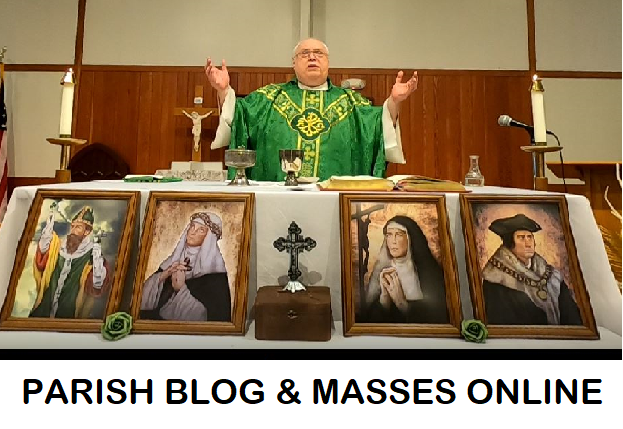
Sometimes we as Catholic Christians, making manifest the same Christ, our Savior, will discover similar rejection and even embarrassment. Speaking the words of God will be difficult, not only because we want to be accepted, but because of how they might touch others. Like medicine, the healing of our Lord comes in a package that may include more preliminary pain before any true healing can take place. The presence of Jesus among his own people would work this way. Some would have to earnestly struggle with his message and presence. For most of his disciples, witnessing for the Master would also cost them their mortal lives; however, in return they would receive everlasting life.

I mention this because there is much about God’s truths that can make us uneasy. God tells us, “Before I formed you in the womb I knew you, before you were born I dedicated you, a prophet to the nations I appointed you” (see Jeremiah 1:4-5, 17-19). Most of us were anointed at baptism with the holy chrism as Christian prophets. As children, the challenge afterwards was to be nurtured in the faith by our parents. Later, we were to proclaim it to others as adults. I wonder if we always do that, myself included? It is so easy to get comfortable and to allow others to do all the work of evangelization or Christian witness. However, what would become of a world filled with people so poorly motivated? I shudder to imagine.

The particular wording in Jeremiah is reminiscent of other passages which deal with God calling us, even before we saw the light of day. In the New Testament, the most famous is the one in which the prophet John the Baptist leaps with joy in his mother’s womb when he is near to his Savior still hidden deep inside Mary’s flesh. From the very beginning, each and every one of us is called.

Annually, many citizens of this land march on Washington for the sake of the unborn, a very troubling issue to be sure. Those children who for one reason or another are not wanted, have from the very beginning, been called by God to fellowship with him. Those young women who have faced this crisis, and the many that have made agonizing decisions, have also been called by God. The same could be said for those who are often the invisible partners in this tragedy, the men who have become reluctant fathers. All of them need healing. The woman who makes a poor decision, or who was pressured into doing so, needs to realize the wrongness of what happened, so that true repentance and healing might be achieved. The same sense of scrutiny and responsibility also needs to be accepted in the lives of men who are partners in this holocaust. We can be partners in sin or we can be helpers to one another in grace. As for the child, we believe that God desires the salvation of all. If we should abandon the youngest of children, God will not. They are alive. This realization can be the hardest of all for those who have suffered this dilemma. They are alive. Adopted by the loving arm of the Church; touched by the same love which embraced the children killed by Herod in Christ’s stead; they are alive. As such, they pray for their parents and God willing, wait until we are all rejoined together in Paradise.

Our faith tells us that all are called. No life is to be wasted. All life is precious. 1 Corinthians 12:31-13:13 tells us that faith, hope, and love are everlasting. When it comes to the truths of our faith or the moral values which the Gospel upholds, we need to be courageous. Do we attend Mass every Sunday in order to worship God in the community? Do we pray a few minutes every day? Do we try to be charitable and peaceful? Do we stand up for our beliefs and for our Church when they are mocked or ridiculed? Do we attempt to correct those in error? Do we use or waste the great gift of life with which God and our parents gave us?

In every new life and in ever old life made new by Christ’s forgiveness, hope is born. What might we become? With God, the possibilities are endless. What are our hopes for each other? A time when children can go to school and play safely? A world that does not throw the precious gift of creation back into God’s face? A future wherein we all meet the goals set for us by God, growing in wisdom and grace, just as Christ once did? We work to achieve these hopes, knowing that in God’s will, all things come in his own good time. We wait in hope, knowing that God calls every one of us. One day the hopes of believers will be realized.

When this happens, it will be because God loved us and loved us first. We exist because of love, the love of God and the love of a man and woman. We live for love; if you do not believe this just try to exist without it. Maybe it all boils down to our responding with the same kind of trusting love with which Christ accepted the Father’s will in his life? Of all visible creation, it is only the human being who can respond back to God in prayer and a life of love.

For more such reflections, contact me about getting my book, CHRISTIAN REFLECTIONS.