PLEASE NOTE that this is an apologetical dialogue that does not appeal to everyone’s tastes. No recrimination is intended against the non-Catholic community.

RONIE:
I am sorry, but I will not call you as others address you. Christ said to call no man “Father.” Mr. Joe, can you tell me (as you understand) the meaning of “Church”?
FATHER JOE:
- The Church is the Mystical Body of Christ.
- The Church is the great Sacrament of Salvation.
- The Church is the House that Jesus built.
- The Church is that community of faith which receives its life from the Eucharist.
- The Church is built on the foundation of Christ (invisible head) and the ROCK of Peter (visible head).
Turning to the matter of my title, let us look at Matthew 23:9: “And call no one on earth your Father; for one is your Father, who is in heaven” (Matthew 23:9).
This is an example of a Scriptural literary form known as Hebraic Hyperbole. It is like the passage that admonishes tearing your eye out or cutting your hand or foot off. It is a way of speaking to give heightened emphasis. The fundamentalist reads everything as if the primary language is English and the author contemporary. This is also an example of taking a verse out of context and distorting its meaning. Verse eight says to call no one Rabbi or teacher. However, do we not use this word all the time? Further, if this line is absolute against Catholic priests who possess a spiritual fatherhood, then what about our foster fathers and biological fathers? It would have to apply there as well. Almost no one would agree to this. The word FATHER is a wonderful sign of respect and relationship. The matter about which the Lord is concerned is that his disciples not imitate the Pharisees in their pride and hypocrisy, lording their positions over others. God is the true and ultimate Father of all. If any fatherhood does not flow from and participate in divine fatherhood, then it is a lie and oppressive. St. Paul speaks of himself as a spiritual father in his first letter to the Corinthians and admits that there are other such fathers, although not many. The shortage of vocations to the priesthood is still a matter with which we must deal.
[In speaking of our priorities] “He who loves FATHER or mother more than me is not worthy of me” (Matthew 10:37).
[About marriage] “For this cause a man shall leave his FATHER and mother, and cleave to his wife, and the two shall become one flesh” (Matthew 19:5).
[Placing discipleship to Jesus first] “And everyone who has left house, or brothers, or sisters, or FATHER, or mother, or wife, or children, or lands, for my name’s sake, shall receive a hundredfold, and shall possess life everalasting” (Matthew 19:29). {see also Mark 10:29}
[Abraham is called father] “For this reason, it depends on faith, so that it may be a gift, and the promise may be guaranteed to all his descendants, not to those who only adhere to the law but to those who follow the faith of Abraham who is the FATHER of all of us, …” (Romans 4:16). {see also Romans 4:11-12,17}
[Treatment of elders] “Do not rebuke an older man, but appeal to him as a FATHER” (1 Timothy 5:1).
[Enduring trials] “For what ’son’ is there whom his FATHER does not discipline?” (Hebrews 12:7). {see also Hebrews 12:9}
[My favorite and very similar to calling the priest, Father] “I am writing you this not to shame you, but to admonish you as my beloved children. Even if you should have countless guides to Christ, yet you do not have many FATHERS, for I became your FATHER in Christ Jesus through the gospel. Therefore, I urge you to be imitators of me” (1 Corinthians 4:14-16).
RONIE:
Dear Mr. Joe, I would like to give a clarification of Matthew 23:9. Sorry, but I have to say this, you are out of context. The “Father” in this text refers to “God the Father,” which is SPIRITUAL and the other verses (like Matthew 19:29; Mark 10:29; and Romans 4:16 refer to EARTHLY fathers. The fathers of our flesh must be called fathers, and as such we must give them reverence; but only God is allowed as the Father of our spirits (Heb. 12:9). Our religion must not be derived from or made dependent upon any man. Our flesh fathers do not have authoritative power over men’s consciences, in matters of faith and obedience, as do God and Christ.
Christ’s sense is, that he would have his disciples not fond of any titles of honor at all, and much less assume an authority over men, as if they were to depend on them, as the founders of the Christian religion, the authors of its doctrines and ordinances, and to take that honor to themselves, which did not belong to them, nor even choose to be called by such names, as would lead people to entertain too high an opinion of them, and take off of their dependence on God the Father.
You know, Mr. Joe, the scribes and Pharisees love to be called by these titles. Kindly check 1 Corinthians 4:14-16, and notice the text “for I became your father.” It is not found in the Greek text. I prefer the text in the KJV below:
1 Cor. 4:14 – “I write not these things to shame you, but as my beloved sons I warn you.”
1 Cor. 4:15 – “For though ye have ten thousand instructors in Christ, yet have ye not many fathers: for in Christ Jesus I have begotten you through the gospel.”
1 Cor. 4:16 – “Wherefore I beseech you, be ye followers of me.”
Your explanation about “church” is less clear, different and more complex than that from Scripture. You know “church” is not a house or a building. The Church is called the Bride of Christ, and also is called the Body of Christ (1 Corinthians 12:12-14). Its members all have different functions. It is composed of saved and baptized believers— that is why Christ loves the Church. The word, “church,” in Greek is “ekklesia” which means “called out assembly.”
Peter is not the rock because the 12 disciples, knowing the Old Testament well, recognized the Rock as a description or name for God. “He is the Rock, His word is perfect” (Deuteronomy 32:4). Also, there is, “The Lord is my Rock, and my fortress…” (Psalm 18:2). Further, we read, “For Who is God save the Lord? Or who is a Rock save our God?” (Psalm 18:31). We see here that there is no other Rock than God, not even Peter. Jesus Christ is the foundation Rock on which the Church is built.
Oh, by the way Mr. Joe, Peter did not even reach Rome. The only Man sent by God to preach to the Gentiles was Paul. Also, if Peter is your first Pope, why are priests not allowed to marry, since Peter had a wife? (Matthew 8:14)
FATHER JOE:
“Sorry” does not make it right. The proper title for a cleric is Father, Reverend or Pastor. Why should I spend any time with a person who begins with a deliberate act of disrespect? But given that our Lord would want repentance and conversion for both the ignorant and the bigoted who blaspheme against the Holy Spirit, I will try to make a short response. Admittedly, I have little confidence that anything I might say will penetrate the walls fabricated by those who are obstinate against the truth and closed to the movement of divine grace.
You write: “I would like to clarify to you in this text, ‘And call no man your father upon the earth: for one is your Father, which is in heaven’” (Matthew 23:9). Actually it is best that we look at the entire section and our Lord’s use of Hebraic hyperbole (verses 1 to 12):
Then said Jesus to the crowds and to his disciples, “The scribes and the Pharisees sit on Moses’ seat; so practice and observe whatever they tell you, but not what they do; for they preach, but do not practice. They bind heavy burdens, hard to bear, and lay them on men’s shoulders; but they themselves will not move them with their finger. They do all their deeds to be seen by men; for they make their phylacteries broad and their fringes long, and they love the place of honor at feasts and the best seats in the synagogues, and salutations in the market places, and being called rabbi by men. But you are not to be called rabbi, for you have one teacher, and you are all brethren. And call no man your father on earth, for you have one Father, who is in heaven. Neither be called masters, for you have one master, the Christ. He who is greatest among you shall be your servant; whoever exalts himself will be humbled, and whoever humbles himself will be exalted.
The authority of the Church instituted by Christ would eventually supersede that of Moses and his successors in leadership, the Pharisees. The bishops of the Catholic Church sit in the seats of the apostles. The popes govern from the Chair of Peter. Jesus establishes both a new People of God and the accompanying authority. Our Lord was critical about the hypocrisy of the Pharisees and pleaded with his apostles that it should not be so with them. He gave them the example of the foot-washing and urged humility in service. The hyperbole stresses that the ministers of the Church should not seek earthly rewards, titles and esteem, but rather that imperishable treasure of being in right relationship with God. The titles rabbi, father and teacher (or master) would continue to be used. Even St. Paul speaks of himself as a spiritual father. Lost in translation is the peculiar Hebrew form of stressing a point by pushing a matter to absurdity: call no man father or teacher or rabbi; if your eye causes you to sin, pluck it out; if your hand causes you to sin, cut it off. These matters were never meant to be understood in a literal fashion. Apart from the truth of Christ, no one is a suitable teacher. In conflict with the fatherhood of God, no fatherhood is genuine.
You say that my reference to “father” is out of context. You must be kidding! You are the one who gives no real context at all. Indeed, you treat Scripture as if it were written originally in English. Instead of respecting the message and historical setting, you offer an illogical and contrived explanation that goes against the practices and writings of the early Christians. They were close to the source and were in a position to know the truth. They did not understand this text as you do.
The text cannot be dissected as you attempt. The meaning is that there is no true fatherhood which usurps or conflicts with the fatherhood of God. This includes both spiritual fathers (as with St. Paul) and with our biological or adopted fathers. Matthew 19:29 and Mark 10:29 speaks about the family of the Church and the communion of the saints. Romans 4:15 makes mention of Abraham as our father in faith. God calls him forth and his family becomes a tribe and later a nation. He is a crucial starting point in the history of salvation.
The texts you cite either contradict or do not support your view. The Church sees herself as a family and addresses God in her prayers as FATHER MOST HOLY. Priests, bishops and popes are spiritual fathers in that they perpetuate the teachings and mission of Jesus Christ. The Church fully subscribes to the understanding of her membership as brothers and sisters to one another. In faith and baptism, Jesus is our elder brother and Mary is the queen mother. We are adopted sons and daughters of our heavenly Father. The reference to earthly fathers means any type of fatherhood here on earth. Our mortal fathers, no matter if biological, adopted or spiritual, must reflect divine fatherhood or else they are false. There is nothing here that says that biological fathers are exempt. Further, your citation of Romans 4:16 is in reference to Abraham, not almighty God. He is called the father of all.
Parents are the primary educators of their children in the faith. They constitute the “little church.” You wrong Christian fathers by reducing them to roosters who service hens. St. Paul tells us that the Christian husband/father is the head of the home just as Christ is the head of the Church.
You next write:
Christ’s sense is, that he would have his disciples not fond of any titles of honor at all, and much less assume an authority over men, as if they were to depend on them, as the founders of the Christian religion, the authors of its doctrines and ordinances, and to take that honor to themselves, which did not belong to them, nor even choose to be called by such names, as would lead people to entertain too high an opinion of them, and take off of their dependence on God the Father.
What you write is absolute gibberish. Indeed, your run-on sentence even defies linguistic diagramming. And yet it makes more sense than what you usually write. Of course, you did not write it. You stole it. You plagiarized. You borrowed the work and genius of another to foster the pretense of knowing what you are talking about. These are not your words, but those of one who was a polemicist against Catholic claims. As I said before, you prefer parroting the enemies of the Church instead of learning objectively and directly from her own mouth. These words come from an EXPOSITION OF THE ENTIRE BIBLE written (between 1746 to 1763) by John Gill.
The commentary here is not your own and I dislike dialoguing with cut-and-paste intellectual thieves. However, despite this and the convoluted language, I will try my best to parse it out. Our Lord was not so much against titles as he was concerned that “show” not replace “substance.” The title “apostle” itself becomes one of great distinction. Our Lord was often called “master” or “teacher” or “rabbi.” He explicitly gave his authority to his apostles and sent them out to baptize the nations. He explicitly gave Peter the authority of the keys and the power to loosen or bind over sin. He tells him, after the resurrection, to feed his sheep and to care for his flock. It is quite evident that Jesus gave them such authority as shepherds to the community. This authority would be passed down to others. Failure to see this demonstrates your blindness to important passages in the Word of God. Jesus, himself, was the founder of the Christian religion, i.e. the Catholic Church. He is the ultimate source of revelation. He would send his Spirit to insure the Church’s fidelity to the truth, the doctrines and ordinances that men should know and follow. As I have mentioned before, the great apostle Paul spoke about himself as a spiritual father. There was no prohibition, either about the title or the function. The spiritual title of FATHER given to a priest in no way detracts from the fatherhood of God. Indeed, he becomes a flesh-and-blood symbol of God’s abiding love and mercy in the faith community.
Just because the Pharisees allowed their titles to go to their heads does not mean that such must always be the case for others. The title “father” is an expression of endearment.
“I write not these things to shame you, but as my beloved sons I warn you” (1 Cor. 4:14). Paul admonishes the Corinthians as his beloved children. There is definitely a fatherly relationship.
“For though ye have ten thousand instructors in Christ, yet have ye not many fathers: for in Christ Jesus I have begotten you through the gospel” (1 Cor. 4:15). This is a somewhat archaic Protestant translation. A better translation is the RSV, also Protestant (but acceptable to Catholics): “For though you have countless guides in Christ, you do not have many fathers. For I became your father in Christ Jesus through the gospel.” The reference to “father” is in the Greek text as is the term for being begotten of a father:
ἐὰν γὰρ μυρίους παιδαγωγοὺς ἔχητε ἐν Χριστῷ ἀλλ’ οὐ πολλοὺς
πατέρας ἐν γὰρ Χριστῷ Ἰησοῦ
διὰ τοῦ εὐαγγελίου ἐγὼ ὑμᾶς ἐγέννησα
“Wherefore I beseech you, be ye followers of me” (1 Cor. 4:16). More than followers, he is literally urging them to imitate him. He sends Timothy as his emissary and calls him his “Beloved and faithful son in the Lord.” The spiritual fatherhood of every priest is akin to that of the apostle Paul.
I have spoken numerous times about the Church as the bride of Christ. Indeed, the Mass is a sacramental participation in the marriage banquet of heaven. This Church is one and the same with the Catholic Church. The members of the Church have different functions and gifts. We make distinctions between the clergy and the laity. Baptized believers with faith in Jesus live in the hope of their salvation. Your reference to the “saved” might be criticized under the sin of presumption. Jesus loves the Church as his own body.
The term “ekklesia” was originally a political term for the calling together of an assembly. It becomes descriptive of the assembly of the Church. Christ calls us both to a personal faith in him and to a CORPORATE faith as his Church. I suspect that you would tend to minimize this latter understanding. No one is saved apart from Christ; no one is saved apart from the Church.
Moving on, I am sorry, but Peter is the ROCK because Jesus said so. “And I also say to you that you are Peter, and upon this rock I will build My church; and the gates of Hades shall not overpower it,” (Matt. 16:18). Our Lord is the foundation stone of the Church. He gives something of his own authority to Peter and his successors to shepherd his flock. There is no contradiction in that Jesus is also called our rock of safety and refuge. Peter is literally a chip off the old block.
There is ample historical evidence that Peter reached Rome. The problem you face is that you exclude any information not put forward in the Bible. That would also exclude the works of the Church fathers and the legacy of the saints. Or maybe this is not true? You do seem to esteem the interpretive works of reformation anti-Catholics like Gill even more than the Bible. Excavations have discovered the tomb and the bones of Peter, clearly marked. The Holy See sits upon the twin pillars of Peter and Paul. As for priests getting married, the fact that Peter has a wife says nothing against the discipline of celibacy as practiced by Jesus, Paul and others. Celibacy is not so much a doctrinal matter as it is one of Church discipline. Disciplines can change or even be revoked, doctrines cannot.
Filed under: Bible, Catholic, Church, Discipleship, Faith, Family, God, Jesus, Pope, Priests | Leave a comment »














 Jeremiah 20:10-13, taken alone, might make us think that the prophet Jeremiah has something of a persecution complex; however, the oppression he feels is real. No sooner had he warned the people of a coming judgment from the Lord, because of their disobedience and neglect of God, the priest Pashhur had him arrested and scourged.
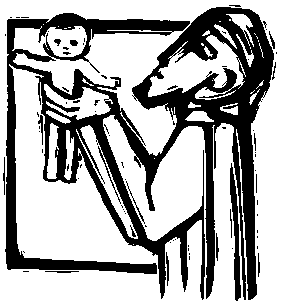 Jesus revealed himself publicly in the synagogue as the promised messiah. Although initially pleased with his learned exhortations, they quickly begin to question his authority (Luke 4:21-30). Those who knew him as a child or knew his family begin to gossip about him. Hidden in these words is their disbelief that the promised one could possibly be one from their own midst, and a poor man at that! Their acceptance of him swiftly soured into rejection. They no longer wanted to hear what he had to say.
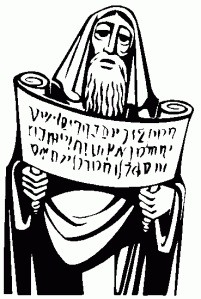 Ez. 2:2-5 has many interesting elements for us to consider. The Spirit of God moves Ezekiel; he says it “set me on my feet.” In other words, the Spirit compels or moves him to action. He stands before God and must be on his way to the Israelites. God, himself, admits that they are an obstinate and hard-hearted people, but this makes no difference. Come what may, Ezekiel will be the mouthpiece of God and “they shall know that a prophet has been among them.”
 At this point in my narrative, I would like to tell a story– a story about two boys. They started out like most young children. They loved playing ball. They liked cartoons, especially those filled with lots of super-heroes and villains. Ice-cream was their favorite food, for both main course and dessert. They both had that most peculiar attraction all boys seem to have toward dirt and bruises. And, both wanted a dog. The first boy, Arnold, came from a house which the second boy, Zachary, could only experience in his wildest dreams. Arnold was given everything. He got away with all kinds of poor behavior. His room looked like a bomb hit it. Arnold ate only what he wanted and when he wanted. He had toys piled up in the garage and outside– toys with which he easily tired. He wanted a dog and his parents bought him several purebreds, but he mistreated one of them and it had to be put to sleep. He was a brat. He would cry and yell if he did not get what he wanted, and he would get it. As he got older, he would stay out late, hit all the parties, and even got messed up with a pretty tough crowd. His parents thought, well he’s just a boy having fun. To say he was spoiled would have been an understatement. It is a little sad really. When he grew up into a man, things did not get much better. He stayed a self-centered child. Unfortunately, his parents could not live forever, and when they died, he found himself alone, unable to cope or to be happy in the world. He could not satisfy his desires, and they were unbridled– lawless. He was unhappy.
 Traditional Catholics and Homeschooling parents are always lamenting the fact that they cannot find modest swimsuits for the young women in the family. Everything is designed these days to show ballooning cleavage and legs extended past the waistline, or so it seems. It is all a very scary business, especially if there are young men and teenage boys on the beaches too. Remember, the most dangerous thing for a teenage girl is a teenage boy! Many of us have not visited beaches in years so as to preserve the custody of the eyes. Well, if you are tired of parading your young daughters to the ravenous beach wolves, there is hope in sight. It comes from a highly unlikely place, the Muslims.
 SPLASHGEAR MODEST SWIMWEAR has been designed with loose-fitting swim shirts (yes, even that pretty neck is covered!), swim pants (legs, what legs?) and hair covers (which she can use at Mass, too!). Why these girls look almost like boys they are covered so effectively. Fathers will no longer have to worry, indeed, they can get modest swim-gear for their wives too (they come even in jumbo sizes!).

 The Church should start its own line, and we could sell to “good” Catholics and Muslims alike. But until then, the Muslims have online and mail-order catalogues! If our kids are afraid that others might make fun of them, we can start groups that will go to pools and beaches together. Catholic homeschoolers and Muslim girls can swim together and urge authorities to force those nasty boys to go somewhere else! With strength of numbers, our families and girls can admonish the other so-called Catholic females on the beach: “Have you no shame for exposing yourselves in underwear? Protestants, I mean Prostitutes wear more clothes than you! Why don’t you save money and just wear a couple pieces of cotton thread instead of that $500 string-bikini! Your butt is fat! My newborn baby sees you and all he wants to do is nurse!” You’ll have those immodest sirens running from the beaches in tears.
 The Lord appears to Mary Magdalene, consoles her, and sends her off with the news, “I have seen the Lord!” (see John 20:11-18). The insistence upon the witness of women in the Scriptures reveals to us just how much both men and women were called to be Christ’s disciples. Mary Magdalene proclaims the Good News to Jesus’ other followers, the men with whom he had entrusted his apostolic authority and power. Notice his words to her. She is so thrilled to see him that he must immediately tell her not to cling to him. He exclaims that he is “ascending to my Father and your Father, to my God and your God!” This is one of the clearest statements by Christ that his particular Easter event will also be ours. The words also echo the time when he taught his friends to call God, “Our Father,” in the Lord’s Prayer. We, who belong to Christ, belong also to the one who sent and raised him up. We who are now identified with Christ can appropriately call God our adopted Father. He keeps us in existence and in baptism refashions us into the likeness of his Son.
 “Choose life, then, that you and your descendants may live, by loving the Lord, your God, heeding his voice, and holding fast to him” (Deuteronomy 30:19-20). These words when offered to the People of God by Moses were an encouragement to follow the commandments, and thus to seek God’s blessing and not his curse. So often this translated into the naive understanding that if one were good, only good things would enter one’s life. However, in the book of Job and then in the life of Jesus himself, we become well aware that sometimes suffering and even death can inflict the very best of people. The Christian appreciation of this text is very deep. Like a child trusting utterly in his or her parent, we are to rely upon and to be faithful to God — no matter what. Jesus lived out this passage, because as ironic as it might seem, by allowing himself to be betrayed, mocked, tortured, and murdered — he was choosing life for us. Now, in response to his sacrifice, we too have to open ourselves to a share in this life — a life which will ultimately be beyond the reach of pain and death. Notice what the Scripture said, we are to love God, heed his voice, and cling fast to him. We are to hold on so tight that no storm of sin and weakness can drive us away from him. This will require that our love for him always be fused with obedience, just as Christ was obedient unto the Cross. The secret is not to give up on God even when the times become difficult. What is more, we need desperately to find the peace and joy which comes with perfect discipleship in this life, despite the cost, loving God entirely for his own sake.
 Although there is no Mass, the rituals for Good Friday are very moving and evocative. However, it is the faith that we bring to the ceremonies which gives it importance for us. An outsider to our faith, might look upon such ritual with awe towards its simplicity and yet confusion as to its meaning. This is because we celebrate a theme which much of our culture seeks to ignore or postpone. We commemorate death. Assuredly, it may not be death as many people understand it, but nevertheless it remains something mysterious and even feared. Our society, with its newfound confidence in science, ironically hides the tragic death of the unborn behind the guise of linguistics while many in the medical field go to elaborate techniques to keep certain other people alive, no matter what the cost. One of the tasks of the Christian is to visit the sick; and yet, how often have we hesitated from that duty? And we know why — because to meet an elderly or handicapped or sick person is to face the specter of our own mortality, death. We dye our hair, or wear something over our heads that lost recently at the horse races; we cake our faces in makeup to cover the blemishes and wrinkles of age; we diet to wear clothes that we could not fit into even as teenagers; we take an assortment of drugs to maintain our vitality; we do all this and more to escape the prospect of age and the ghost of death which lingers in the periphery of our lives.
 A few years ago, I recall watching a re-run episode of the old series, The Twilight Zone, which I think might help us to appreciate God’s Word. In it, three robbers made an incredible heist of gold bars. It was worth a fortune. However, the gold was too hot to handle. So, one of the men, being a scientist, devised a way for them to go into suspended animation or sleep, to wake up healthy and rich a hundred years hence. They bet their lives on this proposition for wealth. A hundred years later, they awaken from their slumber. Sometime during their stasis, a rock had fallen and had broken a glass cylinder containing one of their friends. He was dead. There were only two left; so much the better. They would be richer for it — they thought. The remaining two men exited their cave in the desert with their loot. The sun was hot. Civilization was no longer where it used to be. The truck they had counted upon broke down. They fought with each other. Greed set in. The water became scarce. A tussle broke out and suddenly, there was only one man left. He laughed. He was rich beyond avarice. He carried the heavy bars in the hot desert sun. Just when he thought he was finished, he met a couple of people in some kind of futuristic hot-rod. He fell to the ground. “Water, water,” he begged, “Give me some water and I’ll make you rich beyond your dreams!” He held out the gold. One of the people whom he met pitied the dying man but found him very curious. For everyone knew that in the latter twenty-first century, gold was easily accessible and virtually worthless.













 Blogger Priest