The blog header depicts an important and yet mis-understood New Testament scene, Jesus flogging the money-changers out of the temple. I selected it because the faith that gives us consolation can also make us very uncomfortable. Both Divine Mercy and Divine Justice meet in Jesus. Priests are ministers of reconciliation, but never at the cost of truth. In or out of season, we must be courageous in preaching and living out the Gospel of Life. The title of my blog is a play on words, not Flogger Priest but Blogger Priest.
“We have the responsibility to consider others, including future generations.”
Why? God is out of the picture, so why care? No matter what we do, top scientists tell us that the universe is doomed. It is hard enough to care for ourselves and find happiness. Does it really make sense to care for others and generations unborn? We already abort half a million unborn children in the U.S. each year. If the living does not matter then caring about prospective people seems arbitrary and meaningless. Cold and honest atheistic logic cries out: “Maybe it would be better to let the poor and the defective die outright? If we eliminate the world’s refuse, then there will be more for us and the Western elite. We can make the world safe for endangered species by subtracting overcrowding populations of humans. Do we have any more right to the earth than the animals? Show me scientifically that we have an obligation to others and the future! Prove it or give it up. Our personal world might be better off if there were a few less mouths to feed.”
Anyway, we are all such hypocrites. Look at all the stuff we buy these days that comes from slave labor and where people are oppressed. If it is cheaper, it is better… that is today’s mantra. We take advantage of the poor and the worker. The host of Mythbusters can make up this commandment… but even his television show bobble heads and DVDs are manufactured in Chinese sweatshops. We can thus avoid paying local workers at all and pay others a non-livable wage. The rich get richer and the poor get poorer! Yeah, we really care about others… NOT!
As a Christian, I believe that every person has an incommensurate worth. All human life is sacred and we are called to be good stewards of creation. I believe that there is something immortal and lasting about every person conceived into this world. We are all God’s children and God loves you no more or less than he does me. I believe there is an order and a divine plan. It is important to play our part as instruments of divine providence.
“Be mindful of the consequences of all your actions and recognize that you must take responsibility for them.”
This is not so much a commandment as it is a quality of good character. All of us need a level of integrity in how we approach the world and behave. This does not tell us what to do. Rather, it is a premeditation and a later resolve to carry through and accept what comes. I was surprised to see this one on the list because it is the edict that atheists and secularists so often seek to escape.
Notice what is left unsaid.
1. How does one judge the consequences?
2. How far can one go to change the consequences?
3. Should the weight of the consequences upon the agent and others be equally measured?
4. Do others have a right to weigh in upon the consequences of acts that one proposes to perform?
5. As long as one will accept responsibility for acts, what determines that these acts are good and moral?
6. What exactly does it mean to take responsibility… obedience, dissent, not getting caught?
The Church urges this dictum when it comes to sexual activity between men and women. Couples should first be married and they should be mindful that this activity is how lovers become mothers and fathers. Sexual intercourse is geared to fecundity and fertility. Of course, the critic objects to this necessary connection. He would prefer a reflection so that an escape clause or out might be found. Thus, as an example, sexual acts might be manipulated or the faculty of generation destroyed through contraception. Instead of avoiding such acts that are inherently life-giving, the act is distorted into one where bonding and pleasure are now the only ends. If the contraception should fail, the traditional believer would say then the child should be welcomed. However, here the so-called commandment is violated or expanded again to include abortion. In truth, responsibility for acts is avoided.
As a Catholic, a difficulty I see is the ingredient of atheism itself. What if Christians should be right about the last things: death, judgment, heaven and hell? Then there are obviously consequences for our actions that the non-believer has failed to evaluate. The tragedy here is that there will be an eternity to suffer remorse.
“God is not necessary to be a good person or to live a full and meaningful life.”
What does it mean to be a good person? What makes life meaningful or worth living? It seems to me that God is like the paper upon which we write. Without him we do not even have the tools or perspective to answer satisfactory either question. The atheist critic contends that the believer is greedy and wants a better deal than the universe gives. Unhappy with a broken world, he argues that theists imagine another world where there is a God who cares and an order that will make sense of the present mess. Karl Marx made much of this “pie-in-the-sky” interpretation of religion. These critics contend that eternal life and the joys of heaven are imaginary rewards fabricated to placate those who are currently suffering or doing without. Note that the rise of American atheism has followed the fall of Soviet communism and the red threat. Many Americans once viewed socialist leanings and atheism as stripes belonging to the same animal. In contradiction, we still find a lingering merger of faith to patriotism. It is almost always the atheist or secularist who throws down the gauntlet: challenging “under God” in the pledge, public prayer, the Bible in schools, the teaching of intelligent design along with evolution and civic toleration of religious symbols.
It is true that sinners and the godless can know good fortune and a level of earthly happiness. But what happens when things do not go our way? The believer finds consolation in his faith, particularly in the face of disappointments, suffering and struggle. Other than taking a mood pill, what does the atheist do when he is facing the prospect of failure, pain and death? What is the meaning of life when everything must be defined in terms of limited mortality? Apart from God, do we even know what it means to be a good person? Why be charitable or self-sacrificing when it costs us and this is the only life we will ever know? Are fornication and homosexuality good? Is adultery only bad when you are caught? Is it okay to steal if you think you can get away with it and there will be no negative consequences? If life gets too hard is it good to take an overdose of pills and end it all? If drugs make you happy then should it not be a personal decision to take them? Is it good to help a scared girl to have an abortion even if believers contend it is the murder of a child? Christians are confused about such matters, too. Many think that simply being good will save them or that following their conscience, even an erroneous one, absolutely frees them from culpability. It does not.
People who reject God might stumble upon being good persons, and there are such things as natural virtues, but I suspect it is usually because they have been touched or “contaminated” by the faith of people around them. It is hard to argue for supernatural virtue or ethical principles or defined commandments when there is no belief in God. It strips the law of any genuine imperative. Precepts become arbitrary or capricious. We see this with the current transition of homosexuality from a crime and defect to a right and gift. Instead of civil laws backing up the laws of God, the laws of men become the final authority and they can change at any moment with the current fads and fashions. Politicians become the new priests and prophets, demanding that vice be regarded as virtue and that moral evil be rendered as good. Morality becomes a matter for vote and legislation, not something imposed by a God in Scripture or from a principal agent behind nature and creation.
Liberalism might rule the day at present, but views can change and we may see an atheistic secular world fighting itself over what is right and wrong. A person might tolerate sodomy but condemn pederasty. The pederast or pedophile might object to bestiality. The bar is increasingly lowered but not every atheist may find he can bend so low in reference to certain indignities. Killing the child in the womb might earn his or her remarks of gratitude as a feminist for women’s rights; but kill a three year old that no one wants might make the same critic puke in disgust. Such is the brave new world we are creating. What we have forgotten is that even Hitler and his Nazis thought they were good persons doing good work with eugenics and holocaust. Today we would stamp them as evil although many of their stratagems against the innocent have been put back into place. I will say it again and again. Without God, we do not know how to be good. Of course, this is a different question than, are Christians actually good? The believer acknowledges that he is a sinner who has fallen short. We need the mercy of Jesus. While God’s grace can make us saints; his law reveals how much we have fallen short and how much conversion we still require. If there is no God then there is no sin and no need for forgiveness. We must also then face a universe that could not care less about us. We can live for a few seconds of a hundred years, but eventually the world will get its way and we will die. We are children of nature and we are destined to die. A fallen world will kill us. We will get cancer or diabetes or heart trouble or something else. The atheist says he is not afraid to live and die. I suppose those who feel they have achieved something might feel this way. But what if you are a “nobody” with nothing going right in your life? Suppose you think that nobody loves you. No one wants you. You might conclude, “I would be better off dead,” and if the atheists are right then you would probably be right. In any case, you will get your wish. You will die. We all do. The atheist has to face the prospect that he will be forgotten. It will be as if he never were. Nothing he did will have any permanent significance. How can one be really happy when the transitory is all that one believes to exist? The story of Job was in response to such concerns. The ancient Jews gave little thought to an afterlife. They saw God’s reward in earthly success: wealth, property and family. But what if evil men should flourish and good or innocent people should suffer? Where is the justice in that? Here is the conundrum and it leaves us with one of two possibilities. Either there is no God or at least none that cares a damn for us or there is a good God who will balance the scales in another life where some will be rewarded and others punished. The former argues that we live in a universe where ultimately there is neither justice nor mercy— a prospect that many of us find too terrible to conceive. The latter claims that there is more to reality than we know and that a just God has given us an innate desire for life and happiness that he will satisfy— not in this world but in the kingdom of Christ.
“Every person has the right to control over their body.”
This modern commandment is directly connected to the issue of legalized abortion. Atheists deny the existence of a soul. Thus it is easy for many of them to discount the embryonic as human with rights. Despite a human developmental trajectory, the unborn (at least at early stages) is judged as no more than tissue or at most, only a human being “in potency.” This commandment would have more credibility if there were respect for the body and/or the separate but dependent integrity of the unborn child. Frequently language games will be employed to avoid the truth about the child’s humanity in the womb. When it comes to issues like partial birth infanticide an irrationality takes hold. It is argued that it would be cruel to adopt a child out to strangers; and yet, with adoption they would become a loving family. The blindness of selfishness is heinous. If there be a physical defect, a strained comeback might point to a dubious or difficult quality of life. Frequently there is an appeal to overall viability although medical science is saving the lives of increasing premature babies. Certain ethicists have noted that young children (up to maybe three years of age) are not really viable without constant adult intervention. They just do not know how to care for themselves. That is why a few rogues are proposing “post-birth abortion.” Beyond the logical inconsistencies, the pro-abortion position gives rights to some and strips them entirely from other persons. The definition of a baby becomes shallow: “it is only a baby if you want it.”
Life issues are often interconnected. A consequence of this maxim would also be assisted suicide. If the person has absolute dominion over the body then he or she can terminate the life of that body whenever he or she deems to do so. With God extracted from the equation, he no longer has sovereignty and out goes the fifth commandment: “Thou shalt not kill.” Turning to lesser matters, it would also permit all sorts of bizarre tattoos and piercings. Indeed, one could turn his or her body into a for-profit advertising banner if so desired. This is really a monstrous commandment and points out that separated from God; we really do not know how to be good. Since we are our bodies, this permissive commandment would also open the door to all sorts of distortions in sexual behavior, way beyond the evils of artificial contraception and fornication. The Christian would argue that personal control of the body is not absolute. We must respect that all life belongs to God and the plan of nature by which we are made. We must also respect others, including the little people who start out in the womb.
“The scientific method is the most reliable way of understanding the natural world.”
I have a profound respect for the utility of the scientific method; however, it would be the height of hubris for one to place it alone on the dais of truth. It has very significant limitations. I am not surprised that this “new” commandment is proposed by one of the renowned television Mythbusters. One of my favorite shows, the premise is that a “myth” or hypothesis must be testable through experiments or observations that are repeatable. The program gives one of three answers: Confirmed, Plausible or Busted. Despite a desire from certain cast members to tackle “religious myths,” the Discovery Channel has said no, if not to avoid the mockery of faith at least to preserve a large faith-based audience.
Such an approach to the natural world is often best with particularized or tightly delineated questions. The topics that concern philosophers and theologians are generally beyond the parameters of the scientific method. For instance, string theory might make good math but how would one go about proving experimentally a theory “about everything”? When researchers try, the experiments, by necessity become increasingly expansive. Astronomers and astrophysicists want telescopes that see further into the universe and into bands of light or energy that we could not normally perceive. We now think we have detected the cosmic radiation present after the Big Bang. Physicists peer in the opposite direction, looking for the God particle or the infinitesimally small, as with the massive (17 miles long) Hadron Collider. However, after all the number crunching and investigation, there is still no good science that demonstrates either a doomed or self-perpetuating cosmos without a Creator. This should force even the most hardened cynic to agnosticism, not to an atheist’s absolute denial of a deity. They will argue that the burden of proof is upon the believer. And yet, the believer looks around and sees proof everywhere; he is shocked that the atheist cannot see it. Nothing comes from nothing. If there is no Creator, then nothing should exist— not a butterfly or a smiling child— not a tick of the clock or the movement of an electron and proton— nothing, no time, no space, no matter, and definitely nothing that should be asking these questions or reflecting upon existence. But here we are. Are we just a cheap accident? That is no answer. If being and non-being is a flip of the coin, then I want to know who is supplying the change!
While the Catholic already accepts the existence of God and even says that he has intervened in human history as a caring God; nevertheless, he wants to make sense of the natural world. God can use miracles and suspend his laws but usually he does not. Otherwise, creation would be capricious and God would seemingly curse the very order he put into place. The Catholic notion of intelligent design looks at the patterns in the natural order and philosophically deduces a knowing agent. Schools often refuse to admit the view, even though it respects the scientific data associated with theories of creation and evolution. There is no empirical test to prove or disprove the existence of a divine being. Public schools, in particular, will make room for experiential science, but increasing reject not only religion but the benefits of natural reason and philosophy. This throws out the best of Western civilization and represents a type of intellectual reductionism. The same philosophy that would allow for intelligent design would also promote logical reasoning and a study of the virtues. It is no wonder, that vice and actions are increasingly separated from the concern of culpability or objective morality. Schools become hell holes because we have subtracted everything of heaven out of them.
The scientific method is a useful tool, but it is only that. It has led to discoveries that have both improved and endangered the world. Knowledge is gained but often without the wisdom as to how to use it properly. Understanding the atom has made possible new sources of energy and medical treatment; it has also made possible the Bomb and the prospect of nuclear holocaust. It is truly a two-edged sword.
It falls short in teaching us values and in answering the question about the origin of the natural order. Even if there were an infinite sequence, and eternal regression and progression, (which Thomists regard as an absurdity), the question could be raised as to whom or what put it into place. Similarly, if creation has a beginning and an end then questions emerge that beg for an answer. When the last of the energy evaporates from the one remaining black hole, what happens next? Or looking to the very beginning, where did the point or singularity come from? Compared to the claims of science, those of religion are looking more credible, even if still inscrutable. God lives outside of time and space. Even though he is the source for the natural world, there is a wall between experiential knowledge and a dimension without matter or temporal and spacial extension. He is existence or the source of all being. He creates everything from nothing. While no one is compelled to believe in a deity, similarly the notion should not be ridiculed or banned. As a believer, I contend he shares with creation the perfections that he has in infinite measure as their source. God by definition would defy being placed under the microscope or being reduced to mathematical formulae. He has called us to know him, but only the surface of this “knowing” can be scratched. The mystery remains and the response of believers is gratitude and praise. I suppose the lack of thankfulness is what most infuriates believers about atheists.
“Strive to understand what is most likely to be true, not to believe what you wish to be true.”
What seems “likely true” might not always be the case. The pagan worldview had to surrender to the Judeo-Christian. Many presumed that the world was flat, that the earth was central with a revolving sun, etc. The majority held a view that was challenged by Copernicus and later by Galileo, both Catholics and the former, a monk. When science widely advocated spontaneous generation, Louis Pasteur discerned a small invisible world where contamination and vaccination was possible. When science took for granted a Newtonian view of the world, modern physics would largely rewrite the book. We strive to understand what is true, but that which is most likely can shift and change.
I am not convinced that all atheists are so objective. It seems to me that some of them fervently resist any and all assaults against their denial of a God and/or Creator. In other words, while they would applaud the rejection of God by believers; they would not permit any data on their radar that would imply his existence. Science is a wonderful area of investigation and knowledge; but scientists (religious and atheists) can and do battle with each other over what they “believe” and “wish” to be true. Indeed, these arguments can become very passionate: everything from a closed to an open universe to warm-bloodied dinosaurs over cold reptilian. Data is interpreted in a way that favors their views or hypotheses.
Nevertheless, Catholic believers are also called to be rationalists. We do not subscribe to the faulty proposition held by certain Protestants of a “blind faith” or “faith over reason.” Indeed, it is because of this philosophical demarcation that certain Fundamentalists hate and attack Catholicism. Catholicism proposes “faith seeking understanding.” While the fundamentalist argues for a literal six days of creation and a world that is six thousand years old; Catholicism accepts the reckoning of time from archeologists and physicists, unperturbed at the prospect of millions of years of evolution and a cosmos that is 13.8 billion years old, as long as one might posit intelligent design. The difference with the atheist is that the informed Catholic has a profound respect for divine revelation and refuses to invalidate his subjective experience of a relationship with a living God. Indeed, he feels that we are wired for God and have an inherent capacity to acknowledge the divine transcendent… a reality he tries to convey not only in Scripture and ritual but in poetry and art. I suppose we would argue that there is something measured here that is just as real as in the scientist’s mathematical formulae and in Hubble’s distant astronomical images. There is a sense of awe which many of us refuse to associate with chaos or chance but rather see the finger of God and providence. The proposition here seems to imply that it is a matter of “either/or” while the Catholic Christian would say it is a matter of “and.” Catholicism is the religion of the “great and.” It is not faith alone or the Bible alone or Jesus alone or even empirical science alone. Catholicism is the religion that speaks to faith and works; the Bible and sacred tradition; Jesus and Mary and the saints, etc. She is the religion that fostered great scientists, even as she stumbled sometimes to see the tapestry where science might be interwoven with faith. She embraces all that is good and true and claims it for her own. That is why the Church has the Vatican Advanced Technology Telescope (VATT) on top of Mount Graham in Arizona. That is why our universities foster some of the best scientific research in the world. That is why the Pontifical Academy of Sciences includes believers and non-believers alike who further the advancement of the mathematical, physical and natural sciences and the study of related epistemological problems.
I suppose we need that child-like faith which trusts that what we believe can also be true. Atheists sometimes witness to this truth in their romantic liaisons and families. Cold science might argue for finding the optimum physical specimen for reproduction. However, most fall in love and embrace a mystery with their hearts even as their heads insist it is all just chemistry and sparking synapses. I suspect the transcendent shows itself even as certain critics contend that it cannot exist.
“Be open-minded and be willing to alter your beliefs with new evidence.”
First, the problem here is that atheists are not “open-minded.” They begin with the absolute premise, which many of us would judge as false, that there is no God. This means that they violate the very first so-called new commandment they propose. Second, they tend to reduce truth and knowledge to empirical proofs. They find satisfaction with numbers and that, which can be seen and measured, but are utterly distressed by philosophical arguments, the prospect of divine revelation and by subjective witness. They look at the ordered universe and refuse to acknowledge that there is any agent behind the order.
When it comes to changing beliefs, they do not mean what they say. They have deified science which is a kind of self-preoccupation. This they refuse to change. A worldview might shift, but not the underlying secular faith. It presumes that man has the capacity to fully understand the universe. There is no proof to show that this assumption is true. Indeed, while the various string theories are understood, albeit in a contradictory manner between theories, only a very small portion of the human race has the intellectual genius to appreciate the math. Who is to say that there are not mysteries too complex for men and the wiring in their heads? We already use machines to store information and to calculate where human brains fall short. When the atheists talk about the willingness to abandon faith, they are speaking in a dictatorial manner to people with religious beliefs. They insist there is no evidence for God and the various religious creeds. Consequently, they judge people who refuse to abandon such faith as backward (stupid) and stubborn.
Catholicism has a greater appreciative for the whole human experience. We would not reduce knowledge or truth to what computers might tabulate. That is why the Church embraces the arts as also a medium to communicate the Gospel. Catholicism teaches that there must be a complementarity of truth. If something does not correlate between the disciplines then something is wrong and must be adjusted. We find truth in philosophy, in theology and in science. Philosophy allows for a rational reflection upon truth and the nature of things. Theology permits a reflection upon the elements of faith in divine revelation. Science offers insight in understanding the makeup of the world where we find ourselves. They ask different questions but there is an overlap. That is why Catholics speak of intelligent design but do not insist upon a fundamentalist or literalist interpretation of Genesis and creation. That is why we speak of the Bible as a book to help us go to heaven, not as a book that tells us how the heavens go. Philosophy would have us ask questions like: What is the nature of man? Is there a God? Theology or Religion would ask: Who is this God that has revealed himself to us? Does God care about us? Science would ask: How do the organs of the body work together? What is this world or creation where we find ourselves? How do things work? There are some questions that certain disciplines can and cannot answer.
I have been giving some thought to the pressing issue of keeping our young people Catholic and in the Church. Before I lay fault at the proper doorposts, it must be said that many of our parents are faithful in raising their children in the faith and insuring the opportunity for the sacraments. When their kids abandon the faith and Mass attendance, these good people are the first ones who feel guilty and wonder if there be more they could have done. But they did their duty and there comes a point where we have to let go and trust the Holy Spirit. Similarly, there are pastors and catechists who try program after program in hoping that the next one might turn matters around. They join their tears to those of heaven praying that prodigals might come home and that the children might be counted among the saints. Too many have forgotten God. Too many have turned their backs on the practice of their faith.
I would not want to condemn anyone, even parents who are themselves “fallen away” Catholics. God will be their judge. But of course, we can target many sources for the current problem. Whole generations of Catholics were poorly catechized. Poor text books and an air of dissent infected the Church. I recall tried-and-true books being thrown away because they represented the thinking of “the old pre-Vatican II Church.” And yet, this mentality betrayed a false dichotomy. There are no two churches. The accidentals may change but the deposit of faith is faithfully transmitted generation after generation in the one true Church instituted by Jesus Christ. The later publication of the universal catechism was an attempt to correct any false thinking about this issue. Our appreciation of doctrine can develop but the public revelation is fixed. What is objectively true will always be true. The false “spirit of Vatican II” has been exposed and in many circles has increasingly lost sway as a general segment returned to orthodoxy. This is cause for hope. Those resisting it have necessarily found themselves set adrift. The truths of faith were never denied by the Magisterium, but progressive theologians and their enthusiasts wrestled to place the whim of men over the wisdom of God.
There is no denying that the dominoes began to fall. The damage was done. Religious relativism, a false view of universal salvation, and the moral failure of churchmen to live out the faith compounded the situation. People fell away from the Church. The stakes did not seem as high as they once did. Meanwhile, the world was changing and Western Christian culture was collapsing. The process had begun prior to Vatican II. Indeed, the Enlightenment and later the French Revolution were signposts to what was fast approaching. Pope Pius IX promulgated his Syllabus of Errors. Pope Pius X confronted Modernism. When Vatican II arrived, many had hoped that there might be a dialogue with the modern world. Unfortunately, the world did not play fair and the council was unable to forestall the many negative agencies poised against her. A secular humanism was quickly taking hold. Man would be regarded as the measure of all things. The degree of hubris involved here would have been unthinkable in much of our earlier history. The “God is Dead” movement of the 1960’s and 70’s was thought by many as the final result of this movement. But there was more to come. Today many do not consider God as dead but rather, while rejecting the incarnation, declare that Man is God. The love of science, which in its place is a good thing, becomes a kind of idolatry where technology and the media are secular sacraments. There is the fantasy and/or pseudo-science that even death will one day succumb to man’s genius. Paralleling all this there has been the ascendance of a new paganism, expressed through heightened eroticism (homo- and heterosexual) and a general vulgarity in speech, music and behavior. Pleasure is sought as an ends to itself, not as an element of a greater good.
What does the baptized Catholic believe today? It is amazing how many false assumptions are made about the faith. While the Church teaches intelligent design and the complementarity between science, theology and philosophy; many view Catholicism through the prism of Protestant fundamentalism. Enthusiasts for evolution ridicule the Church for a literalism which she does not profess. Neither does Catholicism embrace a blind faith, which is rightly decried as mindless. While recognizing mystery, we espouse a faith seeking understanding and as a true companion to human reason. The Church argues for modesty and yet is not puritan in her aesthetic appreciation for the human body and the beauty of sexual love as a part of the divine plan. Nevertheless, some critics (even Catholics) mock the Church as if it is a Calvinist congregation or one knotted to Jansenism. The Church seeks to work with non-Catholics for a better world and for the remittance of human suffering; however, despite false allegations from traditionalists, lays hold to no ecumenism that would compromise her singular faith claims. It has also been a sad discovery that many Catholics suffer an impoverished understanding of the Trinity, the meaning of the incarnation, the value of the Mass, the mystery of the real presence in the Eucharist, the nature of the afterlife and the prayers for the dead, etc. Indeed, some believers deny the existence of hell despite the biblical testimony and the presence of evil that demands the full measure of divine justice. The occult has also infected believers, substituting magic for supernatural faith. It is ironic that atheism and the occult should simultaneously infect members of the Church. We need to do all we can to correct the errors of our times. There is no reincarnation. There is no parallel oriental bad force that counterbalances the good. We do no become angels after death as popularized in movies. The dead human body is a corpse. The human soul is a ghost. We are promised restitution in the resurrection of the dead. I cannot begin to say how many Catholics do not know the truth about these matters. Yes, even those in the pews need correction and a renewed formation. But, other than with preaching how do we do this? Many will not attend special classes or even online workshops. They fail to attend bible study or instruction classes. As for those not in the pews, is there any way left to bring them and their children home? How can the message of the Church compete with the many voices of the world?
Why are we suffering again with this “he said” and “he did not say” business? Did no one learn a lesson from the earlier confused ramblings of this aging atheist who interviewed the Pope soon after the election? Does no one keep reliable transcripts or recordings? I had hoped the Vatican would learn now that the left-leaning publications are not to be trusted. They want scandal and will spin anything if it gets what they want, in other words, a diminished Church and lots of publicity and sales. I can appreciate that the Pope would call sexual abuse “leprosy in our house.” That is not surprising. But did he really say there were abusers among the cardinals? I really doubt it. They would have been expunged by now. It would signify the worse possible self-recrimination. Already the Vatican is saying the statement was inaccurate. In other words, the newspaper La Repubblica is LYING! Let us call it what it is. This being the case, why should we regard any of the rest as a reliable interview with Pope Francis?
Of course the damage does not end there. The paper’s founder Eugenio Scalfari offers the article as a “reconstruction” of his one-hour conversation with the Pope. This is the day of digital recording; why must we suffer inaccurate and controversial reconstructions? The Pope is quoted as saying, “Many of my collaborators who fight with me (against pedophilia) reassure me with reliable statistics that say that the level of pedophilia in the Church is about two percent. This data should hearten me but I tell you that it does not hearten me at all. In fact, I think that it is very grave.” The world press grabbed this statement and headlines blasted across the globe that two percent of priests were pedophiles or child molesters! While he probably meant throughout the whole Church, not just the ministries, what is the basis for such an assessment? Is it the statistical average in the world population, Catholic or not? I do not recall any polling or phone calls asking about orientation or perversions. Are these just made-up numbers? Again, if we knew for sure we had potential child molesters in the ranks of the priests, why have they not been removed? Are we just guessing that they might be there given past misconduct?
People are doing the math. As of 2012, if there are some 414,000 priests then at 2%, how many pedophiles does that make? The answer is 8,280! I do not believe it. I think the figures are mere conjecture. Seminary formation would have prevented many such men from being ordained. Others have already been ousted. I would contend that most priests today are no threat to children or other people at risk.
Again the Vatican issued a warning statement that Scalfari has a habit of reconstructing interviews from memory, not recording or taking notes. Why he is one of Italy’s best known Italian journalists is beyond me. It seems to me that he is highly unreliable. The Vatican is telling us that the newspaper is seeking to “manipulate naïve readers.” If that is the case, then why talk to this anti-Catholic newspaper, anyway? It makes no sense to me. These are not our friends. Indeed, it seems that both the Church and the truth are casualties to such interviews.
When recently talking to the victims of abuse, the Holy Father rightly spoke about this as a cause for weeping and how there was a real need for reparation. He compared predator priests to the evil of cults and black Masses. He vowed zero tolerance and that bishops would be held accountable for how the dealt with charges and situations. I would add that we must also be careful not to scapegoat the Church’s ministers as wicked and dangerous men. This would do a disservice to the many saints who sacrifice everything for God and his people.
Let me begin by saying that I admire Bill O’Reilly and often enjoy his program on FOX News. One can also tell in his writings, especially about Lincoln and Kennedy, that he was probably a first class high-school history teacher. Having said this, I fear that writing about Jesus may have placed him somewhat at a disadvantage. Jesus was a man but so much more. When we miss that element of more, history itself becomes falsified or distorted. Like any good researcher, he relies heavily upon sources. And yet, religion more than any other field, is subject to a vast range of opinion and much of it unreliable or biased. Of course, his task from the very beginning may have been handicapped. Can people of faith ever approach Jesus as if that faith does not matter and does not speak to the truth?
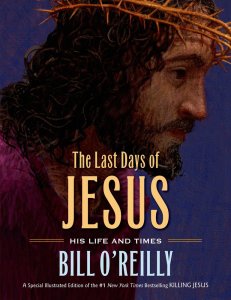
The book for young readers, The Last Days of Jesus by Bill O’Reilly alternately embraces a biblical literalism as with the Nativity narratives, harkens to pious tradition as with the association of Mary Magdalene with the prostitute, and is permeated with a modern agnostic historical-criticism as with the avoidance of the miracles and resurrection of Christ. The book often reads like a disjointed commentary on various biblical texts. O’Reilly connects Mary Magdalen with the prostitute or sinner woman in Scripture. This is a correlation disputed by many modern exegetes and even by the authorities he cites in the back of the book. (He recommends these sources for further reading but they are not written for young readers.)
This work is the offspring to the adult book, Killing Jesus: A History. The difficulty in the focus upon our Lord in the former work is transplanted into the latter. The emphasis is placed upon “the man” Jesus of Nazareth and not upon Jesus as the Christ, Messiah or Savior. Taken too far and this ushers us back to the ancient heresy of Nestorianism where the divine unity is shattered and we begin to speak of two sons, Jesus the Man and Christ the God. Nestorius was condemned for preferring the Marian titles “Mother of the Christ” and “Mother of the Man” to the label, “Mother of God.” Subtracting his godhood entirely would restore the ancient heresy of Arianism. Any history that subtracts the divinity and its attributes becomes a falsification of the past. Those who would utterly restrict themselves to Christ as a human creature have already adopted a methodical atheism. In his usual gentle way, Raymond Arroyo brought this up on his television EWTN interview with O’Reilly. O’Reilly elaborated with him, too, that he purported to give a historical accounting of Jesus, not a spiritual one. My concern as a priest is simple: is such a rendering really possible and does it not malign the spiritual as if it is somehow unreal? (I do not question or doubt O’Reilly’s word that he remains a Catholic and a believer.)
When speaking about the incident where our Lord as a boy is teaching the teachers in the Temple, we must be careful not to speculate too much about what Jesus knows and feels (see page 36). There is a real debate about the psychology of Jesus. While he has human experiential knowledge, he is reckoned by the Church as a divine person. Thus, he knows what he needs to know. While he might pocket elements of his divine knowledge, it is always there. Even for ourselves, as human beings, we do not focus upon everything we know at any given moment. Further, when Jesus had disappeared from the caravan, he was puzzled that they had to search and did not know that he had to be in his “Father’s house.” Notice in the conversation between Jesus and Mary that Joseph is silent. He well appreciates that as the foster father of Christ, his role is reserved to protector or guardian of the Holy Family. He is already beginning to decrease and will never appear again in the Gospels. Christ will be obedient to them but given his true identity, such is by choice and not necessity.
We cannot know for sure why Jesus does all that he does. We cannot begin to imagine how infused science might have impacted upon Jesus’ knowing. But the question keeps arising, what did Jesus know and feel? Did Jesus know only “a little Hebrew”? Jesus seemed very learned and probably spoke to Pilate in Latin. Greek was also a popular language. We know our Lord spoke Aramaic. He was raised as a Jew in a Jewish community. It is true that he had experiential knowledge, but it would be wrong to infer that he had nothing of the divine. Ours is not an amnesiac deity. He always knows who he is.
Does O’Reilly come close to heresy? If so it is probably inadvertent and has to do with the selection of words. I am troubled how he speaks about the agony in the garden. We all know what our Lord does and says but O’Reilly writes, “It is a moment of anguish and despair” (page 190). Anguish, yes, but despair, no! Despair is a sin against hope and such would be impossible for the God-Man. As with the temptations, our Lord could be tempted but he could not fall. God cannot be placed in opposition to himself. There is no historical Jesus or strictly human Jesus that has ever existed. He is an exegetical fiction. His angst is not despair but the genuine sign that the incarnation was real. No human being in his right mind wants to be tortured and murdered. Our human nature rebels at the prospect and that is what happens here. Nevertheless, in the face of this sorrow, he reaffirms the mission given him by his Father. This is more than asking for strength. Jesus is not going to run away. He knows what is coming. He demonstrates what true fidelity means. He shows us the true face of courage.
It was not so much that Christians were embarrassed by the Cross (see page 258); rather, the difficulty had to do with a Greek philosophical bias against such vulnerability, especially from one purported to be divine. It was a stumbling block to conversions. Christians were aware that the Cross was a sign of contradiction and yet the symbol of Christ’s role as our sin-offering; he dies on our behalf. As we see in the Good Friday liturgy, the Cross appeared to be Christ’s defeat and yet it becomes a sign of his victory. It is precisely this demarcation in the text between the so-called historical Jesus and the Christ of faith that skews a proper understanding of what Jesus is about. Of course, such falls in line with the atheistic agenda of the Jesus Seminar (which the book recommends as a source).
The author writes, “But Jesus has committed a grave offense—he interrupted the flow of funds from the temple to Rome when he flipped over the money changer’s tables” (page 197). I am not sure that there is much evidence for such a financial collusion. The text infers at this point that the financial pressure and greed from the Pharisees is what brought Jesus to trial. However, later on the text rightly narrates it as blasphemy. Does O’Reilly view the allegation of blasphemy as a trumped charge to indict Jesus? Again, I think a narrow vision damages the full truth. The Pharisees and scribes are true believers and zealots. Yes, they do not want anyone to erode their authority. Yes, the turning over of the money-changing tables did not win him friends among them. However, they were also appalled by his healings on the Sabbath and references to him as God’s Son. Monotheism and the Law were principal elements of their religion and they failed to see how Jesus could fit into this picture.
I seriously doubt that this book will find a place in parish catechesis programs. Too much is missing. Even if one were to restrict an evaluation to our Lord’s social mission, the outreach of Christ to the poor, the sick, the oppressed, the weak and to women, is largely neglected. And yet, it was precisely this preferential option for the poor, the suffering and sinners that made the religious leadership hate Jesus all the more. They may have been afraid of an uprising but they also resented that he was winning the hearts of the people, especially the rabble. God did not only bless the religious elite or the rich and powerful. God also loved those who were lost, afraid and weak. We would not want to cast Jesus as an Obama-like social worker; but neither would we image him as a modern-day Republican hardliner or fiscal conservative.
The Lord’s Supper is essentially reduced to an interchange about Judas and the betrayal. Totally absent is how Jesus will take the Seder and change the rubrics to refer to himself as the new sacrificial Lamb of God. I find this odd because he immediately connects this meal with the coming ordeal of the Cross. I suspect it is subtracted because it refers to sectarian topics like the priesthood and the Mass. However, it also removes the sense that Jesus will not simply have his life taken from him; rather, he will lay it down.
As with the Pharisees, the principal motivation for Judas is depicted as greed and yet many biblical authorities suggest that it was far more complex. It may be that Judas was impatient and wanted to force Jesus’ hand— to compel him to act as the Messiah and bring about insurrection. This other element is breeched quickly on page 177.
The incident of the tax and the coin is reduced to Jesus not offending Rome but giving it deference. Here too the situation is far more complex. Yes, it is a trap but a question is asked. Often the more liberal voices will speak about how this supports dividing our loyalties between Caesar and God. This is the thinking of politicians who claim to be good Catholics but enable the murder of children through the administration’s reproductive services policies. The fact is that Jesus neither falls for the trap nor answers the question. He never really says one should pay the tax. If he says not to pay then he can be painted as an enemy of Rome. If he says pay, then he can be judged as a traitor to his own people. All he does is point to a coin with the emperor’s face on it and says give to God what belongs to God and give to Caesar what belongs to Caesar. In truth, everything belongs to God. The Scriptures are clear, ours is a jealous God.
Is Jesus “a revolutionary with a band of disciples and growing legion of followers” (page 162)? The text itself admits that Jesus did not intend to establish a new government or overthrow the Romans. He often steers away from the title of Messiah because it is so generally misinterpreted in military terms. Nevertheless, our Lord did come to establish a new People of God or a Church. This theme is generally omitted from the text. Note that when Jesus asks the question about his identity, he applauds Peter for seeing the truth, “You are the Messiah, the Son of the living God” (page 127). However, absent in the text is the Lord’s offer of a new identity upon Peter as ROCK and that upon this ROCK he would build his Church. (A brief mention of the renaming appears on page 97 but minus the connection to the Church.) Our Lord next prophesies his coming passion and death. He will die for the Church. He will pass on something of this authority to the Church. Without this appreciation, a major theme that leads to his sacrifice is omitted. Certain religious revisionists propose that references to the Church were later written into the biblical accounts; however, the teaching Church would argue that such reflected the mind of Christ and were part of these events.
When it comes to the miracles, the text speaks of “stories” of Jesus doing so (page 119) and that he “apparently” healed a man’s withered hand. The miracles are viewed by Christianity as proofs to Christ’s divinity and mission. Along with the resurrection, their subtraction or reduction to conjecture immediately eliminates any arguable profession of divinity. Except for how Jesus has been “used” by people in history, the assessment of our Lord would be that he was a failed prophet who was executed as a criminal and later had his body stolen and probably destroyed. O’Reilly never says this, and as a Catholic would probably not hold such a view, however, it is what the text tends to communicate. While Jesus does use “logic and words of Scripture to upend” the arguments of the Pharisees, the primary mode of communication is through stories and actions. He tells parables and he works miracles. Much of his attraction comes down to these two operations. They are elements largely missing from the book’s overall assessment of Christ.
The Afterword itself, after mentioning the story of the Jewish leadership that Jesus’ body was stolen, gives the various views about our Lord held by Christians, Jews, Buddhists, Hindus, and Muslims. The implication within this religious indifferentism is that all the interpretations might be fanciful. Of course, restricting oneself to the natural elements throughout would seem to invalidate the supernatural altogether. It ends with the empty tomb and the simple line, “To this day, the body of Jesus of Nazareth has never been found.” While we have a curt ending in the Gospel of Mark, the Christian testimony is far richer. I have serious reservations about an agnostic or atheistic retelling of the story of Jesus that subtracts the miraculous. Who is to say that these things are not based upon real history?
This is the home of the AWALT PAPERS, the posting of various pieces of wisdom salvaged from the writings, teachings and sermons of the late Msgr. William J. Awalt.
























 Why? God is out of the picture, so why care? No matter what we do, top scientists tell us that the universe is doomed. It is hard enough to care for ourselves and find happiness. Does it really make sense to care for others and generations unborn? We already abort half a million unborn children in the U.S. each year. If the living does not matter then caring about prospective people seems arbitrary and meaningless. Cold and honest atheistic logic cries out: “Maybe it would be better to let the poor and the defective die outright? If we eliminate the world’s refuse, then there will be more for us and the Western elite. We can make the world safe for endangered species by subtracting overcrowding populations of humans. Do we have any more right to the earth than the animals? Show me scientifically that we have an obligation to others and the future! Prove it or give it up. Our personal world might be better off if there were a few less mouths to feed.”























 Blogger Priest