











• Our Blogger

    Fr. Joseph Jenkins

  • An important theme for this blog is the scene in the New Testament where Jesus can be found FLOGGING the money-changers out of the temple. My header above depicts a priest FLOGGING the devils that distort the faith and assault believers. The faith that gives us consolation can and should also make us very uncomfortable. Both Divine Mercy and Divine Justice meet in Jesus. Priests are ministers of reconciliation, but never at the cost of truth. In or out of season, we must be courageous in preaching and living out the Gospel of Life. The title of my blog is a play on words, not Flogger Priest but Blogger Priest.

  • Archives

  • Categories

  • Recent Posts

  • Recent Comments

    Father Joe's avatarFather Joe on The Prayer to Saint Michael at…
    Inveilis's avatarInveilis on Ask a Priest
    Joanne M Rowan's avatarJoanne M Rowan on Reflecting Upon SSPX Dissent…
    Joanne M Rowan's avatarJoanne M Rowan on The SSPX Makes It Itself Out M…
    Jeremy's avatarJeremy on Ask a Priest

The Prayer to Saint Michael at the End of Mass

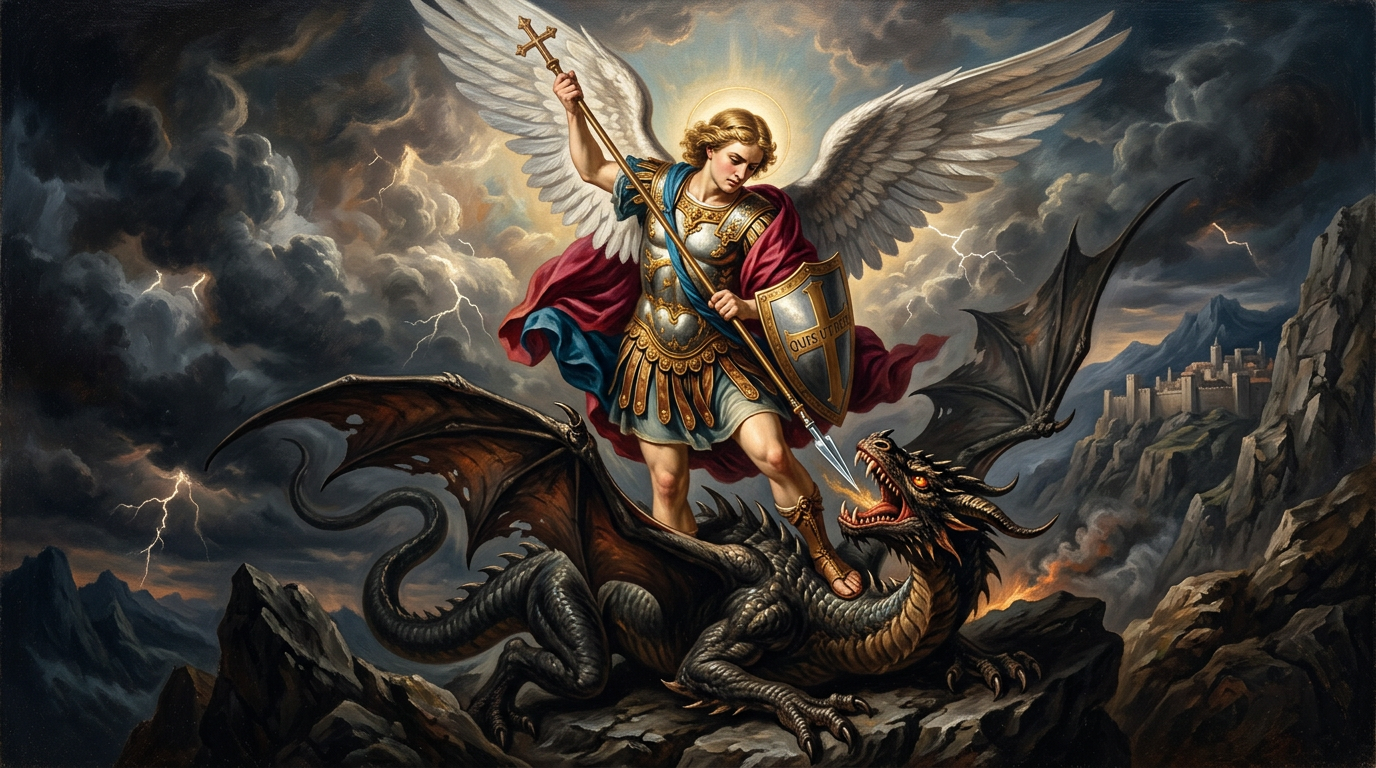
Archangel Michael with sword and shield fighting a dragon on rocky terrain

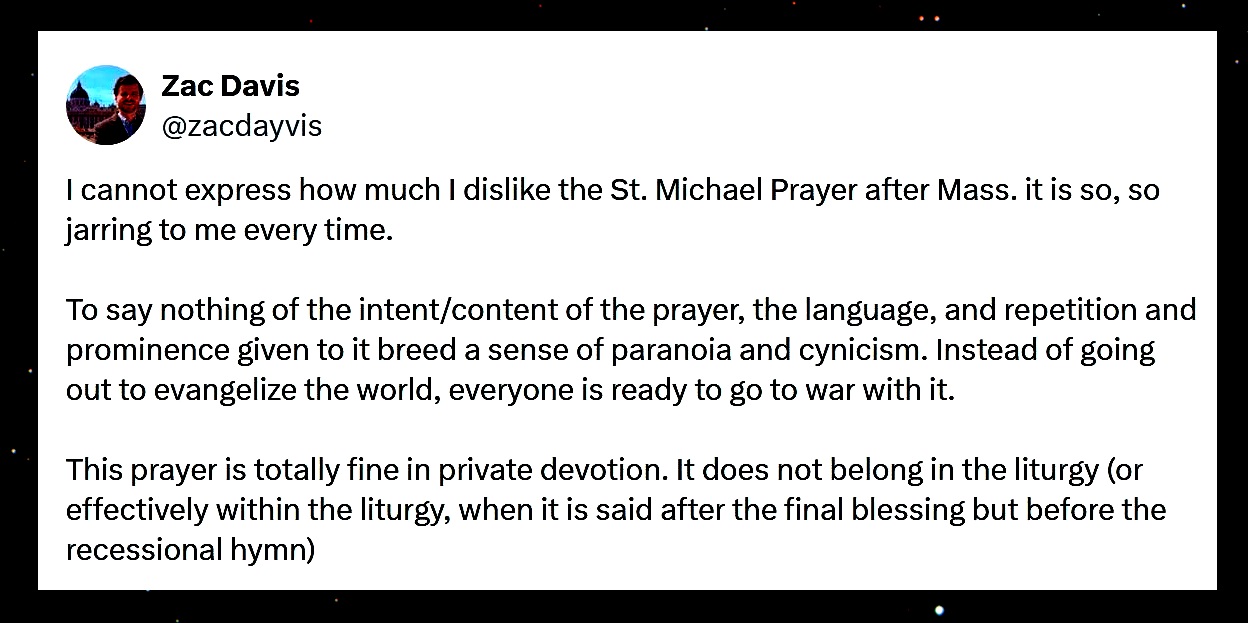
Zac Davis, the associate editor at America Magazine writes:
(1) Does the Devil Exist & If So What or Who Is He?

How can a man of Zac Davis’s learning and standing write something so incredibly dismissive of what may be the greatest deliverance prayer of the Church? His progressive dissent on LGBTQ issues aside, does he not believe in the existence of spiritual beings, good and demonic? This question is not entirely rhetorical because certain theologians deny the existence of angels and devils, arguing instead that they are metaphors or vague forces but not personal powers and principalities. This is crucial because the devil would prefer us to believe that he does not exist. It makes it easier for him to hide. The devil is a spiritual roach, nesting in the dark cracks of the world, shunning the light.
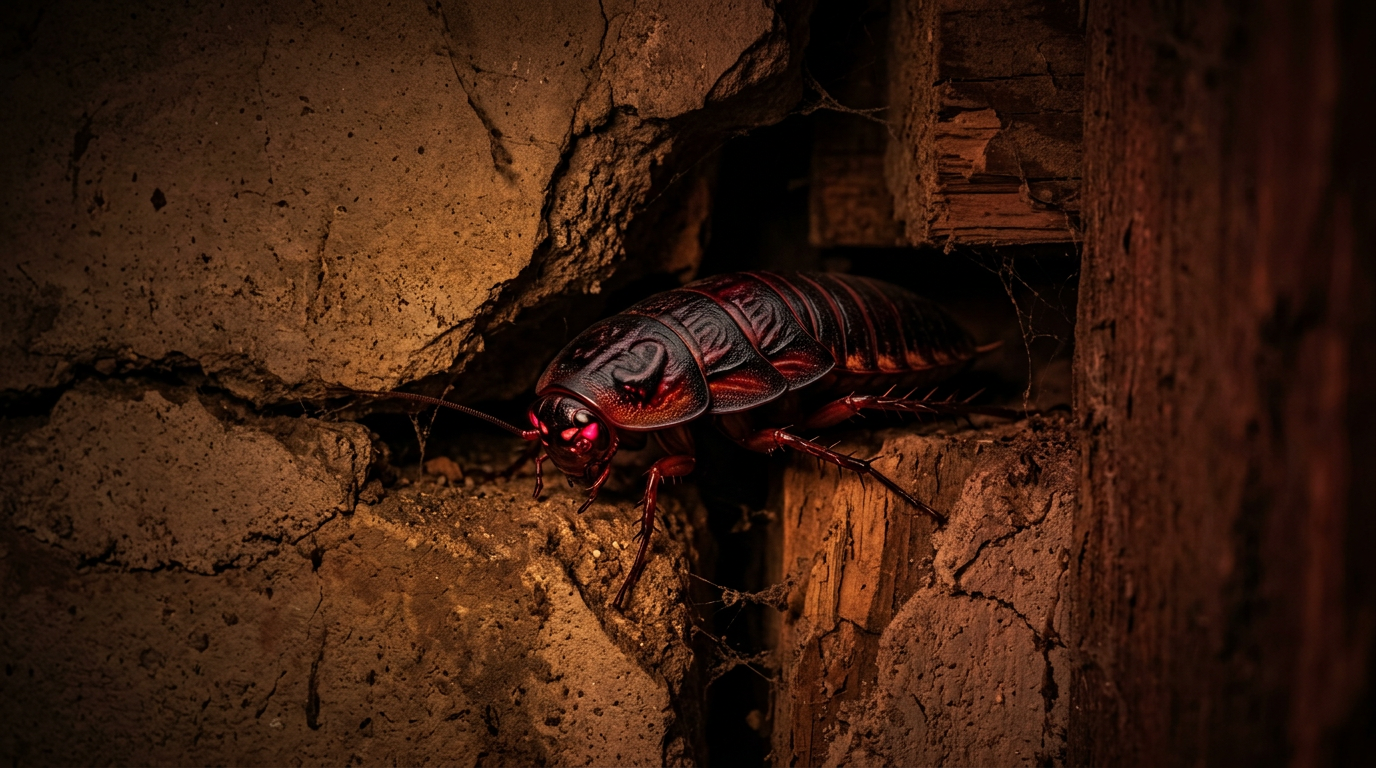
A cockroach resting in a crack between rough, earthy surfaces

Davis would contend that the “concept” of a devil might have a helpful function in terms of regular “spiritual discernment,” but he would brush aside the notion of any literal “warfare.” Rather than speaking at length about a personal devil, he writes about temptation and the “spirit of the world.” Distancing himself from the artistic renditions of Satan as a horned devil, he would suggest imaging the devil as “a deceptive force” or compulsion not to be one’s true self.  

(2) Is Not the Church Militant Called to Spiritual Warfare?

Despite what he says about the prayer being acceptable for private devotion, it is not an oration you would ever hear from his lips. His comment here is utterly disingenuous. Let it be clear, his objection to the Prayer of St. Michael is not just when it is associated with Mass, but at any time or place. As in his quote, he views spiritual warfare as breeding a sense of “paranoia and cynicism.” He says that we should be looking for good in the world instead of seeking where to wage war. This seems incredibly naïve in my estimation. We do not have to go looking for evil, it quickly comes looking for us. He would have us go into spiritual battle unarmed and with eyes closed. Despite his analysis, the Prayer to St. Michael does not imply absolute antagonism between the Church and the world. Instead, like the surgeon who removes cancer to save a patient, the Church would seek to save the world by divulging the devil’s hiding places and purging him from his nests.  Spiritual warfare is not contradictory to John 3:17, where we are taught, “For God did not send his Son into the world to condemn the world, but that the world might be saved through him.” We may be Christ’s Pilgrim Church, but we also remain the earthly Church Militant. The Church is our spiritual oasis and our headquarters in a war with powers seen and unseen. We call upon St. Michael, a general in God’s forces, and yet, as in Jeremiah 20:10-13, the LORD is our Great Champion. If God is on our side then whom shall we fear?
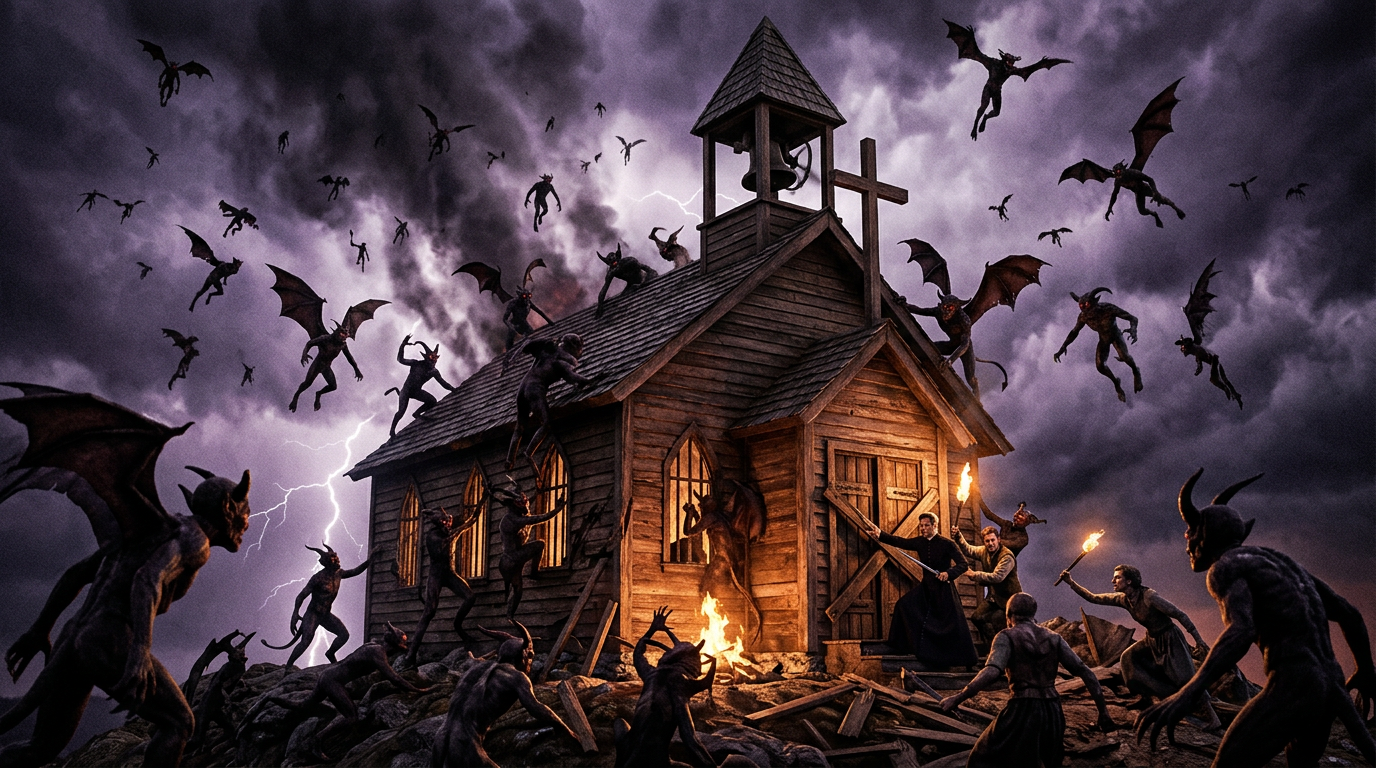
Winged demons attacking a small wooden church with people defending using torches

(3) Is the Prayer to St. Michael a Liturgical Prayer or Not?

While the critic argues that the Prayer to St. Michael does not belong to the liturgy, those who know the history of the prayer could argue otherwise. After having a terrifying vision of demons swarming to attack the Church, Pope Leo XIII in 1886 mandated the Prayer to Saint Michael at the end of the Catholic Low Mass. It was composed precisely as a prayer to be said by congregants at the end of liturgy. It remained an element of the Mass until 1965 when it was discontinued as part of the Vatican II reforms. Its reintroduction today is not a capricious act by believers but came at the behest of the late Pope John Paul II.
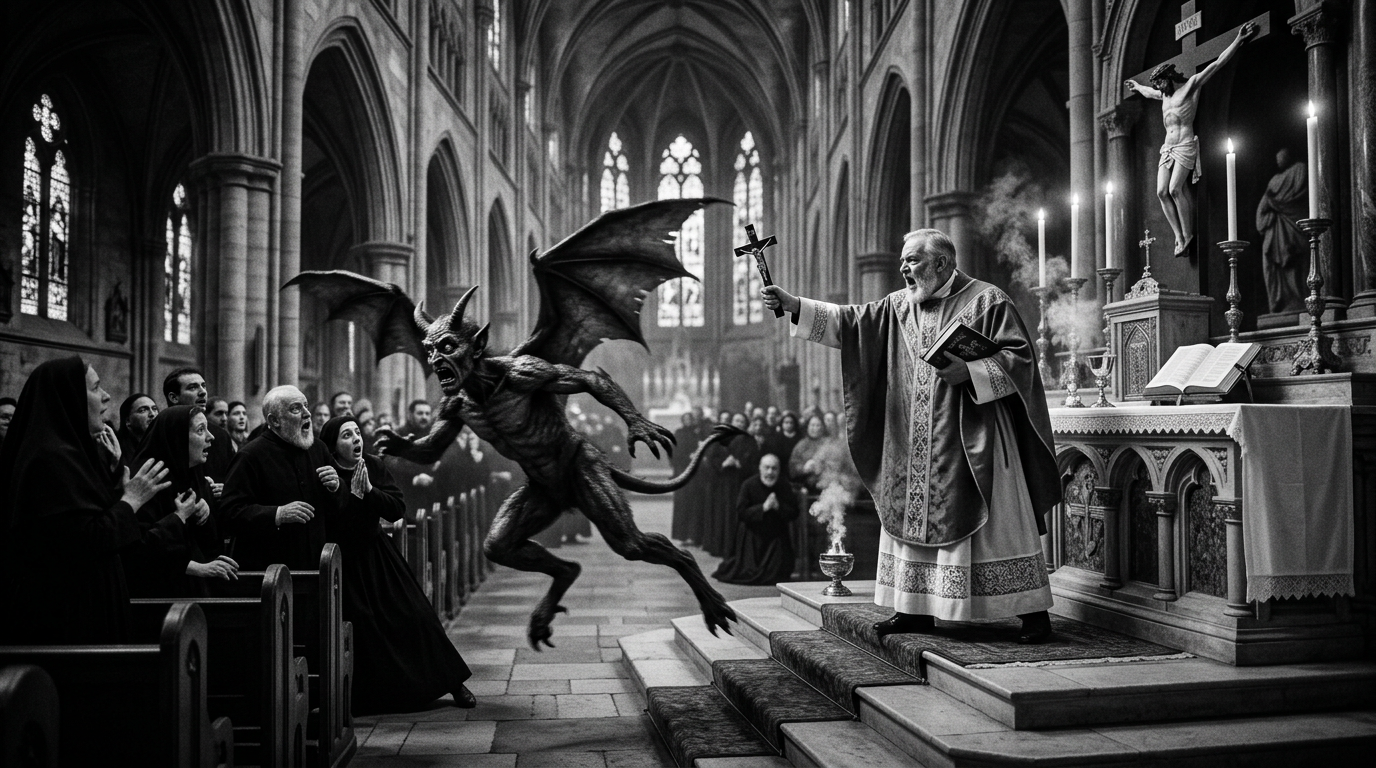
Priest holding crucifix confronting winged demon in cathedral with frightened congregation.

(4) Does the Prayer Target the World or the Church?

Pope Leo XIII received a private revelation that the devil would be permitted a time of testing where he would numb consciences to the truths of faith and morality. Thus, it is, that today we have Catholics who make a mockery of faith and cannot distinguish between right and wrong. Many who supposedly share our faith, never go to Mass, celebrate the deadly sins, and jubilantly enable the infanticide or abortion of children nine months in the womb, ready to be born. They are spiritual victims of this infestation. Remember that even Pope Paul VI lamented, “from some fissure, the smoke of Satan has entered the temple of God.” Pope John Paul II knew that the deliverance prayer annoyed those in our midst who were under demonic oppression. We cannot proclaim the Gospel of Life if we succumb to a culture of death. The oration to St. Michael invokes both angelic and divine power to shield us and to work as a bulwark against demonic oppression. The devil would cloud minds from the truth and harden hearts to real love and compassion. This critic says it places us into an adversarial position against the world. This is not the true focus. The prayer targets the Church. We cannot be sent out on mission to bring Christ’s light if we are compromised by the darkness. 
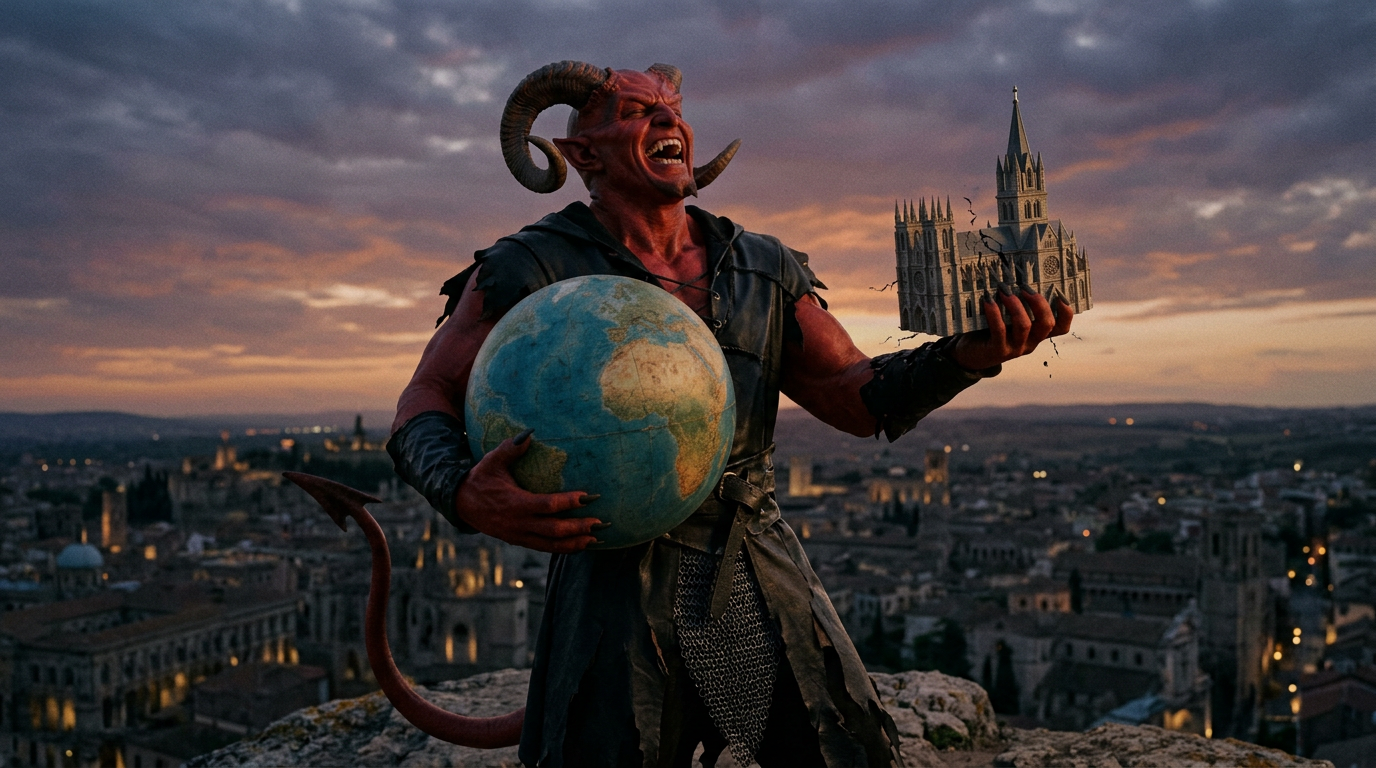
Red demon with horns holding a globe and crumbling cathedral model at sunset

(5) Is the Recitation of the Prayer Outside Liturgical Norms?

Davis writes that the Prayer to St. Michael “does not belong in the liturgy.” If we were to restrict ourselves to the current liturgical rubrics, then what he says is correct. Indeed, he cites it as a violation when recited “after the final blessing but before the recessional hymn.” Believe it or not, many bishops agree with his stance and as priests we have been told that we are not to initiate the prayer at any time during the Mass. However, the animus that Davis has for the prayer carries him away into absurdity.  Let me explain. There is a loophole in that lay congregants can say the prayer just as they might say a rosary immediately following Mass. Many of us as pastors have coordinated the effort with our flocks prior to the service. We get parishioners to lead the prayer. Prayer cards are passed out. Our good people are not blind. Given the scandals with clergy and liturgical abuses, Mass-goers want to say this deliverance prayer. As for the closing or recessional hymn, the critic has spoken either from ignorance or prejudice.  It is entirely inconsequential because the Roman Rite (including the Novus Ordo) has no closing or recessional hymn. We add it on Sundays and omit it on weekdays as entirely a matter of custom. The Mass ends with the words of dismissal recited by the priest or deacon. And the liturgists are correct, at that point he shuts his mouth. But the congregation is entirely free to recite the Prayer to St. Michael, share the Rosary, or sing a closing hymn.
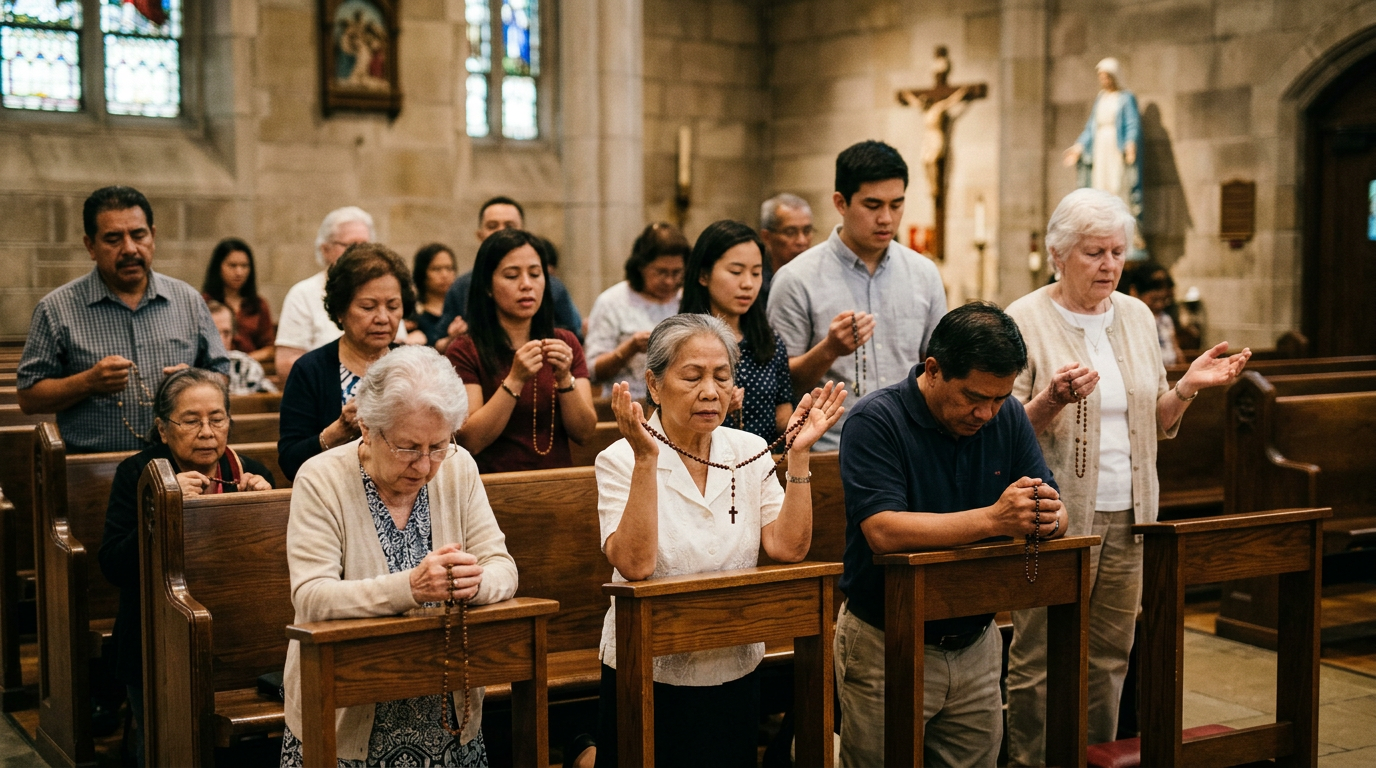
People praying with rosary beads inside a church

As for why anyone might oppose this prayer, I would continue with a reading from John’s Gospel:

“And this is the verdict, that the light came into the world, but people preferred darkness to light, because their works were evil. For everyone who does wicked things hates the light and does not come toward the light, so that his works might not be exposed. But whoever lives the truth comes to the light, so that his works may be clearly seen as done in God” (John 3:19-21).

Our Adversary the Devil

I recall from my days as a seminarian, working in the campus library to make money to pay for my books, there was one student at the tables about whom there were nervous whispers.  He stayed to himself and had piles of books at his workstation about devils and demonic possession. At one time such works were cordoned off in the Forbidden Books section. Maybe it was a good idea because this young man was obsessed about the subject. His proper studies suffered due to the long hours he spent researching this dark topic. I am not even sure he ever graduated. It took over his life.

That is the danger in discussing fallen angels and the devil.  There is a peculiar attraction about the matter. I suspect that is why it is so frequently the theme of fanciful books and movies.  It gives a terrifying thrill. As with an amusement ride, it feels dangerous but there is the presumption of safety— why? I suspect it is because many do not have any credible faith and so the subject is treated as fiction.  The devil is reduced to a caricature.  Many of the emerging satanist clubs are populated not by religious devil worshipers but by atheists who campaign against theism with parodies and mockery. But if the devil and hell are real, then they are in for the shock of their lives— and it will be no joke. 

The issue here is not purely psychological. As a Christian I believe that we battle not only evil men but invisible powers and principalities. The devil and his minions are real and while they are diminutive and weak compared to the power of Christ, they can still exert a dreadful influence upon souls. More than the comical devil on one shoulder and an angel on the other, Satan can corrupt a person through the openings made by malice and human weakness.  More prevalent than outright possession are the phenomena of obsession and oppression.  Indeed, they are arguably more insidious as they seduce the human will and lead victims into mortal sin. The devil can also numb the conscience to moral truths, as with matters of bigotry or threats to the sanctity of life. 

The Lord’s Prayer is evidence of how serious this matter is. The oration literally asserts “deliver us from the evil one.”  The serpent or devil that tempted Adam and Eve also tempted Christ in the desert. Of course, our new Adam prevailed.  Unfortunately, we often play the part of Judas. We are easily swayed by the world, the flesh and the devil. 

The name given to the devil is Lucifer which means “light bearer.” Compared to Jesus as the Light of the World, the devil is a false light. He initiates the angelic rebellion, and he is the chief of the demons that plot the damnation of souls. Given the mystery of Christ’s redemptive work on the Cross, the devil has lost the spiritual war. Nevertheless, Satan fights skirmishes over individual souls.  The fallen angels were created as good by God, but their fall recast them as demons.  Their decisive choice allows for no repentance or reconciliation.  They are cast into hell.  Indeed, one might say that they are hell or carry hell with them wherever they go.  Hell is more than fire. The greatest pain of perdition is the alienation from God and from saving grace. The devil was ranked among the highest angels, a Cherubim or maybe even a Seraphim.  We read in Isaiah 14:12: “How you have fallen from the heavens, O Morning Star, son of the dawn! How you have been cut down to the earth, you who conquered nations!”

Demons may cause grave spiritual harm, or if permitted by God, even hurt to the bodies of men and women. The story of Job cannot be written off as merely literary fiction. It speaks to both the wounded human condition and to our chief adversary that propelled humanity on this dreadful trajectory. Jesus performed several exorcisms and gave the ministers of his Church authority over unclean spirits. Today we often recite after Mass, the Prayer to St. Michael against the devil.  We are also urged to recite deliverance prayers and to avoid those things that can lead to demonic infestation such as vengeance, the occult and lewdness. Pornography is often employed by traditional devil worship. The devil delights in anything that impugns the dignity of God or our own persons. Demons exert various levels of bondage: obsession, oppression, and possession.  The greatest tool we have against demonic influence are the sacraments, particularly the Eucharist and the sacrament of penance.             

Demonic “oppression” is what it says, literally a pressing down or weighing upon a person.  Such an attack from the outside can target anyone, even the most fervent Christian. Often the situation we face is used against us— moral persecution, natural calamity, indebtedness and poverty, hunger, sickness, etc. We are tempted to despair or to do something rash. A person may be in a dark mood that evades shaking off. Another may experience an inexplicable fearfulness— uncomfortable around a person, place, or thing. Some even suffer physical ailments for which no one can find a natural cause.   

Demonic “obsession” is a form of subtle mind control wherein one becomes mentally drawn or addicted to evil.  There is an attraction to the things of sin and an aversion to elements of faith or holiness.  Just the mention of Jesus’ name can sometimes send such victims into a rage. I have often wondered if this might be a reason why vulgar songs, slasher films and other questionable media become so popular, especially with the youth. There is a level of deception in this, with sufferers thinking such preoccupations are neutral or not offensive.  Indeed, some will wrongly equate evil with the will of God. This trespasses into blasphemy against the Spirit of God.  Sexual sins are readily excused or even justified. Christians with traditional values or beliefs are mocked. Compromises are made about prayer and worship that do not serve the purpose of growing in holiness. Bible reading and prayer is neglected.  Anxiety replaces trusting the Lord. Instead of centering one’s life upon Christ, the obsession is about the devil and the many supernatural ways he interacts in people’s lives.  Even the rash of exorcism books by Christian authors might be dangerous to such people as they are overly enamored by the topic. The kids into goth styles and vampire fantasies might be another manifestation of obsession. The darkness saturates where there should be light.  New Age religion and occult practices often reflect the intervention of the demonic into people’s minds and hearts.       

Demonic “possession” is the most feared, although it can signify the least human volition or control of the three afflictions.  While something of the occult like a Ouija board, a séance or tarot cards might initiate a series of events leading to possession; once it begins, the person becomes like a puppet on a string.  Habitual sin, particularly deadly sin, can be a window to the demonic, as well.  Possession is only a hop and a skip away from allowing oneself to be a slave to sin.  The devil moves in and takes control of the will.  It is a dangerous situation.

A priest must be given episcopal approval to perform an exorcism. Often such efforts take place in hospitals because the demon will fight to remain and may hurt or even try to kill the possessed person. The exorcist must be in a state of grace, himself.  The devil will lie and try to frighten those who oppose its presence.  Sometimes the exorcist gets hurt.  There are various signs to be observed in the discerning of spirits.  The exorcist can ask questions but should avoid general conversation with the spiritual invader.  The devil will lie.  The demon will sometimes show a knowledge of languages, like Latin, Greek, Hebrew, and Aramaic. Often demons speak in a shrill sing-song voice, accenting the wrong words. This is often a give-away that the demon and not the human demoniac is talking. Just like artificial intelligence engines on the phone or internet, you can often tell that the speaker is not human. It does not sound right. The devil cannot tell the future, but he is a good guesser and can read into situations and fool his listeners. He can learn a great deal by watching. He cannot read one’s mind unless one invites him to do so.  There may be supernatural manifestations like objects apparently moving of their own accord.  Demons in possessions often seem bestial (a sign of their degradation). The exorcist can ask the name and number of the demons but always remembering that demons are deceptive.  No bargains can be made.  The Church’s prayers deliberately insult the devil. He is commanded to leave.  Once liberated, the possessed person should embrace faith, to help forestall the possibility of a relapse.  The devil loves a spiritual vacuum.  By contrast, if one is filled with the presence and grace of God, the demon will shy away from setting up a nest in that person.  The exorcist invokes the saving name of Jesus and the communion of the saints in administering an exorcism. 

Despite the naysayers, the devil is real and so is hell.  But the devil is a creature, a fallen angel.  The true power remains with God.  If we walk with Christ, the devil will fear both the Lord and us.










