







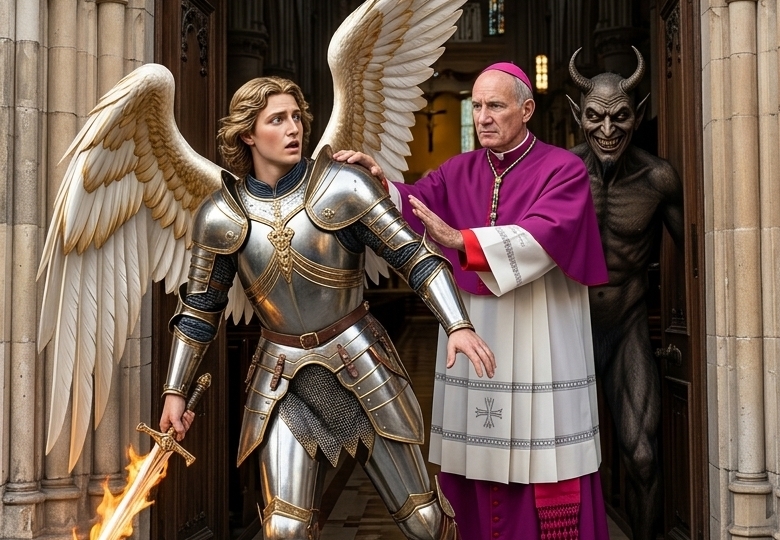
While we should always show due deference to our bishops and their authority, sometimes they say and do things that make us scratch our heads. A recent example of this confusion is from Bishop James Beckman in the Diocese of Knoxville. The good bishop sent out a letter to his diocese ordering the laity to cease praying the Prayer to St. Michael after Masses. Given the pressing presence of the demonic in the world, many have returned to the use of this prayer. It originated with Pope Leo XIII in 1886 when the Holy Father ordered its recitation at the end of all Low Masses. The Pope had a terrifying vision of the devil assaulting the Church. He composed the prayer, along with three Hail Mary prayers, a Hail Holy Queen and a prayer for the Church. These orations were suppressed in 1964 with the Vatican II reforms. St. Pope John Paul II on April 24, 1994, urged the recitation of the Prayer to St. Michael, particularly before or after gatherings for worship. The Holy Father was discussing St. Paul’s Epistle to the Ephesians and the Book of Revelation. He said, “I ask everyone not to forget it and to recite it to obtain help in the battle against forces of darkness and against the spirit of this world.” Faithful Catholics responded by voluntarily resuming its recitation at the end of Masses and in private devotions.
Bishop Beckman does not seem to worry about such spiritual warfare. Indeed, he has directed his priests to initiate RE-EDUCATION catechesis to persuade lay men and women to cease the practice of saying the Prayer to St. Michael and other common prayers after Mass. This goes against the grain for clergy in the trenches who have urged prayers of preparation before Mass and prayers of supplication and thanksgiving after services. Clergy, even here in Washington, have for some time been urged not to initiate private devotions or extra prayers following the dismissal and blessing. However, there was no rule about the laity pursuing such prayers after Masses, a common practice after weekday liturgies. Sodalities and other prayer groups frequently say the Prayer to St. Michael and the Rosary either before or after Masses.
While the suppression of the Traditional Latin Mass surprised and hurt many believers attached to the older form, more startling is how it has acted as a catalyst for the micro-managing of the Novus Ordo and devotions associated with Mass. Bishop Michael Martin of the Diocese of Charlotte sought to prohibit priests from privately saying vesting prayers and banned the “ad orientem” posture of the priest, the general use of Latin, the use of fiddleback vestments and birettas, the ringing of an entry bell, and the use of Mass veils by women reading, singing or serving at liturgies. The practice of kneeling for Holy Communion, in contradiction to the GIRM, was also forbidden. He decreed the removal of altar rails designating sacred space around altars in all churches by January 2026.
Returning to the recent news about Bishop Beckman, he is within his rights to insist upon where the universal Church delineates the conclusion of Mass. But is he consistent? Even the closing or recessional hymn is not properly part of the Mass. There is no mention of it in the directives. But I suspect he will make no move to forbid the final hymn. In any case, if the additional prayers added by the laity are not officially part of the liturgy, how can he tell believers they cannot pray them after Mass in their own churches? Must they pray privately in silence as if they be ashamed to join voices after Mass? This is utter nonsense. His authority is not absolute. The prayers said before or after Mass are in sync with Catholic belief. If they were heretical then he would have a case, but that is not where things stand. The most any bishop can demand is that post-liturgical prayers not be instigated or immediately orchestrated by the priest or deacon. Indeed, other than expecting good decorum, the priest himself can make no further demand upon the congregation after the formal dismissal. Regarding this matter, the bishop himself, may need some corrective catechesis. The bishop is not forbidding additional prayers to the liturgy but seeking to ban prayers outside the Mass. That comes across as a bit crazy for a Catholic shepherd.
The bishop’s concern seems to be about any prayers after Mass as he adds the Prayer of St. Francis to that of St. Michael and any invocation of the Holy Spirit. I guess many had better watch their step— traditionalists, charismatics and those who associate our worship and faith with social outreach to the poor. This situation really makes no sense. The bishop is discouraging prayer in his churches. This sounds more like something happening in Communist China, not the United States. While too many come late for Mass and rush out at the end, should we not be encouraging people to stick around and pray in our churches? That is what makes this matter into a kind of unbelievable madness.
It may be that no one cared when it was two or three elderly women saying their prayers. However, the pedophile scandals and especially the fall of the criminal Cardinal McCarrick brought many more of the faithful to their knees. As St. Pope Paul VI said, “the smoke of Satan has entered the Church,” and believers can no longer look away. The faithful are astonished and even fearful. They want their priests and bishops to be saints, not devils. The Prayer of St. Michael seems more valuable than ever before. It signifies a Church invoking heavenly aid for healing and mercy. It arose spontaneously as an act of the spirit. Many priests were asked by their congregations if they might say it and faithful clergy were happy to see the initiative taken by their flocks. But now Bishop Beckman would shut it down. Given the scandals, payouts and resignation of Bishop Stika, one would think that Bishop Beckman would invite and not deter additional prayerful support. But no, St. Michael is given the door instead— so much for reparation.
If the celebrant kisses the altar and, along with the other ministers, recesses out, then how can there be any blurring of the lines as to where the Mass ends. The diocese says that “these prayers remain vital parts of the Catholic ‘treasury of prayer’ and are highly encouraged for private, individual devotion.” But the bishop cannot have it both ways. He has no authority to restrict prayers to individual or dare we say it, secret recitation. Indeed, our Lord urged, “For where two or three are gathered together in my name, there am I in the midst of them.”
St. Michael the Archangel, defend us in battle. Be our protection against the wickedness and snares of the Devil. May God rebuke him, we humbly pray, and do thou, O Prince of the heavenly hosts, by the power of God, thrust into hell Satan, and all the evil spirits, who prowl about the world seeking the ruin of souls. Amen.
Filed under: Uncategorized | Tagged: authority, Bible, Bishops, Catholic, christianity, Faith, Jesus, Mass, st-michael | Leave a comment »