The blog header depicts an important and yet mis-understood New Testament scene, Jesus flogging the money-changers out of the temple. I selected it because the faith that gives us consolation can also make us very uncomfortable. Both Divine Mercy and Divine Justice meet in Jesus. Priests are ministers of reconciliation, but never at the cost of truth. In or out of season, we must be courageous in preaching and living out the Gospel of Life. The title of my blog is a play on words, not Flogger Priest but Blogger Priest.
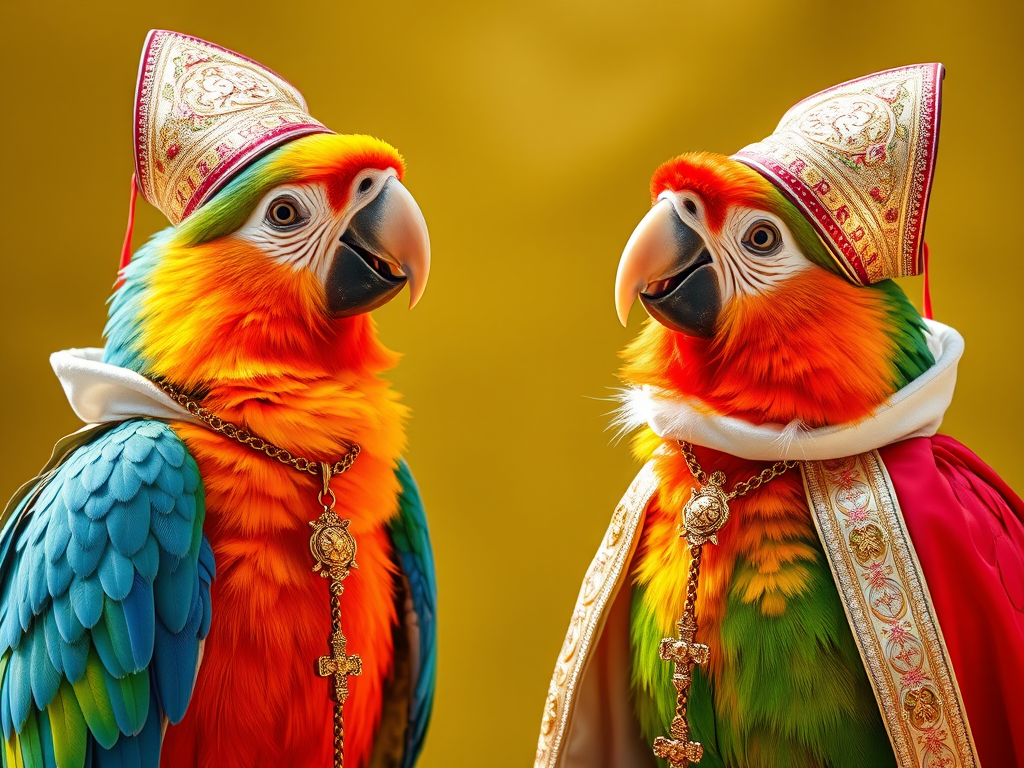
The SSPX prefer unchanging liturgy and stagnant cut-and dry definitions. And yet, at this crucial time in history, we neither need nor want talking parrots without the basic tools for the give-and-take required in theological reflection and discourse with intellectual giants like Cardinals Robert Sarah and Gerhard Ludwig Müller.
We must be wary of those who speak out of both sides of their mouths. Certain progressives would supplant an oblation to the divine with a fellowship supper and prefer a revolutionary break with past teachings and values. Anachronistic traditionalists would embrace an unchanging liturgy and dogmas reduced to staid definitions that are either disconnected from modernity or attack it head on. Instead of ecumenical outreach the Society is often locked in attack mode and employs old and aggressive proof text apologetics. This will not get us very far. Both the SSPX and the Vatican must take care about who speaks for them in any dialogue. Many of their priests would do poorly with their ingrained resistance. This is not a debate that one must win at all costs. The starting point must be obedience to the Holy See, affirmation of the various liturgies approved, and the acceptance of Vatican II as a genuine ecumenical council. This does not mean that the door is closed to clarifying teachings and reconciling them with previous formulations. When it comes to the brightest minds in favor of the traditional Latin Mass, and who are aware of the other issues, we must turn to learned laymen like Dr. Peter Kwasniewski and Dr. Taylor Marshall. While we might sometimes disagree with them, they would legitimately seek to maintain communion with the living Magisterium. Resolution about the status of liturgy and reconciling Trent with Vatican II would be good for the Church overall, even if the SSPX and other groups should still go into formal schism or their bishops face excommunication.
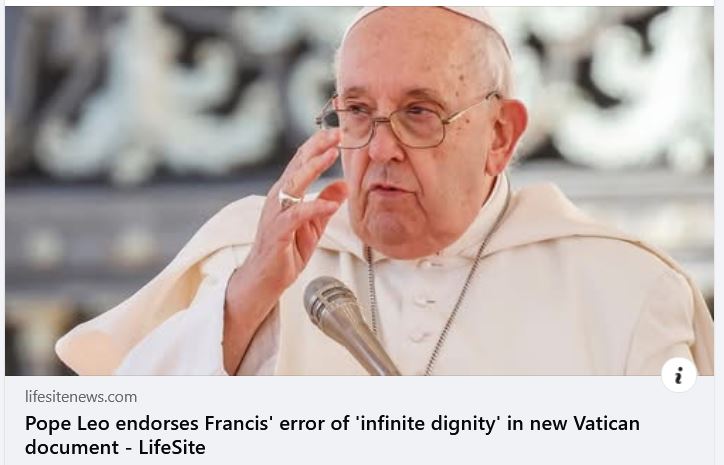
Every time Pope Leo XIV agrees with Pope Francis on something, the critics go crazy! Here there is opposition to the argument from Pope Francis in DIGNITAS INFINITA that human dignity is an “infinite” value. The concern is that it seems to deify the human creature when only almighty God is truly infinite. It is argued that this compromises Catholic teaching on original sin.
I think a grievous misreading has been made. I may be wrong but I discern shades of Pope John Paul II’s thinking in this, too. Yes, we are are finite creatures. We do not self-exist and we cannot save ourselves. However, there is an ancient notion that elements like the good, the true and the beautiful are perfections of God in which we participate or share in some small measure. Whatever we share can be traced back to God the Creator who has infinite value. Human dignity is viewed on two levels, first that of human creatures born of women into the human family, and second, as regenerated sons and daughters of the Father reborn at the womb of the baptismal font. The latter (spiritual dignity) builds upon the first (ontological dignity). Indeed, sanctifying grace divinizes the person with a share in Christ’s life. While all human life is incommensurate as God’s gift to us; the dignity of the human person is further enhanced by the sacraments. While we are finite, that which God shares of himself is not— basic existence and on top of that eternal life in Christ.
The late Pope Francis taught that the human person possessed an immeasurable or incommensurate worth. This was a major contention of the late Dr. Germain Grisez (1929–2018). He contended for the incommensurability of basic human goods.
Reflexive Goods: Self-integration, Practical Reasonableness, Justice and Friendship, and Religion.
Substantive Goods: Life and Health, Knowledge of Truth, Appreciation of Beauty, and Excellence in Work and Play.
(The basic goods delineated by John Finnis were similar.)
Grisez claimed they are equally good in themselves and cannot be rationally compared. He argued that the basic goods are equally ranked and thus there can be no proportionalism in their regard— you cannot act against one to promote another— there is no lesser evil for a greater good. This becomes foundational for his moral theology on behalf of the sanctity of life and the indissolubility of marriage. Contraception, abortion and euthanasia are entirely removed from the drawing board! Everyone is thus viewed as precious and irreplaceable. Every person has immeasurable worth, even the convict on death row.
Pope Francis broke down dignity in terms of anthropology: The first is “ontological.” Every moment God is keeping us in existence. If he were to forget us for an instant we would cease to exist and be annihilated. Such would be against the divine economy. This value is incommensurate. The second is “moral” and here dignity can be lost through evil acts and sin. This is where original sin and concupiscence come into the picture. The third is “social” and dignity can be violated by oppression and poverty. However, worth remains the same. The fourth is “existential” which refers to a person’s subjective experience of life.
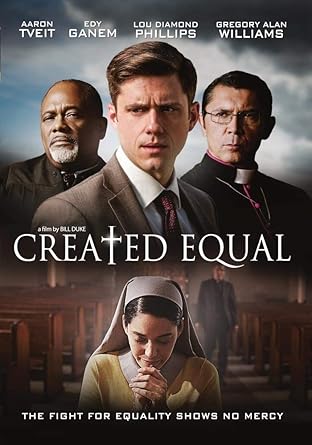
The film seems oblivious to the fact that the conflict is one-and-the-same as that of the Roman empire against the early Church. It is the question as to whether we follow Caesar or the Lord. The courts and the world of politics have no jurisdiction over the faith of the Church. That is where the story should have ended. However, the premise of the film is that the Catholic Church might be compelled to open the priesthood to women by intimidation of the civil legal system. This is not the case. Whatever the state might decide, the Church would refuse to comply, even if it meant persecution and martyrdom. One is reminded of the Church of England that sought to manipulate the Church when a king demanded a divorce. But the Church was willing to allow an entire country to evade its grasp to preserve the meaning of marital fidelity. Like holy orders, marriage is a sacrament of the Church. The Church has the right to administer her sacraments as she feels fit. The jury in the film judges a male-only priesthood as discrimination; but this is not true because priesthood is not a job or an entitlement. Yes, as a vocation it is a calling, but just like the nature of our saving faith, it is both personal and corporate. Any calling from the candidate must be affirmed by the Church, notably the bishop and those placed in charge of formation. Priesthood is a gratuity and no one can demand that gift.
The film would intimate that our religious liberty comes entirely from the state, but our founding documents merely acknowledge that such freedom comes from God, himself. No judge and jury, particularly made up of non-Catholics and/or those unsympathetic to Catholicism have any say about the Church. Indeed, even the laity that constitute the “sensus fidelium” must live and share the tenets of our holy religion. Pope John Paul II definitively answered the question about women’s ordination, explaining that the Church has no power to change the practice of ordaining only males. Short of any new miraculous revelation, the Church is bound to keep the tradition. Responding to the challenge of stereotypes, the pagan world had many priestesses and yet the new dispensation of Christ that fulfilled the promises of Judaism maintained male leadership among the apostles. Our Lord was shown to break convention as when he spoke to the Samaritan woman at the well. She would become a prophetess to her people, but not a priest. The Blessed Virgin Mary was the holiest woman to ever walk the earth and yet while she takes a priestly stance at the foot of the Cross, she is entrusted to the apostle John who was a sharer in Christ’s ministerial priesthood. While all of us participate in a baptismal priesthood (given that sacrifice defines our faith and charity), the ordained priesthood is reserved to men, and not all men, but a select few. If the state were to assume authority over our ministers, then it could just as likely demand married and divorced men and women or even overt homosexuals. But our sacraments are not subject to the fads of changing times or the capricious desires of men and women. Indeed, even if we should want to ordain women, we cannot do so.
The reasoning of the Church is clear and sound. While the Church can mitigate disciplines like celibacy in specific cases, the matter of gender is no accidental that can be brushed aside. The theology of the body focuses upon gender as being constitutive of our deepest identity and personhood. Just as only a man can be a father and only a woman can be a mother, only a man can be a priest. If we should attempt to ordain females and it should prove against the will of Christ, then we would forfeit both the sacrament of holy orders and the Mass. There would be no more Eucharistic real presence of the risen Christ. There would be no more unbloody re-presentation of the sacrifice of Calvary. The oblation and banquet that renews our covenant with Christ would disappear with the loss of apostolic succession.
A male-only priesthood is no injustice and not chauvinism. The house of the Church is that of a family with a given structure. Would you allow strangers to come into your house and tell you how to run your home? Children obey parents, not the other way around. The objective of this film would introduce dysfunction into the home of faith, the Church. Where there was a faint promise of teaching on this subject, the film gives a simplistic and one-sided view. Even the churchmen are so terribly caricatured that they are hard for knowing believers to watch. The nun in the movie might believe but she is also a rebellious daughter. Her journey will likely take her into Anglicanism where they have priestesses that go through the motions but a faith that compromises to secular modernity at every turn.
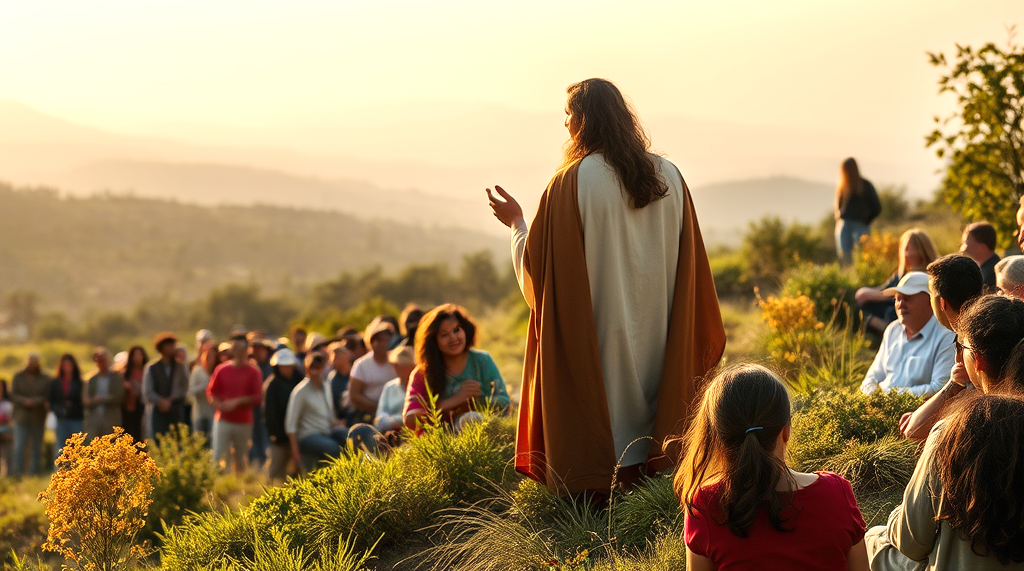
The Gospel this evening is the presentation of the Beatitudes by our Lord. It is essentially a guide toward holiness or sainthood. As Catholics we ordinarily ponder the men and women canonized by the Church. Here at Holy Family, we even celebrate a monthly saint, requesting intercession and seeking our own emulation. But in truth, there are far more saints than those few on any list that we might keep. The saints of God are listed in heaven. While we struggle with our sinfulness, how many living saints have we encountered over the years? I think of all the good Catholics that helped their fellow man and were faithful to the sacraments. There are likely some in this Church as I speak who are very close to God. Sainthood is not an unreachable goal. By God’s grace, we can all know sanctification and holiness of life. It is the one goal we have in life. Nothing else matters other than becoming holy and eventually finding ourselves with the Lord in his heavenly kingdom. Years ago, I had the opportunity to visit the mount upon which Jesus preached the Beatitudes. There was a small but beautiful chapel there. Just as our Lord instructed his apostles, today there is a seminary on that hill where men are prepared for the priesthood. What do these benedictions teach us?
“Blessed are the poor in spirit, for theirs is the kingdom of heaven.”
The word for poor here is (’anāwîm), taken from the Old Testament it refers to the destitute who have nothing but God. It came to infer the qualities of lowliness or a profound humility. The addition of the words “in spirit” are added by Matthew to clarify that being materially poor would not necessarily save anyone. We know that in our own society, poverty is often a catalyst for jealousy and crime. Hearts can be poisoned by resentment toward the rich or because of struggle. Disappointment can twist or corrupt the soul. Poor people often suffer from the rich man’s dreams. By contrast, poverty in spirit might be voluntary, as with religious who embrace poverty for the kingdom. Christian poverty also implies acceptance in whatever comes. We see ourselves as unworthy and all that we have as a gift. It also implies generosity. We would not want to be well off at the cost of a neighbor who is homeless, hungry, naked and afraid. Poverty in spirit means that we might have things, but we would not allow the things to have us. True richness is not found in material things but in standing in right relationship with God. We are all the poor man or woman, dependent upon God.
“Blessed are they who mourn, for they will be comforted.”
Many question God because of the problem of pain or suffering. This blessing would turn that around. We should not get angry or run away from God because of loss or a hard life. Rather, we should trust that God will make all things right. This implies not only that God will give comfort, but that as his stewards we should try to bring a healing presence to the pain of others. The ultimate response of God to pain is solidarity with Christ in his passion and death. God is present with us, and we must be present to one another. We are together in this. We are not alone or abandoned.
“Blessed are the meek, for they will inherit the land.”
Just as in the story of salvation, the Jewish promise of Jerusalem and a land of their own was only made possible by the power of God. Human strength of arms would always fall short. However, if we keep the covenant, God will keep us. As Christians, this land refers to the kingdom of Christ, realized in the Church and in the promise of heaven. We must acknowledge our profound dependence upon God.
“Blessed are they who hunger and thirst for righteousness, for they will be satisfied.”
This benediction gives root to the Church’s teachings on social justice. We yearn for a world where the right prevails and evil is thwarted. Unfortunately, then and now, there is so much injustice and prejudice. Good people suffer and the bad seem to flourish. Ordinarily we understand righteousness as moral conduct that conforms to divine law or God’s will. Here it means something more. Righteousness is literally the saving power of God. We cannot make ourselves good, only God can do that. Only the Lord can save us. We cannot save ourselves. We are sinners who need a Savior. We must submit to God’s plan of salvation. Jesus is faithful to this mission from the Father, unto the Cross.
“Blessed are the merciful, for they will be shown mercy.”
It is as in the Lord’s Prayer, “Forgive us our trespasses as we forgive those who trespass against us.” It is only by forgiving others that we open ourselves to divine mercy.
“Blessed are the clean of heart, for they will see God.”
Just as one had to be ritually pure to worship God in the temple, our Lord takes it one further and teaches that we must be clean of heart or pure to see God in heaven. We must become perfect as our heavenly Father is perfect. This appreciation is behind our understanding of penance, absolution and prayer for the poor souls.
“Blessed are the peacemakers, for they will be called children of God.”
Ultimately this peace is about more than avoiding hostility or violence. It means a radical imitation of Christ. Our Lord would have us joined or united with him in how we confront earthly power and injustice. The peace of Christ demands trust and sublime courage in facing the mystery of evil. This unity is in terms of adoption into the family of God.
“Blessed are they who are persecuted for the sake of righteousness, for theirs is the kingdom of heaven.”
We will know that we are on God’s side because the world will target us as signs of contradiction. If there is no tension with the world and no opposition, it means one of two things: either we have converted the world (which is unlikely) or that the world has compromised us.
“Blessed are you when they insult you and persecute you and utter every kind of evil against you falsely because of me. Rejoice and be glad, for your reward will be great in heaven.”
I suspect this last beatitude is where our Lord lost some of his disciples. Who wants to be insulted or persecuted or even murdered. We naturally turn away from such prospects. And yet, as a parable people, we are to find joy in such adversity. It is not because we love suffering or pain, that would be sadistic. No, the overriding reality in this scenario is that we walk with the Lord. Whatever the world takes away. God can give back many times over. The natural man must give way to the supernatural man. There is a crown in heaven waiting for the saints who have followed the Lamb.
I read with interest the article by Gregory DiPippo about Brian Holdsworth’s video on the Church’s liturgies. A position is critiqued that argues that it does not matter which liturgical form is followed, either ordinary (reformed) or extraordinary (TLM). But in all honesty, I know of no learned believers who hold such a position. Note that the question here is not whether either liturgy (particularly the reformed ritual) is valid, licit, or spiritually effective. Catholics in good standing hold that the Mass in either form is a re-presentation of the sacrifice of Calvary, makes Christ present in the Blessed Sacrament, participates in the marriage banquet of heaven, and is an oblation for propitiation or for the satisfaction of sin. Either form constitutes Catholic worship, although one form or the other (and even how it is conducted) impacts upon what is communicated as well as to aesthetic tastes. The tension is real because both sides in the debate feel it does matter which form is followed, at least to them.
As a priest who is familiar with the older ritual, but has always said the reformed liturgy, my preference is for the somewhat streamlined liturgy of Paul VI. However, I can lament the reduction of certain beautiful prayers, especially from the revised offertory. Having admitted this, I believe in the freedom acknowledged by the late Pope Benedict XVI in granting liberty for priests and communities to celebrate the TLM. The two forms side by side might provide for deeper insight into any future reform. Indeed, looking back, it is likely that such a strategy might have borne better fruit than the reductionist intervention imposed after the council. While what is done is done, we can pursue a more gradual organic development of the Mass in the days to come. I suspect something of the blueprint in the English-speaking world might be the providential inclusion of the Anglican returnees in their three Personal Ordinariates. Their missal savors tradition, sacred worship-language, and a profound respect for the Roman Canon.
Why does a sizable remnant prefer the Traditional Latin Mass (TLM) or Mass of Pius V? Advocates cite its perceived reverence or sense of mystery (especially with chants, Latin and sacred silence), historical continuity, and theological clarity. The concise rubrics give order to a worship that highlights the transcendent.
Those who prefer the Novus Ordo (Ordinary Form) or the Mass of Paul VI list the following: more complete biblical selections, renewed emphasis given to the homily, the restored intercessions or bidding prayers, clearer emphasis on community participation, an understandable vernacular, and an effort to connect with modern believers.
More than just subjective, the differences between the liturgies are real and objective, However, are they worth alienating whole groups in the Church? Traditional believers who argue that the reformed or “new” Mass is dangerous and refuse to attend are not being helpful and probably had a part to play in the renewed suppression of the TLM. Those who attend the reformed liturgy are also guilty of blaspheming the Holy Spirit by maligning an ancient Mass that formed and enriched the many saints.
The article sides with the advocates for the TLM and views the reformed liturgy as an orphaned child, belonging not to Vatican II and only vaguely to the Church’s patrimony. Pope Paul VI is faulted for placing his stamp of approval upon it. The author of the articles writes, “If we understand this, we can see why it is possible to question and even reject the modern rites without being disloyal to the Council.” Councils aside, popes view themselves as the Roman Rite. The late Pope Francis thought so for sure. Priests of the ancient Church imitated the papal liturgy and made it their own. If this is the case, can we really claim loyalty and reject outright the rite of the last six popes? We may each firmly believe we are right, but regardless of this, how do we move forward? I would stop worrying about the extremist fanatics and ponder the needs of the good people in the pews. If they love and feel enriched by the old Mass, then let them have it. If people prefer the new, and the celebration is reverent and sacred, then let them have their worship. Neither are second-class or bad Catholics.
We can discuss and debate the elements of liturgy. We can judge one as superior to another, or at least better in-tuned to our spiritual character. There are many rites of Mass within Catholicism. The Roman Rite is currently divided between the Traditional Latin Mass, the Novus Ordo, and (to a lesser extent) that of the Personal Ordinariate (former Anglicans). All liturgy should be reverent, giving emphasis to the sacred and focus upon the Almighty. Accidentals do matter. But the substance should not be eclipsed. There is a bottom line but all liturgies are not the same. Many today judge the Traditional Latin Mass by beautiful Gregorian chants, mysterious Latin which is the language of the Church, organized ritual and meaningful sacramentals, etc. But in days of old, there were no microphones on altars, priest often rushed through the prayers at machine-gun speed (especially on weekdays), low Masses lacked music or it was poorly done, homilies were skipped, and we simply said our rosaries or personal prayers during Mass. People grew spiritually but there was sometimes a disconnect. It was hoped that the Novus Ordo would bridge this, but problems remain and may have grown worse. Many today are quick to judge the Novus Ordo, not by reverent renderings, but by clown and puppet shows or with liturgical dancers or whatever. But these are the crazy aberrations.
My ministry is about the forgiveness of sins and helping people to get into heaven. That is really what the Church should focus upon. The Mass and the Eucharistic Christ are essential. Without the Mass, we will spiritually starve. Without the Mass, we cannot render the worship that Almighty God demands. If I were to reject a form of the Mass authorized by the Church and her popes, then my ministry would end and my flock would suffer spiritual starvation. A priest cannot reject a form of the liturgy that he is morally committed to offer. This being the case, how can any of the flock reject that Mass? I am only a poor simple parish priest in the trenches. I will leave it to better minds to ponder the important accidentals of Catholic liturgy. Meanwhile, I will daily approach the altar, knowing that I am a sharer in the Lord’s priesthood, and with the epiclesis and words of consecration, transform bread and wine into the body and blood of Christ.
My evangelical friends delight in distributing pamphlets that urge all they meet to make “a saving faith profession in Jesus Christ as their personal Lord and Savior.” This usually comes along with a few essential questions posed to Catholics about their state of faith. The believer might answer that he is a baptized Catholic who partakes of the sacraments. Frequently this response is rebuffed because the non-Catholic questioner has little or no place in his faith system for sacraments. A follow-up query is, “If you were to die right now, where would you expect to spend eternity?” Learned Catholics might say “purgatory,” an answer sure to set the evangelical off because he already presumes Catholics are destined for hell and he can allow for no purification after death or prayer for the dead. His faith ignores the history or tradition of faith and any escape from stark individualism. His notion of “church” is one of fellowship but not of sanctification.
The heart of the Church are the sacraments instituted by Christ. These divine mysteries have undergone development but in one form or another were celebrated from the earliest days of the new dispensation. Indeed, the Mass is a command performance given to us by the Lord. The redemptive Cross and paschal mystery of Christ is remembered and made present. We find ourselves at the sacred oblation of Calvary where the Lord Jesus is substantially present and “really” active for our sake. He is the one high priest and the saving victim. Baptism as the gateway to the sacraments stems from the Lord’s demand to his apostles at the Great Commission.
Apologetics arguably would have the informed Catholic immediately assault the simplistic assumptions of the non-Catholic. Indeed, the fundamentalist missionary at this point often fully unveils his anti-Catholic posture. But given poor catechesis and lackluster devotion, most Catholics prove lacking in making any kind of suitable reply. Some will fall prey to the traps laid before them and accept the hollow and bigoted negative assessments of their holy faith. Those that will try to argue often run out of steam. They find themselves on the offensive but only armored with a faith based upon authority and not directly upon the truths of Scripture and Catechism.
As I said, the gullible might allow their faith to be errantly taught to them from a source hostile and bigoted to Roman Catholic. False teachings emerged either from outright ignorance or deception. I would urge those with a superficial faith-understanding not to engage such outreach ministers. Those trained to recruit Catholics are often given a series of religion questions to undermine the faith of those targeted. They have memorized biblical proof texts. Sadly, biblical quotes are taken out of context and are often misinterpreted. We must not relinquish the parameters of the discussion. Ideally, we should have the same stamina and desire to make converts as our challenger. How should we proceed in such situations if one is a knowledgeable Catholic?
First, realize that you and the fundamentalist speak a very different faith language. Do not surrender the upper ground. This is how I respond at the very top of the conversation: “Yes, I have accepted Jesus as my Lord and Savior, not just personally but corporately within the context of the Church that Christ directly founded upon his rock Peter and given to the apostles.” Second, if they should ask about our eternal destiny, make it clear, “Trusting in Jesus Christ, my Lord and Savior, I have every reason to HOPE for a share in eternal life with God in heaven.” Remember, even should we pass through purgatory, all the poor souls are destined for paradise.
Third, if they should emphasize the need for a verbal faith profession, explain that you affirm Christ and your belief in the Mass and in a weekly creedal profession. If they debate this, I would explain that “once saved, always saved” has been proven repeatedly to be false. Even Protestant ministers who claimed “Jesus” have fallen and committed the most devastating sins. While the faith of a few might have been counterfeit, we take them for their word that they believe in Jesus and his saving works. But real faith can die. One must remain steadfast in faith.
Fourth, I would ask the would-be missionary a question, “what is faith?” It is amazing how many people stumble on this matter. Faith is not magic. Too many regard it as did Martin Luther, simply as a juridical imputation. The argument is that we remain sinners, but that Jesus stands between us and God the Father. When the Father looks upon us, he only sees his Son and gives us a share in his Son’s reward. But Jesus speaks in the Bible of being born again— that repentance and conversion must be effective and genuine— that we must be changed. We must be holy as God is holy. A saving faith in Christ is transformative. We can still stumble but baptism has configured us to Christ. The sacrament (water baptism in the name of the Trinity) is essential. We are incorporated into the mystical body of Christ and into the family of faith. This is a royal family, and we enter the divine kingdom. Christ is King and Mary is our Queen Mother. We become adopted sons and daughters to the Father, children of Mary and kin to Christ. Sin is washed away, original and personal. We are granted sanctifying grace. Our Lord gives us the sacrament of penance so that we as sinners (who believe in Jesus) might become saints. The Bible makes the dynamics of faith quite clear. I would tell the missionary who targets Catholics, “We are saved as members of a new People of God, the Church. This personal and communal faith must be realized in loving obedience.” The two-fold commandment of love toward God and neighbor comes from the mouth of Jesus. The commandments given the first people called by God have not lost their binding force. We must realize or manifest a saving faith through works of charity. We cannot save ourselves. Works have value because “greater is he who lives in me than he who lives in the world.” If Christ is alive in us, then his works will always have saving or meritorious value. We must be transformed into the likeness of Christ. This is made possible by sanctifying grace. We are saved, not by faith alone but by grace alone.
Faith in the Lord is everything. There is no such thing as a part time Christian. Ours is a jealous God. The posture of the creature to the Creator is one of humble submission and dependence. We must surrender ourselves to him and to his service. Prayer and the sacred liturgy allow us to join the angels of heaven in their celestial praise of God as Holy, Holy, Holy.
Maybe I am handicapped by chronic cynicism? But I am often wary of those who criticize others about how they understand justice when their own appreciation would likely not muster close inspection. The word “justice” like “love” and “rights” has been hackneyed in every possible way, as well as assumed into the ranting politics of left, right and all stances in-between. The Black Lives movement clamors for justice against racism and power. Radical feminists define justice as liberation, not only from males but from their own biology and fertility. Militant Zionists demand a justice for past Jewish martyrs with a retributive justice hard to distinguish from revenge. Marxists demand a one-sided variation of justice reminiscent of Robin Hood, where the people “rise up” to steal from the rich (the bourgeoisie) and give to the poor workers (the proletariat). [In practice a party dictator takes power and all bets about justice are off the table.] While American citizens can rightly demand border security, what becomes of justice without sufficient compassion or mercy, particularly when the poor and the persecuted are lumped with criminals and the gangs from drug cartels? Can a society justly take the lives of the guilty in capital punishment when it wrongly strips the innocent unborn of any right to life? [The late Pope John Paul II said “no,” that any jurisdiction to deprive another of life under the banner of justice is forfeited in a culture of death.]
It is hard for a civilization to appreciate the cardinal virtue of justice when it is saturated with a parade of vices. While quick to judge, many people literally do not know what it means to be good or what constitutes the “right thing.” I suspect that is why we see the vast multiplication of surveillance cameras. Increasing numbers of people feel it is okay to steal, so long as they are not caught. Intimidation has replaced the virtues.
What do we as human beings have coming to us and what is “due” or owed to others? This varies from person to person. Business and general exchange of services relates to commutative justice. The employer should pay his employee an adequate wage. The employee needs to be diligent in providing serves or goods for which he or she is remunerated. Distributive justice is directed toward our relationship with a community. We all have equal rights to the same freedoms and general opportunities. But we do not all have the same resources, talents or obligations. This form of justice respects proportionality. Each person in a society does his or her part for the whole. Finally, there is what we call social justice. Here we often find a conflict between legal definitions and what we regard as just according to both divine positive law and natural law.
Turning to the Church, we need to cease mimicking the polarity that we find in partisan civil politics. Otherwise, we violate the peace of Christ that we celebrate at the Eucharist. This peace is focused upon our unity in Jesus Christ. How can we possibly appeal to those outside the Church for either evangelization or for social justice while our own believers are at each other’s throats in divergence from one another. We should not compromise the Gospel of Life by making too little of abortion or making too much of capital punishment. There need be no conflict about preserving secure borders and in proportional justice to illegals, distinguishing between desperate families who love the promise of America and the criminal invaders who should be expelled or punished. Neither side should use the justice system to attack political enemies. All should demonstrate a religious respect for the Holy Father, instead of a nasty knee-jerk criticism about the role of women, gays, environmental stewardship or various liturgical concerns. I really hate the current politicization of faith. We should not be quick to judge or condemn the Catholic character of men and women who voted either for Harris or Trump or someone else in the last election. Neither candidate articulates nor manifests the full kerygma as we understand it. No Catholic should allow his or her party platform or agenda to supplant the demands of the Gospel. The moral values of the Gospel are what they are. We should all seek to be good Catholics, keeping the commandments and loving God and our neighbor. We should exhibit a modicum of human respect, even when differences of opinion are severe. This must be the stance from both authority and from the rank-and-file. We need to be contrite about past ridicule and careful not to mock others or to use incendiary language. It is far better to build bridges than to burn them down.
Today we begin the Advent season and Advent is a time of preparation. Look into your lives as you prepare for the non-spiritual celebration of Christmas – a time of shopping and cooking – of tree-buying and decorating – a time of cleaning. It is also a time of renewal. Before texting, Facebook and emails, many of us would write letters and holiday cards to friends reconnecting and telling them about the past year with its joys and sorrows. We would renew old friendships. Given the current cost of postage and the intrusion of modern technology, letters and cards are increasingly out of fashion.
It is still a time of travel. Families and friends try to get together. If this is so physically, I would remind us that Advent is a season of spiritual travel. We travel into the Light and by the Light. Today, we ignite one candle on the Advent wreath and as the weeks go by we will light the second, third, and fourth. It is hoped that the Light of Christ will burn evermore brightly in our hearts. While we might be surrounded by darkness, we are called as pilgrims to follow the one who is the Light of the World. He illumines our way into the kingdom. The promise of the first reading is realized: “O house of Jacob, come, let us walk in the light of the Lord!” Without the Lord, we would be lost.
Advent is a time of coming home. It is also a season of becoming, knowing both growth and fulfillment in the Lord. Advent is the pregnant time in the history of salvation. We make ready for the Second Coming of Christ by remembering his first coming hidden in the womb of Mary. Advent signifies the ancient promise given the Jews for a coming Messiah. Christmas is the realization of that promise. Later Lent and Easter will celebrate the work of our Savior to redeem a people and to give us a share in his divine life.
Today’s first reading speaks of a day of promise when God’s justice will be fulfilled and peace will reign. The responsorial recalls Jerusalem as the city for the first people chosen as we await a new house of the Lord. “Let us go rejoicing to the house of the Lord.” This admonition is fulfilled with the house Jesus built, the Church. The second reading urges us to read the signs of the times. The days grow short and we must be awake or alert as watch-persons for the Lord, ready when he comes. We read: “You know the time; it is the hour now for you to awake from sleep. For our salvation is nearer now than when we first believed . . . .” The Gospel continues this theme. We are urged to be steadfast, awake sentinels for the Lord’s return and judgment. Jesus says, “So too, you also must be prepared, for at an hour you do not expect, the Son of Man will come.”
In our readings over the next few weeks, we will hear of a call to peace, and a call to justice. There is a joyful hope. Indeed, we will be told to rejoice because the Lord is near, because the Lord has removed the judgment against us. We also begin a new liturgical year. We have a fresh start; a chance to set our spiritual lives on a path that will lead us to that joyful welcoming of the Christ-child on Christmas morning. We will also heed the words of John the Baptizer when he says, make ready the way of the Lord; and when he tells us to receive a baptism of repentance. In the light of the liturgical renewal and in response to the Baptist’s cry, we would do well to reflect upon the sacrament of reconciliation.
The sacrament of reconciliation, as we shall see is also a means of preparation. It allows us to be healed and restored. It joins us more closely to Almighty God as it is his life, his grace, which we receive every time we celebrate the sacrament. Oftentimes we think that we only receive God in the Eucharist. We receive God every time we celebrate any of the sacraments; because each sacrament was instituted to be a channel or instrument of God’s life – God’s grace. The sacrament of penance is a sign of hope and loving trust in God’s forgiveness. It is a call to justice, a justice which forces us to examine, in truth, our relationship with God, with our brothers and sisters, and with our very selves. The sacrament also brings us peace. Oftentimes, the emotional burdens of guilt can weigh heavily upon us. It causes stress and disruption in our lives. By celebrating the sacrament of reconciliation, we can put much of this behind us. We can be at peace with ourselves and with those whom we encounter. Finally, this sacrament allows us to begin again— to be restored— to be made whole.
Anne Arundel Community College is literally in our backyard. Montgomery County is also considering adding a Satan Club to their approved campus organizations. Disguised behind a false rationalism and a host of liberal causes, it is a hate group and exists only to mock both faith and believers.
When people claim Satan but then argue that it is all a ploy, don’t believe it. They are fooling themselves. I have no doubt that the devil has his hand in this!
The Satanic Circle asserts that it does not believe in a literal Satan. Members claim a degree of enlightenment they do not possess. Dismissive of the many great scientists and thinkers who posited faith in a higher power, they grant to science a form of natural faith even though it asks different questions than philosophy and theology. Deductive science might tell us how a watch runs but not who made the watch. The theoretical sciences and mathematics deal with abstraction over the real. While many aggressive atheistic thinkers attack religion as espousing a “God of the Gaps,” they are blind to their own gaps in understanding both the macro- and micro universe. Many of the so-called rational satanists are those with weak minds who parrot the arguments of influential atheists in the scientific community. They are particularly influenced by those in the media. Kids in high school and rebellious youths in college are quick to distance themselves from the beliefs and values of parents and others. They image religious believers as ignorant fools while in fact they are the ones who have little knowledge of anything and know next to nothing about the ultimate questions. They live lives devoid of any appreciation of metaphysics and genuine intellectual reflection. Adherents rattle on against theistic faith even as they make a religion or cult of their atheism and proposed satanism.
Their reasoning signifies dislocated or illogical atheistic rationalism. They make many claims but do not know how to think for themselves. Question them about the definition of a syllogism and they would only give a blank stare. Those with recourse to a dictionary or the internet might answer with words they do not understand. Unable to truly debate, they turn to so-called proof-statements from leaders in the movement. But those answers fail to satisfy so they turn to mockery and ridicule. These new militants who promulgate an evangelistic or missionary atheism, have fooled themselves. We must not allow the wool to be pulled over our own eyes. This is a real concern at a time when many youths are only superficially Christian. They do not understand their faith as they should, and they cannot defend it.
The devil is powerful, and he strategically exploits doubts and denials about his existence. Those who caricature him as a joke do not know that the joke is on them. This new breed of satanist might welcome occult witches or Wiccans or even new age religionists to their gatherings for “fun,” but in debates they are also criticized as closet theists. They purloin their symbols and nomenclature as their own. They deny that the supernatural is real even as they come under a hidden spiritual oppression. Signs of such manipulation are realized in the dark fruits of their coalition. They go out of their way to mock Christian believers while demanding respect for themselves. They hate the Jews as the progenitors of the Judeo-Christian faith. Indeed, they would side with terrorists against the state of Israel. They are inherently Marxist, contending for “mischief” or revolution to overthrow genuine faith and the Mosaic commandments. They create a false dichotomy between reason and faith, elevating a science that does not have all the answers, especially about the ultimate meaning for humanity.
They are political activists. Instead of arguing for Christian stewardship over creation, they raise up nature and ecology as in rivalry or war with humanity. They would save whales but exterminate unwanted human babies. The new Gnostics, while they claim an allegiance to science and nature, wholeheartedly endorse same-sex disorientation and gender dysphoria. They not only support the LGBTQ+ agenda, but they also embrace a no holds barred sexual expression between consenting adults. Despite the clear mention of the Almighty in our founding documents as a nation, their interpretation of separation of church and state would go far beyond the intent of our founding fathers. Instead of a mere prohibition of a national denomination or confession, they propose the disavowal of any belief in God and the accompanying religious values. Under the heading of “bodily autonomy,” they would deny the right to life of the unborn. Against the Gospel of Life, they are activists for abortion on demand “whenever women want it.” This false secular humanism allows hidden demons to savor their favorite food, the sacrifice of children to the lust and selfishness of their sycophants.
The satanists are of two types, exhibitionists on one side and cowards on the other. The first group believes in shock value. They are often heavily tattooed and have disturbing body piercings. They wear clothes that immediately offend with crude or derogatory messages. The second group are outright cowards. They love to wear masks and hoods to disguise their identities. Both feel that they can use Satan as a weapon and not get hurt, themselves. But they are slaves of the devil even if they are unaware. They are wounded by sin and sentinels for hell.
The souls of the dead in heaven are divinized as saints by grace but by nature are still human. We will have a share in the risen life of Christ. However, we will always be finite creatures. There can be no tedium in heaven because by intellect and will, we can never fully exhaust the divine mystery. We will be drawn eternally into the depths of knowing and loving God. This process begins in this world. We come to the Lord with a faith realized in loving obedience. God gives us sanctifying grace and we are made sons and daughters to the Father, kin to Christ, children of Mary and inheritors of the kingdom of heaven. Death makes this orientation permanent. We encounter Christ, not as strangers but as friends. Restricting ourselves to this world, we find that all the saints of the Church demonstrate great holiness while many of their opinions, even in reference to religious faith, sometimes fall short or are inexact. Error will certainly end when we pass through the door from this world to the next; but our capacity to understand and to contain the mystery of God will always be limited by our nature. This truth applies to both angelic and human spirits.
I do suspect there is a profound openness to truth and the gift of love in heaven. This would conflict with hell where the demons and lost souls know something of the truth but place a limit or barrier upon their knowing and loving. We experience in this world a similar type of division and adversity from those with hardened hearts, “I want nothing to do with you! I’ll use you up and throw you away! You mean nothing to me! I disown you!” The damned in hell probably have a comparable mentality and stagnation of the heart.
Here on earth we receive the risen Lord in the Eucharist. God feeds us. There are no sacraments in heaven as there is no need for sacred signs. The saints see God and the mystery directly. There is no more faith because the saints behold and know God (as well as his truths) in an immediate fashion. There is no more hope because every aspiration has been realized. The only theological virtue that can cross the threshold of heaven with us is love or charity. This love draws us into the Trinitarian life. The sacrifice of the Pilgrim Church re-presents the oblation of Christ. The sacramental meal is a foretaste of the banquet of heaven where our union with God is realized and our Lord gives us a full share in his life. There can be no melancholy or boredom in heaven. Paradise is a far cry from the popular image of lazy angels sitting on clouds playing harps. The mystery of God can never be exhausted. There will always be more to know. The more we know, the more we will love. The more we love, the more we will want to know. This is the pattern of the finite creature to the infinite Creator.
I can well appreciate that secular critics deny the soul and view the intellectual life as the operation of fleshy brains. Romantics might speak of the heart as the source of love, but in truth the brain is the place where material memories and thinking takes place. As a Christian, I would suggest that as a composite of flesh and spirit, the efforts of the brain mimic the powers of the soul. Brains are not all the same and all of them have limits in regard to learning and to the physical senses. Cerebral matter can also become diseased, causing people to struggle with thinking and remembering the most basic of facts and relationships. The brain is physical and like the rest of the body, it has parts that can break down. Parallel to this, the human soul has no parts and is indestructible. It grants us a self-reflective knowledge that goes beyond the ability of the brain. We are more than thinking meat. Memories are not merely stored as electrochemical processes used by neurons but also make lasting impressions upon the human soul. Just as we are often surprised by the detail of dreams; I suspect we will also be surprised as to what the soul retains after death. What would a human being be if he were never to forget and we were to ponder matters with perfect clarity? I suspect that the material brain both enables rational knowing and reflection as well as impedes it. (In any case, I would not want to define the soul as simply a hard drive or cloud backup of what is in our brains. There is a constant inter-working that is part of the mystery of the human mind as understood by Christian believers.) What we now see as through a fog or veil, we will see clearly.
What and who we know, as well as love, survives the grave. Indeed, it gives us our eternal orientation. We are either like the wise virgin bridesmaids at the door with the burning lamps or like the foolish ones who walk away looking for more oil. When Christ, the divine bridegroom comes for us, he should find us alert and ready to enter into the nuptial banquet. If we fail to remain steadfast and prepared, we might hear those terrible words of damnation, “Amen, I say to you, ‘I do not know you.’”
If pride is the overriding sin of the devils, then a lasting humility is the posture of the saints. Compared to God we may seem insignificant, literally as nothing. And yet, Almighty God has looked upon us as his children. I would argue that the prayer that Jesus gives his apostles has an eternal significance. The word Jesus uses for “Father” is purported by certain exegetes as the one used by little children. I suppose we would render it as “papa” or “daddy.” All of us, even the greatest doctors of the Church like Augustine and Aquinas, may be counted among the babes of heaven. We are summoned to know and to love God while in this world. All we know is still just scratching the surface. Eternity will allow us to continue this exploration of knowing and loving. Humility is not just the approach of men and women in this world, but of the saints and angels in the next. We must become like little children if we want a place in the kingdom. Those who are bloated with pride, feeling that they are all grown up and know enough already will find themselves in hell. Similarly, all those who place limits on love will also know the loss of heaven.
This is the home of the AWALT PAPERS, the posting of various pieces of wisdom salvaged from the writings, teachings and sermons of the late Msgr. William J. Awalt.














































 Blogger Priest