The blog header depicts an important and yet mis-understood New Testament scene, Jesus flogging the money-changers out of the temple. I selected it because the faith that gives us consolation can also make us very uncomfortable. Both Divine Mercy and Divine Justice meet in Jesus. Priests are ministers of reconciliation, but never at the cost of truth. In or out of season, we must be courageous in preaching and living out the Gospel of Life. The title of my blog is a play on words, not Flogger Priest but Blogger Priest.
We are called to pursue something of a personal discernment in regards to our sinful nature. Look at 1 Corinthians 2:10-16. The selection begins, “The Spirit scrutinizes all matters, even the deep things of God.” It is a wonderful and insightful depiction of the interior life. We as Christians do not simply follow laws in blind obedience. We are called not to go through the motions of faith; quite contrarily, we are to be filled within by God’s Spirit.
It is difficult for me to convey what I mean here. On the spiritual level, we need to be in communication with the Spirit of God. God helps us to see our failings as well as offers us gifts to transcend them. We pray. In the quiet of prayer our open hearts are clasped by a heart greater still.
We reflect upon our life and ask God for a deeper share in his, by instructing, loving, forgiving, and healing. Anything that would contend against these values of Christ would be from the spirit of the world and not from God. The world’s spirit cannot understand us because it is too restless. It hides sin behind deceit and rationalization.
It is no friend of the truth. It loves its own ends without full consideration of others. It seeks revenge instead of forgiveness and will not admit wrongs. And, instead of healing, it will step on anyone or anything to get what it wants.
In the quiet of our life, we need to know that other Spirit which seeks peace. The fruits for these two rivals in our loyalties are so different, that it should not take long to begin the work of distinguishing one spirit from the other. However, it may take a whole lifetime to detach one. The spirit of the world will not readily leave and it is greedy to possess us. It wants to dull or deafen our consciences with the noise of sin and distraction.
Like the demonic in the Gospel (see Luke 4:31-37), we need Christ’s help in destroying it and demanding it to come out. We cannot do it alone. Christ’s voice alone is loud enough to restore order and peace. He has been given this authority to liberate us and to fill us with God’s Spirit. In this way, we can put on the mind of Christ and not the mindlessness of the world. Consequently, our continuing reflection must rely upon a profound trust in Jesus Christ and his grace in us.
For more such reflections, contact me about getting my book, CHRISTIAN REFLECTIONS.
The message which emerges from our Gospel is sometimes quite unsettling. Take for instance Mark 7:1-8;14-15;21-23. Preachers might even be afraid to bring further attention to it because of the possible angry reactions it might evoke. None of us, myself included, like to be reminded of how imperfect, weak, and sinful we are. We create all kinds of barriers in our lives to protect ourselves from this realization. We try earnestly to project images of wholesomeness and sanctity, even when we realize that we have a long way to go.
We need to be careful not to become a people of pretense, but rather a people of true purity and holiness. This is not some goal reserved to those of past history or to those outside our materialism in poorer nations as in Eastern Europe or Latin America. We here in the capitol of one of the richest, most technological, and powerful nations in the world, we too need to place our trust completely in God, despite the distractions. Christ condemns the Pharisees by using the words of the prophet Isaiah against them, “This people pays me lip service, but their heart is far from me.” Our hearts need to belong to God. It is the only response from us that makes sense. After all, Christ in the Mass comes to live in our hearts by way of the sacrament of his very self, the Eucharist. How contradictory is this miraculous gift to the kind of sad things by which many people are enslaved.
The Lord gives us a long grocery list of the type of wicked designs which emerge from the core of the heart, things which would never allow room for Christ’s presence to reside there. In our prayer and in the sacraments, especially reconciliation, we need to root out these foreign loyalties so that there will be room for Christ to live in us. But to do this, we must also be sensitive to that which does not belong to God.
We need to be on the alert lest we deaden ourselves to the tragic infestation of sin. Throughout this great land, people of all ages flaunt a lifestyle of fornication that Christ noted as the first wicked design to condemn on his list. Perhaps this shows us how serious it is? Elsewhere in Scripture, it is said that no fornicator can have any part of the Kingdom of God. The Church could no more retract this teaching than it could reject Christ’s divinity or his resurrection. People, especially the young, give away their very persons before they even know what they are relinquishing. Our identity is a precious gift. Christ would have any who would share it in the most intimate way, to do so within the secure confines of a holy marriage — a life open to fidelity and receptive to new life.
Also on the list is adultery. If marriage is that special covenant by which the deep relationship of Christ is revealed in regard to his bride the Church, then this is a most serious transgression indeed. It is idolatry. Instead of loving Christ in your spouse, you have turned elsewhere. It undoes everything the Christian is about.
The other sins Christ mentions are also things which should send off warning lights in our lives.
Theft — how many ways, both petty and major, have we stolen during our lives? How often have we taken more than what was our due? How often have we even robbed others of their good name and dignity?
Murder — how many have never lifted a hand to prevent a young woman from destroying her unborn child? How many of us in our words and actions have killed the spirit of such women by not forgiving them afterwards? How many times have we killed others by taking away their hopes and dreams, making them a walking dead?
Greed and Envy — why must we always keep up with the Joneses and decide to insure our lifestyle even at the cost of having children? How often have we made material things into our goal instead of Christ and salvation?
Maliciousness — why is it that sometimes we look back on our behavior and try to justify our meanness?
Deceit — from the white lie and minor alteration to the black and complete dishonesty, how can we justify this as a people who follow a Savior called, “the Way, the Truth, and the Life?”
Sensuality — while not denying our sexuality, why is it so often used as bait for sinful pleasure instead of as an integral part of us? Why do we allow the passions such a free reign in our life, forgetting to mortify ourselves?
Blasphemy — how can it be that our faith and God can be insulted and so many of us fail to be agitated? Why is it that blasphemous movies can be made which distort the image of Christ as a wimpish fool and mock the priesthood and so few seem concerned?
Arrogance and Obtuse/Insensitive Spirit — why is it today that the Word of God and Tradition as interpreted by the teachers in the Church can all be ridiculed with impunity?
How is it that we can show disrespect to sacred images, articles, places, and persons? Why is it that so many of our brothers and sisters can make time for television, movies, dances, sports and other such things, and find no time for God or the Mass? Why is it that we can become callous and cold, even to the needs of others?
If these things convict us of sin, then we must be willing to recognize it and to ask for God’s pardon. He loves us all more than we will ever know. With the gift of his pardon, we will also receive his grace to avoid sin and to become more like that figure in the psalm “Who walks blamelessly and does justice; who thinks the truth in his heart and slanders not with his tongue. Who harms not his fellow man, nor takes up a reproach against his neighbor; . . .” (see Psalm 15:2-3; 3-4; 4-5).
I know a young girl who has just returned to college. To use an old term, she really is a “nice girl.” Some of her friends, especially a few boys she really likes have mocked her values and have alienated themselves from her because of what she believes. She went to church Sunday and they made fun of her. She is decent and they harass her. She called home to her folks and asked, “Mom, why are they doing this to me?” She asked this in tears because she had thought these people were her friends.
We need to pray for such young people who struggle courageously to maintain their faith and values. We know how deeply it can sometimes hurt. It would be good for us in word and example to continue our prophetic witness of Christ’s kingdom breaking into the world; and to pray for ourselves and such young people who need our love and encouragement.
For more such reflections, contact me about getting my book, CHRISTIAN REFLECTIONS.
Many parishes celebrate “Come Home for Christmas” and “Come Home for Easter” reconciliation services. Of course, Confession is available all year long. Priests delight in being ministers of reconciliation. The Christian regularly needs to examine his conscience and behavior.
We do this, not in light of some nebulous feeling or even according to the values of the majority of our peers; we do so in comparison to the standard of Christ and his Church. In season and out, popular or not, the truth is proclaimed.
The first realization which must dawn upon us is that we are all sinners. From the last harsh word we uttered to the little lies we tell; from our lack of preoccupation in the liturgy to our passivity regarding the murder of the child in the womb — we are sinners. We need to be honest to ourselves and to God about that fact. In our consciences, we very often try to run away from this reality; after all, it is an admission of imperfection. However, humility requires this acknowledgment, even if satanic pride would deny it.
I use the word “satanic” here because I believe it is all too easy in our lax consciences to reduce all sin to the level of a simple fault, a mistake, or a stumble. All of these words fail to take into consideration that sin is more than our merely tripping over our own feet. We sin because there is a part of us that chooses to do it, likes doing it, wants to do it some more, and will seek to hide it. There is a malicious and wicked quality to it. Sometimes we might be so good at hiding our sins that we even hide them to ourselves. We rationalize that “everybody’s doing it” or “that I am not a saint.” And yet, if we are following in Christ’s footsteps, it was for going against the former that Jesus was put to death and for the latter that he allowed his passion and death. We are all called to be holy and his grace can make this seemingly impossible goal obtainable.
This leads us to our second realization, that if we are sinners, we have not been left to despair and to die in our sins; Jesus offers us the grace of his presence, a presence of healing, peace, and forgiveness. Here too our consciences must not collapse between the tension of either being lax or scrupulous. Our appreciation of sin and the sense of guilt or remorse which brings us to confess and seek pardon is a noble human gesture. However, once that forgiveness of God is given, we must forgive ourselves as well. We need to believe that God does what he claims to do. When Christ forgives our sins through the instrumentality of the priest, healing us and dissolving our breach with God and the community, the slate of our lives is wiped clean. Like a newborn baby we are made new. Temporal punishment may remain and so we are given a penance; but our standing in the Church and before God is healed and restored.
Although the seal of confession prevents me from naming particulars, the habit (no matter how rare these days) of keeping mental or written lists containing hundreds of particular sins, big and small, throughout the week, demonstrates an obsession with one’s sins, a sense of inferiority and depravity. We need to believe that God has made us wondrous creatures to behold, a little less than angels. When I was a teenager, I was so scrupulous that I even thought my feelings, beyond my control, were sins calling for remission.
Our sexuality, one of God’s greatest gifts to us, is sometimes cursed among supposedly chaste people because of the intensity of an attraction to others. Can we not praise God for his creation and leave evil thoughts behind? Even at Saint Peter’s in Rome itself, the beauty of the human form is displayed in great works of art. Having said this, it occurs to me that sexuality is one of those issues which we have to keep in tension. If we are not to be scrupulous about it, we must also not be lax. The commandments of Scripture and the natural law more than suggest an objective norm in living out our sexuality, reserving its fullest expression to marriage and in mandating that it always nurture fidelity and new life. I could have spoken at length this way about any of an assortment of concerns and sinful extremes, but it does seem that sex is the most popular topic these days.
If the lax conscience sins by presumption of God’s will and mercy; the scrupulous sins by questioning and even rejecting his forgiveness. We may fall into certain regular or habitual sins that need to be confessed; but, why tell the same sin committed many years and tears ago, over and over again? [I am not talking here about a general confession which seeks to examine the general thrust or orientation of our life.] Could it be that sometimes we do not believe that God can do what he claims? God does not forgive as we often do. Frequently, our offer of forgiveness is tainted by a threat or warning, “Okay, I’ll forgive you this time, but next time, pow!” When God forgives, he acts like he forgets. The all-knowing God puts our sins behind him, and no longer looks upon them. Perhaps we would do better if we tried to forgive in the same way? Years ago, I was watching the 700 Club on TV and there was an interview with a couple whose teenage son was ruthlessly murdered by another boy for what little pocket change he carried. In our own hearts, how many of us would have wanted to respond with violence in kind? They did not; instead, this young murderer, an orphan of the streets, was regularly visited in jail by only two people, the murdered boy’s parents. They prayed and even forgave him. The youth accepted Christ. They fought for his release and when that day came, they took him home and made him their own. How many of us could have done that? Perhaps that shows how much more conversion we still need?
We killed God’s Son by our sins, and yet he forgives us. Oddly enough, no matter how prayerful and devout, the failure to forgive ourselves may be the most dangerous kind of sin of all. How some people must hate themselves! I mean that. Only hate could make people rehearse their past transgressions in their minds over and over. Have they grown to desire the pain it brings? I do not know. If the lax have made themselves fools to their passions of self-love; the scrupulous have become slaves to their own self-loathing. Christ would have us be free. He would have us responsibly love ourselves as precious in his eyes because he has first loved us. Indeed, unless we love ourselves in this way, what becomes of the commandment, “To love your neighbor as yourself?”
I would like to say a few more precise things about conscience. It is neither the comical stereotype of an angel whispering on one shoulder and a devil on the other nor an arbitrary feeling that something is either good or bad. Conscience is an attempt of the mind to make an appropriate judgment about whether an action is either right or wrong. True judgment demands knowing the facts and deliberation over them prior to action. Odd as it may seem, we are obliged to follow our conscience even when a false judgment is made. However, as soon as we learn otherwise, we must accordingly adjust to agree with a now properly formed conscience. Judgment can be flawed for all sorts of reasons; we might be perplexed, coerced, scrupulous, lax, etc. We suspend judgment when in doubt and do not act until a certain conclusion has been reached. The Church maintains that conscience needs to be properly informed and a judgment must be made according to the appropriate law, i.e. natural law, Ten Commandments, and the law of love.
In all visible creation, only human beings have been called by God to accept responsibility for their actions. Neither pre-programmed robots nor animals of blind instinct; we have been given free will and an intellect capable of discerning God’s design from the natural order and revelation. Unhealthy extremes in conscience would include the static which would have the Church spoon feed everything, dismissing the enlightening power of God’s Spirit and responsibility; and the dynamic conscience which would go to the other side in embracing revolution or even rebellion in actions. These are the people who think the Church and its bishops are always wrong until they say something about which they agree. No one can tell them what to do, even God and his Church! The true path of conscience is between these two and is surmised by a 1973 document from the Canadian Bishops: “We can qualify this as the dynamic Christian conscience. This is the conscience which leads us to have a responsible attitude to someone, to Jesus, to the community, to the Church, etc. Every person who fits into this category feels a responsibility for a progressive search and striving to live out a life ideal according to the mind of Christ” (Statement on Formation of Christian Conscience #22).
We need to examine our consciences. Look at the blind spots in your life. Only you can make the resolution to change for the better. The power to loose and bind from sin, given to the Apostles, is not a principle of enslavement but of freedom. “The truth will make you free” (John 8:32).
For more such reflections, contact me about getting my book, CHRISTIAN REFLECTIONS.
This famous pop artist, avant-garde filmmaker and so much else was the darling of Hollywood celebrities and the wealthy. He delighted in what many of us would regard as tacky or mundane. I can still remember his Campbell’s Soup Can picture— ah, made me hungry to look at it! Although some thought his work was cheap, many critics today rank him in the same category of creativity with Picasso, although with more diffused interests.
As a child, his family attended St. John Chrysostom Byzantine Catholic Church in Pittsburgh, PA. When he died, his two brothers had the body brought back to Pittsburgh. During the wake, he was posed with a small prayer book and a red rose. The Mass was held at Holy Ghost Byzantine Catholic Church. The eulogy was given by Msgr. Peter Tay. After the Mass, the priest and procession drove to the old family church cemetery where he was buried next to his parents. Another memorial service was later held at St. Patrick’s Cathedral in New York.
If his work was regarded as peculiar, his personal life was no less enigmatic. Many regarded him as a homosexual and yet it is also said that his personal virginity was unassailed.
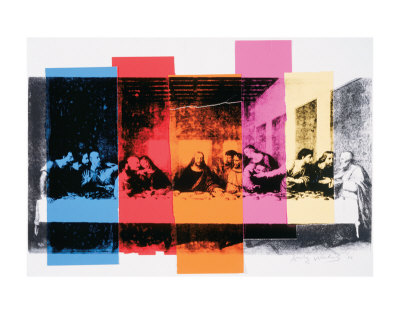
I have to wonder if he did not purposely exalt the commercial and secular so that we might better see the naked truth about ourselves and our culture. His juxtaposing a religious message and consumerism in his last works seems to demonstrate this fusion and/or contradiction with which we live. Many of us did not like his work and many of his messages, I suspect, because he pushed up into our faces the artificiality and market-mentality that possesses us. Even Leonardo da Vinci’s LAST SUPPER, has become the stuff of home decoration, with cheap rip-offs but void of true meaning. He took this work and multiplied it over and over again with secular signs added. It was awful— it was our society held up against a mirror.
THE LAST SUPPER (1986)
Many people are surprised to discover that Warhol was a practicing Catholic, although of the Eastern or Byzantine rite. He often went to Mass at Roman Catholic churches. He saw himself as a religious person and personally volunteered at New York homeless shelters. A number of private religious works were discovered in his estate after his death. He went to daily Mass at St. Vincent Ferrer in New York. The pastor reported that he would kneel or sit in the back but rarely came up to the altar for communion for fear of being recognized. It is said that, given some of his art and films, he was afraid to bring scandal upon the Church. One of his brothers stated that he was “really religious” but also intensely “private” about his Catholic faith. The art historian John Richardson in a eulogy noted that he was devout, saying, “To my certain knowledge, he was responsible for at least one conversion. He took considerable pride in financing his nephew’s studies for the priesthood” (Wikepedia).
Here is a copy of the letter of congratulations I sent the archbishop:
October 20, 2010
Most Rev. Donald W. Wuerl (His Eminence Donald Cardinal Wuerl)
Archbishop of Washington
P.O. Box 29260
Washington, DC 20017
Your Eminence,
When you first came to Washington, I remarked to you that your TEACHING OF CHRIST catechism was used by many of us in seminary, not only to learn the basics of faith but to give doctrinal content to our spiritual reflection and prayer. Many of us followed your life and the tasks given to you by the Holy See with prayer that God would give you both strength and courage. Sometimes the jobs you were given were hard and you were placed under great pressure; but you did what needed to be done with obedience and professionalism. You became a bishop and then an archbishop, but throughout you have remained a wonderful model of the priesthood. I watched you on television for years and it was readily apparent that here was a man who was in love with the faith and who was moved by the Holy Spirit to proclaim and teach the truth.
Today we got news of your elevation to the College of Cardinals. I cannot express how delighted I am by this news. Although I am only one of many of your priests, and one of no particular renown, please know that as you accept the responsibilities of this office, you will remain in my daily prayers and Masses. I have always taken very seriously, that while configured to Christ, every priest is also an extension of his bishop. I know that you will continue to do much good for both the local and universal Church, building up the Mystical Body in unity, holiness and peace.
Again, many congratulations and prayers on your behalf,
I thought the following remarks were worthy of a posted dialogue or brief reflection.
GUEST OPINION: Sometimes parents and grandparents lament the choice of a young man to become a priest. Given the stories about abusers and gay clergy, will the heterosexual man find himself the odd man out or one among a brotherhood of normal men who embrace single-hearted love? Parents want grandchildren and worry about his happiness.
FATHER JOE: There is nothing more wonderful than the priesthood. It is worth the greatest sacrifices. The scandals around sexuality are tragic and devastating to the Church’s reputation. But there have always been weakness, confusion and sin. We see the same with marriage, especially today when half of all unions end in divorce, often under the grounds of adultery. Scandals should no more prevent men from answering a call to ministry than they should deter good Christian couples from pledging their love to each other within the covenant of marriage.
GUEST OPINION: Many berate “celibacy,” while even clergy are often quiet and/or resentful about their chosen lifestyle. They talk about the Church DEMANDING it instead of about themselves CHOOSING and EMBRACING it. It is a discipline of the Catholic priesthood, but sacrifices might be joyfully pursued and can open all sorts of doors for discipleship. Strangely enough, I have known some who were energetic in the defense of our religion and rigorists about the rules, not because they were on fire with fervor for the faith and their promises, but because they were trying to convince themselves.
FATHER JOE: No sooner do you say something good that you ruin it. Celibate love opens a man to single-hearted love of God and selfless service to the community. You are right that it opens all sorts of doors to responding to God. While a few might be pretentious in living out the demands of priesthood; I would hope that most men do so out of a conviction and excitement about the faith and the part they play in the work of salvation made possible in Christ Jesus.
GUEST OPINION: The man looking at priesthood wants to take care of others, but who will take care of him? A priest friend told me that every ordination homily used to sound like a Mother’s Day sermon. The bishop assured the women that the Church would take care of their boys. Today pension plans are strapped for funds and the Church has reneged on long-term care for elderly and ailing priests. Has the Church broken a trust with these women and their sons?
FATHER JOE: While creative, this writing is also fairly cynical. I understand the frustrations, but we have to be realists about the problems we face today as well. Men do not become priests because we want someone to take care of us. We become priests because the wondrous love of God has called us as caregivers for the salvation of souls. We want to make Christ’s sacrifice present and to be the dispensers of his sacraments, particularly the Eucharist. Empowered to forgive sins, we seek to bring divine mercy to our fellow men and women. When a man is ordained for the altar he is configured to participate in the one priesthood of Christ. He ministers, not in his own name, but as a representative of Christ and his Church. Priests are commissioned by Christ and authorized to function as extensions of their bishops. Instead of seeing tension between the shepherds, we should acknowledge the ministry of the Church as a whole and the unity that exists between her ministers. Mistakes might be made regarding practical matters, but the grace of God remains with his Mystical Body. The Church is still One, Holy, Catholic and Apostolic. The Holy Spirit safeguards the truth of the Gospel and empowers the weakest of men to teach and pass on the faith and morals revealed by God. Every priest is a servant or slave of the Gospel. We do not live for ourselves, but for God and others. When our lives are used up, we should echo Luke 17:10, “When you have done all you have been commanded, say, ‘We are unprofitable servants; we have done what we were obliged to do.’”
GUEST OPINION:
The priest has no spouse or children to rely upon. Canon law says that the relationship of a bishop to his priests should be that of a father to a son. Is that always the case, especially when priests make mistakes, get in trouble, or just face sickness? It seems that legal expediencies and financial threats can quickly cause a vast divide. We forgive everyone, except our own.
We may have to rewrite the parable of the prodigal son. When the prodigal comes home, his father refuses to meet him and sends out a lawyer who tells him that he has severed his ties and must go his own way. Indeed, he has been disowned and can no longer be called his son. “You are laicized and maybe even excommunicated.” The elder son hears that there is a commotion and confronts the father. His father seemingly has amnesia about ever knowing the prodigal. Regardless, anything this person did could not possibly be his fault or connected to him. Unfortunately, there is more bad news because the farm is failing and the inheritance that the elder son expected will now have to go to the lawyers for legal expenses. “You face ever escalating expectations and demands for funds, reprimand for speaking too honestly and forcefully about moral issues from the pulpit, and may face a retirement, not in a priests’ home, but as a ward of the state.”
FATHER JOE:
The guest opinion writer would normally be regarded as quite orthodox. Concerned about the priesthood, he is wrestling over certain issues. I must acknowledge that I deleted a few points of the opinion above because of coherence and my own personal preferences about the nature of this blog. It is for this reason that my response seems to go beyond the perameters of the opinion piece.
A priest prays for his bishop every day in the Mass and the Liturgy of the Hours. Most bishops are good shepherds of the Church and seek to support their brother priests. While there is a fatherly relationship in authority, there is also a brotherly affinity in love and service. The positing of an adversarial relationship is perverse and counter to Catholic ecclesiology. Priests are men under authority. In days gone by and in the present, they go where they are sent and do the work they are charged to do. The promise or vow does not expire when a priest retires. Given the need for clergy, even most retired priests still work hard. Genuine retirement for a priest comes when he closes his eyes for the last time and hears his Master’s voice calling, “Come good and faithful servant.”
It is true that we cannot excuse false teaching, ministerial indolence, or harmful scandal from the clergy. However, neither should the laity ridicule their ministers. God’s people must support their priests and bishops, helping them to become the shepherds we deserve and need. We can witness to one another by example in remaining steadfast in faith and true to our state of life.
Good bishops and priests love the people they serve. Do the people in the pews always love their priests? Are they appreciative of all the personal sacrifices these men make so that we might share the Eucharist and have our sins forgiven? Do we take account of the frightful challenges facing our bishops as they strive to insure the unity of faith, preserve our Christian legacy, and dialogue with a combative secular society? We have many good people, but some of our worst enemies are so-called Catholics, themselves. Today, there are critics who have nothing good to say about the Church. They tell jokes about priests and bishops, slandering good men because of a few renegades who played Judas. Particularly sad is how normally pious folk are now joining into the litany of criticism and venomous gossip that was once reserved to the Church’s enemies.
If you would like to share your opinion on this Blog, you can write the message in the ASK A PRIEST comment section or send an email to frjoe2000@yahoo.com. I always take editorial liberties and reserve the right to add a response.
I suppose most Thomists would say that animals do not go to heaven, given that they do not possess immortal souls. This somewhat harsh response is often softened with the assertion that they are not entirely gone in that other animals (like dogs) share their substantial form. Others would say that an animal, like your favorite dog, continues to exist as an idea in the mind of God.
C.S. Lewis remarked that canine loyalty and affection oftentimes put human fidelity and friendship to shame. Because of this he thought that maybe dogs would be allowed to join their masters in heaven. Critics contend that this is just another instance of over-blown English sentimentality.
Why would a priest waste his time talking to people about the fate of dead animals? Well, to be honest, it immediately leads to their views about life after death in general. That is more properly my concern. Animals are often the first reminders to us, usually as children when we have lost a pet, that everything that lives in this world will eventually die. We are mortal. We share our physicality with the other earthly creatures around us. Some, like dogs (and maybe cats), give us great comfort and companionship. They matter to us and so the question arises, is this all there is? Will we see them again? Can we find solace in knowing that all we cherish as good in creation will be reflected back to us in the beatific vision of the Creator?
This post is in response to inquiries about people’s pet dogs and the question as to whether they would be given entry into heaven. I would move the gravity to stress human immortality and our hope for heaven. Animal substantial forms would continue to exist as paradigms in the divine mind. Anything more would be up to God’s mysterious providence and I would not presume to give an answer where the Church has not. Others are free to speculate, but we will not know anything more for sure until or if we find ourselves among the saints.
It is possible that my view would make some angry with me but I am not mean-spirited. Others come down on the side of continued existence of animals because these creatures are a part of our affection and shared existence in this world and thus, the argument goes, they would add to our happiness in the next.
Certain animal apologists cite Scripture and argue for a literal new earth. Some ridicule the whole notion of an afterlife, for anyone or anything. Others agree with me that the stress has to be upon the beatific vision and how we (people) are made for God.
I would not worry much about the fate of animals after they die. If we love animals we should do what we can now to protect them from abuse and suffering. We live in a world where many species are rapidly becoming extinct.
Further, some may err by the sin of presumption about their own salvation. Are you sure that you are going to heaven? Speaking for myself, I have faith in Christ and try to be a faithful disciple in the Church. I worship God and seek to serve him through my charity and sacrifices for others. However, if people forget God, discount obedience to the commandments, and hate their fellow man… well, they may be in for a terrible surprise!
In any case, there is a growing concensus that the outer circle of hell is patroled by cats. (Yes, that is a joke!)
Muslim cleric Sheikh Maulana Abu Sayeed tells a reporter on THE SAMOSA website:
“It is not an aggression, it is not an assault, it is not some kind of jumping on somebody’s individual right. Because when they got married, the understanding was that sexual intercourse was part of the marriage, so there cannot be anything against sex in marriage. Of course, if it happened without her desire, that is no good, that is not desirable. But that man can be disciplined and can be reprimanded.”
We as Christians often speak about our beliefs and our witness as signs of contradiction on behalf of the Gospel. Where the Judeo-Christian faith once heavily informed Western culture, there is today increasing tension and conflict. Scandal has made the situation even more critical, not only the past presence of predators among certain clergy but the passivity of many of the laity toward deviant lifestyles and the mass destruction of the unborn. However, although individual Catholics fail to be everything they are supposed to be, the Church stands for the dignity of the person and for justice. More aberrational and sometimes in conflict with our views from another angle is the rise of Islam in our society. The tendency toward religious relativism is hard-pressed to sustain itself in light of a religion where many still espouse forced conversions and the subjugation of women. As one secular critic remarked, “In light of Muslim rigidity, maybe we did not have it so bad under the Church and the Pope?” I would contend that the best of our values and the most objective truths about things are gifts from the Church and developments from the Good News of Christ. We should be careful not to stereotype religions and their adherents, but there should also be a critical honesty in reference to them.
This morning there was a MSNBC headline which brought this point home: “U.K. cleric: Rape is impossible within marriage.” I can imagine some readers looking at this and immediately asserting about the danger of Islam, “I told you so!” The topic itself is a difficult one to discuss. Over the years I have had to counsel women who were assaulted. Many think it is all about sex. Actually, it is more about violence and wrongfully asserting power over another. Such crimes are extremely serious and should not be taken lightly. Many women take years to heal and some scars may well be permanent. It is a sin that might leave bruises, but more than this, it wounds a person’s soul and destroys trust. It is also a very prevalent crime, often unreported.
Given the many sexually laden influences around us and massive promiscuity, it is often hard or impossible to prove that such encounters were not consensual. When purity was more of a premium, the righteous anger and justice of society against the violation of a virgin and another’s wife was swift and severe. Today, it is suggested that a third of teenage girls under 18 have endured attempted date rapes. Forgive me for a moment more, as my mind frequently wanders, but I also recall a situation where a diminutive young man was ridiculed for bringing up charges against a woman for raping him. He became the butt for all sorts of jokes. As one sick person remarked, “Men might be rapists, but outside of gay sex, men cannot be raped.” I would categorize such a critic as “sick” because he can envision a man as an abuser but not as a victim. Such a person is very dangerous.
Looking at the news article today, I suspect there are many other “dangerous’ people as well.
The Imam in question is not a wildcard or a rare fanatic. Sheikh Maulana Abu Sayeed is the president of the Islamic Sharia Council. He is a leading Muslim cleric in London. We are often told that we have nothing to fear from the “real” Islam, well the rape of human beings is pretty serious and word games make it no less so. The controversy is simple. Speaking as a teacher of his faith, he argues that it is impossible for a husband to rape his wife. Consequently, he says that the husband should never be prosecuted by law for raping his wife. The most we can request, he continues, is that the husband ask her forgiveness for any roughness. He concludes that should be enough. He is right that “sex is part of marriage,” but as I said earlier, this is a crime of violence. He explains on the Samosa website, “Maybe aggression, maybe indecent activity… Because when they got married, the understanding was that sexual intercourse was part of the marriage, so there cannot be anything against sex in marriage. Of course, if it happened without her desire, that is no good, that is not desirable.” He qualifies his remarks, but take note of the use of “maybe.” There is NO MAYBE about it. He does not believe a husband can rape his wife— period. He would have it that women should have no recourse to the authorities for justice and protection!
Illegal in Britain since 1991, this basic protection for married women would probably be stripped away by Islam. Proof of such an eventuality is in how Islamic countries so often treat their women. We have read the stories. Apologists would say that we do not understand and that they are isolated incidents. But the fact is that the problem is systemic and that even one such tragedy is too many. Women, married are not, are not property but persons with a sacred dignity, worth and calling. Husbands and wives are helpmates and companions. While they have different roles in the home, there is never an excuse for brutality or for oppression. Christians may view the husband and father as the head of the home but the wife is the loving heart. That heart must always be treated with respect and gentleness. They give each other to one another. They belong together. They are as the Scriptures remind us, one flesh. One commentor observed, “A religion which permits multiple wives and utterly subjugates them under the husband’s authority is jarring to our culture but also to the sensibilities of Christians.”
The cleric continued, that if the husband “does something against her wish or in a bad time,” he “may be disciplined, and he may be made to ask forgiveness. That should be enough.” Again, look at how carefully he couches his language. The conditional “may” is used again and again. These are hesitant allowances, but really he is giving up nothing about his view.
He is really saying that husbands have a right to rape their wives, but afterwards, if they feel like it, they can say they are sorry. Maybe they can give them flowers? Of course, they can rape them again tomorrow, and do so with impunity. But you wait and see, there will soon be people defending the cleric and brow-beating “intolerant” secularists and infidel Christians for criticizing him, the Koran and Islam.
Islam is a religion of the LAW. What the cleric is giving us is a legal definition and interpretation of rape under Muslim law. He told The Independent, “In Islamic sharia, rape is adultery by force. So long as the woman is his wife, it cannot be termed as rape. It is reprehensible, but we do not call it rape.” At least he calls it “reprehensible,” but still it is regarded as not something that can be prosecuted.
Although I am increasingly tempted toward cynicism, I am still hopeful that we will hear sane voices from Islam, Christianity and the secular world about this question.
Out of curiosity, I went to DICTIONARY.COM and looked up the definition of rape. The first entry reads: “the unlawful compelling of a woman through physical force or duress to have sexual intercourse.” A secondary entry omitted the reference to gender. I would elaborate that it also refers to a lack of consent. Husbands and wives should want to share the marital act, but sometimes because of the spacing of children, fatigue and illness, there should be a measure of restraint and understanding. The marital act is a duty of their state and hopefully a joy open to the generation of new human life. Respecting human dignity, consent needs to be present.
Apart from the question of married couples, it should be added that some like children and those mentally challenged need to be protected because they cannot lawfully give consent and get married.
About three years ago I wrote a post on another blog entitled, “XTC Dear God, Is It Blasphemous?” It spurred an interesting discussion and a number of non-believers took part. Given that the topic of atheism and faith is still very much in the news, and probably will continue as such for the foreseeable future, I thought I would repost the information here. The initial post was quite short and included a third-party video which employed the song in question:
XTC DEAR GOD, IS IT BLASPHEMOUS?
Dear God by the Musical Group XTC
Is this song blasphemous?
I have heard that it is the atheist’s song.
It may be that our own failure to reflect the divine presence has brought this angst upon us.
The song calls upon God and yet the singer says he cannot believe in him. It is as if he is so angry that he wants to hurt God.
What do you all think?
My reckoning is that it is a musical way of asking an old question, “How can a good God allow evil?”
There is so much sickness and suffering in the world. We endure natural calamities and the terror of men.
The Christian answer is that disharmony was brought into the world by human sin.
We contend that while Christ is victorious over sin and death and the war is won; nevertheless, these dark realities are not yet undone.
While we still experience pain and death, we know solidarity with God’s Son, and appreciate that this world of sorrow is passing away.
NOTE: Notice who is portrayed as Satan by the slide presentation…funny, but definitely not nice.
After many comments, here is an interchange between an atheist and myself:
GIL: Much of the motivation for all this writing, stems from the believers’ (mostly Christian) propensity to transform logic as secularists understand it, into an imaginative litany of excuses and alibis for the inconsistencies, errors and omissions of religion, the Bible, and other Christian dogma, in the light of scientific information acquired over the last half-a-millenium. The scientific evidence has gradually eroded the underpinnings of the Christian view of the cosmos, and as a result, they have responded with increasingly convoluted apologias for these shortcomings, necessitating more explanations from scientists and other secularists in an ever escalating spiral of explanation and rebuttal.
FATHER JOE: The motivation of this post is to speak about the Christian kerygma against the backdrop of modern atheism. It may be true that fundamentalists often posit the argument for blind faith over reason; but such is not the Catholic perspective. Indeed, it sometimes seems that secularists are themselves void of the very logic that they fault Christians for contorting. The language of faith is different from that of science. There are many roads that one may take to the truth. Elements of the truth might be better viewed through the respective prism of religion, philosophy or science. The truths of faith are often discerned through parable and allegory; however, this should not be construed as “an imaginative litany of excuses” or “alibis for the inconsistencies.” An old cliché comes to mind, “The Bible teaches us how to go to heaven, not how the heavens go.”
GIL: However, the millions of words generated by the capable defenders of Atheism, Agnosticism, and other non-religious viewpoints, fascinating as they may be, in a way, may all be only superfluous dressing on the delicious pastry of skepticism. In my opinion, the best (and really only necessary) argument for the nonexistence of God was arrived at two milleniums ago by the great stoic philosopher Epicurus, who disposed of the idea of God in a mere forty-five words, although these are probably not the actual words that he had used. Since, as with many ancient writers, we have to depend on later admirers and students for knowledge about their ideas, and the few extant examples of Epicurus’ own letters are fragmentary, the “riddle” is stated in a phraseology that was probably authored by someone else.
FATHER JOE: I am not sure what “scientific evidence” has undermined the Christian view of creation. I would not expect that we would find God through the eye-piece of a telescope. However, when I have studied the order and majesty of the universe, I have been filled with awe and my faith has been refueled. My late deacon friend was a top-notch scientist, and he saw no contradiction between his secular and spiritual professions. I will allow the contention that sometimes authorities are not entirely honest; however, such a lack of integrity afflicts both believers and the secular scoffers.
It is peculiar, at least to my mind, that anyone would regard the defenders of nothing or atheism or skepticism as a “delicious pastry.” It would seem to me that there is nothing on their plate, either to please the taste buds or to fill the stomach. Indeed, what they generate are polemics for despair.
GIL:
But regardless of the authenticity of its grammatical structure, as it is most often presented, (although it has never been found among Epicurus’ writings in that particular form) it asks and says:
Is God willing to prevent evil, but not able? Then he is not omnipotent.
Is he able, but not willing? Then he is malevolent.
Is he both able and willing? Then whence cometh evil?
Is he neither able nor willing? Then why call him God?
FATHER JOE:
While I run the danger of being rude, I suspect what we merely see in the last comment is an overly erudite but simplistic assertion that the riddle of Epicurus resolves the argument at hand in favor of atheism.
In Catholic circles, this is not known so much as the first postulate of atheism as it is an early rendition of the problem of evil. We should note that while there was little of true divinity about them, Epicurus believed in the existence of gods. Epicurus distanced himself from the concept of an all-powerful God and judged the gods as unconcerned about men and creation. The riddle itself emerges in the writings of a Christian apologist, Lactantius. He essentially echoed the Neo-Platonist argument in favor of theism over atomist materialism.
GIL:
In James A. Haught’s book 2000 Years of Disbelief, Haught rewrites or “requotes” Epicurus as saying more prosaically, “Either God wants to abolish evil, and cannot; or he can, but does not want to. If he wants to, but cannot, he is impotent. If he can, but does not want to, he is wicked. If God can abolish evil, and God really wants to do it, why is there evil in the world?”
Some experts claim that this argument is “a reductio ad absurdum of the premises” and not a riddle or paradox at all, but when I tried to research and understand the meaning of a reductio ad absurdum of the premises, my head began to ache and I thought I’d try my own metaphor instead.
As I see it, solutions to the riddle of Epicurus are similar to someone telling me that they own a simple three-dimensional solid object that simultaneously possesses all the qualities of a sphere, a cube and a regular pyramid. One does not need a doctorate in mathematics, or even to have had a course in solid geometry to understand that an object cannot possess mutually exclusive attributes. Like oxymorons, they define themselves out of existence.
FATHER JOE:
The critic fails to appreciate that much of what we know about an infinite and all-powerful God is through analogies that fall short. God cannot be reduced to mathematics or geometry. Such a god that is ridiculed in arguments of this sort is not really God at all. Christians speak of a Trinity: three divine persons but one divine nature. This is doctrine but no one really understands it. Augustine and Thomas would use the analogy of the mind or soul to speak about it. The Father knows himself and generates from all eternity the Son. There is infinite goodwill (Love) between the Father and Son, generating from all eternity the Holy Spirit. Taken too far, the analogy falls apart. But it still speaks truth. God is complete in himself. He is a perfect Spirit. He is the divine “esse” or existence itself and the source for all created beings. He is the Unmoved Mover. He has no parts and is changeless. He creates out of nothing and stands outside of time. And yet, the Second Person of the Trinity becomes a man, dies on the Cross and rises from the dead. Philosophical proofs might bring one to an awareness of God’s existence, but divine positive revelation and religion bring us into a personal and corporate relationship with him. One teaches, albeit poorly, “what” God is and the other “who” he is. True religion gives substance to that which we discover by natural reason.
The argument of Epicurus is laid out plainly enough in 2000 Years of Disbelief by James Haught:
“Either God wants to abolish evil, and cannot; or he can, but does not want to.”
“If he wants to, but cannot, he is impotent.”
“If he can, but does not want to, he is wicked.”
“If God can abolish evil, and God really wants to do it, why is there evil in the world?”
There seems at first glance to be a serious conundrum. If we were to accept these statements in an unqualified manner, then a logical contradiction appears. By definition, God must be both omnipotent and omnibenevolent. Given the fact of evil, this reasoning would back the theist into a corner. A deity (as understood by Christianity) that is either impotent or wicked is impossible. The problem is compounded when we add the element of divine omniscience.
Obviously an all-good God is opposed to evil. Would not such a God desire to abolish evil? The answer is yes, and in the course of time, his providence in this regard will be accomplished. Given that we are finite and only see a small temporal and spatial portion of reality, we are handicapped in any appraisal of the perimeters of this question. The problem of evil requires that we envision all of history and the final consummation. Indeed, given the angelic hosts, this question has a cosmic dimension that goes beyond material creation (where there may be duration but not time as such). Such a solution might be logically adequate but the problem of evil and suffering remains a mystery because we are intensely self-preoccupied. There is no evil that hurts as terribly as that which faces us right now in the present moment. A couple who loses a child cannot be consoled. The patient suffering pain in a hospital bed cries out for morphine, wanting the pain to stop, even if the treatment will kill him. The mother watching her children starve and sicken cannot be cheered with platitudes. Realities like these do not undermine the truth of Christian argument, but they do dampen or nullify our emotional and personal ability to be satisfied by them.
God is able to prevent evil.
However, the presence of evil is not an immediate sign that God is malevolent.
GIL:
Whether or not you understand what a reductio ad absurdum of the premises is, it is self-evident that there are no square circles . . . nor are there any gods as defined by the god-fearing. Either way, Epicurus came to the inexorable conclusion that the existence of god, as most Abrahamic religions describe him, is impossible.
But believers, most notably Christians, are not impressed with what appears to Atheists to be unassailable logic, and employing a mysterious logic of their own, have devoted countless hours, energy, and mental and semantic manipulation in attempting to refute, obfuscate and deny the undeniable conclusion of the “Epicurean paradox,” as it is sometimes called. In so doing, they have created the branch of theology called “theodicy” which despite its partial aural resemblance to “idiocy” is not necessarily etymologically related to that noble enterprise.
In an interesting statement (quoted form the Catholic Encyclopedia)* Catholics display an amazing degree of chutzpa mingled with self-contradiction, in calling theodicy “a science” while describing theology as the “knowledge of God as drawn from the sources of supernatural revelation” (Thereby admitting to the failure of theology.)
FATHER JOE:
There is nothing about the definition of theodicy or theology which admits to failure. The critic makes silly assertions but offers no sensible or logical argument.
Epicurus, himself, lived at a time prior to the incarnation and had not been exposed to the God who would reveal himself in human history. God created man in his own image and likeness. Of all creation, men and women could respond to God, not with blind animal instinct but with deep awareness and love. There was a terrible cost with such freedom and power for self-determination. God’s will would permit evil but would not remain frozen regarding it. This is why God is not a monster and why this argument against his existence fails. He intervenes in human history. What he would not prevent, he comes to heal and to forgive. He comes to make right the wrongs we committed. While sin, suffering and death have not been undone, they have been conquered. The Greatest Good, which nothing greater can be conceived and which by necessity must exist, will prevail over evil.
The “reduction to absurdity” argument is dependent upon the accuracy of the premises. If any of the assertions lack consistency or wholeness of meaning, the conclusion would be invalid. It seeks to prove a contention by deriving an absurdity from its denial. I am reminded of the omnipotence paradox. “Given that God can do anything and is omnipotent, could God create a rock too heavy for anyone to lift?” If God could then he would not seem to be omnipotent at all. If he could not, the same conclusion would be applied. In truth, there is an inner contradiction to the reasoning. God can doing anything except violate his own nature, identity and will. God is an objective reality possessing the perfections of attributes in which we participate in a lesser manner. Similarly, Epicurus’ understanding of omnipotence, evil and goodness might need a re-evaluation. What God directly wills is not evil, no matter what name we might give it. This does not mean that evil is an illusion, only that there is some value we might not immediately perceive in permitting it, like free will and a contingent good. God is man’s judge, not the other way around. We can abstract from finite things the concept of the infinite. We know imperfection and thus attribute to God the perfection we do not experience. However, the finite can never exhaust or fully comprehend the infinite. There will always be mystery.
Just as he might contend that believers are bias in their reasoning, the atheist critic is also prejudiced in that he assumes he has proven what he set out to prove. I suppose he thinks that this brings under his ridicule the “Abrahamic religions” of Judaism, Islam and Christianity. While I cannot speak to the other two monotheistic faiths, the essential message of Christianity is a resolution of the problem of sin and evil. Christ redeems a people and heals the breach caused by human iniquity. The lamentation of Job is given its final resolution and response in the God who made our pain his own. He who was higher over us than we are over ants has made himself an ant for us. Such is not a sign of malice but a sacrificial love that is unmerited and unfathomable. Now the Father finally receives the love and fidelity he deserves. We join ourselves with Jesus so that there might be one eternal Lamb which surrenders himself to the Father. The riddle of Epicurus speaks against the god of the deists who like a watch-maker abandons his creation. False gods do not exist. But the God of Christian faith keeps us in existence from every moment and makes possible our re-creation in Jesus Christ.
GIL:
Gottfried Wilhelm Leibniz is alleged to have coined the term in a philosophical treatise ”The Theodicee,” published in 1710, while he was engaged in the practice of “apologetics, . . . a branch of theology devoted to the defense of the divine origin and authority of Christianity.” By doing this he made inroads into the nefarious practice of combining theology and philosophy, thereby contributing to the corruption of both, although it is difficult to conceive of the corruption of theology. I say this because in my opinion, theology (like Seinfeld’s TV show) has as the object of its study . . . “nothing.” Imagine; thousands of people, many with doctorates, scouring the earth, its libraries, and all of the vast repositories of human knowledge, and every one of them is engaged in what they believe and proclaim to be a scientific study; to which I add . . . of nothing.
For thousands of years, believers and apologists, have attempted to convince Atheists and other freethinkers, beginning with Epicurus, that there really is no problem with the existence of a benevolent god in a world full of plagues, tsunamis, (and in modern times) Holocausts, and educated professionals, who fly fuel-laden commercial jetliners into hundred-story skyscrapers.
FATHER JOE:
The critic here really has no argument of his own. All he can do is offer empty ridicule. He calls theodicy “idiocy” because he gives no value to theological reflection. He displays ignorance at many stages of his response, proving I suppose that schools give fools doctorates these days if they can parrot their teachers and pay tuition bills. The word “science” is used in regard to theology and he mocks such a label, evidently unaware that it traditionally signified any field or branch of knowledge. He speaks about Leibniz as a progenitor in the combination of theology and philosophy and yet Augustine much earlier used Neo-Platonism and Aquinas employed Aristotelianism. This represented no corruption but truth building upon truth. He impugns such work as the vast studying of “nothing.” Again, he is very presumptuous, borrowing information he does not understand and criticizing that which by his own admission he deems as unworthy of study. Such attitudes make for very dull-witted minds although they will sometimes masquerade as informed, plagiarizing those with bigger heads and thumbing excitedly through thesauruses.
While he contends that atheists and believers have been at loggerheads for thousands of years; the history of the matter is that most arguments have been among theists. Atheism as we know it today is a fairly modern animal. Epicurus would not be counted among them although the mythic deities of his age and culture were all too fallible and often more reprehensible in character than many men.
GIL:
For me, the problem came to light, again, in an after-dinner conversation recently with a Christian schoolteacher who described the wonderful experience of having had a student discover that some good might have resulted from the Holocaust. The student had come to the conclusion that the reason the concentration-camp inmates did not rebel against their captors, was that the energy they would have needed for such a daunting undertaking was consumed by their desperate daily obsession with food, water and survival. They did not have the luxury of exploring solutions to problems like rebellion. The teacher described this student’s enlightenment as an “epiphany” and said that it demonstrated that “some good had come out of the death of six million Jews, in the fact that a high-school kid in South Florida realized how lucky he was to not have to spend his entire waking life in the pursuit of safety, food and water!”
I protested that this was another example of apologetics, whereby the apologetic stretch for the identification of “good” in the face of unimaginable horror, is analogous to claiming that some good was derived from the San Francisco earthquake in April of 1906 because in a few places near the sea it formed cliffs for affluent twentieth-century Californians to build homes with an ocean view.
FATHER JOE: The aside about a Christian school teacher and a partial apologia or rationalization of the Holocaust is aberrant to this discussion and ridiculous. However, can good come from terrible evil? The legacy of the early Christian martyrs is a point in favor. Their blood watered the plant that was the early Church. We are moved and inspired by those who witness for the Gospel as signs of contradiction in the world. As for the Jewish Holocaust, we should never forget this terrible evil and the hatred and apathy of men that made it possible. There is nothing we can do to change what happened. However, we can work for a better world where there is understanding and toleration. The reason why there is a museum to this mass murder in Washington, DC, is so that these deaths will not be in vain. God did not intervene and stop it but the believer trusts that after our short sojourn in this world, there is an eternity that awaits us. This world with our frightful freedom prepares us for what is to come. Christians trust that even in the present, because of the passion of Jesus, God is in solidarity with the suffering, the oppressed and the poor. God will reward faithfulness and punish disobedience, particularly the failure to love.
GIL:
Of course, it is always possible to redefine terms, restructure ideas and waffle on descriptive categories, as was done by one of the most eminent of biologists and free-thinkers, who unfortunately was also an apologist of sorts. Self-described “Jewish agnostic” Stephen Jay Gould, in arguing for the peaceful co-existence of science and religion, created his concept of non-overlapping magisteria, NOMA, in which each magisterium was a “domain of teaching authority,” and by so doing, in 1999, he arbitrarily established the existence of two universes, despite the fact that as a scientist he was obligated to live and study in only one.
He wrote, “. . . I have great respect for religion, and . . . I believe, with all my heart, in a respectful, even loving, concordat between our magisteria—the NOMA concept.”
FATHER JOE: Stephen Jay Gould writes about a collaboration of believers and secularists. The critic contends that such falsely creates multiple universes where there is only one. (I guess he is not familiar with string theory and possible overlapping universes, but this takes us to another subject.) He fails to fathom that there may be many roads to approach some of the same truths and values. The Church focuses upon natural law as a means by which believers and non-believers might hold similar views about human dignity, behavior and life. He sees religion and God as a joke, not even as something which enriches human society and culture. His way is no way at all. It leads to persecution of believers and the marginalization of faith and values.
GIL: So it is possible not only for theologians and philosophers to play the game of “apologetics,” apparently even prominent scientists are not above this attempt to circumvent logic and common sense in an effort to placate the gods. But over two thousand years ago, Epicurus, in a mere few sentences, refuted for all time, the pious, misguided meanderings of theologians, philosophers, scientists and ordinary people, . . . including my erstwhile dinner companion. . . . Yet none of them have the slightest clue that they are attempting to define “truth” as ideas that are in accord with their own distorted reality.
*The Catholic Encyclopedia also referred to today as the Old Catholic Encyclopedia, is an English-language encyclopedia published by The Encyclopedia Press. It was designed to give “authoritative information on the entire cycle of Catholic interests, action and doctrine.”
FATHER JOE:
The distortion of reality belongs to the critic here. It is no wonder that such a closed-minded person cannot begin to appreciate the complexity of the question about God’s existence and the problem of pain. It amazes me that while we cannot even make a basic seed from scratch, that we would presume in two or three short sentences to refute the existence of the very Creator who ordered the universe and gave us the seeds we plant. There is one word that summarizes the feigned mastery and pathetic argument of the critic here: HUBRIS.
God could have created a world void of evil. The Church contends that God allows evil as a result of the fall and as the price for human free will. He could have made us like ants or robots. Christians also believe that divine providence will ultimately prevail. This challenges us to acknowledge that we only see a small part of the whole situation. God does not view creation in a sequential fashion, but all at one time. As all powerful, he is above it all. The very fact that God can make right what we see as so many wrongs is a demonstration of his authority.
Christians are realists in regard to the presence of evil in the world. God’s passive or permissive will tolerates and even uses quantitatively limited evils for long-term eventual goods. There is no denying the possibility and the subsequent occurrence of evil; however, God does not directly will evil in itself. Christianity gives great weight to divine providence but it would not be catalogued as a form of determinism or fate. It is precisely because God desires for us to know the greatest good of love that he has given us free will. Divine omnipotence is not compromised by the insertion of such freedom into the human equation even though it includes potency for evil or sin. There is also the potential for faithfulness. Indeed, the divine response to iniquity is the passion and death of Christ. The absurdity of the Greeks (Epicurus) becomes the wisdom of God. The God that they cannot fathom to exist, by the implementation of his almighty power, traverses the infinite distance between the Creator and the creature in becoming man and subjects himself to the punishment of suffering and death which we incurred by sin. In the course of salvation history, God in Jesus Christ conquers evil and the devil. Goodness itself shines all the brighter against the backdrop of evil. We see this in the courageous witness of martyrs and saints. Indeed, suffering or sharing in Christ’s Cross brings us into a closer relationship or affinity with God. The Christian resolution to the mystery of evil and suffering is our Lord’s solidarity with us in the dark things of life. He gives them a transformative meaning and does not abandon us as orphans. We are promised a share in his risen and glorified life.
Catholic thought about evil or sin and suffering in the world is heavily informed by an Augustinian theodicy. Reading Genesis, it is apparent that what God created was good but sin came into the world because of the primordial rebellion of our first parents. Suffering from a fallen nature, moral evil is perpetuated by human beings who have distanced themselves from God and have disobeyed him. This fall also brought about a disharmony in the world or natural evil. Evil is either a deviation from the path given us by God or a privation of goodness. Evil does not exist in itself. While God is all-good, there is no such thing as an all-evil entity. The devil is a fallen creature but not the parallel opposite extreme of God. Thomas Aquinas would echo Augustine and speak of metaphysical, moral and physical evil. There are some things we regard as natural evils only because human beings are involved, like living next door to an active volcano or caught in a raging fire storm or flood. Evil is thus seen as a relational concept. Thomas would write that the created universe would be less perfect as a whole if it contained no evil. The example is given of the wood which gives warmth as it is consumed by the fire. Similarly, we eat other creatures to survive. However, the evil of sin is permitted but finds its source in men and not in God. It is the result of the abuse of free will.
Christian anthropology will sometimes speculate about what might have been had man not fallen. Perhaps the final consummation would have taken place at the beginning of human history instead of at the end? Maybe death would have been like our casual walking through a doorway from one room to another, not true death at all? But men sought to return to the bestial, denying their high calling. Sin and death entered the world. God brings good from our evil. He does not abandon us. The priest or deacon sings in the Exultet on Holy Saturday, “O happy fault, O necessary sin of Adam, which gained for us so great a Redeemer!”
Just as Jeremiah images the blind and lame as among the throng returning from exile, Jesus pays particular attention to the crippled and blind. The Gospel scene in Mk 10:46-52 is very touching and telling. Bartimaeus is a blind beggar who has heard about the miraculous deeds of Jesus. Now that Jesus is nearby, he calls out to him. People literally scold him to keep quiet. He shouts all the louder. The crowd did not want to hear him. Maybe they were even ashamed of his presence? Nevertheless, while their ears and probably their hearts are closed to the beggar, Jesus hears his cry. Note what Bartimaeus says, “Son of David, have pity on me!” He is acknowledging that Jesus is a descendant of David and from his royal line is to come the Messiah and Savior of Israel. The beggar cries for mercy, but attached to his plea is a profession of faith in our Lord. When Jesus calls him over, the sentiment of the throng seems to change. There is a total about-face. “You have nothing whatever to fear from him! Get up! He is calling you!” There is a two-fold action. This remains an element of discipleship. We cry out for mercy and God hears our prayer. We seek God and he seeks us out. Note what Bartimaeus does. He throws aside his cloak, jumps up, and comes to Jesus. As a blind beggar he probably had little else besides his one cloak. No doubt he slept and sat upon it, lest it be blown away or stolen. Instead of grasping it tightly around him while walking to Jesus, he throws it aside. He no longer needs what is literally his security blanket. He will be able to find it afterwards because he believes that he shall soon see. He wastes no time and jumps up. Such should be our disposition when God calls us. When he reaches Jesus, our Lord does something a bit peculiar, no doubt for the crowd. He asks, “What do you want me to do for you?” We might ask, is it not obvious? The beggar responds, “I want to see.” What else might he ask? Was Jesus hoping for another answer? In any case, the gift of sight is given him. No more mention is made of the cloak. The beggar’s old life has been swept away. He sees, not only with physical eyes, but with eyes of faith. Jesus tells him, “Be on your way! Your faith has healed you.” Here is where we get a hint as to what Jesus wanted to hear from the beggar. His eyes open, Bartimaeus follows him up the road. He becomes one of the many followers or disciples of Jesus. Can you imagine what laughter would have resulted had he answered Jesus’ question, “I want to be your disciple.” Nevertheless, the result here is the same. Tradition suggests that many of those given restored sight and made able to walk would later be blinded and crippled again in the persecution of the Christian saints. Their little faith that brought healing would blossom into a great faith meriting a share in Christ’s eternal life.
For more such reflections, contact me about getting my book, CHRISTIAN REFLECTIONS.
This is the home of the AWALT PAPERS, the posting of various pieces of wisdom salvaged from the writings, teachings and sermons of the late Msgr. William J. Awalt.
























 We are called to pursue something of a personal discernment in regards to our sinful nature. Look at 1 Corinthians 2:10-16. The selection begins, “The Spirit scrutinizes all matters, even the deep things of God.” It is a wonderful and insightful depiction of the interior life. We as Christians do not simply follow laws in blind obedience. We are called not to go through the motions of faith; quite contrarily, we are to be filled within by God’s Spirit.
 The message which emerges from our Gospel is sometimes quite unsettling. Take for instance Mark 7:1-8;14-15;21-23. Preachers might even be afraid to bring further attention to it because of the possible angry reactions it might evoke. None of us, myself included, like to be reminded of how imperfect, weak, and sinful we are. We create all kinds of barriers in our lives to protect ourselves from this realization. We try earnestly to project images of wholesomeness and sanctity, even when we realize that we have a long way to go.
 Many parishes celebrate “Come Home for Christmas” and “Come Home for Easter” reconciliation services. Of course, Confession is available all year long. Priests delight in being ministers of reconciliation. The Christian regularly needs to examine his conscience and behavior.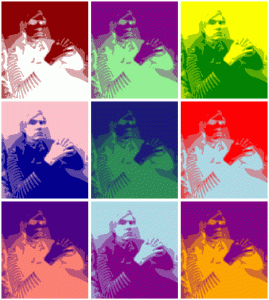


 I suppose most Thomists would say that animals do not go to heaven, given that they do not possess immortal souls. This somewhat harsh response is often softened with the assertion that they are not entirely gone in that other animals (like dogs) share their substantial form. Others would say that an animal, like your favorite dog, continues to exist as an idea in the mind of God.
 Just as Jeremiah images the blind and lame as among the throng returning from exile, Jesus pays particular attention to the crippled and blind. The Gospel scene in Mk 10:46-52 is very touching and telling. Bartimaeus is a blind beggar who has heard about the miraculous deeds of Jesus. Now that Jesus is nearby, he calls out to him. People literally scold him to keep quiet. He shouts all the louder. The crowd did not want to hear him. Maybe they were even ashamed of his presence? Nevertheless, while their ears and probably their hearts are closed to the beggar, Jesus hears his cry. Note what Bartimaeus says, “Son of David, have pity on me!” He is acknowledging that Jesus is a descendant of David and from his royal line is to come the Messiah and Savior of Israel. The beggar cries for mercy, but attached to his plea is a profession of faith in our Lord. When Jesus calls him over, the sentiment of the throng seems to change. There is a total about-face. “You have nothing whatever to fear from him! Get up! He is calling you!” There is a two-fold action. This remains an element of discipleship. We cry out for mercy and God hears our prayer. We seek God and he seeks us out. Note what Bartimaeus does. He throws aside his cloak, jumps up, and comes to Jesus. As a blind beggar he probably had little else besides his one cloak. No doubt he slept and sat upon it, lest it be blown away or stolen. Instead of grasping it tightly around him while walking to Jesus, he throws it aside. He no longer needs what is literally his security blanket. He will be able to find it afterwards because he believes that he shall soon see. He wastes no time and jumps up. Such should be our disposition when God calls us. When he reaches Jesus, our Lord does something a bit peculiar, no doubt for the crowd. He asks, “What do you want me to do for you?” We might ask, is it not obvious? The beggar responds, “I want to see.” What else might he ask? Was Jesus hoping for another answer? In any case, the gift of sight is given him. No more mention is made of the cloak. The beggar’s old life has been swept away. He sees, not only with physical eyes, but with eyes of faith. Jesus tells him, “Be on your way! Your faith has healed you.” Here is where we get a hint as to what Jesus wanted to hear from the beggar. His eyes open, Bartimaeus follows him up the road. He becomes one of the many followers or disciples of Jesus. Can you imagine what laughter would have resulted had he answered Jesus’ question, “I want to be your disciple.” Nevertheless, the result here is the same. Tradition suggests that many of those given restored sight and made able to walk would later be blinded and crippled again in the persecution of the Christian saints. Their little faith that brought healing would blossom into a great faith meriting a share in Christ’s eternal life.



















 Blogger Priest