























Lou writes:
The Letter of Barnabas (as a source before 100 AD) is unfortunately for the Sunday-keeping proponents, an unreliable source. This is not of the “Barnabas” who was the companion of the apostle Paul. This is but a forgery in a futile attempt to bolster the validity of Sunday-keeping, which has NO Biblical authority.
Father Joe writes:
Says who, you? If ignorance were really bliss, you would be in heaven already. Just as some of the Pauline letters in Scripture were written by another hand, this does not make the documents into forgeries according to the criteria of the ancients. It was attributed to Barnabas by Clement of Alexandria, Jerome, Origen, the Codex Sinaiticus, and in later manuscripts. However, the oldest texts are anonymous. We do not know the author’s identity for sure. This is the stance of the Catholic faith regarding this text. The validity of source material in both Sacred Scripture and Sacred Tradition is based not so much upon an author’s identity as it is upon the reception of these documents as expressive of the Church’s abiding faith. Thus, all your citations that dismiss the letter because of “false” authorship can, themselves, be dismissed. Again, it is the antiquity of the document and its revelatory character regarding the early Church that makes it important. It was probably written between 100 AD to 131 AD.
The thrust of the document is not merely “Sunday-keeping” as you call it. The “way of light” and “way of darkness” sections are reminiscent of the DIDACHE. He implements an allegorical means of interpreting the Hebrew Scriptures as opposed to a more radical or literal approach. It is a somewhat tedious polemic against Jewish cultic (worship) practices. His community celebrates Sunday, “the eighth day” (15:8-9). Lou claims that this was the Catholic Church’s “futile attempt to bolster the validity of Sunday-keeping”; however, it was only translated into Latin during the third century. Considered canonical Scripture by many in ancient Egypt, the epistle had little impact upon Rome and the Western Church. It is a legitimate picture of the early Church. Again, Cathy answered your response and did so quite well.
Lou writes:
“The writings of the so-called Apostolic Fathers are, alas! come down to us, for the most part, in a very uncertain condition; partly, because in early times writings were counterfeited, under the name of these venerable men of the church, in order to propagate certain opinions or principles; partly, because those writings which they had really published were adulterated, and especially so to serve a Judao-hierarchical party, which would fain crush the free evangelical spirit. We should here, in the first place, have to name Bamabas, the well-known fellow traveler of St. Paul, if a letter, which was first known in the second century, in the Alexandrian church, under his name, and which bore the inscription of a Catholic epistle, was really his composition. But it is impossible that we should acknowledge this epistle to belong to that Barnabas who was worthy to be the companion of the apostolic labors of St. Paul, and had received his name from the power of his animated discourses in the churches. We find, also, nothing to induce us to believe the author of the Epistle was desirous of being considered Barnabas. But since its spirit and its mode of conception corresponded to the Alexandrian taste, it may have happened, that as the author’s name was unknown, and persons were desirous of giving it authority, a report was spread abroad in Alexandria, that Barnabas was the author.” (History of the Christian Church of the First Three Centuries, pp. 407, 408, Rose’s Trans.)
Father Joe responds:
Cathy uses primary source material and you parrot secondary material. Again, the Catholic Church admits it may not be the companion to St. Paul. So what? Does he even make the claim? Many people have the same name! Just as many authorities claim the hand of John’s disciples in the Johannine writings, why not here in reference to Barnabas?
Note that your so-called authority dismisses all the Apostolic Fathers. This takes care of the debate quite nicely. The ostrich buries his head in the sand.
Lou writes:
“The Epistle of Barnabas was the production of some Jew, who most probably lived in this [the second] century, and whose mean abilities and superstitious attachment to Jewish fables, show, notwithstanding the uprightness of his intentions, that he must have been a very different person from the true Barnabas who was St. Paul’s companion.” (Church History, Vol. 1, p. 113, Maclaine’s Trans.)
Father Joe responds:
You miss the whole point. Using an analogy, the discussion here is about the value of eggs, not about which chicken laid them. Let me say it still again, Rome does not insist that the author of this epistle is St. Barnabas! Since he seems to have some blind spots regarding Jewish practices, he was probably not a Jew as this citation asserts, but a Gentile who was familiar with many Jewish ways.
Lou writes:
“For what is suggested by some of its having been written by that Barnabas who was the friend and companion of St. Paul, the futility of such a notion is easily to be made apparent from the letter itself. Several of the opinions and interpretations of Scripture which it contains, having in them so little, either of truth, or dignity, or force, as to render it impossible that they ever could have proceeded from the pen of a man divinely inspired.” (Historical Commentaries, Century 2, See. 53.)
Father Joe responds:
Many of the great figures of Christian history had a different assessment of the quality of this work. In any case, I will say it once more; it makes no difference if the authorship is not St. Barnabas. The Church has not made any definite claimed it was. Indeed, most authorities, Catholic or otherwise, assert that it cannot be him. But the document stands on its own historical merits.
Lou writes:
“Among the rejected writings must be reckoned also the Acts of Paul, and the so-called Shepherd, and the Apocalypse of Peter, and in addition to these the extant Epistle of Barnabas, and the so-called Teachings of the Apostles.” (Church History, Book III., chap. 25, Sec. 4. The Nicene and Post-Nicene Fathers, Vol. I., p. 156.
Father Joe responds:
The Catholic bishops did indeed REJECT all these writings as canonical Scripture. They are useful in our historical appreciation of the early Church, but they are not “lost” books of the Bible. Do we agree upon this much?
Lou writes:
“The letter still extant, which was known as that of Bamabas, even in the second century, cannot be defended as genuine” (Commentary on Acts, p. 251).
Father Joe responds:
Genuine what? We know it is plenty old. That is all that Cathy is contending. These citations about authorship (stolen from footnotes or editorial notes?) do not address her contention. Cathy wins on this score. The Sunday observance was practiced within the first century of the Christian era!
Filed under: Anti-Catholicism, Apologetics, Sabbath | Leave a comment »

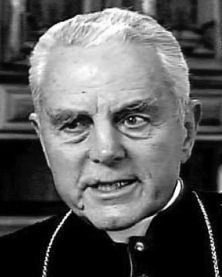
 Pope” and “the Modernist Rome.” Some of their sermons online and various writings go so far as to call counterfeit both the “Novus Ordo” priesthood and the “new” Mass. One writer claimed that since Cardinal Ratzinger was made a bishop under the new ritual that he did not share in the episcopacy and thus could not be a genuine pope. People like that will not want to “pollute” themselves with any association with the rest of us. There is a lot of wishful thinking, but after almost a half-century separation, many of them have gotten used to their independence. Slamming the rest of the Church and slurring the Holy Father, at least in sermons and in routine discourse has become second-nature. They do not seem the least bit afraid that they might be committing blasphemy against the Holy Spirit. Even Bishop Bernard Fellay has lamented this problem. It has become a habit hard or next to impossible to break. They will not reconnect with what they see as the enemy.
 The Body of Christ has yet another meaning and here we are indebted to St. Paul. The union that exists between Christ and his people (since their baptism into Christ by the waters of the sacrament) is identified as the Body of Christ by St. Paul. Looking at 1 Corinthians 12:27, we read: “Now you are Christ’s body, and individually parts of it.” St. Paul refers to the Church as the Body of Christ. He likens all of us, united to Christ and to each other, as in an intimate union. At Baptism, each of us, if you will, becomes a cell in that body and at the same time participating in the life of the whole body with its head, Christ. That union is not a physical union as in nailing two boards together, nor is it a moral union as when people are united as members of the same club or organization. This union of Christ and his members is unique; so much so, that we have to make up a new phrase to help us understand it. We call it the Mystical Body of Christ. All of us are united to Christ and to one another. Christ tried to inform us of this union with the parable of the vine and the branches. As the branch must adhere to the vine to live; we must adhere to Christ. Life must flow through Christ, the vine, to the branches, bringing about the fruit of our lives. St. Paul, back when he was Saul, persecuted the early Christians. Our Lord called out to him, “Saul, Saul, why do you persecute me?” He asked, “Who are you, Lord?” The Lord responded, “I am Jesus the one you are persecuting” (see Acts 9: 4-5 and Acts 22: 7-8). Again, our attention is called to the union between Christ and his people. Christ also said, “Whatever you do to the least of my brethren, you do unto me” (Matthew 25: 40). Modern social concerns tell us to see Christ in the poor, underprivileged and handicapped persons. We see in these references a reality telling us of the union that is likened to the human body. Christ is the head. We are the members. All of us are important. St. Paul says, “Does the hand say to the foot, I have no need of you?” (see 1 Corinthians 12: 15). All of us have our mission in the Church, the gathered-together people with Christ. Each of us has a mission. It may be very different from another’s mission; but, each of us is important. When we say in the Nicene Creed, “I believe in one, holy, catholic and apostolic Church” or in the Apostles’ Creed, “I believe in … the holy catholic Church,” this does not refer only to the hierarchy but to the whole Christ. At Mass, we beseech God, not to look on our sinfulness, but on the faith of the Church. When I hear this, I think of the known and unknown sacrifices being made by missionaries and martyrs, the unseen raising of children, care for the poor and the sick, and the elderly praying with gnarled hands. This Mystical Body has a structure like the human body with its skeleton; otherwise, it would collapse. Our structure is the Pope, bishops, priests and lay people. The union of people is composed of the saints in heaven, the ones who are striving to get to heaven (pilgrim people) and those waiting for perfection so as to be entirely one with Christ. While Jesus has a human body, a resurrected body; now, he also has the Church as his Mystical Body, where we are united spiritually in its members to Christ and to one another. At baptism we became children of God, members of the divine household and family. We are in union with Christ, both when we pray alone and when we worship together.



















 Blogger Priest