• Our Blogger

    Fr. Joseph Jenkins

  • The blog header depicts an important and yet mis-understood New Testament scene, Jesus flogging the money-changers out of the temple. I selected it because the faith that gives us consolation can also make us very uncomfortable. Both Divine Mercy and Divine Justice meet in Jesus. Priests are ministers of reconciliation, but never at the cost of truth. In or out of season, we must be courageous in preaching and living out the Gospel of Life. The title of my blog is a play on words, not Flogger Priest but Blogger Priest.

  • Archives

  • Categories

  • Recent Posts

  • Recent Comments

    Barbara King's avatarBarbara King on Ask a Priest
    Ben Kirk's avatarBen Kirk on Ask a Priest
    Jeremy Kok's avatarJeremy Kok on Ask a Priest
    Barbara's avatarBarbara on Ask a Priest
    forsamuraimarket's avatarforsamuraimarket on Ask a Priest

Praying to Mary

bvm_028QUESTION:  Why do you have to ask Mary to take your prayers to Jesus? Can’t you just go straight to Jesus?

Of course, one can and should address Jesus directly in prayer; however, this does not negate Mary’s role. The question is a good one and possesses some complexity. All of the attributes of mercy and love attributed to Mary find their ultimate source in the Lord. The unity between the Mother and her divine Son is very intimate and unbreakable. Even when we address our prayers to Jesus or show him homage, we are also honoring his Mother and invoking her assistance. Mary rejoices when we come to her Son, no matter what the path. The Dominican priest, Fr. Jelly wrote that in this sense, even the most fundamentalist of Protestants are showing their respect to Mary in their devotion to Christ. Conversely, God is honored when we honor Mary. God loves us to honor Mary as a Father is pleased when his daughter is honored.  Every honor we give to Mary is reflected back to God since we honor her for what He has done for her, with her, and through her. When we honor her, we honor Him. When Catholics address Mary, it is because there is something about her maternal qualities which soothe our souls and remind us of the great company of heaven— the home to which we hope one day to enter. Even in human families, the love and help of parents could just as well come from one parent or the other; but sometimes we want the strength of our fathers and at other times the feminine touch of our mothers. Mary is a creature, not God like her Son, and yet her abiding proximity and union to Christ makes her a fitting figure for our prayers. We reverence her, as we do all the saints, but true worship is addressed to God alone. Otherwise, we would fall into idolatry. Christ is our only mediator (1 Tim. 2:5-6) with the Father, but Mary can intercede (pray for us) with her Son Jesus. Jesus worked his first miracle at her request (Jn. 2:1-12). Just as we can ask other members of the Church on earth to pray for us (1 Tim. 2:1; 2 Tim. 1:3; Phil. 4:22), so too, can we ask members of the Church in heaven to pray for us (Rv. 5:8; 6:9-11; 7:10-12; 8:2-6; Mt. 22:31, 32).

We are also called to imitation of Christ. Did Jesus follow the commandments? Sure. Including the fourth commandment? Yes. Then if Jesus honored Mary his Mother and took her direction seriously, would this commandment be abrogated in heaven? Further, if Mary is given to us as our Spiritual Mother, are we not to pay the same respect to her as he did– imitating Christ even in this? Yes. The honor we give Mary our Spiritual Mother in no way subtracts from the worship we give to God any more than honoring our earthly mother does. In fact, it conforms to God’s holy will, and we who are adopted sons of God honor her whom the Son honored.

How Catholic are You?

We can test to see how badly infected our people are with doubt and faithlessness. Here are some sample questions:

1. Do you believe that deliberately missing Sunday Mass is a mortal sin, as detailed in the precepts of the Church?

2. Do you believe that premarital sex and/or cohabitation is a mortal sin?

3. Do you believe that a Catholic can get married validly outside the Church and how can this be if it is a sacrament?

4. Are you for or against the legal choice for abortion even though the Church calls it the murder of ensouled human beings?

5. Do you believe that the marital act must always be that type of act that is open to mutual self-giving and the generation of new human life or do you favor the use of artificial contraception?

6. The Church teaches that same-sex attraction is a disorder and that its pursuit is a violation of the natural law and is seriously sinful. Do you believe this?

7. Is the Eucharist a symbolic presence using bread and wine, a nostalgic remembrance or the actual Risen Christ (divinity and humanity, body and blood)?

8. Do you ever go to Confession? Do you believe that the priest has the power to forgive sins? Do we really need the priest for this at all?

9. Is the Mass a real sacrifice just as the death and oblation of Jesus on the Cross?

10. Does it really matter what one believes as long as he or she is a good person? Is one Church pretty much as good as another? Is it intolerant to insist that the Catholic Church is the one true Church established directly by Christ?

11. Do you believe that the Pope as Vicar of Christ has universal jurisdiction and is given the gift of infallibility in teaching about faith and morals?

12. Do you pray daily and if so how do you pray? Do you really think someone is listening? Do you remember the various types of prayer?

Prophecies: Malachy, Fatima & Padre Pio

GENUSLILIUM: Father, I have some important questions to ask. My first questions are about false prophets or prophecies. How do I know if they are false, or true?

FATHER JOE: You do not mean true prophets but fortune tellers and soothsayers. I would regard most if not all as false. This does not mean they are or are not sometimes pious people. As for private revelation, the Church does not require you to believe one way or the other. Just stay prepared for the coming of Christ. Either at the end of the world or upon your death, you will meet Jesus. That is for sure!

GENUSLILIUM: I am concerned about the Prophecy of St. Malachy. He had detailed visions of 112 Popes until Doomsday, also known as The Biblical Apocalypse. The current Pope, Benedict XVI is the 111th named Pope, so is it true that only 1 pope remains until the return of Jesus?

FATHER JOE: The so-called prophecies probably do not belong to St. Malachy. They are curiosities, but I put no trust in them.

GENUSLILIUM: My next question is about the prophecies from The Miracle at Fatima. I truly believe in our Blessed Mother, and I have no doubt that her appearances are true. In the third prophecy that Lucia wrote, it specifically states, according to eyewitnesses, that the Pope would betray the flock and turn his sheep over to the slaughter devised by Lucifer himself. John XXIII fainted because he thought he would be the Pope who would open the door to Satan and that he would be the long awaited anti-pope. Is this true? Please explain.

FATHER JOE:

This is not the third prophecy of Fatima and the history you cite is bogus.

“The third part of the secret revealed at the Cova da Iria-Fátima, on 13 July 1917: I write in obedience to you, my God, who command me to do so through his Excellency the Bishop of Leiria and through your Most Holy Mother and mine. After the two parts which I have already explained, at the left of Our Lady and a little above, we saw an Angel with a flaming sword in his left hand; flashing, it gave out flames that looked as though they would set the world on fire; but they died out in contact with the splendour that Our Lady radiated towards him from her right hand: pointing to the earth with his right hand, the Angel cried out in a loud voice: ‘Penance, Penance, Penance!’ And we saw in an immense light that is God: ‘something similar to how people appear in a mirror when they pass in front of it’ a Bishop dressed in White ‘we had the impression that it was the Holy Father’. Other Bishops, Priests, men and women Religious going up a steep mountain, at the top of which there was a big Cross of rough-hewn trunks as of a cork-tree with the bark; before reaching there the Holy Father passed through a big city half in ruins and half trembling with halting step, afflicted with pain and sorrow, he prayed for the souls of the corpses he met on his way; having reached the top of the mountain, on his knees at the foot of the big Cross he was killed by a group of soldiers who fired bullets and arrows at him, and in the same way there died one after another the other Bishops, Priests, men and women Religious, and various lay people of different ranks and positions. Beneath the two arms of the Cross there were two Angels each with a crystal aspersorium in his hand, in which they gathered up the blood of the Martyrs and with it sprinkled the souls that were making their way to God.”

Pope Benedict wrote about the third secret:

“A careful reading of the text of the so-called third ‘secret’ of Fatima … will probably prove disappointing or surprising after all the speculation it has stirred. No great mystery is revealed; nor is the future unveiled…. The purpose of the vision is not to show a film of an irrevocably fixed future. Its meaning is exactly the opposite: it is meant to mobilize the forces of change in the right direction. Therefore we must totally discount fatalistic explanations of the ‘secret’, such as, for example, the claim that the would-be assassin of 13 May 1981 was merely an instrument of the divine plan guided by Providence and could not therefore have acted freely, or other similar ideas in circulation. Rather, the vision speaks of dangers and how we might be saved from them…. The concluding part of the ‘secret’ uses images which Lucia may have seen in devotional books and which draw their inspiration from long-standing intuitions of faith.”

GENUSLILIUM: My other question is about the prophecies of Padre Pio. Is this real? How do we know if it’s real or false? My heart tells me its true, but I do not want to be misled.

FATHER JOE: We should not regard such things too literally. The fact of tribulation and suffering for believers requires no great stretch of the imagination. Look at the hedonism, perversity and anti-life mentality that afflicts our society. The prophecy of blood, also noted by the late Pope John Paul II, will require courage from the faithful. We need to remember the words, BE NOT AFRAID.

GENUSLILIUM: Jesus said that no man knows the hour or the day of the End of Days. Even Jesus didn’t know. Only his father did. But Jesus added that he hoped that those who will live in the Final Generation would look for the signs in the hope their suffering would not be so great.

FATHER JOE: Certainly Jesus as God is aware of such things. What was meant was that it was not for him to divulge God’s time-table while he was still in the world. I suspect that it was an element of his divine knowledge which he placed behind him (in a sense) so that he could truly be like us in all things. But ours was no amnesiac God and he could always call upon his divine knowledge.

GENUSLILIUM: It also disturbs me that people call the Catholic Church “satanic” and “demonic.” It really discourages me, because I know the Catholic Church is right because they do not make excuses for sin, or change their beliefs to fit with the “New Age.” It hurts me because immediate family members have said these things to me, and I know better. How do I respond to them without stating an argument because it always turns into one, and it makes me very upset. All I want is for me, and my children, and the ones I love to go to Heaven, how can I get through to them?

FATHER JOE: The best response any Catholic can make to such charges is the witness by fidelity and holiness of life. We leave the conversion of souls and the movement of grace in others to God.

GENUSLILIUM: Okay. Thank you Father for clearing those things up for me. It is kind of scary thinking about the whole anti-pope, 3 days of darkness, and the 112 popes left, when we are at our 111th.

Should I get blessed candles, salt and holy water because of what Padre Pio has told us? or is it not necessary?

FATHER JOE: Sacramentals are nice. People should keep holy water and blessed candles in their homes. However, I would not get all bent out of shape about apocalyptic prohesies. Remain in a state of grace and do not give in to fear.

GENUSLILIUM: If the prophecies of the 112 popes were not made by St. Malachy, who do you think could have made that up? Whoever it was was pretty accurate on the popes we have had thus far.

FATHER JOE: You can read a great deal into them. Their accuracy is arguable.

GENUSLILIUM: Do you think we are living in the Final Generation?

FATHER JOE: Me or the kids after me? Ponder your own death, not the end of the world. We know our days are numbered.

FINAL NOTE

Genuslilium gave me a list of web sites where his/her material was gathered.  One was a site on the paranormal but it was not a Christian source.  Indeed, the information seemed deiberately wrong as if one were trying to see how gullible Catholics might be.  Another site was purportedly about the Divine Mercy.  However, it was a hodge-podge of information from both approved and unapproved sources. We should be careful of sites that use the appeal of popular devotions to push an agenda of conflict with the authentic Catholic Church in union with the Holy See.  The one given to me for review demonstrated an animus against the reformed liturgy and too much gravity upon private revelation.  The third site I reviewed, and I have opted not to list them here, focused upon the prophecies of Malachy but then added its own peculiar brand of mysticism and devotionalism.  Indeed, it actually had messages from innerlocutions or visions not approved by the Church. Anyone can go online and claim that God or Mary is speaking through him or her. I would steer clear of such sensationalism. Stick with the the universal catechism and the Catholic Bible!

Questions & Answers About Miscellaneous Matters

Does it really matter to what church a person belongs as long as he does what is right?

While we must all live and believe according to the dictates of conscience, objectively speaking, if a person wants to be assured of knowing and doing what is right, he will belong to the right or true Church. The various churches are not the same. Christ directly established the Catholic Church and saving truth subsists in her.

Why are there so many sinners in the Catholic Church?

This is no truer for the Catholic community than it is for others. Christ called to himself sinners and the Catholic Church has been ever faithful in doing the same. We seek the repentance and conversion of souls. We leave ultimate judgment of the weeds and the wheat to our Lord.

Cannot a person be an honest and faithful Christian without going to church?

He may on some level be a believer, but such a person is not a good Christian. The true Christian realizes that just as he is indebted to neighbors and friends, so too does he have debts before God. He was made for God. The Christian approaches God, not as an isolated individual, but as a member of a family of faith, a new People of God. It is our duty to go to Church and every Catholic is required under pain of mortal sin to participate at Sunday Mass.

Why is not fidelity to the Bible sufficient for a union of faith?

The problem is that the “right meaning” of the Bible must be followed for such a unity. The so-called bible churches all claim to follow the Bible and yet they are divided from each other and the fragmentation continues. The union of faith mandates an infallible teacher or interpreter of the Bible as well as a membership willing to submit their judgment to higher authority.

Why do Catholics believe in dogmas instead of the Bible?

Catholic dogmas of faith are generally the teachings of the Bible defined and elaborated upon by competent authority.

Are there not many roads leading to heaven?

Our Lord, Jesus, said that there would be one fold only– one faith, one Church, and one God. No, there is only one road to heaven and that is the one Jesus has marked for us. Truth is not relative, especially upon this point. Christ cannot contradict himself. This gives great impetus to our missionary and evangelization campaigns. However, Catholics themselves should as St. Paul reminds us, “Be of one mind,” and be configured to Christ (Phil 2:5). God certainly judges us according to what we know to be true and how we live out our faith in good conscience. The Church prays for her own and even for those outside her fold. She seeks to embrace them and save them. Who can estimate the efficacy of such intercessory prayer?

Can we believe in a Catholic Church as the true Church but not in the ROMAN Catholic Church?

No, we cannot. They are one and the same. No matter whether the rite is Western or Eastern, the head of the true Church is the bishop of Rome, the Pope.

Do we not all believe in one God?

Most, but not everyone is monotheistic. Mormon doctrine actually holds for polytheism (multiple gods). Religions from the East are also bringing pagan gods into the picture of our culture. Some believe in no god at all. Others define him in unacceptable ways. Further, we do not practice the same things that we were commanded. It should also be said that the devil knows there is one God and it does him no good.

Why do Catholics believe in teachings that are said not to be understandable?

While we do not understand the intrinsic nature of certain doctrines, we know they must be true because God who will not and cannot deceive us revealed them. Of course, there are still natural mysteries that we do not entirely comprehend, and yet, we believe and experience them as true.

Why do Catholics fail to wash one another’s feet as Christ commanded in John 13:1-15?

Actually, it is done on Holy Thursday. The bishop washes the feet of twelve men. This command was not given to all, but to the apostles. It is intimately connected to the call to ministry and priesthood. Jesus did not offer this ritual as a required act for salvation, but only as a reminder of humility modeled after our Lord, himself.

Why do Catholics burn incense in church since Isaiah 1:13 says: “Incense is an abomination to me”?

God rebuked the people for their sins while offering incense to him. God himself commanded the offering of incense, but only as long as it was done with a pure heart.

If Catholics are so good then how can the Church excuse the persecution of Protestants in Spain during the Inquisition?

The civil government of Spain used religion to promote its agenda of unification and national security; the Church did not sanction the harsh treatment of Protestants. Ferdinand and Isabella established the Inquisition for more political than religious reasons. The Jews and the Moors faced the blunt of the assault. The latter group was seen as an enemy of the state. The royal officers who made up the inquisitors also persecuted bishops and priests when it suited their political aims. They imprisoned the Archbishop of Toledo for sixteen years. Repeatedly, the popes protested against the inquisition.

Did Protestants ever persecute Catholics?

Martin Luther advised his followers to kill the popes, cardinals, bishops, and all who would defend them. John Calvin unmercifully persecuted those who disagreed with his views. John Knox was so ruthless that some 17,000 so-called witches were burned in Scotland alone in the course of forty years. Knox said that people were bound in conscience to execute the queen and to kill all the priests. In England, Catholics were fined a hundred dollars a month for failing to participate at Protestant worship. Irish Catholics were imprisoned in dungeons, hanged, drawn and quartered, and faced other frightful ends because of their fidelity to the Catholic faith.

Is it not the Galileo affair, in which he was imprisoned, proof that the Catholic Church opposes progress?

The Pope merely refused to accept proofs that Galileo offered to prove the theory that the earth moves around the sun. Galileo tried to prove it from the Bible, which was impossible. Protestants and Catholics alike rejected his proofs. Nevertheless, the Church honored Cusa and Copernicus who maintained similar theories. However, they claimed as their scientific opinion, only what they could prove.

Since there is nothing in the Bible about it, how can Catholics contend that St. Peter was the bishop of Rome?

Much of what we know comes from tradition. Archeological work and the evidence are that St. Peter was executed in Rome. Pious tradition and Christian lore tend to fill out the story:

St. Peter started his apostolic work ten days after the ascension, about the fifteenth of May in the year 34 AD. He remained four years in Jerusalem and preached the gospel there. Afterwards, he traveled to Antioch where he remained seven years, preaching and administering Church affairs. He left Antioch and returned to Jerusalem where he was imprisoned. Miraculously delivered (Acts 12), he went and preached the gospel in Rome. He performed many miracles and the Church flourished. From that location, he began to send bishops and priests throughout the known world. After seven years, the Emperor Claudius banished him from Rome. He visited Britain, Carthage, and Alexandria and finally returned to Jerusalem. It was there that St. Paul consulted him regarding the Gentiles and the observance of circumcision (Council of Jerusalem). St. Peter decided that the Gentiles were not bound by this matter of the Mosaic law. When Emperor Claudius died, the infamous Nero succeeded him. Peter returned to Rome, just as Aquilla and Priscilla had done. Two years later, St. Paul joined Peter as a prisoner in Rome. During the 22nd year of St. Peter’s Roman pontificate, Nero set the city on fire. The emperor placed the blame on the Christians and persecution ensued. St. Peter left Rome again. The 24th year, he returned and foretells his death (Acts 1:14). St. Peter and St. Paul had frustrated Simon Magus’ magical arts. The two apostles were thrown into the Mamertine prisons for nine months, where St. Paul composed his second letter to Timothy. They converted Process, Martinian, the keeper of the prison, and 47 prisoners. St. Peter miraculously caused water to spring forth from the prison floor in order to baptize the new converts. This well is still preserved. In the 25th year of his Roman pontificate, St. Peter and St. Paul were sentenced to death. St. Peter was crucified upon an inverted cross on Mount Janiculum (feeling unworthy to die precisely like his Lord). St. Paul was taken to the Salvia waters about four miles south of Rome and beheaded. When St. Paul’s head fell under the sword, it made three bounds and a fountain is said to have sprung forth at each place where his head hit the ground. Three fountains are still venerated at the site.

For more such material, contact me about getting my book, CATHOLIC QUESTIONS & ANSWERS.

Questions & Answers About Relics & Holy Pictures

Why do Catholics show honor to the relics of saints?

One could also ask, why does a child save his dead mother’s ring? Why are the belongings of those we love sometimes treated as sacred? Why do fans collect memorabilia of their sports heroes and entertainment stars? The story is told about a very old man who insisted in his will instructions that a locket of hair and a particular handkerchief be placed in his casket. It turned out that these were the only items that he possessed from a girl who had suffered a fatal accident when he was a young man. He loved her. He still loved her. Relics, no matter whether they be something used or worn by the departed saint, or something contacted to the body after death, or even a part of the body itself, all point to the life and extraordinary discipleship of the faithful departed. They remind us that the bonds of faith and life are not destroyed by death. Love is stronger than death. In the case of saints, relics are tangible reminders that true holiness is possible. Relics, especially of the body, provide an intimate connection with the departed. Such relics are held in special esteem because the living bodies of Christians are temples of the Holy Spirit. The souls of the righteous live with God and one day they will rise body and soul with Christ. The Christian sees the dead body, not crudely as an empty husk, but as an element of our personhood esteemed for its past powers and consecrated by the grace of God. We treat the bodies of the faithful departed with a profound respect and reverence. Every corpse reminds us of our Savior who was brought down from his cross and laid in a tomb. We have been signed in Christ crucified. And yet, we know the promise of what waits for us on the other side of the cross.

Nevertheless, is it not idolatry to honor relics, even in they are parts of a person’s dead body?

No, it is not idolatry. Of course, as with devotion to saints, error exists in the extremes. If one were to offer divine worship to things and persons, living or dead, then it would be idolatry and a serious sin. The Church, herself, teaches this. Rather, by honoring the friends of God, we honor God himself.

Do Catholics use relics as talismans, believing while they wear or carry them, that no evil can befall them?

This question has to be very carefully answered because we live in times when there has been a resurgence of witchcraft in naturalist and new age cults. Some of this unfortunate business is infecting our young people and entering the mainstream. It is peculiar that in our technological age and scientific culture that many of the old superstitions are reappearing, albeit in refashioned guises. Certainly, kids use to do such things as carry a rabbit’s foot for good luck, although having four of them did the rabbit no good. However, what was once done in fun has taken on the pallor of a religion. While some people will wear crosses and attribute little if any meaning in the practice; others use religious symbols and items to ward off bad luck and curses. Sometimes they even commit sacrilege in pseudo-religious rituals.

I recall one time finding wax figures used in such diabolical practices, along with profane candles and statuary of the saints (dressed in strange voodoo clothing) hidden in a church. A woman from Haiti turned out to be the culprit. She had tainted her Catholic faith with pagan superstition. This is a terrible sin and a grave offence against God.

Having offered this warning, it must be said that in Catholic circles it is held that relics might avert evil. However, the object itself has no magical power! The relic becomes an expression of our faith, just as we may voice it in words and actions. If our faith is real and actualized in charity, then God may indeed see in a relic a call for assistance. Further, the saint represented by the relic may also intercede and pray for us.

How do we know that the so-called saint is actually in heaven?

We can know it from the holy life they lived while still in the world, by the wonders and miracles he performed, and by the scrutinizing canonization process itself in the Catholic Church.

Does the Bible say anything about us honoring relics?

Look at Exodus 13:19: “And Moses took the bones of Joseph with him; for Joseph had solemnly sworn the people of Israel, saying, ‘God will visit you; then you must carry my bones with you from here.’” Now read Acts 5:15-16: “They even carried out the sick into the streets, and laid them on beds and pallets, that as Peter came by at least his shadow might fall on some of them . . . . the sick and those afflicted with unclean spirits . . . were all healed.” Another passage is Acts 19:11-12: “And God did extraordinary miracles by the hands of Paul, so that handkerchiefs or aprons were carried away from his body to the sick, and diseases left them and the evil spirits came out of them.” All this goes to prove the importance of relics, particularly when grounded in Christian faith. But how could it be any other way? Like the hemorrhaging woman, who believed that touching the mere tassel of our Lord’s cloak would bring her healing, may we also use wisely the things of God.

Moving on to a related topic, why do Catholics keep holy pictures in their homes?

These images bring to mind the lives and virtues of the saint they represent. They inspire us to imitate their example.

But, if this is all it is, then why do Catholics kneel down and bow before such pictures and statues?

These representations assist our imaginations. While the custom of bowing at official engagements has been largely lost in secular greetings; it has been retained in regards to religious practice. We bend at the waist as a signed of greeting and respect to an old friend in heaven (whom the image represents). If we fall to our knees, we are actually taking a humble stance before Christ himself who has often shined ever so brightly in the lives of his saints.

Does the Bible say that we are permitted to make pictures and statues in honor of the saints?

First of all, we are doing little more externally than what civil society does in putting up a statue in honor of a famous citizen or soldier. Second, there is ample precedent for such a practice in the Bible. (The reason for the Hebrew reservation regarding images was because so many of the peoples around them actually worshipped false gods of stone.) We read in Exodus 25:18: “And you shall make two cherubim of gold; of hammered work shall you make them, on the two ends of the mercy seat.” In Numbers 21:8-9, we read: “And the LORD said to Moses, ‘Make a fiery serpent, and set it on a pole; and everyone who is bitten, when he sees it, shall live.’ So Moses made a bronze serpent, and set it on a pole; and if a serpent bit any man, he would look at the bronze serpent and live.” The brazen serpent foreshadowed (as a type) Christ and his saving cross. Honoring the Ark of the Covenant, “Joshua rent his garments and fell flat on the ground, before the ark of the Lord until evening, both he and all the ancients of Israel.”

Nevertheless, how can this be reconciled with the divine prohibition, “You shall not make a picture or any other likeness . . . thou shall not adore them, nor serve them” (see Exodus 20:4)?

Context here means everything. Otherwise, one would have to say that the Word of God contradicts itself. The invisible God of the Hebrews absolutely forbid the making of images for purposes of divine adoration. However, he did not prohibit images as such. Indeed, in the case of the ark, they were mandated. Of course, given the inclination of the early Jews to fall easily into idol worship, it is no wonder that the prohibition was often extended and made more severe.

Making a secular comparison, many of us adorn our homes with statuary, paintings, and photographs. We have them for beauty and for sentimental reasons. Is a picture of one’s child or a grandmother vain idolatry? I think not. Neither are depictions of saints and other holy personages.

For more such material, contact me about getting my book, CATHOLIC QUESTIONS & ANSWERS.

Questions & Answers About Prayer, Fasting & Blessings

What is the prayer book from which priests and religious read?
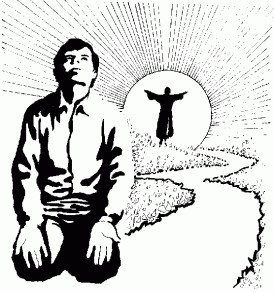
Called the Liturgy of the Hours or the Breviary, it is one of the principal ways, along with the Mass, that the Church seeks to pray unceasingly throughout the world. Priests and religious use the Breviary as a staple in their prayer life. It is a form of prayer mandated for them and optional for the laity. It structures prayer during the day: Office of the Readings, Morning Prayer, Daytime Prayer, Evening Prayer, and Compline.

What constitutes this book?

It consists of Scripture lessons, readings from the Church fathers and saints, prayers composed by the Church, and most prominently, the psalms. The psalms are recited and chanted because they were the prayers Jesus would have known by heart and prayed daily. The psalms consecrate the Breviary as the prayer book of Christ. There are also hymns in the book. Several editions and translations exist. In the United States there is both an edited one volume and a complete four volume set.

What is the purpose?

It insures prayer and gives unity to the Church’s prayer all over the world. When used by priests, it allows them to imitate Christ in rendering constant intercession for the people.

What is the origin of the Angelus prayer?

Churches would call people to prayer three times a day by ringing the church bell. This was introduced by Pope Urban II in 1095 AD to invoke Mary’s protection upon the crusaders. After the conflict, it was retained as a special way to thank God three times a day for the blessings of redemption merited through Christ.

What is the Rosary?

What is it not? The Rosary is a collection of many prayers into one; and yet, it is a simple prayer, introduced by St. Dominic in the thirteenth century and highly approved by the Church. It is called the Rosary because it is composed of a series of beautiful prayers and meditations about the principal stages in Christ’s life, which are strung together one after the other like a garland, in other words, like so many beautiful and fragrant roses. Christ’s life is divided into the joyful, sorrowful, glorious and luminous mysteries.

Why do Catholics repeat the same prayers in the Rosary? Is it not vain repetition?

Is it vain repetition to breathe one breath after another? Does a lover ever tire of telling his beloved, “I love you”? No, there is nothing vain here. Like the angels who eternally praise God as “Holy, Holy, Holy,” we say certain holy prayers and praises over and over. The core prayer is the HAIL MARY, sandwiched between an OUR FATHER at the beginning of each decade and closed with a GLORY BE and an optional FATIMA ASPIRATION. There are five events recalled and meditated upon. The opening prayer is the APOSTLES’ CREED and after an OUR FATHER, three HAIL MARYs are said (for an increase of faith, hope, and charity). The Rosary concludes with the HAIL HOLY QUEEN.

Outside the Rosary, other prayers of importance for the Catholic would be the ACT OF CONTRITION, the REGINA CAELI (substituted for the Angelus during the Easter season), GRACE BEFORE & AFTER MEALS, the STATIONS OF THE CROSS, and various novenas and litanies, etc.

Why do Catholics also do things like fast?

Actually, there is far less of it than there used to be. Fasting and abstinence (avoiding meat) was once much more strictly regulated. Unfortunately, many people have misunderstood the change regarding Friday abstinence. It was not utterly revoked. Rather, one could substitute another form of penance or mortification. Many people either did not know this or simply failed to sacrifice something else. Catholics fast because Jesus fasted (Matthew 4:12). Indeed, he told us to fast (Matthew 1:16,18). Also, St. Paul fasted (2 Corinthians 4:10) and the other apostles did so too (2 Corinthians 6:5). Good people under both the old and the new dispensation have fasted as a sacrifice to God, to firm up their discipline, and to prolong their life (1 Corinthians 9:27).

Why do Catholics abstain from meat on the Fridays of Lent and are asked to render some similar penance on Fridays throughout the year?

It is not because meat is bad, but precisely because it is good. We abstain as a small sacrifice in remembrance of the death of our Lord on a Friday. Today, the Church requires that Catholics abstain from meat on Ash Wednesday and all Fridays of Lent. On Ash Wednesday and Good Friday, Catholics are both to abstain from meat and to fast.

What is a blessing?

It is a holy action whereby the priest invokes the divine blessing on persons or things, just as Jesus did when he blessed children, bread, fish, and other objects.

What does the Church bless through her ministers?

The Church blesses houses, fields, persons, and about any object that can benefit people.

Why does the Church use holy water?

It is a suitable substance, reminding us of our baptism and faith, to bless people and things. It is a wonderful symbol (sacramental) to wash us from venial sin and to protect us against the evil spirit.

When do Catholics use holy water?

Catholic Christians sign themselves with the water upon entering and leaving the church. They also use it at home: upon rising and retiring, before prayer time, upon going out, etc.

Why are people sometimes sprinkled with holy water at Mass?

It is because we should be cleansed and sanctified when we enter into God’s house and his abiding presence there. We also recall our baptism.

For more such material, contact me about getting my book, CATHOLIC QUESTIONS & ANSWERS.

Questions & Answers About Indulgences

What exactly are the eternal punishments due to sins?
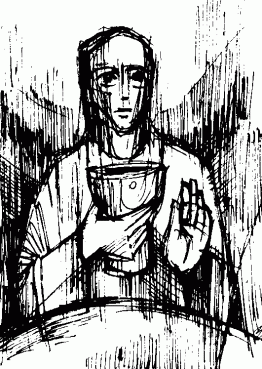
When we speak of eternal punishment, we are referring to the everlasting pains of hell.

What then are the temporal punishments due to sin?

Punishments, which take place in the temporal realm or in time, are basically the ills and struggles of mortal life. We all know sickness and dying. We experience loss and grieving. We face man’s inhumanity to man as well as natural disaster. The pains of purgatory would also be added to this list.

In what ways are the temporal punishments due to sin forgiven?

There are many ways, including penance, prayer, good works, and indulgences.

Can it really be shown that Jesus gave his apostles the power to grant indulgences or to remit the temporal punishment due to sin?

Yes, this power is found in the sacred charge given Peter by Jesus: “I will give you the keys of the kingdom of heaven, and whatever you bind on earth shall be bound in heaven, and whatever you loose on earth shall be loosed in heaven” (Matthew 16:19). The authority is given to Peter from Christ to remit whatever it is that hinders people from the gate of heaven.

Is it lawful for the Catholic Church to charge money for granting indulgences?

No, it is not. Such trafficking in indulgences is an abuse that has always been condemned by the Church.

But, did not the Pope charge money for the indulgences sold to help build St. Peter’s in Rome?

The charge behind this question is a gross distortion of the facts. The conditions placed upon those desiring such an indulgence were clearly enumerated: they were first to make a good confession, and only then as an act of penance, they might offer some money to the building of the great church. However, no one was obliged to make this payment, as there were many other ways to have temporal punishment forgiven.

Wait a minute, how can this be true? The Dominican monk, Tetzel, told the crowds that the payment of a dollar could gain an indulgence of past and even of future sins.

Well, if the monk really said this, then he was sorely mistaken. Such behavior would have been in contradiction to Church teaching. Reputable authorities give a different picture of Tetzel. Indeed, in 1517, he published a thesis upon the subject wherein he writes that to gain an indulgence there must be sorrow for sin, a good confession, Holy Communion, fasting, and church visitation. He also writes that the indulgence does not forgive sins, but only the temporal punishments of past sins, and not of future sins.

Why does God not forgive sins directly, without priestly and papal mediation?

Such is well within the prerogatives of God; however, he wisely created the ministry of priests. First, the priest functions in Christ’s name and corrects the sinner from his evil ways. Second, the priest imposes a penance upon the sinner, just as our Lord would do if he still visibly walked the earth. Third, the encounter with a minister of the Church amplifies the certainty of God’s friendship and mercy; one does not have to endure a life of uncertainty about the forgiveness of one’s sins.

Could it be that indulgences might forgive the temporal punishments imposed by the Church, but not those put into place by God?

No, the authority here is absolute. “Whatsoever you shall loose on earth, shall be loosed in heaven.” This power granted the Church through Peter makes no distinctions.

What does the term “treasury of the merits of the Church” mean?

This has to do with the infinite merits of Christ, the “superabundant merits” of the Virgin Mary and those of the saints. Our Lord gave the Church the power to distribute these merits to penitent sinners and to remit to them the temporal punishments due to sin.

Will not people abandon a spirit of penance if they see that temporal punishments can be forgiven easily?

No, because to gain an indulgence, such a contrite heart, free from sin, and averse to evil inclinations, must be present. Such a disposition can quite easily shorten the time of penance.

For more such material, contact me about getting my book, CATHOLIC QUESTIONS & ANSWERS.

Questions & Answers About Liturgical Matters

Why does the Catholic Church have so many ceremonies?

The ceremonies and rituals assist in our lifting up of our hearts to God. The instrumentation of visible symbols helps us to grasp the invisible mysteries of faith.

Does the Bible approve of such things?

The Old Law prescribed many Jewish ceremonials. Christ made use of numerous such rituals and introduced his own ceremonies.

What is the altar?

The altar stands for the table upon which Jesus instituted the sacrament of the Eucharist.

Why is the altar often so imposing and made of marble or stone?

While other materials may also make up the altar, the traditional altar was fashioned in the likeness of the martyrs’ tombs upon which the Mass was often said in the early Church.

Why is the altar covered with linen cloths?

It serves as a decorative cover giving reverence to the holy sacrifice, to help insure that if spilt no precious blood shall fall to the ground, and as a vestment for Christ symbolized there.

Why is there a cross (usually a crucifix) near the altar?

It is a visible reminder that the sacrifice of the Mass is an unbloody re-presentation of the sacrifice of the cross.

What is the chalice?

This is the cup into which the priest pours wine that is to be transformed into the blood of Christ.

Why do priests wear particular vestments at the altar?

The vestments remind us that the priest is a living representative of Christ at the altar. He acts in the very “person of Christ,” head of the Church. God himself prescribed vesture to be worn in the divine services of the Old Covenant.

What is the amice and what is its meaning?

This is a shoulder cloth that serves the practical purposes of covering the priest’s ordinary clerical attire and keeping the neck of certain albs (the white gown) clean. At one time it was even worn over the head as a cover against the cold. It signifies “the helmet of salvation” (Ephesians 6:17), with which the priest arms himself against devilish assaults.

What is the significance of the alb (a long white garment)?

It signifies the purity of body and soul with which a priest should possess before approaching the altar.

What does the cincture (rope worn around his waist) symbolize?

It calls to mind his priestly chastity and continence.

What does the stole (looks like a scarf) signify?

It is a vesture of dignity, as with the ancient Roman senators, symbolizing his honor and power.

What is the purpose of the chasuble (garment worn over all the rest)?

Just like the altar, as a symbol for Christ, is dressed; so too is the priest. The chasuble reminds us that he puts on Christ in a singular fashion. He is Christ, the one high priest, at the altar. It signifies the yoke of the Lord and reminds us all that to follow Christ means to take up the cross.

Suppressed today, although still implemented in the traditional liturgy is the maniple (a band hanging from the left arm); what is it about?

It is a symbol of penance, as well as of the various cares and responsibilities of the priestly vocation.

What do the different colors of vestments mean?

WHITE implies innocence and is particularly festive; it is used on feasts of the Lord and of saints who were not martyrs.

RED signifies martyrdom and is used at commemorations of the Passion, Pentecost and on the feasts of martyrs.

GREEN is used during Ordinary Time and represents the hope of eternal life.

VIOLET signifies penance and to some degree royalty (Advent and Lent).

BLACK is rarely used these days; however, it can replace white or violet at funerals and may still be used on All Souls Day. It expresses sorrow and morning.

SILVER and GOLD are variations upon white and point to even greater festivity.

What do the candles beside the altar signify?

They are another symbol for Jesus who is the Light of the World. We are reminded that his charity should always burn in our hearts. They also call to mind the first Christians who offered up the sacrifice in the dark and cold catacombs.

What is the meaning of incense?

It is a symbol of prayer that rises up to heaven as a sweet odor before God (Psalm 141:2).

Why do the priest and people make the sign of the cross at Mass?

It reminds us of the suffering and death of Christ on the cross. It also dedicates that activity to the Lord and sanctifies it. Associated with grace and blessings, it is often made over people and things.

What is the bow, bending the knee (genuflection), the bent head, and the kissing of holy objects about?

They are signs of veneration, and when directed to God, of adoration, respect, and homage to the presence of Christ upon the altar and/or in the tabernacle.

What are the principal parts of Mass?

Traditionally they were catalogued as the Offertory, Consecration, and Communion. The revised liturgy has much reduced the Offertory and simply calls it the Preparation of the Gifts. In light of renewed interest in the Scriptures, post-Vatican II directives speak of the two main parts of the Mass: the Liturgy of the Word and the Liturgy of the Eucharist. Having said this, the center of gravity will always be upon the Eucharist. At the words of consecration the priest changes the bread and wine into the living body and blood of Christ. God makes himself present upon our altars. Holy Communion is our reception of the bread of life and the cup of salvation.

What ingredients compose the host that is to be consecrated?

It is unleavened bread made from pure wheaten flour and water.

What is the tabernacle?

This is the container, either upon its own altar table or in a wall, where the Blessed Sacrament is reserved.

What is the Introit?

Usually replaced by a musical piece on Sundays, it is the Entrance Antiphon of the Mass.

What is the Confiteor?

It is a confession of fault and sin; in other words, of our unworthiness as we begin the Mass.

What is the Gloria?

It is a solemn song of praise to the goodness and majesty of God.

What is the Liturgy of the Word?

It is composed of various readings and their application is a homily. The pattern on Sundays is as follows: Old Testament Reading, Responsorial Psalm, New Testament Reading, Alleluia and/or Verse, Gospel, Homily, Creed and Prayer of the Faithful (General Intercessions).

What do we understand by the Profession of Faith at Mass?

This is the Creed given to the universal Church at Nicea in 325 AD and again at the council of Constantinople in 381 AD. It is a formal confession of the Catholic faith.

What is the meaning of the priest pouring a drop of water into the wine?

It signifies the union of the divine and human natures in Christ, and it represents the water that flowed from the side of Christ.

What is the purpose of the Lavabo?

It is to clean the priest’s hands and prepare them to touch the Sacred Host. It signifies an inward purity of soul with which we should offer this holy sacrifice to God.

What is the Preface?

It is a solemn hymn of praise and thanksgiving just before the canon of the Mass proper.

What is the Sanctus?

It is the thrice-repeated salutation of the angels in heaven: Holy, Holy, Holy.

What does the word “Canon” mean?

It refers to the anaphora or Eucharistic prayer used at Mass. The oldest in the West is the first Eucharistic prayer, the Roman Canon. The word “canon” means rule and here points to the unchangeable rule or manner in which the holy sacrifice is daily commemorated. The Roman canon had remained unchanged for almost 1,300 years prior to the Second Vatican Council. The most essential part of the canon, as with those in the newer ones, finds its source in the words of our Lord, himself. Of course, the traditions of the apostles and church fathers, as well as the reverent regulations of popes, have played a part in the development of liturgy, too.

Why does the priest extend his hands over the gifts?

This action parallels a similar gesture in the old law where the priest was required to lay his hands upon the sacrificial offerings as a sign that the animal now bore their sins and had to expiate them by death. At Mass, the extension of the hands signifies that Christ is the Lamb of God who took upon himself all the sins of the world. It is also associated with the invocation of the Holy Spirit (epliclesis). The power of the Holy Spirit makes possible the sacrifice of the Mass and the transformation of the gifts.

What does the priest do at the consecration?

The priest says what Christ said at the Last Supper: “Take this, all of you, and eat it: this is my body which will be given up for you. . . . Take this all of you, and drink from it: This is the cup of my blood, the blood of the new and everlasting covenant. It will be shed for you and for all so that sins may be forgiven. Do this in memory of me.”

What is the effect of these words?

When they are spoken, the bread and wine are changed into the true and living body and blood of Christ.

Why does the priest raise up the bread and chalice?

Not only does it better allow the people to see, he lifts up the host (not simply bread) and then the chalice with the precious blood, as an invitation to adore our Lord and Savior now present under the forms of bread and wine.

What are the two prayers, which immediately follow the consecration?

The first is a Vatican II interpolation of the words associated with the consecration, “Mysterium fidei,” or THE MYSTERY OF FAITH. The congregation offers one of several memorial acclamations, which affirm that our Eucharistic Lord and the historical Christ are one-and-the-same: “Dying [you] destroyed our death, rising [you] restored our life. Lord Jesus, come in glory.” The anamnesis or memorial prayer is next. By recalling Christ, we make present in the Eucharist both his person and saving activity. We affirm that this is a “holy and perfect sacrifice, the bread of life and the cup of eternal salvation.”

How does the priest pray for the dead?

He prays that the faithful departed may also receive from the fruits of the Mass and be granted “Light, happiness, and peace” in God’s presence. Sometimes the priest will even mention the dead by name. This is called the “memento” of the dead. The congregation should pray also for their deceased relatives and friends at this stage of the liturgy.

Why do we offer the Lord’s Prayer after the Eucharistic prayer?

It is because as children of God we are entitled to call upon God as “Our Father.” The mediation of Christ brings our prayer to God in heaven. We are confident that God will hear our prayer and give us what we need for body and soul.

Why does the priest break the host?

The fracturing of the priest’s host reminds us of the passion and death of Christ when his soul parted from his body. A fragment of the consecrated host is mingled with the precious blood as a sign that Christ is here present as our Redeemer, risen from the dead.

What is the Agnus Dei?

This is the “Lamb of God” prayer that echoes Scripture in repeating three times that he is the lamb of sacrifice “who takes away the sins of the world.” It is a prayer for mercy and one which acknowledges what Christ has accomplished.

What is with the sign of peace?

It is a ritual gesture, not simply a handshake, where we extend Christ’s peace to one another. We are admonished not to come to the altar unless we are reconciled with one another. St. Paul tells us: “Greet one another with a holy kiss” (Romans 16:16). That is why it is sometimes called the kiss of peace.

What does the response “Amen” mean at communion?

It is a faith profession and means “Truly” or “Surely.” It is an affirmation of the priest’s words, “The body of Christ,” or “The blood of Christ.” More than that, it also expresses acceptance and unity with the Church that offers the sacrament. In other words, a person is saying that I accept all that the Church holds as true, the Holy Father and all the bishops in union with him, etc. Not wanting to make hypocrites of people, we do not invite non-Catholics to receive. However, we do ask them to hunger with us for a more full unity and, if possible, to make a spiritual communion.

How is Mass concluded?

The priest does a post communion prayer, renders a Trinitarian blessing and then either the priest or deacon says the words of dismissal: “The Mass is ended, go in peace.”

How is the blessing offered?

Using his right hand he makes an outward sign of the cross, saying, “May almighty God bless you, the Father, and the Son, + and the Holy Spirit.” The people answer, “Amen.”

For more such material, contact me about getting my book, CATHOLIC QUESTIONS & ANSWERS.

Questions & Answers About Anointing of the Sick

Does the Bible say anything about priests praying over the sick and anointing them with oil?

It most certainly does say something about this. “Is any among you sick? Let him call for the elders [priests] of the church, and let them pray over him, anointing him with oil in the name of the Lord; and the prayer of faith will save the sick man, and the Lord will raise him up; and if he has committed sins, he will be forgiven” (James 5:14-15). We also find this passage in Mark 6:12 where the apostles “anointed with oil many that were sick and healed them.”

Is not the authority of the Letter of James rather dubious?

No, Christianity has acknowledged this book from Scripture from the earliest days. It is absolutely authentic, inspired and truthful. Only in the sixteenth century, namely with the Protestant reformer, Martin Luther, was it rejected since it contradicted his views regarding the unimportance of works in our salvation.

Have not some rightly argued that James meant faith by his use of the word “oil”?

Such a contention is silly. If James had meant faith, instead of oil, he would have said so plainly. His teaching reflected the practice of the apostles in anointing the sick with oil. This practice comes all the way through the centuries to today. It is an olive oil blessed by the bishop, usually on Holy Thursday.

What other sacraments are associated with that of anointing?

When applied to the dying, the anointing of the sick has been called Extreme Unction. If the person is conscious, it is usual for them to go to confession first. If not, the presumption is made that they would like the sacrament and are sorry for their sins. Certainly, if aware and able, any serious sins should be confessed. Following the anointing, and again if possible, the sick person would receive Holy Communion. These three sacraments are sometimes called the Last Rites.

How is it administered?

The sacrament is offered by the priest who first lays his hands upon the head of the person. Then, anointing the forehead and hands, he prays: “Through this holy anointing may the Lord in his love and mercy help you with the grace of the Holy Spirit. [Amen.] May the Lord who frees you from sin save you and raise you up. [Amen.]

What are the effects?

It forgives some sins, remits temporal punishment due to sin, gives assistance to patiently suffer and to die a holy death, grants strength against the devil’s temptations, and sometimes even restores physical health.

How should a room be traditionally prepared for these sacraments to the infirm?

A table is covered with a white cloth. A small crucifix stands between two candles. Along with these items, holy water and a glass of ordinary water may also be placed upon the table.

For more such material, contact me about getting my book, CATHOLIC QUESTIONS & ANSWERS.

Questions & Answers About Holy Orders

What exactly do Catholics believe about the power of their priests?

We believe that priests are so configured to Christ that they have a special power from God to confer in Christ’s name the graces of redemption to men and women.

Does the Bible say anything about Christ commanding priests to distribute the graces of redemption?

It is clearly taught. St. Paul says, “All this is from God, who through Christ reconciled us to himself and gave us the ministry of reconciliation” (2 Corinthians 5:18). Our Lord commanded the apostles to go out and baptize all nations. They were to forgive sins and to commemorate the sacrifice of the cross for the sins of the world. Faithful to their ministry, they would pray over the sick, lay hands upon those in need of the Holy Spirit, etc. All this is evidence that God wished his apostles and priests to confer by these signs his divine favor and graces. The role of the minister of God cannot be reduced solely to preaching.

But is not Christ alone the mediator and dispenser of graces?

Assuredly, Christ is the central Mediator and the dispenser of his graces. This no one should deny. However, he distributes his graces through the ministry of priests.

Is not such a ministry part of the universal call given all believers in baptism?

No, this is not the case. We should not confuse our identity as members of a priestly people in the Church by virtue of baptism with that singular priesthood made possible by ordination. St. Paul attests to a distinction: “Now there are diversities of ministries, but of the same Lord” (1 Cor 12:5). He goes on to say, “God indeed has set some in the Church, first, apostles; secondly, prophets; thirdly, doctors (teachers)” (1 Cor 12:28 DRB). All are not apostles; all are not prophets; all are not teachers.

But the Bible says that we are all priests, does it not?

If such is strictly the case, then why did the apostles elect and ordain some men to be bishops and priests? Why were not all people ordained? Why did they not ordain women? And, why did St. Paul say that women should be silent in church? Baptismal priesthood is not ordained or sacerdotal priesthood. The priesthood of believers simply means that we all can sacrifice to God our prayers, good works and our hearts.

What do Protestants generally believe about the power of their ministers?

For the most part, they believe that their ministers possess no power whatsoever to distribute the graces of redemption. He is merely a preacher. According to this perspective, the ministers should not even pray for their people or bless them. If they do, then they are implying that they are intercessors and that they would have the priestly power to distribute the graces of Jesus Christ to their people.

Can a priest reconcile a sinner to God?

If the sinner is moved by faith and contrition, and receives the sacraments, then the priest can indeed reconcile him to God.

Why do Catholics call their priests “Father,” in contradiction to Christ’s command to his disciples not to be called Fathers?

Implementing a form of speech known as Hebraic Hyperbole, our Lord did not mean that the term could not be used regarding our male parent or a special spiritual father. Rather, he meant that they should not allow themselves to be called “Father” to the exclusion of our almighty Father in heaven. God himself is our ultimate Father and our Teacher. However, if the term is used with humility and in submission to God, our Father, then it is permitted.

Does the Bible say anything about priests receiving a special grace or power from God in ordination?

We read: “Do not neglect the gift [grace] you have, which was given you by prophetic utterance when the council of elders laid their hands upon you” (1 Timothy 4:14). The hands of bishops are imposed upon new priests or presbyters. We also read: “Hence I remind you to rekindle the gift of God that is within you through the laying on of my hands; for God did not give us a spirit of timidity but a spirit of power and love and self-control” (2 Timothy 1:6-7).  St. Paul warns Timothy to be cautious regarding whom he invites to this sacrament: “Do not be hasty in the laying on of hands, nor participate in another man’s sins; keep yourself pure” (Timothy 5:22). We also recall Christ’s words: “All authority in heaven and on earth has been given to me” (Matthew 28:18) . . . “As the Father has sent me, even so I send you . . . If you forgive the sins of any, they are forgiven; if you retain the sins of any, they are retained,” (John 20:21,23), etc. Christ sent his apostles with power, just as the Father sent him. St. Paul asserts, “This is how one should regard us, as servants of Christ and stewards of the mysteries of God” (1 Corinthians 4:1) . . . “All this is from God, who through Christ reconciled us to himself and gave us the ministry of reconciliation” (2 Corinthians 5:18).

Did the apostles hand down this power and authority to others?

Yes, they did. The apostles prayed and imposed hands on Paul, and sent him out as the special apostle to the Gentiles. Such could also be said for Barnabas. Paul, in turn, imposed hands on Titus and Timothy. They imposed hands on others, and so on and so forth to the present day. “This is why I left you in Crete, that you might amend what was defective, and appoint elders [ordain priests] in every town as I directed you” (Titus 1:5).

Why do Roman Catholic priests not marry?

  • Because the Church commands that her priests not marry.
  • Because even the apostles left their wives to follow Christ.
  • Because St. Paul exhorts priests to follow his example of the single life.
  • Because celibacy allows more time and energy for prayer, teaching, administration of the sacraments, visiting the sick, spreading the Gospel, leaving home and facing adversity, etc.
  • Because people would not so readily confess their sins to a married priest for fear that he would reveal them to his spouse.
  • Because it best protects the property and general interests of the Church.

Was not the law of celibacy made in 385 AD by Pope Ciricius?

He only commanded that it be more strictly enforced. This ruling existed long before this date. The Pope himself in that council called celibacy an institution of the apostles.

Would there not be less scandal if priests were married?

This is a fantasy. There are fewer scandals among celibate priests then among married men in general and even among married ministers. The only difference is that a fallen priest is exploited by the news while cases among others are usually ignored or deemed insignificant.

Honestly, is it not impossible to keep celibacy?

Honesty has nothing to do with it. Only those of dark and unbridled passions would insinuate such a thing. There are many among the laity, of strong will and pure hearts, who keep celibacy. Such can be much easier for the priest to whom God gives special graces to observe his celibacy.

But, how can this stance not contradict St. Paul, himself, who says: “A bishop shall be of one wife”?

The apostle is simply saying that a man married twice should not be raised to the dignity of bishop. If his wife dies, he should not remarry. In those early days they had to select some married men for the priesthood because they could not find enough single men to administer the increasing number of the faithful.

How is this fair? After all, St. Paul says that it is better to marry than to burn.

“To burn,” means to find great difficulty in preserving chastity. Such people, reasons St. Paul, should not become priests. Rather, they should get married. A simple temptation against chastity does not mean “to burn.” Such temptations should be overcome.

How might one define Holy Orders?

It is a sacrament by which bishops, priests and deacons are ordained and receive the power and grace to perform their sacred duties.

Who administers the sacrament?

The bishop does so as the successor of the apostles.

What ministries must a man pass through prior to ordination?

The revised pattern is that within his educational and spiritual formation, he will be installed as a Reader and as an Acolyte. These are lay ministries, but they act as a preparation for ordination and the clerical state. Formerly, there were many other stages and the clerical state began with tonsure.

What are the three tiers of Holy Orders?

They are the diaconate, the priesthood, and the episcopacy (bishop).

What are the deacon’s duties?

The diaconate is an apostolic office of divine institution (Acts 6:1-7). Authority is granted to preach, to baptize, to administer Holy Communion, to proclaim the Gospel, to preach, and to assist the priest at Mass.

How is the ordination to the diaconate conducted?

During the Mass, the bishop imposes his hands upon the candidate, he is vested with stole and dalmatic, and the Book of the Gospels is presented to him.

What are the powers particular to priesthood?

He has the power to celebrate the sacrifice of the Mass, to forgive sins and to administer the other sacraments, with the exception of Confirmation (unless he is so delegated) and Holy Orders.

How is the ordination to the priesthood conducted?

The priesthood is also granted during Mass. The bishop instructs the person to be ordained concerning the duties of the priestly life. During the Litany of the Saints, he lies outstretched with his face on the floor. The bishop invites him forward and imposes hands upon his head. This is the crucial gesture, which imparts the priestly character. He is invested with the priestly stole and with the chasuble. The palms of his hands are anointed and he receives the sign of peace from the attending bishops and priests. He is presented with the paten and chalice for the celebration of the Eucharist.

What is the highest rank of priesthood?

The highest rank is that of bishop. He possesses the fullness of priesthood. A successor of the apostles, the bishop administers confirmation and holy orders, and has charge of a diocese. The consecrating bishop lays hands upon a priest being elevated to the episcopacy. The crosier or bishop’s staff is handed him as a sign of his office of shepherd and of his power to discipline. A ring is placed on his finger as a sign of his faith and fidelity to the Church. He also receives a mitre, which, like a helmet, signifies the courage and force with which he must proclaim the Gospel and defend the Church.