The blog header depicts an important and yet mis-understood New Testament scene, Jesus flogging the money-changers out of the temple. I selected it because the faith that gives us consolation can also make us very uncomfortable. Both Divine Mercy and Divine Justice meet in Jesus. Priests are ministers of reconciliation, but never at the cost of truth. In or out of season, we must be courageous in preaching and living out the Gospel of Life. The title of my blog is a play on words, not Flogger Priest but Blogger Priest.
You claim that Peter was the first Pope, and yet Scripture attests that he was married. Since this great apostle could be married, why not all bishops and priests?
RESPONSE:
Restricting ourselves to the Gospels, no doubt you are referring to Peter’s mother-in-law. We read in Luke 4:38-39: “After he left the synagogue, he entered the house of Simon. Simon’s mother-in-law was afflicted with a severe fever, and they interceded with him about her. He stood over her, rebuked the fever, and it left her. She got up immediately and waited on them.” See the story again in Mark 1:30.
The Catholic Church does not deny that Peter was married. However, note her general absence in the New Testament texts. We do not even know her name. We only encounter the mother-in-law, never his wife or any children. Indeed, throughout the Gospels and the Acts of the Apostles, references are made to Peter’s activities and travels; but, only a vague intimation by Paul in 1 Cor. 9:5 that he had a right to travel with his “believing wife.” If it were not for this mention in the epistle, one might suppose that Peter was a widower. Tradition suggests that his wife was martyred. It is peculiar that although the wife would ordinarily have cared for the needs of guests, Peter had to rely upon his wife’s mother.
However, granting that she was still around (somewhere); she evidently assumed a secondary role in his life behind his leadership of the infant Church. Indeed, her insignificance in the biblical witness would seem to provide weight to the supporters of priestly celibacy. Like Peter, bishops and priests might do better to serve God’s people without the distraction of wives and children. Jesus gives his sheep to Peter. Pastors similarly love Christ and care for their flocks. This is the emphasis of Catholic ministry, our family in faith.
This post was never meant to be a defamation against Peter’s wife. I have also edited it to avoid any peripheral discussion about whether or not the tradition can be trusted regarding her martyrdom; given that some authorities speculated that she might have died earlier and/or that there might have been a second bond. It is probably best that we accept the tradition at face value.
Here are early testimonies for the martyrdom of Peter’s wife:
CLEMENT OF ALEXANDRIA (died around 215 AD)
(THE STROMATA, 7:11)
So then he undergoes toils, and trials, and afflictions, not as those among the philosophers who are endowed with manliness, in the hope of present troubles ceasing, and of sharing again in what is pleasant; but knowledge has inspired him with the firmest persuasion of receiving the hopes of the future.
Wherefore he contemns not alone the pains of this world, but all its pleasures.
They say, accordingly, that the blessed Peter, on seeing his wife led to death, rejoiced on account of her call and conveyance home, and called very encouragingly and comfortingly, addressing her by name, Remember the Lord. Such was the marriage of the blessed and their perfect disposition towards those dearest to them.
Thus also the apostle says, that he who marries should be as though he married not, and deem his marriage free of inordinate affection, and inseparable from love to the Lord; to which the true husband exhorted his wife to cling on her departure out of this life to the Lord.
Was not then faith in the hope after death conspicuous in the case of those who gave thanks to God even in the very extremities of their punishments? For firm, in my opinion, was the faith they possessed, which was followed by works of faith.
EUSEBIUS (around 265 AD to 340 AD)
(ECCLESIAL HISTORY, 3:30)
1. Clement, indeed, whose words we have just quoted, after the above-mentioned facts gives a statement, on account of those who rejected marriage, of the apostles that had wives. Or will they, says he, reject even the apostles? For Peter and Philip begot children; and Philip also gave his daughters in marriage. And Paul does not hesitate, in one of his epistles, to greet his wife, whom he did not take about with him, that he might not be inconvenienced in his ministry.
2. And since we have mentioned this subject it is not improper to subjoin another account which is given by the same author and which is worth reading. In the seventh book of his Stromata he writes as follows: They say, accordingly, that when the blessed Peter saw his own wife led out to die, he rejoiced because of her summons and her return home, and called to her very encouragingly and comfortingly, addressing her by name, and saying, ‘Remember the Lord.’ Such was the marriage of the blessed, and their perfect disposition toward those dearest to them. This account being in keeping with the subject in hand, I have related here in its proper place.
DISCUSSION
GERRY:
Thanks for all your insights, Fr. Joe. They are priceless! I’d like to let you know that I look forward to reading the “feeds” from your blog site. God Bless!
KARL:
Who would sit in judgment for all the annulments? Certainly the Pope does not have the time and men who cannot keep their houses in order (like those divorced and seeking annulments) certainly should not sit in judgment of each other and their wives.
What would happen to a bishop who abandoned his wife? Should he continue to serve as a bishop? Who would pay for the divorce, alimony and child support settlements? Who would get the Cathedral, the wife?
Anyone who thinks it is wise to have a married clergy is likely naive, foolish or has difficulty keeping their mind off their private parts. Oops, or Orthodox or one of the Uniate Rites.
ALEXANDER ROMAN: As a Ukrainian Catholic, I wanted to take great exception to a comment on that refers to Eastern Catholics as “uniates.” That term is pejorative and offensive – that it is used by a Latin Rite Catholic is not helpful.
FATHER JOE:
Churches of the East do not permit dating priests. They have to be married before ordination. Only single men become bishops. There is a different sense of priesthood between those who are celibate and the ones who are married. The first married Episcopalian priest in the U.S. who became a Catholic priest is now divorced. His wife left him, saying that nothing in the Episcopal church prepared them for what his life would be like. She gave him an ultimatum, leave the Catholic priesthood or she would leave him. He is now a divorced and celibate priest.
CATHOLIC GIRL:
Catholics and Protestants arguing for a married Priesthood (or worse those who propose that Mary was not a perpetual Virgin) miss the point with their literal interpretations.
Catholics are not literalists (although most Protestants are). We hold the Bible as no more or less important as Church tradition and teaching. Remember who put the Bible together – the Catholic Church. Who better to understand and interpret the meaning?
The important part of the message about St. Peter is that he – Peter – represents the Church. Christ was returning to the Father and so he gave Peter a duty as the first Pope and left us with the Church as the visible symbol of his love. He specifically said that he would be with the Church until the end of time and gave it the “keys to heaven,” what they bind on Earth is bound in Heaven.
He knew Peter was not perfect – after all, he denied he knew Christ three times. He did expect and continues to expect that we follow him and that means that unmarried persons should remain celibate – as he did.
Only the Catholic Church has the keys to the kingdom. Pope Benedict says that the tradition will not be changed. The Church isn’t a democracy and those that don’t agree are simply not Catholic. So he’s the boss and that discussion is closed!
MARK:
The Church has never taught the two sacraments are incompatible; neither did Our Lord. That the Church has chosen to promote celibacy in the model of Christ should be sufficient for the discussion.
“In essentials, unity. In non-essentials, liberty. In all things, charity.”—St Augustine
FATHER JOE:
It is probable that his wife later suffered martyrdom but her absence from the Scripture texts is still a significant fact. Except for the fact that Peter had the right to bring her along, there is little or nothing that can be cited to show that his wife actually did participate in his most important missionary journeys.
You are right that the sacrament of marriage and that of holy orders are not intrinsically incompatible with each other; although, there is early evidence of tension. Many of the Popes and saints over the centuries have written about celibacy in the priesthood and religious life as if it were the best course to pursue. Could it be said that just as there was an organic development of doctrine, that celibacy for priests reflects a positive evolution in discipline as well, also under the guidance of the Holy Spirit? I think so. Indeed, there is growing evidence that priests who were married during the apostolic and patristic age were expected to practice perpetual continence after ordination.
ANGELA:
I personally believe that leaders of the church should be able to get married if they want; but I think it is great when they are capable of remaining celibate. I guess I feel if God has called you to become a priest, then he has also called you to become celibate since that is in accordance to what priesthood is.
I no longer attend a Catholic church, although I grew up in one. I have met some great priests and some not so great. I have also met some great married pastors and some not so great. It does talk about how it is better for a man to remain celibate unless you are incapable. I believe if a man can do this successfully he will be greatly rewarded.
Unfortunately, if a man is choosing to go into the priesthood and have lust issues, they may want to consider what going into the priesthood really means. He should either first address such issues or consider the possibility that maybe God wants him to be a leader of men in a different way that allows marriage. He should not necessarily change denominations if he feels his faith corresponds more greatly with Catholic belief systems; but there are so many ways to be a shepherd among men and yet be married.
That being said, I still admire the man and woman who can devote their hearts, minds, and souls solely to God and remain pure in heart, mind, body and soul.
JAKE:
Peter was a [expletive deleted] and his wife was well to be rid of him. Peter is well said to be the founder of the ‘mother of [expletive deleted] church’. Women were nothing more than cattle in the [expletive deleted] bible and the men, including jayzus were perverted [expletive deleted] [expletive deleted]. The catholic church is indeed the true church of jayzus. If priests aren’t [expletive deleted] each other, they are [expletive deleted] innocent children and being paid by stupid people to do so.
FATHER JOE:
I must report your IP number (Atlanta) to the authorities for misuse of this forum. Sorry, but you forced my hand.
JAKE:
Peter=child molester
jayzus=[deleted pejorative word for homosexuals]
catholic church=mother of [plural expletive deleted]
FATHER JOE:
Jake=Bigot
LUCIA:
It is an interesting topic and one I am not sure I yet fully understand. It is my understanding that the vows of celibacy from the priesthood all the way to the pontiff are a matter of the disciplines of the Church. Its necessity is established by the Authority of the Church based on the inspired judgments of the Church.
Thus it is possible that the Church can change its mind on this point for its own reasons, or make exceptions to the rule. For example I know that in cases of Eastern Catholics, those from the predominantly Orthodox regions which are now in full communion with Rome, there are exceptions allowing married priests. None of this creates a problem.
So to my thinking, if as Clement of Alexandria and Eusebius relate, Peter was in fact married as an apostle/bishop it doesn’t matter. If the Church then later decided that it would require celibacy of priests and all the clergy in the higher ranks as well then that is the rule. The rule established by the authority of the Church. If Peter was not married as a bishop likewise it remains a discipline the Church has established and maintained for good reason. And one which, in limited cases to which it makes exception.
Do I understand correctly? Thanks.
FATHER JOE:
Sounds like you do. Priests promise celibacy when they are ordained transitional deacons.
MD:
Lucia has the simplest answer but the most profound.
CO:
First of all, the Bible refers to Peter’s mother-in-law. My assumption is that there is a wife and the Scriptures do not tell me different…meaning, he was married. My concern, however, is the belief that he was the first Pope. If you are basing it on the fact that Jesus said that on this Rock I will build my church, and he was speaking to Peter, Christ is the Rock, not Peter. Peter in the original Greek is petros, which in interpreted… “pebble.”
FATHER JOE:
Actually, in common usage the word PETROS could mean more than pebble. The reason why that word is used instead of the more common Greek word for ROCK is because Greek words have gender. Peter is given the male version of the word. In itself it is a transliteration of the Aramaic which makes no distinctions about ROCK. Peter is literally a chip off the old block, Jesus Christ, who is the foundation stone of the Catholic Church. Peter is Rock because Jesus is ROCK.
I would like to know if a person married in civil rites to a non-Catholic 40 years ago, then separated after five years of marriage and with 3 children needs an absolution from the Pope even if the person after separating confessed her sin and received absolution from a priest?
FATHER JOE:
It may be that you are confusing “absolution” with “annulment” but in either instance the Pope would not normally enter the picture. Given that the person who married a non-Catholic is a Catholic, the civil marriage ceremony would have no standing in the Church. A simple declaration of nullity would be all that is required should that person want to marry in the Church. The amount of time that has passed since the attempted marriage and separation, even the instance and number of children, would be inconsequential to the ecclesiastical grounds against it being licit. Church law requires that Catholics have their marriages witnessed by a deacon or priest unless the appropriate dispensations have been granted. The absolution of a priest after a divorce or separation is a separate matter; however, if a Catholic should cohabitate with a civil law spouse, absolution could not be given.
If the person who married a non-Catholic were also a non-Catholic at the time of the civil ceremony, then the Church would consider that marriage as lawful and binding. If there were a divorce and either party wanted to marry in the Catholic Church, a formal annulment case would have to be entered and adjudicated by a Church Tribunal to determine the true validity of the prior bond. If the first marriage is shown to be binding and genuine, no second marriage could be permitted until the death of one of the spouses.
MARIA:
Further to my question, since you said that the Catholic/non-Catholic couple who entered into marriage through civil rites and have separated, only requires nullification, who will perform this then? The Catholic woman has no intentions of getting married but is guilty of the mortal sin she committed against God so wants to have an absolution from the Pope if possible.
FATHER JOE:
A declaration of nullity comes from the Tribunal and the Bishop. The application and supporting documentation is sent to the Chancery. A copy of the civil license, divorce decree and the baptismal certificate is part of the package. There is little other documentation because a civil union of a Catholic outside the Church is NO MARRIAGE. The declaration of nullity is NOT an annulment strictly speaking. A formal case ANNULMENT regards a bond that fulfills the external norms of the law: two witnesses, before a priest and deacon, proper dispensations, and jurisdiction. If a Catholic marries in the Church then the presumption is that the marriage is genuine. A formal case requires testimony by people who saw problems early on and an essay by the petitioner.
If the person you are talking about does not intend to get married (again), she should simply see a priest and receive absolution. The Pope has nothing to do with her case. There is nothing more to be done. As for the previous marriage, if it were out of the Church, then forget about it. As far as the Church is concerned, it never happened… sacramentally, that is.
MATT:
Indeed Father Joe is correct, making a good confession and receiving absolution is all that is required. Sure, it would be great to see the Holy Father, but make that trip after you have seen your parish priest. Make it a joyous trip rather than an act of penance. See a priest, make a good confession and allow the joy and peace of Christ to return to your heart. Know too that my prayers are with you.
JULIA:
Father Joe, thanks for your insights.
I am dealing with a marriage related situation, too, but not of me.
My sister is being married at 54 for the first time. She has cohabitated with the gentleman she is marrying (whom I know) for about 15 years. They even bought a house together about 7 years ago. The man is divorced. No decree of nullity is being sought. They are being married at a facility which has set ups for both a wedding ceremony and a reception. A minister (not sure who or the denomination or if they are of a mainline denomination or one of the more flexible type) is presiding. To top it all off the whole matter is happening on Holy Saturday. They consider themselves proud to be Catholic but not in agreement with all parts of the Church’s law. For example, they are as outraged as are the majority of us re: the President’s ongoing smackdown on religious freedoms. I love my sister, but am really torn. There are so many situations here where I feel I will be witnessing to illegality if I go to the ceremony or the reception. “Keeping the peace” is not my main concern, as there are many young nieces and nephews whom I feel are subtly “taught” in this situation (that one just does what one wants). Do you have thoughts on this matter? Ugh, to put it colloquially!
FATHER JOE:
I have sometimes urged participation for family peace. But there are way too many elements that are wrong in this situation. She is not proud enough to be a Catholic given that she spurns basic Catholic values and practice. Marriages are NOT permitted on Holy Saturday. Of course, her attempted marriage will not be in the Church. Let us call the situation what it really is: after years of fornication, cohabitation and adultery, she now wants a piece of worthless paper to say they are married. Tell her you love her but let her know that you are exercising your RELIGIOUS LIBERTY in not participating in such a farce.
On Saturday, March 24, I gave a talk on the Biblical Foundations of Marriage at the PreCana Classes held at St. Mary of the Assumption in Upper Marlboro, MD. Some of the notes are give in the immediately previous posts. There is a joke that if you get two ministers in a room, you will get three different interpretations of Scripture. Given that biblical interpretation is so volatile these days, I first gave the gathering my five basic presuppositions. Next, I gave the ten basic principles of marriage from Scripture.
Presuppositions As we Begin
1. The Scriptures are inspired by God and teach truth.
2. We must have the mind of the Church in how Scripture is interpreted.
3. The Bible is not a marriage manual.
4. Better understanding of Scriptural truth comes through a contextual approach.
5. The truth about marriage in the Bible is revealed in a progressive way, culminating in the New Testament.
A Few Basic Biblical Principles
While the Bible is not a manual for marriage, there are some basic principles we can derive from God’s inspired Word. Here are a few:
1. Men and women were made for each other. Most men and women are called to marriage.
2. Marriage is a covenant between a man and a woman. They pledge themselves to each other in vows made in the sight of God.
3. The husband is the head of the home and the wife is its heart.
4. While the Bible speaks of the wife’s submission to her husband, there is mutuality in this surrender since the husband is commanded to practice sacrificial love for her, even offering his life as Christ did on the Cross.
5. The husband and wife are dependent co-creators with God.
6. The spouses are called to be helpmates to one another in grace and holiness.
7. Marriage is a vocation that takes precedence over other preoccupations. Your attention and energies must first be focused toward one another.
8. Marriage is a sexually intimate relationship between a man and woman.
9. Christian marriage infers a third in the marriage, Christ. Couples enter into the mystery of Christ and his Church. Our Lord identifies himself with the beloved.
10. Couples should come to the marriage bed undefiled. All sexual activity outside of marriage was regarded by the Jews as a violation of the commandment against adultery.
Given that one sees a hierarchy in marriage; neither spouse should lead the other into sin. Similarly, parents can rightfully demand honor and obedience from children, but they must be worthy of such honor. Many things might be excused to preserve the peace of a home; but once a husband starts ordering his wife and children around as slaves, it will not be a happy home. When there is abuse, cruelty and sin; an offending spouse is stripped of authority by the one who is the source for all authority. The message of the Gospel is to embrace a sacrificial love. Jesus pours himself out on the Cross. If this is to be realized in marriage, then it must be mutual. The husband pours his hopes and dreams and life into his wife. Conversely, she pours all her longings and love into her husband. When there is this mutual self-donation, a couple may always be filled and whole. Indeed, their love may bear the wonderful and mysterious gift of children wherein God makes them co-creators with himself. When one gives and the other only takes, the one finds him or herself empty and the other caged in selfishness. Such a mentality is at the root of cold marriages, adultery and the culture of death.
Men and women are both made in the divine image; they have a need for mercy and a capacity for grace. The Scriptures make it very clear that they are called to be helpmates in becoming holy. Marriage comes down from our first parents to the present as an institution to bring fidelity and fruitfulness to the loneliness of the human condition.
While always regarded as something more than a man’s land and livestock, the Mosaic writ of divorce and cataloguing women along with property, tended to undermine something of the woman’s personal worth and her role as a companion in marriage. Jesus seeks to correct this by stressing the primordial union and elevating the value of women whom he encountered. The woman caught in adultery was threatened with stoning. His challenge to the crowd saves her. But he tells her to avoid this sin in the future. She was singled out for condemnation by the mob, but where was the man with whom she sinned? A double-standard was at work. The Samaritan woman at the well is told her past by Christ, who knows all her infidelities, and he offers her saving water. She too did not sin alone and who knows what dire circumstances pressed her into many transitory unions? She becomes a prophetess for her people. He forbids divorce as something that was never supposed to be, but tolerated before his coming because of the hardness of their hearts. Women deserve better treatment and should not be cast off.
Then there is the Mother of Christ. At the wedding feast of Cana she tells him that the wine has run out. He says to her, what business is this to me, woman? Joseph is gone and now Jesus is the head of her little household. Nevertheless, she tells the stewards to do as he says and he changes water into wine. The heart of the home will always have a lot of influence and meaning. Jesus preserves the joy of the marriage banquet. Similarly when located in the temple, the boy Jesus challenges her. And yet, we are told that he “immediately” came along with her and the good St. Joseph and was obedient to them. Mary was “the woman,” and according to the fathers of the Church, “the new Eve.” She would be the spiritual Mother of the many adopted sons and daughters of God. Although his physical Mother, she would also prefigure the Church as the spiritual and spotless bride of Christ. Her model for womanhood would always be with Jesus. Our Lord saw in her the great dignity and immeasurable value of all women, and their inherent potential for holiness.
A major source of discussion these days is the notion of a husband’s headship. Largely because of the sexual revolution, many take serious exception to it. However, I suspect that it is largely misunderstood. While isolated verses would seem to place all the gravity with the husband, the Catholic “contextual” approach would weigh it with references to the role and value of the wife. There is equality between the spouses and yet this should not be interpreted in any egalitarian manner. Each spouse has his or her complementary role to play. Notice in the life of the Holy Family, Joseph is understood as their great defender. And yet, it is Mary who is focused upon as the parent at the Presentation in the Temple. Similarly, when the boy Jesus is found in the Temple, the recorded conversation is between Jesus and Mary. Joseph is the foster father of Christ. He is entrusted with his family’s care. But respecting Mary’s motherhood and her deep faith, he steps back and allows her to do the talking. This does not destroy his headship. Instead, he had a good enough head to appreciate Mary’s strength, gifts and calling.
As a boy my family always respected my father as the head of the home. Daddy would work hard, cash his check and give mother all the money to pay the bills. She would take out two dollars and put it back into his wallet saying, “A man should always have money in his wallet.” She did so many things that he found difficult. They worked together. They lived out a real partnership. At the same time, my mother always gave my father the deepest respect. We were a poor family but my dear father worked from 5:30 AM to 6:00 PM six days a week so that we could have a roof over our heads and food on the table. Mother was a stay-at-home Mom, but she worked just as hard or harder in caring for the home and seven children. She would have been the first to say that Daddy was the head of our family; but by the same token, mother was the heart of our home. Which is more important, the head or the heart? Take away either one, and a body dies.
St. Paul speaks about the headship of the husband and father but also insists that they be subject to one another as to the Lord (Ephesians 5:21). There is a profound unity between the husband and wife going back to Genesis. The two become one flesh (Genesis 2:24). Jesus will also stress this unity (Matthew 19:4-6; Mark 10:7-9). It signifies a definite spiritual bond or connection between the spouses. Given its ecclesial significance, Christ raises this union to the level of a sacrament.
St. Paul is the Jew’s Jew. He draws from the Old Testament relation of marriage between the Chosen People and God to speak analogously of Christ as the divine bride groom and the Church as his bride. Paul is also very practical. While he has a preference for single-hearted or celibate discipleship, he acknowledges that not everyone has that gift.
Certain Sadduccees tried to trick Jesus with a question that mocked the resurrection. They asked, without pure intent, whose wife a woman would be in the kingdom who had alternately married seven brothers, each dying in turn?
Luke 20: 34-38: “Jesus said to them, ‘The children of this age marry and are given in marriage; but those who are deemed worthy to attain to the coming age and to the resurrection of the dead neither marry nor are given in marriage. They can no longer die, for they are like angels; and they are the children of God because they are the ones who will rise. That the dead will rise even Moses made known in the passage about the bush, when he called ‘Lord’ the God of Abraham, the God of Isaac, and the God of Jacob; and he is not God of the dead, but of the living, for to him all are alive.”
This teaching fits neatly into the appreciation of marriage as a sacrament. Marriage in this world is a sacred sign which participates in the great marriage banquet of heaven between the Lamb and his Church. When we rise to new life, there will be no more faith, because we will know the truth and see God face to face. Mortal marriage ends at the entry way from this world to the next because we will know a unity with the divine bridegroom. Having said this, death does not bring an end to love. Indeed, in Christ, love conquers the grave. Love is eternal because life is everlasting. The figure or sign of marriage will be replaced by that which is most real and pure. We will abide within God, that perfect union in divine love, forever.
Jesus raises the bar on marriage, taking sides in the debate about divorce. Jewish men might write a writ of divorce, leaving the women vulnerable and destitute in their society. Our Lord would have none of it. Citing creation itself (Genesis 1:27 and 5:2), he asserts that men and women were made for each other and that God intended their union to last throughout life. This position in favor of permanence reflected the school of Shammai. An opposing view was espoused by the rabbinic school of Hillel, which permitted men to divorce their wives, even capriciously. This would be similar to the idea of no-fault divorce today.
Jesus saw husbands and wives both culpable for failed marriages. The two in one flesh did not permit any wiggle room or escape clause. Both monogamy and marital permanence become traits of Christian marriages. Divorce would generally disappear from Christian circles until the Protestant Reformation.
While St. Paul would speak about celibacy as an eschatological sign of the kingdom, our Lord also associates his kingdom with marriage. His very first miraculous sign in his public ministry will be at the wedding feast of Cana. While some might suppose that Jesus only lightens the burdens placed upon people by the Pharisees, he actually adds to their weight. The reason why he seems more gentle and tolerant is because of his generosity in offering the mercy of heaven and divine grace. Remember that Jesus has taken away the option for divorce and says things like love those who hate you and forgive those who persecute you. He says that just to hate your brother is to violate the commandment against killing. Returning to this topic, at the Sermon on the Mount, he commands that even to look at a woman lustfully is the commission of adultery. The Mosaic Law, often referenced by St. Paul as burdensome, permitted a writ of divorce. Instead, Jesus substitutes an absolute prohibition, except for what is sometimes translated as “sexual immorality” or “adulterous.” These words fail to appreciate the magnitude of what Jesus is saying. The actual word used is PORNEA and in this context the New American renders it politely as “unlawful marriage,” but it probably means INCEST. Such marriages are not true marriages, the reason why the Church grants annulments, such unions are not sanctioned by God. However, if a marriage is genuine, then it will endure until the death of one of the spouses. Given the fact that it was a patriarchal society, divorce forced women to seek a new protector and source of support. In this sense, not only the man, but the woman was forced into adultery.
Over the years I have received a number of questions about disabilities and marriage. I am always reminded about one of my first ministerial tasks at the Washington Hospital Center in the District of Columbia. A 22 year old marine had experienced a training accident which left him a paraplegic. His young and very attractive fiancée was ever at his bedside, holding a hand which could no longer feel hers. He wanted to die. Certainly he did not want to tie her down to a man the doctors insisted would always be an invalid. Her response was to remain by his side and to offer tears of intercession for his pain and their lost dreams. Many years have passed since our encounter, and I am still unsure what might best be said in such a situation. It was not a time to come down on their hopes with a debate about the laws of nature and of the Church. I shared their space, offered them prayers and what consolation I could muster, but I could not take away the depths of their loss.
The marital act open to new life and seeking the good of the beloved is a sign and seal of the sacrament. The marriage covenant is consummated and renewed by it. Cognizant of our nature as bodily persons, the Church is also realistic and pragmatic enough to realize that marriages which shortchange sexual intimacy often fuel the fires of infidelity and alienation. The question here is not simply one of disability, but of the type of disability. Blindness, deafness, loss of certain limbs, etc. pose no such impediment to marriage. Even infertility does not negate the right of marriage if no deceit is present when the vows are made. However, can a person mentally deranged or seriously incompetent get married? No, not if they lack a conscious awareness of the nature and obligations of marriage. A paralyzed person, might be fully aware of the responsibilities of marriage, but be incapable of fulfilling them. The law of the Church in such cases is simply a reflection of the natural law. Having said this, once consummated, a tragic accident of such a nature would not abrogate the bond. The initial consummation, uncoerced and unimpeded by contraception, makes a sacramental marriage indissoluble.
What recourse would a couple have in getting married if one of the members is paralyzed from the neck or even from the waist down? Depending on the situation, the bishop himself may not be at liberty to grant a dispensation for marriage. This would especially be the case if there is no real possibility of recovery and consummation of the bond. Having said this, a very grave concern of the Church would be the use of oral sex as an attempted substitute for the marital act. While permissible in the old morals manuals as a precursor to intercourse, it cannot be sought as an ends unto itself. It falls on many of the same arguments as masturbation and homosexual interactions. Moving on, it is possible that some degree of medication and therapy might restore enough function to fulfill the marital act. In such a case, marriage could be permitted. Further, modern technologies have made available various pump mechanisms (requiring surgery) which would make possible an erection. If there is some transmission of seminal fluid, then again, marriage might very well be permitted. This position is not a reduction of the human person to a gross physicalism but the recognition that our living bodies, inextricable animated by souls, are the real expressions of our identity. Unless forsaken for the kingdom, the needs of these personal bodies– our very selves– cannot be underestimated. Having said all this, there is still another avenue a couple might pursue, although a sexual dysfunction might be coercive in its regard– virginal marriage. They could live their lives promising perpetual virginity along the lines of the Virgin Mary and the good St. Joseph.
Whatever a couple in such a fix decides to do, they will definitely know the Cross. It is my hope that the Church will always show them the redemptive value of joining our sufferings to the passion of Christ. What this world takes away, the next will restore. What this world leaves us, we can utilize for the coming of the next.
Discussion
SIMON:
Father, this is an interesting summary, and thank you for writing and posting. Here is my question. I have been married for almost 20 years. For the past 7, I have suffered from impotence due to diabetes. My wife and I were blessed with 4 children before the impotence occurred, and were always open to children in our marriage. Since becoming impotent, I have respected my wife’s opinion that we are to remain chaste from now on. Although I have tried all available impotence remedies, none work for us. I would never ask her to do anything she is uncomfortable with, but I cannot grasp how we are forbidden from being intimate even though we can no longer have intercourse. I understand that intercourse is meant to be both procreative and unitive. Impotency has removed our ability to be procreative, but why are we no longer allowed to be unitive, not through intercourse (which we would gladly do if it were at all possible), but through oral or digital stimulation? In the case of sterility, couples are encouraged to be unitive without being able to be procreative. This identification of intercourse as the only unitive act for couples suffering from the heartbreak of impotency pains me. My wife cries about the loss of intimacy. How can this be right? Must we lie together every night and never experience any physical love again? At least a priest’s or homosexual’s decision to remain celibate isn’t constantly tested every night by having the object of their desire lying right next to them. They can remove all “near occasions of sin.” Short of moving out of the marital bed, further removing some of the marital intimacy, I have no recourse to lessen the constant reminder and struggle to understand why the Church deems this to be better for us. It does help to get this off my chest. I do not feel comfortable discussing this with anyone.
FATHER JOE:
Dear Simon, I am sorry for the frustration both you and your wife feel. If you have not already, the problem of impotency might be something better discussed with a professional counselor sympathetic to Catholic teaching. When I discuss generalities, it can come across as cold. Certainly, as a celibate priest, I can in no way appreciate the full personal dynamics of such a situation. You are right; there is a vast difference between a man who sleeps alone and one who rests in bed with the female object of his desire and affection.
I am unable to give you the answer or clarification I know you wish to hear. Although I suppose given the nature of your bond, the moral gravity of an illicit act of affection might be lessened.
While impotency prior to a marriage is an impediment, it has no appreciable effect upon the sacrament afterwards, given that there has been consummation, not to mention, children.
While you suggest a parallel with the question of potency without fertility, the pivotal difference is that the mechanics of the marital act remain the same. It is still the type of act that naturally can result in children and to which the male and female bodies complement each other. Such cannot be said where male potency has been compromised and oral or digital manipulation is pursued.
The Church’s understanding of marital intimacy is more than sexual excitement and physical intimacy. It is the bonding of flesh and souls, with one another and with Jesus. Oral sex and digital manipulation might arguably be closer to masturbation than to the marital act. And while there might be some legitimacy when practiced in tandem with the marital act, the Church resists any complete substitution.
However, if you disagree, I would simply suggest that you regularly bring the matter up in confession, out of respect for Church teaching, and do the best you can to live the Christian life. God knows you love each other and any transgressions from weakness and longing between a husband and wife in such a situation would seem to be small matters to be kept between yourselves and your confessor. It may happen one day that some new therapy or medication may cure the problem. We cannot know the future and should struggle to do the best we can in the present.
There are priests out there who might say, go ahead do what you want, it does not matter. But I cannot in good conscience do that. What I can say is do not despair and know that God is infinitely forgiving and understands how unfair and difficult life can become. If we trip from time to time, he will help pick us up.
Finally, there are some wonderful ways to express intimacy that might restore the romantic elements you both knew when dating and in courtship. Candy and flowers always go a long way. Ballroom dancing is making a come-back. Picnics and boat rides are good. Holding each other tight on a porch swing and sharing lots of hugs and kisses is not so bad either… or so I am told. As spouses you can cuddle and flirt and if things get a little out of hand, well God called you together as lovers and in the heat of passion the boundaries might become blurred on occasion.
Trust each other.
Keep faith in God and in his mercy.
Respect the teachings of the Church.
I will be praying for you both.
ROBERT:
Dear Father Joe, I am a young Catholic man (age 24) engaged to be married and have been researching for personal interest “Josephite Marriage” or “White Marriage.”
As I understand it, under Canon Law, a couple where one of the partners is antecedently and perpetually impotent may not contract any marriage.
As I understand it, what a couple exchange in the marriage vows is the right to demand the marital debt from one another (if the request is reasonable and opportune).
In a “virginal marriage” this right is not used by the mutual consent of the couple. This right is mutually given up for the “sake of the kingdom.”
In a “virginal marriage” there is a mutual agreement not to use a right exchanged (the right to the marital debt).
In an antecedently and perpetually impotent couple, the right to the marital debt cannot be exchanged. Hence, there can be no marriage. One cannot exchange what one does not have.
Hence (from what I’ve gathered on the internet), no marriage can take place between a couple in which one or both partners are antecedently and perpetually impotent not even if the non-impotent party agrees to live a virginal marriage. God bless.
FATHER JOE:
Yes, Robert, you are quite right that canon law stipulates that “a couple in which one of the partners is antecedently and perpetually impotent may not contract any marriage.” Actually, Canon 1084 §1 says that it “invalidates the marriage.”
Note, however, that my post was also very tentative, saying that virginal marriage was a course that such a couple “MIGHT pursue” and that “a sexual dysfunction MIGHT be coercive.” I know the prohibition seems absolute on paper, but I have known cases where exceptions were made, particularly if the dysfunction were not absolute.
While confidentiality does not allow me to reveal many details, I can say this much:
1. Such cases were referred to the local bishop.
2. Only after a canonical, medical and pastoral investigation were decisions made.
3. Bishops themselves (in contact with Rome) gave dispensations from the canonical impediment (somewhat controversial because a few of us thought it might be elevating a juridical process over natural law) or argued that Canon 1084 §2 took precedence.
4. Both partners had to make a faith profession and renounce any and all sexual activity for the sake of the kingdom. It was understood, however, that if the problem of impotence should later find medical resolution, that the bishop had the authority to release them from their vowed celibacy.
5. A theoretical conjecture was noted whereby future medical discoveries might restore the partner’s lost sexual capacity.
6. A rather progressive interpretation was given to this law: “If the impediment of impotence is doubtful, whether the doubt be one of law or one of fact, the marriage is not to be prevented nor, while the doubt persists, is it to be declared null” (Canon 1084 §2 ).
When bishops give such a dispensation and/or ruling, and the news goes public, as you might suspect, there is a lot of controversy. This is particularly so because not all bishops would grant such permission anyway. Speaking as a mere parish priest, I have serious reservations about it, myself.
One case that I recall revolved around the fact that the woman was the paralyzed man’s principal caregiver as well as his best friend. It was also taken into consideration that they were engaged before the accident. Being devout Catholics they wanted to be together, but did not want to commit the scandal of cohabitation outside of marriage. I heard of another case, where a couple already had a child out of wedlock (before the incident that caused paralysis), and they wanted to provide a home with both a father and a mother.
The situation and question can became increasingly complicated, as you can see.
Somewhat as an aside, the whole question of impotence and how it is defined often comes up. Some men resort to implants and pumps so that they can have an erection. While this permits them to have sexual intercourse, this does not mean that they have much if anything in the way of sexual pleasure or sensation because of it. Just the thought of such extremes leaves me almost speechless.
The situation of allowing impotent men to marry, for the male is where the gravity rests in our theology, is a serious risk on many levels. People are sexual beings. A young woman married to a paralyzed man would naturally desire sexual congress with her husband; the real danger exists that improper acts might be committed and even adultery. The impotent and/or paralyzed man is also taking a terrible chance, as he may find himself emotionally frustrated at not being able to fulfill his marital duty toward his spouse. They might also commit the sin of invitro-fertilization after harvesting sperm cells. In the past, paralyzed people were almost always refused the marriage rite; however, medical discoveries have made people increasingly optimistic about recovery of some sensation and mobility. I am not sure yet if this current optimism is well enough founded on hard science to recommend liberality regarding impotence and freedom to marriage. If impotence is not reversed, the healthy spouse could readily leave the marriage and seek an annulment on the grounds that there was no consummation. Such cases go to Rome. In any case, this leaves the handicapped man open to abandonment.
Aquinas admitted that sexual copulation was not essential to marriage, thus why virginal marriages are even possible; however, he was quick to assert that marriage gives both spouses the natural right over the other spouse’s body for the purpose of the marital act. A permanently paralyzed and/or impotent man cannot consummate the bond, either in actuality or potency. Nevertheless, the female spouse has a right to that unitive act that furthers both fidelity and procreation.
It should be added that if a man is injured (becoming paralyzed and/or impotent) after marriage and its consummation with the marital act, the couple remain married and must endure with faithfulness and courage the plight that has come to them.
DON:
Please, someone tell me this particular column is a cruel joke, kind of like a news story from the Onion website.
FATHER JOE:
About a tragic subject, for sure, but this page is entirely serious.
MARC:
Father Joe, good reasoning in your discussion; my prostate removal has left me not only with ED but also with the absence of seminal fluid. Periodically, I use injections for an erection which “sometimes” is shared with my wife depending on timing, etc. When this happens, it is used to a good moral use well within Church guidelines. But on many other occasions, there is neither erection nor fluid. My wife and I feel that we need to keep our intimacy strong or the relationship will fade leaving both of us blind to each other’s love. Is oral not an option at our age of 64 and married 41 years? Thank you and confused.
FATHER JOE:
Sexual expression and/or the marital act are precious gifts to married couples. However, if the marital act should become difficult or impossible, then the couple should explore chaste forms of affection and signs of love, as with the initial courtship. Dinner and a movie, snuggling on the couch, holding hands and taking walks, kisses and cuddling, etc. You also have your memories.
LINDA:
I have been told by a priest that artificial insemination is allowed if one’s spouse is sterile by deformity (but not impotent) and that to alleviate the “frustration” of the woman to bear a child of her womb, the Church would not reject this couple or child. Is there precedent for this?
FATHER JOE:
What the priest told you is not true. Artificial insemination is forbidden without exception by the Church. The reasoning is that every human being should come into existence through the marital act. There can be no third party intervention in the act of bonding and mutual surrender of the spouses to each other and to divine providence. There is a precise act that God has instituted for the creation of human beings. Artificial insemination and IVF can create the mentality that children are commodities. Further, Christianity teaches that children are a gift from God; no one has a RIGHT as such to a child.
If a couple violate moral law and defy the Church, the Church would not reject the couple and/or the child. The child is innocent and cannot be faulted for the misbehavior of parents, no matter whether it be through illicit fertilization procedures or acts of rape or incest. The parents can know absolution if they express some small degree of sorrow and subsequent respect for Church authority.
MORGAN:
Father Joe, I met my wife in Medugorje. We wrote letters to each other over the years and fell in love. One day she said to me over the phone, “When you find out about me, you will have the choice to come or go.” I didn’t know then what it meant. I had many guesses in my mind. But none were reasonable. Then one night while in prayer I heard what I believe was the Lord. He told me what was wrong with her and asked me if I would love her. I said yes. A few moments later the phone rang and it was her. I told her what was wrong and she was surprised. I also told her that I would love her.
My wife had cancer when she was 2 years old. They took her uterus, vagina and eggs. Everything was taken leaving a scar and a clitoris. There is no penetration.
I went to Medugorje with her again and asked a priest if marrying her was the right choice despite her impotency. He said we could be together as long as we lived as the angels do.
She further went and talked to her local bishop who said marriage in the church was not possible, but we could do a legal marriage to be together so long as we live chastely.
The day we got married, it was not our intention. It was the only day my sister could organize with the judge, April 14, 2006— Good Friday of that year.
We have lived together for 3 years now. My wife does have feeling in her clitoris and I am a fully capable male. If we did do anything, would it be wrong for us to do? Can we get married in the Catholic Church? If not, do we seek this Virginal Marriage from our local bishop and would it constitute as a marriage inside the church?
Also, we ran into a priest who said our legal marriage was wrong, we couldn’t adopt kids, and he tried to make my wife promise we would separate after some time. He said he wouldn’t give her absolution in confession unless she promised to do so. She did not promise it. She came to me in tears.
I love my wife. She has stuck with me through a war, taken care of me, and we both share a cross. I couldn’t see myself with anyone else. Do I need to seek a miracle and if so, how do I do that?
FATHER JOE:
I would suggest that you seek out someone in the diocesan chancery and/or authorities in Catholic medical ethics. Infertility would not prevent marriage. The issue is impotency and the marital act. There are many points here which are unique to your case and would need to be explored by experts, both in medicine and in Church law. I can only speculate, but would it be possible to surgically refashion a type of female genitalia for her? I know there have been cases of men, particularly those with paralysis, who have had pumps surgically inserted to make the marital act possible. Oral and anal sex are disapproved as beneath human dignity and do not constitute consummation of the bond. A virginal relationship would pose no particular problem, but a Catholic marriage respecting sexual intimacy poses important hurdles for you both. Vowed virginal marriages in the Church are fairly rare, and usually require that a couple denounces vaginal sex, not that they are incapable of it.
I am sorry for the suffering you both endure and regret that you feel hurt by the hard counsel of a brother priest. I wish I had more answers for you or those you so desperately want to hear. Even if you should be asked to refrain from Holy Communion, go to Mass each Sunday and pray daily with each other. Yours are not sins of malice. Your struggle is with love, affection and the frailty of the human condition. You will both remain in my prayers.
FRANK:
Father Joe, re: Josephite Marriage, and your previous discussion of it, I fail to understand just what kind of union results from the exchange of promises, (of chastity and fidelity), in a marriage in which one of the principals is irreversibly impotent. Is there a real covenant? One which is just as binding civilly and religiously as in a normal marriage? Can’t understand why the healthy party in such cases can’t just, willy nilly, choose to walk away, without considering the medium of divorce or annulment.
FATHER JOE:
I did say that “a sexual dysfunction might be coercive in its regard– virginal marriage,” meaning that such an alternative would be problematical. The post was originally written some time back and I am not sure I meant a “Josephite marriage,” probably just an analogous spiritual friendship. A true Josephite marriage would imply that a couple freely opted not to exercise their genital prerogatives. Impotence means there is no choice, no potential for the marital act.
LAURA:
I came across this post today when trying to look into this issue as it has been bothering me. I may be wrong, but I thought that in the case of a “properly functioning” couple, John Paul II drew a distinction between oral sex for men and women. As I understand the teaching, since the female orgasm has nothing to do with conception, oral stimulation of the woman is permitted even if not in conjunction with a completed act of intercourse. At least that’s how I have had the teaching explained to me. If that’s the case, I still can’t wrap my head around why, for a couple for whom conception is impossible (i.e. a couple where one partner is impotent), the teaching would be any different. In other words, I didn’t think the “no oral sex without completed act of intercourse” rule was about conception and being open to life, not about mechanics of the act. If the couple would be open to life but for the impotence, I’m not sure how oral sex for this couple is different than the permissible oral sex on a woman in a normal-functioning couple.
FATHER JOE:
I do not recall the late pope making any such distinction that would permit female masturbation. The marital act is defined as that sexual act which is the type of act that is open to the transmission of human life. Pleasure for both men and women is an enticement for intercourse that is required for the propagation of the species. It is also an ingredient in the fidelity of the spouses. While the old moral manuals permitted a certain level of foreplay to facilitate the marital act, as well as manipulation of the female if the male climaxed too quickly, such stimulation apart from intercourse was frowned upon. As far as I know, nothing has changed. I suspect someone taught you wrong. Where is Pope John Paul II supposed to have said otherwise? The late pope gave an emphasis upon spousal fidelity that was sometimes eclipsed by procreation in Catholic thinking; but nothing in his theology of the body overturned basic morality.
LAURA:
I went back and looked at what I had read, and I suppose you are right that oral sex on a woman is not permitted in and of itself. But here is what I read (by Christopher West) that is still not quite what you are saying:
“The acts by which spouses lovingly prepare each other for genital intercourse (foreplay) are honorable and good. But stimulation of each other’s genitals to the point of climax apart from an act of normal intercourse is nothing other than mutual masturbation… An important point of clarification is needed. Since it’s the male orgasm that’s inherently linked with the possibility of new life, the husband must never intentionally ejaculate outside of his wife’s vagina. Since the female orgasm, however, isn’t necessarily linked to the possibility of conception, so long as it takes place within the overall context of an act of intercourse, it need not, morally speaking, be during actual penetration… Ideally, the wife’s orgasm would happen simultaneously with her husband’s [orgasm], but this is easier said than done for many couples. In fact, if the wife’s orgasm isn’t achieved during the natural course of foreplay and consummation, it would be the loving thing for the husband to stimulate his wife to climax thereafter (if she so desired).”
FATHER JOE:
Yes, he is correct. I have not written anything which contradicts this. Onanism is still a sin, no matter whether alone or with a partner. Strictly speaking, this regards the male “spilling the seed.” Foreplay that includes male climax is not foreplay. Rather, it has wrongly been substituted for the marital act. Similarly, after intercourse, the manipulation of the female by the husband so that she might climax has been judged as lawful by moralists.
LAURA:
I recognize that Christopher West is not an official authority in the Church, but if what he’s saying is true, while I’m wrong that female stimulation is permitted as an isolated act, it would appear that oral sex as foreplay is not “frowned upon” as you say, nor is some female stimulation prohibited even after sex (which does not confine it just to the realm of “foreplay”). This is also consistent with what is written in the book “Holy Sex,” written by a number of modern Catholic theologians.
FATHER JOE:
What West writes is okay, however, your commentary is not clear. Foreplay is only frowned upon if the male climaxes without true intercourse. But, as I said, then it is not foreplay but simply oral sex or masturbation. Give me the quote where I am wrong and I will correct it. Peace!
DAVID:
Are implants to treat impotence banned by Church teaching where there are no other alternative treatments to achieve a valid marriage?
FATHER JOE:
Implants, as such, are not banned.
DAVID:
Are surgically implanted pumps allowed as a means of overcoming impotence?
FATHER JOE:
It is a tricky and somewhat controversial business. Evidently bishops will sometimes give a dispensation for marriage after the implantation of such pumps. The argument is that with this intervention the impotence is no longer absolute. I am not sure if all bishops are happy with such a compromise. Particularly in cases of paralysis, it might make the mechanics possible, but the man would still not feel anything. How would this affect their mutual self-donation and bonding in the marital act? There may be little other recourse after marriage. If paralysis or injury brought about such serious impotence in a man prior to marriage, I would probably advise a reconsideration altogether. People are not machines and the flesh is weak. My perspective might seem cold, heartless and cynical. I do not intend to come across this way. But I have seen too many relationships of this sort, between a woman and impotent man, fall apart with the most devastating consequences. Could not such men settle for simple and chaste friendships?
EILEEN:
My question is not related directly to this topic, but I have been searching for an answer and cannot find it, so figured I’d try here.
Thirteen years ago, upon learning that I was pregnant with our sixth child, my husband, against my wishes, had a vasectomy. This nearly broke our marriage and it took a long time to recover. (He was not raised Catholic and is a convert who struggles with the ban on contraceptives.)
Since that time, there have been a few occasions (very few) where during sexual activity he has engaged in self-stimulation along with the mutual activity. Usually, this all ultimately ends up with penetration taking place and the completion of the sex act as it should; but on a couple of occasions, he has ejaculated outside of [the body].
As the ejacula no longer carries sperm, and as the intent at the beginning of the sexual activity was to complete internally, is this a mortal sin?
FATHER JOE:
First, the vasectomy was wrong and sinful for several reasons. It is regarded as a mutilation of the human person and the generative powers. It reflects a contraceptive mentality wherein the openness to human life which is intrinsic to the marital act is spurned. Upon repentance, and where possible, the Church would also recommend repair of the damaged faculties.
Second, there may have been emotional healing, but an important element of the sacramental reality of your marital covenant remained wounded.
Third, given the vasectomy, it would seem that the matter of a ban upon artificial contraceptives would be a “personally” mute point. He has embraced perpetual infertility over periodic sterility. Many lifelong Catholics also dissent upon this matter. He may have been a convert, but did he “convert” enough?
Fourth, while an element of manipulation may be understood as foreplay and preparation for the marital act; such activities must not be pursued in themselves or seen as independent. Human beings are not animals and the marital act should not be reduced to cold mechanics. It is ideally a self-donation and surrender to the beloved. While accidents do happen, we should still be watchful against the sin of Onanism.
Fifth, the intention behind the actions that surround the marital act do have moral weight. However, the fact that the ejacula is deficient or void of sperm does not matter in this situation of self-manipulation or arousal outside the marital act.
JAN:
Erectile dysfunction (ED) treatment has evolved a lot from traditional times. Earlier this problem was believed to be caused by psychological factors only, but now we know better, so have the treatments.
ROSIE:
What do you do when you have been married for nearly 9 years and your husband has never been able to properly [fulfill the marital act]? The cause being diabetes but you didn’t know this until recently. He is able to bring you to climax [through manipulation] but you find this, although better than nothing, very much unsatisfactory. Also you can’t talk about how you feel with him. Also facing the temptation of other males on the scene for which intercourse would be very easy. Is this a real marriage or should it be annulled?
FATHER JOE:
Dear Rosie, I am far from an authority upon such issues and this is a somewhat delicate question. However, there are a few points I would like to note:
First, as a married couple you should be able to dialogue with your spouse about your personal needs in this relationship. It might be hard, but nothing can be done to help the situation unless you work together.
Second, your marriage should go deeper than issues like pleasure in the mutual act. It is important, but you have both entered into a covenant where sacrifices will have to be made.
Third, I would urge you to avoid both actual temptation and fantasies toward adultery. Take the matter of divorce and annulment off the table. You have been married for almost a decade. Fight for your marriage and love one another, “for better or for worse” until death do you part.
Fourth, do not be afraid to work with a doctor who might be able to help you both. Not all physical problems can be overcome, but sometimes situations can be much improved. Peace!
ALLIE:
I have a question. You said, “Somewhat as an aside, the whole question of impotence and how it is defined often comes up. Some men resort to implants and pumps so that they can have an erection. While this permits them to have sexual intercourse, this does not mean that they have much if anything in the way of sexual pleasure or sensation because of it. Just the thought of such extremes leaves me almost speechless.”
And later, you suggested that the woman who had surgery for cancer at age 2 that removed her vagina (and uterus, and ovaries), have surgery to create an artificial vagina. Can you help me understand Church law regarding these types of surgeries? And why have you tied male sexual pleasure as a necessity of the marital act? Especially since, as you pointed out, “Second, your marriage should go deeper than issues like pleasure in the mutual act. It is important, but you have both entered into a covenant where sacrifices will have to be made.”
It seems to me that whatever couples decide upon as being mutually agreeable to bind them together as a couple should be permissible, whether that is allowing impotent couples to come together in intimacy of their own choosing or allowing couples to marry who know that what they currently have in a physical relationship (i.e., paraplegics, etc.) is all they can lawfully have. I should think that the binding thread here is LOVE. Having read the entire page today, it seems to me that the unlawful marriage of the couple from Medjugorie is far more of a loving union than Rosie’s marriage of almost a decade. My heart goes out to all the couples here. You are struggling with much. And I am struggling to understand myself.
FATHER JOE:
The marital act is defined by the Church in light of natural law. Other forms of intimacy and/or sexual congress have neither the capacity to consummate the marital covenant nor any significant degree of fecundity. The general subjective experience (which often includes some degree of pleasure) furthers the good of fidelity between spouses. My emphasis is not directly upon pleasure but upon the capacity of a couple to engage in non-contraceptive sexual intercourse as a requirement for marriage.
As for the reconstruction of genitalia, the morality hinges upon the repair of something impaired, as through accident or cancer. Such repair is not always possible. Further, no such reconstruction should seek to alter the external gender in contradiction to that given at birth and in the DNA. The Church opposes so-called sex-change operations and views such measures in terms of self-mutilation and the unlawful or immoral damaging of physical faculties.
You would accept as legitimate “whatever couples decide upon as being mutually agreeable to bind them together as a couple.” However, by extension, this is also the erroneous argument posed by homosexuals seeking the recognition of their unions as a form of marriage. The problem is that the marital act between a man and woman, defined as non-contraceptive vaginal intercourse, allows for no substitutions. One can feign the act, either through choice or because the actual act is impossible, but such neither consummates nor renews the marital covenant. Instead of a virtuous act which brings grace, there would be the commission of sin instead. That is the Catholic view, again based upon divine positive law and especially natural law. Love and friendship are indeed important. But one can have both outside of sexual relationships. Indeed, as a celibate priest, I have dedicated my life to the love of God and to the service of his people. Marriage is not the only sacrament of love. The ordination of a priest is a sacrament of love. Indeed, our common baptism into the family of God is the first and most basic sacrament of love. The right to marriage is not absolute. If it were, we would have to pass out spouses just as we distribute bread to the hungry. It does not work that way.
This is the home of the AWALT PAPERS, the posting of various pieces of wisdom salvaged from the writings, teachings and sermons of the late Msgr. William J. Awalt.
















 QUESTION:
 MARIA:
 A Few Basic Biblical Principles
 Given that one sees a hierarchy in marriage; neither spouse should lead the other into sin. Similarly, parents can rightfully demand honor and obedience from children, but they must be worthy of such honor. Many things might be excused to preserve the peace of a home; but once a husband starts ordering his wife and children around as slaves, it will not be a happy home. When there is abuse, cruelty and sin; an offending spouse is stripped of authority by the one who is the source for all authority. The message of the Gospel is to embrace a sacrificial love. Jesus pours himself out on the Cross. If this is to be realized in marriage, then it must be mutual. The husband pours his hopes and dreams and life into his wife. Conversely, she pours all her longings and love into her husband. When there is this mutual self-donation, a couple may always be filled and whole. Indeed, their love may bear the wonderful and mysterious gift of children wherein God makes them co-creators with himself. When one gives and the other only takes, the one finds him or herself empty and the other caged in selfishness. Such a mentality is at the root of cold marriages, adultery and the culture of death.
 While always regarded as something more than a man’s land and livestock, the Mosaic writ of divorce and cataloguing women along with property, tended to undermine something of the woman’s personal worth and her role as a companion in marriage. Jesus seeks to correct this by stressing the primordial union and elevating the value of women whom he encountered. The woman caught in adultery was threatened with stoning. His challenge to the crowd saves her. But he tells her to avoid this sin in the future. She was singled out for condemnation by the mob, but where was the man with whom she sinned? A double-standard was at work. The Samaritan woman at the well is told her past by Christ, who knows all her infidelities, and he offers her saving water. She too did not sin alone and who knows what dire circumstances pressed her into many transitory unions? She becomes a prophetess for her people. He forbids divorce as something that was never supposed to be, but tolerated before his coming because of the hardness of their hearts. Women deserve better treatment and should not be cast off.
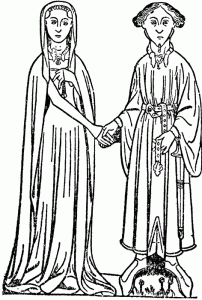 Certain Sadduccees tried to trick Jesus with a question that mocked the resurrection. They asked, without pure intent, whose wife a woman would be in the kingdom who had alternately married seven brothers, each dying in turn?
 Jesus raises the bar on marriage, taking sides in the debate about divorce. Jewish men might write a writ of divorce, leaving the women vulnerable and destitute in their society. Our Lord would have none of it. Citing creation itself (Genesis 1:27 and 5:2), he asserts that men and women were made for each other and that God intended their union to last throughout life. This position in favor of permanence reflected the school of Shammai. An opposing view was espoused by the rabbinic school of Hillel, which permitted men to divorce their wives, even capriciously. This would be similar to the idea of no-fault divorce today.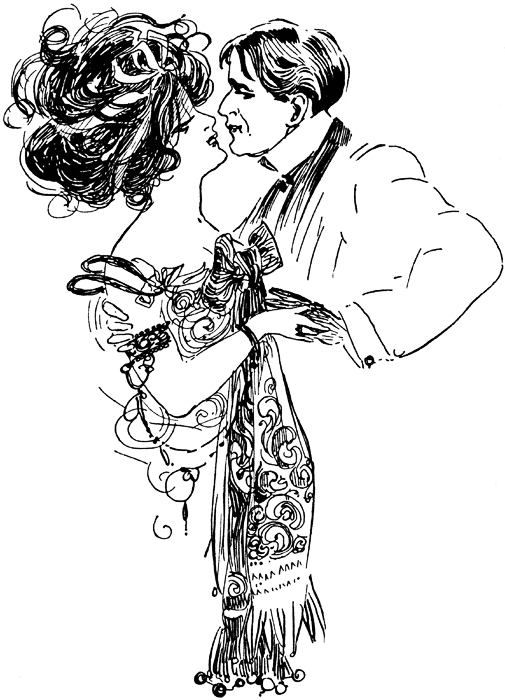
















 Blogger Priest