• Our Blogger

    Fr. Joseph Jenkins

  • The blog header depicts an important and yet mis-understood New Testament scene, Jesus flogging the money-changers out of the temple. I selected it because the faith that gives us consolation can also make us very uncomfortable. Both Divine Mercy and Divine Justice meet in Jesus. Priests are ministers of reconciliation, but never at the cost of truth. In or out of season, we must be courageous in preaching and living out the Gospel of Life. The title of my blog is a play on words, not Flogger Priest but Blogger Priest.

  • Archives

  • Categories

  • Recent Posts

  • Recent Comments

    Anonymous's avatarAnonymous on Ask a Priest
    Michael J's avatarMichael J on Ask a Priest
    Jeremy Kok's avatarJeremy Kok on Ask a Priest
    Mike Zias's avatarMike Zias on Ask a Priest
    Jeremy Kok's avatarJeremy Kok on Ask a Priest

A DISCUSSION: About Priestly Fathers & the Church

PLEASE NOTE that this is an apologetical dialogue that does not appeal to everyone’s tastes. No recrimination is intended against the non-Catholic community.

RONIE:

I am sorry, but I will not call you as others address you. Christ said to call no man “Father.” Mr. Joe, can you tell me (as you understand) the meaning of “Church”?

FATHER JOE:

  • The Church is the Mystical Body of Christ.
  • The Church is the great Sacrament of Salvation.
  • The Church is the House that Jesus built.
  • The Church is that community of faith which receives its life from the Eucharist.
  • The Church is built on the foundation of Christ (invisible head) and the ROCK of Peter (visible head).

Turning to the matter of my title, let us look at Matthew 23:9: “And call no one on earth your Father; for one is your Father, who is in heaven” (Matthew 23:9).

This is an example of a Scriptural literary form known as Hebraic Hyperbole. It is like the passage that admonishes tearing your eye out or cutting your hand or foot off. It is a way of speaking to give heightened emphasis. The fundamentalist reads everything as if the primary language is English and the author contemporary. This is also an example of taking a verse out of context and distorting its meaning. Verse eight says to call no one Rabbi or teacher. However, do we not use this word all the time? Further, if this line is absolute against Catholic priests who possess a spiritual fatherhood, then what about our foster fathers and biological fathers? It would have to apply there as well. Almost no one would agree to this. The word FATHER is a wonderful sign of respect and relationship. The matter about which the Lord is concerned is that his disciples not imitate the Pharisees in their pride and hypocrisy, lording their positions over others. God is the true and ultimate Father of all. If any fatherhood does not flow from and participate in divine fatherhood, then it is a lie and oppressive. St. Paul speaks of himself as a spiritual father in his first letter to the Corinthians and admits that there are other such fathers, although not many. The shortage of vocations to the priesthood is still a matter with which we must deal.

[In speaking of our priorities] “He who loves FATHER or mother more than me is not worthy of me” (Matthew 10:37).

[About marriage] “For this cause a man shall leave his FATHER and mother, and cleave to his wife, and the two shall become one flesh” (Matthew 19:5).

[Placing discipleship to Jesus first] “And everyone who has left house, or brothers, or sisters, or FATHER, or mother, or wife, or children, or lands, for my name’s sake, shall receive a hundredfold, and shall possess life everalasting” (Matthew 19:29). {see also Mark 10:29}

[Abraham is called father] “For this reason, it depends on faith, so that it may be a gift, and the promise may be guaranteed to all his descendants, not to those who only adhere to the law but to those who follow the faith of Abraham who is the FATHER of all of us, …” (Romans 4:16). {see also Romans 4:11-12,17}

[Treatment of elders] “Do not rebuke an older man, but appeal to him as a FATHER” (1 Timothy 5:1).

[Enduring trials] “For what ’son’ is there whom his FATHER does not discipline?” (Hebrews 12:7). {see also Hebrews 12:9}

[My favorite and very similar to calling the priest, Father] “I am writing you this not to shame you, but to admonish you as my beloved children. Even if you should have countless guides to Christ, yet you do not have many FATHERS, for I became your FATHER in Christ Jesus through the gospel. Therefore, I urge you to be imitators of me” (1 Corinthians 4:14-16).

RONIE:

Dear Mr. Joe, I would like to give a clarification of Matthew 23:9. Sorry, but I have to say this, you are out of context. The “Father” in this text refers to “God the Father,” which is SPIRITUAL and the other verses (like Matthew 19:29; Mark 10:29; and Romans 4:16 refer to EARTHLY fathers. The fathers of our flesh must be called fathers, and as such we must give them reverence; but only God is allowed as the Father of our spirits (Heb. 12:9). Our religion must not be derived from or made dependent upon any man. Our flesh fathers do not have authoritative power over men’s consciences, in matters of faith and obedience, as do God and Christ.

Christ’s sense is, that he would have his disciples not fond of any titles of honor at all, and much less assume an authority over men, as if they were to depend on them, as the founders of the Christian religion, the authors of its doctrines and ordinances, and to take that honor to themselves, which did not belong to them, nor even choose to be called by such names, as would lead people to entertain too high an opinion of them, and take off of their dependence on God the Father.

You know, Mr. Joe, the scribes and Pharisees love to be called by these titles. Kindly check 1 Corinthians 4:14-16, and notice the text “for I became your father.” It is not found in the Greek text. I prefer the text in the KJV below:

1 Cor. 4:14 – “I write not these things to shame you, but as my beloved sons I warn you.”

1 Cor. 4:15 – “For though ye have ten thousand instructors in Christ, yet have ye not many fathers: for in Christ Jesus I have begotten you through the gospel.”

1 Cor. 4:16 – “Wherefore I beseech you, be ye followers of me.”

Your explanation about “church” is less clear, different and more complex than that from Scripture. You know “church” is not a house or a building. The Church is called the Bride of Christ, and also is called the Body of Christ (1 Corinthians 12:12-14). Its members all have different functions. It is composed of saved and baptized believers— that is why Christ loves the Church. The word, “church,” in Greek is “ekklesia” which means “called out assembly.”

Peter is not the rock because the 12 disciples, knowing the Old Testament well, recognized the Rock as a description or name for God. “He is the Rock, His word is perfect” (Deuteronomy 32:4). Also, there is, “The Lord is my Rock, and my fortress…” (Psalm 18:2). Further, we read, “For Who is God save the Lord? Or who is a Rock save our God?” (Psalm 18:31). We see here that there is no other Rock than God, not even Peter. Jesus Christ is the foundation Rock on which the Church is built.

Oh, by the way Mr. Joe, Peter did not even reach Rome. The only Man sent by God to preach to the Gentiles was Paul. Also, if Peter is your first Pope, why are priests not allowed to marry, since Peter had a wife? (Matthew 8:14)

FATHER JOE:

“Sorry” does not make it right. The proper title for a cleric is Father, Reverend or Pastor. Why should I spend any time with a person who begins with a deliberate act of disrespect? But given that our Lord would want repentance and conversion for both the ignorant and the bigoted who blaspheme against the Holy Spirit, I will try to make a short response. Admittedly, I have little confidence that anything I might say will penetrate the walls fabricated by those who are obstinate against the truth and closed to the movement of divine grace.

You write: “I would like to clarify to you in this text, ‘And call no man your father upon the earth: for one is your Father, which is in heaven’” (Matthew 23:9). Actually it is best that we look at the entire section and our Lord’s use of Hebraic hyperbole (verses 1 to 12):

Then said Jesus to the crowds and to his disciples, “The scribes and the Pharisees sit on Moses’ seat; so practice and observe whatever they tell you, but not what they do; for they preach, but do not practice. They bind heavy burdens, hard to bear, and lay them on men’s shoulders; but they themselves will not move them with their finger. They do all their deeds to be seen by men; for they make their phylacteries broad and their fringes long, and they love the place of honor at feasts and the best seats in the synagogues, and salutations in the market places, and being called rabbi by men. But you are not to be called rabbi, for you have one teacher, and you are all brethren. And call no man your father on earth, for you have one Father, who is in heaven. Neither be called masters, for you have one master, the Christ. He who is greatest among you shall be your servant; whoever exalts himself will be humbled, and whoever humbles himself will be exalted.

The authority of the Church instituted by Christ would eventually supersede that of Moses and his successors in leadership, the Pharisees. The bishops of the Catholic Church sit in the seats of the apostles. The popes govern from the Chair of Peter. Jesus establishes both a new People of God and the accompanying authority. Our Lord was critical about the hypocrisy of the Pharisees and pleaded with his apostles that it should not be so with them. He gave them the example of the foot-washing and urged humility in service. The hyperbole stresses that the ministers of the Church should not seek earthly rewards, titles and esteem, but rather that imperishable treasure of being in right relationship with God. The titles rabbi, father and teacher (or master) would continue to be used. Even St. Paul speaks of himself as a spiritual father. Lost in translation is the peculiar Hebrew form of stressing a point by pushing a matter to absurdity: call no man father or teacher or rabbi; if your eye causes you to sin, pluck it out; if your hand causes you to sin, cut it off. These matters were never meant to be understood in a literal fashion. Apart from the truth of Christ, no one is a suitable teacher. In conflict with the fatherhood of God, no fatherhood is genuine.

You say that my reference to “father” is out of context. You must be kidding! You are the one who gives no real context at all. Indeed, you treat Scripture as if it were written originally in English. Instead of respecting the message and historical setting, you offer an illogical and contrived explanation that goes against the practices and writings of the early Christians. They were close to the source and were in a position to know the truth. They did not understand this text as you do.

The text cannot be dissected as you attempt. The meaning is that there is no true fatherhood which usurps or conflicts with the fatherhood of God. This includes both spiritual fathers (as with St. Paul) and with our biological or adopted fathers. Matthew 19:29 and Mark 10:29 speaks about the family of the Church and the communion of the saints. Romans 4:15 makes mention of Abraham as our father in faith. God calls him forth and his family becomes a tribe and later a nation. He is a crucial starting point in the history of salvation.

The texts you cite either contradict or do not support your view. The Church sees herself as a family and addresses God in her prayers as FATHER MOST HOLY. Priests, bishops and popes are spiritual fathers in that they perpetuate the teachings and mission of Jesus Christ. The Church fully subscribes to the understanding of her membership as brothers and sisters to one another. In faith and baptism, Jesus is our elder brother and Mary is the queen mother. We are adopted sons and daughters of our heavenly Father. The reference to earthly fathers means any type of fatherhood here on earth. Our mortal fathers, no matter if biological, adopted or spiritual, must reflect divine fatherhood or else they are false. There is nothing here that says that biological fathers are exempt. Further, your citation of Romans 4:16 is in reference to Abraham, not almighty God. He is called the father of all.

Parents are the primary educators of their children in the faith. They constitute the “little church.” You wrong Christian fathers by reducing them to roosters who service hens. St. Paul tells us that the Christian husband/father is the head of the home just as Christ is the head of the Church.

You next write:

Christ’s sense is, that he would have his disciples not fond of any titles of honor at all, and much less assume an authority over men, as if they were to depend on them, as the founders of the Christian religion, the authors of its doctrines and ordinances, and to take that honor to themselves, which did not belong to them, nor even choose to be called by such names, as would lead people to entertain too high an opinion of them, and take off of their dependence on God the Father.

What you write is absolute gibberish. Indeed, your run-on sentence even defies linguistic diagramming. And yet it makes more sense than what you usually write. Of course, you did not write it. You stole it. You plagiarized. You borrowed the work and genius of another to foster the pretense of knowing what you are talking about. These are not your words, but those of one who was a polemicist against Catholic claims. As I said before, you prefer parroting the enemies of the Church instead of learning objectively and directly from her own mouth. These words come from an EXPOSITION OF THE ENTIRE BIBLE written (between 1746 to 1763) by John Gill.

The commentary here is not your own and I dislike dialoguing with cut-and-paste intellectual thieves. However, despite this and the convoluted language, I will try my best to parse it out. Our Lord was not so much against titles as he was concerned that “show” not replace “substance.” The title “apostle” itself becomes one of great distinction. Our Lord was often called “master” or “teacher” or “rabbi.” He explicitly gave his authority to his apostles and sent them out to baptize the nations. He explicitly gave Peter the authority of the keys and the power to loosen or bind over sin. He tells him, after the resurrection, to feed his sheep and to care for his flock. It is quite evident that Jesus gave them such authority as shepherds to the community. This authority would be passed down to others. Failure to see this demonstrates your blindness to important passages in the Word of God. Jesus, himself, was the founder of the Christian religion, i.e. the Catholic Church. He is the ultimate source of revelation. He would send his Spirit to insure the Church’s fidelity to the truth, the doctrines and ordinances that men should know and follow. As I have mentioned before, the great apostle Paul spoke about himself as a spiritual father. There was no prohibition, either about the title or the function. The spiritual title of FATHER given to a priest in no way detracts from the fatherhood of God. Indeed, he becomes a flesh-and-blood symbol of God’s abiding love and mercy in the faith community.

Just because the Pharisees allowed their titles to go to their heads does not mean that such must always be the case for others. The title “father” is an expression of endearment.

“I write not these things to shame you, but as my beloved sons I warn you” (1 Cor. 4:14). Paul admonishes the Corinthians as his beloved children. There is definitely a fatherly relationship.

“For though ye have ten thousand instructors in Christ, yet have ye not many fathers: for in Christ Jesus I have begotten you through the gospel” (1 Cor. 4:15). This is a somewhat archaic Protestant translation. A better translation is the RSV, also Protestant (but acceptable to Catholics): “For though you have countless guides in Christ, you do not have many fathers. For I became your father in Christ Jesus through the gospel.” The reference to “father” is in the Greek text as is the term for being begotten of a father:

ἐὰν γὰρ μυρίους παιδαγωγοὺς ἔχητε ἐν Χριστῷ ἀλλ’ οὐ πολλοὺς
πατέρας ἐν γὰρ Χριστῷ Ἰησοῦ
διὰ τοῦ εὐαγγελίου ἐγὼ ὑμᾶς ἐγέννησα

“Wherefore I beseech you, be ye followers of me” (1 Cor. 4:16). More than followers, he is literally urging them to imitate him. He sends Timothy as his emissary and calls him his “Beloved and faithful son in the Lord.” The spiritual fatherhood of every priest is akin to that of the apostle Paul.

I have spoken numerous times about the Church as the bride of Christ. Indeed, the Mass is a sacramental participation in the marriage banquet of heaven. This Church is one and the same with the Catholic Church. The members of the Church have different functions and gifts. We make distinctions between the clergy and the laity. Baptized believers with faith in Jesus live in the hope of their salvation. Your reference to the “saved” might be criticized under the sin of presumption. Jesus loves the Church as his own body.

The term “ekklesia” was originally a political term for the calling together of an assembly. It becomes descriptive of the assembly of the Church. Christ calls us both to a personal faith in him and to a CORPORATE faith as his Church. I suspect that you would tend to minimize this latter understanding. No one is saved apart from Christ; no one is saved apart from the Church.

Moving on, I am sorry, but Peter is the ROCK because Jesus said so. “And I also say to you that you are Peter, and upon this rock I will build My church; and the gates of Hades shall not overpower it,” (Matt. 16:18). Our Lord is the foundation stone of the Church. He gives something of his own authority to Peter and his successors to shepherd his flock. There is no contradiction in that Jesus is also called our rock of safety and refuge. Peter is literally a chip off the old block.

There is ample historical evidence that Peter reached Rome. The problem you face is that you exclude any information not put forward in the Bible. That would also exclude the works of the Church fathers and the legacy of the saints. Or maybe this is not true? You do seem to esteem the interpretive works of reformation anti-Catholics like Gill even more than the Bible. Excavations have discovered the tomb and the bones of Peter, clearly marked. The Holy See sits upon the twin pillars of Peter and Paul. As for priests getting married, the fact that Peter has a wife says nothing against the discipline of celibacy as practiced by Jesus, Paul and others. Celibacy is not so much a doctrinal matter as it is one of Church discipline. Disciplines can change or even be revoked, doctrines cannot.

Continuing the Prophetic Witness

Someone asked me once if there were any Scriptures where a relationship between a mother and daughter was pivotal. The one that came immediately to mind was in the tragic story of John the Baptist and his execution (Mark 6:17-29). This was hardly something for emulation. Living in an age where so many teenage girls crave things like digital music, computers, shoes, cars, clothes, and jewelry — this figure of Herodius’ daughter is a peculiar one — at her mother’s urging, she wants the head of John the Baptist. I suppose times do change, if just the externals, but this seems a bit over the top to say the least.

I spoke about how the Lord gave his disciples a long list of sins to avoid. He challenged them not to be hypocrites but to be a genuine people in love with the Lord. I mentioned that such lists, if preached upon, can make us angry, the reason being that most of us do not like to be reminded of our sinfulness and weakness. We even try to keep it from ourselves. Herodias was like this, too. John the Baptist would not allow them to forget or to ignore the great sin with which she and Herod had become involved. She soon discovered that the only way to silence him was to have his head on a platter, to force her lover to kill him.

We need to be, not like Herodias, but like John the Baptist. He fully realized that we were all sinners, needing to admit this reality to ourselves and to repent. Indeed, the baptism he offered in the desert was one of repentance and conversion. We should face up to what we do and to who we are, both to the beautiful and to the ugly. If we are not honest to ourselves, how can we dare face ourselves, our neighbor, and our God with any semblance of integrity?

Sometimes to be a prophetic witness like John the Baptist will require hardship for us as well. It might mean that we will also have to die. If not physically, we may have to endure the little dyings that come when we challenge others to a more moral life and one which places God in a central position.

For more such reflections, contact me about getting my book, CHRISTIAN REFLECTIONS.

A DISCUSSION: About Purgatory, Peter and the Church

Recently I entered into a heated discussion with Dennis on an assortment of topics.  He is very negative to the Catholic faith.  PLEASE NOTE that it is an apologetical dialogue that might make some readers uncomfortable.

DENNIS:

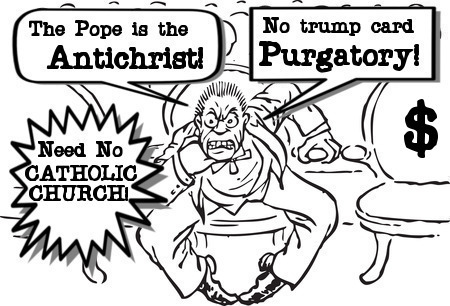
Purgatory is a myth. Peter was Jewish so how could he be the first pope? I am no longer going to the catholic church because it is all symbolism over substance. It will be a pope (HOLY FATHER, WHAT A JOKE!) who will be the antichrist or at least be very supportive. I joined the catholic church before getting married 29 years ago and I told my wife (who is catholic) that many things the church did were wrong. After many years she agrees and my daughter has taken religious courses that prove the evils that exist.

FATHER JOE:

In the course of God’s progressive revelation to his people, the Jews had come to believe in both an afterlife and that atonement could be made for the dead. Jesus speaks about the afterlife drawing from the analogy of a debtor’s prison where none could be released until the last penny was paid. While the passion and death of Christ makes possible our redemption, he desires that we have both a saving personal faith in him and a corporate faith as members of his new People of God, the Church. Purgation is a sign of God’s gracious mercy. We must be transformed by grace and made perfect for heaven. If we belong to God, then he will finish what is started in this world. The saints of purgatory are all destined for heaven. As they approach the fire of God’s love, that eternal flame burns away the last vestiges of sin and vice. Temporal punishment is appeased and we are made truly holy. Such is no more a myth than our abiding faith that our Lord has gone ahead of us and that he prepares a place in heaven for his children.

The first called by Jesus were the Hebrew people. Salvation comes from the Jews. The apostles were all Jewish and yet at the Last Supper our Lord instituted both the priesthood and the Eucharist. Just as there are Semitic Catholics today, Peter was both Jewish and visible head of Christ’s Church, the Catholic Church. The Jews became the first Catholics.

You probably never really understood your Catholic faith to really know what you were rejecting. Did you ever sit down with a priest and ask your questions? Did you take advantage of adult faith formation in your parish? The odds are that you did not. There is no conflict between sacred signs and a faith of real substance. The problem is that you may never have known where to look for that substance or the meat of faith.

The Pope or Holy Father has even written a personal reflection on the life of Christ, now in two volumes. He preaches and witnesses to our Lord. Be careful of blasphemy against the Holy Spirit. If God does protect Pope Benedict XVI and the faith and morals he teaches, then you slander not men but God. Only ignorant men filled with hatred would call the Pope by the demonic name of “antichrist.” Be careful that the joke is not on you.

You did not have to join the Catholic Church to get married in the Church. The fact that you entered a Church in which you placed no faith is tragic. It says nothing against the Church but volumes about your own lack of integrity and discretion. Why would you lie and say you believed when you did not? You should have shared your reservations then and withheld your prejudiced venom now.

I suspect that you undermined your wife’s weak faith and now delight that your child has also been stolen from the Church. Am I supposed to take these remarks seriously? I challenge you to bring your family to a strong parish-run Catholic instruction program. Bring your questions to the priest. You assume many things and there are plenty of misguided ministers ready to steer you away from Catholicism… not with a positive message of their own, but with a negative message against the Roman Catholic Church. They build themselves up by tearing others down. My Church preaches love, not hate.

DENNIS:

You tell me I assume many things. What about you? You assume I undermined my wife’s faith. You assume that her faith is weak when she has more faith than anyone. You assume that I am delighted that my daughter has been stolen from the church. WRONG! …AND BESIDES SHE IS HERE TO FOLLOW CHRIST not the church. I will never believe in purgatory no matter how persuasive your arguments. If Peter was pope, which I do not believe, then his successors should have been married like him. Perhaps then all this sick disgusting behavior would never have occurred? I will say no more, but I never personally attacked you like you have me. Some of your responses to others seem almost hateful. Trust me; I have done plenty of researching to draw the conclusions that I have. Stop thinking you are the only one with truths. Thanks for your time.

FATHER JOE:

Your assumptions about Catholicism are not coherently argued. You are working from a prejudiced view of the faith, not as one who is truly informed.

As for myself, mine is a faith seeking understanding. Catholics do not accept a blind faith that is at war with reason. We seek to know the truth from all the pertinent sources: the authority of the Church, the Sacred Scriptures, Sacred Tradition, philosophical and theological inquiry, dialoguing with other disciplines of learning, etc.

If your wife abandoned her religion in light of your postured conversion, it is only reasonable to assume that you undermined her Catholic faith. Indeed, you take delight that you have had a part in your family’s defection. I am sorry if you think I am rude but I find what you did to be reprehensible and dishonest.

Catholics regard our relationship with Jesus Christ to be intimately bound to our union with the Church. Our Lord makes himself and his saving activity present through the sacraments of the Church. Defection from the faith means a certain level of estrangement from our Lord, although as in your wife’s case, it might not be absolute. Only God is the ultimate judge as to whether such actions will cost people their salvation.

Peter was the first Pope, although the title was only used later. Being married or not married is beside the point. You would condemn celibate priests as well as chaste single people. Not everyone gets married. Some choose not to do so, like Catholic clergy, and others never meet the person with whom they want to settle down. Our Lord Jesus never married. The beloved apostle John never married. St. Paul never married. The Pope’s line of apostolic succession runs from both St. Peter and St. Paul, although the universal primacy passes down from St. Peter. You equate not being married with perversion and the child predator. You are a very sick and bigoted man. Why are you so angry? Why would you condemn the virginity of the Pope and so many priests? Yes, there have been a few criminals, but there are many of these among married men, too— even Protestant ministers.

I have not sought to be hateful, only truthful. Your allegations are in themselves of the most vulgar sort. It is hard to make proper responses to such bigoted allegations and ignorance. I suppose you would judge any response, as hateful. Part of the problem may be that you have neither the intellectual nor the spiritual tools to discuss such matters calmly and reasonably. That is one of the reasons why I suggested that you contact your local priest and maybe enter the continuing religious formation program. You should at least understand what you are rejecting.

Research has to go further than Chick comics and the ravings of anti-Catholic apologists who hate the Church. If you have nothing to fear, then go to the source… and speak and act with humility.

DENNIS:

I would love to talk to you personally and see if you would call me such things to my face. God have mercy on you for being so judgmental and hateful.

FATHER JOE:

You are upset with me? Listen, you come to “my” blog and assert the following:

  1. You bluntly stated that Purgatory is a myth.
  2. You illogically argued that Peter was Jewish and thus could not be Pope.
  3. You ridiculed the Catholic Church as placing symbolism over substance.
  4. You mocked the Pope, saying his title “HOLY Father” is a joke.
  5. You fall for the fundamentalist lie that the Pope is the antichrist.
  6. You joined the Catholic Church to marry your wife but never believed in what it taught (where is integrity?).
  7. You taught your wife and daughter that the Church was evil and so they defected with you.
  8. You will never believe in Purgatory no matter what sensible arguments I and others might make.

Either on the Internet or at my door I would tell you the same. I am not being mean to you, only truthful. Sorry if the truth hurts.

DENNIS:

It is not the truth that hurts. What hurts are the many lies the catholic church has told. I am glad I found out in time. Find out about things that go on inside the vatican: statue of Buddha placed on an alter; giving those of the wiccan faith a room to worship; the upside down cross that is satanic. I only want to leave a church. I am not leaving CHRIST. It is only HIS grace that can save us. The church was not built on peter but Christ. “The Rock the builders rejected became the cornerstone.”

Jesus told the criminal on the cross, “Amen I say to you, today you will be with me in Paradise.” Jesus did not say anything about purgatory. I asked a priest about this and basically he said he defied the odds. I only laughed at this.

Only Jesus is HOLY not the pope.

Praying with people who practice witchcraft, worship Buddha, making the Nazi sign with Hitler, kissing the Quran… are these not signs of antichrist?

I married my wife because of love. Since then we have learned that many things the church teaches are lies. Have you never believed something at one time and then found out it was not what you thought?

You state I taught my wife and daughter these things. My daughter learned many of these things at university here in Canada. We still believe STRONGLY in JESUS CHRIST.

My non-belief in purgatory has nothing to do with salvation. It is only by GOD’S GRACE that we are saved. Acceptance of CHRIST as your savior is the only way to eternal life.

The catholic church has collected plenty of money over the years for saying masses for “SOULS IN PURGATORY.” If there is no purgatory then this money will be a testimony against it at the time of judgment. Great pastors and preachers like BILLY GRAHAM, DAVID JEREMIAH, CHARLES STANLEY, I could name many more, (hardly a list of wackos), do not preach about or believe in purgatory.
So the truth does not hurt at all, it sets one free.

FATHER JOE:

Say what you like, you are still running away from the truth (about yourself). I am a Catholic priest, but while convinced of the Church’s claims, I have studied the writings of the Reformers directly and as objectively as possible. I disagree with many of the views of the Protestant churches, but I have never pretended to be a Protestant. I would also not want to build my Church up by tearing down the religious beliefs of others. Christians of various denominations can find points of concurrence and work together for a more loving and just society. Not all non-Catholics are anti-Catholics. But you would fit the profile of a bigot against the Catholic Church. You classify Church teachings as lies. You even gloat about your prejudice. And, like so many of your ilk, you get basic facts wrong.

Someone wrongly placed a small Buddha statue on an altar during the Assisi Ecumenical Conference (not Vatican) back in 1986. Cardinal Ratzinger (now Pope Benedict XVI) was furious about the mistake.

I have no idea what the Wiccan reference is about. Such paganism is in direct conflict with Catholic teaching and worship. Indeed, several years ago there was an incident where Wiccans insisted on using a military chapel for their services. The U.S. Government cannot play favorites regarding the faith practices of uniformed men and women. The military code of conduct required that the Wiccans keep their clothes on. Afterwards, the Catholic priest and several Protestant ministers offered prayers and ritual to spiritually exorcise or cleanse the room and altar-table.

The so-called upside down cross is not satanic. It is the ancient symbol for the first Pope, Peter. Tradition has it that he was crucified upon an inverted cross. He requested it, not feeling worthy to die like his Lord.

I cannot know your conscience, and only God can judge you, but in my estimation, defection from the Church is a departure from Christ.

Christ is indeed the cornerstone of the Church, but Peter remains KEPHAS or ROCK. He says he will build his Church upon him and after his resurrection, he heals him with the threefold admonition to his question, “Do you love me?” Jesus says: FEED MY LAMBS; TAKE CARE OF MY SHEEP; and FEED MY SHEEP.

As for purgatory and the good thief, you are being silly. Temporal punishment can be remitted by earthly penance and endurance of suffering. Given that he had faith in our Lord and was repentant, dying on a cross next to Jesus must assuredly count for something. Our Lord promises a place with him in paradise. As for ourselves, even if we must pass through purgation, we are also promised a place in his mansion of joy.

All holiness belongs properly to God. But God can extend his presence and make us saints. We can be transformed by the mysterious holiness of God. We can apply the word HOLY to the Pope and to all who have a share in the eternal life of Christ.

You fault the Church for an errant ecumenism which the universal Church and Pope Benedict would not condone. Each can worship as his conscience dictates, but we would not blend the Christian dispensation into a mix with those outside the Judeo-Christian tradition. There can be separate acts of prayer, communal dialogue and debate, a cooperative exploration of the truth and a partnership in making a better world. But Catholics do not practice witchcraft, worship Buddha or any of the Hindu deities. National Socialism, along with Communism, was condemned by the popes, even prior to World War II. You hate the late Pope for kissing a Koran as a sign of human respect to the one billion plus Moslems in the world, well, then so be it. But you are chasing ghosts because everyone knows that the Pope places his faith in Jesus and not in Islam or Mohammad. Indeed, when Pope Benedict XVI urged Moslems to disavow violence as a means to bring about conversion, millions chanted, “Kill the Pope!” It seems that you might have more in common with these fanatics than the Holy Father. If the Pope is truly the Vicar of Christ and you oppose and ridicule him, would this not make you an antichrist?

I am glad you married your wife because of love. I became a priest because of love. However, I always tried to act honestly and from conviction. My entire life is dedicated to God’s service, loving God by ministering to his people. While a teacher, I am also a perpetual student. We can disagree about various points, but I do not see lies when I examine Catholicism. As a matter of fact, I would not accuse Protestant churches of lies, either. There are many good Protestant churchmen who study and teach and work with honesty and professionalism. You would not extend such words of courtesy to the Pope or to a lowly priest and pastor like me.

I am glad you still believe strongly in Jesus Christ. That may be the one element we share. The doctrine of purgatory is a facet of soteriology. We must be made perfect. The elect want to be made perfect. Everything is grace. We are redeemed, given faith and perfected by grace. We cannot save ourselves. Prayers for the dead are literally our way of adding our breath to that divine fire which purifies us like the gold in the furnace. In the end there will only be two realities, heaven and hell. Jesus is the way and the truth and the life. There is no other way to the Father. This is basic Catholic teaching 101.

The stipends for Masses are gifts to the priest. At one time they were the only resources he had to live upon. But the priest will apply the fruits of his Mass even without remuneration for the effort. Ultimately, the sacraments are free. The priest is duty-bound to pray for his people, living and dead. It will be upon that, that he will be judged.

I can give you a long list of popes, bishops, priests, deacons and laity who accept and teach about purgatory. Looking at your list, did you know that Billy Graham has said that the Catholic Gospel is the same as his? Did you know that he contacts the local Catholic churches when he does revivals and sends Catholics who answer the altar call to Catholic churches? Did you know that he has shared his pulpit with Catholic clergy? Evidently he does not see the doctrine of purgatory as an impediment in witnessing the faith alongside Catholics. Do you really think that your venom would please him? I would not be surprised that you turn on him now, like so many other Fundamentalist bigots have chosen to do.

Sometimes the truth does hurt. You say it does not. But that is the problem, it is supposed to hurt. The freedom that we know demanded the great “hurt” of the cross. Our Lord invites us to take up our crosses and follow him.

DENNIS:

I can no longer see any point in discussing things with someone who continues to assume so much about me.

FATHER JOE:

I assume nothing; you come out and reveal what you are about to us all.

DENNIS:

As for BILLY GRAHAM, sharing the pulpit with catholics does not mean he believes in purgatory.

FATHER JOE:

But it does mean that he sees no problem with such a belief and views Catholicism as a saving Christian faith.

DENNIS:

By accepting JESUS as our savior he enters us and lives HIS life through us.

FATHER JOE:

Actually, by accepting Jesus, we enter into his life and are transformed.  There is a two-fold movement.  We accept the redemptive intervention of Christ.  We believe in the infusion of divine grace.  We believe that Jesus enters us through the gift of Holy Communion.  Jesus became a man (coming to us) that we might have a share in his divine and eternal life (entering into the divine mystery).  You do not believe in such a transformation or becoming a new creation in Christ.  Those who reject purgatory tend to subscribe to the Lutheran view of juridical imputation.  This has been labeled by one critic as salvation by disguise.  We must enter into and make our own the mystery of Christ.  Christianity is an incarnational religion.  Christ lives in us.  We must give birth to Christ’s presence, proclamation and activity through our lives. 

DENNIS:

We are cleansed by the blood he shed for us.

FATHER JOE:

His blood makes possible the remission of sins.

DENNIS:

But basically you are saying that is not enough and that we need purgatory.

FATHER JOE:

No, you are saying that, Catholic teaching sees no conflict in the redemptive work of Jesus with purgatory. Our Lord makes possible our approach to God and our entry into heaven. We must still participate and accept his gift. Souls that belong to God but are not yet perfected, endure purgation as they approach heaven. Not all souls pass through purgatory.

DENNIS:

Purgatory therefore is a higher trump card than CHRIST.

FATHER JOE:

Purgatory is no trump card at all. Souls that pass through purgation are all headed toward heaven.

DENNIS:

As for the pope, he is the head of the catholic church, not all Christianity.

FATHER JOE:

The Catholic Church is the one, holy, catholic and apostolic Church. All true Christians are in some fashion, even if tenuously, attached to this Church. In that sense, Catholicism is the purest form and the true Christianity.

DENNIS:

As for calling me silly about the criminal, fine if you want to resort to name calling, but this is an issue I prayed about and this is where God directed me, but as you have little respect for me you probably won’t believe me.

FATHER JOE:

I did not call you a “criminal.” Using the word, I was referring to the few misbehaving priests. What you said (about the good thief) was silly. And please be honest, you never had any respect for me from the very beginning. How could you, since you regard the pope as the antichrist and me as one of his minions. What do I think about you personally? I do not think I actually shared much of anything about that, except for a deep disappointment. You pray, and that is good. Prayer is certainly positive, but remember the posture of humility and the need to feed your faith with truth.

DENNIS:

Also I will repeat, just because I don’t want to attend the catholic church anymore does not mean a defection from Christ.

FATHER JOE:

Only you can know this in your own conscience. As for me, any departure from the Church would constitute turning my back on Jesus.

DENNIS:

Also I will credit you with teaching what you believe, it is just that I do not believe some of the catholic teachings and have moved on.

FATHER JOE:

That is fine, but remember this is my blog, and I have a right to express my faith here. I also get the last word.

DENNIS:

You say yourself there are only two realities, heaven and hell. I guess with purgatory no one will see hell.

FATHER JOE:

Why would you say this? The existence of hell is also Catholic doctrine. Once again, here is a statement that proves to me that you really do not understand Catholic teaching. Traditional Catholic eschatology is very clear. Some souls go straight to heaven (forever). Some souls go straight to hell (forever). Some souls go to heaven but pass through purgation (so that they can be perfect in heaven). Souls in purgatory have been forgiven. Like those in heaven, they have been washed in the blood of the Lamb. All souls in purgatory will go to heaven. When the end comes and the final consummation, there will be two realities, heaven and hell. Purgatory will cease to exist.

DENNIS:

Again, thanks for your time. The many things that you have assumed about me certainly do not demonstrate love. To call someone a bigot is HORRIBLE. I would never refer to someone this way even if I thought that way about them.

FATHER JOE:

You cannot have it both ways. You insult the Pope as the antichrist and imply that Catholicism is involved with witchcraft and false religion. I am a priest; mock and malign the Pope and the Church and you impugn me as well. I call it as I see it. I speak the hard truth in love. Yes, Dennis you are an anti-Catholic bigot. You might love Jesus but you have amply shown that you hate his Church. I am spiritually married to that Church and have given up wife and family to serve God with a single-hearted love. You probably feel that I have wasted my life. You have no love and no desire for priests or the sacrifice of the Mass in your life. I became a priest to offer the Mass for the living and the dead. I became a priest, so that like St. Paul, who was an ambassador for Christ and a minister of reconciliation, that I might bring our Lord’s forgiveness of sins to the lives of God’s people. This is not my job. This is my identity and vocation. But I guess I am talking to the wind. You are too far gone to understand. As you said, you have moved on. I will pray for you. Maybe one day you will wake up, and even if you do not come home to the Church, maybe you will again see that good Catholics are your Christian brothers and sisters? Enough said!

Our Call as Prophets

Ez. 2:2-5 has many interesting elements for us to consider. The Spirit of God moves Ezekiel; he says it “set me on my feet.” In other words, the Spirit compels or moves him to action. He stands before God and must be on his way to the Israelites. God, himself, admits that they are an obstinate and hard-hearted people, but this makes no difference. Come what may, Ezekiel will be the mouthpiece of God and “they shall know that a prophet has been among them.”

It is a wonderful image of the prophet for us who follow that other “son of man,” Jesus, who is also the Son of God. God calls us in our baptism to be prophets to the world. However, do we stand up and take action and speak prophetic words? Or, do we remain at rest and hope that God will change his mind or get tired of summoning us?

How are we called as prophets today? Four thousand unborn babies die in our nation each day through abortion. Do we raise our voices in protest? Do we support the local pro-life efforts and pregnancy centers? Do we lobby our elected officials and hold them accountable? Have we considered peaceful civil disobedience and marching? This is the first and most important issue facing us today, although there are others as well. Do we stand for racial integration and social justice? Do we promote marriage by our lifestyle and counsel over promiscuous and/or disoriented behavior? Do we take the high ground in avoiding and not patronizing pornography in films, television, magazines, Internet, and books? Do we dress, act, and speak modestly? Do we use language worthy of the children of God or instead use words from the gutter that corrupt lips that should praise God? Do we respect the Church’s teaching about the transmission of human life and birth control? Do we worship regularly and support our struggling churches? Do we honor our bishops, priests, and religious or do we mock and joke about the special messengers of God? Do we pray when there seems no time or we find ourselves busy? Do we defend our Church against ridicule or do we ourselves become sources of defamation against the Rock of Christ? Do we speak the truth in love to our families or smother the message under empty human affection? Have we been our brother’s keeper or have we exploited others for our own selfish purposes? If we stand up for what our faith tells us is right, then no matter whether others approve of us or not, they will know that prophets have been in their midst. If we have sometimes failed, we can follow the late Pope’s lead in making a “mea culpa” for the past and in becoming true signs of contradiction in the present. As the psalm response tells us on the 14th Sunday Mass of Ordinary Time (B), we can say: “Our eyes are fixed on the Lord, pleading for his mercy.”

Like Ezekiel, Paul is called by God and, along with a thorn in the flesh against pride, is told that divine grace is sufficient for his witness. All that matters is that we are faithful. Everything else belongs to the providence of God. The true prophet will know persecution. Paul says, “Therefore I am content with weakness, with mistreatment, with distress, with persecutions and difficulties for the sake of Christ; for when I am powerless, it is then that I am strong” (2 Corinthians 12:10). We have Catholics in Chinese prisons for their loyalty to the Pope. We have murdered Christians in parts of Africa and the Orient for daring to make converts. We have believers in American jails for saying rosaries outside abortion clinics. We have nurses, interns, and pharmacists who have lost their positions because of their fidelity to the Gospel of Life. We have children who have been silenced from mentioning God in prayer or listing the commandments in school. We have brothers and sisters in the military that have been passed over for promotion for speaking their mind in disagreeing with the liberal policy on active homosexuals in the ranks. We have Christian friends who have been punished for putting a bible or religious image on their workplace desk. Christians are fined or litigated against for wanting public religious displays of faith during the seasons of Christmas and Easter. Coalitions of Catholic and Protestant Christians are ridiculed as “far right” or “fascist,” sometimes even by those who are supposed to be Christian. The issues are many, and yet the Christian posture should always be the same: fidelity to God in the face of the faithlessness of a civilization that has turned its back on him.

It is a shame that while television programs advertising the possible winning of a million dollars or marrying a millionaire get high ratings, religious programming has virtually disappeared from the commercial and public stations. Indeed, marriage is reduced to sex and money; that which is supposed to be a sign of the covenant between Christ and his Church. The world and certain televison networks minimize it to primetime prostitution. Where are the prophets? Where is the outcry?

Mark 6:1-6 has Jesus going home and speaking in the synagogue. He laments that those who think they know him really know nothing. Their lack of faith reduced his effectiveness among those to whom his heart most wanted to embrace. He healed a few and then went to the neighboring villages instead. We have prophets in our midst, too. However, sometimes we call them fools or fanatics. People who really speak and live their faith make most of us uncomfortable. They remind us about what we would prefer to forget– our own impoverished discipleship. The great Catholic sin comes to mind, not what we have done, but what we have failed to do. Jesus is in our midst, do we recognize him?

For more such reflections, contact me about getting my book, CHRISTIAN REFLECTIONS.

Yearning for Life and Happiness

We do not want to die. Okay, I know that some would object to this statement, but opposing sentiments are usually the exception. These exceptions are generally aberrations due to some form of suffering. We have all heard of suicide victims due to mental illness and depression, emotional trauma, excessive physical pain and handicap, and delusion (as in certain cults). In all these cases there is a running away from something (pain or anxiety) or a fleeing toward something (a higher plain of existence or some other such alternative). The latter comes close to the Christian hope, although with one essential difference, true faith defends the dignity and sacredness of all life, here and now.

Our desire for life is joined with a natural longing for happiness and a supernatural yearning for reconstitution and union. Thoughts of heaven are often filled with joyful images. It is associated with the festivity of a wedding banquet. We will be eternally happy. We will know the peace that the world can only dream about. All our analogies pale in comparison to what awaits us. Popular religion often envisions peaceful angels playing harps while sitting on soft clouds. It is a cute picture, but the reality we anticipate as Catholics is more complex. We want to live forever, but not at all costs. That is why the contrary image of hell is ever so frightful. Instead of happy images, popular piety views it as a dark abode of stifling smoke, eternal flame, and agonizing pain. Again, this is very interesting, but here too, the Catholic contribution would go much further. Why is there joy in heaven and pain in hell?

When we attempt to answer that question, our view of life after death becomes much more mature and realistic. Those who opt for hell, despite the irrationality of it, have mysteriously chosen it. A good God will not force his children to be happy and so he honors this choice. This is the most frightful freedom given to us, the ability to embrace or to reject the God for whom we were fashioned. Unlike the Seventh Day Adventists and similar groups, we do not believe that the dead momentarily pop out of existence or sleep or become unconscious. They are alive. However, the eternal life promised by Christ refers not merely to continued existence beyond the grave but to a participation in the life of God. This is first made possible in this world through faith, the sacraments, and the grace of God. Thus, the elect of God, despite difficult bouts with sin and the need for constant forgiveness, already in this world walk with one foot in the next.

We believe that the souls of the dead, commonly called ghosts, pass from this world into heaven or hell. That journey to heaven may take them through a period of purgation, a time of cleansing in which our prayers are most beneficial for them. While hell signifies eternal frustration and both a hatred of God and self; heaven is understood primarily as the abode of God. Christ has promised a room in his Father’s house to those who love God.

The life of heaven implies perfection into the likeness (holiness) of God. We are not only completely healed from the lingering effects of sin, but grace builds upon nature making us something greater than if left to ourselves. God fills that space in us that only he can make complete. There is union with God and with those who have gone before us. This reunion with our beloved dead is a principal element of our expectation for the life of heaven. Every loss has wounded us. Every death has reduced us. This is given back in heaven. The stagnant image of heaven and eternal life, so prevalent in popular Christian culture, would never satisfy. The finite creature can never exhaust the mystery of an infinite Creator. Heaven allows an exploration into God himself that will never know final resolution. Heaven is endless discovery and satisfaction. By comparison, everything we know now fails quickly to satisfy. Mortal life is short and often filled with disappointments, hurts, and loss. While we are promised a full restoration, body and soul; like our glorified Lord, we will know the wondrous everlasting fruits of his victory over suffering, sin, and death.

There is an irony today regarding our desire for life and happiness as compared to our society in the grips of a culture of death. Our preoccupation with our own personal lives and transitory pleasure seeks to disfigure what life is really about. Many who claim a faith affiliation live and act as if this existence is all there is. When this life becomes difficult, increasing numbers want the option of euthanasia. Quality of life decisions and careers often take precedence over the lives of the unborn, leading to millions and millions of abortions. Many are advocating infanticide for those children deemed defective, as if a handicapped life has no worth, and creating too great a burden upon us. The new deity of science is holding out the prospect of longer lives through DNA manipulation and the harvesting of body parts from clones designated as non-persons. It may sound like Science Fiction, but the brave new world is rushing upon us and the dignity of human life may very well be a casualty.

For more such reflections, contact me about getting my book, CHRISTIAN REFLECTIONS.

A Royal Household

Christ invites us into his kingdom, not merely as subjects, but as members of the royal household. There are no strangers in heaven. All who belong to Jesus are his brothers and sisters, adopted sons and daughters to the Father and children of Mary. I am reminded of a family who lost their son in the Second World War. At the end of the war with Germany, they hosted a young German soldier recently released from the prison camp. He had been captured on the very battlefield where their son was killed. It was even possible that he had been the one who took their son’s life. They had every right to rant and rave. However, instead of hating the young man they showed him the hospitality of a loving family. They shared their faith with him and he attended church services with them. When they discovered that he had no family back in Germany, they invited him to stay with them. While they would never forget the son they lost, they could say, in a genuine way, that their son was lost and has been found, dead but now come to life again. We murdered Jesus on the Cross by our sins. However, instead of condemning us, we are given a share in the eternal life of his kingdom.

For more such reflections, contact me about getting my book, CHRISTIAN REFLECTIONS.

A Message for Every Age

The Lord appears to Mary Magdalene, consoles her, and sends her off with the news, “I have seen the Lord!” (see John 20:11-18). The insistence upon the witness of women in the Scriptures reveals to us just how much both men and women were called to be Christ’s disciples. Mary Magdalene proclaims the Good News to Jesus’ other followers, the men with whom he had entrusted his apostolic authority and power. Notice his words to her. She is so thrilled to see him that he must immediately tell her not to cling to him. He exclaims that he is “ascending to my Father and your Father, to my God and your God!” This is one of the clearest statements by Christ that his particular Easter event will also be ours. The words also echo the time when he taught his friends to call God, “Our Father,” in the Lord’s Prayer. We, who belong to Christ, belong also to the one who sent and raised him up. We who are now identified with Christ can appropriately call God our adopted Father. He keeps us in existence and in baptism refashions us into the likeness of his Son.

Likewise, the disciples in Acts 2:36-41 take this message and make it the cornerstone of their ministry. We have put Christ to death by our sins; however, we can repent and be baptized into Christ Jesus. Peter said, “It was to you and your children that the promise was made, and to all those still far off whom the Lord our God calls.” I would love to etch those words near the main doors of the church. The message of Christ was not simply for the Jewish people, nor was it for the Gentiles alone who lived two-thousand years ago. His has been a message for every age. We are many miles and many years separated from the period when Jesus walked the earth; however, no matter how far off we have been from him, his message is just as important and alive today as it was yesterday. We are still called to repent and believe. No political order, no philosophy, no educational program, no, none of these have been able to make man one iota better than he was in ancient Palestine. “Save yourselves from this generation which has gone astray.” Yesterday and today our hope remains in Christ and in his forgiveness. Just as our sins in this age contributed to his crucifixion; so too does his grace and forgiveness contribute to our redemption.

For more such reflections, contact me about getting my book, CHRISTIAN REFLECTIONS.

The Kiss of Death

The title chosen for this subheading might make one imagine a romantic setting where some daring spy has an affair with a deadly enemy agent. Such is how our minds and imaginations work these days. The arachnologist might fantasize in some poor anthropomorphic way about the love of two black widow spiders. The male was under her spell. Did he know that her embrace guaranteed new life and the end of his own? Snap! She bites off his head — oblivion, the end of a relationship — now he is merely fodder for a patricidal cannibalistic brood. Sweet and deceptive is the kiss of death. Perhaps the maiden being drained of her blood by a vampire in a late-night B-movie would think so? I digress enough. While these might make interesting if not sick asides; what I want to mention briefly is a far more realistic kiss, a kiss which has touched the lives of each and every one of us.

It is the story about a lonely figure in a garden. His friends are asleep. He had hoped they could spend awake what little time he had remaining with them, but alas, the flesh was too weak. All are asleep, except for one other. He had called this man friend. He had trusted him with their traveling purse. He had called him to follow him by name. And if Christ most loves the sinner, then this was the one man besides his beloved John whom he held closest to his heart. His name was Judas Iscariot. He came quietly in the night. Drawing near, he greeted his Master with a kiss. It had begun. All the sin that had ever erupted into the world, or whichever would, was a part of that kiss. A thousand, a million, no a billion and more lips touched his check in a gesture which should have meant love. Instead, it was an act of the direst betrayal. Voices in history would echo the cry, “It would have been better if this man had never been born!” (see Mark 14:21). Maybe it is so. Does he now reside beside Satan? I don’t know. What tears he must have cried in knowing that he could not force Christ to be something he was not. No, Jesus would not liberate with arms or with trumpet blasts. He would submit. He would die.

The seeming irony of our faith is that the kiss of death on our part, the hypocrisy of its false love is turned around by real love, a love which gives life and not death. Maybe like the sinner woman who dared to enter into the Pharisee’s home to wash Christ’s feet with her tears and later to dry them with her hair, we too need to see that the strangeness of God’s ways are not always ours? He comes not for the righteous but for the sinner; not for the rich but for the poor; not for the satisfied but for those still hungry. He comes not waving a sword but pierced by one.

For more such reflections, contact me about getting my book, CHRISTIAN REFLECTIONS.

God Does Not Forget Us

“Can a mother forget her infant, be without tenderness for the child of her womb? Even should she forget, I will never forget you” (Isaiah 49:15).
Isaiah 49:14-15 has a deep meaning full of touching significance. They are words which can offer great consolation in times of hardship, if only we would really believe them. Jesus lived these words. As the reflection of the Father and His love in our world, he embraced the outcasts and made them his friends; he touched the sick and made them well; he went out to sinners and offered them forgiveness; and he became our brother in dying, so that we might share his new life. In all this, God did not forget us even though His children might turn their backs on Him. Jesus makes reference to these words of consolation, when on his way to the Cross. Those of you who pray the Stations of the Cross will well remember it. He tells the women of Jerusalem not to fear and weep so much for him, as for the children to be born of them. He foretells a time when love will become sterile and the barren womb blessed. He can well say this, for he has realized in his own flesh, indeed, his very person, the love which is eternal and yet which is rejected.

If the Lord is our foundation, if it is his love and constant care that matters to us, then this kind of trust will help us a great deal in the uncertainties of life and in the fickleness of human friendships. Of course, some relationships by their very nature seem to reflect the human/divine fellowship more clearly. Not too long ago I was in the hospital with an elderly man who got to see his wife a few moments before serious surgery. He said to her as he touched her face, “You know who loves you, don’t you?” And then, ever so softly, with tears in her eyes, she responded, “I know, you do– I love you, too.” For half a century they had loved and cared for each other. I don’t know about you, but that says something to me about my commitment to love as a Christian and as a priest. Most important of all, it gives me a glimpse of just how much God loves and never forgets a single one of us– not even for a moment.

He is our rock, our salvation, our hope, our strength, and safety. We are to surrender our lives to him in trust and love– for he loved us first. Apart from him, we would have nothing. No, we would be nothing.

In Matthew 6:24-34, Jesus practically begs us to trust the Father and his unceasing love and concern for us. So much more important are we than the birds of the sky or the lilies of the field. We can respond to God’s love with love. He desires for us to discard our fears and believe in his saving power. How often we must fail him? We worry about so many things. The money is short. The children are difficult to control. The job is boring or too straining. School work is piling up and the studies for tests are driving us crazy. A special friend or even a spouse in their distance to us, might be a cause for fear or loneliness. Our worries are many, too many. We kill ourselves with worry. The Church, having the mind of Christ on this matter and yet so very aware of our tendency to fret over things large and small, even daily petitions the Lord in the Mass, following The Lord’s Prayer, to DELIVER US FROM ALL ANXIETY. Notice the English translation says, not SOME, not UNNECESSARY, but ALL ANXIETY. It is not from God.

No matter what comes, God will be there with us– even if his presence is hidden behind the veil of pain and his will glimpsed only piecemeal through the flickering haze of human history. If everyone we love should abandon us, either through death, pain, or neglect, he will never abandon us. The Lord is our Everlasting Friend. A sign that we truly believe with all our hearts and minds in this friend and in the Father who sends us both his Son and the Spirit who is Love Personified, is that we trust as Christ himself trusted– not just externally for others to see– but to be at PEACE in ourselves.

Our Lord in his Gospel says to those weak in faith: “Your heavenly Father knows all that you need. Seek first his kingship over you, his way of holiness, and all these things will be given you besides. Enough, then, of worrying about tomorrow; let tomorrow take care of itself. Today has troubles enough of its own” (Matthew 6:32-34) — wise words. The troubles may come. But along with them, faith, hope and love remain possible in Christ. If we find it lacking, then let us ask for it, pray for it, live for it. It will be given.

For more such reflections, contact me about getting my book, CHRISTIAN REFLECTIONS.

Discernment of Spirits

We are called to pursue something of a personal discernment in regards to our sinful nature. Look at 1 Corinthians 2:10-16. The selection begins, “The Spirit scrutinizes all matters, even the deep things of God.” It is a wonderful and insightful depiction of the interior life. We as Christians do not simply follow laws in blind obedience. We are called not to go through the motions of faith; quite contrarily, we are to be filled within by God’s Spirit.

It is difficult for me to convey what I mean here. On the spiritual level, we need to be in communication with the Spirit of God. God helps us to see our failings as well as offers us gifts to transcend them. We pray. In the quiet of prayer our open hearts are clasped by a heart greater still.

We reflect upon our life and ask God for a deeper share in his, by instructing, loving, forgiving, and healing. Anything that would contend against these values of Christ would be from the spirit of the world and not from God. The world’s spirit cannot understand us because it is too restless. It hides sin behind deceit and rationalization.

It is no friend of the truth. It loves its own ends without full consideration of others. It seeks revenge instead of forgiveness and will not admit wrongs. And, instead of healing, it will step on anyone or anything to get what it wants.

In the quiet of our life, we need to know that other Spirit which seeks peace. The fruits for these two rivals in our loyalties are so different, that it should not take long to begin the work of distinguishing one spirit from the other. However, it may take a whole lifetime to detach one. The spirit of the world will not readily leave and it is greedy to possess us. It wants to dull or deafen our consciences with the noise of sin and distraction.

Like the demonic in the Gospel (see Luke 4:31-37), we need Christ’s help in destroying it and demanding it to come out. We cannot do it alone. Christ’s voice alone is loud enough to restore order and peace. He has been given this authority to liberate us and to fill us with God’s Spirit. In this way, we can put on the mind of Christ and not the mindlessness of the world. Consequently, our continuing reflection must rely upon a profound trust in Jesus Christ and his grace in us.

For more such reflections, contact me about getting my book, CHRISTIAN REFLECTIONS.