












• Our Blogger

    Fr. Joseph Jenkins

  • The blog header depicts an important and yet mis-understood New Testament scene, Jesus flogging the money-changers out of the temple. I selected it because the faith that gives us consolation can also make us very uncomfortable. Both Divine Mercy and Divine Justice meet in Jesus. Priests are ministers of reconciliation, but never at the cost of truth. In or out of season, we must be courageous in preaching and living out the Gospel of Life. The title of my blog is a play on words, not Flogger Priest but Blogger Priest.

  • Archives

  • Categories

  • Recent Posts

  • Recent Comments

    Anonymous's avatarAnonymous on Ask a Priest
    Michael J's avatarMichael J on Ask a Priest
    Jeremy Kok's avatarJeremy Kok on Ask a Priest
    Mike Zias's avatarMike Zias on Ask a Priest
    Jeremy Kok's avatarJeremy Kok on Ask a Priest

The Spirit and the Church’s Mission

The annual commemoration of Pentecost is to the Church what Christmas is to Jesus, the celebration of a birthday. Our Lord had compared the Church to a grain of mustard-seed, among the smallest of seeds. But, it grows into a great tree in which the birds of the air build their nests. Imbued with the hidden and fertile presence of God, what seems dead, little more than bothersome dust, blossoms into the mystical vine and branches of God’s holy people. Christ is the vine– we are the branches. What God initiates by the power of his Spirit, he joins to himself in permanent and life-giving intimacy. Watered by the blood of the martyrs, the Spirit of God continues to minister to the Church, preserving us in the truth of the Gospel and giving efficacy to the sacraments.

Christ sets down the foundations for his Church during his preaching and in his drawing to himself a number of apostles and disciples. On Pentecost, some three thousand people were baptized, and later, two thousand more. Such was the power of the Spirit to instill faith. Christ chose twelve apostles to preside over the rest and one to be the head of all. The descent of the Holy Spirit empowered the apostles to preach the Gospel throughout the world, in accordance with Christ’s command, and gave legitimacy to the many Christian communities they established.

Acts 2:1-11 tells us that the believers in Christ had an experience of the power of the Spirit. It seemed to overwhelm them. They spoke ecstatically in a multitude of languages. This gift of tongues was very much coveted. Scholars dispute whether or not these languages were always intelligible. However, it may be that Luke, in stressing that each person heard his own tongue, was trying to emphasize that the Holy Spirit and the Good News were offered to all, regardless of race or place of origin.

1 Corinthians 12:3-7,12-13 offers the early battle cry of the Church; “Jesus is Lord.” In the life of the follower, to call Jesus “Lord,” meant to give Christ one’s complete loyalty in life and to worship him from the innermost depths of the heart. This sacred phrase of faith with its intense meaning could not possibly be said with sincerity without God’s grace. This gift of faith is the most fundamental. Apart from the gift of saving faith, the lesser gifts would be meaningless. Having said this, we are all given different gifts. Paul stresses that we are to use what we have for the sake of the whole, the Body of Christ. All that we have– all that we are– is not simply for our own sake or pleasure, but for all in the service of God. Selflessness rather than selfishness is the proper way or disposition for glorifying God. When we think of gifts, they need not be spectacular, like prophecy and faith healing. A person might be a good carpenter, an electrician, a painter, a secretary, or whatever. All these talents and more are also gifts from God that we need to perfect and use wisely.

John 20:19-23 intimates that the apostles continued to meet in the upper room where they had celebrated the Last Supper. However, can you imagine the fearfulness that has now replaced the intimacy and peace they knew there with Jesus? The authorities have killed Christ. Maybe they are next? They lock the doors. What do they do now? Suddenly, as out of air, Jesus appears to them and restores to them his peace. Jesus comes to commission the Church. He has defeated death. There is nothing of which to be afraid. God is on our side. Jesus, himself, is the message of hope– he is the living embodiment of the Gospel. After the bitterness of men had done all it could to him, convicting him as a criminal and a liar; after they had tortured and executed him as the least of men– the verdict of men is overturned by the almighty Father. The Father’s love for his Son and the Son’s love for the Father proved stronger than death. This LOVE, that is itself God the Holy Spirit is now shared with us that we might also participate in eternal life.

Jesus breathed on his disciples and they received the Holy Spirit. The calling of the Spirit is linked to the power of creation when God formed men and women from the dust of the ground and breathed life into them. The Holy Spirit awakens the world from the slumber of death back to life. Sometimes we experience something similar to it when we are released from the death-grasp of sin back into a life of divine grace– through prayer, the liturgy, and especially the sacrament of reconciliation. Seen in light of the keys of the kingdom given to Peter, the Church is given something of Christ’s authority and power. This mandate from Christ is not simply for the Church’s glory, but to give God glory in saving souls and forgiving sins.

God conceived Jesus in the womb of Mary by the power of the Holy Spirit. On Pentecost, the same Spirit conceives the Church. The Spirit in the Church offers us truth and consolation. Do we take ample advantage of the gifts of the Spirit? Do we embrace as our own the teachings of the Magisterium, trusting that God’s Spirit preserves the Church in the truth? Do we listen attentively to the inner voice of Christ in prayer and Scripture study? Do we discern the powerful action and presence of the Spirit in Catholic worship? Do we find confidence in God, believing that his Spirit will guide and watch over us? We are sorely tempted to trust in our own meager powers, despite the anxiety and fear. We should surrender everything to the Lord who loves us so much that he has counted the hairs on our heads and would keep us in the palm of his hand.

As Christians, we claim that we are temples of the Holy Spirit. Faith is one of the prime gifts of the Spirit. By its very nature as our treasure, saving faith is a gift that we are compelled to share with others. A faith unshared withers and dies. If something great has happened in your life– someone has proposed marriage, or you have won a car, or a new baby is born– you want to shout it out from the rooftops; such is your happiness and joy. Similarly, if our faith is our most precious and undeserved gift, ought we not to share this wonder with others? Indeed, we should share it with conviction and enthusiasm. Although faith is a gift of the Spirit, we are instruments of Jesus in the world. In our talk and service we should not be timid about extending God’s offer of love to others.

You might think that you are unworthy or incapable of really fervently sharing God’s Good News. This may to some extent be accurate. The Holy Spirit works in us as rational men and women, not as things that can simply be impressed upon. We need to make as many avenues for the prompting of the Spirit as possible in study and prayer. Otherwise, we will have a hard time sharing what we do not fully possess. Worse yet, we might loose our grasp of the truth or be seduced by the arguments of others. God wants us to be the best of tools in his service of evangelization. Keep in mind, however, that the burden of conversion is held between the individual and God. Only God can change a wicked man into a saintly man. By our care for the poor, the sick, our families, and our neighbors– we preach the mission commissioned by Jesus. This mission is a constitutive element of the Church’s identity. It still goes on.

For more such reflections, contact me about getting my book, CHRISTIAN REFLECTIONS.

The Mission of the Church

The mission of the Church is to spread the Gospel and to baptize in the name of the Father and of the Son and of the Holy Spirit. As Christians, we are sent on mission at the end of Sunday worship each week: “The Mass has ended. Go in peace to love and serve the Lord.” We must take our role as missionary seriously. Where is our passion for the Gospel? Why are we not on fire telling people about it?

Certainly, we all relate to our brothers and sisters in different ways. But what does it matter? Everyone has something to contribute. Because of in-depth knowledge of our teachings and the Scriptures, some may be called to add apologetics to the work of winning converts. Others might find themselves in jeopardy if they walked that route, but be exceptional in helping people with their hurts and in touching others through personal charity. Some may relate well with young people who often look for answers in the wrong places. Still others may be able to reveal in ecumenical prayer and service the fraternity of Catholics with other believers in the Lord. We need to bring the Gospel to our homes, to our neighbors, and to our workplaces.

However, if we are going to share our faith, we had best make sure that we are Christians and good Catholics first. We need to nurture a determination to stick with the Church no matter what disappointments may come our way. Some do not do this and the results can be tragic for all. I recall a woman who studied at a Catholic college for four years and was certified to do parochial work. When the new pastor was assigned, he failed to keep a position for her. Along with this disappointment, the Pope reaffirmed that women could never be priests. Well, that was the last straw for her and she left the Church. What is sadder is that she took a few others with her. There are only so many clergy and most of the outreach into the community must be done by the laity. We have to be flexible enough to bounce with the bumps in the road. Doors close and other doors open. We have to be receptive to God’s will, even when we do not entirely understand it. The work is not so much ours, as it is the Lord’s. Some are given the gift of Holy Orders, but there are other gifts, particularly given to the laity, that facilitate the expansion of the Church and the proclamation of the Good News. Married couples are missionaries to their children. Many non-Catholic spouses embrace the faith of their Catholic partner. Single people have the gift of time and availability to help in youth groups, bible study programs, prayer circles, charity endeavors, etc. With the loss of sisters and religious brothers, the laity teach in Catholic schools, CCD and RCIA programs, etc. There are even parishioners that go door-to-door with the invitation to explore the faith and their parishes.

Spreading the faith requires that we grow in the faith, ourselves. We should search in ourselves and with others for a stronger faith and then share it, loving and caring for those with whom we come into contact– keeping in mind that the burden of conversion is held between the individual and God. God changes a wicked person into a saintly one. Our care for the poor, the sick, our families, our neighbors, by our pursuit of social justice, for peace, etc., in all these things we witness for the Gospel.

Souls are not simply converted by highly educated or witty missionaries; rather, they are brought to the Lord through the work of Christ in holy men and women inspired and sanctified by the Holy Spirit. Look at Peter, he was an ignorant fisherman! Neither Mary nor Joseph was ordained a priest; and yet, who could estimate the enormous spiritual benefits that both of them have exerted for our well being? The Holy Spirit is the Divine Counselor, who like Father and Son, makes use of frail instruments to achieve his purposes.

While the kingdom of Christ will be realized in God’s good time, the laity and clergy work together for this eventuality. Having spoken about our universal call as missionaries, I would like to say a few words about priestly ministry. Have you ever wondered what it must be like as a priest? He knows the dark secrets of people’s lives and weeps over their sins and the sheep that go astray. He sees more than his share of sickness and dying, particularly those with a regular hospital ministry. Yes, he knows the joy of witnessing marriages; but he also feels the arrogance of those who violate the commandments in dating promiscuity and cohabitation. He sometimes wonders if the young even listen to him. The happiest times are when he baptizes a child; and yet, he can never forget the babies he could not save from abortion. When things go right, God gets the praise and when they go wrong, the priest gets the blame.

People angry with the Church see him as an icon for the institution and assault him for things he had no part in, possibly going back to before he was born. This often happens when priests wearing clerics are recognized in public. When I was a young associate, I recall one fellow on the subway who sat next to me and without any introduction, shouted, “I left the Church thirty years ago, and let me tell you why!” In such situations, the priest wants to get away or argue in return, but he just sits back and listens. “A priest yelled at me in the confessional,” the man says, although he cannot recall what it was about. Such a little thing, and for all we know the poor priest probably had his own demons plaguing him at the time or was maybe just not feeling well. In any case, it was enough to make this man leave the Church. I explained how sorry I was that it happened, and the tone of the conversation changes. I miss my metro stop, but it is okay. His wife recently passed away and he had a bad heart. His mind often went back to his childhood days. Eventually, he asks, “Father, how do I come back to the Church?” What happened? I could not recall saying anything particularly moving. It must have been God’s grace. I take out my purple stole. His eyes open wide. We move to a vacant section of the train, he falls to his knees, and says, “Bless me Father, for I have sinned.” When I leave the train a prodigal son is back home. I catch a subway car going in the opposite direction, back to my exit which I missed. When I enter the rectory, I am chastised for my tardiness. I say nothing.

As a sign of contradiction in our culture, the priesthood can be difficult. However, there is also a deep consolation in being an instrument of God’s mercy in a sometimes cold world. The same difficulty should be a daily element in the lives of all Christian believers. Evangelization is not just the business of professional religious people. It is an indispensable part of our baptismal call. We can work together to make the Church a more heart-warming place for all those wounded and searching.

When it comes to Christology, the theological study of Jesus, there are some theologians who seem heavily orientated toward Christmas (the incarnation) and others who branch out from Easter (the resurrection). These are the poles of Christ’s earthly life and both have essential importance. If we are to share Jesus, we must know him.

For more such reflections, contact me about getting my book, CHRISTIAN REFLECTIONS.

Bringing in the Harvest

While the Scriptures are composed over an extended expanse of time, I am often quite awestruck over how the theme of salvation is interweaved through so many settings and types of literature. They speak of creation, growth, and re-creation. In Isaiah 55:10-11, the prophet Isaiah uses the image of rain making the earth fertile to illustrate how his words are also to bear fruit in the faithfulness of the chosen people. Psalm 65:10,11,12-13.14 paints the picture of a teeming agricultural paradise where God’s blessing causes the seed which falls on good ground to produce a rich harvest. Romans 8:18-23 offers the testimony of Paul who views all of creation groaning and in agony as it experiences its growth pains from the old to the new order. And Matthew 13:1-23, has Jesus using the tensive language of parable to speak about the seed of faith.

Throughout most ages there has been a preoccupation with the seed. It has only been since the days of the Industrial Revolution and the modern distribution of labor, that many of us have lost sight of some of the natural necessities like seed and its symbolic significance. We buy bread at the store; we don’t have to grow wheat. We purchase most if not all of our vegetables from others; I wonder how much thought have we ever given to its planting and harvesting? It can become easy for us to forget the importance of the seed. Without it, plants would cease to be. Without it, the life-cycle would be so disrupted that even animal life on this planet would eventual exhaust itself. And yet, in the depths of who we are, we all began as no more than a seed, a tiny little treasure-house, bursting with life.

In the days long gone, there was a reverence for the seed which approached worship and awe. To the superstitious, it was a magical thing; to the religious, it was among the most miraculous of God’s gifts. The people of Jesus’ time lived close to the earth; they had to in order to survive. The seed and water and good soil meant the difference between life and death. The prophets, including Jesus, were well aware of this. The Gospel celebrates this understanding. The Scriptures return to this theme again and again, like in the story of the smallest of seeds, the mustard seed, becoming a great bush or tree. We need to recover something of their sense for the natural if we are really going to appreciate such teachings. Just imagine, locked away in the most meager seed, hidden behind its shell, is a life organized in such a way that a fully mature plant can come from it. The colossal redwood forests, some of which go back before the incarnation of Christ into our world; they all began as seeds. The grass in our lawns, all began as seeds. Much of the food we eat, began as seeds. Could you create a tree or even a blade of grass from scratch? No. None of us could. And yet, this insignificant thing, maybe the size of a piece of dust, can be filled with information and life to do all these things; indeed, in doing so, it makes possible a whole new generation of seeds. I recall in school, some years past, that we got into a fairly academic and maybe nonsensical argument related to this very point. The question was, did the plant live for the seed, or the seed for the plant? We never really answered it. Only eggheads could get into a debate like that. A good farmer would simply take that seed, plant it, and take pride in being a steward in God’s creation. He would harvest it for the many who would otherwise be hungry.

In Matthew 13:1-23, Jesus tells us a story about the mysterious seed, something to which all his listeners could relate, so that they might catch a glimmer of what the gift of faith means. It is an awkward tale he tells. A farmer went sowing. He was definitely clumsy. He dropped some seed on the footpath and birds ate it up. He dropped some of it on rocky ground and it immediately sprouted with anemic roots and shriveled away. Again, he was a poor farmer. However, there is an interesting detail here we might miss. Jesus says the seed grew at once. A farming friend of mind told me a few years ago that Jesus would have gotten a few chuckles in his parts, because saying that seed immediately sprouts is a tall tale. And it is true, Jesus is stretching his image here to fit what he wants to say about faith. The farmer goes on to drop seed among thorns where it was choked to death. Either this was one accident-prone farmer or he was very dumb. But finally, maybe despite himself, some seed is dropped upon good ground. But, what luck this stupid farmer had! What a tall-tale my farmer friend from Iowa would yell — this grain yielded a hundred- or sixty- or thirty-fold! You can almost hear Jesus’ audience respond with a shuddered hush.

Jesus later goes on to explain his parable to his disciples. The seed eaten by birds on the path represents the man who hears the Good News, but he fails to really understand what Christ and his kingdom is about. He is easily misled, and the evil one may steal what little he has. Sometimes we may find these kind of people in our own midst, who say they believe, but who all too readily follow the fads of the day, even to the point of forsaking the message of Jesus and his Church. The seed that shriveled on rock was like a man filled with the satisfaction which comes with conversion, but when the excitement has passed, he quickly falls away. His roots only reached to the pleasures and gratification which come with faith; his roots did not pierce to a love of God, simply for being God. This is important, because we can confuse God for the gifts he gives us. When those gifts and satisfactions, even from prayer, are not what we want them to be, we might fall away. Remaining steadfast, we should find them as occasions for further growth in holiness. Sometimes you must pass through “the dark night of the soul” so that you can reach the bright new day offered by the kingdom. I guess what I mean to say is that the seed lost on rocky ground represented the person more in love with himself than God. It is no wonder that added to this, any kind of persecution or bigotry, whether it is explicit or hidden may cause these rootless seeds to fall by the wayside all the sooner. The seed among thorns is choked, just as fears and greed may choke the life of God in us. Who is our God? Is it Wealth? Is it Power? Is it Prestige? And most terribly, is it Fear? That must be the most terrible of all the contenders against God! Fear — anxiety — it can choke God’s grace in us; we need to make Christ the Master of our lives — not Fear — never Fear. As hard as it might be, we need to trust him no matter what. If not, then we will never totally become the disciples we were called to be.

Like the seed in good soil, we need to allow the seed of faith — of God’s grace — to take root and grow in us. In the waters of our baptism it was planted with our dying in Christ; in those same waters it is to rise and bloom. Our faith cannot be stagnant, if so, it drowns. A hundred-fold it has to reach out and embrace others. In the way we live our lives and in what we say, we witness and throw off further seed to be planted and to grow.

I would like to ask two questions. First, ask yourself, what have you done to help allow God to grant you an ever greater share of faith and holiness? Make a list. Second, ask yourself, how many people during your lifetime have you helped to receive the gift of faith and to become a Catholic Christian? How many? Make a list. And if you should be a little disappointed, then start anew in allowing God’s love and life to touch you and through you, others. Please do this. The harvest is ready; workers are needed to bring it in.

For more such reflections, contact me about getting my book, CHRISTIAN REFLECTIONS.

Make Disciples of the Whole World

Mark has Jesus appearing to his friends at table in Mark 16:9-15 and takes note of the fact that they were at first hesitant to believe that he had risen from the dead. Mark says that Jesus “took them to task for their disbelief and their stubbornness, since they had put no faith in those who had seen him after he had been raised.” Remember, all except for John, had fled into hiding and Peter had denied ever knowing him. They had practically given up on Jesus. His resurrection was now an occasion for Jesus to call them back to faithfulness — to call them back to life.

Acts 4:13-21, shows us just how very successful Jesus was. Peter and John answered the priests and elders with courage and honesty: “Judge for yourselves whether it is right in God’s sight for us to obey you rather than God. Surely we cannot help speaking of what we have heard and seen.” There is no way under God’s heaven that they can keep quiet now. Just as Jesus aided them to make a huge catch; now he will fulfill his promise to make them fishers of men. He tells them to go out and to make disciples of the whole world.

We also need to be so enthusiastic with the message of Easter that we have to proclaim it to everyone we meet. Jesus is alive! And, what’s more, he wants all of us to have a share in his life. In a world steeped in sin, suffering, and death, this message is as vital today as ever before. In our prayer, our witness, and our proclamation we must bring this to people still blinded by the darkness of oppression and suffering. Just as the disciples were able to cure the lame man which incited an interrogation; we too can offer healing to others, if not always in body, then at least in spirit. We are the hands and feet and mouths of the risen Christ in the world — he lives in us!

For more such reflections, contact me about getting my book, CHRISTIAN REFLECTIONS.

Out of Prison

Imagine that you are in prison. You are afraid. You have been whipped and mocked. Your feet are bound down in chains. A guard is at the door and there seems no way of escape. Who knows, maybe they will beat you more tomorrow? Maybe they will go even further? Can you imagine how desperately you might want to escape and run away?

Paul and Silas find themselves in this situation (Acts 16:22-34). However, instead of betraying their cause or crying out in despair and fear — they sing songs. They pray and sing hymns to God. The other prisoners listen and maybe find some consolation in their hymns. Suddenly, there is an earthquake. The guard is asleep. The doors fly open. The chains are pulled loose. Run! Run! This is the natural human sentiment. It is probably what most of us would do. Get out of there quick! Hide! Escape! Freedom!

The guard awakens and thinking that the prisoners have escaped, he draws his sword to commit suicide. He is like us. He feels that he has run out of options. If he takes his life, the authorities may spare his family. However, Paul shouts out, “Do not harm yourself! We are still here.” The jailer cannot believe it. He calls for a light, and there in the shadows are Paul and Silas. He falls at their feet. Why did they not escape? They speak to him and he asks them what he would have to do to be saved. Their action is changing him.

Suddenly he is more concerned about the salvation offered from God then simply avoiding the punishment from his superiors. His fear evaporates. He himself takes them out of the prison and to his household. He bathes their wounds and then Paul bathes him and his family in the waters of baptism. With a table spread out, they all then celebrate the newfound faith.

A jailor, whom many of us would have thought about murdering, was himself saved by God. There have been similar stories during our own age, where the witness of Christians in prison has lead to the conversion of their persecutors. We may not find ourselves behind bars for our faith, but we may sometimes be prisoners nonetheless. We can hide our faith behind the bars of indifference, prejudice, or even just laziness. We often fail to try to move people we love to greater faith in Jesus and we practically forget about those we dislike. Indeed, instead of praying and working for the conversion of all, we might be very selective in whom we choose to confide about Christ. Paul was not. Friend or foe, male or female, Jew or Gentile, slave or free, ugly or beautiful— the Gospel is meant for all.

For more such reflections, contact me about getting my book, CHRISTIAN REFLECTIONS.

Demonstration of Faith

The mission to bring the Good News of God transcended the rules of a society which were often unjust. At the Council of Jerusalem, Peter sided with Paul in that circumcision would not be required of Gentile men who converted. This legislation also had much to offer women. In the order of grace they would be equal to men in dignity. Baptism would be the great rite of initiation for all. Jesus in his own ministry did not hesitate to speak and deal with women, even when there were taboos against doing so. He spoke to the Samaritan woman at the well. He allowed himself to be anointed by the sinner woman. Although he had nothing, there were holy women who followed and supported him from their purses. He spoke with Martha and Mary as friends, dealing with them on the level of true disciples.

In Acts 16:11-15, Paul is seeking a place to pray. At the bank of a river they find several women and speak to them. However, listen to what the Scriptures have to say about one of them: “One who listened was a woman named Lydia, . . . She already reverenced God, and the Lord opened her heart to accept what Paul was saying.” The message of Christ was offered to many, but unlike Lydia, they heard without listening. Like Paul himself some time earlier, her heart already belonged to God; now, she would know personally the one to whom her heart belonged. Notice also that her whole household was converted. From Paul’s lips to those of Lydia, we find the proclamation of disciples. To demonstrate the reality of her newfound faith she invited Paul and his company to stay at her house.

The Lord offers his message to us as well. We cannot simply allow the words to passively pass through our ears. We need to hold the Good News in our hearts and wonder at its meaning for us. And, if the Word of God is alive in us, then like Paul and Lydia, we can offer it to others whom we meet.

For more such reflections, contact me about getting my book, CHRISTIAN REFLECTIONS.

Peter & the Papacy

Every year we celebrate the feast of the Chair of Saint Peter the Apostle. It is an occasion of great joy for us in the Western Church. Twenty centuries have passed and still this central chair of our Church stands firm. However, the sadness of this celebration and teaching is that Peter who should be for all Christians a focus of unity has instead become a point of controversy and division. Our Orthodox brothers and sisters, while willing to recognize him with their bishops as the first among equals, cannot yet work out among our churchmen a mutually acceptable view of his primatial authority. The Lutherans are willing to admit some sort of role for him as the ecumenical seat of the Church but not as one who could officially and infallibly teach. The Anglicans find difficulty in regards to the tension between the papacy and the role of their conferences and nationalist leadership. And some of our Baptist friends, like the late Pastor Jerry Falwell would not accept him as a full associate unless he dressed in business suits, got rid of the rituals and “costumes,” and slid down slides for money at amusement parks. (Pastor Falwell did that stunt when he took over operation of an amusement park once owned by Baker’s PTL ministry.) I mention all this lest we forget how others sometimes see us and the one whom we discern as Christ’s Vicar on earth.
As a fan of history I cannot help but remark about that title “vicar.” At first, those who were the bishops of Rome were actually called the Vicars of Peter and only later was this term redefined as the Vicar of Christ. After all, he is the one who is visible on earth replacing or better, representing Christ to the Church in the See or Chair of Peter. Of course, Peter had not always been in Rome. Even though he founded his see there, it was the place of his death. Earlier he founded the See of Antioch which was then the capital of the East. Saint Gregory the Great claimed that Peter was Bishop of Antioch for seven years. It is because of this that this feast was formerly commemorated on January 18 in honor of the Roman Pontificate and on February 22 in honor of his governance in Antioch.

Peter in 1 Peter 5:1-4 admonishes his friends to be examples to the flock in their generosity and humility. It is no wonder that the successors of Peter, despite all their worldly titles should still cling to the most humble title imaginable in being called “the Servant of the Servants of God.” Peter learned well his lesson when he at first had refused to allow the Master to wash his feet. The Lord told him that unless he allowed it, he could have no part of him. After the Paschal Mystery, it is Peter who would emerge as the one to most humble himself and to shepherd the People of God. Unlike Judas who betrayed the Lord and despaired; Peter recovered from his denial of Christ, and became the visible and humble bedrock of Christ’s Church. His are the keys of Christ which invite even the most grievous sinner to seek and receive forgiveness. This same Peter would follow Christ all the way to his own crucifixion on an inverted cross. Peter died, but his chair did not. Our Holy Father today wields the same keys to the kingdom which were used by Peter, keys which seek to open our hearts to God’s truth and mercy. The Church shows us the light of Christ in a world still stumbling in darkness. The Church is the compassion of God in a cold world. May we always see in the Chair of Peter the source of our historical and spiritual unity to the living legacy of Christ.

For more such reflections, contact me about getting my book, CHRISTIAN REFLECTIONS.

Catching the Spirit

The Spirit of God descends upon Moses, and then as if contagious, upon the elders gathered in the tent, and even upon two who were not assembled with them (see Numbers 11:25-29). When some want to stop the two from prophesying, Moses cries that he would have them be a nation of prophets. This is precisely what Jesus seeks to make a reality. We are anointed in baptism as prophets of the Good News. The essential mission of the Church, in all her members, is to be a prophetic voice of Christ’s kingdom.

This prophetic role is utterly dependent upon the action of God. It is his word, and not our own, that moves the Christian disciple. Prophesy or the proclamation of the Gospel in our words and actions, is an expression of divine favor or grace. God gives his servants that which is necessary for the acquisition of our ultimate end, union with him. Toward this end, he infuses habits and/or virtues that assist us in our earthly pilgrimage. The Holy Spirit lives in us as in a temple, illumining our steps. We understand the significance of the Spirit’s presence as a participation in the divine nature. God extends something of himself. The one who is ALL HOLY sanctifies us. The one who is UTTERLY IMMACULATE washes us clean and grants us purity. The one who is ALMIGHTY makes the weakest of us into a soldier for Christ, a champion of faith. The genuine prophet surrenders himself into the loving hands of God. It is for this reason that Jesus seems to glorify poverty and the central role of charity. The widow’s mite is the secret to sanctity and to true prophecy. Everything we have is a gift. All must be surrendered, either to others in their need or by the strong hand of death and judgment. Jesus would have us opt for the former.

Nothing is ours. Like a burner on the stove, while the electricity courses through it, the ring radiates a red glow of heat. However, turn off the electricity, it quickly grows cold and dark again. Without the divine energy of the Spirit, we also grow cold and dark. Grace is like the electricity or a burning fire. It changes us and sets us aflame, but we are not consumed. We may put on Christ, but mortal men and women we remain. Sometimes we can be surprised by whom God chooses to move by his dynamic Spirit.

In terms of our relationship to the Holy Spirit, we all play the feminine role. Not taking the analogy too far, as a daughter to God’s Spirit and as a bride to Christ, we are refashioned as members of Christ’s Church. The prophet rejoices in the wedding gown given by the Spirit as Isaiah did in days of old: “I rejoice heartily in the Lord, in my God is the joy of my soul; For he has clothed me with a robe of salvation, and wrapped me in a mantle of justice. Like a bridegroom adorned with a diadem, like a bride bedecked with her jewels” (Isaiah 61:10). The gifts of the Holy Spirit adorn the soul. We are made pleasing to God and given fortification. We do not need Samson’s hair for strength, but the virtues that accompany the Spirit. God is our armor. Further, the actions– even mundane ones– of just men and women, bring merit, so long as sin is avoided. Christ’s whole life was a saving work. If Christ thoroughly lives in us then everything we do, not just extraordinary virtuous acts, become saving moments. Eating, drinking, sleeping, even taking care of the necessities of nature are viewed in the context of our Lord and know favor. They are part of the wondrous panorama of our lives. All is grace.

Christian prophets are adoptive children of God. Their names appear in the book of life and they are offered a share in eternal life. They proclaim the truth, not merely that others might be saved, but that they themselves might merit salvation.

The grace of God can bestow understanding just as the Spirit acted upon the elders and Moses. As Catholics such an illumination takes into consideration the public manner of revelation and lawful authority. The Holy Spirit inspires Scripture, making it truly the Word of God. As a guarantee of the authentic and accurate interpretation of revelation, this same Spirit guides our chief teachers of faith, the bishops in union with the Pope. It is in this context that the Spirit of God instructs us and makes us missionaries of the Gospel.

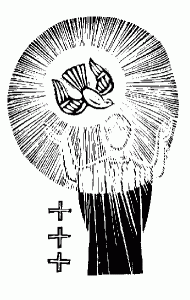
Except for Confirmations and the feast of Pentecost, we often neglect to speak about the Holy Spirit. It is an image hard for our minds to grasp. Certainly we are well accustomed to the theme of God as Father from the witness of our families. The figure of Christ on the Cross gives meat to our appreciation of the Son of God. But we struggle in appreciating the role of the Holy Spirit. People can relate easily to a notion of God as their heavenly Father and to Jesus as our elder Brother in faith who surrenders his life for us. But, look at the images of the Spirit. We use fire for light and warmth, but it is regarded as a thing. The dove, while beautiful and free in flight, is still just an animal. Wind might be felt against one’s face, but few of us would talk to it. The Holy Spirit is signified by non-personal elements, and yet, he is the Third Person of the Blessed Trinity and a fundamental catalyst and source of our life, faith, and sanctification. It is true that since the Trinity is a single God, devotion and worship rendered to any one applies to all three. But this does not resolve the struggle in our psychology to embrace the Spirit. It is no wonder that the charismatic movement in the Church exhibits so many elements that speak of mystery: the tongues, prophecy, interpretation, faith healing, etc. However, ecstatic external expressions of being moved by the Spirit need not be present.

The men of ancient Israel felt a need to surrender themselves to the divine movement. Their chanting, dancing, and prophesying uncovered that need. Such actions were in harmony with the times and culture, paralleling the manifestations among the pagans. The one difference was not the external actions but the substance behind them: the true God had shown his face and will to Israel. The truth has prevailed in Israel and the Church while the so-called prophetic messages to others around them have disappeared. If it were not from God, it could not last. Within the family of God, the distinction between a good and a false prophet is noted in Psalm 19:7, “The law of the Lord is perfect, refreshing the soul; The decree of the Lord is trustworthy, giving wisdom to the simple.” Such delineation is still valid today. Any voice that claims a divine mandate and yet violates the commandments is that of a false prophet.

We must be discerning so that we will not seek to silence the voice of God’s prophets and that we will not be led astray by false messengers. What are the false prophets saying today? We know all too well. “We love each other, how could something so wonderful be sinful? If we don’t live with each other, how can we know if we are sexually compatible or not? The Church is living in the dark ages; we have to use the pill! We can’t have this baby now; we have school and our careers to consider. Is it not better to get rid of it then to adopt it out to strangers? I am sure that if grandma were in her right mind she would tell us to pull the plug. Jim and Jack are sweet guys, why should they be punished for how God made them– especially since they use condoms? Everyone steals office supplies from work, it is expected. That was a great movie, even though they did take God’s name in vain a dozen times. These sexy dresses (what there is of them) will sure get Tom’s motor running. It doesn’t matter if you go to a Protestant or Catholic church– it’s the same thing– what matters is going. I’m not a bad person for sometimes missing Mass; it isn’t like I murdered someone. I only read Playboy for the articles. I wish the city would stop those beggars from annoying hardworking people like me. It would probably be best if their kind were sterilized. This is good stuff; take it, everyone’s doing it.”

Do you recognize any of these voiced statements? It is in the sea of lies that the true prophet raises his voice as a living sign of contradiction. He tells us to follow the commandments and the moral laws of the Church. He tells us to defend the dignity of all human life and the values that most respect human personhood and the family. He also tells us not to compromise the honor that is due to God alone. The true prophet encounters resistance, mockery, and sometimes even martyrdom. The New Testament acknowledges this eventuality: “The shouts of the harvesters have reached the ears of the Lord of hosts. You live in wanton luxury on the earth; you fattened yourselves for the day of slaughter. You condemned, even killed, the just man; he does not resist you” (James 5:4-6).

For more such reflections, contact me about getting my book, CHRISTIAN REFLECTIONS.

Prophetic Witness No Matter What the Cost

Jeremiah 20:10-13, taken alone, might make us think that the prophet Jeremiah has something of a persecution complex; however, the oppression he feels is real. No sooner had he warned the people of a coming judgment from the Lord, because of their disobedience and neglect of God, the priest Pashhur had him arrested and scourged.
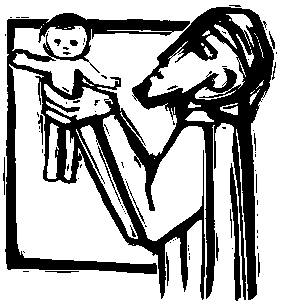
Upon his release from the stocks, he is compelled by his mission to continue his prophecy. He gives the credit for his persistence against mockery and abuse, not to his own fortitude and strength, but to the Lord whose message “becomes like fire burning in my heart.” The phrase, “Terror on every side,” reiterates that Pashhur and the people who have rejected his message will share the fate of doomed Jerusalem. Jeremiah contrasts the betrayal of his friends with the steadfastness of God. God’s prerogatives will not be circumvented.

Psalm 69 is another testimonial in just how far the love of God might take us. “For your sake I bear insult, and shame covers my face. I have become an outcast to my brothers, a stranger to my mother’s sons, because zeal for your house consumes me, and the insults of those who blaspheme you fall upon me” (Psalm 69:8-9). God comes first and last. This should be a sentiment for us all. However, there are many temptations to such a courageous stand. The greatest of these is our desire for the acceptance of others, especially of family and friends. Jews saw their fellowship with one another and the intimacy of their families as central to their lives. However, the Scriptures counsel us all that the most important relationship is with God. If this fundamental association is compromised, then all the rest becomes a sham and we invite destruction. This is still very much the case. Peer pressure or the false prophets of popular media often sway young people. The rest of us sometimes surrender our good standing with God behind small deceits and the disproportionate attraction to material things and comfort. Toleration and peace can become a sham if behind them there is a disregard for the poor and the dignity of human life.

Are we prophets like Jeremiah or priests like Pashhur? Do we seek to silence the voice of the prophets among us? Such questions we must ask ourselves. Several years ago, a priest friend of mine in Georgia decided that he was going to integrate his church instead of operating two facilities, one for whites and the other for blacks. When he tried to do so, the collection plummeted, threatening phone calls rang at all hours, and letters poured into the chancery office. The situation became so dangerous that he was reassigned to a teaching post in another diocese. The experience wounded him deeply and yet he knew it was the right thing and what God wanted. I know a loving nurse who was harassed and finally lost her position in a teaching hospital because she refused to assist in abortions. She knew she had no other choice as a Catholic and as a true believer in Jesus; and yet, it cost her what she most wanted out of life. Many more stories about the prophets in our midst could be told. Will we add our own stories to theirs? Will we see something of our story in Jesus Christ who embraced the Cross to save us despite the mockery of our sins and the scourging of our infidelity?

Romans 5:12-15 draws to our attention precisely this: that through one man (Adam) sin and death entered the world while through another, Christ (the new Adam), grace and life. Jeremiah and all the Old Testament prophets could warn their people and even suffer at their hands for them; however, unlike Jesus, they could not utterly redeem them. The ancient prophecy, repeated time and time again, is fulfilled in Christ. “Sing to the Lord, praise the Lord, for he has rescued the life of the poor from the power of the wicked!” (Jeremiah 20:13).

Look at Matthew 10:26-33, Jesus admonishes his disciples to follow his example and that of the ancient prophets. He tells us not to be afraid. “Do not let men intimidate you.” He promises that whoever avows him before others, his Father will claim in heaven. What more could we want? And yet, so often we allow the problems and the pressures of the day to master us.

For more such reflections, contact me about getting my book, CHRISTIAN REFLECTIONS.

Courageous on Behalf of the Gospel

Jesus revealed himself publicly in the synagogue as the promised messiah. Although initially pleased with his learned exhortations, they quickly begin to question his authority (Luke 4:21-30). Those who knew him as a child or knew his family begin to gossip about him. Hidden in these words is their disbelief that the promised one could possibly be one from their own midst, and a poor man at that! Their acceptance of him swiftly soured into rejection. They no longer wanted to hear what he had to say.

Sometimes we as Catholic Christians, making manifest the same Christ, our Savior, will discover similar rejection and even embarrassment. Speaking the words of God will be difficult, not only because we want to be accepted, but because of how they might touch others. Like medicine, the healing of our Lord comes in a package that may include more preliminary pain before any true healing can take place. The presence of Jesus among his own people would work this way. Some would have to earnestly struggle with his message and presence. For most of his disciples, witnessing for the Master would also cost them their mortal lives; however, in return they would receive everlasting life.

I mention this because there is much about God’s truths that can make us uneasy. God tells us, “Before I formed you in the womb I knew you, before you were born I dedicated you, a prophet to the nations I appointed you” (see Jeremiah 1:4-5, 17-19). Most of us were anointed at baptism with the holy chrism as Christian prophets. As children, the challenge afterwards was to be nurtured in the faith by our parents. Later, we were to proclaim it to others as adults. I wonder if we always do that, myself included? It is so easy to get comfortable and to allow others to do all the work of evangelization or Christian witness. However, what would become of a world filled with people so poorly motivated? I shudder to imagine.

The particular wording in Jeremiah is reminiscent of other passages which deal with God calling us, even before we saw the light of day. In the New Testament, the most famous is the one in which the prophet John the Baptist leaps with joy in his mother’s womb when he is near to his Savior still hidden deep inside Mary’s flesh. From the very beginning, each and every one of us is called.

Annually, many citizens of this land march on Washington for the sake of the unborn, a very troubling issue to be sure. Those children who for one reason or another are not wanted, have from the very beginning, been called by God to fellowship with him. Those young women who have faced this crisis, and the many that have made agonizing decisions, have also been called by God. The same could be said for those who are often the invisible partners in this tragedy, the men who have become reluctant fathers. All of them need healing. The woman who makes a poor decision, or who was pressured into doing so, needs to realize the wrongness of what happened, so that true repentance and healing might be achieved. The same sense of scrutiny and responsibility also needs to be accepted in the lives of men who are partners in this holocaust. We can be partners in sin or we can be helpers to one another in grace. As for the child, we believe that God desires the salvation of all. If we should abandon the youngest of children, God will not. They are alive. This realization can be the hardest of all for those who have suffered this dilemma. They are alive. Adopted by the loving arm of the Church; touched by the same love which embraced the children killed by Herod in Christ’s stead; they are alive. As such, they pray for their parents and God willing, wait until we are all rejoined together in Paradise.

Our faith tells us that all are called. No life is to be wasted. All life is precious. 1 Corinthians 12:31-13:13 tells us that faith, hope, and love are everlasting. When it comes to the truths of our faith or the moral values which the Gospel upholds, we need to be courageous. Do we attend Mass every Sunday in order to worship God in the community? Do we pray a few minutes every day? Do we try to be charitable and peaceful? Do we stand up for our beliefs and for our Church when they are mocked or ridiculed? Do we attempt to correct those in error? Do we use or waste the great gift of life with which God and our parents gave us?

In every new life and in ever old life made new by Christ’s forgiveness, hope is born. What might we become? With God, the possibilities are endless. What are our hopes for each other? A time when children can go to school and play safely? A world that does not throw the precious gift of creation back into God’s face? A future wherein we all meet the goals set for us by God, growing in wisdom and grace, just as Christ once did? We work to achieve these hopes, knowing that in God’s will, all things come in his own good time. We wait in hope, knowing that God calls every one of us. One day the hopes of believers will be realized.

When this happens, it will be because God loved us and loved us first. We exist because of love, the love of God and the love of a man and woman. We live for love; if you do not believe this just try to exist without it. Maybe it all boils down to our responding with the same kind of trusting love with which Christ accepted the Father’s will in his life? Of all visible creation, it is only the human being who can respond back to God in prayer and a life of love.

For more such reflections, contact me about getting my book, CHRISTIAN REFLECTIONS.









