











• Our Blogger

    Fr. Joseph Jenkins

  • An important theme for this blog is the scene in the New Testament where Jesus can be found FLOGGING the money-changers out of the temple. My header above depicts a priest FLOGGING the devils that distort the faith and assault believers. The faith that gives us consolation can and should also make us very uncomfortable. Both Divine Mercy and Divine Justice meet in Jesus. Priests are ministers of reconciliation, but never at the cost of truth. In or out of season, we must be courageous in preaching and living out the Gospel of Life. The title of my blog is a play on words, not Flogger Priest but Blogger Priest.

  • Archives

  • Categories

  • Recent Posts

  • Recent Comments

    Inveilis's avatarInveilis on Ask a Priest
    Joanne M Rowan's avatarJoanne M Rowan on Reflecting Upon SSPX Dissent…
    Joanne M Rowan's avatarJoanne M Rowan on The SSPX Makes It Itself Out M…
    Jeremy's avatarJeremy on Ask a Priest
    Father Joe's avatarFather Joe on How a Celibate Priest Looks at…

Pentagon’s Reduced Religious Designations

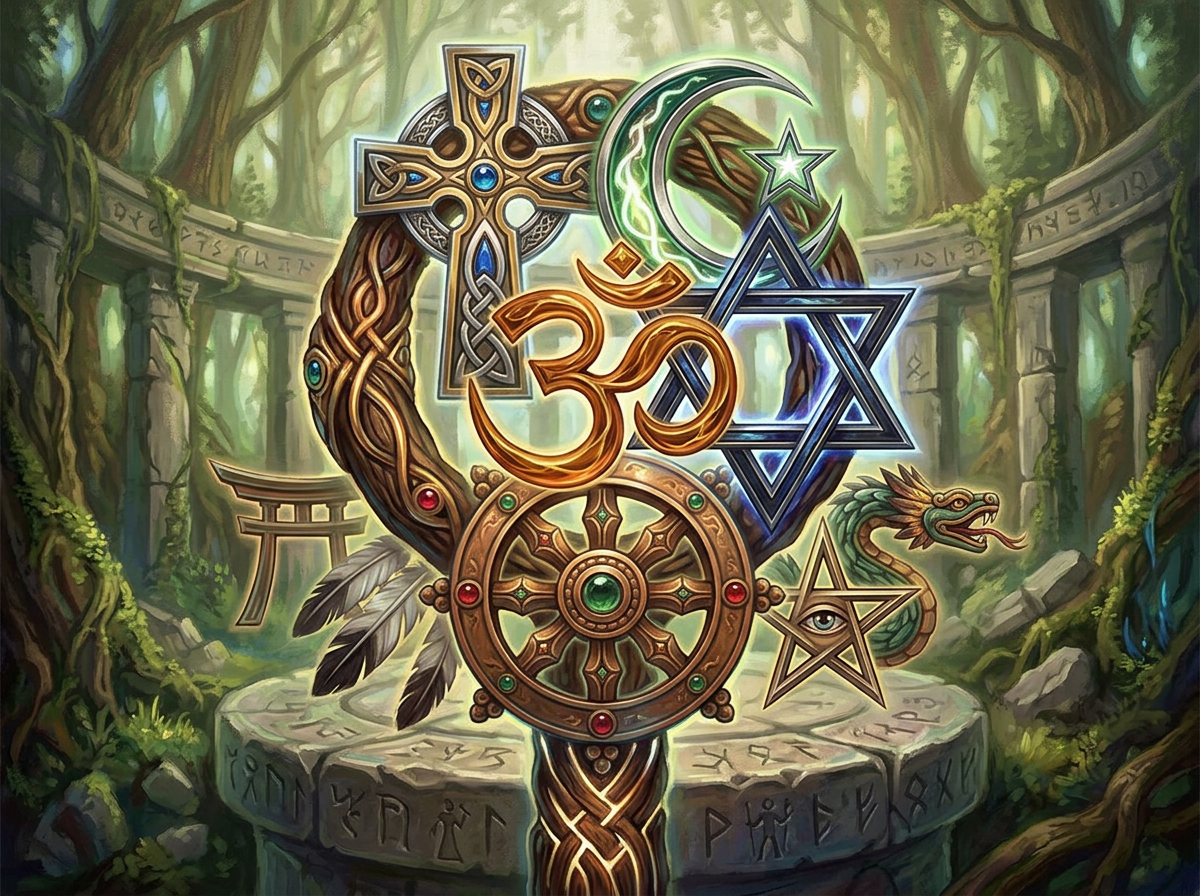
Religious symbols including the cross, crescent moon and star, om, Star of David, Dharma wheel, pentagram, and torii gate in a forest ruin.

I cannot fault the Pentagon for the reduction in recognized religions as the numbers had become unmanageable. We also had the problem of sharing an altar used for Mass and Protestant communion services with witches who conducted a so-called Black Mass. However, they were told that it could not be conducted in the nude as that violated the military code of conduct.  The pentagram was the emblem for their chaplains. Both the Catholic and Protestant community subsequently had to rededicate the altar after its desecration. This sinister group were not regular worshipers but rather liked giving the finger to traditional believers.

The Department of Defense has significantly narrowed the number of religious affiliations it officially tracks for U.S. troops, cutting the list from more than 200 faiths down to just 31. It is unfortunate that it has caused backlash from the Church of Jesus Christ of Latter-day Saints (LDS) or Mormons as they were no longer classified as Christian. Given the influence of evangelicals, I am surprised that Catholics were also not given a separate designation; however, there is a strong Catholic presence among officers, especially in the Navy.

The Catholic Church would be more restrictive than the federal government about this. While we do not regard the Mormons as true Christians, we also reject the Jehovah Witnesses, Quakers and Christian Scientists. We would generally accept Pentecostals if they were baptized with water in the name of the Trinity, and not merely in Christ’s name. Due to vast variations, we would be uncertain about so-called non-denominational Christians and non-specified faith communities.

The thirty-one faiths retained are as follows:

  • No Religion (NR)—around 29% of U.S. adults are religiously unaffiliated.
  • Agnostic (AN)—around 0.5% of Americans.  
  • Christian—Evangelical (EV)—almost 25% of U.S. adults.
  • Christian—Catholic (CA)—around 20% of Americans.
  • Christian—Non-Denominational (ND)—around 6% of Americans.
  • Christian—Methodist (ME)—approximately 3% of Americans.
  • Christian—Pentecostal (PE)—around 3% of Americans.
  • Christian—Lutheran (LU)—approximately 1% of Americans.
  • Christian—Baptist (BA)—approximately 1% of Americans.
  • Christian—Presbyterian (PR)—about 1% of Americans.
  • Christian—Episcopal/Anglican (EA)—around 1% of Americans.
  • Christian—Church of Christ (CC)—approximately 1% of Americans.
  • Christian—Church of God (CG)—around 1% of Americans.
  • Christian—Orthodox (OX)—around 1% of Americans.
  • Christian—Assemblies of God (AG)—around 1% of Americans.
  • Christian—Church of the Nazarene (CN)—around 0.6% of Americans.
  • Christian—Seventh Day Adventist (SA)—approximately 0.5% of Americans.
  • Christian—Jehovah’s Witnesses (JW)—less than 1% of Americans.
  • Christian—Reformed (RE)—over 0.03% of Americans.
  • Christian—Brethren (BR)—slightly more than 0.03% of Americans.
  • Christian—Quaker (QU)—over 0.03% of Americans.
  • Christian—Scientist (SC) No data.
  • Christian—Other (CO) No data.
  • Church of Jesus Christ of Latter-day Saints (CJ)—around 1% of Americans.
  • Judaism (Jewish) (JU)—about 2% of Americans.
  • Islam (Muslim) (IS)—around 1% of Americans.
  • Hindu (HI)—about 1% of Americans.
  • Buddhism (BU)—approximately 1% of Americans.
  • Baha’i Faith (BH)—more than 0.05%.
  • Sikh (SI)—around 0.02% of Americans.
  • Other Religions (OR) No data.

The doctrines proposed by the Mormons or the Church of Jesus Christ of Latter-day Saints are radically distinct from the basic tenets of Christianity.  It is true that they have a high regard for Jesus, but their Christology is a strange variation of the early heresy of Adoptionism. While Catholicism defines the godhead as ONE divine nature (God) in three divine Persons, Mormons divide the Holy Trinity into three distinct deities. Catholicism teaches that God exists from all eternity outside of time and space as a perfect spirit and as the source for existence itself. He is the Creator of all. However, Mormonism teaches that God the Father was once a man who underwent an “exaltation” and that he still has a physical body. Jesus is defined as his glorified offspring. Teaching eternal progression, they believe that as offspring of God the Father and a Heavenly Mother, we can become gods, ourselves. This religion is polytheism. Genuine Christians are monotheists.

Two Utah lawmakers were angry about the non-Christian designation, even though it is theologically accurate. However, if other “churches” that were not Christian could be so designated by the military, then one must wonder about credibility or competence in making such official categorizations. Given the importance of the Mormons to the Republicans, it does not surprise me that today the broad CHRISTIAN designations have been quickly removed.      

Graced or Imbued with the Divine Life

Just as the Spirit of God makes possible the transformation of the Eucharistic gifts into the real presence of the risen Christ; this same Spirit configures or changes us, forming us into the likeness of Christ. It all begins with faith and baptism. The infusion of grace makes possible a spiritual transformation. We are disposed or made into tabernacles or suitable vessels for God, living temples of the Holy Spirit (1 Cor. 3:16; 2 Cor. 6:16). Of course, any and each Person of the Trinity draws to itself the fullness of God.  As the classical definition reminds us, there are three divine Persons in one divine nature— one God. We can distinguish between the Persons of the Trinity but must be vigilant against heresy. Some fall prey to modalism wherein the triune God is defined by his activities and not by name. Others wrongly speak about the divine Persons as distinct gods, signifying a practical polytheism. Both constitute grievous sins against the divine godhead.  

We are adopted sons and daughters of the Father. We are kin to Christ and Mary is our Queen Mother.  God the Father first sends the eternal Word, his Son, to ransom us from sin. Next God sends his Spirit that we might become his adopted children (Galatians 4:4-7). The Spirit of God that hovered over the waters of creation now makes possible something of the divine life in us. We are invited to enter God the Trinity. Christ promises to send the Advocate, his Spirit of truth upon the Church (John 14:16-17). It is within the context of salvation history that the Trinity comes to light as the central revelation of the Gospel. Jesus reveals the face of God. It is in Jesus that we appreciate God as Abba or Father. It is in Jesus that we will receive the Holy Spirit.  God communicates himself to us through Christ, the living Word. All this is so that we might have a genuine relationship with the Lord. It is a basic principle that you cannot have a relationship with someone you do not know.  We are called to know and to love the Lord. While we can speak about the Trinitarian or inner life of God within us by grace; it must also be admitted that we cannot trap or utterly contain the divine presence. God saturates us and yet we make poor sponges; he drips and leaks from us. It is not simply God inside us but also all around us. We leave puddles. We soak those with whom we come into contact. God exudes or emanates from the saints.  Changing from the image of water to light, that is why artists often portray saints with halos or whole-body auras. They do not hinder the light but amplify it for all to see. Something of this is intimated with the Virgin Mary who responds to the angel, “My soul doth magnify the Lord. And my spirit hath rejoiced in God my Savior” (Luke 1:46-47 – Douay-Rheims).

I am reminded of a child coloring the pictures of a coloring book.  Little children always fail to color between the lines with their crayons. Similarly, we are colored or given life by God, but the colors of his presence also fail to stay between the lines. They cross lines and bleed through the pages. Again, we cannot completely contain or trap the divine presence.  But this is okay. If faith is real, then it must be shared. We must give away what we have.  Faith is not private but communal. Yes, the goal of every Christian is to go to heaven. But more than this, we should want to take others with us. What many fail to appreciate is the identification of heaven with the Trinity. We are called to live within God forever. Knowing the beatific vision, everywhere the saints look, they see God.

We often view love or charity as either a sentiment of the heart or as an action of benevolence. The measure of the Cross would have us evaluate it in terms of sacrifice and surrender. This is the ruler imposed upon every married couple and parent, as well as any who would be a missionary for Christ.  The command of Jesus to take up the cross and to follow is an order to love one another. While not negating the value of our own life and happiness, we look beyond ourselves to prize those who are dear to us.  The radical nature of Christ’s Gospel is that this command must be applied to those who are hard to love.  This love that so often falls short among humanity is given an infinite value or measure in Christ and his relationship with the Father.  Indeed, infinite or perfect love must be granted the highest standing that we can imagine, literally personhood. It is for this reason that we speak of God as love or of the Holy Spirit as personified LOVE. Those who would be graced with the inner life of God must necessarily share in this divine LOVE.   We read in John 14:15-17: “If you love me, you will keep my commandments. And I will ask the Father, and he will give you another Advocate to be with you always, the Spirit of truth, which the world cannot accept, because it neither sees nor knows it. But you know it, because it remains with you, and will be in you.” This reference to remaining “with” and “in” us is not figurative but real.  We tend to be good at explaining the real presence in the Eucharist, but we often stumble in appreciating this real presence in the human heart.  Do we treat our “persons” or “bodies” with the respect to which they are entitled as vehicles for the divine? This is so very important that Jesus will repeat himself, “Whoever loves me will keep my word, and my Father will love him, and we will come to him and make our dwelling with him” (John 14:23).










