
• Our Blogger

    Fr. Joseph Jenkins

  • The blog header depicts an important and yet mis-understood New Testament scene, Jesus flogging the money-changers out of the temple. I selected it because the faith that gives us consolation can also make us very uncomfortable. Both Divine Mercy and Divine Justice meet in Jesus. Priests are ministers of reconciliation, but never at the cost of truth. In or out of season, we must be courageous in preaching and living out the Gospel of Life. The title of my blog is a play on words, not Flogger Priest but Blogger Priest.

  • Archives

  • Categories

  • Recent Posts

  • Recent Comments

    Anonymous's avatarAnonymous on Ask a Priest
    Michael J's avatarMichael J on Ask a Priest
    Jeremy Kok's avatarJeremy Kok on Ask a Priest
    Mike Zias's avatarMike Zias on Ask a Priest
    Jeremy Kok's avatarJeremy Kok on Ask a Priest

Considering Cardinal Roche’s Consistory Document

Is This a Genuine Application Newman’s Organic Development?

(CLICK the image to go to document.) The first paragraph of his document to the cardinals at the extraordinary consistory speaks about past historic changes in the Mass and about the process of liturgical reform as one of “organic development.” It is true that the Mass has always been subject to “a process of organic development.” However, this fact does not mitigate the tension over post-Vatican II reforms. Reforms were historically not accomplished over a period of months or a few years but extending decades and even centuries. Further, they were the product of priests and the lay faithful alike, not a small group of so-called experts or a single liturgist. Changes in the liturgy would consist of an addition here or a small deletion there, but not a wholesale rebranding and substitution of the Roman Canon. How can anyone with a straight face argue that the changes effected during the last half-century were truly “organic” in scope? There is no getting around it, the changes were revolutionary. The practical proof of this claim was the reaction among those in the trenches. While many youths embraced folk and rock Masses as part of their natural rebellion, older Catholics were upset but complied because of a strong affinity toward obedience of just authority. Catholics often did as they were told because they loved the Pope and trusted their bishops and priests. I can still recall whole parish and religious school libraries being emptied into dumpsters because the “new Church” would no longer need the old liturgical books or morality manuals. Despite debates to the contrary, this negative treatment against treasures from the past spoke volumes about a hermeneutic of rupture. The psychology here was not rooted in continuity but in a break or a new start. Everything old was deemed bad and everything new was judged good. Ironically, this mentality, in reverse, is what we hear from certain traditionalists— that the “old” is better and holier and that the “new” is bad and heretical. Increasing numbers of learned critics contend that the liturgical changes went far beyond the mandate of the council. Nevertheless, the reforms received ecclesial approbation. This truth cannot be sidestepped. It must be said that the reforms were imposed based upon various contemporary presuppositions (of questionable credulity): that the Latin liturgy was unintelligible to modern men and women, that it lacked logical internal organization, that it wrongly rebranded the preparation of the gifts into an offertory functioning as a secondary natural oblation, that it overly anticipated the transformation of the sacred species, that it lacked a coherent and clear epiclesis, that the liturgy of the Word was eclipsed or minimized by the Eucharist, and that it deified the person and power of the priest over any active participation by the laity.

Does One Faith Demand Absolute Uniformity?

The second paragraph of his missive to participants of the extraordinary consistory is just as nonsensical as the first. As a defense for the abrogation of the traditional Latin Mass, it is ironic that Cardinal Roche should cite Saint Pius V’s assertion that since “there is only one way of reciting the psalms, so there ought to be only one rite for celebrating the Mass.” Today there are many ways that the psalms are recited given the many translations, chant and modern musical renditions. The psalms may be recited straight through, antiphonally or with intruding responses. The Roman rite was translated into the vernacular from Latin, and one translation often disagrees substantially with another. Where we had one canon in the West, we now have four ordinary ones, as well as special Eucharistic prayers for children and reconciliation. Further, the Anglican returnees have their traditional liturgy and Catholicism permits many lesser rites around the world. Given all this diversity, why cannot room be carved out for those spiritually attached to the old Roman Canon? That which is not from God will pass. That which belongs to the Lord will blossom and grow under the movement of the Holy Spirit. Can we not trust God about this? How can the good cardinal both impugn Pope Pius V’s logic and then claim it as a support for the intransigence of Traditionis Custodes?

Constant Reform or Long-Term Stability?

The third paragraph of Cardinal Roche’s consistory document would seem to argue for perpetual reform without end. This ignores several important concerns. The reformed liturgy was neither something entirely old nor simply the product of “cultural elements that change in time and place.” It was largely the result of one time and place. There was an almost “Pollyanna” optimism during and after Vatican II. The signs of the times were a tradeoff of antiquity and the ageless for the contemporary and fickle. Note that many modern liturgies and the accompanying music still resemble something from the 1969 Woodstock festival. First, not all cultures and times are the same. The Church is the mother of Western civilization. It is not that she is just the product of her times but that often her faith and rituals were the catalyst and source for the ideas and cultural values around her. Second, while the relationship of the Church to the surrounding culture communicates in two directions, sometimes the situation is mutually supportive and at other times, clashing and combative. No authentic liturgical reform can embrace elements that are contrary to authentic Christian beliefs. Third, the nature of the paschal mystery itself mandates that certain elements of faith and ritual should be judged as immutable. Just as Jesus is the same, yesterday, today, and tomorrow— a liturgy should be historically grounded as a permanent anchor in a world of incessant change. Do words and ceremony communicate what they should— making present the mediation of Christ in his passion, death, resurrection and ascension? Is it not precisely the argument of the advocates for the traditional Latin Mass, that the sacred language, silence, ordered movement, and heightened reverence, all better convey a sense of the paschal mystery of Christ?

Pope Benedict versus Pope Benedict?

Is there no shame? Cardinal Roche in paragraph four of his consistory document would quote Pope Benedict XVI (out of context) to support the suppression of the traditional Latin Mass and the reversal of Summorum Pontificum. Really? Has he not read what the late Pope wrote about liturgy? Pope Benedict XVI did indeed speak about sacred tradition as a “living river,” but the streams of that river extend both to the Vatican II reforms and to what came previously. Indeed, one might ask, are the waters freely flowing to the tried-and-true of centuries past as to the novelties not yet a hundred years old? Indeed, to keep the analogy going, might Traditionis Custodes be interpreted as a dam to those waters.

A Bias for One Liturgy Over Another?

Paragraph five of Cardinal Roche’s consistory document seems to envision a “dynamic vision” as belonging exclusively to the Novus Ordo. Is this not the same kind of negative bias of which the other side in this debate is accused? Legitimate progress must not be interpreted as change for change’s sake. It is true that a living tradition would forestall a “collection of dead things.” But it was never Pope Benedict XVI’s intent to resuscitate a zombie rite. Both rituals are alive and make Christ present in his person and in his saving activity. He hoped that the old and reformed liturgy, side-by-side, might cross-pollinate and enrich one another. Might the old liturgy be pruned in part? Might it benefit from an enriched lectionary and an extended responsorial for the gradual? Might it be offered in Latin and the vernacular? Could a form of concelebration be returned to the old liturgy? Might a sense of reverence and order be given the reformed rites? Might there be a reconsideration of the reduction of the offertory in the Novus Ordo? Could we see a restoration of some Latin and Gregorian chant? Might the liturgical calendar be reconciled between the old and new? Unfortunately, all this is short-circuited by the current suppression. How is this healthy? How does this promote the life of souls? If we are all about giving the people a voice, then why do churchmen make demands against kneeling and communion on the tongue? What became of freedom about such things? Why should we care if reverence and care are taken?

Might Something Be Gained & Lost By Reform?

Paragraph six of the consistory document simply says that there is no reform of the Church without liturgical reform. This is true given the intimate inter-connectiveness of constitutive elements of the Church. Paragraph seven is an expression of confidence in the scholarship (theological, historical and pastoral) behind the liturgical reform. Left unspoken is the possibility that reformers, no matter how well intentioned, can lose their way. Reformed Judaism had gone through its own reform earlier and with unanticipated negative results. The rabbis warned churchmen that a more streamlined and ordered liturgy might not have the same compelling power of a somewhat messy conglomeration. A ritual that arises over time from the genuine prayer of a priest and congregation around an altar often proves itself better than one composed by a professor more familiar with academic than the pastoral setting. Ritual touches the human being, not only on the rational level, but upon the emotive and spiritual as well. For instance, repetition and striking the breast might change little in terms of meaning but have a tremendous impact upon the human psyche. Similarly, the “artistic” and “beautiful” cannot be reduced to cold mathematical formula. As for paragraph eight, while formation is invaluable for deeper understanding, we must not forget that the language of sign and symbol should also immediately convey a sense of the sacred and a meaning imbued with mystery. Those attached to the traditional Latin Mass may not have degrees in liturgy, but we should not devalue or undermine as inconsequential any attestation of a powerful experience of the transcendent. If the reformed liturgy places a premium on words and translation, the older ordo placed greater weight upon the sacred spectacle of smells, bells, gesture and chant. While the reformed liturgy emphasizes external participation, the older ritual emphasized an internal movement of just being present and many personal prayers. Who is to say which is better? Maybe different people vary in the type of liturgy that serves them best?

Does an Old & Reformed Liturgy Signify a Defunct and a New Church?

The danger of paragraph nine and the extended quote from Pope Francis should be self-evident. It is a direct appeal to a rupture in the tradition. It asserts that one cannot be faithful to the Vatican II Church and desire a strict association of the prior liturgy. However, in truth it is the same Church. Further, who is not to say that certain conciliar principles will not have an impact on the Tridentine liturgy over time? The argument that the Mass change is a fait accompli to which everyone must slavishly comply seems nonsensical if brute authority must be exacted against otherwise good and faithful Catholics? If the new liturgy were perfect, then it is doubtful that a problem would have arisen. Why would Pope Leo XIV beseech Eastern churches to maintain their tradition of liturgy while we have largely thrown ours away. Allowing both the old and the new to exist side-by-side may be the perfect way toward integration, not by ecclesial force but by a natural spiritual attraction. Maybe we have been too stringent in restricting and defining the movement of the Holy Spirit to the work of Archbishop Annibale Bugnini and his team? The groundswell of support for the old Mass and the demand for an end to abuses in the new might be the true work of the Spirit of God. While there is much in the way of cultural adaptation and freedom given Catholics in regard to all sort of parallel traditions and experimental liturgies, then why not carve out a space for those who acknowledge papal authority but should be shown sensitivity and compassion about a liturgy that bred many of the saints and still resonates with the Catholic soul?

Paragraph ten simply gave some of the recent history about the liturgy and the popes, conveniently omitting the name of Pope Benedict XVI. Paragraph eleven returns us to Pope Francis’ view in paragraph nine. He writes: “I do not see how it is possible to say that one recognizes the validity of the Council . . . and at the same time not accept the liturgical reform born out of Sacrosanctum Concilium . . .” Both Cardinal Roche and the late Pope Francis view it as an ecclesial matter. This mentality pretty much insures an eventual full schism with the SSPX and makes any future for groups like the Fraternity of St. Peter more than precarious. It is ironic that an attachment with the old liturgy should call their Catholicity into question. Contestations to the contrary, much of Vatican II can easily be reconciled with tradition.

A Few Broader Vatican II Questions Beyond Liturgy

As for the harder Vatican II questions like freedom of conscience and the extent of religious freedom and ecumenism, should they not be argued and hammered out by believers. Given a world where Catholic states have all but disappeared, it makes sense for Catholic social teachings to honestly reflect the current lived reality. While we have every right to insist upon the truth of our beliefs, we can still work with others for a peaceful and just society. Is it really too much to concede that believers should not use torture or violent intimidation? Indeed, is this not the high ground of the Church against Islamic extremism? Further, an emphasis upon the incommensurate value of human life and the high dignity of “persons” is no threat to the divinization of believers by grace. None of us should be so attached to the anachronistic that we would further fracture the Church and society when there is a desperate need to build bridges and heal old wounds.

Honey, You’re Not a Catholic Priest!

The December 29 headline in the KANSAS REFLECTOR read, “Kansan returns to the Catholic Church as the state’s first woman priest,” by Anna Kaminski. The story was published under the sectioned off heading of CIVIL RIGHTS.  All I can say is No, and No. Tina Thompson is not a Catholic priest and vocations in the faith are not entitlements in justice but gifts for service. Further, I suspect Episcopal female clergy might be offended because while Catholicism judges Anglicans orders as null-and-void, they also consider themselves priests. Arguably the more appropriate term here is “priestess,” although there are unavoidable pagan connotations.    

Thompson attempted ordination not in the Catholic Church but in a dissenting, meaning “protestant” sect called Roman Catholic Womanpriests (RCWP).  More than lacking formal recognition, this group is spurned by the Catholic Church.  Those involved with such efforts to circumvent sacramental laws are regarded as excommunicated from true faith. She says the matter is “so much bigger” than her, but it is really all about her. Along with other like-minded women, the issue is rebellion from clearly articulated teachings that stem from long-standing tradition and from Pope John Paul II’s solemn definition. She may be one of hundreds around the world but none of these ladies is a licit or valid priest of the Roman Catholic Church.  Even if a legitimate bishop (possessing apostolic succession) had sought to ordain her, she would still not be a priest as it is not the will of Christ and his Church.    

She says, “We are still the church, but we are different in that we open the tent. We want everyone to feel like they are welcome.” This is a deception. The theological definition of “church” requires both a valid priesthood and Eucharist.  She and her girlfriends have neither.  They can dress up but all they are doing is playing priest.  They are fooling themselves and would seek to do the same to others.  It is terribly sinful because it would cost the gullible both absolution from sin and the saving Eucharist. A priest is a man configured to the incarnate Christ as our high priest.  He is an icon of our Lord.  Some orders and Eastern rite congregations would even have the priest grow the accidental of a beard to help convey his ministerial unity with Jesus. A woman cannot sacramentally signify Christ at the altar. 

Estrangement from the Church for twenty years is hardly proper formation for ministry. Tina Thompson talks about her work as an artist but says next to nothing about the sacrament of Penance and the Eucharist.  She is a fake, not a priest and only tenuously a juridical Catholic because of baptism. The church in which Tina Thompson attempted ordination was not Catholic. Unity Church in Lawrence, Kansas must have rented their facility because, while led by women, it does not even claim bishops.  We read on the website for Unity Church in Lawrence, Kansas: “Unity is an open-minded, accepting spiritual community that honors all paths to God and helps people discover and live their spiritual potential and purpose. A positive alternative to negative religion, Unity seeks to apply the teachings of Jesus as well as other spiritual masters. Unity affirms the power of prayer and helps people experience a stronger connection with God every day.” They also reject the notion of heaven with the saints, asserting, “Heaven is not a place, but a state of consciousness.”  Nonsense! Ordination in such a setting further compromises any claims of Catholicity.  It is literally a NEW AGE movement that is arguably not even Christian. It might be a welcoming tent, but it is not the house that Jesus built. The ordinations are not valid despite her protestations. They have not abided by apostolic succession because while they might have satisfied form, they have substituted invalid matter. The line back to Christ is broken.     

The KANSAS CITY REFLECTOR steps away from its headline and Tina Thompson’s claims by stating: “Women priests do not perform their duties in Catholic churches, and they cannot be officially ordained in one either. They are not recognized and are often excommunicated from the Catholic Church if they are heavily involved before their ordination as Roman Catholic women priests.”

Thompson might claim to be Catholic, but she has turned away from basic truths transmitted by the faith. She does not believe in the indissolubility of marriage and accepts divorce. She also dissents in her approbation for homosexuality.  The aging women of Roman Catholic Womanpriests would redefine, not just Holy Orders, the Church and her values.  None of these imposters in the presbyterate would demand a celibate priesthood. Most would also redefine marriage. No matter what Thompson calls herself, she is a Protestant minister, pure and simple. She says that she was ordained a deacon on August 22, 2024, and a Roman Catholic Women Priest on Nov. 1, 2025. But notice that the article is silent as to who attempted to ordain her. 

After doing research online, it appears that Bishop Paula Hoeffer attempted to ordain her as a priest.  Hoeffer is a former religious sister (Sister of Notre Dame de Namur) who left the convent half a century ago for marriage.  She only became a supposed bishop, herself, in 2025. Her initiation into this fraudulent sacerdotalism was through Joan Houk, still another fake woman bishop. Houk’s elevation into this feigned episcopacy was the work of Patricia Fresen (Germany), Ida Raming (Germany) and Christine Mayr-Lumetzberger (Austria). They were three from the infamous Danube Seven ordained on a river boat in 2002 by Rómulo Antonio Braschi (a priest who defected to found the Catholic Apostolic Charismatic Church of Jesus the King) and Ferdinand Regelsberger (a former Benedictine monk that Brashi consecrated as bishop). It is not a pedigree to be proud about. 

Thompson admits herself, “We’re just a schism, as they say,” and are not in unity with Rome. The fact remains that Rome decides who is or is not a “Roman” Catholic priest. Like so many aging militant feminists, she errantly equates a “male-guided” Church with a “misguided” institution. The article observes, “Her ministry as a priest isn’t yet clear.”  That is an understatement if ever there was one. We are told that her time gravitates toward art. Does this not reduce priesthood to a side-line hobby instead of as a sacrificial vocation?    

Article 12 of the Declaration on Human Dignity

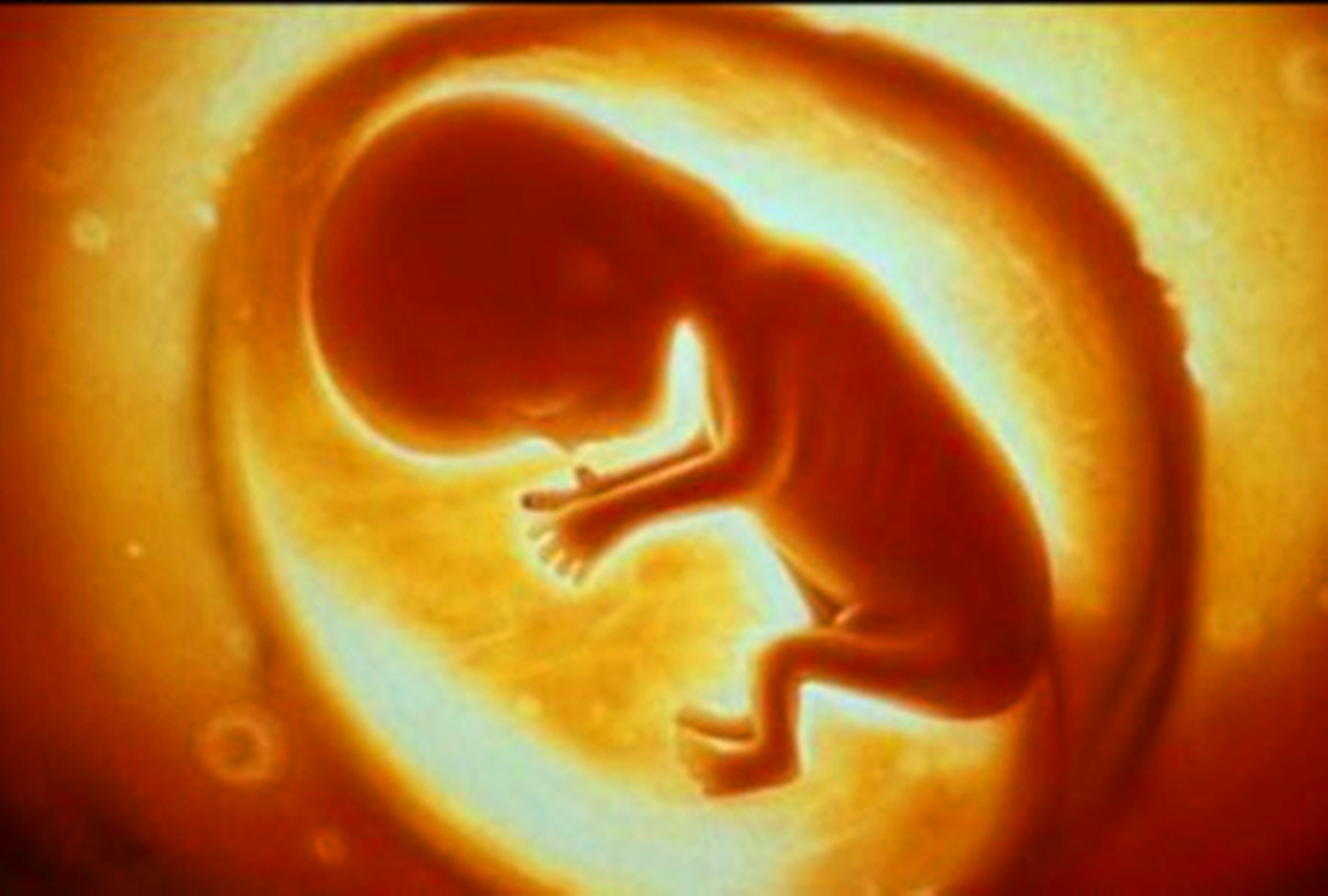
Article 12 of the declaration speaks of the dignity to be found in Christ’s solidarity with humanity by being “born and raised in humble conditions.” Next, we are told that his public ministry “affirms the value and dignity of all who bear the image of God, regardless of their social status and external circumstances.” It should be clear that the Cardinal Fernández is not referring to the elevated supernatural dignity given by grace to persons regenerated through faith and baptism. Several religious pundits have attacked the him and the Holy Father on this front without conceding a dignity that is inherent firstly, as a rational creation of almighty God, and secondly, as one who shares a kinship with Christ due to the incarnation.  The whole point about the change of economy regarding images in the Decalogue is that God has now revealed himself through a human face.  While there is a discrepancy in how the terms are used, one might argue that we are all created in the image of God but that through the sacraments we are reborn into the likeness of Christ.  This natural dignity is very much a part of Pope John Paul II’s theology of the body.  Note that when it comes to the Gospel of Life, the unborn child (although lacking baptism) possesses a right to life and dignity that should not be assailed. 

Jesus also defended a moral dignity of persons, especially toward the oppressed and marginalized.  The Church must similarly be the voice for the voiceless.  Citing Scripture, the document takes note of his outreach to the tax collectors, women, children, lepers, the sick, strangers, and widows. The Cardinal writes that Jesus “heals, feeds, defends, liberates, and saves.”  The love of neighbor flows from our love of God and must be dynamic in the life of charity.

The one problematical element of this article is the following:

For Jesus, the good done to every human being, regardless of the ties of blood or religion, is the single criterion of judgment. The apostle Paul affirms that every Christian must live according to the requirements of dignity and respect for the rights of all people (cf. Rom. 13:8-10) according to the new commandment of love (cf. 1 Cor. 13:1-13).

Critics contend that the Cardinal Fernández and the Pope undermine religion as a basic factor in our judgment and salvation. However, we should remember that the document is written for believers, and it is taken for granted that the good being done is by Catholics in right standing with God. I doubt the Holy Father would undermine basic soteriology. There is no salvation apart from Christ and his holy Church. Further, any merit for good acts also requires that the agent be in a state of grace.  A person in mortal sin remains under God’s negative judgment until the remission of sin through heartfelt contrition and the sacrament of penance.  However, for the justified believer, grace builds upon grace.  Our good work is not limited to our own.  A disciple of Christ is compelled by love and truth to preserve human dignity and in justice to defend human rights.     

As a Christian I am required to be compassionate and just to all, even those who are not of my family or ethnicity or religion.  I can know the catechism backwards and forwards, but without charity I have nothing.  Again, on the level of creation, there is a duty to preserve basic human rights and dignity. I believe this is what the document is saying.  It connects to the teaching about the corporal works of mercy in Matthew 25:41-45:

“Then he will say to those on his left, ‘Depart from me, you accursed, into the eternal fire prepared for the devil and his angels. For I was hungry and you gave me no food, I was thirsty and you gave me no drink, a stranger and you gave me no welcome, naked and you gave me no clothing, ill and in prison, and you did not care for me.’ Then they will answer and say, ‘Lord, when did we see you hungry or thirsty or a stranger or naked or ill or in prison, and not minister to your needs?’ He will answer them, ‘Amen, I say to you, what you did not do for one of these least ones, you did not do for me.’”

I suspect that what Cardinal Fernández and Pope Francis are wanting to say is made clearer in 1 Corinthians 13:1-8: 

If I speak in human and angelic tongues but do not have love, I am a resounding gong or a clashing cymbal. And if I have the gift of prophecy and comprehend all mysteries and all knowledge; if I have all faith so as to move mountains but do not have love, I am nothing. If I give away everything I own, and if I hand my body over so that I may boast but do not have love, I gain nothing. Love is patient, love is kind. It is not jealous, love is not pompous, it is not inflated, it is not rude, it does not seek its own interests, it is not quick-tempered, it does not brood over injury, it does not rejoice over wrongdoing but rejoices with the truth. It bears all things, believes all things, hopes all things, endures all things. Love never fails. If there are prophecies, they will be brought to nothing; if tongues, they will cease; if knowledge, it will be brought to nothing.

What Does It Mean to be a Catholic?

I have had people angry with me because there was no formal way for them to disaffiliate with the Catholic Church. A few years ago, there was an effort to allow those intellectually and/or emotionally alienated from the faith to juridically separate themselves with a written document signed by their pastor and bishop.  But clergy largely refused to sign it.  The legitimacy of this whole business was called into question regarding dispensations, marriage annulment cases and tribunals. Complicating matters further, there was a disagreement between two Vatican congregations— Liturgy and Doctrine of the Faith. The pressing doctrinal fact remains that baptism is a once-and-forever sacrament.  Baptism cleanses us of original sin, infuses sanctifying grace, makes one an adopted child of the Father and a temple of the Holy Spirit.  We become a Christian and a member of the Church with privileges and duties.  Baptized a Catholic, one remains always a Catholic.  A person might become lapsed or start worshiping in a non-Catholic church, but he or she remains a Catholic and will be judged by God as a Catholic.

There are many others that insist upon being designated as “Catholic” when they have long since stopped living the faith.  Their religion is treated as a club or as an ethnic matter. When pollsters interview such people on beliefs and the value shifts of the day, the results are skewed to the left.  That is why those seeking serious statistics distinguish between those Catholics that regularly participate at Mass and those that do not. 

Can one be a Catholic in truth while abiding in mortal sin, literally with one foot in hell?  Remember that the deliberate failure (through our own fault) to go to Mass on Sundays and holy days is a grievous sin that brings us to perdition.  Status becomes even more dire when a host of other mortal sins are added like fornication, adultery, homosexuality, abortion, and various forms of contraception.  The failure to worship dishonors almighty God.  The so-called pelvis or sexual sins bring dishonor to created persons and human life. The trouble with the latter is not a misplaced preoccupation of the Church with human sexuality but rather a failure of men and women to respect themselves as bodily creatures.  Human dignity is violated through disobedience to both natural and divine positive law.       

It may be that many others go through the motions of faith but suffer from missing or inadequate religious formation. How many do not understand or reject the “real presence” of Christ in the Eucharist?  Does everyone in the pews appreciate that the Mass is an unbloody re-presentation of the immolation of Calvary?  Do we go to church solely from duty or do we intend to adore the trinitarian God?  Do we all pray? Are there some that do not know how?  Do we invoke the Holy Spirit and petition for the intercession of the saints? Do we see the priest at the altar as one who participates in the one priesthood of Jesus Christ?  He is so very different from a minister as in Protestant sects.   

At baptism we were anointed as priest, prophet, and king.  A priestly people render sacrifice, literally taking up their crosses to follow Jesus— spiritually grafting themselves to Jesus as an acceptable offering to the Father.  As a nation of prophets, we are commissioned to proclaim and share the Good News of the Lord to all whom we meet.  Given that Jesus is king, and Mary is the queen mother, we are made family members of the royal household of God. Do we acknowledge this privileged dignity and dutifully preach the truth and participate in Sunday Mass?

Salvation requires faith in Christ; however, it is more nuanced than the evangelical’s easy profession of Jesus as one’s “personal Lord and savior.” The Catholic appreciation takes into consideration the Gospel of Mark, the writings of Paul and the epistle by James.  We are not saved by faith alone, but by grace alone.  Works are important as well, because remade in his likeness, we allow the Lord to minister through us.  Whatever Jesus does, has value. Saving faith includes the ingredients of charity and obedience.  We must have both a personal and a corporate relationship with Christ that is realized through loving fidelity (John 14:15; 24).

Affiliation with the Church is not optional.  Just like the Jewish people of old, we are called to the Lord as members of his new People of God or New Zion— the Church.  The Church is the mystical body of Christ.  Just as Jesus is the one WAY to the Father, the Church is also necessarily the way— the means through which we sacramentally encounter Christ.  It is for this reason that we teach that there is no salvation outside the Church.  This provides the mandate for evangelization and for the Church’s prayerful intervention for everyone.  While the identities of “the many” that will be saved remains with divine providence, the Church cooperates in proclaiming the universal call to salvation. 

Our Lord makes a point of instituting the Church and giving Peter the keys to the kingdom.  Jesus gives the promise that the Church will prevail until the very end of the world. This is the same Church we proclaim in the Creed as one, holy, catholic, and apostolic.  These four marks find their home in Roman Catholicism.     

Too often we use political labels for the persuasion or depth of one’s Catholicism.  We say that this or that person is “liberal” or “conservative.”  The true measure of faith is between “orthodoxy” and “heresy.” One cannot be a good Catholic and subscribe to false doctrines or immoral practices. We are also obliged to remain in union with the pope who is the Vicar of Christ and the successor to St. Peter.  Such relationships can be strained when bishops of Rome promote their fallible ideas over immutable truths; but we trust that the Holy Spirit will preserve both the faith and the papacy.  The Pope is the servant of the Word and not its master.  His trust is to preserve and to pass on the timeless faith.  It is for this reason that Catholics have an obligation to know the Scriptures and the Catechism. Too many are ignorant and easily swayed by the changing fads and whimsy of the day. Indeed, many have spoken of an unofficial schism that afflicts the Church. We should make the firm resolution to practice the Catholic faith, despite outside pressures, disappointments inside the Church, and personal doubts and weaknesses. 

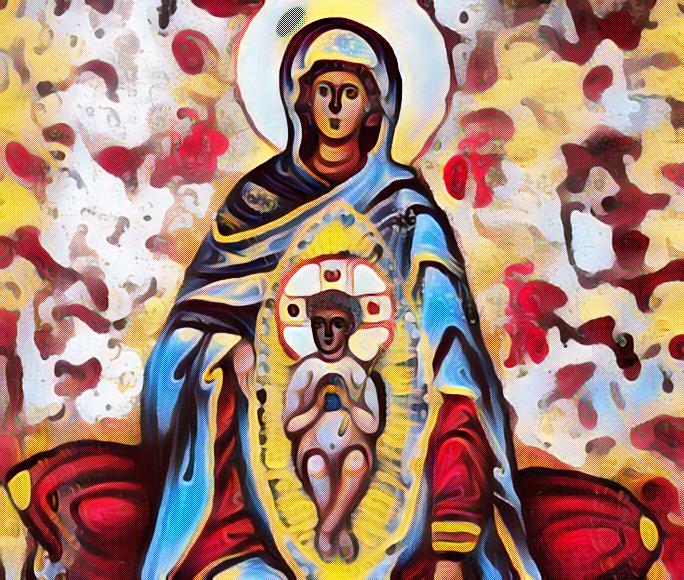
The Wonderful Absurdity of the New Eve

Granting that the role of Mary is a manifestation of truth, it still stands out to many as a theological absurdity.  Her place in the history of salvation becomes a point of contention in the early Church.  She plays a singular part in cooperating with the redemptive work of her Son.  And yet, we affirm that Jesus is the one Redeemer— the Way, the Truth, and the Life.  There is no other WAY to the Father except through him. Concurrently, Mary is acclaimed as the Theotokos (Bearer of God) or Mother of God. Indeed, given that Jesus is a divine Person (God), the genuine adversary of Satan (an angelic creature) is the Virgin Mary (a human person and creature of flesh and spirit). It astounds us that almighty God would make himself dependent and entrust himself to a creature.  How can the first principle for all things proceed from that which is secondary?

Something of this mystery is spoken about in the primordial garden.  Satan as the serpent tempts the first Eve with fruit from the forbidden tree, saying, “God knows well that when you eat of it your eyes will be opened and you will be like gods, who know good and evil.” The irony here is that there is a twisted truth hidden behind the deception.  Our first parents would know good and evil because they would literally “know sin” and stand before God as guilty of a disobedience that would bring disharmony to all creation. Whenever humanity usurps the sovereignty of the deity, the very first of the commandments is violated— it is the highest in the hierarchy of sins. But how does this speak to the person and role of Christ’s Mother?  The words of the serpent are fully realized in a manner that mocks the devil.  While Adam and Eve will not themselves be “as gods,” over the expanse of time a Savior would be born to humanity, a new Adam who literally is the incarnate Second Person of the Blessed Trinity.  Jesus as a son of Adam is also the eternal Son of God. Christ comes to restore what was lost.  While Eve is the vehicle for Adam’s transgression by giving him the forbidden fruit to eat; Mary is the handmaid of the Lord who gives us all the saving “fruit” of her womb, Jesus. The devil despises the woman as she is beneath him in the hierarchy of being. He is a pure spirit, albeit fallen, while the sons and daughters of Adam and Eve are akin to animals, sacks of skin filled with blood.  Of course, Mary has that which the devil has forever forfeited, sanctifying grace.  Those who are children of God in faith and baptism, and thus sons and daughters to Mary, also share this divine favor that allows us to be spiritually born again.  Satan hates the Blessed Mother and all who take refuge under her mantle.   

Her YES to God at the annunciation is made not just for herself but for all humanity.  She has been preserved from sin so that she might serve as the immaculate vehicle or conduit through which God would enter the world of men. The sacramental value of the cross reaches backward into human history and touches her at the first moment of her existence in the womb of St. Ann. Unlike the first Eve, she will treasure her righteous standing before God, remaining sinless and now interceding for us as the Queen of Heaven.

Although only a blessed creature and not divine, she is called upon as “Mother” throughout the world and the many passing centuries.  She is the first disciple of her Son. She is at the creche, at the Cross and in the Upper Room.  She holds out her newborn child at Bethlehem and extends her arms again to receive him on Calvary. The Mother of the Redeemer becomes the Mother of all the redeemed.         

Awaiting the Messiah, any woman could have been the vehicle through which the ancient promise would be fulfilled. Despite the lies of our times, this signifies that gender does matter and is never irrelevant.  There is a profound miracle to the feminine potency for motherhood. It is a hallmark of God’s plan that clashes with human capriciousness and fanciful denial. A similar discordance arises between a secular world and the meaning of Mary’s Son as the incarnate Christ. We view something of the Christ Child in the countenance of every child.  Any child could have been the Christ Child. That is why the Good News will always be a Gospel of Life. Mary becomes a guidepost, not only to Christ, but to the dignity of motherhood and the person. If the first Eve ushers forth death, Mary as the new Eve is the cradle of life. Of course, this is through her cooperation with her Son.  “For just as in Adam all die, so too in Christ shall all be brought to life . . .” (1 Corinthians 15:22). The apostle repeats this message in Romans 5:19: “For just as through the disobedience of one person the many were made sinners, so through the obedience of one the many will be made righteous.”

After condemning the serpent to crawl on its belly, the divine judgment against the devil plays a part in our understanding of Mary as “the woman” or new Eve: “I will put enmity between you and the woman, and between your offspring and hers; They will strike at your head, while you strike at their heel” (Genesis 3;15). That last line is sometimes translated as “her heal” making the connection with Mary even more striking.  While we often posit the image of Mary as meek and humble, as the new Eve she is not only a sovereign of the kingdom but a warrior queen. The first Eve rebels within the safe and peaceful confines of the garden; Mary’s fidelity comes to realization on the battlefield of a dangerous world. The first woman forfeited grace while the immaculate Virgin Mary is hailed as full of grace. The first Eve fostered division between God and man as well as within the human family. The new Eve would know an intimate unity with the Lord which she would share with all her children.