























 The Lord is ever so patient with us. Look at Matthew 13:24-43. Weed (sinners) and wheat (saints) are allowed to grow together. Where are we in this? What is our response to salvation and Christ’s coming kingdom?
We are told that God’s “mastery over all things makes [him] lenient to all” (Wisdom 12:16). In other words, God has nothing to prove. Just as God is almighty, and along with his power comes divine justice, he also possesses a boundless mercy. Indeed, he is forgiveness itself. As believers in Christ, along with the first people called by God, we are also called sons and daughters of God. “And you gave your sons good ground for hope that you would permit repentance for their sins” (Wisdom 12:19). While the promise of salvation has been fulfilled in Christ, the working out of the saving mystery in our lives is our occasion for hope. The difficulty is not with God but with us. Will we repent and believe? Will we remain steadfast afterwards? These are the fundamental questions that must be asked and finally answered for each one of us.
Turning to Matthew 13:24-43, we are given the parable of the wheat and the weeds, the mustard seed, and the yeast. Prior to the harvest, it may be difficult to distinguish the weeds from the wheat. It is the same way with people. A young woman argued with me once that there was no such thing as hell. All people, she said, are basically good. Over and over again, she asserted that a loving God would never do such a thing to anyone. Years later, after the divorce from an abusive marriage and the assault of her daughter by an assailant, she confided that sometimes she had trouble thinking God was good or that he cared. In any case, she had little difficulty in believing in hell as she had experienced a taste of it. Evil is real, although it is sometimes well disguised. The Church requires that we believe in the existence of hell, although as the lay theologian and street preacher Frank Sheed once insisted, we can hope that the devil is lonely.
Charity is the ingredient that distinguishes the wheat from the weeds. If the love of God and of neighbor is not present, then the yield is worthless. Wheat is made into bread and bread is life. We feed one another with our very selves in love, surrendering our lives for one another. Weeds are good for nothing other than burning. They give nothing– not life and not love. Do we take the existence that God has given us as an opportunity to pour ourselves out in loving service? Or, do we manipulate and drain the life out of others?
The parable of the mustard seed has been taken as an analogy for the mysterious and rapid growth of the Church, the kingdom of God breaking into the world. There is a similar understanding for the yeast. However, some authorities have also seen in them a message about the kingdom in each and every believer. The Hebrews saw the mysterious and life-giving hand of Jesus in the seed and in the yeast added to the flour. The soul must be willing to receive the seed or yeast. It must allow watering or kneading. In any case, the work is entirely that of God. The Father kept his promise in sending a deliverer, Jesus. Jesus is the Son of God who allows himself to be planted in the ground after he is taken from the tree of the Cross. He comes back to life and grants us a participation in his new life. We can see something of this organic model in the analogy of the vine and the branches.
If we refuse to allow ourselves to die with Christ, to remain grafted to him, then we cannot possess eternal life. The weeds mimic life, but offer nothing. This is what makes the matter so tragic and confusing. Good people sometimes do bad things. Bad people sometimes, despite themselves or for ulterior reasons, do good things. Who is who? It is no wonder that hypocrisy made Jesus furious.
Sometimes our error is not that we do things clearly wrong, but through omission, fail to do the works of love we should do. A wonderful story about this comes to mind regarding the famous essayist Thomas Carlyle.
He married his secretary Jane Welsh, an intelligent and good-looking woman. A number of years into the marriage she came down with cancer and became bedridden. Being a workaholic, Thomas only spent small snatches of time with her. After lingering for a while, she died. Following the funeral he happened by her diary next to her bed. What he read traumatized him to the depths of his soul. She had written a single line on one page, “Yesterday he spent an hour with me and it was like heaven; I love him so.” He began to awaken from his moral slumber. He had been too busy to be there for her. All the wasted time came to mind when he had ignored her. He felt the knife pierce his heart with the turning of the page, reading, “I have listened all day to hear his steps in the hall, but now it is late and I guess he won’t come today.” After reading a little more, he threw the book down and raced from his home. Friends discovered him at his wife’s grave, his face buried deep in the mud. He wept uncontrollably. It seemed he was trying to bury himself with her. He rambled again and again, “If I had only known, if I had only known.” Carlyle lived another 15 years, but his illustrious writing career ended that day. He had trouble forgiving himself for his preoccupation with fame and fortune, and his failure to love.
(Source: Article from “American Family Association” Newsletter, date unknown. Dr. Donald E. Wildmon, President).
All sin is a failure to love. We can bury our faces in the mud; but the remedy is to repent of our hardness of heart. If we truly love God and neighbor then we will regret our negligence and seek to bury ourselves with Christ, the one we murdered with our sins– the one we have often failed to appropriately love above all things.
St. Augustine tells us that in this world we cannot know for sure who belongs to what kingdom. However, manipulation and selfishness are true indicators of spiritual disease and maybe death. Should this cause us concern? Yes, most assuredly it should do so. However, while there is still mortal life there is hope that we will be counted among the elect, no matter how wicked we have been. Romans 8:26-27 tells us that “the Spirit too helps us in our weakness,” that our prayer and life might be brought to sincerity and authenticity. Psalm 86:16 gives us the posture or openness we need to render for the Spirit: “Turn to me, and have pity on me; give your strength to your servant.” We are all sinners. We have all fallen short of the glory of God. We are not the masters of our lives. Repentance is a prerequisite for faith— and love makes it all real.
For more such reflections, contact me about getting my book, CHRISTIAN REFLECTIONS.
Filed under: Catholic, Confession, Discipleship, Forgiveness, Redemption, Reflection, Repentance | Leave a comment »
 A central theme of Christianity is reconciliation with our neighbor and with God. In Matthew 5:20-26, Christ exhorts us to nurture a holiness which goes beyond external appearances and which emanates essentially from within. Our hearts need to be forgiving and willing to accept forgiveness. Our minds need to elevate good thoughts about our brothers and sisters, and not be centered upon how we might get even with those who hurt us. This is what Christ would do for us who murdered him by our sins. Instead of utterly destroying us with thunderbolt and fire, he offers us a share in his victory over death. He died, loving and forgiving his murderers. When we come together to celebrate this great gift offered by Christ, the Lord desires us to respond in kind. He says, “If you bring your gift to the altar and there recall that your brother has anything against you, leave your gift at the altar, go first to be reconciled with your brother, and then come and offer your gift” (Matthew 5:23-24). With the bread and wine which comes up to the altar, we have to offer ourselves for transformation, so that Christ may live more fully in us. This is the essential meaning behind the sign of peace. This becomes even more essential when we recognize that Christ identifies himself with the persons in our lives whom we least love. Here is the kind of love which grants blessings upon another and not curses, even when we find it difficult to like someone. It is this kind of love which is quick to forgive and which makes one willing to admit his or her sinfulness, and need for forgiveness. The Old Testament was not silent about such a disposition. Ezekiel 18:21-28 challenges us to forgive as God forgives. Ezekiel said, “None of the crimes he committed shall be remembered against him; he shall live because of the virtue he has practiced.” When God forgives, it is as if he forgets. We are made as white as snow. For this reason, let us forgive as God forgives, without resentment and backstabbing. Let us forgive ourselves, recognizing that we have no right to hold bound what Christ in the Church has loosed.
 Sometimes the Church is falsely charged with the wrongful coercion of people into guilt-trips and/or with brain-washing the young through religious indoctrination. This allegation is unfair. What the Church wants people to know is that while we are guilty as sinners, we can know the forgiveness of sins in Christ. Religious formation in the truths of faith respects human freedom and conscience; but, objective truth remains what it is. Others skip condemnation of the Church and directly charge the Judeo-Christian God with intimidation and harshness, especially in regard to hell and judgment. Believers would argue that the critics have it backwards; intimidation and/or manipulation are precisely the tools of sin and the relationship of devils. If there is no genuine love, what other cohesive force is there for control? C. S. Lewis paints an image in his writings of big devils that literally eat the lesser ones– in other words, they use them to their own advantage without regard to their personhood and rights. Sometimes we might paint a picture of God’s justice that falsely falls into such a category. Hellfire images that threaten damnation from a wrathful God are a case in point. Do not get me wrong. Fearing the loss of heaven and suffering the fires of hell have their place. These are real tragedies. But people choose this fate for themselves, more so than by divine imposition. The prophets and our Lord were willing to endure any hardship for the saving message they delivered. Did they do this out of fear of almighty God or out of love? The answer is love. A true parent does not abuse or lie or callously manipulate children. Rather, he or she speaks the truth, even when it is unpopular, and makes every sacrifice to insure the well being of the family. May we all be imitators of God and speak with his voice.

 Isaiah 66:10-14 gives us the image of Jerusalem as a loving and nurturing mother. Similarly, the Church would be viewed as the New Jerusalem, the first glimmerings of Christ’s kingdom breaking into our world. While we find security and comfort in the maternal analogy, verses 15 to 17 speak of the Lord coming in fire to judge all mankind. He shall wave a sword “and many shall be slain by the Lord” (verse 16). It was this messianic vision that many sought in Jesus but he surrendered his life on the Cross and told us to forgive one another. However, the Second Coming of Christ retains the full force of this passage. If we are members of Mother Zion, we can be saved; if we reject her, and here we really mean Mother Church, then we will be subject to fire and the sword. Here we find a serious imperative for the mission activity of the Church. Similarly, the great apostle tells us, “Peace and mercy on all who follow this rule of life (never boasting of anything but the Cross), and on the Israel of God” (Galatians 6:16). Luke 10:1-12,17-20 has Jesus sending out the seventy-two to proclaim the Good News. The urgency of the proclamation is illustrated by Christ’s instruction against a walking staff and traveling bag and against wearing sandals or greeting people along the way. He gives them something of his power but warns them not to be proud, just content that their names “are inscribed in heaven.”
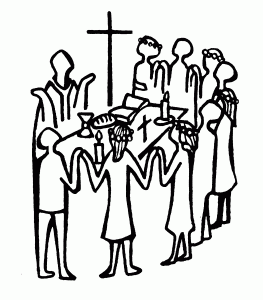 The message about the Church as a New Jerusalem and the analogy of a wedding banquet has serious doctrinal implications that are not always considered by believers in Jesus outside of Catholicism. While there is certainly an individual component to our ultimate salvation, the institution of the Church reminds us that there are vital corporate components as well. Jesus calls to himself disciples and appoints Apostles who will pass their authority down to the bishops who themselves will ordain priests and deacons. Jesus institutes a new covenant in his blood and commands it be repeated “in memory” of him, not in an empty nostalgic way but in a manner that makes present and available that which is recalled. He gives his message and divine mysteries, not to individuals, but to the Church, and appoints Peter and his successors as the visible head. It is the Church that assembles and declares inspired the Bible. Jesus sends his Spirit upon the Church at Pentecost to empower its leadership and to give efficacy to the sacraments. More wondrous than Isaiah could have ever imagined are the splendors given to the People of God.



















 Blogger Priest