• Our Blogger

    Fr. Joseph Jenkins

  • The blog header depicts an important and yet mis-understood New Testament scene, Jesus flogging the money-changers out of the temple. I selected it because the faith that gives us consolation can also make us very uncomfortable. Both Divine Mercy and Divine Justice meet in Jesus. Priests are ministers of reconciliation, but never at the cost of truth. In or out of season, we must be courageous in preaching and living out the Gospel of Life. The title of my blog is a play on words, not Flogger Priest but Blogger Priest.

  • Archives

  • Categories

  • Recent Posts

  • Recent Comments

    Barbara King's avatarBarbara King on Ask a Priest
    Ben Kirk's avatarBen Kirk on Ask a Priest
    Jeremy Kok's avatarJeremy Kok on Ask a Priest
    Barbara's avatarBarbara on Ask a Priest
    forsamuraimarket's avatarforsamuraimarket on Ask a Priest

Priestesses: Ancient Heresy & New Church

Do we really think that allowing women to be ordained would be an improvement for priesthood? I suspect that numbers of interested women are greatly exaggerated. We are having trouble with shrinking orders of women religious. Further, it is interesting that many of those who are most vocal would insist also upon being married or having same-sex partners. They want to violate doctrine and change the long-standing disciplines of the Church.

Akin to Gnosticism is another heresy of the early Church called Docetism. It claims that Christ’s body only appeared to be real and therefore his suffering and death was a pretense. In Gnosticism, Christ the Redeemer is really one of the aeons (cosmic and semi-divine powers) who descend upon the human Jesus in order to reveal the saving knowledge or gnosis. Similarly, he did not really become a man and die on the cross. Both saw the material as evil. Removing the sexual requirements from sacerdotal priesthood “is a Docetism as romantically superhuman as that which engages plans for a non-institutional Church, free of the trivia of administration” (Priest and Priestess by George William Rutler, p. 79). Fr. Rutler writes:

“It places the burden of integrity on the individual’s talents rather than on the simple fact of his sexual existence, scorning the Messianic precedent which chose a specifically masculine human nature with all its limitations for the earthly representative of the High Priesthood of Christ Himself” (Ibid., pp. 79-80).

Over a decade ago, I read an article in the National Catholic Reporter about 72 lay women from the Catholic Theological Union in Chicago promoting women’s ordination. In the course of the report, Dean Hoge, a sociology professor at Catholic University noted that studies he had conducted suggested that if ordination were opened to women, only about 3,600 would take up the offer by the millennium. While I was not convinced of his figures, I had to wonder what kind of women would make up this group. It gives me cause to shudder. One student at CTU remarked, “It isn’t the Eucharistic part [I should hope not], I’m attracted to that. It’s the clericalism, the celibacy and the political system that I couldn’t stand.” Ah, so the nature of priesthood and our ecclesiology would have to be revamped before many women would embrace orders. It makes sense. Indeed, would not the ordination of women itself imply such a transformation? Yes, I think so. There would be a new priesthood for a new Church. It would also mean the end of real Christianity.

POPE JOHN PAUL II: “I declare that the Church has no authority whatsoever to confer priestly ordination on women and that this judgment is to be definitively held by all the Church’s faithful” (Ordinatio Sacerdotalis).

Priestesses & Dissent Against the Deposit

It is evident from the Epistles and the Acts of Apostles that the roots of our ordination teaching are pre-Nicene. While insufficient to remedy the break in apostolic succession that afflicted the Anglican ordinal early in England’s reformation, it is true that their priests and bishops who have shored up their orders with Old Catholic and Orthodox Bishops concelebrating their ordinations and consecrations may indeed be sharers in holy orders. When the Anglican Archbishop of London was received into the Roman Catholic Church, he was not re-ordained as is the usual practice but was conditionally ordained a priest. This exception was shown because he was able to show with some certitude his pedigree of orthodox precursors. Otherwise, the 1896 papal bull, Apostolicae Curiae, still holds: Anglican orders are null and void. This all aside, the point I want to make is that the exclusion of women is a long held tradition that cannot be dismissed arbitrarily. Indeed, it is a fitting example of the canon discerned by St. Vincent of Lerins about the certitude of a doctrine as a practice or belief common to the Church “everywhere, to everyone, at all times.” The Church would allow for the organic development of doctrine analogous to the growth of a human body from infancy to maturity; but, and this comes straight from John Henry Newman, this development while real must not result in the least alteration to the original significance of the doctrine involved. This cannot be said of the revisionist position in favor of Christian priestesses. The faithful Catholic must “guard the deposit” (1 Timothy 6:20), the revelation enshrined in the Scriptures and interpreted in the Church’s tradition by the Magisterium.

Proponents of women’s ordination dissent from the promulgated Catechism of the Catholic Church. This work has been given the Imprimi Potest by Joseph Cardinal Ratzinger himself, head of the Congregation of the Faith, who is now Pope Benedict XVI. It is introduced by the Apostolic Constitution, Fidei Depositum, by Pope John Paul II. He writes: “It can be said that this Catechism is the result of the collaboration of the whole Episcopate of the Catholic Church, who generously accepted my invitation to share responsibility for an enterprise which directly concerns the life of the Church.” He makes no qualification in declaring “it to be a sure norm for teaching the faith and thus a valid and legitimate instrument for ecclesial communion.” A couple of paragraphs later, he says it again: “This catechism is given to them that it may be a sure and authentic reference text for teaching catholic doctrine . . . .”

Nevertheless, by dissenting against the teaching of the male-only priesthood, critics seek to undermine the truthfulness of the entire document and the God-given authority of the Church to teach it. They even castigate the Magisterium as murderers of vocations. They make relative what should be objective truth. They reinterpret Scripture according to their own “personal” and false enlightenment and dismiss the exegetical role of the teaching Church. They ignore tradition as irrelevant or pretend that it is somehow in their favor. They do all this, and yet plead to be a good Catholics. We must be careful of dissent.

Let us look at what the catechism says about women priests:

[1577] “Only a baptized man (vir) validly receives sacred ordination” (CIC, can. 1024). The Lord Jesus chose men (viri) to form the college of the twelve apostles, and the apostles did the same when they chose collaborators to succeed them in their ministry. The college of bishops, with whom the priests are united in the priesthood, makes the college of the twelve an ever-present and ever-active reality until Christ’s return. The Church recognizes herself to be bound by this choice made by the Lord himself. For this reason the ordination of women is not possible (Cf. John Paul II, MD 26-27; CDF, declaration, Inter insigniores: AAS 69 [1977] 98-116).

Inter insigniores leaves no room for discussion. It says:

“. . . the Sacred Congregation for the Doctrine of the Faith judges it necessary to recall that the Church, in fidelity to the example of the Lord, does not consider herself authorized to admit women to priestly ordination.” A sentence or so later it reiterates the point: “The Catholic Church has never felt that priestly or episcopal ordination can be validly conferred on women.”

Body Integrity Identity Disorder

This is a reposting of a topic from 2006 when I was the pastor of Holy Spirit Church in Forestville, MD. 

Body Integrity Identity Disorder (BIID), also known as Amputee Identity Disorder or Apotemnophilia (from Greek αποτέμνειν “to cut off”, and φιλία “love of”) is the overwhelming desire to amputate one or more healthy limbs or other parts of the body. Sometimes its sufferers take it upon themselves to amputate their own limbs and/or penis. Although it most commonly refers to people who wish to amputate limbs, the term BIID, or ‘wannabe’ also applies to those who wish to alter their bodily integrity.” (WIKIPEDIA)

amputeefamily.jpg

Claire – October 28, 2006

Hi Father,

This doesn’t have a whole lot to do with sex, but a lot to do with life. I would very much like to have a Catholic viewpoint on the treatment of Body Integrity Identity Disorder. I have written an open letter to you here:

http://transabled.org/thoughts/dear-father-joe.htm

Thanks for your time and consideration.

God bless,

Claire

amputee.jpgDear Claire,

Certainly, I will keep you in my prayers. I cannot say that I had heard of Body Integrity Identity Disorder, but I have encountered people suffering from mental illnesses or problems akin to it.

It is unclear to me why my perspective is required. You already do a good job in your post focusing on the Catholic Church’s position regarding such matters as unwarranted amputation. It falls under the sin of mutilation. The inconsistency in the thinking of such individuals seems readily apparent. One might think that if he or she could have the impaired body of choice (with which one identifies) then he or she could go on with life and its responsibilities. However, speaking as a pastor of a small elderly community, physical handicaps can be as terrible as the mental ones. Mental or physical illnesses can both incapacitate the person and make it impossible to fulfill the duties of our state of life.

Not having an adequate expertise in the fields of psychology and medicine, I cannot speak to what experiences and/or biochemistry causes mental illness. What the Church would say is that, just as in gender mis-identification and same-sex attraction cases, there is a basic disorientation. This disorientation, in itself, is not a sin. However, the moral line is crossed with acting out and/or engaging in forbidden behavior. The American Psychiatric Association no longer considers homosexuality to be a mental illness. However, the Church has never accepted this revision as legitimate. It should also be said, that mental illness can mitigate somewhat from the gravity of a sin. The conditions for a sinful act are laid out as follows: the act must itself be evil or wrong; the agent must know that is immoral; and the agent’s volition must be sufficiently unimpaired or free.

Given the problem that you describe, the most serious wrongs would center upon the issue of causing self-harm, like amputation, causing blindness or deafness, or breaking one’s back and severing the spinal cord. If all you wanted was some general impairment, then I would just tell you to wait. The aging process itself robs us naturally of our ability to see, to hear and to move around comfortably. However, you indicate that those inflicted with this malady must also deal with a particular specificity regarding the desired impairment. Is it not all rather selfish? Our bodies are often not what we would want them to be. I would like to be thin and athletic, but I also like to eat too much. Short and tall men and women can do little to change their actual height. Indeed, I have known many people over the years who prayed that they might be healed from the very afflictions you describe.

I still recall a 20-something year old Marine who had a training accident and ended up permanently paralyzed from the neck down. He was supposed to get married the following month and his fiancee was at his bedside. Unable to perform the marital act, they would never be able to get married in the Church. All their dreams and hopes were lost in a moment. Many loved ones run away from those who become invalids. Such situations always leave me at a loss as to what to say. How could someone want that? The pity that good people give such victims becomes its own kind of poison. I have wiped the bottoms and washed the bodies of people so afflicted. They are embarassed and apologetic. But there is nothing for it. I am reminded of a line from an old Beatles song, “I get by with a little help from my friends.” That is indeed the truth. Speaking as a priest, our greatest friend is Jesus.

I do not know if pretending is a sin or not, I would doubt it. However, while it may give immediate relief, it is hardly a long-term solution to the anxiety you describe. The Catholic Church sees the human person in an integralist way. People these days mistreat the body. The implication is that the person is a mind or soul locked in a mechanical body that one manipulates. The Church rejects this view as well as the physicalism on the other extreme. The human person is a spiritual-corporeal composite. The unity is so intense that we can say that “You are your body.” This is not a crude materialism, but a recognition of our mortal nature. Even our views about the afterlife include the resurrection and glorification of the body. We are not angelic spirits and we will not remain disembodied souls forever after death. We find hints as to what this glorified body will be like in the mystery of Christ’s resurrection and Mary’s assumption. Our eternal destiny speaks to the importance of the human body in the present. If men and women did not have bodies they would have neither the desire nor the need for marriage or the sexual life. Our physical nature gives us many joys: eating, drinking, a leisurely nap, and so much else. Our bodies are God’s gifts to us.

The desire for an impaired body would seem to violate the gratitude we should show God for the gift of health and physical integrity. Does the person who has sight but would prefer blindness not curse the divine gift itself? If God gives us two hands to do his work, who are we to act as if we have only one?

I no longer have the body I would most desire. Arthritus causes almost crippling pain in my back and even pain relief medicine can only do so much. My eyesight is poor and daily medicine regulates my bloodpressure. I become easily winded upon walks. Here too, the mental image of myself and my abilities does not reflect the reality that harshly faces me every day. The difference between us is that I have a rather positive mental image of myself that no longer reflects my physical condition. You have a negative mental image for yourself even though the body is in actuality not so handicapped. In both cases, we have to live with the discrepency. We need to accept who we are, no matter what our shortcomings or disappointments.

There is no real benefit to being handicapped. It is a challenge that we can overcome or deal with, but as we see in the Scriptures, most people pray to be whole. No one asked Jesus in the Gospels to be made blind, or deaf, or crippled.

Well, these are my quick ramblings, nothing scholarly, just a quick evening reflection.

Again, you have my prayers, Claire. God bless you!

Father Joe

Sean – October 29, 2006

Dear Father Joe,

Thank you for your response to Claire. I am the owner of the site transabled.org, and must admit to not being religious. This probably explains part of my incomprehension of some points you made. Please understand I’m not trying to be argumentative, just to better understand your comments.

God made us the way we are. For transabled individuals it is not a question of *choice* to feel the way we do, no more than it is a question of choice or lifestyle to be gay. It is an integral part of who I am, and I dearly wish I didn’t feel the way I do. So, God gave us the body we have, but one would assume he also gave us the brain connections that make us feel the way we are. Of course, there is something about free-will, but if BIID could be willed away, I’d have been free of it decades ago!

People pray to be taller/etc. But they can’t do anything about it. Well, some do, getting breast implants, etc. For most of these people, it’s also not a question that consumes them all day (and night) long. Whereas we *could* do something about it, given the options. I am sorry you have arthritis, my late wife (who was a paraplegic) also did, and was barely able to pick up a pen towards the end. I understand both issues related to paralysis and arthritis. Were there a relatively simple “cure” to arthritis, would you not take it? Is it against God’s will to heal yourself if it is possible?

I see the body/mind as a whole, and cannot separate the mental well being from the physical well being. To me, it only makes sense that if I have a cancer that will kill me, I will remove the cancer, cut the affected limb. In a way, BIID is such a cancer, of the mind. And to become a paraplegic would address the cancerous problem. This is a conceptual problem I have with the approach of “don’t damage the body God gave you”, because I trully believe that one cannot separate body and mind, at least not on *this* plane. One must look at the entire package to define “optimal”.

It was about ten years ago that a paraplegic friend of mine pointed out the irony. She’d do anything to walk again, whereas I’d do anything to be unable to walk. She said that in many ways, that fact alone made our experiences rather similar in a way. I couldn’t disagree with her, yet, that doesn’t make it any easier.

Again, thank you for taking the time to respond to Claire.

Sincerely,

Sean

97_1.jpgCatholicism acknowledges that creation is good and that human nature is as well, in addition to being supplemented by divine grace because of the Incarnation and the gifts that God gives believers in the Church. This is different from certain non-Catholic Christian perspectives that see the human being as essentially bad for whom salvation is juridically imposed but without any real transformation or conversion.

Nevertheless, we do believe that both human and natural evil inflict us because of the primordial rebellion. God offers us hope and redemption, but the negative consequences of sin upon nature and in the hearts of men is still with us. Thus, apart from any moral judgment upon the person, the Church would still contend that a person with same-sex attraction suffers from a disorientation that should not be pursued. Similarly, while “transabled individuals” may not always be such through choice, and thus are culpable of no sin in this regard; nevertheless, any effort at physical mutilation would be judged morally wrong.

God is indeed our Creator, but the harmony we would desire in the world does not exist. Children sometimes die from spontaneous abortions or miscarriages, others may be severely retarded (I knew one child who lived eight months without a brain), and countless people are born with serious mental and physical defects. Such things are permitted by God’s passive will, but not his active will; although, all things will mysteriously work out in his divine providence. Consequently, just because we are born or develop a certain way does not mean that God would want us to enshrine a defect as something that is neutral or beneficial, even if God himself can draw good out of evil.

You say yourself that you wish you did not suffer from BIID, and so there is already a pejorative admission. This does not mean that you can will the problem away. I have known some homosexuals who have successfully changed their orientation to heterosexual and they seem happy; however, most of the gays I have met have been unable to do so. The ones in the Courage Movement see their situation as a witness to faith as they live out chaste lives of service for others. Their struggle remains and short of some medical cure or miracle, they are as they will be for the rest of their lives.

As for cures, they should not in themselves entail a moral evil. My leg might hurt, but cutting it off would be a rather extreme way of trying to deal with the problem. A cure for Alzheimer’s would be a great blessing, but not if we have to kill unborn children to do so. Relieving the pain of arthritis and restoring full mobility would be a godsend, but not if it damaged another faculty like my liver or kidneys.

As for the body/mind connection, the soul itself is informed by matter. What we are really talking about here is the connection between the brain and the rest of the body. It seems to me that the problem here is in the brain, not in some other body part or in our mobility. It may be that surgical or chemical intervention is warranted, but the technique has not yet shown itself and that it should focus upon the brain itself and not chopping off limbs.

The late Christopher Reeves also demonstrated the terrible cost of keeping paraplegic people alive and how it is often a losing battle with infections, respiratory ailments, etc. Body mutilation and euthanasia for people suffering from BIID would all fall under the commandment, “Thou shall not kill.”

Anyway, no offense taken, I knew there might be disagreement. I am just offering a priest’s perspective.

Take care, Sean,
Father Joe

Claire – October 29, 2006

Dear Fr. Joe,

Thank you for your response! I appreciate your taking the time out to help this strange little marginal community of ours. Your prayers are appreciated. I just have a few comments:

>It is unclear to me why my perspective is required.

Because I might have missed something! :o)

> It falls under the sin of mutilation.

But circumstances alter cases. Take the case of a tubal pregnancy. You remove the diseased tube (with the fetus in it) because the intent of the operation is to remove the diseased tube, NOT to end a life, and the abortion of the fetus is just an unhappy side-effect of this action. This is allowed in the Church, is it not? In the case of BIID, your intent isn’t to mutilate the person, your intent is to counter an otherwise incorrigible neurological(?) problem in the brain. Can’t some parallel be drawn there, for the treatment of BIID? Researchers at the University of San Diego are now studying BIID from a neurological, as opposed to a psychological viewpoint. They believe there are actual, physical, neurological differences in the brain of a person with BIID. Were that to be proven true, would that change anything? We’d now have a biological cause of BIID, and then would surgery not fall under “therapeutic medical reasons?”

> Mental or physical illnesses can both incapacitate the person and make it impossible to fulfill the duties of our state of life.

> There is no real benefit to being handicapped.

Many of us were drawn at an early age to have close contact with people with disabilities. I myself have seen first-hand the consequences of long-term paraplegia, to the point of death. It isn’t pretty. But that’s why this is a mental illness, because it’s not logical. Most of us aren’t under any delusions that life would be physically easier. Only that we’d be free of a pathological obsession. And, given the choice, we’d RATHER HAVE A HEALTHY MIND THAN A HEALTHY BODY (caps for emphasis, not for shouting :o) ). They are both God’s gifts to us. My mental illness makes it, while not quite impossible, very difficult to fulfill the duties of my state in life, and certainly impairs my ability to do so with any great success. Why should we have to choose the body over the mind? Is the body more important than the mind? You can’t change the brain to fit the body, but you can change the body to fit the brain, and evidence tells us that this is, in fact, effective.

> Is it not all rather selfish? Our bodies are often not what we would want them to be.

I want to be thinner, but I don’t obsess over it. It doesn’t make me miserable or unable to think straight because I can’t get my mind off of it. I want to be free of hearing loss, but these thoughts don’t consume nearly every waking moment. There is a fundamental difference between my wanting to be thinner or to hear better, and my wanting to be a paraplegic. The former two are normal everyday human desires. The latter is a pathological obsession going back to age 6; that’s 30 years now, Father. I don’t see how someone with a mental illness could be termed selfish. It’s not logical, it’s just obsessive and uncontrollable — until you get the surgery, according to those who have actually done it.

Again, thanks Father Joe for your time. Now you and your readers have seen yet another strange variation of the human condition, one you probably never imagined possible! You don’t have to spend any more of your time answering this, I can imagine the demands on your time. In any case, it’s all a moot point because the surgery is not yet available. But there are many teams around the world right now studying BIID from several different viewpoints, and the day may come when the Church is called on to respond to this new challenge in medical ethics.

God bless you,
Claire

amputeefamily2.jpgDear Claire,

Mutilation is defined in Catholic morality as the unnecessary deforming of the human body. Obviously the removal of a cancerous organ, a gangrenous limb, etc would be permissible. Mental disconnects with the body would not make an amputation legitimate. Thus, it falls under mutilation.

As for the example you offer, it is not without its own controversy. What you describe in regard to a tubal pregnancy is not quite correct. Doctors are instructed by Catholic ethicists to do what they can to transfer the unborn child from the fallopian tube to the uterus. This is often not successful and only a few hospitals are equipped to even try. In some cases pregnant mothers are kept in a hospital bed throughout the pregnancy until the child is large enough for possible survival with medical assistance outside the mother. If the tube itself is diseased, as with cancer, or even the womb itself suffers a malady, then surgery might be permitted under the principle of double-effect. However, the intention and the act itself has be morally neutral or good. In this instance, the concern is the cancer, and the “immediate” unfortunate consequence is the loss of the child.

The Church would condemn the mutilation or crippling of the body as an evil act, even though the personal culpability might be mitigated somewhat by mental illness. Any doctor that assisted in such a procedure would commit mortal sin. Such mutilation is also condemned in cases where people suffer from gender misidentification and procure so-called sex-change operations.

If the intent is to “counter the otherwise incorrigible neurological problem in the brain” then it must be the brain itself that requires treatment and not the handicapping of some other corporeal appendage or power. Surgery might be warranted, but it would be brain surgery, not the subtraction of arms and legs or the breaking of a person’s spinal cord.

Really, the situation can become quickly silly. What if your body image is a head and torso without arms and legs? Would we store such a person in a box and take him out for supper? How would he make a living, displayed as a side-show freak? Who is going to feed and care for such people? If a person deliberately has his spinal cord broken, why should society pay the millions of dollars to sustain such a life when others who are so because of tragic accidents need the limited funds? Where do we draw the line? Maybe you want your eyes and ears removed…maybe you want to be skinned alive…might there be no end to the madness? Therapeutic treatment cannot make evil acts legitimate. We are not permitted a utilitarian approach where an evil is condoned for some purported good.

It is true that mental and physical illnesses can incapacitate a person. But such a situation must be tolerated when the only relief or alternatives seem to be immoral acts. One might argue that euthanasia is the surest way to end a suffering person’s pain; however, it is still murder. Sometimes there is nothing for it except suffering. The Christian embraces the Cross and finds something redemptive in it.

Further, why is it that you suppose that the crippling or amputation of an element of the body might bring an end to a pathological obsession. The mental illness would still be there, even if it no longer offered the mental and emotional trial that it once did. You can have cancer and sometimes feel quite well. All you would be doing is masking the real problem and adding new physical challenges.

As for selfishness, it can afflict anyone, even those with mental diseases. No one can want the life of an invalid and not be somewhat selfish and self-absorbed. We were put here to serve and not to be served. Catholicism in particular does not see suffering as a waste, and those with BIID are no doubt challenged by the Lord to add their crosses to the Cross of Jesus. It might not seem fair, but life is not fair. There is an old saying, “Man was made to suffer.” It sounds fatalistic, but it is also quite true. We are not promised perfect happiness in this world, just in the next.

This disease was not one about which I had given much thought, but it is a question that Church ethicists have discussed over the years. Catholicism would never approve of crippling the body for the sake of a person’s mental image. I suspect what we shall see is more work on the mystery of the brain itself.

God bless you,
Father Joe

POSTSCRIPT: I ADDED PHOTOS, MOSTLY OF BROKEN DOLLS AND MANNEKINS FOR THIS POST, AND YET, THE SUBJECT MATTER IS SO TROUBLING THAT EVEN THESE PICTURES MAKE ME UNCOMFORTABLE. IT IS DEFINITELY A MATTER THAT NEEDS TO BE BROUGHT TO PRAYER.

Priestesses & a Flawed Interpretation of Galatians

There is much confusion in the argument for women’s ordination around the hackneyed use of St. Paul’s Letter to the Galatians. The passage in question is in reference to a baptismal formula and is not a justification for priestesses. It regards the universal offer of salvation in Christ, not the makeup of the sacrament of holy orders. Arguing that “there is neither male nor female; for you are all one in Christ Jesus” (Galatians 3:28) as a qualification for priestesses is nothing more than a cheap classical reductionism. What is the statement actually saying? The phrase, “neither male nor female” is not focused on biology or psychology, just as “nether slave nor free” is not a statement of sociology and “neither Jew nor Greek” fails to center on anthropological realities. Moving away from fundamentalism or literalism, the statement in Galatians is heavenly, even apocalyptic language. This particular unity does not emanate from a common humanity but rather from God’s election. It is similar to that for which Jesus appealed: “I pray not only for them, but also for those who will believe in me through their word, so that they may be one, as you, Father, are in me and I in you, that they may also be in us, that the world may believe that you sent me. And I have given them the glory you gave me, so that they may be one, as we are one, I in them and you in me, that they may be brought to perfection as one, that the world may know that you sent me, and that you loved them even as you loved me” (John 18:20-23).

This unity for which Christ prays is not yet fully realized. During our earthly pilgrimage, the Church must be sufficiently sacramental so as to perceive the current realities of sex, position, culture, etc., raising up that which is of value in each and discarding that which profanes both God and men. Fr. George Rutler writes:

Secular exploitation of sexual differences in fields which theoretically have no sexual restrictions violate the Christian mind but that is a far different matter from the divine discrimination which merely states the reality of different sexes. St. Paul’s statement about male and female eradicates the fact of maleness and femaleness no more than his statement about bond and free or Jew and Greek denies the reality of Onesimus and Philemon or the fundamentals of geography. Certainly his readers know this; that is the source of one of the great ironies of the ordinal controversy: proponents of priestesses quickly label St. Paul an anti-feminist on the grounds of his abiding awareness of the different order of men and women yet they simultaneously use his own writing in Galatians 3:28 as a proof text for the indistinguishability which he himself found so grim. Having sighted the careful line between representation and misrepresentation, these exegetes have approached it with all the temerity of Caesar at the Rubicon. (Priest and Priestess, pp. 21-23).

Women Priests or Priestesses?

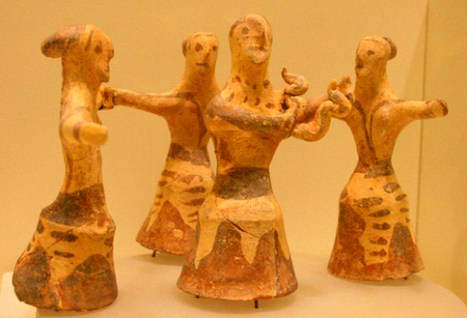
Maybe we should stop using the phrase, “woman priest”? It seems to me that the modern abhorrence of the word “priestess” is a telling fact. Even our unconscious psyches are uncomfortable with the possibility and this Orwellian word game is somehow an attempt to bypass our revulsion and the theological absurdity. Fr. George Rutler remarked in his Episcopalian days: “. . . and to say ‘woman priest’ is semantically as androit as saying ‘female rooster.'” Perhaps we avoid the word priestess because it tears to shreds any conception of this notion as fresh and modern? The word may even be older than “priest.” (See the book Priest and Priestess by Fr. George W. Rutler.)

The new Episcopalian priestesses are not so much one with true Catholic priests as they are with their western European and Mesopotamian forebears who rendered sybilline declamations over animal entrails.

Critics of the Catholic exclusion often quote the universality of baptism and faith in Christ, “There is neither Jew nor Greek, there is neither slave nor free, there is neither male nor female; for you are all one in Christ Jesus” (Galatians 3:28). They confuse Catholic soteriology (that salvation is available to all) with the tradition of a male-only priesthood instituted by Christ and maintained by the apostles.  A favorite verse of mine is this one: “But I want you to know that Christ is the head of every man, and a husband the head of his wife, and God the head of Christ” (1 Corinthians 11:3). Paul addresses himself in the subsequent text to some of the lesser and changeable traditions (like Mass veils), but his theological underpinnings are what constitutes the revealed truth. More exactly, he is talking about Christian anthropology and the sacrament of marriage. A woman cannot signify the groom, Christ the head. An even greater scandal erupts if such a priestess were literally married. She who is subject to her husband would then seek the submissiveness of the Church, including her husband, to her. A contradiction would emerge. Those who do not like this analogy have an argument, not with me, but with St. Paul and the Holy Spirit which inspired him.

If critics can cast aside the teachings of popes and apostles, how can they be so sure that they have the mind of Christ regarding women’s ordination?

ALSO READ:

Bishop Kenneth Untener on Women Priests

Mary’s Role in the Sacred Encounter

The entire history of salvation is subjected to two poles: first and foremost, it is the self-revelation of God along with his desire to share his life with us; and second, is man’s own graced movement toward God in seeking understanding and salvation. Of course, while it is not for finite creatures to completely understand or to exhaust the divine mystery, we are exposed to as much of the mystery as we can comprehend. When we enter into eternity, we will progress ever deeper and deeper into the mystery of the Trinity, knowing eternal joy and discovery. In other words, there is no boredom in heaven. There is a foretaste of this knowing and loving in this world. Such is a component of romantic love, where a couple falls in love and then actively seek to know more and more about each other.

God may be the Unmoved Mover but heaven is not static. The saints share the beatific vision and are ever in motion, drawing ever closer to the Infinite Goodness which called us into existence and sustains us. Mary plays a significant role in both God’s self-revelation and our approach to the Almighty. So that we might know and love God more truly, in Jesus he takes to himself a human face.

God and man will be joined, not simply on the level of the spirit, but in the flesh. God becomes one with his creation.

Mary & Jesus are the Answer

We are all searching for meaning and answers. Mary and Jesus are at the core of this pursuit for Christians. Meditation upon the mysteries of the rosary helps us to access what we need to know and insures that we do not lose our bearings in a secular society filled with distractions. If the Church is a ship and the Pope is our captain, then we sail as pilgrims by the Mary star to that Promised Shore where Christ awaits us. While the Bible is a library of inspired books, the rosary is a collection of prayers. Along with the Eucharist, it is a great weapon in the Church Militant’s arsenal against sin and the powers and principalities which battle the saints.

Mary’s Mantle of Divine Mercy

Adam and Eve ate from the tree of knowledge of good and evil. But the name of this tree was deceptive. They already knew the good, indeed, it was all they knew. Really, the fruit of this tree was the knowledge of evil, not in an academic appreciation but by an actual participation in it. Innocence is destroyed and ashamed of their nakedness they hide themselves.

We should ask ourselves, are we like the old Adam and Eve or like the new, Jesus and Mary? Full of grace, Mary has not been touched by sin. She is utterly devoted to her Son, the source of her holiness. She brings all her spiritual children to Jesus. She would invite them to put on the wedding garment of the Lamb. We do not have to be fearful or ashamed anymore. Forgiveness is available. But, without the Lord, we remain naked and exposed. We are called to put on Christ.

When I imagine Mary’s mantle, my mind races back to my childhood. My mother would tuck me in when I went to bed. She would check on me on cold nights and adjust the blanket. She desired to keep me safe and warm. Mary wants the same.

Mary’s mantle of mercy does not merely protect us from the justice of God; its very fabric is the Divine Mercy, himself.

Black Sheep Dog or BLACK WOLF?

SOLT PRESS RELEASE – July 5, 2011

HOW IT STARTED

Father Corapi made his first announcement in March 2011:

On Ash Wednesday I learned that a former employee sent a three-page letter to several bishops accusing me of everything from drug addiction to multiple sexual exploits with her and several other adult women. I have been placed on “administrative leave” as the result of this… All of the allegations in the complaint are false, and I ask you to pray for all concerned.

EWTN removed his programs from the cable network:

In EWTN’s thirty years of existence, the Network has never knowingly aired programming featuring any priest whose priestly faculties have been suspended. The Network has always responded consistently and immediately in such situations by removing such programs from the air. We are obliged to do so in obedience to the discipline of the Church. Father John has long been a friend of EWTN and many of us have worked closely with him throughout the years. He is a tremendously gifted preacher who has led many souls to Christ. We are doing exactly as he has asked and supporting him and everyone involved in the situation in the best way possible, through our prayers.

Many of us were unfamiliar with the nature of his SOLT religious community:

The Society of Our Lady of the Most Holy Trinity is a community of disciples of Jesus and Mary composed of all vocations: priests, deacons, brothers, sisters and single and married laity. The Society was founded in 1958 and has been approved by Rome as a Society of Apostolic Life. ‎Ecclesial Teams are the basis of our community life as well as the means by which our missions are staffed. A complete Ecclesial Team is composed of at least one priest, religious and lay person or married couple. At the present, the International Headquarters of Our Lady’s Society is located in the United States, in the city of Robstown, Texas under the Diocesan jurisdiction of the Diocese of Corpus Christi, Texas. In looking forward to when The Society of Our Lady of the Most Holy Trinity achieves Pontifical Status within the Church, the International Offices will be transferred at that time to Rome, Italy.

There was a clarification from the lucrative company, Santa Cruz Media, over which Fr. Corapi was identified as the CEO:

Santa Cruz Media, Inc. is the owner of all of Fr. John Corapi’s intellectual property and the DVDs, CDs, and books that flow from it. We are a secular corporation and not affiliated with the Catholic Church in any way. As such, we are not under the jurisdiction of any bishop or other official in the Catholic Church, although we have the utmost respect for Church authority.

Here is my FACEBOOK comment from March 2011:

FATHER JOE: Priests are men under authority. Fr. Corapi, himself, says that they cannot play games with their promise of obedience and others should respect this. If Father Corapi’s faculties have been removed and his ministry suspended, then EWTN was morally required to take the action they did. Hopefully the matter will be resolved and he will be restored to his place on television and radio. Having said this, the sale of media (audio, video, web and print) would also fall under “ministry.” Given the situation, Fr. Corapi could certainly require Santa Cruz Media, Inc. (an extension of his ministry) to suspend sales and distribution of his materials. I suspect that the good priest is innocent, but there is much to which we are not privy. Prayer is our proper posture at this time, not ridicule of episcopal jurisdiction in the Catholic Church.

WHERE IT STANDS NOW

ON JUNE 17, 2011 AN ANNOUNCEMENT WAS MADE BY FATHER CORAPI THAT HE WOULD CONTINUE MINISTRY BUT NOT AS A PRIEST IN GOOD STANDING. IT IS A VERY SAD DAY.

FATHER JOE:

(June 2011)  I have not blogged about this matter until now and I am not comfortable about posting on it.  This issue has gone beyond Father Corapi and could harm the very souls for whom he has confessed concern.  Already on the social network sites, his fans are taking sides with him and attacking the Church. This has quickly become a very dangerous situation, another reason why cult worship of religious media personalities should be discouraged. Our faith is in Jesus and the Church, not in preachers with impressive rhetoric and militant attitudes.

This business has gone sour and Father Corapi, as much as I hate to say it, is duplicitous in saying (on one hand) that the bishops have a right to do what they are doing and then (on the other) to malign them for violating his rights and daring to impose discipline upon him. He is a priest and cannot pretend to be anything else, as with this pathetic “black sheep dog” foolishness. His failure to shut down his multimillion dollar business was an early sign that he would not obey the demand of the bishops to suspend public ministry. Now he is taking it to the next level. Faithful Catholics have no choice; in tears and anguish, we must leave Father Corapi. Pray for him but do not participate in his pretense of obedience while he is actually disobedient. True humility would have him submit and accept the Cross. His obstinacy insists that no one will tell him what to do– that was the trouble with his independence all along.  More grievous than any genuine or false indiscretion with a woman, the skirting or outright violation of obedience is the greatest possible failing for any priest.  Everything from his assignments to the moral life is covered in his fidelity to the Church and Christ.  He is to discern God’s will in his obedience to the bishop and his superiors.  Evidently, he has become a dissenter on the nature of priesthood and its obligations, as well as upon Catholic ecclesiology.   While on “administrative leave,” a suspended priest can neither preach nor teach religion; his intention to do so anyway would be a movement toward the Protestant camp, no matter what the message.

REMARKS ON HIS STATEMENT

FATHER CORAPI:  All things change, only God stays the same, so I have to tell you about a major change in my life. I am not going to be involved in public ministry as a priest any longer. There are certain persons in authority in the Church that want me gone, and I shall be gone. I have been guilty of many things in the course of my life, and could easily and justifiably be considered unfit to engage in public ministry as a priest.

FATHER JOE:  The problem is that priesthood is not merely a job we can change or a hat we can trade for another. Even if the priest is laicized, he is configured to Christ as a priest, forever. If he cannot engage in public ministry, then he cannot do so in any fashion, even if he drops his priestly title or goes under a pseudonym as in a superhero’s secret identity. [It is rarely permitted, but sometimes a laicized priest can give religious instructions with permission of the bishop if it is generally not known that he was a priest and no scandal would result.  Fr. Corapi is too well known for this exception ever to apply.]  The label “Black Sheep Dog” is a literary fiction without meaning. It says nothing that would grant him an escape from Church censure. He is a suspended priest who has no faculties for preaching or publicly teaching the faith. That means he cannot do it— even on the Internet or with books or with audio/visual media. If the Church authorities want him gone, and it is uncertain who he really means, then he should pursue his canonical rights in private. He has opted not to do this. Suspensions can take a year or more to resolve. He did not last three months! That is hardly the image of a tough former Special Forces military man. (But wait, we found that this part of his biography was a fabrication. We will let that fact check go given his more serious troubles.) Of course, he may acknowledge one important grain of truth; he may indeed be “unfit to engage in public ministry as a priest.” It should be said that all priests are unworthy.  The best of priests fall short.  If he were sincere then he should fight for his priesthood, no matter how much time it might take to be restored to ministry or good standing.  However, such must be done within the system and among the fraternity of his brother priests.  He should hold his tongue about how he feels about the process and treat the bishop, his superiors and the Church with trusting respect.  A priest who caricaturizes the Church as the enemy is burning his bridges.  These latest remarks have ignited a fiery inferno.  Fame and fortune should mean nothing to a good and humble priest.  He might argue that the Church has forced his hand, but every faithful priest knows this not true.  The laity may not clearly understand this situation.  Our lives and obligations are very different.  He may want to step away from his priesthood, but a priest he is, and that means that any public ministry without ecclesial approbation will be PROTESTANT ministry, not Catholic.

FATHER CORAPI:  I did not start this process, the Bishop of Corpus Christi, Texas ordered my superiors, against their will and better judgment, to do it. He in fact threatened to release a reprehensible and libelous letter to all of the bishops if they did not suspend me.

FATHER JOE:  Notice how quickly Fr. Corapi uses the word libelous. Would he resort to the civil courts to punish any in the hierarchy who would dare challenge him, his importance and his resources? He says that he loves the Church and so I am hoping that he will not.  Nevertheless, are the assets of his “for profit” company fully his or do they belong to the Church?  I suspect they are in his name.  We might see a fight about this yet.  In his own mind, he is the Church’s great defender. He is Superman, Batman and the Green Lantern all rolled up into one. His fans echo his own conviction— “Oh how will the Church survive without him?” In truth, the Church will fare perfectly well without him. But, if he decides to pursue this BLACK SHEEP DOG nonsense, it is possible that he could inflict great harm upon the Church and cost good people their salvation. As for the bishop’s actions, it confirms what I suspected, that SOLT was impotent in reigning in this isolated Lone Ranger priest who had made religion into his own personal big business.  Let me be fair, he may not have started out expecting this happen.  But the media can make celebrities of anyone, even religious leaders.  When fans tell you that you are wonderful, their praise can be seductive and the person can become addicted to adulation.  This is deadly for the minister of God.  Everything we have is gift.  Every priest should be the poor man– the sinner who seeks to bring God’s mercy to other sinners.  Fr. Corapi did some incredible work.  My fear is that everything might now be undone.

FATHER CORAPI:  My canon lawyer and my civil lawyers have concluded that I cannot receive a fair and just hearing under the Church’s present process. The Church will conclude that I am not cooperating with the process because I refuse to give up all of my civil and human rights in order to hold harmless anyone who chooses to say defamatory and actionable things against me with no downside to them. The case may be on hold indefinitely, but my life cannot be.

FATHER JOE:  And who are these canon and civil lawyers? Was there an appeal to the Congregation for the Clergy in Rome? No, I doubt it. My suspicion is that Fr. Corapi refused to cooperate with the process. Maybe he never understood what the Catholic priesthood was really about? His promise of obedience was not selective and he had indeed surrendered certain rights. He promised celibacy and gave up an important natural right to marry. His overall promise of obedience meant that he would speak for the Church and not for himself on matters of faith and morals. In a negative way, it also meant that he would not speak if the Church so deemed. His faculties to say Mass, to hear Confessions, to preach and to publicly teach, all fell under lawful authority. He was to function as an extension of the Church and his bishop. Now he is claiming that such a promise of obedience conflicts with his “civil and human rights.”  He should reflect more intensely upon the biblical scene where Jesus washed the feet of his apostles.  The first must be last.  He was called to be a servant, not the Master.  Demanding large audiences and tens of thousands of dollars for talks is not the way of humble priests.  The Pope could give him a lesson.  We call the Holy Father the “Servant of the Servants of God.”  This word “servant” can be translated as SLAVE.  In any case, I guess Fr. Corapi wants his own version of freedom, but he will pay a terrible price for his alienation from the true Church.

FATHER CORAPI:  I shall continue, black sheep that I am, to speak; and sheep dog that I am, to guard the sheep—this time around not just in the Church, but also in the entire world. I am, indeed, not ready to be extinguished. Under the name “The Black Sheep Dog,” I shall be with you through radio broadcasts and writing.

FATHER JOE:  The sheep dog has no occupation separated from the chief shepherd or bishop. A dog that runs after the sheep on its own is not a true sheep dog, but rather we use another name for that canine… we call him a wolf. If people leave the Church or attack our bishops over this scandal then I would suggest that Fr. Corapi change the name of his blog and new label to BLACK WOLF.

FATHER CORAPI:  I hope you stay with us and follow us into our new domain and name of “The Black Sheep Dog.” Through writing and broadcasting we hope to continue to dispense truth and hope to a world so much in need of it.

FATHER JOE:  Those who collaborate, defend and buy his products will be offering material support to a suspended priest. In other words, he will be making his sin, their own.

Dear Fr. Corapi, reconsider what you are planning to do.  Speaking as a brother priest, (if I were in your shoes), before bringing spiritual harm to others and scandal to the Church, I would have preferred to “quietly lie down and die.”   But in actuality, the Church is not asking you to do this.  We want you to live and to offer oblations for God’s people.  You are a priest and your prayers to heaven have power even if they are said from a lonely monastic cell.  You do not have to shout from the housetops  to be a good priest.  I know my words are critical and I might sound harsh, but I am thinking both of you and of your followers.  We all make mistakes.  We are all sinners.  Sometimes we speak out of turn.  We become frustrated and afraid.  Old demons try to reclaim us under new guises.  Be strong!  Be a man!  Be a priest!  Be a faithful son of the Church, no matter what the personal cost.     

The complete statement by Father Corapi is available on THE BLACK SHEEP DOG site.

CALLING BLACK SHEEP DOG BACK HOME

UPDATE

Joan Frawley Desmond writes a masterful and eye-opening article for the National Catholic Register (June 19) on the Fr. John Corapi scandal.  Not only his fans, but his dear friend retired Bishop Rene Gracida were apparently duped by the famous media priest.  Incardinated into the Society of Our Lady of the Most Holy Trinity (SOLT), Fr. Gerard Sheehan, his religious superior, revealed that the process and investigation into possible misconduct was complicated by Fr. Corapi, himself.  The priest had gone ahead and filed a civil suit against the former employee who accused him of sexual misconduct.

“When she left the company, she signed a contract that she would not reveal anything that happened to her while she was at Santa Cruz Media. Fr. Corapi paid her for this. Father was suing her for a breach of contract.  In canon law, there can’t be any pressure on witnesses; they have to be completely free to speak. The investigation was compromised because of the pressure on the witnesses. There were other witnesses that also had signed non-disclosure agreements.  The canon lawyers were in a difficult situation, and Father does have his civil rights and he decided to follow his legal counsel, which he had a right to do.  We tried to continue the investigation without speaking to the principal witnesses.”

If innocent of wrongdoing, why did Fr. Corapi pay employees to sign a non-disclosure agreement?  About what were they not supposed to speak?  Evidently he did not like where things were going and so he sent SOLT in writing his resignation from “active ministry and religious life.”  This brought the investigation to an end.  This insures that no report will be published.  Fr. Sheehan noted that he sent him a letter in return asking for confirmation.

As I suspected, the society was offering him ways to save his priesthood and he decided not to do so.  He refused to leave Montana and live within a SOLT community.  He refused to meet or talk with his superior.  He refused to live according to their rule of life and the changes approved by the Holy Father.  It seems that his failure at obedience went far deeper than anyone could have imagined.  He maligned a Church that was very patient and fair with him.  He cast himself as the victim while orchestrating something entirely different behind the scenes.  It makes me want to weep and weep and weep.

His superior stated:

“We wanted him to come back to the community, and that would have meant leaving everything he has. It would have been a drastic change for him.  We will continue to move pastorally and charitably, taking steps to protect his good name.”

His autobiography, BLACK SHEEP DOG, was in the works for some time which indicates that this break from ministry as a priest was planned all along.

I mentioned earlier that this business brings into question the oversight or lack therefore over members by such societies.  Why was Fr. Corapi not living in conformity with SOLT’s 1994 constitution?  There is no good answer, except that the society looked the other way. Fr. Sheehan assures us that the rules will be enforced in the future:

 “The founder’s arrangement with Father Corapi was established before that time, when Father Flanagan believed that every mission should take care of its own needs.  Now, according to our constitution, a different way of life has been established for members. All the money we make is turned over to the society, which gives us an allowance.”

I also mentioned months ago on FACEBOOK that while his home and operations were in the Helena diocese, he had no faculties from the bishop to engage in ministry there.  This shows the depth of his free reign and lack of ecclesial supervision.  All the Church is insisting upon now is what should have been in place initially.  Despite what Fr. Corapi says against the bishop of Corpus Christi, the official diocesan news release stated “that SOLT authorities had initiated the action to temporarily remove him from active ministry.”

I suspect that Father (Mister?) Corapi will have a spin on these new revelations, with an appropriate marketing pitch for his media products and books.  This tragedy may make a cynic of me yet.  But I hope not, such is also not befitting a priest.

A PRAYER FOR FR. CORAPI

I have offered Mass and prayed for Father. There is a frenzy about this subject that I did not really anticipate and which makes me uncomfortable. We really need to love him. If he has disappointed us, we need to forgive him, too. Below is a prayer I will share with you. I sometimes compose my prayers and will be saying this regularly on his behalf. God bless you all!

Dear Heavenly Father,

We want to bring to you in prayer our beloved priest, Father John Corapi. It is hard to know what is going on and our trust has been sorely tried.

He has inspired us with his example of reform and instructed us with his sound Catholic teaching. He has proclaimed the Gospel without equivocation or apology. He quickly became a rock of truth in a world filled with compromise and deception. He defended the rights of the unborn when so many were silent. While the Church was rocked with scandals involving the clergy, here was a towering figure that seemed to epitomize both real manhood and priestly courage. We listened to him on the radio and watched him on television. While a few saw him in person, most of us came to know and to love him through the modern communications media. Millions had the opportunity to encounter him, and through him, the Christ whose kingdom is breaking into the world.

We desperately wanted him to be a saint and yet he himself reminded us again and again that like all the rest of us, he was a sinner. We all fall short of the glory of God. Today, however, he faces a serious personal trial and perilous choices. Many of his friends have abandoned him. Others deride him with no regard for his priestly dignity and all the good work he accomplished in your name. Still others seek to defend him by defaming the Church he has always loved.

The facts are becoming clearer, but we do not know what is going though his heart and mind. If he is angry, please Lord— grant him the gift of a tranquil heart and the patience to endure all things for Christ Crucified. If he is fearful, please Lord— let him know that you are with him and that he need not be afraid. Many temptations face us all, but priests in particular face the worse assaults of the devil. If he has fallen, pick him up. If he remains standing, then give him the courage to embrace humility and truth in the coming storm. Even brave men sometimes need a greater share of courage. Do not allow him to run away from his high calling. He participates in the high priesthood of Christ; there is no more crucial vocation. Let him know that even if he should be reduced to poverty and have to minister alone in prayer or to the smallest congregation, that the oblations of such a priest still have infinite meaning and power.

Promises are made to be kept. Father often spoke about this in regard to the sanctity and dignity of the marriage covenant. He made promises as well— to be a servant of all by embracing a life of celibate love and of obedience to the voice of Jesus in the bishops and his superiors. Preserve him in your grace and defend him against the sins that afflict him, particularly that of pride and of despair. As long as there is the breath of life, there is hope. Let him embrace this hope and put on the mind and the heart of Christ in the Church.

When it seems that a great defender of the Church is suddenly in an adversarial relationship with her, it is easy to see that something has gone terribly wrong. It is our prayer that this beloved priest will surrender his life and his work, all that he is and all that he has done, into the loving arms of the Church over which the Blessed Mother gives the protection of her mantel of mercy. Dear Lord, we know you are not finished with him yet; but we also know that no service to you can be authentic and fruitful if there is a denial of his priestly office. Help him to see this and to know the graces that will testify to your truth and glory.

Amen.

Polygamy OUT, Monogamy IN

Msgr. Pope writes a good post on his blog about the seeming conflict between the monogamous plan of creation in Genesis and the practice of polygamy by the ancient patriarchs.

Msgr. Pope’s Blog Article: Don’t Do Polygamy

In passing, he notes that marriage is defined by God as a relationship between a man and a woman. The core purposes of marriage are also espoused:

  1. Adam is lonely and is given a helpmate who complements him in a shared nature.
  2. Adam and Eve are told to be fruitful and multiply.

The unitive meaning (fidelity) and procreation are stressed. There is nothing capricious about this bond. It is expected that it will be lasting and life-long. They are no longer two, but one.

But as we hear from our Lord in the Gospel of Matthew, there is a problem with their hardness of hearts. The early believers are much like their pagan neighbors. The marriage bed is compromised with many would-be spouses and Moses would even allow a writ of divorce. This is not the way things were supposed to be.

It may be that primitive men of faith lacked the capacity to receive the fullness of truth and God tolerated or even used a situation that would later be remedied. Further, as with various Islamic men today, such extended households were usually reserved to the wealthy and/or to the leadership. Most men had their hands full caring for one wife and family. By the time of Jesus, polygamy was frowned upon and the sin of adultery was attached to any who would compromise a singular union. We must learn from God’s Word, not by extracting isolated proof texts but by an integral approach which respects progressive revelation. The people of God grow in the ways of God and the fullness of truth.

Msgr. Pope argues that the rivalries between the wives and the place of their children are illustrative that polygamy was always frowned upon by God. It is fraught with problems. I would concur, although even having one wife can be a source of both joy and heartache, going back to Adam, the first man. When ladies lament that they feel sorry for priests and wish we could get married, I often respond (somewhat tongue-in-cheek), “Why would I want to get married; I have enough penance in my life!”

Today, our society is indeed returning to the transgressions and abuses of the past. Divorce and remarriage, or the practice of cohabitation and fornication, is essentially serial or successive polygamy. Similarly, just as certain Greeks tolerated and institutionalized homosexual liaisons, there are efforts today to condone and legalize same sex civil unions. When will we learn?

Pic:  Adapted from National Catholic Register Blog, America’s Most Complete Catholic News Source.