• Our Blogger

    Fr. Joseph Jenkins

  • The blog header depicts an important and yet mis-understood New Testament scene, Jesus flogging the money-changers out of the temple. I selected it because the faith that gives us consolation can also make us very uncomfortable. Both Divine Mercy and Divine Justice meet in Jesus. Priests are ministers of reconciliation, but never at the cost of truth. In or out of season, we must be courageous in preaching and living out the Gospel of Life. The title of my blog is a play on words, not Flogger Priest but Blogger Priest.

  • Archives

  • Categories

  • Recent Posts

  • Recent Comments

    Barbara King's avatarBarbara King on Ask a Priest
    Ben Kirk's avatarBen Kirk on Ask a Priest
    Jeremy Kok's avatarJeremy Kok on Ask a Priest
    Barbara's avatarBarbara on Ask a Priest
    forsamuraimarket's avatarforsamuraimarket on Ask a Priest

Witness in Hollywood: Caviezal

person-of-interest-001.jpg

Jim Caviezel (pictured here on the left from PERSON OF INTEREST) is well-known as a practicing Catholic. He asked the director of ANGEL EYES, one of his first big roles, if he could change the sex scene in the movie to simply him kissing Jennifer Lopez, because he felt uncomfortable with it and thought the scene was unnecessary. The director agreed. He would become famous as Jesus in THE PASSION. It was reported recently in the news that he gave up the lead role in CBS’ upcoming Navy SEAL drama pilot over “creative differences.”

LINK:  Acting on moral convictions

Pope Urges Use of Exorcists

devilshirts

It is no wonder that Pope Francis is urging the appointment of more exorcists!

CRUX reported:

According to Pope Francis, confessors should not be averse to referring their penitents to exorcists if they suspect demonic activity is at work, and after consulting psychological professionals. The pontiff said the ministry of confession takes place on the “peripheries of evil and sin.”

Pope Francis stated:

Discernment is necessary also because those who approach the confessional may come from the most desperate situations; they could also have spiritual disturbances, whose nature should be submitted to careful discernment, taking into account all the existential, ecclesial, natural and supernatural circumstances. When the confessor becomes aware of the presence of genuine spiritual disturbances – that may be in large part psychic, and therefore must be confirmed by means of healthy collaboration with the human sciences – he must not hesitate to refer the issue to those who, in the diocese, are charged with this delicate and necessary ministry, namely, exorcists. But these must be chosen with great care and great prudence.

LINK: Audience with participants in the Course on the Internal Forum

Death of Monsignor Richard Hughes

hughespicLongtime Pastor, Fondly Remembered as a “True Spiritual Father”

October 10, 1928 to March 6, 2017

In a letter sent to priests Cardinal Wuerl announced “with sorrow” the death of Reverend Msgr. Richard A. Hughes on March 6, 2017. He was 88 years old and a resident of Sacred Heart Nursing Home in Hyattsville, MD.

The Washington native was ordained to the priesthood on December 20, 1952 at the Basilica of St. John Lateran in Rome. His seminary formation took place at St. Charles College in Catonsville, St. Mary’s Seminary (Paca Street) in Baltimore and the North American College in Rome with classes at the Gregorian University.

His first assignment as parochial vicar was at the Church of the Little Flower in Bethesda and in 1962 as parochial vicar at Saint Teresa of Avila Parish, Washington, DC. In 1965 he was named pastor of Holy Angels Parish, Avenue, MD and in 1968 pastor of Saint Margaret of Scotland Parish, Seat Pleasant, MD. He was named pastor of Saint Mark the Evangelist Parish, Hyattsville, MD in 1970, then pastor of Saint Michael Parish, Baden, MD in 1987 and in 1994 as pastor of Saint Mary of the Assumption Parish, Upper Marlboro, MD. He retired in 2007 and resided at Mount Calvary Parish, Forestville, MD. In 2013, he moved into Sacred Heart Nursing Home, Hyattsville, MD.

Msgr. Hughes was named a papal chamberlain in 1972 and a domestic prelate in 1978. He served on the Priest Senate, as Censor Librorum for the Archdiocese of Washington and on the Archdiocesan Board of Education as a parish priest examiner. He was dean of Southern Prince George’s County, chaplain of various Maryland Knights of Columbus Councils (4076, 3022 and 1955), served as a Faithful Friar for the Knights of Columbus Fourth Degree, spiritual director for the Knights of St. John, and confessor to Mother Teresa’s sisters.

His vigil was held on Thursday, March 9, 2017, from 3:00 PM to 7:00 PM at St. Mary of the Assumption Parish, Upper Marlboro, MD. The vigil Mass was at 7:30 PM and Rev. Thomas LaHood preached. Cardinal Donald Wuerl celebrated the funeral Mass at Saint Mary of the Assumption Parish at 10:30 AM on Friday, March 10, 2017. Rev. Joseph Jenkins preached. He had served with Msgr. Hughes at St. Mary of the Assumption back in the 1990’s and they remained close friends.  Interment was at Resurrection Cemetery, Clinton, Maryland.

At the Mass of Christian Burial, Father Jenkins remembered Msgr. Hughes as “a true spiritual father” with a priestly “devotion that would put many of us to shame.”

The article in THE CATHOLIC STANDARD (March 23, 2017) continued as follows:

Every moment of his life, Msgr. Hughes was praying, saying Mass or serving God’s people. The homilist related how Msgr. Hughes routinely read the death notices in the morning’s paper, took notes and prayed for the dead.  While many people at the funeral Mass “are fairly convinced that Monsignor is a saint; he would tell us to keep praying,” because if he is in heaven, then those graces would go to another soul who needs them. “Nothing is wasted in God.”

Msgr. Hughes took his role as pastor and teacher seriously, approving textbooks for religious education, handing out at Mass copies of the Catechism of the Catholic Church and teaching RCIA classes. The homilist remembered a particular time when Msgr. Hughes taught about Jesus at RCIA.  Without using notes he recited Scripture. By doing this, Msgr. Hughes was “giving as a gift to all of us” the Jesus that he had come to know throughout his whole life. “He made it possible for a lot of people to have that same saving encounter with Jesus.” In everything that Msgr. Hughes did, his objective was clear— it was to save souls.

“Many men were inspired to be priests because of him; many men stayed priests because of him; and many men became better priests because of him.”

Msgr. Hughes also enjoyed looking at the stocks in the morning paper— and he was very good with money.  “Nevertheless, he never treated what he made for himself as his own.” If a student’s family could not pay for tuition, Msgr. Hughes would do it for them; and if a family was losing hope and could not pay their bills, he would take care of it. At his death, he left everything to the Church.

In particular, the homilist remembered Msgr. Hughes’ interactions with a beggar who continually returned to the church rectory to knock on the door.  Msgr. Hughes would always open the door, talk to the man, ask him to change his ways and give him some money before he left.  When it happened repeatedly, his associate priest asked him about it, and found out that the man was once a boy from a parish at which Msgr. Hughes used to serve. Before the boy’s parents died, he had promised to look after their son, and “when Monsignor made a promise, he meant it.” “Years later he was still trying to help the boy.” As priests, our hearts are broken… we weep with our people, but we never give up.”

Msgr. Hughes began a clothing bank at St. Michael’s in Baden, where people could buy articles of clothing for a dime each.  He called it, “a dime with dignity” because the poor were able to buy their own clothes like everybody else.

“Everyone who knew him saw him as their priest in a very personal way.”

At the conclusion of the Mass, Cardinal Wuerl offered his sympathy to Msgr. Hughes’ family.  He said it seemed appropriate that God would be calling him home during the Lenten season, while the Church reflects on the mystery of new life in Christ, because it is in this mystery that Msgr. Hughes found his purpose and his calling.

PDF Copy of Post

Appreciate Priests & Look to Saints

“Today as then, the infidelity and ingratitude of Pastors has repercussions on the poorest of the faithful people, who remain at the mercy of strangers and idolaters.”

01popenews

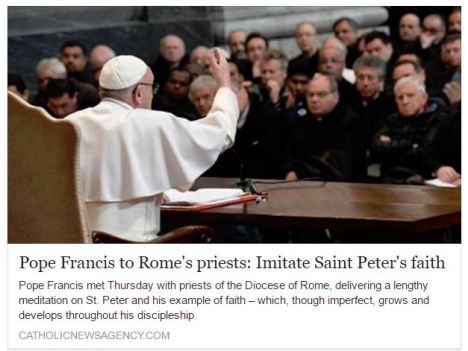
Pope Francis to Rome’s priests: Imitate Saint Peter’s faith

He might get his point across but his attacking-style does not help morale. Instead of always criticizing or even insulting clergy for their faults, he might have better fruits in his reform efforts by showing appreciation for their good works and by highlighting the witness of priestly saints.

Still Looking for Clarity in the Pope’s Homily

When I was reading and preaching Friday morning, I could not help but wonder how the Holy Father might interpret the liturgical text for February 24, 2017.  Would his homily shed light upon the controversy raised by the small but troubling section of Amoris Laetitia on possible access to the sacraments by divorced and remarried couples?  After reading his remarks, I suspect that the confusion will pretty much remain.  He says that we must abandon a legalistic obsession with what is and is not permitted, and instead strive to integrate divine justice with divine mercy.  What does this integration imply?  Many of the bishops of Germany and Malta are asserting that there are particular cases where Holy Communion and absolution must be extended to those in irregular unions.  But is it mercy to compound sin upon sin?  Does this policy not undermine moral teaching?  This is all happening on Pope Francis’ watch, but he resists making strict clarifications. Canon lawyers are often targeted but the notion of law can also refer to creation and Scripture.  Much of canon law is not capricious but codifies truths from natural law and divine positive law.  As an instance of missing specificity, the Holy Father speaks about happiness, but is this earthly happiness and satisfaction or joy in knowing that one is in right relationship with the Lord?  If one is not disposed to the graces of the sacraments, then what good is it to go through the motions?  If there is a lack of contrition and no genuine intention for amendment of life, would not the penitent remain in sin, even if the priest attempted to offer absolution at the end of the sacrament of Penance?  Would the priest err and sin by enabling couples to remain in sin or by deceiving them about their actual stance before almighty God?

The Pope speaks negatively about casuistry.  One definition of “casuistry” is that it refers “to the application of broad principles to concrete cases.”  This seems perfectly in order.  More often the word is defined as “the use of clever but unsound reasoning, especially in relation to moral questions,” in other words, sophistry.  Ironically, it may be this equivocation that has forced cardinals, priests and professors to ask for clarification from the Holy See.  The request comes from men and women in shock.  Literally, they are thinking, “the Pope cannot be saying what we think he is saying.”

What does the Holy Father mean by casuistry?  When I look at the Scripture he preaches upon, I suspect that he defines it as dishonest language meant to trick or to bring ridicule upon the person being questioned or opposed.  Thus, the Pharisees were not seeking real enlightenment or truth but only wanted to discredit Christ.  Does Pope Francis see those who are asking for clarification from him in this light?  I sincerely hope not.  But note his remarks come only about a week after his Council of Cardinals made the unusual if not political move of visibly expressing their “full support” for the Pontiff after facing a handful of public challenges.

I have been warned that my questions and concerns are precisely what the Holy Father is condemning as casuistry?  But how could this be?  He would also have to condemn as casuistry the Church’s long-standing teachings and practices on the subjects of marriage and sexual morality.  I just cannot see that happening.  Indeed, I have been told again and again that Church doctrine has not changed, just the praxis that would invite people back to the fold and make possible an accompaniment with the Church’s ministers.

The stumbling blocks for me are (1) walking in the wrong direction during this accompaniment that the Pope urges; (2) the misuse of the sacraments for people ill-disposed to the graces dispensed; and (3) the priority given to the subjective feelings of distressed couples in irregular unions over their objective moral stance before God.  I suspect that this third point is what motivates many churchmen to either support or criticize such leniency.  No doubt proponents are viewing this as a process in which people who counted themselves unalterably loss to the Church might find their way home.  The emphasis is upon a process that is a “means to an ends.”  I think there is nobility in the goal.  But I am not convinced that it is a legitimate course to follow and that it will work.  There may be some situations that just cannot be easily fixed.  I would concur with the Holy Father that life is sometimes messy.  But the wrong responses and solutions can make matters worse.

As a case in point, three clients with whom I was working for annulments have terminated the process.  Each of them pointed to news stories that the Pope was changing the rules.  The formal case essays are difficult.  Couples are quick to pursue an easy out.  They were told that they could not be absolved from adultery until they separated or got an annulment and convalidation.  They were told to attend the sacrifice of the Mass but not to take Holy Communion.  But with news of this discipline changing, they shopped around for a more “understanding” pastor with a like-mind to the pope or at least to those more liberal interpreters of his exhortation.  As far as they could tell, there was no apparent need to pursue any further legal work or to change their lives or even to suffer a sacrificial conversion.  How could I compete with that?  If I told them they would be living a lie, they could respond that I was promoting the bygone discipline of a dead rigid Church over the current practice recommended to priests by bishops, cardinals and the Holy See.  Can a priest who struggles to be holy and orthodox find himself stamped as disobedient and wrong in the eyes of the Church?

The Holy Father was right that “Jesus always speaks the truth and explains things as they were created.”  What he did next though made me step back.  The Pope criticized those who would ask what you can and cannot do as people of faith.  But is not such a questioning basic to the moral life.  We teach children their catechism with references to the Decalogue, Christ’s two-fold commandment, the Precepts of the Church, the Beatitudes, and the Spiritual and Corporal Works of Mercy.  We want to pursue virtue and to avoid vice.  We found something of this in the appeal of the rich man who came to Jesus.  He had kept all the commandments.  He asked what more he might do.  Jesus told him to give away all he had and to follow him.  We are told he went away sad because his possessions were many.  The moral life may demand a great deal of us.  Ours is a jealous God.  He wants us all to himself.  He calls us to follow him.  We may possess things but we must not allow things to possess us.  Instead of compromising important moral teachings, should we not all be witnessing a courageous and sacrificial faith?

The Old Testament and the New agree:  adultery is a sin.  Divine positive law is confirmed by Christ, albeit with the overture of forgiveness.  There is no divorce.  We are commanded to avoid the sin of adultery.  This is vital, not only to the moral life but to the Church’s basic sacramental understanding.  Christ will never divorce himself from his Church.  Our Lord will always be faithful as the groom of the Church.  The question is will we be faithful?  The Church is the bride of Christ.  Her gown of white is bleached or purified by the blood of the Lamb.  He comes to make his bride perfect.  If adultery were viewed as a crime of the woman against the nation of Israel, it is even more a violation of our hope and identity as Christ’s people.  Adultery becomes another word for the great sin of idolatry.  Every marriage is a participation in the marriage covenant of Christ.  Spousal love is raised up, particularly in the marital act, as both the renewal of a couple’s love and the intimate union of Christ with his bride, the Church.  Widespread toleration of adultery would signal a repudiation of this precious signification.

Reflecting back upon the story of the woman caught in adultery, there seems to be a disconnection with how the story is cited by advocates for a change in praxis or discipline.  First, there is no getting away from the fact that adultery is a serious sin.  Second, Jesus is God and as such he has the power to forgive sins.  Jesus could certainly forgive the adulterous woman her moral offense and well as her crime against her people.  But in truth she was guilty and wrong.  Mercy came to her with absolution and the admonition to change her life.  This latter element is missing with couples in irregular unions or living in habitual sin.  They will go home and share the intimacy of a husband and wife even though one or the other is married to someone else.  Where is the mercy for the wronged spouse in all this?  Why a silence for one who may be heroic in the faith in favor of one who might be the reprobate that abandoned the true spouse?

Reflecting on a Papal Homily

I wanted to give some extended thoughts about the papal homily on Friday.  The Gospel reading was from Mark 10:1-12:

“Jesus came into the district of Judea and across the Jordan. Again crowds gathered around him and, as was his custom, he again taught them. The Pharisees approached him and asked, ‘Is it lawful for a husband to divorce his wife?’ They were testing him. He said to them in reply, ‘What did Moses command you?’ They replied, ‘Moses permitted a husband to write a bill of divorce and dismiss her.’ But Jesus told them, ‘Because of the hardness of your hearts he wrote you this commandment. But from the beginning of creation, God made them male and female. For this reason a man shall leave his father and mother and be joined to his wife, and the two shall become one flesh. So they are no longer two but one flesh. Therefore what God has joined together, no human being must separate.’ In the house the disciples again questioned Jesus about this. He said to them, ‘Whoever divorces his wife and marries another commits adultery against her; and if she divorces her husband and marries another, she commits adultery.’”

The Holy Father stressed in his homily that Jesus “doesn’t respond as to whether it’s licit or not; he doesn’t enter into casuistic logic.”  We are told that the question was a trap.  It had previously circulated what Jesus would say.  At the Sermon on the Mount where he gave us the Beatitudes, he had already stated:  “It was also said, ‘Whoever divorces his wife must give her a bill of divorce.’ But I say to you, whoever divorces his wife (unless the marriage is unlawful) causes her to commit adultery, and whoever marries a divorced woman commits adultery’” (Matthew 5:31-32).  The rejection of the authority of Moses might be interpreted as opposition to God.  Our Lord avoids the trap of this charge (their “casuistic logic”?) by placing the question in the context of creation and not the Mosaic Law.  Divine authority has precedence over that of Moses, who makes a human decision to allow a writ because of their hardness of hearts.  Our Lord, as he so often does, re-frames the question, “Is it lawful for a husband to divorce his wife?” Much more fundamentally, he answers that marriage is the enduring reality or truth and that there is no such thing as divorce.  That is why he can so immediately associate divorce with adultery.

Is this faithful to the text?  It seems clear here and even more so in the Gospel of Matthew that while Jesus does not fall for the tricky question, he does render a response that goes beyond the given parameters— beyond Mosaic or Church laws— adding his voice to natural law.

When I reflected on the Scripture text, I had to wonder if Moses did what many of the bishops and theologians are trying to do today— to sidestep a teaching that seems too difficult and arduous for many to follow.  I do not believe that the various requests for clarification from the Holy See are attempts to trick Pope Francis.  The requests are coming from his friends who likewise love him, the Church and Christ.  The question was “Is it lawful for a husband to divorce his wife?”  Jesus’ response was clear.  He cannot abandon her because there is NO such thing as divorce!  When his apostles ask about it, Jesus is blunt— the human construct of divorce leads to adultery.  Note that our Lord does not shy away from using the word, “adultery,” a biblical term that certain churchmen are insisting we avoid so as not to hurt feelings; thus we now speak of couples in “irregular unions.”  I hate to say this but the casuistry seems to be on the other side.

The new question can be framed very simply.  “Can and should couples who are cohabiting and/or living in adulterous situations be invited to receive Holy Communion and be given absolution in the sacrament of Penance?”  There are only a few responses that respect the constant truth and teachings of the Church:

(1)  If the care of children or the needs of the partner demand that the couple remain together, and if there would not be dire scandal, an internal forum solution might be permitted where the couple live as brother and sister.

(2)  While it might seem severe or heartless, given the gravity of adultery, the Church could rightly insist that the couple separate.

(3)  The members of the irregular union might seek an annulment of the prior bond; if granted, the union could be regularized with a convalidation.

(4)  If an annulment is not possible and the couple cannot separate, they would be urged to attend Mass but not invited to take Holy Communion.  If the prior spouse should die then the marriage could be convalidated.  If the irregular partner should die, the remaining member could be absolved in Penance and again take Holy Communion.

The option being argued the Malta bishops and by Cardinal Coccopalmerio is not one that reflects the perennial teaching of the faith, or more recently that of Pope John Paul II.  The Cardinal directly teaches that if the adulterous and/or cohabitating couple means well, then they could be invited to take Holy Communion.  While this might appease the subjective and make people happy at the moment; objectively it would constitute the sin of sacrilege as the couple in mortal sin are not disposed to the graces of the sacrament.  There must be contrition and amendment of life.  Both here are compromised.  While adultery might still be regarded as sin, such a change in discipline would wrongly indicate that it was no longer regarded as serious or even mortal.  Given the growing dissent, we need Pope Francis to give a magisterial answer to the confusion that emerged from his exhortation.  That answer should also reflect continuity in discipline and teaching.  Indeed, all he has to do is assert that Cardinal Müller has spoken for the Holy See.  The good Cardinal recently asserted that those in irregular unions who want to receive the sacraments must practice “perfect continence.”  He further stated:

“For us marriage is the expression of participation in the unity between Christ the bridegroom and the Church his bride. This is not, as some said during the Synod, a simple vague analogy. No! This is the substance of the sacrament, and no power in heaven or on earth, neither an angel, nor the pope, nor a council, nor a law of the bishops, has the faculty to change it.”

Adultery is serious, not simply because of infidelity between spouses; it spiritually ranks up there with idolatry.  Christ identifies himself with the beloved.  Betrayal of a spouse is betrayal of Christ.

Is It Only a Matter of Legal Casuistry?

1907663_articolo-1

Pope Francis: In God there is both justice and mercy

The Pope in his homily of February 24, 2017 said that we should not become obsessed with the “fine points of legal interpretation.”  What were these objectionable fine points?  When I asked a local churchman whom I admire, I was lectured on how canon law was only about a hundred years old and not integral to the lasting faith of the Church.  But I never mentioned canon law.  I just wanted reaffirmation about basic right and wrong.  The Catholic definition of faith was always in terms of charity and obedience.  Thus the laws of God will always be crucial to our overall discipleship.  Jesus might have said, “Woe to lawyers,” but his ire was the gravity given human laws above divine laws and placing unwieldy burdens upon people who were struggling to be faithful.  It was not a renunciation of the Decalogue or Christ’s two-fold commandment or his singular treatment of the divorce question.  It is true that Jesus sometimes seemed to raise the bar but always with the assurance that his grace would lighten the load, even as we took up our crosses to follow him.

Perplexed by the Pope

popehomily

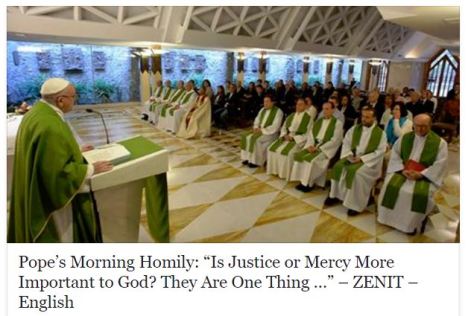
Pope’s Morning Homily: “Is Justice or Mercy More Important to God? They Are One Thing …”

Today the Holy Father preached on Mark 10:1-12. Many of us had hoped the homily would give clarification to questions about Amoris Laetitia. The Pope was both technical and obscure (difficult to decipher.)

He said that the path of Christ was integration of mercy and justice, not legal reasoning. What did this mean? Here are some quotes:

  • “When temptation touches the heart, this path of exiting from casuistry to truth and mercy isn’t easy, it needs the grace of God so we can go forward in that direction.”
  • “A casuistic mentality would ask, ‘What’s more important to God, justice or mercy?’ That’s a sick way of thinking. There aren’t two things, only one. For God, justice is mercy and mercy is justice.”
  • “The Lord helps us understand this path, which isn’t easy, but it will make us happy, and will make lots of people happy.”

He connects justice and mercy and yet they are distinct concepts. Christ will bring both judgment and salvation. There will be the separation of the lambs and the goats.

What exactly is this path he is talking about? Is it life in general? Is it accompanying couples in irregular unions? More than whether it is easy, is it a valid path? Why will we all be happy about it? Our Lord talks about the path to life and the road to perdition. The Church has always taught that we need to be cognizant about our footsteps or direction, following Christ on the so-called “road less traveled.”

There is Conservative, Liberal & Then There is Sick

milo

Milo’s Right: That’s Why Catholics Go to Church

I must be getting old. Sorry, but who the heck is Milo?

Seems like a lot of hype about one strange and confused young man. Definitely he is someone who needs prayer more than either admiration or recrimination. But like I said, I had never heard of him until the last day or two. My conservatism is more in tune with Bill Buckley Jr., Jack Kemp, Bill Bennett and Ronald Reagan than either this juvenile weirdness or the polarizing populism of Trump. I much prefer gentlemen debating ideas than demigods deriding persons and shouting for attention.

Good Seminarians Expelled, Say It Isn’t So!

sem

Malta’s Archbishop: Seminarians Can Leave if They Don’t Agree With Pope Francis

I never thought I would see the day when men of true faith and obedience, and yet struggling to understand the interpretation of a “progressive” pope, would be shown the door.