























I wish I could say that apologetics with fundamentalists is always nice and friendly. But I cannot. We have arguments with certain fundamentalists who hate the Church and all for which Catholicism stands. It is hard to be gentle with bigots. The ecumenical gestures of dialogue, prayer and social cooperation are spurned by them. They do not acknowledge Catholics as Christian brothers and sisters. Indeed, except for singular exceptions, they would say the members of the Church are damned. Many names are used against us: Idolaters, Pagans, Papists, Romanists, etc. Our worship is likewise demeaned as alternately “cookie worship” [Eucharist] and “goddess worship” [Mary]. They believe we are Pelagian heretics who seek to save ourselves with our own good works apart from faith in Jesus. The most fiendish of them will insist that “true Christians,” meaning of their sort, can have no affiliation or cordial association with “demon worshiping” Catholics. They latch upon mentally disturbed ex-nuns and angry former priests to fortify their arsenal of polemics against Catholic teachings and practices.
As I have gotten older, I have tired somewhat of battling such prejudice, hatred and ignorance. Given my own inherited pugnacious nature, I came out swinging as a young priest. It irritated me that smarter men and women in the Church often ignored such challenges and failed to make a response. Indeed, some critics argued that apologetics ran against the grain of Vatican II ecumenism and rapprochement. However, such passivity allowed simple souls with weak faith to be picked off and stolen from the Church. I was one poor shepherd who felt duty-bound to protect his sheep. While my responses have sometimes rescued or preserved a soul from the fundamentalist wolves; I am saddened to admit that very few if any of the so-called wolves or preachers of hate were ever personally moved to abandon such attacks upon the Church. It was my Pollyanna hope that such critics might even be turned around to accept the claims of Catholicism and seek membership. In any case, such matters are best left in God’s hands since he is the source for both repentance and faith.
Here are a few general efforts to share truth and to refute error on behalf of the Church instituted by Jesus. Despite the assertions of Catholic haters, there is no Scripture which invalidates the claims of the Roman Catholic Church. Further, I would beseech all our Christian friends, who see Catholics as brothers and sisters in faith, not to be offended by the harshness of my arguments. They are not addressed to such men and women of good faith who honestly disagree with Catholics about particular points of doctrine or affiliation. I want to make a response to the anti-Catholic bigot, and thus the tone may be more severe and apologetic than usual in interfaith discussions.
Turning to my own faith convictions, I have great confidence in the infallibility of the Catholic faith as made possible by the protective influence of the Holy Spirit. The Spirit of truth guides our teachers in faith (the Magisterium or bishops who are in union with the Pope). The Spirit of truth inspires with divine authorship those written records regarded as canonical (Sacred Scripture). The Spirit of truth guides and gives life to the Church (Sacred Tradition). While revelation ended with the death of the last apostle, our understanding of Christian doctrine grows and matures.
The subject of this safeguard from the Holy Spirit is faith and morals. It does not include all the various secular and scientific truths, upon which the Church’s leaders and membership might make human judgments. Fundamentalists often lose sight of this and posit the popes with wielding authority and a degree of infallibility that they do not even claim. While doing this, they seem to take for themselves the very infallibility they would strip from the Holy Father. Ironically, liberal Catholics will sometimes clamor for papal change in regard to teachings about ministry or sexual morality, even though the popes do not have the power to change what God has demanded in divine positive law or which flows from objective natural law. The first group must understand that the Pope does not claim to be God; and the latter must humbly acknowledge that they have no divine prerogative or veto to treat the Pope as their flunky open to intimidation.
Many charges are made against us. A holdover from the reformation controversy over paid indulgences is the distortion that Catholicism offers salvation for sale. Today, many will offer a donation, called a stipend for a Mass. However, it is a gift, with or without monetary help— the sacraments are free– even if we have to find resources elsewhere to pay for the upkeep of our clergy, facilities and materials. Protestant churches also “pass the basket” so this material side cannot be used to harass the Catholic Church. Yes, we pray for the dead, not to hear ourselves talk, but to manifest our continued unity with our beloved deceased who may still be on their way to paradise. It is true that the price for their entry into heaven has been paid by the blood of Christ. However, we must be made perfect as our heavenly Father is perfect. Those in heaven do not need our prayers and those in hell cannot benefit from them. At least upon this much, the anti-Catholic fundamentalist and the Catholic might agree.
The Roman Catholic Church is the largest Church in the world. Catholics have taken seriously their commitment to love God and neighbor. Catholic schools and hospitals abound throughout the nation. Catholic Charities is one of the largest charity and social assistance organizations on the globe and second only to the U.S. Government. We follow Jesus who is the Way and the Truth and the Life. He gave us the Church as his special family and the breaking of his kingdom into the world. It is unfortunate that despite the Church’s incredible contributions to society that there should still be a few who hate and malign her.
Filed under: Apologetics, Bible, Catholic, Church, Discipleship, Evangelization, Faith, Mass, Pope | 3 Comments »
 Although there is no Mass, the rituals for Good Friday are very moving and evocative. However, it is the faith that we bring to the ceremonies which gives it importance for us. An outsider to our faith, might look upon such ritual with awe towards its simplicity and yet confusion as to its meaning. This is because we celebrate a theme which much of our culture seeks to ignore or postpone. We commemorate death. Assuredly, it may not be death as many people understand it, but nevertheless it remains something mysterious and even feared. Our society, with its newfound confidence in science, ironically hides the tragic death of the unborn behind the guise of linguistics while many in the medical field go to elaborate techniques to keep certain other people alive, no matter what the cost. One of the tasks of the Christian is to visit the sick; and yet, how often have we hesitated from that duty? And we know why — because to meet an elderly or handicapped or sick person is to face the specter of our own mortality, death. We dye our hair, or wear something over our heads that lost recently at the horse races; we cake our faces in makeup to cover the blemishes and wrinkles of age; we diet to wear clothes that we could not fit into even as teenagers; we take an assortment of drugs to maintain our vitality; we do all this and more to escape the prospect of age and the ghost of death which lingers in the periphery of our lives.
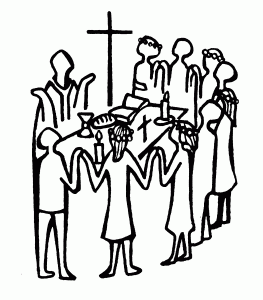 The message about the Church as a New Jerusalem and the analogy of a wedding banquet has serious doctrinal implications that are not always considered by believers in Jesus outside of Catholicism. While there is certainly an individual component to our ultimate salvation, the institution of the Church reminds us that there are vital corporate components as well. Jesus calls to himself disciples and appoints Apostles who will pass their authority down to the bishops who themselves will ordain priests and deacons. Jesus institutes a new covenant in his blood and commands it be repeated “in memory” of him, not in an empty nostalgic way but in a manner that makes present and available that which is recalled. He gives his message and divine mysteries, not to individuals, but to the Church, and appoints Peter and his successors as the visible head. It is the Church that assembles and declares inspired the Bible. Jesus sends his Spirit upon the Church at Pentecost to empower its leadership and to give efficacy to the sacraments. More wondrous than Isaiah could have ever imagined are the splendors given to the People of God.
 The Old Testament prophet speaks about the restoration of Zion and Jerusalem (see Isaiah 62:1-5). His words are quite eloquent and filled with hope. Remember that the people of God had been dispossessed and their nation and its temple destroyed. Such a testimony would seem like foolishness to many. It is no wonder that at the end of their exile, if not of their subjugation, they rebuilt the temple and expected the eminent coming of the Messiah. However, a few years after the crucifixion of Christ, Jews and Christians alike found themselves persecuted with vigor by Rome and the temple was destroyed. Along with it the Jewish priesthood and their ritual sacrifices came to an end. Non-Catholic Protestant fundamentalists and certain Jewish authorities view the political restoration of Israel today as the beginning of a more complete fulfillment of the ancient prophecy. Indeed, the Scriptures were publicly cited when the United Nations recognized the re-establishment of Israel. “You are to be a crown of splendor in the hand of the Lord, a princely diadem in the hand of your God; no longer are you to be named ‘Forsaken,’ nor your land ‘Abandoned,’ but you shall be called ‘My Delight’ and your land ‘The Wedded,’ for the Lord takes delight in you and your land will have its wedding” (Isaiah 62:3-6).
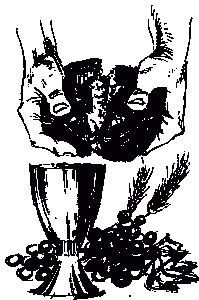 You may have noticed how often the resurrection appearances are linked with meals. I have already mentioned the story of the two men on the road to Emmaus who recognized Jesus in the breaking of the bread. Jesus also took and ate a fish to demonstrate that he had actually risen from the dead.
 The presence and participation of girls as altar servers has become fairly commonplace since their official introduction in the 1990’s. Just as we would hope that our young men might be inspired to consider a vocation to the priesthood; it is desired that our young ladies might give some thought toward a calling to the religious life as either a sister or a nun. While it is only “private” revelation, I have routinely shared with our altar girls the following citation from Mary of Agreda’s CITY OF GOD about the Virgin Mary’s service in the temple:



















 Blogger Priest